Psalms 77:18

Hebrew (Westminster Leningrad Codex) Psalms 77:18 appears in the Hebrew Old Testament. The text above is from the Westminster Leningrad Codex. Each word links to its Strong’s number, a concise gloss, and parsing drawn from the Open Scriptures Hebrew Bible morphology. Click any word for its full Brown-Driver-Briggs (BDB) entry.
Download image
Cite this verse

Psalms 77:18 (World English Bible). Public Domain. Lemma interlinear Bible study tool, https://lemma.gebible.app/v/psalms/77/18.

Show BibTeX & RIS
BibTeX
RIS
English Translation
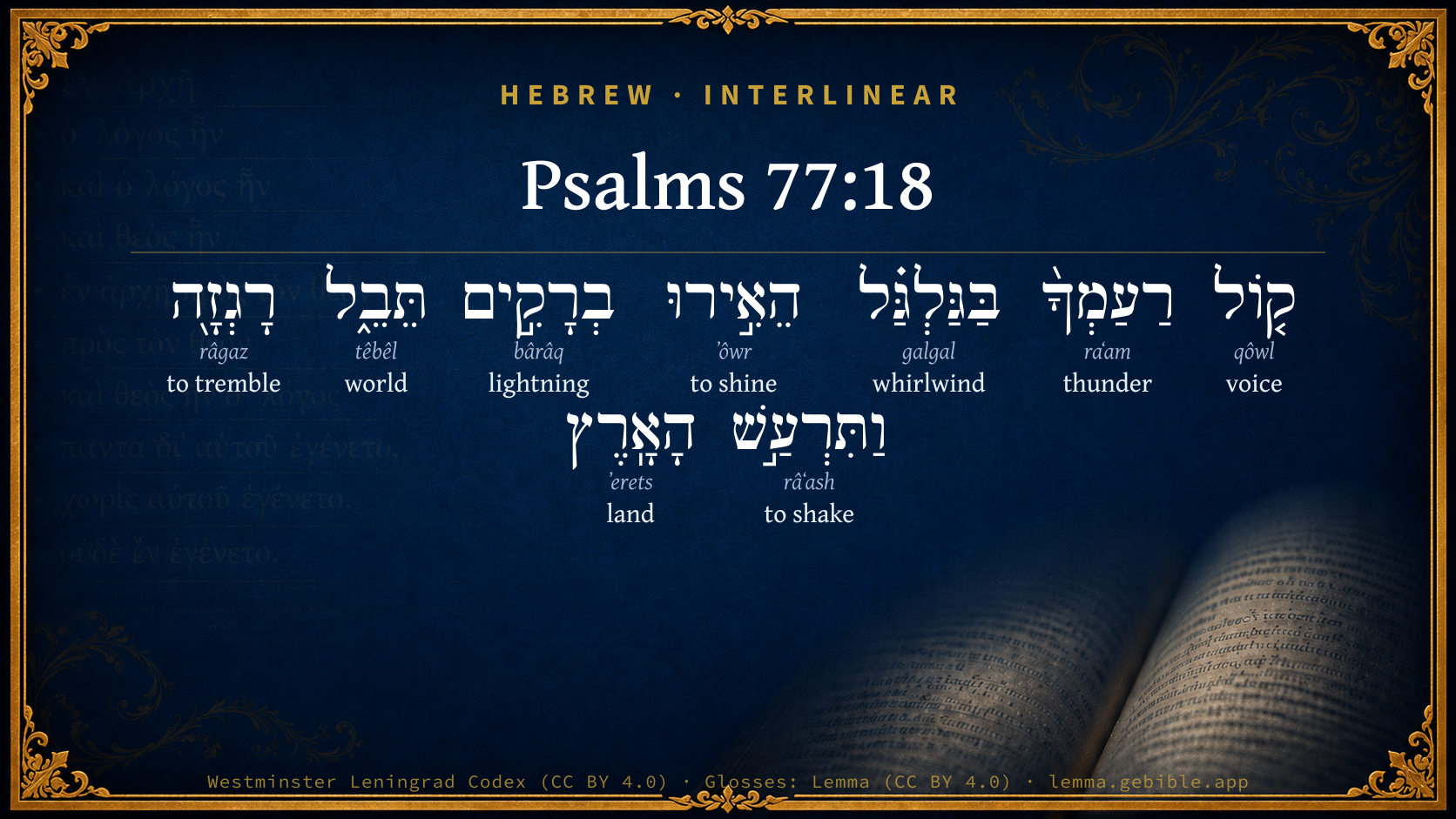
The voice of your thunder was in the whirlwind. The lightnings lit up the world. The earth trembled and shook.
World English Bible · Public Domain
Highlights
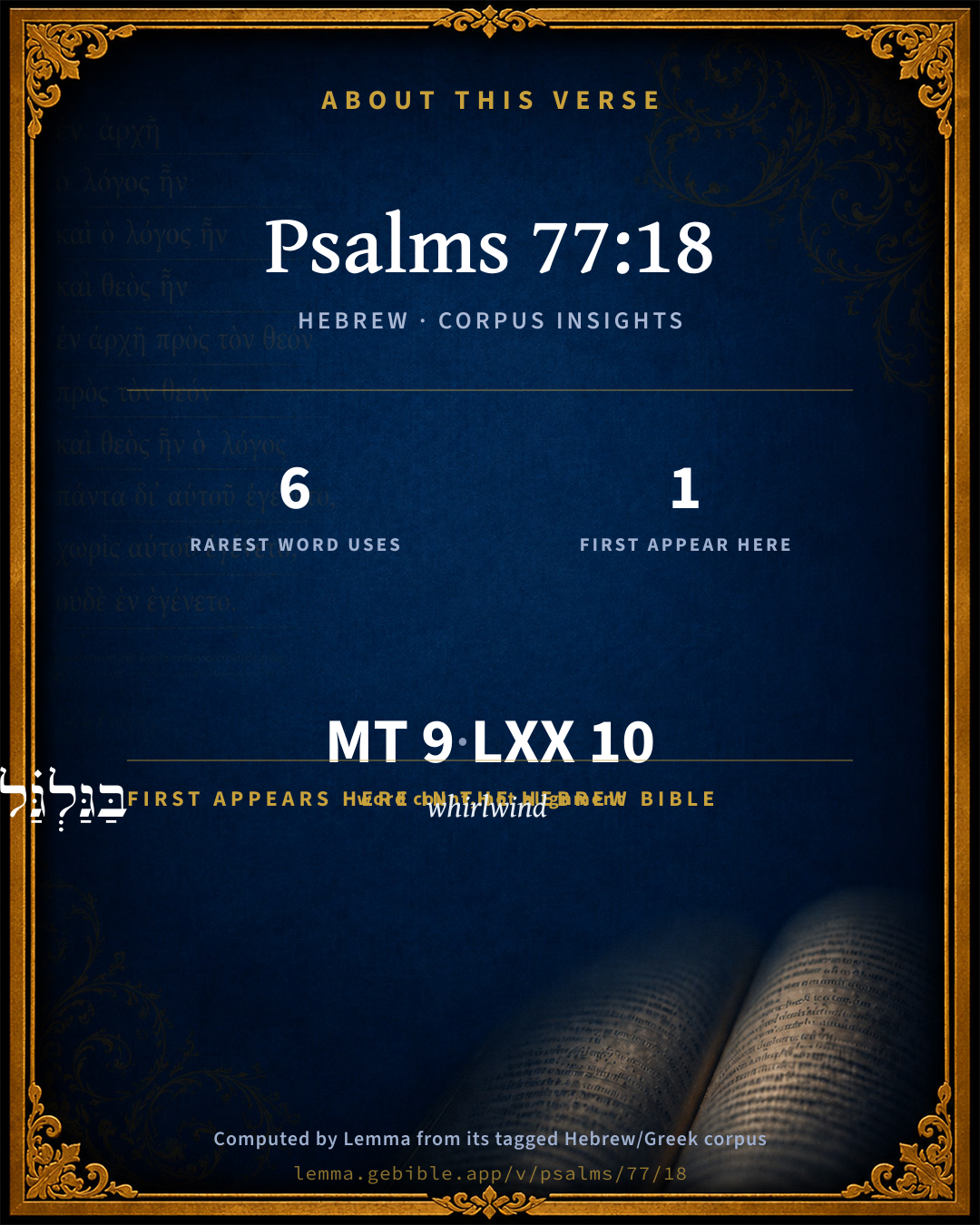
  • 1 first appearance in the Hebrew Bible
Full analysis ↓
Download a study sheet

One document with this verse’s original text, its word-by-word gloss line, the meaning frame, cross-references with their text, attributed commentary, and full source and license credits — printable, and it pastes into notes with its structure intact.

This verse Autodidact and up

Study sheet (.html) Plain text (.txt)

A passage Seminary Student

Up to 50 verses in one chapter. A passage sheet keeps up to 6 commentary sources and 12 cross-references per verse, in the order this page ranks them, and says so on the sheet whenever that leaves anything out. Ask for a single verse and you get the Autodidact verse sheet above.

Everything on this page stays free to read, with no account — the sheet is a download of what is already on screen, not access to it.

Want to remove ads? Support Godless Engineer
Compare translations 3

The same verse in 3 English versions, stacked beneath the original-language interlinear above. Click any original word for its lexicon entry.

Each is an independent rendering of the whole verse — the interlinear is not word-aligned to these translations.

Highlighted words mark where these versions differ — a whole-verse word diff, not a word-by-word alignment.

  • World English Bible Public Domain
    The voice of your thunder was in the whirlwind. The lightnings lit up the world. The earth trembled and shook.
  • King James Version Public Domain
    The voice of thy thunder was in the heaven: the lightnings lightened the world: the earth trembled and shook.
  • unfoldingWord Literal Text CC BY-SA 4.0
    The sound of your thunder in the whirlwind; the lightning lit up the world; the earth trembled and shook.

unfoldingWord Literal Text — © unfoldingWord, licensed CC BY-SA 4.0. Word-aligned USFM3 via Door43 (git.door43.org/unfoldingWord/en_ult).

Versions to compare (up to 4)

3 of 4 selected

Show all 18 translations

Every available English version of this verse, each an independent rendering of the whole verse.

  • World English Bible Public Domain
    The voice of your thunder was in the whirlwind. The lightnings lit up the world. The earth trembled and shook.
  • Berean Standard Bible Public Domain
    Your thunder resounded in the whirlwind; the lightning lit up the world; the earth trembled and quaked.
  • Majority Standard Bible Public Domain
    Your thunder resounded in the whirlwind; the lightning lit up the world; the earth trembled and quaked.
  • King James Version Public Domain
    The voice of thy thunder was in the heaven: the lightnings lightened the world: the earth trembled and shook.
  • American Standard Version (1901) Public Domain
    The voice of thy thunder was in the whirlwind; The lightnings lightened the world: The earth trembled and shook.
  • Revised Version (1885) Public Domain
    The voice of thy thunder was in the whirlwind; the lightnings lightened the world: the earth trembled and shook.
  • Geneva Bible (1599) Public Domain
    The voyce of thy thunder was rounde about: the lightnings lightened the worlde: the earth trembled and shooke.
  • Douay-Rheims (1899) Public Domain
    Great was the noise of the waters: the clouds sent out a sound. For thy arrows pass:
  • Young's Literal Translation Public Domain
    The voice of Thy thunder `is' in the spheres, Lightnings have lightened the world, The earth hath trembled, yea, it shaketh.
  • Literal Standard Version CC BY-SA 4.0
    The voice of Your thunder [is] in the spheres, || Lightnings have lightened the world, || The earth has trembled, indeed, it shakes.
  • Unlocked Literal Bible CC BY-SA 4.0
    Your thunderous voice was heard in the wind; the lightning lit up the world; the earth trembled and shook.
  • unfoldingWord Literal Text CC BY-SA 4.0
    The sound of your thunder in the whirlwind; the lightning lit up the world; the earth trembled and shook.
  • Darby Bible Public Domain
    The voice of thy thunder was in the whirlwind, lightnings lit up the world; the earth was troubled and it quaked.
  • World Messianic Bible Public Domain
    The voice of your thunder was in the whirlwind. The lightnings lit up the world. The earth trembled and shook.
  • Webster's Bible Public Domain
    \\77:17\\The clouds poured out water: the skies sent out a sound: thy arrows also went abroad.
  • Free Bible Version CC BY-SA 4.0
    Your thunder rumbled from the whirlwind; lightning flashes lit up the world; the earth quaked and shook.
  • Bible in Basic English Public Domain
    The voice of your thunder went rolling on; the world was flaming with the light of the storm; the earth was shaking.
  • JPS Tanakh (1917) Public Domain
    (77-19) The voice of Thy thunder was in the whirlwind; the lightnings lighted up the world; the earth trembled and shook.

Literal Standard Version (2020), Covenant Press — licensed CC BY-SA 4.0. Text via the HelloAO Bible API (eBible.org). Unlocked Literal Bible (unfoldingWord) — licensed CC BY-SA 4.0. Text via the HelloAO Bible API (eBible.org). unfoldingWord Literal Text — © unfoldingWord, licensed CC BY-SA 4.0. Word-aligned USFM3 via Door43 (git.door43.org/unfoldingWord/en_ult). Free Bible Version, Dr. Jonathan Gallagher — licensed CC BY-SA 4.0. Text via the HelloAO Bible API (eBible.org).

Word by word

More ways to search: Search by grammar → Find every occurrence → Compare this word →

Practice this passage: Drill this verse → Learn its vocabulary →

רַעַמְךָ֨
raʻam
H7482
“thunder · your”
Noun, Common, Masculine, Singular, Construct + Suffix, Personal, 2nd Person, Masculine, Singular
Part of Speech
Noun
Type
Common
Gender
Masculine
Number
Singular
State
Construct
Full BDB Definition

Origin: from H7481

TWOT: 2189a

thunder
  1. ק֤וֹל qôwl H6963 “voice of” Noun, Common, Masculine, Singular, Construct
  2. בַּגַּלְגַּ֗ל galgal H1534 “in/at the · whirlwind” Preposition, Determined + Noun, Common, Masculine, Singular, Absolute
  3. הֵאִ֣ירוּ ʼôwr H215 “to shine” Verb, Hiphil, Perfect, 3rd Person, Common, Plural
  4. בְרָקִ֣ים bârâq H1300 “lightnings” Noun, Common, Masculine, Plural, Absolute
  5. תֵּבֵ֑ל têbêl H8398 “world” Noun, Common, Feminine, Singular, Absolute
  6. רָגְזָ֖ה râgaz H7264 “to tremble” Verb, Qal, Perfect, 3rd Person, Feminine, Singular
  7. וַתִּרְעַ֣שׁ râʻash H7493 “and · to shake” Conjunction + Verb, Qal, Sequential Imperfect, 3rd Person, Feminine, Singular
  8. הָאָֽרֶץ ʼerets H776 “the · land” Particle, Definite Article + Noun, Common, Both, Singular, Absolute

About this verse

These counts appear in no published source. They are computed here, from the morphology-tagged text and Lemma’s own curated glosses. What Lemma adds →

9
words
9
distinct lemmas
Wisdom
section

Notable vocabulary

The rarest word here is רַעַמְךָ֨ thunder H7482 — appearing just 6 times in the whole Hebrew Bible.

First appearance in Scripture

This word makes its first canonical appearance in the Hebrew Bible here:

  • בַּגַּלְגַּ֗ל whirlwind H1534

Shared distinctive vocabulary

רַעַמְךָ֨ thunder H7482 occurs in 6 verses of the Hebrew Bible. Also found in:

Grammatical profile

  • 3 verbs
  • 6 nouns

Verb forms

  • הֵאִ֣ירוּ Hiphil · Perfect
  • רָגְזָ֖ה Qal · Perfect
  • וַתִּרְעַ֣שׁ Qal · Sequential Imperfect

Hebrew & Septuagint length

In English translation the verse runs 20 words from the Hebrew and 20 from the Septuagint (LXX English) — the same length.

A rough comparison of the two English renderings, which tokenize alike — not a word-level alignment.

Word counts can differ between the Hebrew and the Greek without any difference in meaning — e.g. the Hebrew direct-object marker אֵת has no separate Greek word, and Greek often adds the article ὁ.

In the original languages it is 9 Hebrew tokens and 10 Greek tokens — but the two are counted differently (Hebrew bundles its prefixes and suffixes into one token; the Greek is in lemma form), so that isn’t a like-for-like length.

Cross-references

16

Topical passages linked to Psalms 77:18 in the Treasury of Scripture Knowledge — connected by theme and wording, ordered by reader-vote popularity; previews shown in the World English Bible.

  • Psalms 97:4 His lightning lights up the world. The earth sees, and trembles.
  • 2 Samuel 22:14 Yahweh thundered from heaven, The Most High uttered his voice.
  • Revelation 11:19 God's temple that is in heaven was opened, and the ark of the Lord's covenant was seen in his temple. Lightnings, sounds, thunders, an earthquake, and great hail followed.
  • Exodus 19:16 It happened on the third day, when it was morning, that there were thunders and lightnings, and a thick cloud on the mountain, and the sound of an exceedingly loud trumpet; and all the people who were in the camp trembled.
  • Exodus 19:18 Mount Sinai, the whole of it, smoked, because Yahweh descended on it in fire; and its smoke ascended like the smoke of a furnace, and the whole mountain quaked greatly.
  • Judges 5:4 Yahweh, when you went forth out of Seir, When you marched out of the field of Edom, The earth trembled, the sky also dropped, Yes, the clouds dropped water.
  • 2 Samuel 22:8 Then the earth shook and trembled, The foundations of heaven quaked Were shaken, because he was angry.
  • Job 37:1–5 "Yes, at this my heart trembles, And is moved out of its place.
  • Psalms 18:7 Then the earth shook and trembled. The foundations also of the mountains quaked and were shaken, Because he was angry.
  • Psalms 29:3–9 Yahweh's voice is on the waters. The God of glory thunders, even Yahweh on many waters.
  • Psalms 104:7 At your rebuke they fled. At the voice of your thunder they hurried away.
  • Habakkuk 3:4 His splendor is like the sunrise. Rays shine from his hand, where his power is hidden.
  • Matthew 27:51 Behold, the veil of the temple was torn in two from the top to the bottom. The earth quaked and the rocks were split.
  • Matthew 28:2 Behold, there was a great earthquake, for an angel of the Lord descended from the sky, and came and rolled away the stone from the door, and sat on it.
  • Revelation 18:1 After these things, I saw another angel coming down out of the sky, having great authority. The earth was illuminated with his glory.
  • Revelation 20:11 I saw a great white throne, and him who sat on it, from whose face the earth and the heaven fled away. There was found no place for them.

Cross-references courtesy of OpenBible.info (CC BY 4.0).

Hebrew and Greek witnesses Masoretic Hebrew ↔ Greek Septuagint

The same verse in the two great witnesses to the Old Testament, shown verse-for-verse.

You’re reading Greek Psalm 76 (Hebrew Psalm 77). The Septuagint counts the superscription, so verse numbers can differ from the Hebrew — chapter-level alignment, not verse-by-verse. Numbering follows Rahlfs.

These are two independent witnesses, not word-aligned to each other, and the Septuagint is shown in lemma (dictionary) form.

Hebrew Psalms 77:18 Masoretic · Westminster Leningrad Codex

ק֤וֹל רַעַמְךָ֨ בַּגַּלְגַּ֗ל הֵאִ֣ירוּ בְרָקִ֣ים תֵּבֵ֑ל רָגְזָ֖ה וַתִּרְעַ֣שׁ הָאָֽרֶץ

The voice of your thunder was in the whirlwind. The lightnings lit up the world. The earth trembled and shook.

World English Bible · Public Domain

Greek LXX Greek Psalm 76:18 Septuagint · lemma form

φωνή δίδωμι ὁ νεφέλη καί γάρ ὁ βέλος σύ διαπορεύομαι

The voice of your thunder was abroad, and around your lightnings appeared to the world; the earth trembled a quaked.

LXX2012 (modern English Septuagint) · Public Domain

On this verse, Ellicott's Commentary for English Readers discusses the Septuagint’s reading. Read the note in Commentary ↓

Hebrew: Westminster Leningrad Codex (CC BY 4.0). Greek: Septuagint (public domain); English from LXX2012 (modern English Septuagint) (Public Domain). How the Septuagint differs from the Hebrew →

Commentary

Notes on Psalms 77:18 from classic Christian and Jewish commentators (each source and its license shown beneath its notes). The classic Christian expositions comment on the surrounding passage and are grouped to its opening verse, so a note may address several verses; the Jewish commentaries on the Tanakh (Rashi and others) are per-verse, so they appear only where the commentator wrote on this verse.

Lemma curates 59 commentaries, every one of them public domain or Creative Commons licensed, each selected and text-cleaned for this edition rather than reprinted as found. About our sources →

Trapp's Complete Commentary

John Trapp

Psa 77:18 The voice of thy thunder [was] in the heaven: the lightnings lightened the world: the earth trembled and shook.

Ver. 18. The voice of thy thunder was in the heaven] Heb. in the sphere or round orb of the air. Of the thunder in the air, see Job 37:2-5 Psa 29:1-11 This made the Egyptians say, Let us flee, for God fighteth for Israel against us.

The lightnings lightened the world] Such flakes of fire there were with flashes of lightning, as darkened the sun, and made the whole heaven seem to be on a light fire.

John Trapp, A Commentary or Exposition upon All the Books of the Old and New Testament (1647–1656) — public domain. Text from a community e-Sword module.

J. A. Alexander on Psalms

Joseph Addison Alexander

19. (Psa 77:18). The voice of thy thunder (was) in the whirlwind; lightnings made the world shine; (then) shook and quaked the earth. The word trans-lated whirlwind usually means a wheel, but is sometimes applied to anything whirled or driven round before the wind. See below, on Psa 83:13, and compare Isa 17:13. Hence it may naturally be employed to designate the whirlwind itself as the cause of this rotary motion. This is surely more agreeable to usage than to make it descriptive of mere swiftness or velocity. The common version, in the heaven, if not entirely arbitrary, must rest upon a supposed allusion to the convex appearance of the heavens. Made to shine, illuminated, lighted up. There is, however, no affinity between the Hebrew word and that for lightnings. The whole description is remarkably like that of the theophany in Psalms 18. See also Hab 3:14.

Joseph Addison Alexander, The Psalms Translated and Explained (1850) — public domain. Text from a community e-Sword module.

Ellicott's Commentary for English Readers

(18) In the heavens.—Literally, in the vault. The Hebrew, galgal, from gâlal, “to roll,” has the same derivation as “vault” (volutum, from volvo). It is strange that this rendering, which so well suits the parallelism, should have been set aside by modern scholars in favour of “whirlwind” or “rolling chariot wheels.” The LXX. and Vulg. have “wheel,” but possibly with reference to the apparent revolution of the sky. The word, where it occurs in Isa_17:13, means something rolled by the whirlwind, not the whirlwind itself.

A Bible Commentary for English Readers, edited by Charles John Ellicott (1878–1897) — public domain. Text from a community e-Sword module.

The Cambridge Bible for Schools and Colleges

gen. ed. J. J. S. Perowne

18. in the heaven] The word galgal, derived from a root meaning to roll, was understood by the Jewish commentators to mean the vault or circuit of the heaven. More probably it should be rendered in the whirlwind (R.V.), or, with rumbling, the rolling of the thunder being conceived of as the rolling of God’s chariot-wheels. Cp. Hab_3:8.

The Cambridge Bible for Schools and Colleges (gen. ed. J. J. S. Perowne; Cambridge University Press, 1878–1918) — public domain. Text from a community e-Sword module.

John Gill's Exposition

The voice of thy thunder was in the heaven,.... Thunder is the voice of God, Job 37:5 this is heard in "the orb" (b), or the air, so called, because spherical; the Targum is

"the voice of thy thunder was heard in the wheel;''

so the word here used sometimes signifies; so Eze 10:13, and is so rendered here by some (c); some think this refers to the wheels of the chariots of the Egyptians, which were taken off, it may be by the force of thunder and lightning, so that they drove on heavily, Exo 14:25,

the lightnings lightened the world; not only that part of the world where the Israelites and Egyptians were, but the whole world; for lightning comes out of the east, and shines to the west, Mat 24:27, this was in the night, and a very dark night it was, as Josephus (d) affirms; see Psa 97:4,

the earth trembled and shook; there was an earthquake at the same time; unless this is to be understood of the panic which the inhabitants of the earth were put into on hearing of this wonderful event, Jos 2:9.

(b) "in rotunditate", Montanus, Vatablus; "in isto orbe", Junius & Tremeullis; "in orbe", Cocceius; "in sphaera", Arab. (c) "In rota", Pagninus, Tigurine version, Musculus, Gejerus; "in rotis", Muis, Syr. vid. Suidam in voce (d) Ut supra. (Antiq. l. 2. c. 16. sect. 3.)

John Gill's Exposition of the Whole Bible (1746–1763) — public domain (CC PDM 1.0). Text via the HelloAO Bible API.

Albert Barnes' Notes on the Bible

The voice of thy thunder was in the heaven - Compare the notes at Psa 29:1-11. The word rendered “heaven” here - גלגל galgal - means properly “a wheel,” as of a chariot, Isa 5:28; Eze 10:2, Eze 10:6; Eze 23:24; Eze 26:10. Then it means a “whirlwind,” as that which rolls along, Eze 10:13. Then it is used to denote chaff or stubble, as driven along before a whirlwind, Psa 83:13; Isa 17:13. It is never used to denote heaven. It means here, undoubtedly, the whirlwind; and the idea is, that in the ragings of the storm, or of the whirlwind, the voice of God was heard - the deep bellowing thunder - as if God spoke to people.

The lightnings lightened the world - The whole earth seemed to be in a blaze.

The earth trembled and shook - See the notes at Psa 29:1-11.

Albert Barnes' Notes on the Bible (1834–1885) — public domain. Text from a community e-Sword/MySword module.

Matthew Poole's English Annotations

This tempest is not particularly recorded in its proper place, yet it may well be gathered from what is said Exo 14:24,25, and is in effect acknowledged by Josephus in his history. And this is no new thing in Scripture, for some circumstances of history omitted in the first and properest places to be supplied in following passages; whereof instances have been already given.

Matthew Poole's English Annotations on the Holy Bible (1683–1685) — public domain. Text from a community e-Sword/MySword module.

The Treasury of David

Charles H. Spurgeon

Ver. 18. The voice of thy thunder was in the heaven, or in the whirlwind. Rushing on with terrific swiftness and bearing all before it, the storm was as a chariot driven furiously, and a voice was heard (even thy voice, O Lord!) out of the fiery car, even as when a mighty man in battle urges forward his charger, and shouts to it aloud. All heaven resounded with the voice of the Lord.

The lightnings lightened the world. The entire globe shone in the blaze of Jehovah's lightnings. No need for other light amid the battle of that terrible night, every wave gleamed in the fire flashes, and the shore was lit up with the blaze. How pale were men's faces in that hour, when all around the fire leaped from sea to shore, from crag to hill, from mountain to star, till the whole universe was illuminated in honour of Jehovah's triumph.

The earth trembled and shook. It quaked and quaked again. Sympathetic with the sea, the solid shore forgot its quiescence and heaved in dread. How dreadful art thou, O God, when thou comest forth in thy majesty to humble thine arrogant adversaries.

Whole Psalm. Whenever, and by whomsoever, the Psalm may have been written, it clearly is individual, not national. It utterly destroys all the beauty, all the tenderness and depth of feeling in the opening portion, if we suppose that the people are introduced speaking in the first person. The allusions to the national history may indeed show that the season was a season of national distress, and that the sweet singer was himself bowed down by the burden of the time, and oppressed by woes which he had no power to alleviate; but it is his own sorrow, not the sorrow of others under which he sighs, and of which he has left the pathetic record. J. J. Stewart Perowne.

Charles H. Spurgeon's The Treasury of David (1869–1885) — public domain. Psalms only. Text from a community e-Sword/MySword module.

Whedon's Commentary on the Bible

Daniel D. Whedon

18. Earth trembled and shook—A description of an earthquake, which associates literally with Sinai, not the Red Sea. See Exo_19:18; Exo_20:18; Heb_12:18-19

Daniel D. Whedon (gen. ed.), Commentary on the Old and New Testaments (1874–1909) — public domain. Text from a community e-Sword module.

The Pulpit Commentary

The voice of thy thunder was in the heavens; rather, in the whirlwind (Kay, Cheyne, Revised Version). A storm of wind usually accompanies thunder and lightning. This the author, with poetical exaggeration, heightens into a "whirlwind". (comp. Psa_83:13 Isa_17:13) The lightnings lightened the world. More hyperbole. Not only did they "go abroad" (ver. 17), darting hither and thither, but their intense brightness illuminated the whole earth. The earth trembled and shook. Through the reverberation of air, the earth seems to shake in a heavy thunderstorm.

The Pulpit Commentary (1880–1919), ed. H.D.M. Spence-Jones & Joseph S. Exell — public domain. Text from a community e-Sword module.

unfoldingWord translationNotes

Door43 World Missions Community

thunderous voice

This is personification, referring to the thunder as the voice of God. AT: "voice, which was as loud as thunder" or "very loud voice" (See: Personification)

lightning lit up the world

This is an exaggeration to emphasize that the lightning lit up everything the writer could see. AT: "lightning lit up everything as far as you could see" (See: Hyperbole and Generalization)

Your path ... your way

These two phrases have similar meanings and are combined for emphasis. (See: Doublet)

your footprints

Asaph is speaking of Yahweh as if Yahweh was a person with feet. While this is personification, it should be translated literally, if possible. (See: Personification)

your footprints were not seen

This can be stated in active form. AT: "no one saw your footprints" (See: Active or Passive)

You led your people like a flock

This simile compares God's people to a flock of animals. (See: Simile)

by the hand of

The phrase "by the hand of" here means "by the action of" or "through the action of."

hand

Here "hand" is synechdoche for the whole person. (See: Synecdoche)

translationWords

voice

world

earth

water

flocks

hand

Moses

Aaron

unfoldingWord translationNotes — © Distant Shores Media and the Door43 World Missions Community, licensed CC BY-SA 4.0. Source: git.door43.org/Door43/en_tn.

Rashi

Rabbi Shlomo Yitzchaki (Rashi)

They poured forth thick waters The skies poured forth a stream of thick waters.

Your arrows Heb. חצציך, like חִצֶיךָ.

Rashi on the Tanakh — English translations: “The Judaica Press complete Tanach with Rashi, translated by A. J. Rosenberg” (CC BY 4.0); “Pentateuch with Rashi's commentary by M. Rosenbaum and A.M. Silbermann, 1929-1934” (public domain); “The Metsudah Tanach series, Lakewood, N.J” (CC BY 4.0); and “The Book of Joshua, Metsudah Publications, 1997” (CC BY 4.0). Text via Sefaria.

Lesson kit

Teaching starters — assembled from the data on this page, not authored interpretation. Every prompt links to the verse data it draws on. Edit before teaching.

Psalms, in the Wisdom, opens this verse with 9 words (9 distinct Hebrew lemmas). Its most distinctive word is raʻam (“thunder”). A historical commentator’s framing appears above. Read the whole chapter for the surrounding context.

Discussion questions

  1. What does “thunder” (raʻam) contribute to the verse as a whole?
  2. This is the first place “whirlwind” appears in Scripture (first appears here). What does its debut here establish?
  3. How does Job 26:14, which shares the word «thunder», read alongside this verse?
  4. These translations render this verse differently. What is at stake in choosing one wording over another?
  5. «הֵאִ֣ירוּ» is a Hiphil Perfect verb. How does that grammatical form shape the action described?
  6. Compare how Trapp's Complete Commentary and J. A. Alexander on Psalms read this verse. Where do they agree or differ?

Things to notice

Reading settings

Reading text

Shown beneath each verse's original-language words.

Old Testament
Old Testament edition

Read the OT as the Masoretic Hebrew (MT) or the Greek Septuagint (LXX).

English shown for the Greek Septuagint (in the Hebrew ↔ Greek comparison).

Comparing translations? Open the Compare panel on any verse page to stack up to four side by side.