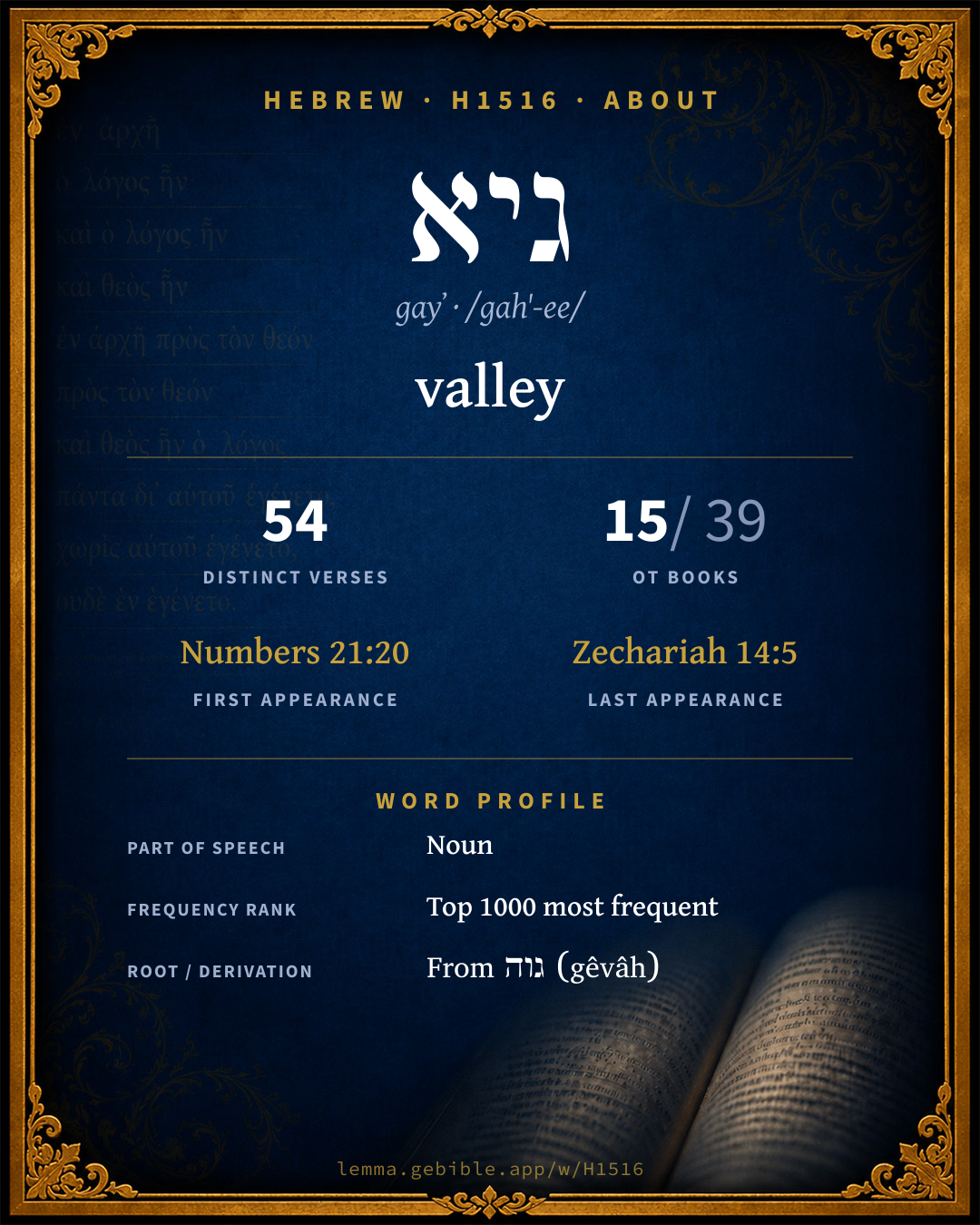
גַּיְא
valley
Full lexicon entry — Brown-Driver-Briggs (BDB)
From Brown-Driver-Briggs (BDB)
Where this word appears
See every Construct-state word in the Hebrew Bible →
Grammar key — what these labels mean
Part of speech
- Noun
- A naming word — a person, place, thing, or idea.
Noun type
- Common
- A common noun — a general class of person, place, or thing (“king,” “city,” “water”), not a specific name.
- Proper
- A name of a specific person, place, or people (e.g. Abraham, Zion, Israel).
State
- Construct
- A noun bound to a following noun in a possessive / “of” relationship (the construct chain).
- Absolute
- The independent form of a noun, not bound to a following word.
Gender
- Both
- Attested as both masculine and feminine.
Number
- Singular
- One.
- Plural
- More than one (in Hebrew, generally three or more).
Grammatical forms
- Noun, Common, Both, Singular, Construct 30 times (48%)
- Noun, Common, Both, Singular, Absolute 15 times (24%)
- Noun, Common, Both, Plural, Absolute 9 times (15%)
- Noun, Proper 7 times (11%)
- Noun, Common, Both, Plural, Construct 1 time (2%)
Parsed forms decoded from the imported morphology (morphhb / Westminster Leningrad Codex — WLC text public domain, morphhb tagging CC BY 4.0), counted across 62 parsed occurrences — not distinct verses.
Every verse where H1516 appears — 54 distinct verses across 15 books. Click any verse to open its interlinear word-by-word view. Verse text shown in the World English Bible for context — . Each verse’s Hebrew form is shown with its reference; the English is not keyword-highlighted, since the data carries no word-level English alignment. Use “Compare translations” on any verse to read it across multiple English versions. This concordance covers the Hebrew Bible; Septuagint (Greek Old Testament) occurrences are not indexed here.
Numbers 1 verse
Deuteronomy 3 verses
- Deuteronomy 3:29 בַּ/גָּ֔יְא prep det + n c bs So we abode in the valley over against Beth Peor.
- Deuteronomy 4:46 בַּ/גַּ֗יְא prep det + n c bs beyond the Jordan, in the valley over against Beth Peor, in the land of Sihon king of the Amorites, who lived at Heshbon, whom Moses and the children of Israel struck, when they came forth out of Egypt.
- Deuteronomy 34:6 בַ/גַּיְ֙ prep det + n c bs He buried him in the valley in the land of Moab over against Beth Peor: but no man knows of his tomb to this day.
Joshua 5 verses
- Joshua 8:11 וְ/הַ/גַּ֖י conj + ptcl def.art + n c bs All the people, [even] the [men of] war who were with him, went up, and drew near, and came before the city, and encamped on the north side of Ai: now there was a valley between him and Ai.
- Joshua 15:8 גֵּ֣י גֵֽי n c bs cs n c bs cs and the border went up by the valley of the son of Hinnom to the side of the Jebusite southward (the same is Jerusalem); and the border went up to the top of the mountain that lies before the valley of Hinnom westward, which is at the uttermost part of the valley of Rephaim northward;
- Joshua 18:16 גֵּ֣י גֵּ֨י n c bs cs n c bs cs and the border went down to the uttermost part of the mountain that lies before the valley of the son of Hinnom, which is in the valley of Rephaim northward; and it went down to the valley of Hinnom, to the side of the Jebusite southward, and went down to En Rogel;
- Joshua 19:14 גֵּ֖י n c bs cs and the border turned about it on the north to Hannathon; and the goings out of it were at the valley of Iphtah El;
- Joshua 19:27 וּ/בְ/גֵ֨י conj + prep + n c bs cs and it turned toward the sunrise to Beth Dagon, and reached to Zebulun, and to the valley of Iphtah El northward to Beth Emek and Neiel; and it went out to Cabul on the left hand,
1 Samuel 3 verses
- 1 Samuel 13:18 גֵּ֥י n c bs cs and another company turned the way to Beth Horon; and another company turned the way of the border that looks down on the valley of Zeboim toward the wilderness.
- 1 Samuel 17:3 וְ/הַ/גַּ֖יְא conj + ptcl def.art + n c bs The Philistines stood on the mountain on the one side, and Israel stood on the mountain on the other side: and there was a valley between them.
- 1 Samuel 17:52 גַ֔יְא n c bs The men of Israel and of Judah arose, and shouted, and pursued the Philistines, until you come to Gai, and to the gates of Ekron. The wounded of the Philistines fell down by the way to Shaaraim, even to Gath, and to Ekron.
2 Samuel 1 verse
2 Kings 3 verses
- 2 Kings 2:16 ה/גיאות הַ/גֵּאָי֑וֹת ptcl def.art + n c bp ptcl def.art + n c bp They said to him, See now, there are with your servants fifty strong men; let them go, we pray you, and seek your master, lest the Spirit of Yahweh has taken him up, and cast him on some mountain, or into some valley. He said, You shall not send.
- 2 Kings 14:7 בְּ/גֵיא prep + n Proper He killed of Edom in the Valley of Salt ten thousand, and took Sela by war, and called the name of it Joktheel, to this day.
- 2 Kings 23:10 בְּ/גֵ֣י prep + n c bs cs He defiled Topheth, which is in the valley of the children of Hinnom, that no man might make his son or his daughter to pass through the fire to Molech.
1 Chronicles 3 verses
- 1 Chronicles 4:14 גֵּ֣יא n c bs cs Meonothai became the father of Ophrah: and Seraiah became the father of Joab the father of Ge Harashim; for they were craftsmen.
- 1 Chronicles 4:39 הַ/גָּ֑יְא ptcl def.art + n c bs They went to the entrance of Gedor, even to the east side of the valley, to seek pasture for their flocks.
- 1 Chronicles 18:12 בְּ/גֵ֣יא prep + n Proper Moreover Abishai the son of Zeruiah struck of the Edomites in the Valley of Salt eighteen thousand.
2 Chronicles 5 verses
- 2 Chronicles 14:10 בְּ/גֵ֥יא prep + n c bs cs Then Asa went out to meet him, and they set the battle in array in the valley of Zephathah at Mareshah.
- 2 Chronicles 25:11 גֵּ֣יא n Proper Amaziah took courage, and led forth his people, and went to the Valley of Salt, and struck of the children of Seir ten thousand.
- 2 Chronicles 26:9 הַ/גַּ֖יְא ptcl def.art + n c bs Moreover Uzziah built towers in Jerusalem at the corner gate, and at the valley gate, and at the turning [of the wall], and fortified them.
- 2 Chronicles 28:3 בְּ/גֵ֣יא prep + n c bs cs Moreover he burnt incense in the valley of the son of Hinnom, and burnt his children in the fire, according to the abominations of the nations whom Yahweh cast out before the children of Israel.
- 2 Chronicles 33:6 בְּ/גֵ֣י prep + n c bs cs He also made his children to pass through the fire in the valley of the son of Hinnom; and he practiced sorcery, and used enchantments, and practiced sorcery, and dealt with those who had familiar spirits, and with wizards: he worked much evil in the sight of Yahweh, to provoke him to anger.
Nehemiah 5 verses
- Nehemiah 2:13 הַ/גַּ֜יא ptcl def.art + n c bs I went out by night by the valley gate, even toward the jackal's well, and to the dung gate, and viewed the walls of Jerusalem, which were broken down, and the gates of it were consumed with fire.
- Nehemiah 2:15 הַ/גַּ֖יְא ptcl def.art + n c bs Then went I up in the night by the brook, and viewed the wall; and I turned back, and entered by the valley gate, and so returned.
- Nehemiah 3:13 הַ/גַּ֜יְא ptcl def.art + n c bs The valley gate repaired Hanun, and the inhabitants of Zanoah; they built it, and set up the doors of it, the bolts of it, and the bars of it, and one thousand cubits of the wall to the dung gate.
- Nehemiah 11:30 גֵּֽיא n c bs cs Zanoah, Adullam, and their villages, Lachish and the fields of it, Azekah and the towns of it. So they encamped from Beersheba to the valley of Hinnom.
- Nehemiah 11:35 גֵּ֥י n c bs cs Lod, and Ono, the valley of craftsmen.
Psalms 2 verses
- Psalms 23:4 בְּ/גֵ֪יא prep + n c bs cs Even though I walk through the valley of the shadow of death, I will fear no evil, for you are with me. Your rod and your staff, they comfort me.
- Psalms 60:1 בְּ/גֵיא prep + n Proper God, you have rejected us. You have broken us down. You have been angry. Restore us, again.
Isaiah 5 verses
- Isaiah 22:1 גֵּ֣יא n c bs cs The burden of the valley of vision. What ails you now, that you are wholly gone up to the housetops?
- Isaiah 22:5 בְּ/גֵ֣יא prep + n c bs cs For it is a day of confusion, and of treading down, and of perplexity, from the Lord, Yahweh of Hosts, in the valley of vision; a breaking down of the walls, and a crying to the mountains.
- Isaiah 28:1 גֵּֽיא n c bs cs Woe to the crown of pride of the drunkards of Ephraim, and to the fading flower of his glorious beauty, which is on the head of the fat valley of those who are overcome with wine!
- Isaiah 28:4 גֵּ֣יא n c bs cs and the fading flower of his glorious beauty, which is on the head of the fat valley, shall be as the first-ripe fig before the summer; which when he who looks on it sees, while it is yet in his hand he eats it up.
- Isaiah 40:4 גֶּיא֙ n c bs Every valley shall be exalted, and every mountain and hill shall be made low; and the uneven shall be made level, and the rough places a plain:
Jeremiah 6 verses
- Jeremiah 2:23 בַּ/גַּ֔יְא prep det + n c bs How can you say, I am not defiled, I have not gone after the Baals? see your way in the valley, know what you have done: [you are] a swift dromedary traversing her ways;
- Jeremiah 7:31 בְּ/גֵ֣יא prep + n c bs cs They have built the high places of Topheth, which is in the valley of the son of Hinnom, to burn their sons and their daughters in the fire; which I didn't command, neither came it into my mind.
- Jeremiah 7:32 וְ/גֵ֣יא גֵּ֣יא conj + n c bs cs n c bs cs Therefore, behold, the days come, says Yahweh, that it shall no more be called Topheth, nor The valley of the son of Hinnom, but The valley of Slaughter: for they shall bury in Topheth, until there be no place [to bury].
- Jeremiah 19:2 גֵּ֣יא n Proper and go forth to the valley of the son of Hinnom, which is by the entry of the gate Harsith, and proclaim there the words that I shall tell you;
- Jeremiah 19:6 וְ/גֵ֣יא גֵּ֥יא conj + n Proper n c bs cs therefore, behold, the days come, says Yahweh, that this place shall no more be called Topheth, nor The valley of the son of Hinnom, but The valley of Slaughter.
- Jeremiah 32:35 בְּ/גֵ֣יא prep + n c bs cs They built the high places of Baal, which are in the valley of the son of Hinnom, to cause their sons and their daughters to pass through [the fire] to Molech; which I didn't command them, neither did it come into my mind, that they should do this abomination, to cause Judah to sin.
Ezekiel 9 verses
- Ezekiel 6:3 ו/ל/גאית וְ/לַ/גֵּאָי֗וֹת conj + prep det + n c bp conj + prep det + n c bp and say, You mountains of Israel, hear the word of the Lord Yahweh: Thus says the Lord Yahweh to the mountains and to the hills, to the watercourses and to the valleys: Behold, I, even I, will bring a sword on you, and I will destroy your high places.
- Ezekiel 7:16 הַ/גֵּאָי֛וֹת ptcl def.art + n c bp But those of those who escape shall escape, and shall be on the mountains like doves of the valleys, all of them moaning, every one in his iniquity.
- Ezekiel 31:12 גֵּ֨אָי֜וֹת n c bp Strangers, the terrible of the nations, have cut him off, and have left him: on the mountains and in all the valleys his branches are fallen, and his boughs are broken by all the watercourses of the land; and all the peoples of the earth are gone down from his shadow, and have left him.
- Ezekiel 32:5 הַ/גֵּאָי֖וֹת ptcl def.art + n c bp I will lay your flesh on the mountains, and fill the valleys with your height.
- Ezekiel 35:8 וְ/גֵאוֹתֶ֨י/ךָ֙ conj + n c bp cs + sfx pers 2ms I will fill its mountains with its slain: in your hills and in your valleys and in all your watercourses shall they fall who are slain with the sword.
- Ezekiel 36:4 וְ/לַ/גֵּאָי֗וֹת conj + prep det + n c bp therefore, you mountains of Israel, hear the word of the Lord Yahweh: Thus says the Lord Yahweh to the mountains and to the hills, to the watercourses and to the valleys, to the desolate wastes and to the cities that are forsaken, which are become a prey and derision to the residue of the nations that are round about;
- Ezekiel 36:6 וְ/לַ/גֵּאָי֜וֹת conj + prep det + n c bp Therefore prophesy concerning the land of Israel, and tell the mountains and to the hills, to the watercourses and to the valleys, Thus says the Lord Yahweh: Behold, I have spoken in my jealousy and in my wrath, because you have borne the shame of the nations:
- Ezekiel 39:11 גֵּ֤י גֵּ֖יא n c bs cs n c bs cs It shall happen in that day, that I will give to Gog a place for burial in Israel, the valley of those who pass through on the east of the sea; and it shall stop those who pass through: and there shall they bury Gog and all his multitude; and they shall call it The valley of Hamon Gog.
- Ezekiel 39:15 גֵּ֖יא n c bs cs Those who pass through the land shall pass through; and when any sees a man's bone, then shall he set up a sign by it, until the undertakers have buried it in the valley of Hamon Gog.
Micah 1 verse
Zechariah 2 verses
- Zechariah 14:4 גֵּ֖יא n c bs cs His feet will stand in that day on the Mount of Olives, which is before Jerusalem on the east; and the Mount of Olives will be split in two, from east to west, making a very great valley. Half of the mountain will move toward the north, and half of it toward the south.
- Zechariah 14:5 גֵּֽיא גֵּי n c bs cs n c bs cs You shall flee by the valley of my mountains; for the valley of the mountains shall reach to Azel; yes, you shall flee, just like you fled from before the earthquake in the days of Uzziah king of Judah. Yahweh my God will come, and all the holy ones with you.
About this entry
At a glance — auto-summarized from this page’s data, not written by a person. Every figure links to its source below. This summary describes the numbers; it doesn’t interpret them.
“valley” is the headline sense of the Hebrew noun גיא (gayʼ). Translators differ — “valley” in the King James Version, then “valley of” (unfoldingWord Literal Text), as the renderings breakdown shows. It turns up in 54 verses across 15 books, a moderately common footprint. First canonically at Numbers 21:20, it enters the text early. From the same root come גוה, גוה and γεεννα. The sections below give every sense, occurrence, and version rendering.
Gloss history
Strong's 1890 vs modern scholarship
About this word
Strong's H1516 catalogs a Hebrew word from the Hebrew Old Testament.
These counts are not copied from any lexicon or concordance. They are computed here, from the morphology-tagged Hebrew Old Testament. What Lemma adds →
- 54
- distinct verses
- The word appears in 54 distinct verses.
- 15 / 39
- OT books
- The word appears in 15 of 39 Old Testament books.
- #623
- by frequency
- Top 1000 most frequent Hebrew words (rank 623 of 8,640 Hebrew words by occurrence).
View all 54 occurrences in the concordance →
By section of the Old Testament
By traditional corpus
Conventional, traditional groupings — biblical authorship is debated, so this is a traditional corpus grouping, not an authorship claim. Each share is this word’s portion of its verses in that division of the Hebrew canon. Each figure is a share of the word’s 54 distinct verses.
- Prophets (Nevi'im) 35 verses · 65%
- Writings (Ketuvim) 15 verses · 28%
- Torah (Pentateuch) 4 verses · 7%
How translations render this word
Counts come from each version’s own published word-to-Strong’s tagging or interlinear alignment — an approximate guide to how each version renders this word, not a word-level alignment the data otherwise carries. Because each total is that version’s own tagged count, the per-version totals vary from one another and need not match the appearance or distinct-verse counts above. These counts may also differ from a printed concordance because Lemma counts each distinctly tagged rendering and does not collapse phrase taggings into a single head-word total. This is a fixed set of word-tagged versions (KJV, ASV, BSB, ULT) and does not change with the reading translation you choose elsewhere. Each version’s license is shown beside its name below (and on Sources).
- King James Version: Valley 43×, Valleys 7×, Is in the valley 2×
- American Standard Version: Valley 40×, Valleys 6×, Is in the valley 2×
- Berean Standard Bible: Valley 34×, Valleys 6×, Valley of ben-hinnom 5×
- unfoldingWord Literal Text: Valley of 22×, Valley 20×, Valleys 7×
King James Version Public Domain
Renders H1516 across 60 tagged occurrences — most commonly:
Plus 8 renderings that appear only once — usually multi-word phrases or single function words the recovered tagging swept in, not distinct renderings.
American Standard Version Public Domain
Renders H1516 across 59 tagged occurrences — most commonly:
Plus 11 renderings that appear only once — usually multi-word phrases or single function words the recovered tagging swept in, not distinct renderings.
Berean Standard Bible Public Domain
Renders H1516 across 57 tagged occurrences — most commonly:
Plus 5 renderings that appear only once — usually multi-word phrases or single function words the recovered tagging swept in, not distinct renderings. Not rendered by a distinct English word in 3 further occurrences.
unfoldingWord Literal Text CC BY-SA 4.0
Renders H1516 across 59 tagged occurrences — most commonly:
Plus 6 renderings that appear only once — usually multi-word phrases or single function words the recovered tagging swept in, not distinct renderings.
7 senses and sub-senses in the full BDB
What do BDB’s symbols mean?
BDB uses these scholarly abbreviations:
| Symbol | Meaning |
|---|---|
| 𝔊 | the Septuagint (the ancient Greek translation, LXX) |
| 𝔙 | the Vulgate (the Latin translation) |
| 𝔖 | the Syriac version (the Peshitta) |
| 𝔗 | the Targum (the Aramaic translation) |
| ψ | the Psalms |
| √ | root (the underlying root or stem) |
| ‖ | parallel passage (a synonymous or contrasted parallel) |
| † | the dagger: every passage where the word occurs is cited |
The 7 senses and sub-senses the full Brown-Driver-Briggs lexicon distinguishes for this word, in lexicon order (not ranked by frequency), with BDB’s own verbatim wording and sub-sense lettering. Shown in Hebrew script with BDB’s own scholarly abbreviations. The condensed entry is in the Lexicon Entry tab. See also the Forms in the corpus table below.
- a. ג׳ יִפְתַּח־אֵל Jos 19:14, 27 perhaps Jotapata JosBJ iii. 7, 7; Rabbin. גופתתא RelandPal. 816;—Tell Jefût RobBR iii, 107. GuérinGal i. 476 f. cf. BdPal. 243. e.g. Joshua 19:14
- b. ג׳ הַצְּבֹעִים 1 S 13:18. e.g. 1 Samuel 13:18
- c. ג׳־הַמֶּלַח 2 K 14:7 (Kt; Qr om. art.) 1 Ch 18:12 2 Ch 25:11 = ג׳־מֶלַח 2 S 8:13 ψ 60:2 (title); S. of Dead Sea, in or bordering on Edom; el-Ghôr RobBR ii. 109. e.g. 2 Kings 14:7
- d. ג׳ הֶחָרָשִׁים 1 Ch 4:14 Ne 11:35, appar. near Lod & Ono, NW. of Jerus., not far from the sea. e.g. 1 Chronicles 4:14
- e. ג׳ צְפַ֖תָֿה לְמָרֵשָׁה 2 Ch 14:9 (? read צָפֹנָה, 𝔊 κατὰ βορρᾶν, to the north of M.) prob. near the great plain of Judah, W. of Jerus., toward the sea; ג׳ הָעֹבְרִים Ez 39:11, E. of Dead Sea (Hi Sm), Co reads ג׳ הָעֲבָרִים. e.g. 2 Chronicles 14:9
- f. name to be changed to ג׳ הֲמוֹן־גּוֹג Ez 39:11, 15. Most frequently e.g. Ezekiel 39:11
- g. גֵּי הִנֹּם Jos 15:8; 18:16 Ne 11:30, גֵּי בֶן־הִנֹּם Jos 15:8; 18:16 2 K 23:10 Qr (Kt גי בני ה׳) 2 Ch 28:3; 33:6 Je 7:31, 32; 19:2, 6; 32:35; valley SW. & S. of Jerus. (RobBR ii. 273 f.), where incense was burned, and children were offered in sacrifice to ‘Molech.’ Others identify with the Tyropœon valley, cf. RSSem i. 353; vid. further הִנֹּם, תֹּפֶת. e.g. Joshua 15:8
Senses from the full Brown-Driver-Briggs lexicon (Brown, Driver, Briggs; Oxford 1906 — public domain), digitized via Sefaria, supplemented by the OpenScriptures HebrewLexicon (CC BY 4.0). Full attribution on Sources.
Word origin
n.m.Is 40:4 (f. Zc 14:4) valley—abs. גַּיְא Nu 21:20 + 8 times + 1 S 17:52 (cf. infr.) גָּ֑יְא 1 Ch 4:39, גֵּיא Zc 14:4, גֶּיא Is 40:4, גַּי Dt 34:6 + 2 times; cstr. גֵּיא Is 22:1 + 21 times גֵּי Jos 15:8 + 13 times; pl. abs. גֵּאָיוֹת Ez 31:12; 36:4, 6 + 7:16; 32:5 (del. Co) + 6:3 2 K 2:16 Qr (so Co Ez 6:3; Kt גיאות); sf. גֵּיאוֹתֶיךָ Ez 35:8;—valley Jos 8:11 (E) Mi 1:6 1 S 17:3 2 K 2:16 (opp. הַר) Is 40:4 (opp. גִּבְעָה, הַר), Ez 6:3; 35:8; 36:4, 6 (in all c. גבעות אפיקים, הרים), 31:12 (opp. הַר), cf. 7:16 (del. B Co) 32:5; specif., valley in Moab, a station of Isr. Nu 21:20 (E); over against Beth-Peor Dt 3:29; 4:46; 34:6; a valley near גְּדוֹר 1 Ch 4:39; ג׳ חִזָּיוֹן Is 22:1, 5 near Jerus.; ג׳ שְׁמָנִים Is 28:1, 4 valley of fatness, fertility, the valley surrounding Samaria; שַׁעַר הַגּ׳ 2 Ch 26:9 Ne 2:13, 15; 3:13; apocalyptic valley Zc 14:4, made by cleaving Mt. of Olives, cf. ג׳ הרים; valley of slaughter ג׳ ההרגה, a future name of valley of Hinnom Je 7:32; 19:6 1 S 17:52 (גַּיְא) 𝔊 reads גַּת cf. We Dr; Je 2:23 of valley of Hinnom, v. infr.; fig. ψ 23:4 ג׳ צלמות cf. צלמות; Ez 39:11 ג׳ הָעֹבְרִים, Co הָעֲבָרִים n.pr. cf. infr.; elsewhere in combination with n.pr.:—
— Brown-Driver-Briggs (Oxford 1906, public domain), digitized via Sefaria, supplemented by the OpenScriptures HebrewLexicon (CC BY 4.0). See Sources.
Derived from גוה (gêvâh) (H1466) — pride.
Jastrow Dictionary
A second Hebrew/Aramaic lexicon for comparison, covering Aramaic and post-biblical (Talmudic, Targumic, Midrashic) usage that the biblical-Hebrew BDB does not. Matched by lemma rather than by Strong’s number, so a lemma may carry more than one Jastrow headword (shown separately below), and the entries cover usage well beyond the Bible.
גַּיְא
- glen, wady. Constr. גֵּיא. Erub. 19ᵃ; Succ. 32ᵇ, v. גֵּיהִינָּם.—Pl. גֵּאָיוֹת. Shebi. III, 8 מדרגות על פי הג׳ steps leading to the ravines (for carrying up the water for irrigation); Tosef. ib. III, 4. Ab. Zar. 54ᵇ
A Dictionary of the Targumim, the Talmud Babli and Yerushalmi, and the Midrashic Literature (Marcus Jastrow; London, Luzac, 1903) — Public Domain. Digitized via Sefaria. Digitized via Sefaria. Full attribution on Sources.
Forms in the corpus
The 41 distinct written forms H1516 takes in the Hebrew Bible, most frequent first — each parse links to that state’s occurrences in the concordance. Hebrew forms include their vowel points and cantillation, so a single lemma takes many written forms.
Same root — word family
Other BDB entries built from the same root as H1516, grouped by Strong’s listed origin. These share a root / origin per the lexicon — not necessarily a shared meaning. Each links to that word’s own entry.
Derives from
Shares the same root
Proper names from this root
People and places named from this root — a name, not an additional meaning of the word.
Compare all same-root words → Showing 4 of 5 — not the complete family. 2 of the same-root words are proper names (people or places). They share a root, not necessarily a meaning.
Septuagint verse parallels
This word appears in 47 verses that also exist in the Greek Old Testament (Septuagint), out of the 54 Hebrew verses it occurs in. You can read those verses in Greek by switching the Old Testament edition to the Septuagint.
Read these verses in the Septuagint
- Numbers 21:20
- Deuteronomy 3:29
- Joshua 8:11
- 1 Samuel 13:18
- 2 Samuel 8:13
- 2 Kings 2:16
- 1 Chronicles 4:14
- 2 Chronicles 14:10
- Psalms 23:4
- Isaiah 22:1
- Jeremiah 2:23
- Ezekiel 6:3
This is a verse-level parallel only — the same verses exist in both the Hebrew and Greek Old Testaments. No word-level Hebrew↔Greek correspondence is claimed: the data carries no such alignment, so no Greek word is shown as this Hebrew word’s translation. Coverage is not total — the Septuagint omits the deuterocanon and renumbers the Psalms, so some Hebrew verses have no direct Greek parallel.