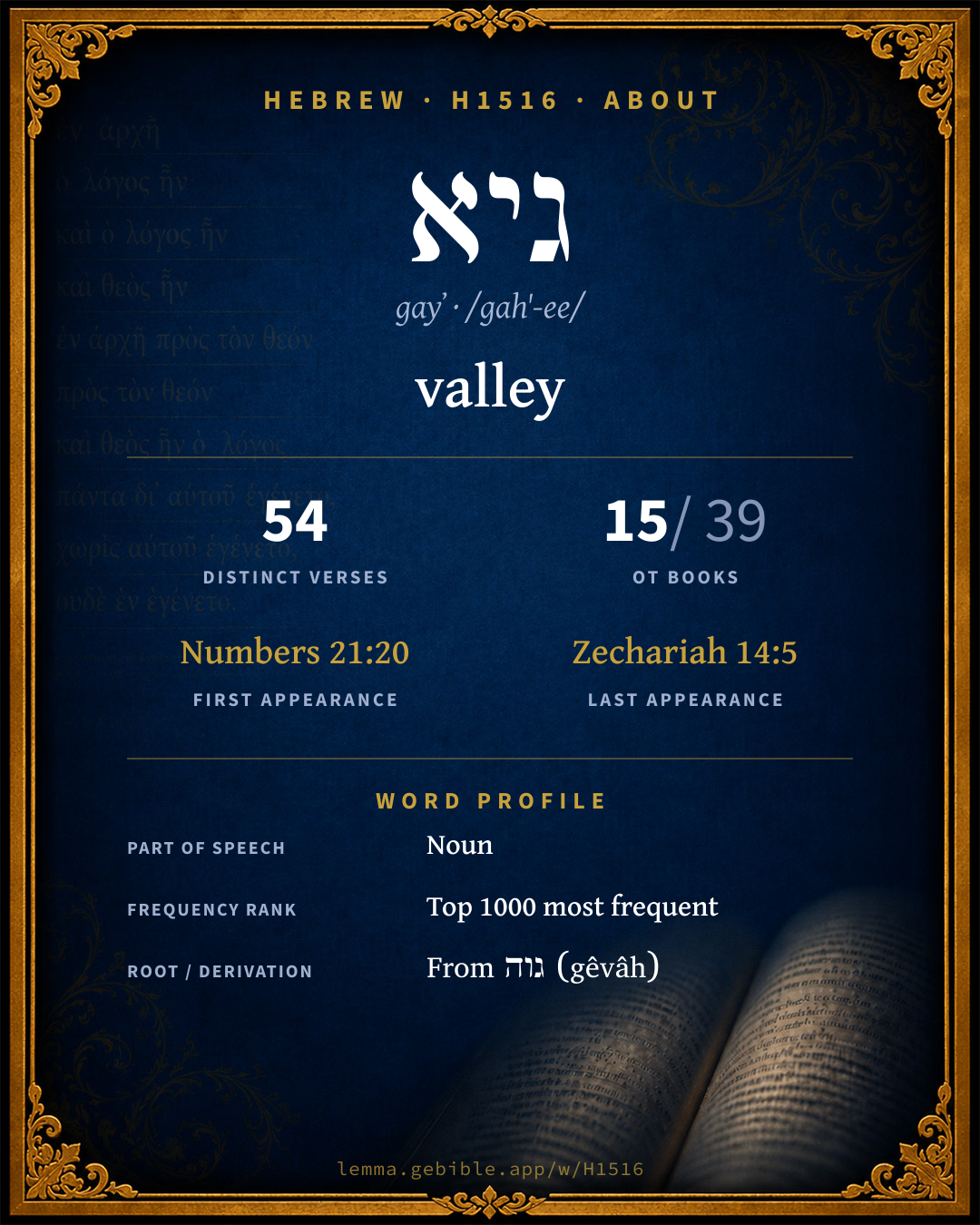
גַּיְא
valley
Full lexicon entry — Brown-Driver-Briggs (BDB)
From Brown-Driver-Briggs (BDB)
Where this word appears
See every Absolute-state word in the Hebrew Bible →
Grammar key — what these labels mean
Part of speech
- Noun
- A naming word — a person, place, thing, or idea.
Noun type
- Common
- A common noun — a general class of person, place, or thing (“king,” “city,” “water”), not a specific name.
- Proper
- A name of a specific person, place, or people (e.g. Abraham, Zion, Israel).
State
- Construct
- A noun bound to a following noun in a possessive / “of” relationship (the construct chain).
- Absolute
- The independent form of a noun, not bound to a following word.
Gender
- Both
- Attested as both masculine and feminine.
Number
- Singular
- One.
- Plural
- More than one (in Hebrew, generally three or more).
Every verse where H1516 appears in the Book of 2 Kings — 3 distinct verses. Click any verse to open its interlinear word-by-word view. Verse text shown in the World English Bible for context — . Each verse’s Hebrew form is shown with its reference; the English is not keyword-highlighted, since the data carries no word-level English alignment. Use “Compare translations” on any verse to read it across multiple English versions. This concordance covers the Hebrew Bible; Septuagint (Greek Old Testament) occurrences are not indexed here.
2 Kings
- 2 Kings 2:16 ה/גיאות הַ/גֵּאָי֑וֹת ptcl def.art + n c bp ptcl def.art + n c bp They said to him, See now, there are with your servants fifty strong men; let them go, we pray you, and seek your master, lest the Spirit of Yahweh has taken him up, and cast him on some mountain, or into some valley. He said, You shall not send.
- 2 Kings 14:7 בְּ/גֵיא prep + n Proper He killed of Edom in the Valley of Salt ten thousand, and took Sela by war, and called the name of it Joktheel, to this day.
- 2 Kings 23:10 בְּ/גֵ֣י prep + n c bs cs He defiled Topheth, which is in the valley of the children of Hinnom, that no man might make his son or his daughter to pass through the fire to Molech.
About this entry
At a glance — auto-summarized from this page’s data, not written by a person. Every figure links to its source below. This summary describes the numbers; it doesn’t interpret them.
“valley” is the headline sense of the Hebrew noun גיא (gayʼ). Translators differ — “valley” in the King James Version, then “valley of” (unfoldingWord Literal Text), as the renderings breakdown shows. It turns up in 54 verses across 15 books, a moderately common footprint. First canonically at Numbers 21:20, it enters the text early. From the same root come גוה, גוה and γεεννα. The sections below give every sense, occurrence, and version rendering.
Gloss history
Strong's 1890 vs modern scholarship
About this word
Strong's H1516 catalogs a Hebrew word from the Hebrew Old Testament.
These counts are not copied from any lexicon or concordance. They are computed here, from the morphology-tagged Hebrew Old Testament. What Lemma adds →
- 54
- distinct verses
- The word appears in 54 distinct verses.
- 15 / 39
- OT books
- The word appears in 15 of 39 Old Testament books.
- #623
- by frequency
- Top 1000 most frequent Hebrew words (rank 623 of 8,640 Hebrew words by occurrence).
View all 54 occurrences in the concordance →
By section of the Old Testament
By traditional corpus
Conventional, traditional groupings — biblical authorship is debated, so this is a traditional corpus grouping, not an authorship claim. Each share is this word’s portion of its verses in that division of the Hebrew canon. Each figure is a share of the word’s 54 distinct verses.
- Prophets (Nevi'im) 35 verses · 65%
- Writings (Ketuvim) 15 verses · 28%
- Torah (Pentateuch) 4 verses · 7%
How translations render this word
Counts come from each version’s own published word-to-Strong’s tagging or interlinear alignment — an approximate guide to how each version renders this word, not a word-level alignment the data otherwise carries. Because each total is that version’s own tagged count, the per-version totals vary from one another and need not match the appearance or distinct-verse counts above. These counts may also differ from a printed concordance because Lemma counts each distinctly tagged rendering and does not collapse phrase taggings into a single head-word total. This is a fixed set of word-tagged versions (KJV, ASV, BSB, ULT) and does not change with the reading translation you choose elsewhere. Each version’s license is shown beside its name below (and on Sources).
- King James Version: Valley 43×, Valleys 7×, Is in the valley 2×
- American Standard Version: Valley 40×, Valleys 6×, Is in the valley 2×
- Berean Standard Bible: Valley 34×, Valleys 6×, Valley of ben-hinnom 5×
- unfoldingWord Literal Text: Valley of 22×, Valley 20×, Valleys 7×
King James Version Public Domain
Renders H1516 across 60 tagged occurrences — most commonly:
Plus 8 renderings that appear only once — usually multi-word phrases or single function words the recovered tagging swept in, not distinct renderings.
American Standard Version Public Domain
Renders H1516 across 59 tagged occurrences — most commonly:
Plus 11 renderings that appear only once — usually multi-word phrases or single function words the recovered tagging swept in, not distinct renderings.
Berean Standard Bible Public Domain
Renders H1516 across 57 tagged occurrences — most commonly:
Plus 5 renderings that appear only once — usually multi-word phrases or single function words the recovered tagging swept in, not distinct renderings. Not rendered by a distinct English word in 3 further occurrences.
unfoldingWord Literal Text CC BY-SA 4.0
Renders H1516 across 59 tagged occurrences — most commonly:
Plus 6 renderings that appear only once — usually multi-word phrases or single function words the recovered tagging swept in, not distinct renderings.
7 senses and sub-senses in the full BDB
What do BDB’s symbols mean?
BDB uses these scholarly abbreviations:
| Symbol | Meaning |
|---|---|
| 𝔊 | the Septuagint (the ancient Greek translation, LXX) |
| 𝔙 | the Vulgate (the Latin translation) |
| 𝔖 | the Syriac version (the Peshitta) |
| 𝔗 | the Targum (the Aramaic translation) |
| ψ | the Psalms |
| √ | root (the underlying root or stem) |
| ‖ | parallel passage (a synonymous or contrasted parallel) |
| † | the dagger: every passage where the word occurs is cited |
The 7 senses and sub-senses the full Brown-Driver-Briggs lexicon distinguishes for this word, in lexicon order (not ranked by frequency), with BDB’s own verbatim wording and sub-sense lettering. Shown in Hebrew script with BDB’s own scholarly abbreviations. The condensed entry is in the Lexicon Entry tab. See also the Forms in the corpus table below.
- a. ג׳ יִפְתַּח־אֵל Jos 19:14, 27 perhaps Jotapata JosBJ iii. 7, 7; Rabbin. גופתתא RelandPal. 816;—Tell Jefût RobBR iii, 107. GuérinGal i. 476 f. cf. BdPal. 243. e.g. Joshua 19:14
- b. ג׳ הַצְּבֹעִים 1 S 13:18. e.g. 1 Samuel 13:18
- c. ג׳־הַמֶּלַח 2 K 14:7 (Kt; Qr om. art.) 1 Ch 18:12 2 Ch 25:11 = ג׳־מֶלַח 2 S 8:13 ψ 60:2 (title); S. of Dead Sea, in or bordering on Edom; el-Ghôr RobBR ii. 109. e.g. 2 Kings 14:7
- d. ג׳ הֶחָרָשִׁים 1 Ch 4:14 Ne 11:35, appar. near Lod & Ono, NW. of Jerus., not far from the sea. e.g. 1 Chronicles 4:14
- e. ג׳ צְפַ֖תָֿה לְמָרֵשָׁה 2 Ch 14:9 (? read צָפֹנָה, 𝔊 κατὰ βορρᾶν, to the north of M.) prob. near the great plain of Judah, W. of Jerus., toward the sea; ג׳ הָעֹבְרִים Ez 39:11, E. of Dead Sea (Hi Sm), Co reads ג׳ הָעֲבָרִים. e.g. 2 Chronicles 14:9
- f. name to be changed to ג׳ הֲמוֹן־גּוֹג Ez 39:11, 15. Most frequently e.g. Ezekiel 39:11
- g. גֵּי הִנֹּם Jos 15:8; 18:16 Ne 11:30, גֵּי בֶן־הִנֹּם Jos 15:8; 18:16 2 K 23:10 Qr (Kt גי בני ה׳) 2 Ch 28:3; 33:6 Je 7:31, 32; 19:2, 6; 32:35; valley SW. & S. of Jerus. (RobBR ii. 273 f.), where incense was burned, and children were offered in sacrifice to ‘Molech.’ Others identify with the Tyropœon valley, cf. RSSem i. 353; vid. further הִנֹּם, תֹּפֶת. e.g. Joshua 15:8
Senses from the full Brown-Driver-Briggs lexicon (Brown, Driver, Briggs; Oxford 1906 — public domain), digitized via Sefaria, supplemented by the OpenScriptures HebrewLexicon (CC BY 4.0). Full attribution on Sources.
Word origin
n.m.Is 40:4 (f. Zc 14:4) valley—abs. גַּיְא Nu 21:20 + 8 times + 1 S 17:52 (cf. infr.) גָּ֑יְא 1 Ch 4:39, גֵּיא Zc 14:4, גֶּיא Is 40:4, גַּי Dt 34:6 + 2 times; cstr. גֵּיא Is 22:1 + 21 times גֵּי Jos 15:8 + 13 times; pl. abs. גֵּאָיוֹת Ez 31:12; 36:4, 6 + 7:16; 32:5 (del. Co) + 6:3 2 K 2:16 Qr (so Co Ez 6:3; Kt גיאות); sf. גֵּיאוֹתֶיךָ Ez 35:8;—valley Jos 8:11 (E) Mi 1:6 1 S 17:3 2 K 2:16 (opp. הַר) Is 40:4 (opp. גִּבְעָה, הַר), Ez 6:3; 35:8; 36:4, 6 (in all c. גבעות אפיקים, הרים), 31:12 (opp. הַר), cf. 7:16 (del. B Co) 32:5; specif., valley in Moab, a station of Isr. Nu 21:20 (E); over against Beth-Peor Dt 3:29; 4:46; 34:6; a valley near גְּדוֹר 1 Ch 4:39; ג׳ חִזָּיוֹן Is 22:1, 5 near Jerus.; ג׳ שְׁמָנִים Is 28:1, 4 valley of fatness, fertility, the valley surrounding Samaria; שַׁעַר הַגּ׳ 2 Ch 26:9 Ne 2:13, 15; 3:13; apocalyptic valley Zc 14:4, made by cleaving Mt. of Olives, cf. ג׳ הרים; valley of slaughter ג׳ ההרגה, a future name of valley of Hinnom Je 7:32; 19:6 1 S 17:52 (גַּיְא) 𝔊 reads גַּת cf. We Dr; Je 2:23 of valley of Hinnom, v. infr.; fig. ψ 23:4 ג׳ צלמות cf. צלמות; Ez 39:11 ג׳ הָעֹבְרִים, Co הָעֲבָרִים n.pr. cf. infr.; elsewhere in combination with n.pr.:—
— Brown-Driver-Briggs (Oxford 1906, public domain), digitized via Sefaria, supplemented by the OpenScriptures HebrewLexicon (CC BY 4.0). See Sources.
Derived from גוה (gêvâh) (H1466) — pride.
Jastrow Dictionary
A second Hebrew/Aramaic lexicon for comparison, covering Aramaic and post-biblical (Talmudic, Targumic, Midrashic) usage that the biblical-Hebrew BDB does not. Matched by lemma rather than by Strong’s number, so a lemma may carry more than one Jastrow headword (shown separately below), and the entries cover usage well beyond the Bible.
גַּיְא
- glen, wady. Constr. גֵּיא. Erub. 19ᵃ; Succ. 32ᵇ, v. גֵּיהִינָּם.—Pl. גֵּאָיוֹת. Shebi. III, 8 מדרגות על פי הג׳ steps leading to the ravines (for carrying up the water for irrigation); Tosef. ib. III, 4. Ab. Zar. 54ᵇ
A Dictionary of the Targumim, the Talmud Babli and Yerushalmi, and the Midrashic Literature (Marcus Jastrow; London, Luzac, 1903) — Public Domain. Digitized via Sefaria. Digitized via Sefaria. Full attribution on Sources.
Forms in the corpus
The 41 distinct written forms H1516 takes in the Hebrew Bible, most frequent first — each parse links to that state’s occurrences in the concordance. Hebrew forms include their vowel points and cantillation, so a single lemma takes many written forms.
Same root — word family
Other BDB entries built from the same root as H1516, grouped by Strong’s listed origin. These share a root / origin per the lexicon — not necessarily a shared meaning. Each links to that word’s own entry.
Derives from
Shares the same root
Proper names from this root
People and places named from this root — a name, not an additional meaning of the word.
Compare all same-root words → Showing 4 of 5 — not the complete family. 2 of the same-root words are proper names (people or places). They share a root, not necessarily a meaning.
Septuagint verse parallels
This word appears in 47 verses that also exist in the Greek Old Testament (Septuagint), out of the 54 Hebrew verses it occurs in. You can read those verses in Greek by switching the Old Testament edition to the Septuagint.
Read these verses in the Septuagint
- Numbers 21:20
- Deuteronomy 3:29
- Joshua 8:11
- 1 Samuel 13:18
- 2 Samuel 8:13
- 2 Kings 2:16
- 1 Chronicles 4:14
- 2 Chronicles 14:10
- Psalms 23:4
- Isaiah 22:1
- Jeremiah 2:23
- Ezekiel 6:3
This is a verse-level parallel only — the same verses exist in both the Hebrew and Greek Old Testaments. No word-level Hebrew↔Greek correspondence is claimed: the data carries no such alignment, so no Greek word is shown as this Hebrew word’s translation. Coverage is not total — the Septuagint omits the deuterocanon and renumbers the Psalms, so some Hebrew verses have no direct Greek parallel.