
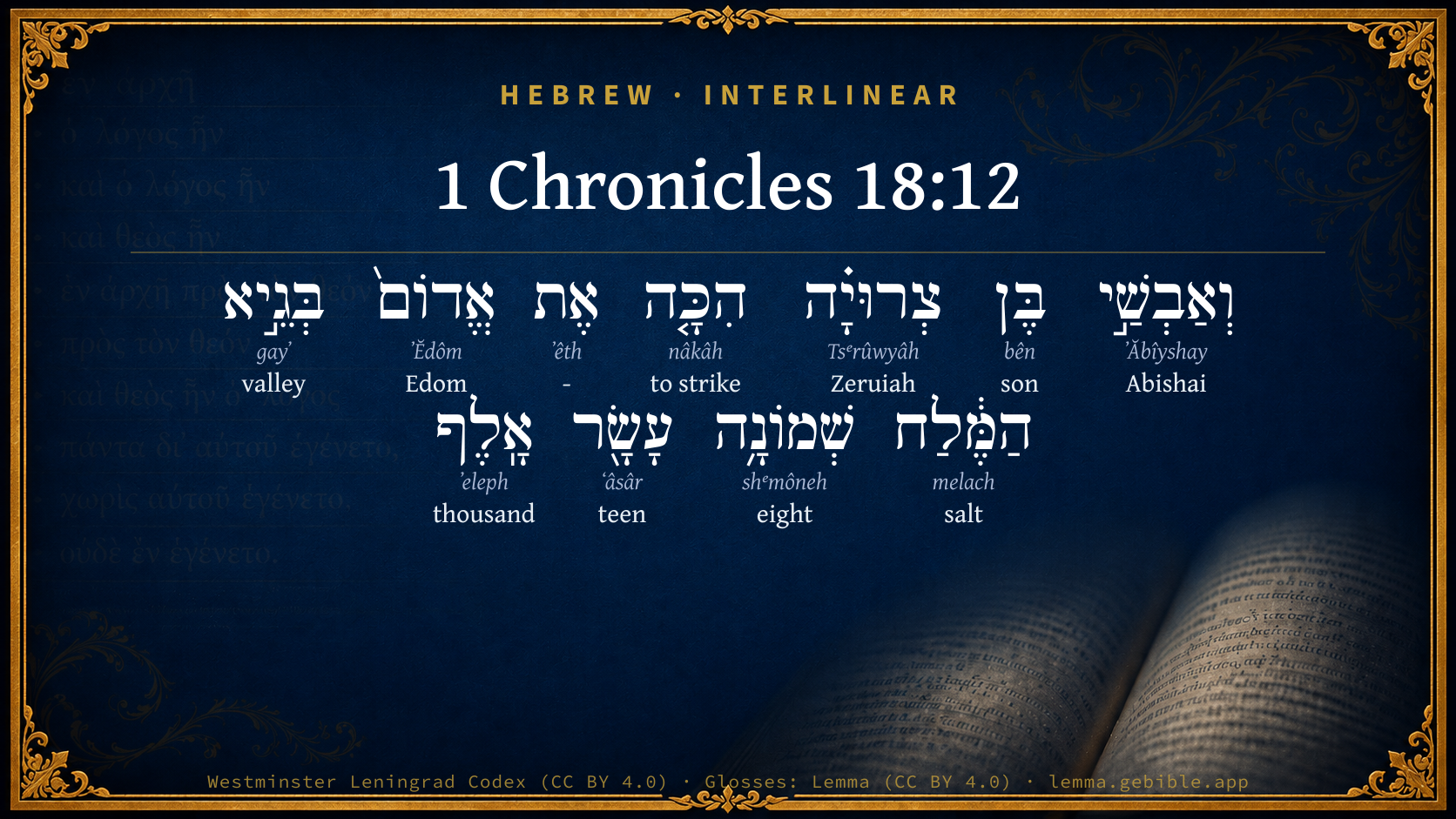
1 Chronicles 18:12

Hebrew (Westminster Leningrad Codex) 1 Chronicles 18:12 appears in the Hebrew Old Testament. The text above is from the Westminster Leningrad Codex. Each word links to its Strong’s number, a concise gloss, and parsing drawn from the Open Scriptures Hebrew Bible morphology. Click any word for its full Brown-Driver-Briggs (BDB) entry.
Download image
Cite this verse

1 Chronicles 18:12 (World English Bible). Public Domain. Lemma interlinear Bible study tool, https://lemma.gebible.app/v/1-chronicles/18/12.

Show BibTeX & RIS
BibTeX
RIS
English Translation
Moreover Abishai the son of Zeruiah struck of the Edomites in the Valley of Salt eighteen thousand.
World English Bible · Public Domain
Download a study sheet

One document with this verse’s original text, its word-by-word gloss line, the meaning frame, cross-references with their text, attributed commentary, and full source and license credits — printable, and it pastes into notes with its structure intact.

This verse Autodidact and up

Study sheet (.html) Plain text (.txt)

A passage Seminary Student

Up to 50 verses in one chapter. A passage sheet keeps up to 6 commentary sources and 12 cross-references per verse, in the order this page ranks them, and says so on the sheet whenever that leaves anything out. Ask for a single verse and you get the Autodidact verse sheet above.

Everything on this page stays free to read, with no account — the sheet is a download of what is already on screen, not access to it.

Want to remove ads? Support Godless Engineer
Compare translations 3

The same verse in 3 English versions, stacked beneath the original-language interlinear above. Click any original word for its lexicon entry.

Each is an independent rendering of the whole verse — the interlinear is not word-aligned to these translations.

Highlighted words mark where these versions differ — a whole-verse word diff, not a word-by-word alignment.

  • World English Bible Public Domain
    Moreover Abishai the son of Zeruiah struck of the Edomites in the Valley of Salt eighteen thousand.
  • King James Version Public Domain
    Moreover Abishai the son of Zeruiah slew of the Edomites in the valley of salt eighteen thousand.
  • unfoldingWord Literal Text CC BY-SA 4.0
    And Abishai, the son of Zeruiah, struck Edom in the Valley of Salt, 18,000.

unfoldingWord Literal Text — © unfoldingWord, licensed CC BY-SA 4.0. Word-aligned USFM3 via Door43 (git.door43.org/unfoldingWord/en_ult).

Versions to compare (up to 4)

3 of 4 selected

Show all 18 translations

Every available English version of this verse, each an independent rendering of the whole verse.

  • World English Bible Public Domain
    Moreover Abishai the son of Zeruiah struck of the Edomites in the Valley of Salt eighteen thousand.
  • Berean Standard Bible Public Domain
    Moreover, Abishai son of Zeruiah struck down eighteen thousand Edomites in the Valley of Salt.
  • Majority Standard Bible Public Domain
    Moreover, Abishai son of Zeruiah struck down eighteen thousand Edomites in the Valley of Salt.
  • King James Version Public Domain
    Moreover Abishai the son of Zeruiah slew of the Edomites in the valley of salt eighteen thousand.
  • American Standard Version (1901) Public Domain
    Moreover Abishai the son of Zeruiah smote of the Edomites in the Valley of Salt eighteen thousand.
  • Revised Version (1885) Public Domain
    Moreover Abishai the son of Zeruiah smote of the Edomites in the Valley of Salt eighteen thousand.
  • Geneva Bible (1599) Public Domain
    And Abishai the sonne of Zeruiah smote of Edom in the salt valley eighteene thousand,
  • Douay-Rheims (1899) Public Domain
    And Abisai the son of Sarvia slew of the Edomites in the vale of the saltpits, eighteen thousand:
  • Young's Literal Translation Public Domain
    And Abishai son of Zeruiah hath smitten Edom in the valley of salt -- eighteen thousand,
  • Literal Standard Version CC BY-SA 4.0
    And Abishai son of Zeruiah has struck Edom in the Valley of Salt—eighteen thousand,
  • Unlocked Literal Bible CC BY-SA 4.0
    Abishai son of Zeruiah killed eighteen thousand Edomites in the Valley of Salt.
  • unfoldingWord Literal Text CC BY-SA 4.0
    And Abishai, the son of Zeruiah, struck Edom in the Valley of Salt, 18,000.
  • Darby Bible Public Domain
    And Abishai the son of Zeruiah smote of the Edomites in the valley of salt eighteen thousand.
  • World Messianic Bible Public Domain
    Moreover Abishai the son of Zeruiah struck eighteen thousand of the Edomites in the Valley of Salt.
  • Webster's Bible Public Domain
    Moreover, Abishai the son of Zeruiah slew of the Edomites in the valley of salt eighteen thousand.
  • Free Bible Version CC BY-SA 4.0
    Abishai, son of Zeruiah, killed 18,000 Edomites in the Valley of Salt.
  • Bible in Basic English Public Domain
    And when he came back from putting to the sword eighteen thousand of the Edomites in the Valley of Salt,
  • JPS Tanakh (1917) Public Domain
    Moreover Abishai the son of Zeruiah smote of the Edomites in the Valley of Salt eighteen thousand.

Literal Standard Version (2020), Covenant Press — licensed CC BY-SA 4.0. Text via the HelloAO Bible API (eBible.org). Unlocked Literal Bible (unfoldingWord) — licensed CC BY-SA 4.0. Text via the HelloAO Bible API (eBible.org). unfoldingWord Literal Text — © unfoldingWord, licensed CC BY-SA 4.0. Word-aligned USFM3 via Door43 (git.door43.org/unfoldingWord/en_ult). Free Bible Version, Dr. Jonathan Gallagher — licensed CC BY-SA 4.0. Text via the HelloAO Bible API (eBible.org).

Word by word

More ways to search: Search by grammar → Find every occurrence → Compare this word →

Practice this passage: Drill this verse → Learn its vocabulary →

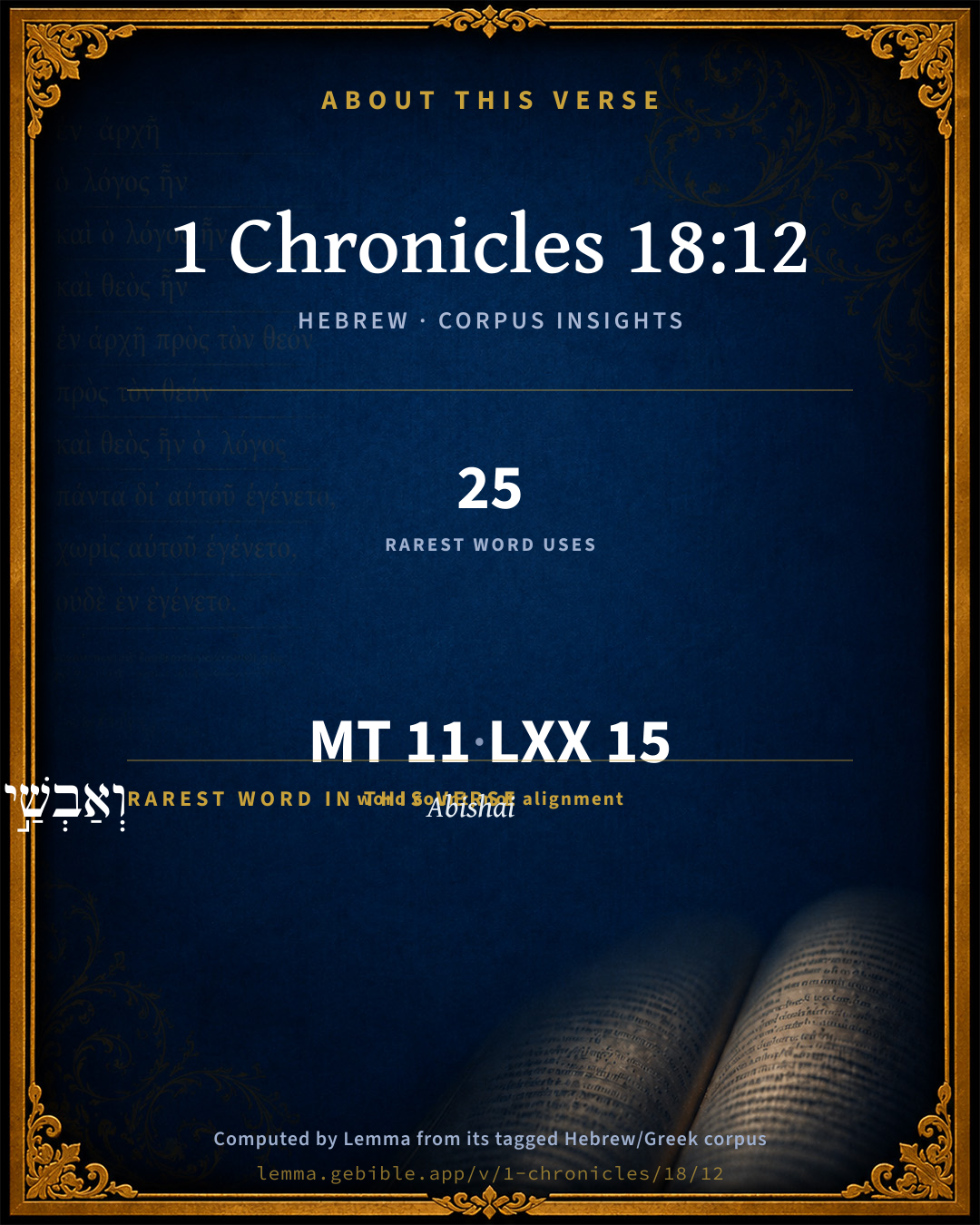
About this verse

These counts appear in no published source. They are computed here, from the morphology-tagged text and Lemma’s own curated glosses. What Lemma adds →

11
words
11
distinct lemmas
Historical
section

Notable vocabulary

The rarest word here is וְאַבְשַׁ֣י Abishai H52 — appearing just 25 times in the whole Hebrew Bible.

Shared distinctive vocabulary

וְאַבְשַׁ֣י Abishai H52 occurs in 24 verses of the Hebrew Bible. Also found in:

Grammatical profile

  • 1 verb
  • 6 nouns
  • 3 adjectives
  • 1 particle

Verb forms

  • הִכָּ֤ה Hiphil · Perfect

Hebrew & Septuagint length

In English translation the verse runs 17 words from the Hebrew and 15 from the Septuagint (LXX English) — closely comparable.

A rough comparison of the two English renderings, which tokenize alike — not a word-level alignment.

Word counts can differ between the Hebrew and the Greek without any difference in meaning — e.g. the Hebrew direct-object marker אֵת has no separate Greek word, and Greek often adds the article ὁ.

In the original languages it is 11 Hebrew tokens and 15 Greek tokens — but the two are counted differently (Hebrew bundles its prefixes and suffixes into one token; the Greek is in lemma form), so that isn’t a like-for-like length.

Cross-references

19

Topical passages linked to 1 Chronicles 18:12 in the Treasury of Scripture Knowledge — connected by theme and wording, ordered by reader-vote popularity; previews shown in the World English Bible.

  • Psalms 60:1 God, you have rejected us. You have broken us down. You have been angry. Restore us, again.
  • 1 Samuel 26:6 Then answered David and said to Ahimelech the Hittite, and to Abishai the son of Zeruiah, brother to Joab, saying, Who will go down with me to Saul to the camp? Abishai said, I will go down with you.
  • 2 Samuel 8:13–14 David got him a name when he returned from smiting the Syrians in the Valley of Salt, even eighteen thousand men.
  • 2 Samuel 10:10 The rest of the people he committed into the hand of Abishai his brother; and he put them in array against the children of Ammon.
  • 1 Chronicles 2:16 and their sisters were Zeruiah and Abigail. The sons of Zeruiah: Abishai, and Joab, and Asahel, three.
  • 1 Chronicles 11:20 Abishai, the brother of Joab, he was chief of the three; for he lifted up his spear against three hundred and killed them, and had a name among the three.
  • 1 Chronicles 19:11 The rest of the people he committed into the hand of Abishai his brother; and they put themselves in array against the children of Ammon.
  • 2 Chronicles 25:11 Amaziah took courage, and led forth his people, and went to the Valley of Salt, and struck of the children of Seir ten thousand.
  • 1 Samuel 26:8 Then said Abishai to David, God has delivered up your enemy into your hand this day: now therefore please let me strike him with the spear to the earth at one stroke, and I will not strike him the second time.
  • 2 Samuel 3:30 So Joab and Abishai his brother killed Abner, because he had killed their brother Asahel at Gibeon in the battle.
  • 2 Samuel 7:13 He shall build a house for my name, and I will establish the throne of his kingdom forever.
  • 2 Samuel 10:14 When the children of Ammon saw that the Syrians were fled, they likewise fled before Abishai, and entered into the city. Then Joab returned from the children of Ammon, and came to Jerusalem.
  • 2 Samuel 16:9–11 Then said Abishai the son of Zeruiah to the king, "Why should this dead dog curse my lord the king? Please let me go over and take off his head."
  • 2 Samuel 19:21–22 But Abishai the son of Zeruiah answered, Shall Shimei not be put to death for this, because he cursed Yahweh's anointed?
  • 2 Samuel 20:6 David said to Abishai, Now will Sheba the son of Bichri do us more harm than did Absalom: take your lord's servants, and pursue after him, lest he get him fortified cities, and escape out of our sight.
  • 2 Samuel 21:17 But Abishai the son of Zeruiah helped him, and struck the Philistine, and killed him. Then the men of David swore to him, saying, You shall go no more out with us to battle, that you don't quench the lamp of Israel.
  • 2 Samuel 23:18 Abishai, the brother of Joab, the son of Zeruiah, was chief of the three. He lifted up his spear against three hundred and killed them, and had a name among the three.
  • 2 Kings 14:7 He killed of Edom in the Valley of Salt ten thousand, and took Sela by war, and called the name of it Joktheel, to this day.
  • Psalms 60:8–9 Moab is my wash basin. I will throw my shoe on Edom. I shout in triumph over Philistia."

Cross-references courtesy of OpenBible.info (CC BY 4.0).

Hebrew and Greek witnesses Masoretic Hebrew ↔ Greek Septuagint

The same verse in the two great witnesses to the Old Testament, shown verse-for-verse.

These are two independent witnesses, not word-aligned to each other, and the Septuagint is shown in lemma (dictionary) form.

Hebrew 1 Chronicles 18:12 Masoretic · Westminster Leningrad Codex

וְאַבְשַׁ֣י בֶּן צְרוּיָ֗ה הִכָּ֤ה אֶת אֱדוֹם֙ בְּגֵ֣יא הַמֶּ֔לַח שְׁמוֹנָ֥ה עָשָׂ֖ר אָֽלֶף

Moreover Abishai the son of Zeruiah struck of the Edomites in the Valley of Salt eighteen thousand.

World English Bible · Public Domain

Greek LXX 1 Chronicles 18:12 Septuagint · lemma form

καί αβεσσα υἱός σαρουια πατάσσω ὁ ιδουμαία ἐν κοιλάς ὁ ἅλς ὀκτώ καί δέκα χιλιάς

And Abesa son of Saruia struck the Idumeans in the valley of Salt, eighteen thousand.

LXX2012 (modern English Septuagint) · Public Domain

On this verse, Ellicott's Commentary for English Readers discusses the Septuagint’s reading. Read the note in Commentary ↓

Hebrew: Westminster Leningrad Codex (CC BY 4.0). Greek: Septuagint (public domain); English from LXX2012 (modern English Septuagint) (Public Domain). How the Septuagint differs from the Hebrew →

Commentary

Notes on 1 Chronicles 18:12 from classic Christian and Jewish commentators (each source and its license shown beneath its notes). The classic Christian expositions comment on the surrounding passage and are grouped to its opening verse, so a note may address several verses; the Jewish commentaries on the Tanakh (Rashi and others) are per-verse, so they appear only where the commentator wrote on this verse.

Lemma curates 59 commentaries, every one of them public domain or Creative Commons licensed, each selected and text-cleaned for this edition rather than reprinted as found. About our sources →

Ellicott's Commentary for English Readers

(12) Moreover Abishai . . .—Heb., And Abishai son of Zeruiah had smitten Edom in the Valley of Salt, eighteen thousand.

In Samuel we read something quite different: “And David made a name, when he returned from his smiting Aram.” “Aram” should be read Edom, as the LXX., Syriac, and Arabic have it. Perhaps, also, the text of Samuel is further corrupted. (Comp. 1Ki_11:15. and Psalms 60, title.) From a comparison of the three passages it appears that Edom took advantage of David’s absence to invade Judah, whereupon the king detached a column of his forces, and sent them south under Joab and Abishai to repulse the new enemy.

Valley of salt.—2Ki_14:7.

(12, 13) The reduction of Edom. The paragraph mark should be at 1Ch_18:12, not 1Ch_18:13.

A Bible Commentary for English Readers, edited by Charles John Ellicott (1878–1897) — public domain. Text from a community e-Sword module.

Geneva Bible (1599)

Geneva Bible translators

Which is understood that Joab slew twelve thousand, as is in the title of the threescore Psalm and Abishai the rest.

Geneva Bible (1599) marginal notes — public domain. Text via Bolls.life.

Adam Clarke's Commentary

Verse 12. Abishai - slew of the Edomites] This victory is attributed to David, 2Sa 8:13. He sent Abishai against them, and he defeated them: this is with great propriety attributed to David as commander-in-chief; qui facit per alterum, facit per se.

Adam Clarke's Commentary on the Bible (1810–1826) — public domain. Text from a community e-Sword/MySword module.

The Cambridge Bible for Schools and Colleges

gen. ed. J. J. S. Perowne

12. Abishai the son of Zeruiah] In 2Sa_8:13 David, and in Psalms 60 (title) Joab, receives the credit of this victory. Probably Abishai commanded in the battle, while Joab (cp. 1Ki_11:16) completed the conquest of the country.

of the Edomites] Lit. “of Edom,” so Psalms 60 (title), but in 2 Sam. “of the Syrians,” lit. “Aram.” The two words “Edom” and “Aram” when written in Heb. are very much alike and are easily confused. The reading “Edom” is right here. Cp. Kirkpatrick on 2Sa_8:13.

the valley of salt] Probably the marshy flat (Bädeker, p. 144) at the S. end of the Dead Sea. This valley is dominated by the Jebel Usdum, a hill consisting “almost entirely of pure crystallised salt” (Bädeker, p. 143).

eighteen thousand] Psalms 60 (title), “twelve thousand,” not an important variation.

The Cambridge Bible for Schools and Colleges (gen. ed. J. J. S. Perowne; Cambridge University Press, 1878–1918) — public domain. Text from a community e-Sword module.

Haydock's Catholic Bible Commentary

Edomites. David seems to have been present, and the victory is sometimes attributed to him. Joab afterwards slew 18,000, 3 Kings xi. 15., and title of Psalm ix. (St. Jerome, Trad.) (Calmet) --- Pits. This place was fatal to that nation: there Amasias destroyed 20,000, 2 Paralipomenon xxv. 12. (Tirinus)

George Leo Haydock (1774–1849), Haydock's Catholic Family Bible and Commentary, 1859 edition — public domain. Excludes Psalms (Douay-Rheims chapter numbering differs from Protestant) and Deuterocanonical books (Catholic canon only).

The Pulpit Commentary

Abishai slew of the Edomites. The parallel place omits to say that it was by aid of Abishai that David slew these eighteen thousand Edomites. They are there called Syrians, which reading is at all events in keeping with the Aram of the previous verse. Abishai, here named son of Zeruiah, possibly served under "Joab son of Zeruiah" (ver. 15), who is spoken of (1Ki_11:15, 1Ki_11:16) as very trenchant in this Edomite war, without any mention being made of Abishai. Psalm 60. (title) probably speaks of an instalment of the eighteen thousand spoken of here, as the nation now suffered all but extermination. The valley of salt. (Situate in 1Ki_11:14-17; 2Ki_14:7; 2Ch_25:11) The word here used for "valley" is ayGe, (Psa_23:4) not the more generic word qm,e, and signifies rather "ravine." The phrase occurs twice with the article expressed, jl; M,j ayge. The place is celebrated also for the achievements of Amaziah (in references just given), who proceeded hence with ten thousand prisoners, to precipitate them down the cliff, i.e. Petra (lSh 2Ch_25:12) The real situation of this place is still doubtful. Since the time of the German traveller Geethen ("Reisen," 2:356), and of Robinson ("Bibl. Res.," 2:109), it has been generally assumed to be a tract of land extending some six miles south of the Dead Sea, and bounded at that distance by the range of hills which there runs across the country; but beside the consideration that the word "ravine" could not describe that tract of country, there are others very unfavourable to the supposition (see these carefully stated by Grove, in Smith"s "Bible Dictionary," 3:1097).

The Pulpit Commentary (1880–1919), ed. H.D.M. Spence-Jones & Joseph S. Exell — public domain. Text from a community e-Sword module.

Scofield Reference Notes

C. I. Scofield

Abishai

Nephew of David, brother to Joab. 2Sa 23:18; 1Ch 2:16.

The Scofield Reference Bible (1917 edition), notes by C. I. Scofield — public domain. Text from a community e-Sword module.

unfoldingWord translationNotes

Door43 World Missions Community

Abishai ... Zeruiah

These are names of men. (See: How to Translate Names)

eighteen thousand Edomites

"18,000 Edomites" (See: Numbers)

Valley of Salt

This is the name of a valley between Edom and Judah that was used as a battlefield.

translationWords

Edom

David

servant

Yahweh

unfoldingWord translationNotes — © Distant Shores Media and the Door43 World Missions Community, licensed CC BY-SA 4.0. Source: git.door43.org/Door43/en_tn.

Lesson kit

Teaching starters — assembled from the data on this page, not authored interpretation. Every prompt links to the verse data it draws on. Edit before teaching.

1 Chronicles, in the Historical, opens this verse with 11 words (11 distinct Hebrew lemmas). Its most distinctive word is ʼĂbîyshay (“Abishai”). A historical commentator’s framing appears above. Read the whole chapter for the surrounding context.

Discussion questions

  1. How does “Abishai” (ʼĂbîyshay) shape what this verse is saying?
  2. How does 1 Samuel 26:6, which shares the word «Abishai», read alongside this verse?
  3. These translations render this verse differently. What is at stake in choosing one wording over another?
  4. «הִכָּ֤ה» is a Hiphil Perfect verb. How does that grammatical form shape the action described?
  5. Compare how Ellicott's Commentary for English Readers and Geneva Bible (1599) read this verse. Where do they agree or differ?

Things to notice

Reading settings

Reading text

Shown beneath each verse's original-language words.

Old Testament
Old Testament edition

Read the OT as the Masoretic Hebrew (MT) or the Greek Septuagint (LXX).

English shown for the Greek Septuagint (in the Hebrew ↔ Greek comparison).

Comparing translations? Open the Compare panel on any verse page to stack up to four side by side.