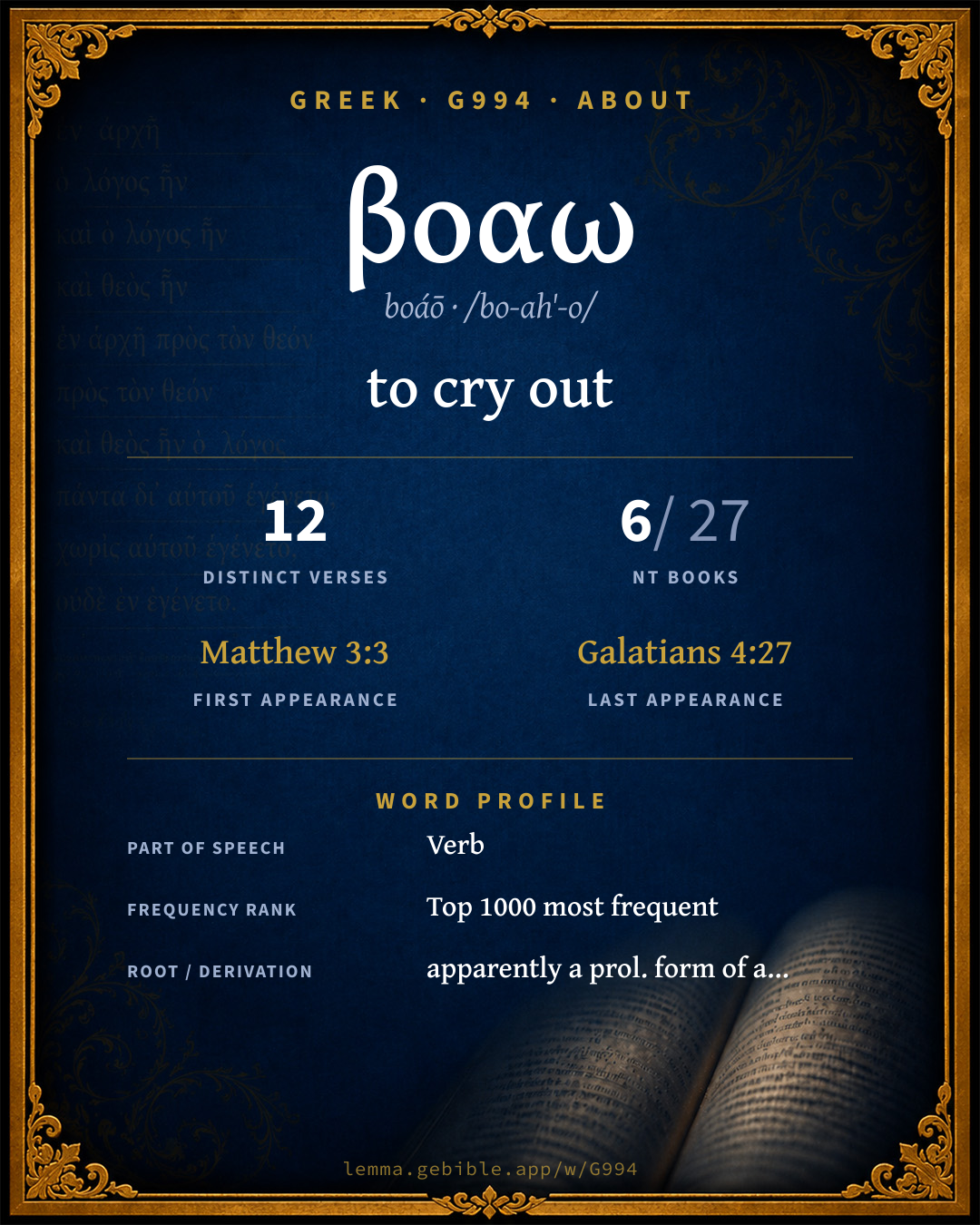
βοάω
to cry out
‘to cry out’ is one of 3 main senses fuller range ↓
Full lexicon entry — Thayer's Greek Lexicon
From Thayer's Greek Lexicon
Where this word appears
See every Present-tense verb in the Greek New Testament →
Grammar key — what these labels mean
Part of speech
- Verb
- An action or state-of-being word.
Tense
- Present
- Ongoing or general action in present time (imperfective aspect).
- Aorist
- Action viewed as a simple whole, without regard to duration — often past (perfective aspect).
Voice
- Active
- The subject performs the action.
Mood
- Participle
- A verbal adjective (“writing,” “having written”).
- Indicative
- States a fact or asks a factual question (the mood of reality).
- Imperative
- Expresses a command or request.
Case
- Genitive
- The case of source, possession, or “of” — answers “whose / from what.”
- Nominative
- The case of the subject (and the predicate nominative).
Person
- 3rd person
- The one spoken about (“he / she / it / they”).
- 2nd person
- The one addressed (“you”).
Gender
- Masculine
- Grammatically masculine.
- Neuter
- Grammatically neuter.
Number
- Singular
- One.
- Plural
- More than one.
Grammatical forms
- Verb, Present, Active, Participle, Genitive, Singular, Masculine 4 times (33%)
- Verb, Aorist, Active, Indicative, 3rd person, Singular 3 times (25%)
- Verb, Present, Active, Participle, Nominative, Plural, Masculine 2 times (17%)
- Verb, Aorist, Active, Imperative, 2nd person, Singular 1 time (8%)
- Verb, Present, Active, Participle, Genitive, Plural, Masculine 1 time (8%)
- Verb, Present, Active, Participle, Nominative, Plural, Neuter 1 time (8%)
Parsed forms decoded from the imported morphology (Robinson–Tischendorf, public domain), counted across 12 parsed occurrences — not distinct verses.
Every verse where G994 appears — 12 distinct verses across 6 books. Click any verse to open its interlinear word-by-word view. Verse text shown in the World English Bible for context — . Each verse’s Greek form is shown with its reference; the English is not keyword-highlighted, since the data carries no word-level English alignment. Use “Compare translations” on any verse to read it across multiple English versions. This concordance covers the Greek New Testament; Septuagint (Greek Old Testament) occurrences of this word are not indexed here.
Matthew 1 verse
Mark 2 verses
- Mark 1:3 βοῶντος pres act ptcp gen sg masc The voice of one crying in the wilderness, 'Make ready the way of the Lord! Make his paths straight!'"
- Mark 15:34 ἐβόησεν aor act ind 3sg At the ninth hour Jesus cried with a loud voice, saying, "Eloi, Eloi, lama sabachthani?" which is, being interpreted, "My God, my God, why have you forsaken me?"
Luke 4 verses
- Luke 3:4 βοῶντος pres act ptcp gen sg masc As it is written in the book of the words of Isaiah the prophet, "The voice of one crying in the wilderness, 'Make ready the way of the Lord. Make his paths straight.
- Luke 9:38 ἐβόησεν aor act ind 3sg Behold, a man from the crowd called out, saying, "Teacher, I beg you to look at my son, for he is my only child.
- Luke 18:7 βοώντων pres act ptcp gen pl masc Won't God avenge his chosen ones, who are crying out to him day and night, and yet he exercises patience with them?
- Luke 18:38 ἐβόησεν aor act ind 3sg He cried out, "Jesus, you son of David, have mercy on me!"
John 1 verse
Acts 3 verses
- Acts 8:7 βοῶντα pres act ptcp nom pl neut For unclean spirits came out of many of those who had them. They came out, crying with a loud voice. Many who had been paralyzed and lame were healed.
- Acts 17:6 βοῶντες pres act ptcp nom pl masc When they didn't find them, they dragged Jason and certain brothers before the rulers of the city, crying, "These who have turned the world upside down have come here also,
- Acts 25:24 βοῶντες pres act ptcp nom pl masc Festus said, "King Agrippa, and all men who are here present with us, you see this man, about whom all the multitude of the Jews petitioned me, both at Jerusalem and here, crying that he ought not to live any longer.
Galatians 1 verse
About this entry
At a glance — auto-summarized from this page’s data, not written by a person. Every figure links to its source below. This summary describes the numbers; it doesn’t interpret them.
βοαω (boáō) is a Greek verb most often rendered “to cry out.” It first appears in Matthew 3:3. It turns up in 12 verses across 6 books, an uncommon footprint. It concentrates in Luke, which alone accounts for 33% of its uses. Its lexical range runs to 3 senses. The sections below give every sense, occurrence, and version rendering.
Gloss history
Strong's 1890 vs modern scholarship
About this word
Strong's G994 catalogs a Greek word from the Greek New Testament.
These counts are not copied from any lexicon or concordance. They are computed here, from the morphology-tagged Greek New Testament. What Lemma adds →
- 12
- distinct verses
- The word appears in 12 distinct verses.
- 6 / 27
- NT books
- The word appears in 6 of 27 New Testament books.
- #904
- by frequency
- Top 1000 most frequent Greek words (rank 904 of 5,347 Greek words by occurrence).
View all 12 occurrences in the concordance →
By section of the New Testament
By traditional corpus
Conventional, traditional groupings — biblical authorship is debated, so this is a traditional corpus grouping, not an authorship claim. Some books belong to more than one corpus (Luke is in both the Gospels and the Lukan corpus, and so on), so these shares overlap and need not total 100%. Each figure is a share of the word’s 12 distinct verses.
- Gospels 8 verses · 67%
- Lukan (Luke–Acts) 7 verses · 58%
- Johannine 1 verse · 8%
- Pauline corpus 1 verse · 8%
How translations render this word
Counts come from each version’s own published word-to-Strong’s tagging or interlinear alignment — an approximate guide to how each version renders this word, not a word-level alignment the data otherwise carries. Because each total is that version’s own tagged count, the per-version totals vary from one another and need not match the appearance or distinct-verse counts above. These counts may also differ from a printed concordance because Lemma counts each distinctly tagged rendering and does not collapse phrase taggings into a single head-word total. This is a fixed set of word-tagged versions (KJV, ASV, BSB, ULT) and does not change with the reading translation you choose elsewhere. Each version’s license is shown beside its name below (and on Sources).
- King James Version: One crying 4×, Cried 2×, Cry 2×
- American Standard Version: One crying 4×, Cry 2×, Crying 2×
- Berean Standard Bible: One calling 4×, Cried out 2×
- unfoldingWord Literal Text: One calling out 3×, Cried out 2×, Crying out 2×
King James Version Public Domain
Renders G994 across 11 tagged occurrences — most commonly:
Plus 1 rendering that appears only once — usually multi-word phrases or single function words the recovered tagging swept in, not distinct renderings.
American Standard Version Public Domain
Renders G994 across 11 tagged occurrences — most commonly:
Plus 3 renderings that appear only once — usually multi-word phrases or single function words the recovered tagging swept in, not distinct renderings.
Berean Standard Bible Public Domain
Renders G994 across 11 tagged occurrences — most commonly:
Plus 5 renderings that appear only once — usually multi-word phrases or single function words the recovered tagging swept in, not distinct renderings.
unfoldingWord Literal Text CC BY-SA 4.0
Renders G994 across 12 tagged occurrences — most commonly:
Plus 3 renderings that appear only once — usually multi-word phrases or single function words the recovered tagging swept in, not distinct renderings.
Senses in Thayer's
The 3 senses Thayer's distinguishes for this word, in lexicon order (not ranked by frequency or importance). The full entry — with sub-senses — is in the Lexicon Entry tab.
- to raise a cry, of joy pain etc.
- to cry, speak with a high, strong voice
- to cry to one for help, to implore his aid
Word origin
Origin: apparently a prol. form of a primary word
Apparently a prolonged form of a primary verb; to halloo that is shout (for help or in a tumultuous way): - cry.
— Strong’s Exhaustive Concordance (1890), public domain.
Forms in the corpus
The 6 distinct written forms G994 takes in the Greek New Testament, most frequent first — each parse links to that tense’s occurrences in the concordance.
| Form | Parsing | Example | Uses |
|---|---|---|---|
| βοῶντος boō̂ntos | Verb, Present, Active, Participle, Genitive, Singular, Masculine | Matthew 3:3 | 4 |
| ἐβόησεν ebóēsen | Verb, Aorist, Active, Indicative, 3rd person, Singular | Mark 15:34 | 3 |
| βοῶντες boō̂ntes | Verb, Present, Active, Participle, Nominative, Plural, Masculine | Acts 17:6 | 2 |
| βοώντων boṓntōn | Verb, Present, Active, Participle, Genitive, Plural, Masculine | Luke 18:7 | 1 |
| βοῶντα boō̂nta | Verb, Present, Active, Participle, Nominative, Plural, Neuter | Acts 8:7 | 1 |
| βόησον bóēson | Verb, Aorist, Active, Imperative, 2nd person, Singular | Galatians 4:27 | 1 |
Same root — word family
Other Thayer's entries built from the same root as G994, grouped by Strong’s listed origin. These share a root / origin per the lexicon — not necessarily a shared meaning. Each links to that word’s own entry.
Derived from this word
Compare all same-root words → They share a root, not necessarily a meaning.
Septuagint usage
The same Greek word βοαω appears 112 times in the Greek Old Testament (Septuagint), across 109 verses in 23 books.
- 112
- LXX occurrences
- Tagged occurrences of this Greek word in the Septuagint.
- 109
- verses
- Distinct Septuagint verses containing this word.
- 23 / 39
- OT books
- The word appears in 23 of the 39 Old Testament books.
Sample Septuagint occurrences
- Genesis 4:10 βοάω
- Exodus 8:8 βοάω
- Numbers 12:13 βοάω
- Deuteronomy 15:9 βοάω
- Joshua 6:10 βοάω
- Judges 4:10 βοάω
- 1 Samuel 5:10 βοάω
- 2 Samuel 15:2 βοάω
- 1 Kings 17:10 βοάω
- 2 Kings 4:1 βοάω
- 1 Chronicles 5:20 βοάω
- 2 Chronicles 13:14 βοάω
Septuagint occurrences (same lexeme)
Every verse where the same Strong’s number (G994) appears in the Greek Septuagint — showing the first 50 of 109. Verse text shown in the World English Bible for context; the Greek form is the matched word — the English is not keyword-highlighted.
- Genesis 4:10 βοάω Yahweh said, "What have you done? The voice of your brother's blood cries to me from the ground.
- Genesis 29:11 βοάω Jacob kissed Rachel, and lifted up his voice, and wept.
- Genesis 39:14 βοάω that she called to the men of her house, and spoke to them, saying, "Behold, he has brought in a Hebrew to us to mock us. He came in to me to lie with me, and I cried with a loud voice.
- Genesis 39:15 βοάω It happened, when he heard that I lifted up my voice and cried, that he left his garment by me, and ran outside."
- Genesis 39:18 βοάω and it happened, as I lifted up my voice and cried, that he left his garment by me, and ran outside."
- Exodus 8:8 βοάω Then Pharaoh called for Moses and Aaron, and said, "Entreat Yahweh, that he take away the frogs from me, and from my people; and I will let the people go, that they may sacrifice to Yahweh."
- Exodus 14:15 βοάω Yahweh said to Moses, "Why do you cry to me? Speak to the children of Israel, that they go forward.
- Exodus 15:25 βοάω Then he cried to Yahweh. Yahweh shown him a tree, and he threw it into the waters, and the waters were made sweet. There he made a statute and an ordinance for them, and there he tested them;
- Exodus 17:4 βοάω Moses cried to Yahweh, saying, "What shall I do with these people? They are almost ready to stone me."
- Numbers 12:13 βοάω Moses cried to Yahweh, saying, Heal her, God, I beg you.
- Deuteronomy 15:9 βοάω Beware that there not be a base thought in your heart, saying, The seventh year, the year of release, is at hand; and your eye be evil against your poor brother, and you give him nothing; and he cry to Yahweh against you, and it be sin to you.
- Deuteronomy 22:24 βοάω then you shall bring them both out to the gate of that city, and you shall stone them to death with stones; the lady, because she didn't cry, being in the city; and the man, because he has humbled his neighbor's wife: so you shall put away the evil from the midst of you.
- Deuteronomy 22:27 βοάω for he found her in the field, the pledged to be married lady cried, and there was none to save her.
- Joshua 6:10 βοάω Joshua commanded the people, saying, You shall not shout, nor let your voice be heard, neither shall any word proceed out of your mouth, until the day I bid you shout; then shall you shout.
- Joshua 15:18 βοάω It happened, when she came [to him], that she moved him to ask of her father a field: and she alighted from off her donkey; and Caleb said, What would you?
- Judges 4:10 βοάω Barak called Zebulun and Naphtali together to Kedesh; and there went up ten thousand men at his feet: and Deborah went up with him.
- Judges 6:6 βοάω Israel was brought very low because of Midian; and the children of Israel cried to Yahweh.
- Judges 7:23 βοάω The men of Israel were gathered together out of Naphtali, and out of Asher, and out of all Manasseh, and pursued after Midian.
- Judges 7:24 βοάω Gideon sent messengers throughout all the hill-country of Ephraim, saying, Come down against Midian, and take before them the waters, as far as Beth Barah, even the Jordan. So all the men of Ephraim were gathered together, and took the waters as far as Beth Barah, even the Jordan.
- Judges 9:54 βοάω Then he called hastily to the young man his armor bearer, and said to him, Draw your sword, and kill me, that men not say of me, A woman killed him. His young man thrust him through, and he died.
- Judges 10:10 βοάω The children of Israel cried to Yahweh, saying, We have sinned against you, even because we have forsaken our God, and have served the Baals.
- Judges 10:12 βοάω The Sidonians also, and the Amalekites, and the Maonites, did oppress you; and you cried to me, and I saved you out of their hand.
- Judges 10:14 βοάω Go and cry to the gods which you have chosen; let them save you in the time of your distress.
- Judges 12:1 βοάω The men of Ephraim were gathered together, and passed northward; and they said to Jephthah, Why did you pass over to fight against the children of Ammon, and didn't call us to go with you? we will burn your house on you with fire.
- Judges 12:2 βοάω Jephthah said to them, I and my people were at great strife with the children of Ammon; and when I called you, you didn't save me out of their hand.
- Judges 18:22 βοάω When they were a good way from the house of Micah, the men who were in the houses near to Micah's house were gathered together, and overtook the children of Dan.
- Judges 18:23 βοάω They cried to the children of Dan. They turned their faces, and said to Micah, What ails you, that you come with such a company?
- 1 Samuel 5:10 βοάω So they sent the ark of God to Ekron. It happened, as the ark of God came to Ekron, that the Ekronites cried out, saying, They have brought about the ark of the God of Israel to us, to kill us and our people.
- 1 Samuel 7:8 βοάω The children of Israel said to Samuel, "Don't cease to cry to Yahweh our God for us, that he will save us out of the hand of the Philistines."
- 1 Samuel 7:9 βοάω Samuel took a sucking lamb, and offered it for a whole burnt-offering to Yahweh: and Samuel cried to Yahweh for Israel; and Yahweh answered him.
- 1 Samuel 8:18 βοάω You shall cry out in that day because of your king whom you shall have chosen you; and Yahweh will not answer you in that day.
- 1 Samuel 11:7 βοάω He took a yoke of oxen, and cut them in pieces, and sent them throughout all the borders of Israel by the hand of messengers, saying, Whoever doesn't come forth after Saul and after Samuel, so shall it be done to his oxen. The dread of Yahweh fell on the people, and they came out as one man.
- 1 Samuel 12:8 βοάω When Jacob was come into Egypt, and your fathers cried to Yahweh, then Yahweh sent Moses and Aaron, who brought forth your fathers out of Egypt, and made them to dwell in this place.
- 1 Samuel 12:10 βοάω They cried to Yahweh, and said, We have sinned, because we have forsaken Yahweh, and have served the Baals and the Ashtaroth: but now deliver us out of the hand of our enemies, and we will serve you.
- 1 Samuel 15:11 βοάω It repents me that I have set up Saul to be king; for he is turned back from following me, and has not performed my commandments. Samuel was angry; and he cried to Yahweh all night.
- 1 Samuel 24:9 βοάω David said to Saul, Why listen you to men's words, saying, Behold, David seeks your hurt?
- 2 Samuel 15:2 βοάω Absalom rose up early, and stood beside the way of the gate: and it was so, that when any man had a suit which should come to the king for judgment, then Absalom called to him, and said, Of what city are you? He said, Your servant is of one of the tribes of Israel.
- 2 Samuel 18:26 βοάω The watchman saw another man running; and the watchman called to the porter, and said, Behold, [another] man running alone. The king said, He also brings news.
- 2 Samuel 18:28 βοάω Ahimaaz called, and said to the king, All is well. He bowed himself before the king with his face to the earth, and said, Blessed be Yahweh your God, who has delivered up the men who lifted up their hand against my lord the king.
- 2 Samuel 20:4 βοάω Then said the king to Amasa, Call me the men of Judah together within three days, and be here present.
- 2 Samuel 20:5 βοάω So Amasa went to call [the men of] Judah together; but he stayed longer than the set time which he had appointed him.
- 2 Samuel 20:16 βοάω Then cried a wise woman out of the city, "Hear, hear! Please say to Joab, 'Come near here, that I may speak with you.'"
- 2 Samuel 22:7 βοάω In my distress I called on Yahweh; Yes, I called to my God: He heard my voice out of his temple, My cry [came] into his ears.
- 2 Samuel 22:42 βοάω They looked, but there was none to save; Even to Yahweh, but he didn't answer them.
- 1 Kings 17:10 βοάω So he arose and went to Zarephath; and when he came to the gate of the city, behold, a widow was there gathering sticks: and he called to her, and said, Please get me a little water in a vessel, that I may drink.
- 1 Kings 17:11 βοάω As she was going to get it, he called to her, and said, Please bring me a morsel of bread in your hand.
- 1 Kings 18:24 βοάω You call on the name of your god, and I will call on the name of Yahweh; and the God who answers by fire, let him be God." All the people answered, "It is well said."
- 1 Kings 21:39 βοάω
- 2 Kings 4:1 βοάω Now there cried a certain woman of the wives of the sons of the prophets to Elisha, saying, Your servant my husband is dead; and you know that your servant did fear Yahweh: and the creditor is come to take to him my two children to be bondservants.
- 2 Kings 6:5 βοάω But as one was felling a beam, the axe head fell into the water; and he cried, and said, Alas, my master! for it was borrowed.
These are occurrences of the same Greek lexeme (G994) in the Septuagint — not a translation of any one Hebrew word. The store carries no word-level Hebrew↔Greek alignment, so no Hebrew original is asserted here. Counts come from the recovered LXX Strong's tagging — high-frequency vocabulary is well covered, while rare or late forms may be untagged — so they reflect tagged occurrences and may slightly undercount.