
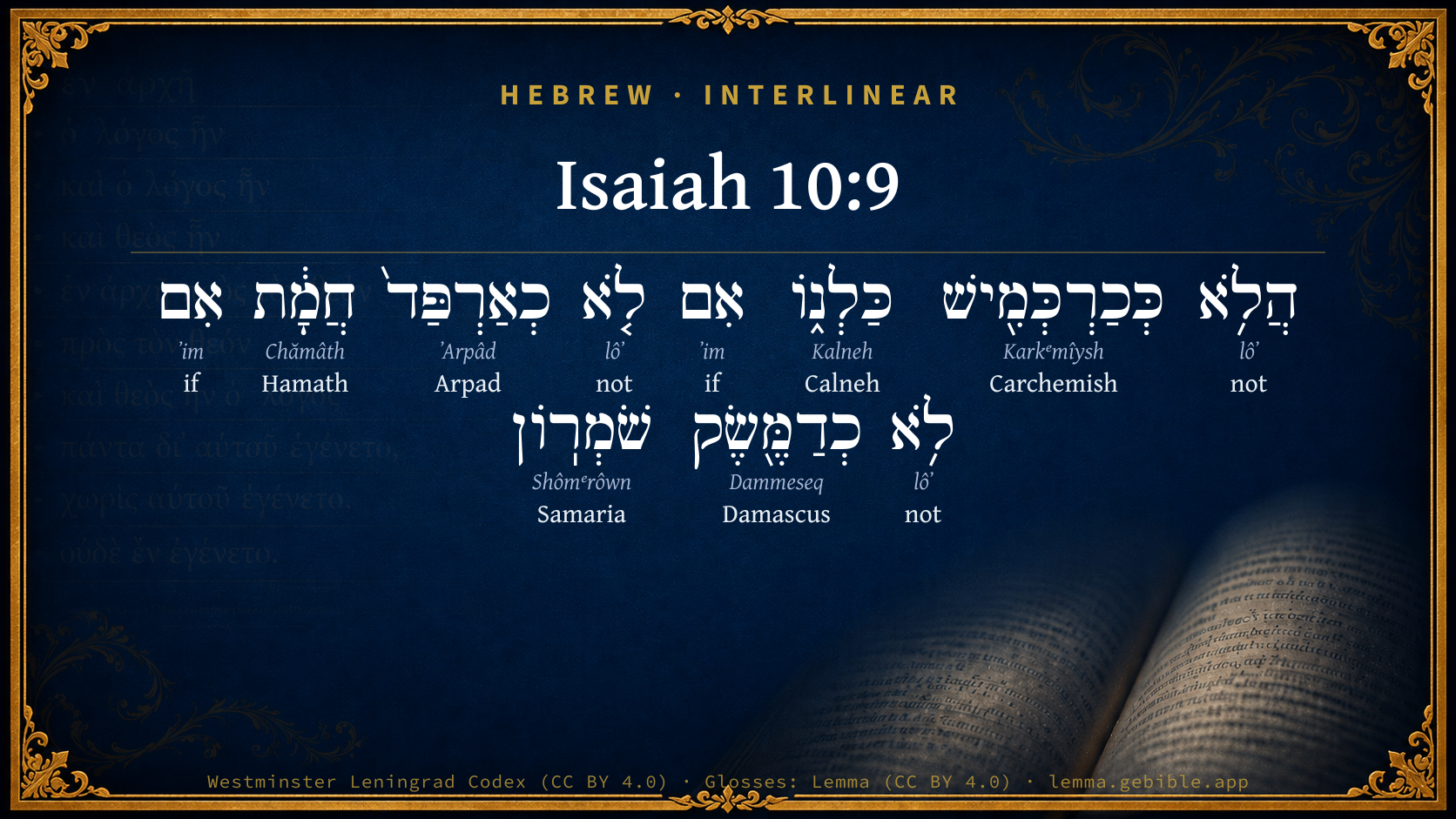
Isaiah 10:9

Hebrew (Westminster Leningrad Codex) Isaiah 10:9 appears in the Hebrew Old Testament. The text above is from the Westminster Leningrad Codex. Each word links to its Strong’s number, a concise gloss, and parsing drawn from the Open Scriptures Hebrew Bible morphology. Click any word for its full Brown-Driver-Briggs (BDB) entry.
Download image
Cite this verse

Isaiah 10:9 (World English Bible). Public Domain. Lemma interlinear Bible study tool, https://lemma.gebible.app/v/isaiah/10/9.

Show BibTeX & RIS
BibTeX
RIS
English Translation
Isn't Calno as Carchemish? Isn't Hamath as Arpad? Isn't Samaria as Damascus?
World English Bible · Public Domain
Download a study sheet

One document with this verse’s original text, its word-by-word gloss line, the meaning frame, cross-references with their text, attributed commentary, and full source and license credits — printable, and it pastes into notes with its structure intact.

This verse Autodidact and up

Study sheet (.html) Plain text (.txt)

A passage Seminary Student

Up to 50 verses in one chapter. A passage sheet keeps up to 6 commentary sources and 12 cross-references per verse, in the order this page ranks them, and says so on the sheet whenever that leaves anything out. Ask for a single verse and you get the Autodidact verse sheet above.

Everything on this page stays free to read, with no account — the sheet is a download of what is already on screen, not access to it.

Want to remove ads? Support Godless Engineer
Compare translations 3

The same verse in 3 English versions, stacked beneath the original-language interlinear above. Click any original word for its lexicon entry.

Each is an independent rendering of the whole verse — the interlinear is not word-aligned to these translations.

Highlighted words mark where these versions differ — a whole-verse word diff, not a word-by-word alignment.

  • World English Bible Public Domain
    Isn't Calno as Carchemish? Isn't Hamath as Arpad? Isn't Samaria as Damascus?
  • King James Version Public Domain
    Is not Calno as Carchemish? is not Hamath as Arpad? is not Samaria as Damascus?
  • unfoldingWord Literal Text CC BY-SA 4.0
    not Calno like Carchemish? Or not Hamath like Arpad? Or not Samaria like Damascus?

unfoldingWord Literal Text — © unfoldingWord, licensed CC BY-SA 4.0. Word-aligned USFM3 via Door43 (git.door43.org/unfoldingWord/en_ult).

Versions to compare (up to 4)

3 of 4 selected

Show all 18 translations

Every available English version of this verse, each an independent rendering of the whole verse.

  • World English Bible Public Domain
    Isn't Calno as Carchemish? Isn't Hamath as Arpad? Isn't Samaria as Damascus?
  • Berean Standard Bible Public Domain
    “Is not Calno like Carchemish? Is not Hamath like Arpad? Is not Samaria like Damascus?
  • Majority Standard Bible Public Domain
    “Is not Calno like Carchemish? Is not Hamath like Arpad? Is not Samaria like Damascus?
  • King James Version Public Domain
    Is not Calno as Carchemish? is not Hamath as Arpad? is not Samaria as Damascus?
  • American Standard Version (1901) Public Domain
    Is not Calno as Carchemish? is not Hamath as Arpad? is not Samaria as Damascus?
  • Revised Version (1885) Public Domain
    Is not Calno as Carchemish? is not Hamath as Arpad? is not Samaria as Damascus?
  • Geneva Bible (1599) Public Domain
    Is not Calno as Carchemish? Is not Hamath like Arpad? Is not Samaria as Damascus?
  • Douay-Rheims (1899) Public Domain
    Are not my princes as so many kings? is not Calano as Charcamis: and Emath as Arphad? is not Samaria as Damascus?
  • Young's Literal Translation Public Domain
    Is not Calno as Carchemish? Is not Hamath as Arpad? Is not Samaria as Damascus?
  • Literal Standard Version CC BY-SA 4.0
    Is not Calno as Carchemish? Is not Hamath as Arpad? Is not Samaria as Damascus?
  • Unlocked Literal Bible CC BY-SA 4.0
    Is not Kalno like Carchemish? Is not Hamath like Arpad? Is not Samaria like Damascus?
  • unfoldingWord Literal Text CC BY-SA 4.0
    not Calno like Carchemish? Or not Hamath like Arpad? Or not Samaria like Damascus?
  • Darby Bible Public Domain
    Is not Calno as Karkemish? Is not Hamath as Arpad? Is not Samaria as Damascus?
  • World Messianic Bible Public Domain
    Isn’t Calno like Carchemish? Isn’t Hamath like Arpad? Isn’t Samaria like Damascus?”
  • Webster's Bible Public Domain
    Is not Calno as Carchemish? is not Hamath as Arpad? is not Samaria as Damascus?
  • Free Bible Version CC BY-SA 4.0
    We conquered Calno like we did Carchemish; Hamath like Arpad; Samaria like Damascus.
  • Bible in Basic English Public Domain
    Will not the fate of Calno be like that of Carchemish? is not Hamath as Arpad? is not Samaria as Damascus?
  • JPS Tanakh (1917) Public Domain
    Is not Calno as Carchemish? Is not Hamath as Arpad? Is not Samaria as Damascus?

Literal Standard Version (2020), Covenant Press — licensed CC BY-SA 4.0. Text via the HelloAO Bible API (eBible.org). Unlocked Literal Bible (unfoldingWord) — licensed CC BY-SA 4.0. Text via the HelloAO Bible API (eBible.org). unfoldingWord Literal Text — © unfoldingWord, licensed CC BY-SA 4.0. Word-aligned USFM3 via Door43 (git.door43.org/unfoldingWord/en_ult). Free Bible Version, Dr. Jonathan Gallagher — licensed CC BY-SA 4.0. Text via the HelloAO Bible API (eBible.org).

Word by word

More ways to search: Search by grammar → Find every occurrence → Compare this word →

Practice this passage: Drill this verse → Learn its vocabulary →

About this verse

These counts appear in no published source. They are computed here, from the morphology-tagged text and Lemma’s own curated glosses. What Lemma adds →

11
words
8
distinct lemmas
Prophets
section

Notable vocabulary

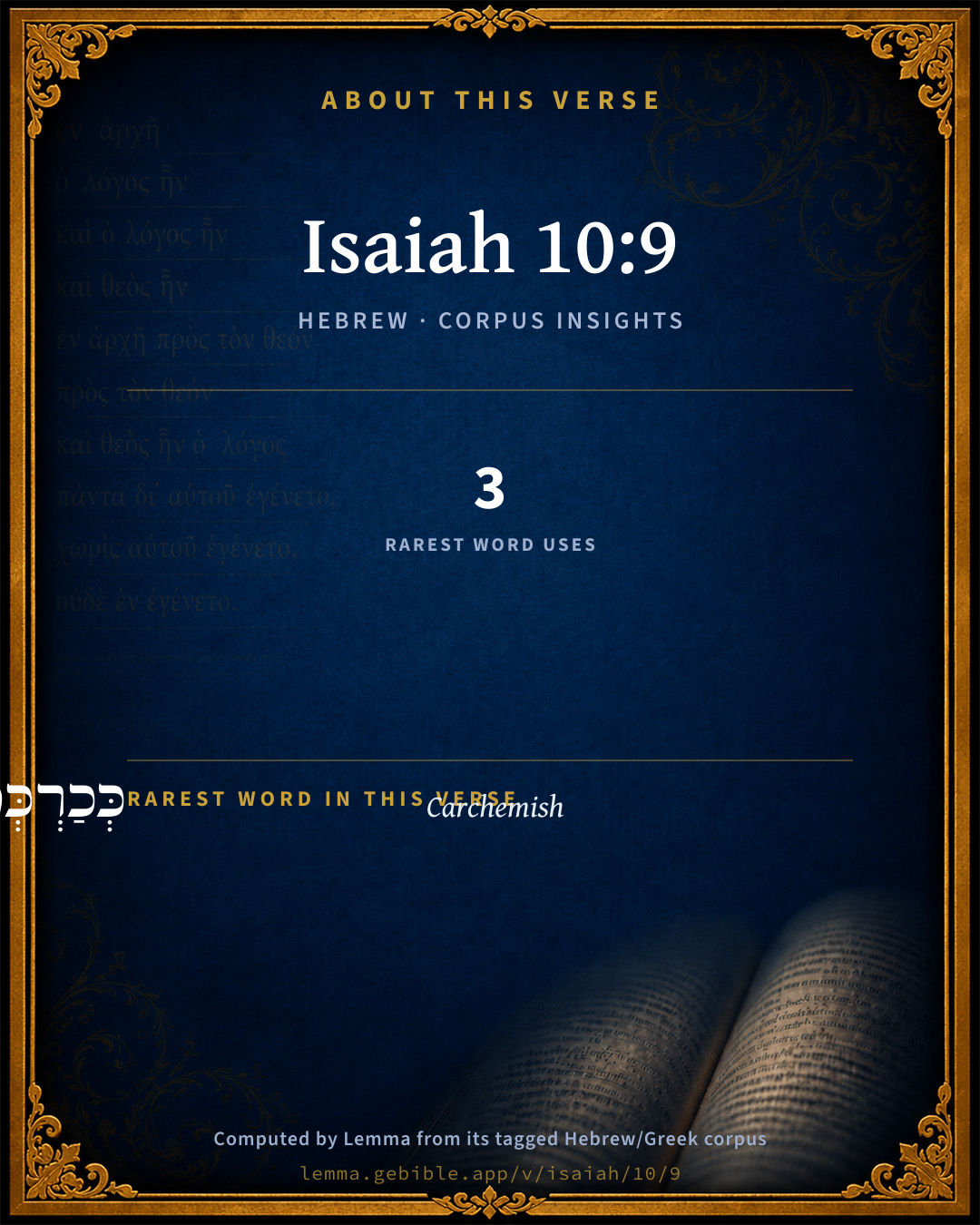
The rarest word here is כְּכַרְכְּמִ֖ישׁ Carchemish H3751 — appearing just 3 times in the whole Hebrew Bible.

Shared distinctive vocabulary

כְּכַרְכְּמִ֖ישׁ Carchemish H3751 occurs in 3 verses of the Hebrew Bible. Also found in:

Grammatical profile

  • 6 nouns
  • 2 conjunctions
  • 3 particles

Repetition

Words recur within this verse — often emphatic in Hebrew:

  • הֲלֹ֥א not H3808 ×3
  • אִם if H518 ×2

Hebrew & Septuagint length

In English translation the verse runs 12 words from the Hebrew and 29 from the Septuagint (LXX English) — the Septuagint runs noticeably longer here. See the side-by-side →

A rough comparison of the two English renderings, which tokenize alike — not a word-level alignment.

Word counts can differ between the Hebrew and the Greek without any difference in meaning — e.g. the Hebrew direct-object marker אֵת has no separate Greek word, and Greek often adds the article ὁ.

Cross-references

14

Topical passages linked to Isaiah 10:9 in the Treasury of Scripture Knowledge — connected by theme and wording, ordered by reader-vote popularity; previews shown in the World English Bible.

  • 2 Kings 16:9 The king of Assyria listened to him; and the king of Assyria went up against Damascus, and took it, and carried [the people of] it captive to Kir, and killed Rezin.
  • 2 Chronicles 35:20 After all this, when Josiah had prepared the temple, Neco king of Egypt went up to fight against Carchemish by the Euphrates: and Josiah went out against him.
  • Genesis 10:10 The beginning of his kingdom was Babel, Erech, Accad, and Calneh, in the land of Shinar.
  • Jeremiah 46:2 Of Egypt: concerning the army of Pharaoh Necoh king of Egypt, which was by the river Euphrates in Carchemish, which Nebuchadrezzar king of Babylon struck in the fourth year of Jehoiakim the son of Josiah, king of Judah.
  • 2 Samuel 8:9 When Toi king of Hamath heard that David had struck all the host of Hadadezer,
  • 2 Kings 17:5–6 Then the king of Assyria came up throughout all the land, and went up to Samaria, and besieged it three years.
  • 2 Kings 17:24 The king of Assyria brought men from Babylon, and from Cuthah, and from Avva, and from Hamath and Sepharvaim, and placed them in the cities of Samaria instead of the children of Israel; and they possessed Samaria, and lived in the cities of it.
  • 2 Kings 18:9–10 It happened in the fourth year of king Hezekiah, which was the seventh year of Hoshea son of Elah king of Israel, that Shalmaneser king of Assyria came up against Samaria, and besieged it.
  • Isaiah 7:8 For the head of Syria is Damascus, and the head of Damascus is Rezin; and within sixty-five years Ephraim shall be broken in pieces, so that it shall not be a people;
  • Isaiah 17:3 The fortress shall cease from Ephraim, and the kingdom from Damascus, and the remnant of Syria; they shall be as the glory of the children of Israel, says Yahweh of Hosts.
  • Isaiah 36:19 Where are the gods of Hamath and Arpad? where are the gods of Sepharvaim? and have they delivered Samaria out of my hand?
  • Isaiah 37:13 Where is the king of Hamath, and the king of Arpad, and the king of the city of Sepharvaim, of Hena, and Ivvah?
  • Jeremiah 49:23 Of Damascus. Hamath is confounded, and Arpad; for they have heard evil news, they are melted away: there is sorrow on the sea; it can't be quiet.
  • Amos 6:1–2 Woe to those who are at ease in Zion, And to those who are secure on the mountain of Samaria, The notable men of the chief of the nations, To whom the house of Israel come!

Cross-references courtesy of OpenBible.info (CC BY 4.0).

Hebrew and Greek witnesses Masoretic Hebrew ↔ Greek Septuagint

The same verse in the two great witnesses to the Old Testament, shown verse-for-verse.

Here the Septuagint runs noticeably longer than the Hebrew — LXX2012 (modern English Septuagint) 29 words vs World English Bible 12. A rough length comparison of the two English translations, not a word-level alignment — read both below.

These are two independent witnesses, not word-aligned to each other, and the Septuagint is shown in lemma (dictionary) form.

Hebrew Isaiah 10:9 Masoretic · Westminster Leningrad Codex

הֲלֹ֥א כְּכַרְכְּמִ֖ישׁ כַּלְנ֑וֹ אִם לֹ֤א כְאַרְפַּד֙ חֲמָ֔ת אִם לֹ֥א כְדַמֶּ֖שֶׂק שֹׁמְרֽוֹן

Isn't Calno as Carchemish? Isn't Hamath as Arpad? Isn't Samaria as Damascus?

World English Bible · Public Domain

Greek LXX Isaiah 10:9 Septuagint · lemma form

καί εἶπον οὐ λαμβάνω ὁ χώρα ὁ ἐπάνω βαβυλών καί χαλαννη οὗ ὁ πύργος οἰκοδομέω καί λαμβάνω ἀραβία καί δαμασκός καί σαμαρεία

then shall he say, Have I not taken the country above Babylon and Chalanes, where the tower was built? and have I not taken Arabia, and Damascus, and Samaria?

LXX2012 (modern English Septuagint) · Public Domain

On this verse, Ellicott's Commentary for English Readers discusses the Septuagint’s reading. Read the note in Commentary ↓

Hebrew: Westminster Leningrad Codex (CC BY 4.0). Greek: Septuagint (public domain); English from LXX2012 (modern English Septuagint) (Public Domain). How the Septuagint differs from the Hebrew →

Targum (Aramaic paraphrase)

1

The Targum is the ancient Jewish Aramaic paraphrase of the Hebrew Scriptures — an interpretive translation, not the Hebrew text itself. Onkelos (literal) and Pseudo-Jonathan (expansive) render the Torah, and Jonathan the Prophets. Coverage is partial: where no permissively-licensed English translation exists for a verse, only the Aramaic is shown. This is verse-level text, not a word-by-word alignment to the Hebrew.

  1. Targum Jonathan Prophets (Joshua–Malachi)
    הֲלָא כְּמָא דְכַרְכְּמִישׁ כְּבִישָׁא קֳדָמַי כֵּן כַּלְנוֹ אִם לָא כְּמָא דְאַרְפַּד מְסִירָא בִידִי כֵּן חֲמָת וּכְמָא דַעֲבָדִית לְדַמֶשֶׂק כֵּן אַעְבֵּיד לְשֹׁמְרוֹן:

    Is it not so? As Carchemish is subdued before me, shall not Calno be so? Surely, as Arphad is delivered into my hands, shall not Hamath be so? As I have done to Damascus, so will I do to Samaria.

    Targum Jonathan — Aramaic: “Mikraot Gedolot” (public domain). English: “Sefaria Community Translation” (CC0 1.0 (public-domain dedication)); “London "Chaldee Paraphrase," 1871” (public domain). Text via Sefaria.

Commentary

Notes on Isaiah 10:9 from classic Christian and Jewish commentators (each source and its license shown beneath its notes). The classic Christian expositions comment on the surrounding passage and are grouped to its opening verse, so a note may address several verses; the Jewish commentaries on the Tanakh (Rashi and others) are per-verse, so they appear only where the commentator wrote on this verse.

Lemma curates 59 commentaries, every one of them public domain or Creative Commons licensed, each selected and text-cleaned for this edition rather than reprinted as found. About our sources →

Trapp's Complete Commentary

John Trapp

Isa 10:9 [Is] not Calno as Carchemish? [is] not Hamath as Arpad? [is] not Samaria as Damascus?

Ver. 9. Is not Calno as Carchemish?] Here in a vaunt he reckoneth up six royal cities vanquished by himself and his ancestors; and boasteth how with a wet finger, as we say, he had taken in all the country between Nineveh and Jerusalem. Of the destruction of Calno and Hamath, see Amo 6:2.

Is not Hamath.] Afterwards called Antiochia.

As Arpad?] Hear how this proud braggard:

“ Proiecit ampullas et sesquipedalia verba! ”

Is not Samaria as Damascus?] Have not I subdued them both pari fortitudine et felicitate?

John Trapp, A Commentary or Exposition upon All the Books of the Old and New Testament (1647–1656) — public domain. Text from a community e-Sword module.

Tyndale Open Study Notes

Tyndale Open Resources

10:9 We destroyed: By 717 BC, the regions to the north of Judah were firmly in Assyrian hands. Calno, in northern Syria (referred to as Calneh in Amos 6:2), fell to the Assyrian king Tiglath-pileser III in 738 BC. Carchemish, on the Euphrates River, was taken by King Sargon II in 717 BC. Hamath, on the Orontes River, was subjugated in 738 and 720 BC. Arpad was located south of Calno. Damascus and Samaria, the capitals of Syria and Israel, were taken in 732 and 722 BC, respectively (Isa 7:8; 8:4).

Tyndale Open Study Notes — © Tyndale Open Resources, licensed CC BY-SA 4.0. Text via the HelloAO Bible API.

Geneva Bible (1599)

Geneva Bible translators

Seeing that I have overcome as well one city as another, so that none could resist, shall Jerusalem be able to escape mine hands?

Geneva Bible (1599) marginal notes — public domain. Text via Bolls.life.

Jamieson, Fausset & Brown

Robert Jamieson, A. R. Fausset & David Brown

Is not . . . as--Was there any one of these cities able to withstand me? Not one. So Rab-shakeh vaunts (Isa 36:19).

Calno--Calneh, built by Nimrod (Gen 10:10), once his capital, on the Tigris.

Carchemish--Circesium, on the Euphrates. Taken afterwards by Necho, king of Egypt; and retaken by Nebuchadnezzar: by the Euphrates (Jer 46:2).

Hamath--in Syria, north of Canaan (Gen 10:18). Taken by Assyria about 753 B.C. From it colonists were planted by Assyria in Samaria.

Arpad--near Hamath.

Samaria--now overthrown.

Damascus-- (Isa 17:1, Isa 17:3).

Jamieson, Fausset & Brown — Commentary Critical and Explanatory on the Whole Bible (1871) — public domain (CC PDM 1.0). Text via the HelloAO Bible API.

Ellicott's Commentary for English Readers

(9) Is not Calno as Carchemish?—The six names obviously pointed to more recent conquests in which Sargon and his predecessors had exulted. One after another they had fallen. Could Judah hope to escape? (1) Calno, the Calneh of Gen_10:10, Amo_6:2. That prophet had held up its fate in vain as a warning to Samaria. It has been identified by Kay with Ctesiphon on the east bank of the Tigris, by Lenormant (Manual, i. 80) with Ur of the Chaldees and with the ruins known now as the Mugheir, by Rawlinson (Five Great Monarchies, i. 20) with Nipur. The Assyrian form, Kil-Anu, means the “house” or “temple” of Anu, an Assyrian deity). Sennacherib (Lenormant i. 398), speaks of having reconquered it after a Chaldean revolt, and sold its inhabitants as slaves. The LXX. version, which instead of naming Carchemish, gives “Calanè, where the tower was built,” seems to imply a tradition identifying that city with the Tower of Babel of Gen_11:4. (2) Carchemish. Few cities of the ancient world occupied a more prominent position than this. Its name has been explained as meaning the Tower of Chemosh, and so bears witness to the widespread cultus of the deity whom we meet with in Biblical history as the “abomination of the Moabites” (1Ki_11:7). It has been commonly identified with the Circesium of Greek historians, but the inscriptions found by Mr. George Smith at Tarabolos (the Hierapolis of the Greeks) on the banks of the Euphrates, at its junction with the Kyabur, prove that this is the true representative of the great commercial city of the old Hittite kings (Times, Aug. 23, 1876). Its importance is shown by the frequent occurrence of the name, in its Egyptian form of Karakumusha, in the record of Egyptian kings. Thothmes I. (circa B.C. 1600) conquered it, and, as a result of his campaign, strengthened the forces of Egypt with the chariots and horses for which it was afterwards conspicuous (Lenormant, Manual, 1 p. 229). Thothmes III. built a fortress there to guard the passage of the Euphrates (ibid. 1 p. 232), the ruins of which, with Egyptian inscriptions and works of Egyptian manufacture, have recently been found there (ibid. 1 p.,263). It revolted against Ramses II. (the Sesostris of the Greeks), with the Hittites and Phœnicians, and other nations, but was subdued by him in the expedition in which the victorious issue is recorded on the monument on the Nahr-el-Kelb near Beyrût. Shalmaneser IV. (contemporary with Ahab) records that he demolished and burnt it (ibid. 1 p. 380). Tiglath-pileser II., the king to whom Ahaz paid tribute, received tribute from its king in B.C. 742 (ibid. 1 p. 389). The last two victories are probably referred to in the boast now before us. At a later period it was conspicuous for the great defeat of Pharaoh Necho’s army by Nebuchadnezzar (see notes on Jer_46:2). Its commercial importance is indicated by the fact that the “mana (Heb., manah) of Carchemish” appears in numerous cuneiform inscriptions as the standard weight of the time, just as that of Troyes, in the commerce of the Middle Ages, is shown by the survival of the name in the “Troy weight” of our arithmetic books (Records of the Past, vii. 114).

Is not Hamath as Arpad?—(1) Hamath on the Orontes, the capital of an Aramæan kingdom, was prominent in the history of the East. Under its kings Toi and Joram it paid tribute to David (2Sa_8:9-10). It fell under the power of Jeroboam II. of Israel (2Ki_14:25). In conjunction with Damascus it revolted against Shalmaneser IV., and was subdued by him (Lenormant’s Manual, 1 p. 380). Its king was first among the tributary princes under Tiglath-pileser II. after having joined with Pekah and Rezin in their revolt (ibid. 1 p. 389). Lastly, to come to the date of the present prophecy, it again revolted, in conjunction, as before, with Damascus and Samaria, and was again subdued by Sargon (ibid. 1 p. 393). (2) Of the early history of Arpad we know less, but it appears as having sustained a three years’ siege from the forces of Tiglath-pileser II. It joined Hamath in its revolt against Sargon, and was again, as this verse implies, subdued by him. It is always united in the Old Testament with Hamath (Isa_36:19; Isa_37:13). Under the name of Erfad it is still traceable about nine miles from Aleppo (Lenormant, 1 pp. 389, 393).

Is not Samaria as Damascus?—These cities, which under Rezin and Remaliah had, as we have seen (Isaiah 7) revolted against Tiglath-pileser, and the latter of which had sought to strengthen itself by an alliance with the Egyptian king So, or Sabaco (2Ki_17:4), of the Ethiopian dynasty, against Shalmaneser IV., close for the present the list of Sargon’s conquests.

A Bible Commentary for English Readers, edited by Charles John Ellicott (1878–1897) — public domain. Text from a community e-Sword module.

The Cambridge Bible for Schools and Colleges

gen. ed. J. J. S. Perowne

9. The six cities are enumerated in geographical order from north to south, the first of each pair being, however, nearer to Jerusalem than the second. (1) The site of Carchemish (Ass. Gargamîsh) was identified by Mr G. Smith with the ruins of Jerabîs on the right bank of the Euphrates. As a great centre of the Hittite confederacy it had been frequently subdued by Assyrian kings, and was ultimately incorporated in the Empire by Sargon in 717. (2) Calno is probably Kullani, a city near Arpad, captured by Tiglath-pileser III. about 738. It is probably identical with the Calneh mentioned in Amo_6:2; but quite distinct from the Babylonian Calnçh of Gen_10:10. (3) Arpad (now Tell Erfâd, about 15 miles north of Aleppo) was taken about 740 by Tiglath-pileser. (4) Hamath (Hamah, on the Orontes, about half way between Carchemish and Damascus) was taken by Tiglath-pileser in 738 and again by Sargon in 720. (5) Damascus fell about 732 and (6) Samaria in 722.

The Cambridge Bible for Schools and Colleges (gen. ed. J. J. S. Perowne; Cambridge University Press, 1878–1918) — public domain. Text from a community e-Sword module.

John Gill's Exposition

As my hand hath found the kingdoms of the idols,.... Which worship idols, as the Targum paraphrases it. He speaks of them as being very easily taken by him; he had no trouble in subduing them; no sooner did he come up to them, and looked on them, and saw where they were, but they fell into his hands; they gave up themselves to him at once, and he took possession of them.

And whose graven images did excel them of Jerusalem and of Samaria; being made of better metal, or more richly ornamented, or worshipped in a more pompous manner; or were "more" than they of Jerusalem and Samaria, exceeded them in number; or were "stronger" and mightier than they, as Kimchi supplies it, and yet could not protect them; or were "from Jerusalem, and from Samaria"; the wicked men of Israel, Jarchi says, supplied all the nations with images, they all sprung from them; and if the idols which came from hence could not secure the nations of the earth from falling into the hands of the Assyrian monarch, neither could they preserve Jerusalem and Samaria from being taken by him.

John Gill's Exposition of the Whole Bible (1746–1763) — public domain (CC PDM 1.0). Text via the HelloAO Bible API.

Albert Barnes' Notes on the Bible

Is not Calno as Carchemish? - The meaning of this confident boasting is, that none of the cities and nations against which be had directed his arms, had been able to resist him. All had fallen before him; and all were alike prostrate at his feet. Carchemish had been unable to resist him, and Calno had shared the same fate. Arpad had fallen before him, and Hamath in like manner had been subdued. The words which are used here are the same nearly that Rabshakeh used when he was sent by Sennacherib to insult Hezekiah and the Jews; Isa 36:19; 2Ki 18:34. “Calno” was a city in the land of Shinar, and was probably the city built by Nimrod, called in Gen 10:10, “Calneh,” and at one time the capital of his empire. It is mentioned by Ezekiel, Eze 27:23. According to the Targums, Jerome, Eusebius, and others, Calno or Calneh, was the same city as “Ctesiphon,” a large city on the bank of the Tigris, and opposite to Selcucia. - “Gesenius” and “Calmet.”

Carchemish - This was a city on the Euphrates, belonging to Assyria. It was taken by Necho, king of Egypt, and re-taken by Nebuchadnezzar in the fourth year of Jehoiachin, king of Judah; 2Ki 23:29. Probably it is the same city as Cercusium, or Kirkisia, which is situated in the angle formed by the junction of the Chebar and the Euphrates; compare Jer 46:2; 2Ch 25:20.

Hamath - This was a celebrated city of Syria. It is referred to in Gen 10:18, as the seat of one of the tribes of Canaan. It is often mentioned as the northern limit of Canaan. in its widest extent; Num 13:21; Jos 13:5; Jdg 3:3. The Assyrians became masters of this city about 753 years before Christ; 2Ki 17:24. Burckhardt mentions this city as situated on both sides of the river Orontes. The town is at present of considerable extent, and contains about 30,000 inhabitants. There are four bridges over the Orontes, in the town. The trade of the town now is with the Arabs, who buy here their tent-furniture, and their clothes. This city was visited by Eli Smith, in 1834. It lies, says he, on the narrow valley of the ‘Asy; and is so nearly concealed by the high banks, that one sees little of it until he actually comes up to the gates: “see” Robinson’s “Bib. Researches,” vol. iii. App. pp. 176, 177.

Arpad - This city was not far from Hamath, and is called by the Greeks Epiphania; 2Ki 18:34.

Samaria - The capital of Israel, or Ephraim. From the mention of this place, it is evident that this prophecy was written after Samaria had been destroyed; see the notes at Isa 7:9; Isa 28:1.

As Damascus - The capital of Syria; see the note at Isa 7:9, and the Analysis of Isa 17:1-14. The Septuagint has varied in their translation here considerably from the Hebrew. They render these verses, ‘And he saith, Have I not taken the region beyond Babylon, and Chalane, where the tower was built? and I have taken Arabia, and Damascus, and Samaria.’ The main idea, however - the boast of the king of Assyria, is retained.

Albert Barnes' Notes on the Bible (1834–1885) — public domain. Text from a community e-Sword/MySword module.

Haydock's Catholic Bible Commentary

As. Literally, "altogether kings." (Haydock) --- Thus Nabuchodonosor kept the conquered princes for derision, Habacuc i. 10., and Judges i. 7. --- Arphad, Arad, or rather Raphanæ, Jeremias xlix. 23. --- Damascus. These two cities were not yet subdued.

George Leo Haydock (1774–1849), Haydock's Catholic Family Bible and Commentary, 1859 edition — public domain. Excludes Psalms (Douay-Rheims chapter numbering differs from Protestant) and Deuterocanonical books (Catholic canon only).

Matthew Poole's English Annotations

Is not Calno as Carchemish? have not I conquered one place as well as another, the stronger as well as the weaker? Have I not from time to time added new conquests to the old? Calno seems to be the same with Calneh, Gen 10:10; Amo 6:2, a great and strong city. Carchemish was a city upon Euphrates, of which 2Ch 35:20; Jer 46:2.

Is not Hamath as Arpad? Hamath was an eminent city of Syria, not far from Euphrates, called Hemath, or Hamath the great, Amo 6:2; of which see 2Ki 14:28; 17:24; Jer 49:23. Arpad seems to have been an obscure place, not being elsewhere named. Is not that as soon conquered as this?

Is not Samaria as Damascus? or, shall not Samaria be as Damascus? Shall I not take that as I have done this city? For although Damascus possibly was not yet taken by the Assyrian, yet the prophet speaks of it as actually taken, because these words are prophetically delivered, and supposed to be uttered by the king of Assyria at or about the siege of Samaria, when Damascus was taken.

Matthew Poole's English Annotations on the Holy Bible (1683–1685) — public domain. Text from a community e-Sword/MySword module.

Whedon's Commentary on the Bible

Daniel D. Whedon

9. Is not Calno as Carchemish — Rawlinson puts Calno, or Calneh, sixty miles southeast by east from Babylon. Carchemish, he thinks, is not the classical Circesium, but lay higher up the Euphrates.

Hamath… Arpad — Both were in Syria; the former is the present Hamah on the Orontes; the latter is not now identified, but it lay probably near Hamath. See Smith’s Dictionary of the Bible.

Samaria as Damascus — Both capitals, one of Israel, the other of Syria. The latter was the first to be taken, hence the comparison. All these were easy to take by such an overgrown power. The very question, “Is not Samaria as Damascus?” (that is, is it not as easy to take?) implies the former as yet untaken; hence the time is yet within the reign of Ahaz.

Daniel D. Whedon (gen. ed.), Commentary on the Old and New Testaments (1874–1909) — public domain. Text from a community e-Sword module.

The Pulpit Commentary

Is not Calno as Carehemish? A further proof of superiority, and ground of confidence, lay in the further fact, that the strongest cities had, one and all, succumbed to the Assyrian arms, and been laid in ruins to punish them for offering resistance. Six such cities are mentioned Calneh, probably Niffer, in Lower Mesopotamia; Carchemish, on the right bank of the Euphrates in Lat. 36 30" nearly; Hamath, the "great Hamath" of Amos, (Amo_6:2) in Coelesyria on the routes; Arpad, perhaps Tel-Erfad, near Aleppo; Damascus, and Samaria. Calneh was one of the cities of Nimrod, (Gen_10:10) and, according to the LXX, was "the place where the tower was built." It may have been taken by Tiglath-Pileser in one of his expeditious into Babylonia. Amos (Amo_6:2) speaks of it as desolate in his day. Carchemish (Assyrian Gargamis) was a chief city of the Hittites, and has been called "their northern capital." Long confounded by geographers with Circesium at the junction of the Khabour with the Euphrates, it has recently been proved to have occupied a far more northern position, and is now generally identified with the ruins discovered by Mr. George Smith at Jerabis or Jerabhs. It was conquered by Sargon in B.C. 717, when "its people were led captive, and scattered over theAssyrian empire, while Assyrian colonists were brought to people the city in their place; Carchemish being formally annexed to Assyria, and placed under an Assyrian governor" (G. Smith, "Assyria," p. 97). Hamath was originally a Canaanite city. (Gen_10:18) By the time of David it had become the scat of an independent monarchy, (2Sa_8:9, 2Sa_8:10) and so continued until its reduction by the Assyrians. We find it leagued with the Hittites, the Syrians of Damascus, and the Israelites against Assyria about B.C. 850 ("Ancient Monarchies," vol. 2. pp. 361-363). About B.C. 720 it was taken by Sargon, who beheaded its king, and probably reduced it to ruins. (ibid., p. 411; comp. Amo_6:2) The name remains in the modern Hamah, where many curious inscriptions have been recently dug up. Arpad was attacked by Tiglath-Pileser in the early part of his reign, and reduced to subjection. It revolted in conjunction with Hamath from Sargon, and was severely punished ("Ancient Monarchies," l.s.c.). Is not Samaria as Damascus? This mention of Samaria among the subjugated and ruined cities may undoubtedly be prophetic; but the connection with Carchemish, Hamath, and Arpad all of them towns reduced by Sargon within the years B.C. 720-717 points rather to the verse being historical, and would seem to indicate that the date of the entire prophecy vers. 519 is subsequent to the capture of the cities, and so not earlier than B.C. 716.

The Pulpit Commentary (1880–1919), ed. H.D.M. Spence-Jones & Joseph S. Exell — public domain. Text from a community e-Sword module.

John Wesley's Explanatory Notes

Is not - Have not I conquered one place as well as another, the stronger as well as the weaker? Samaria - Or, shall not Samaria be as Damascus? Shall I not take that, as I have done this city?

John Wesley, Explanatory Notes Upon the Whole Bible (1754–1765) — public domain. Text via the GEBible commentary corpus.

J. A. Alexander on Isaiah

Joseph Addison Alexander

Having boasted of his princes, he now boasts of his achievements. “Is not Calno like Carchemish? Have they not been equally subdued by me? Or (is) not Hamath like Arpad? Or (is) not Samaria like Damascus?” Similar boastings were uttered by Rabshakeh (Isa 36:19-20; Isa 37:12-13). These conquests were the more remarkable because so speedily achieved, and because the Assyrians had before confined themselves within their own limits. All the towns named were further north than Jerusalem, and probably commanded the navigation of the two great rivers, Tigris and Euphrates. Carchemish was a fortified town on an island in the Euphrates, at the mouth of the Chaboras (River), called in Latin Cercusium. It had its own king (Isa 37:13) and its own gods (Isa 36:19) and was taken by Tiglath-pileser (2Ki 15:29). Calno was the Ctesiphon of the Greeks, on the east bank of the Tigris, opposite Seleucia. Hamath was a city of Syria, on the Orontes (River), the mouth of which river, according to Keith (Land of Israel, Isaiah 2 -Isaiah 3), is the entering into Hamath, sometimes mentioned as the northern boundary of Canaan in its widest extent (Num 34:8; Jos 13:5). It was also called by the Greeks Epiphania. Abulfeda, the Arabian historian, reigned there about the beginning of the fourteenth century. It is now one of the largest towns in Asiatic Turkey, having about 100,000 inhabitants. Arpad, another town of Syria, was near Hamath, with which it is several times named. It is mentioned last in Jer 49:23, and is probably no longer in existence.

Joseph Addison Alexander, The Prophecies of Isaiah (1846–1847; New York: Scribner, 1870–1878) — public domain. Text from a community e-Sword module.

Rashi

Rabbi Shlomo Yitzchaki (Rashi)

Is not Calno like Carchemish Just as the inhabitants of Carchemish are princes and governors, so are the inhabitants of Calno. Therefore, if not like Arpad, which is under the rule of Hamath, which I took from Aram, and if not like Damascus, that I took from Aram, so will I do to Samaria. “If not like Arpad of Hamath,” is the construct state, like Arpad of Hamath. Therefore, it is voweled with a ‘pattach’ [i.e., it reads אַרְפַּד rather than אַרְפָּד].

Rashi on the Tanakh — English translations: “The Judaica Press complete Tanach with Rashi, translated by A. J. Rosenberg” (CC BY 4.0); “Pentateuch with Rashi's commentary by M. Rosenbaum and A.M. Silbermann, 1929-1934” (public domain); “The Metsudah Tanach series, Lakewood, N.J” (CC BY 4.0); and “The Book of Joshua, Metsudah Publications, 1997” (CC BY 4.0). Text via Sefaria.

Ibn Ezra

Rabbi Abraham ibn Ezra

כלנו Kalno כלנה ═ Kalneh (Gen. 10:10); for the names mentioned there (Gen. x.) are names of places called after their founders, like מצרים Egypt.

Ibn Ezra on the Tanakh — English translations: “Sefaria Community Translation” (CC0 1.0 (public-domain dedication)); “Yalkut, Sifsei Chachomim Chumash, Metsudah Publications, 2009” (CC BY 4.0); and “Commentary of Ibn Ezra on Isaiah - trans. by M. Friedlander, 1873” (public domain). Text via Sefaria.

Lesson kit

Teaching starters — assembled from the data on this page, not authored interpretation. Every prompt links to the verse data it draws on. Edit before teaching.

Isaiah, in the Prophets, opens this verse with 11 words (8 distinct Hebrew lemmas). Its most distinctive word is Karkᵉmîysh (“Carchemish”). The Greek Septuagint runs longer here. A historical commentator’s framing appears above. Read the whole chapter for the surrounding context.

Discussion questions

  1. What does “Carchemish” (Karkᵉmîysh) contribute to the verse as a whole?
  2. How does 2 Chronicles 35:20, which shares the word «Carchemish», read alongside this verse?
  3. What does the repetition of “not” (3× in this one verse) do in this verse?
  4. The Septuagint runs longer here than the Hebrew. What might account for the difference?
  5. These translations render this verse differently. What is at stake in choosing one wording over another?
  6. Compare how Trapp's Complete Commentary and Tyndale Open Study Notes read this verse. Where do they agree or differ?

Things to notice

Reading settings

Reading text

Shown beneath each verse's original-language words.

Old Testament
Old Testament edition

Read the OT as the Masoretic Hebrew (MT) or the Greek Septuagint (LXX).

English shown for the Greek Septuagint (in the Hebrew ↔ Greek comparison).

Comparing translations? Open the Compare panel on any verse page to stack up to four side by side.