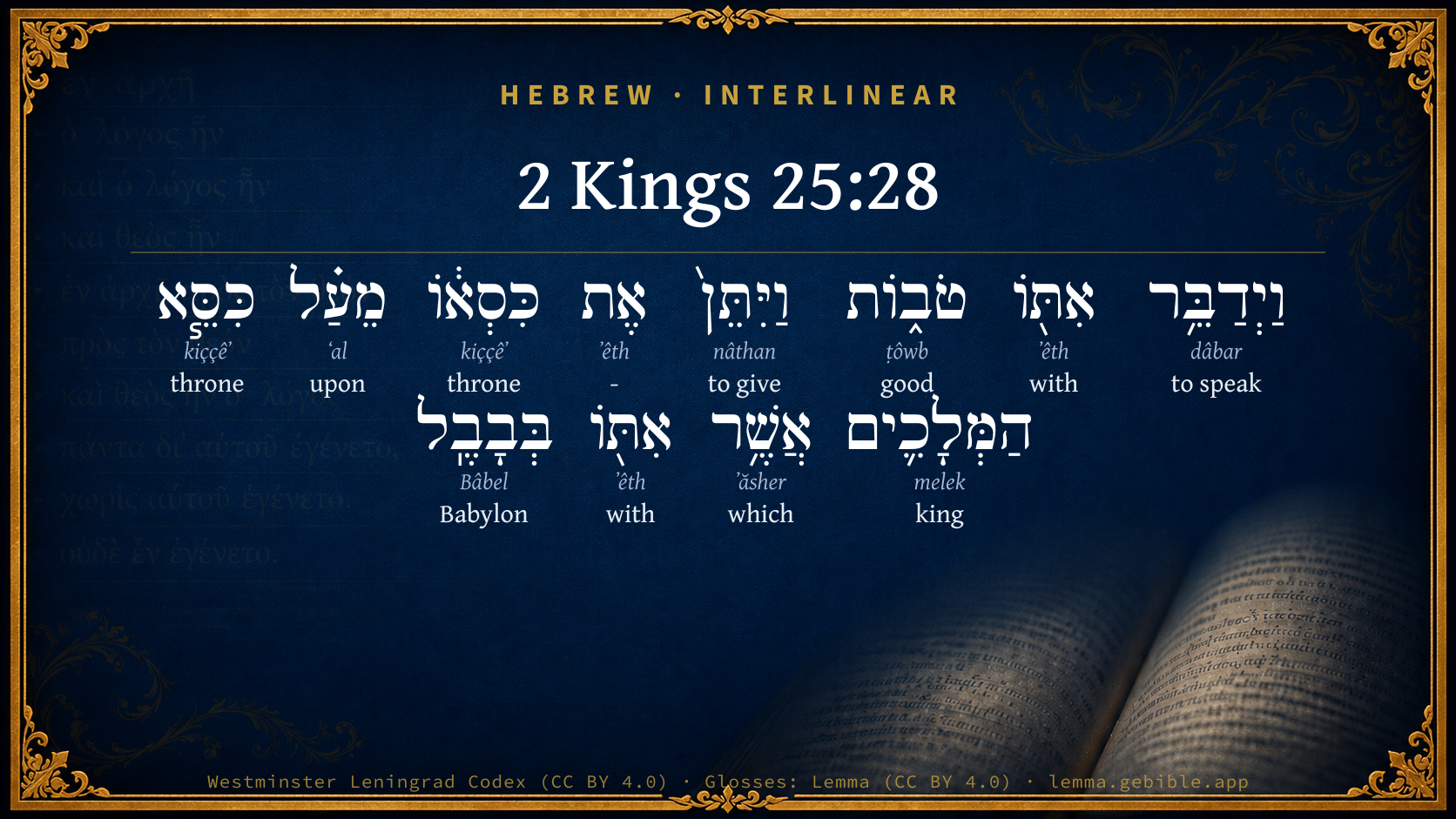
2 Kings 25:28

Hebrew (Westminster Leningrad Codex) 2 Kings 25:28 appears in the Hebrew Old Testament. The text above is from the Westminster Leningrad Codex. Each word links to its Strong’s number, a concise gloss, and parsing drawn from the Open Scriptures Hebrew Bible morphology. Click any word for its full Brown-Driver-Briggs (BDB) entry.
Download image
Cite this verse

2 Kings 25:28 (World English Bible). Public Domain. Lemma interlinear Bible study tool, https://lemma.gebible.app/v/2-kings/25/28.

Show BibTeX & RIS
BibTeX
RIS
English Translation
and he spoke kindly to him, and set his throne above the throne of the kings who were with him in Babylon,
World English Bible · Public Domain
Download a study sheet

One document with this verse’s original text, its word-by-word gloss line, the meaning frame, cross-references with their text, attributed commentary, and full source and license credits — printable, and it pastes into notes with its structure intact.

This verse Autodidact and up

Study sheet (.html) Plain text (.txt)

A passage Seminary Student

Up to 50 verses in one chapter. A passage sheet keeps up to 6 commentary sources and 12 cross-references per verse, in the order this page ranks them, and says so on the sheet whenever that leaves anything out. Ask for a single verse and you get the Autodidact verse sheet above.

Everything on this page stays free to read, with no account — the sheet is a download of what is already on screen, not access to it.

Want to remove ads? Support Godless Engineer
Compare translations 3

The same verse in 3 English versions, stacked beneath the original-language interlinear above. Click any original word for its lexicon entry.

Each is an independent rendering of the whole verse — the interlinear is not word-aligned to these translations.

Highlighted words mark where these versions differ — a whole-verse word diff, not a word-by-word alignment.

  • World English Bible Public Domain
    and he spoke kindly to him, and set his throne above the throne of the kings who were with him in Babylon,
  • King James Version Public Domain
    And he spake kindly to him, and set his throne above the throne of the kings that were with him in Babylon;
  • unfoldingWord Literal Text CC BY-SA 4.0
    And he spoke good to him, and he put his seat above the seat of the kings who with him in Babylon.

unfoldingWord Literal Text — © unfoldingWord, licensed CC BY-SA 4.0. Word-aligned USFM3 via Door43 (git.door43.org/unfoldingWord/en_ult).

Versions to compare (up to 4)

3 of 4 selected

Show all 18 translations

Every available English version of this verse, each an independent rendering of the whole verse.

  • World English Bible Public Domain
    and he spoke kindly to him, and set his throne above the throne of the kings who were with him in Babylon,
  • Berean Standard Bible Public Domain
    And he spoke kindly to Jehoiachin and set his throne above the thrones of the other kings who were with him in Babylon.
  • Majority Standard Bible Public Domain
    And he spoke kindly to Jehoiachin and set his throne above the thrones of the other kings who were with him in Babylon.
  • King James Version Public Domain
    And he spake kindly to him, and set his throne above the throne of the kings that were with him in Babylon;
  • American Standard Version (1901) Public Domain
    and he spake kindly to him, and set his throne above the throne of the kings that were with him in Babylon,
  • Revised Version (1885) Public Domain
    and he spake kindly to him, and set his throne above the throne of the kings that were with him in Babylon.
  • Geneva Bible (1599) Public Domain
    And spake kindly to him, and set his throne aboue the throne of the Kings that were with him in Babel,
  • Douay-Rheims (1899) Public Domain
    And he spoke kindly to him: and he set his throne above the throne of the kings that were with him in Babylon.
  • Young's Literal Translation Public Domain
    and speaketh with him good things and putteth his throne above the throne of the kings who `are' with him in Babylon,
  • Literal Standard Version CC BY-SA 4.0
    and speaks good things with him and puts his throne above the throne of the kings who [are] with him in Babylon,
  • Unlocked Literal Bible CC BY-SA 4.0
    He spoke kindly to him and gave him a seat more honorable than that of the other kings who were with him in Babylon.
  • unfoldingWord Literal Text CC BY-SA 4.0
    And he spoke good to him, and he put his seat above the seat of the kings who with him in Babylon.
  • Darby Bible Public Domain
    and he spoke kindly to him, and set his seat above the seat of the kings that were with him in Babylon.
  • World Messianic Bible Public Domain
    and he spoke kindly to him and set his throne above the throne of the kings who were with him in Babylon,
  • Webster's Bible Public Domain
    And he spoke kindly to him, and set his throne above the throne of the kings that were with him in Babylon;
  • Free Bible Version CC BY-SA 4.0
    The king of Babylon treated him well and gave him a position of honor higher than the other kings there with him in Babylon.
  • Bible in Basic English Public Domain
    And said kind words to him, and put his seat higher than the seats of the other kings who were with him in Babylon.
  • JPS Tanakh (1917) Public Domain
    And he spoke kindly to him, and set his throne above the throne of the kings that were with him in Babylon.

Literal Standard Version (2020), Covenant Press — licensed CC BY-SA 4.0. Text via the HelloAO Bible API (eBible.org). Unlocked Literal Bible (unfoldingWord) — licensed CC BY-SA 4.0. Text via the HelloAO Bible API (eBible.org). unfoldingWord Literal Text — © unfoldingWord, licensed CC BY-SA 4.0. Word-aligned USFM3 via Door43 (git.door43.org/unfoldingWord/en_ult). Free Bible Version, Dr. Jonathan Gallagher — licensed CC BY-SA 4.0. Text via the HelloAO Bible API (eBible.org).

Word by word

More ways to search: Search by grammar → Find every occurrence → Compare this word →

Practice this passage: Drill this verse → Learn its vocabulary →

כִּסְא֔וֹ
kiççêʼ
H3678
“throne · his”
Noun, Common, Masculine, Singular, Construct + Suffix, Personal, 3rd Person, Masculine, Singular
Part of Speech
Noun
Type
Common
Gender
Masculine
Number
Singular
State
Construct
Full BDB Definition

Origin: from H3680

TWOT: 1007

seat (of honour), throne, seat, stool - seat (of honour), throne - royal dignity, authority, power (figuratively)
  1. וַיְדַבֵּ֥ר dâbar H1696 “and · to speak” Conjunction + Verb, Piel, Sequential Imperfect, 3rd Person, Masculine, Singular
  2. אִתּ֖וֹ ʼêth H854 “with · him” Preposition + Suffix, Personal, 3rd Person, Masculine, Singular
  3. טֹב֑וֹת ṭôwb H2896 “good” Adjective, Adjective, Feminine, Plural, Absolute
  4. וַיִּתֵּן֙ nâthan H5414 “and · to give” Conjunction + Verb, Qal, Sequential Imperfect, 3rd Person, Masculine, Singular
  5. אֶת ʼêth H853 “-” Particle, Direct Object
  6. מֵעַ֗ל ʻal H5921 “from · upon” Preposition + Preposition
  7. כִּסֵּ֧א kiççêʼ H3678 “throne of” Noun, Common, Masculine, Singular, Construct
  8. הַמְּלָכִ֛ים melek H4428 “the · kings” Particle, Definite Article + Noun, Common, Masculine, Plural, Absolute
  9. אֲשֶׁ֥ר ʼăsher H834 “which” Particle, Relative
  10. אִתּ֖וֹ ʼêth H854 “with · him” Preposition + Suffix, Personal, 3rd Person, Masculine, Singular
  11. בְּבָבֶֽל Bâbel H894 “in/at · Babylon” Preposition + Noun, Proper

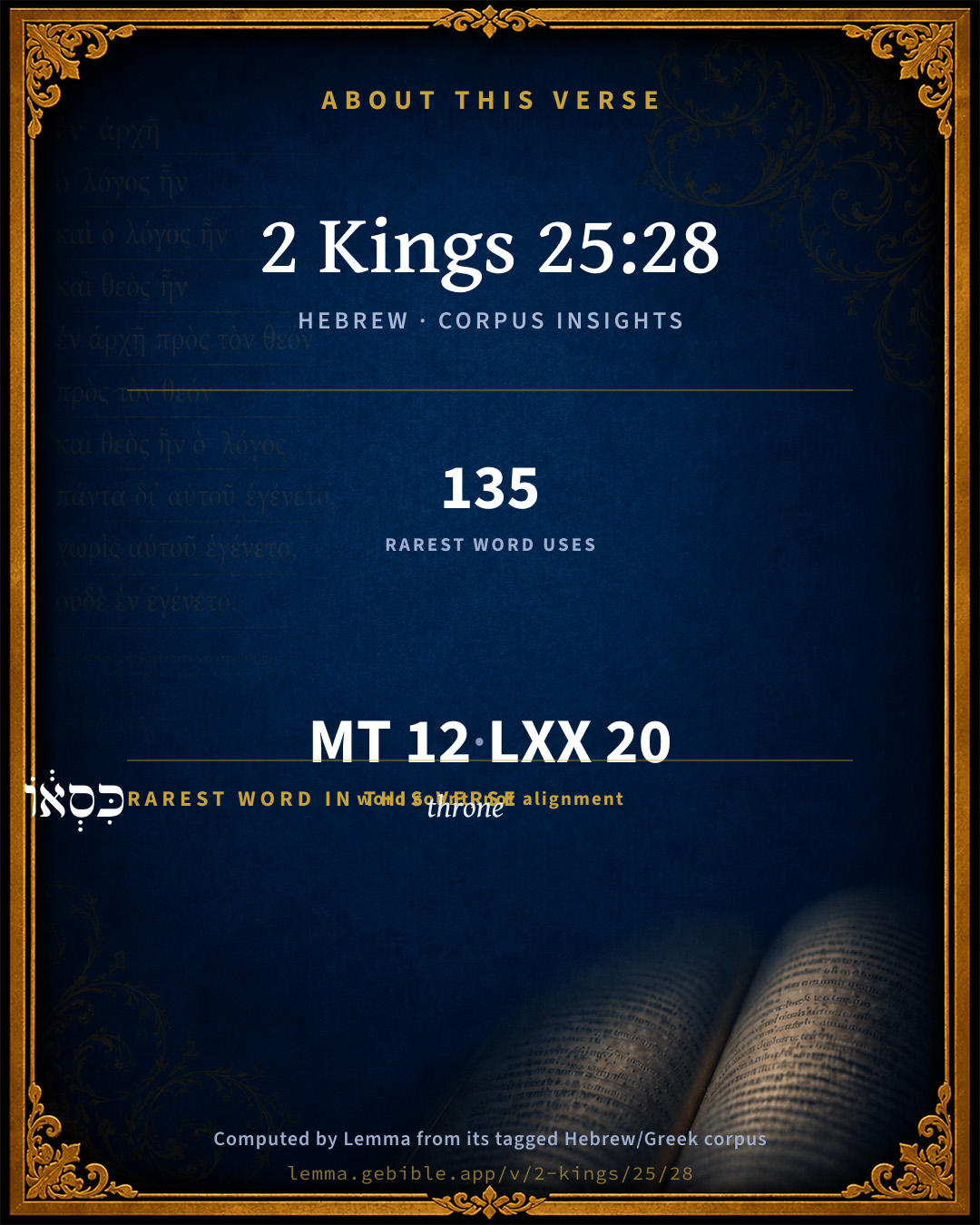
About this verse

These counts appear in no published source. They are computed here, from the morphology-tagged text and Lemma’s own curated glosses. What Lemma adds →

12
words
10
distinct lemmas
Historical
section

Grammatical profile

  • 2 verbs
  • 4 nouns
  • 1 adjective
  • 3 prepositions
  • 2 particles

Verb forms

  • וַיְדַבֵּ֥ר Piel · Sequential Imperfect
  • וַיִּתֵּן֙ Qal · Sequential Imperfect

Repetition

Words recur within this verse — often emphatic in Hebrew:

  • כִּסְא֔וֹ throne H3678 ×2
  • אִתּ֖וֹ with H854 ×2

Hebrew & Septuagint length

In English translation the verse runs 22 words from the Hebrew and 22 from the Septuagint (LXX English) — the same length.

A rough comparison of the two English renderings, which tokenize alike — not a word-level alignment.

Word counts can differ between the Hebrew and the Greek without any difference in meaning — e.g. the Hebrew direct-object marker אֵת has no separate Greek word, and Greek often adds the article ὁ.

In the original languages it is 12 Hebrew tokens and 20 Greek tokens — but the two are counted differently (Hebrew bundles its prefixes and suffixes into one token; the Greek is in lemma form), so that isn’t a like-for-like length.

Cross-references

3

Topical passages linked to 2 Kings 25:28 in the Treasury of Scripture Knowledge — connected by theme and wording, ordered by reader-vote popularity; previews shown in the World English Bible.

  • Jeremiah 27:6–11 Now have I given all these lands into the hand of Nebuchadnezzar the king of Babylon, my servant; and the animals of the field also have I given him to serve him.
  • Daniel 2:37 You, O king, are king of kings, to whom the God of heaven has given the kingdom, the power, and the strength, and the glory;
  • Daniel 5:18–19 You king, the Most High God gave Nebuchadnezzar your father the kingdom, and greatness, and glory, and majesty:

Cross-references courtesy of OpenBible.info (CC BY 4.0).

Hebrew and Greek witnesses Masoretic Hebrew ↔ Greek Septuagint

The same verse in the two great witnesses to the Old Testament, shown verse-for-verse.

These are two independent witnesses, not word-aligned to each other, and the Septuagint is shown in lemma (dictionary) form.

Hebrew 2 Kings 25:28 Masoretic · Westminster Leningrad Codex

וַיְדַבֵּ֥ר אִתּ֖וֹ טֹב֑וֹת וַיִּתֵּן֙ אֶת כִּסְא֔וֹ מֵעַ֗ל כִּסֵּ֧א הַמְּלָכִ֛ים אֲשֶׁ֥ר אִתּ֖וֹ בְּבָבֶֽל

and he spoke kindly to him, and set his throne above the throne of the kings who were with him in Babylon,

World English Bible · Public Domain

Greek LXX 2 Kings 25:28 Septuagint · lemma form

καί λαλέω μετά αὐτός ἀγαθός καί δίδωμι ὁ θρόνος αὐτός ἐπάνωθεν ὁ θρόνος ὁ βασιλεύς ὁ μετά αὐτός ἐν βαβυλών

And he spoke kindly to him, and set his throne above the thrones of the kings that were with him in Babylon;

LXX2012 (modern English Septuagint) · Public Domain

Hebrew: Westminster Leningrad Codex (CC BY 4.0). Greek: Septuagint (public domain); English from LXX2012 (modern English Septuagint) (Public Domain). How the Septuagint differs from the Hebrew →

Targum (Aramaic paraphrase)

1

The Targum is the ancient Jewish Aramaic paraphrase of the Hebrew Scriptures — an interpretive translation, not the Hebrew text itself. Onkelos (literal) and Pseudo-Jonathan (expansive) render the Torah, and Jonathan the Prophets. Coverage is partial: where no permissively-licensed English translation exists for a verse, only the Aramaic is shown. This is verse-level text, not a word-by-word alignment to the Hebrew.

  1. Targum Jonathan Prophets (Joshua–Malachi)
    וּמַלֵיל עִמֵיהּ פִּתְגָמִין תַּקְנִין וִיהַב יַת כּוּרְסֵיהּ עֵיל מִן כּוּרְסֵי מַלְכַיָא דִי עִמֵיהּ בְּבָבֶל:

    (no public-domain English translation for this verse)

    Targum Jonathan — Aramaic: “Mikraot Gedolot” (public domain). English: “Sefaria Community Translation” (CC0 1.0 (public-domain dedication)); “London "Chaldee Paraphrase," 1871” (public domain). Text via Sefaria.

Commentary

Notes on 2 Kings 25:28 from classic Christian and Jewish commentators (each source and its license shown beneath its notes). The classic Christian expositions comment on the surrounding passage and are grouped to its opening verse, so a note may address several verses; the Jewish commentaries on the Tanakh (Rashi and others) are per-verse, so they appear only where the commentator wrote on this verse.

Lemma curates 59 commentaries, every one of them public domain or Creative Commons licensed, each selected and text-cleaned for this edition rather than reprinted as found. About our sources →

Trapp's Complete Commentary

John Trapp

2Ki 25:28 And he spake kindly to him, and set his throne above the throne of the kings that [were] with him in Babylon;

Ver. 28. And he spake kindly to him.] Heb., Good things with him: he both spake and did for him such good things as he little expected; but far better digested than Arthur L. Lisle did King Henry VIII’s courtesy; by whom having been cast into the Tower for suspicion of treason, he was afterwards not only acquitted, but comforted with such good words, besides a rich ring sent unto him off his own finger, that at the hearing thereof, a sudden joy overcharged his heart: and was so immoderately received, that the same night it made an end of his life. {a}

{a} Speed, 896.

John Trapp, A Commentary or Exposition upon All the Books of the Old and New Testament (1647–1656) — public domain. Text from a community e-Sword module.

Ellicott's Commentary for English Readers

(28) Set his throne above the throne of the kings . . .—Gave him precedence of the other captive kings who were kept at the Babylonian court by way of enhancing its glory (comp. Jdg_1:7), and probably marked this precedence by allowing him a higher chair of state in the royal hall. So Cyrus kept Croesus king of Lydia at his court (Herod, i. 88). We may remember also the chivalrous behaviour of our own Black Prince towards his royal captive John of France.

A Bible Commentary for English Readers, edited by Charles John Ellicott (1878–1897) — public domain. Text from a community e-Sword module.

The Cambridge Bible for Schools and Colleges

gen. ed. J. J. S. Perowne

28. and set his throne above the throne, &c.] i.e. He gave him precedence, perhaps by causing him to sit at the table in a place nearer to himself, and also by manifesting special regard for him. That other kings were in the same condition as Jehoiachin, and had been brought to Babylon because they were troublesome in their own countries, we can see from this verse. Some however were imprisoned, as Jehoiachin had been, while others were at liberty but confined to Babylon and the court.

The Cambridge Bible for Schools and Colleges (gen. ed. J. J. S. Perowne; Cambridge University Press, 1878–1918) — public domain. Text from a community e-Sword module.

Albert Barnes' Notes on the Bible

The kings that were with him - Probably captive kings, like Jehoiachin himself. Compare Jdg 1:7.

Albert Barnes' Notes on the Bible (1834–1885) — public domain. Text from a community e-Sword/MySword module.

Haydock's Catholic Bible Commentary

Kings, who had been made captives. Adonibezec had 70, Judges i. 7. Alexander kept Porus and Taxilus at his court, as Cyrus and done Crœsus, whom he treated with great distinction. The prosperity of Joachin does not seem to have been of long continuance, as his benefactor did not reign above two (ver. 27.) or three years, Daniel. viii. 1.

George Leo Haydock (1774–1849), Haydock's Catholic Family Bible and Commentary, 1859 edition — public domain. Excludes Psalms (Douay-Rheims chapter numbering differs from Protestant) and Deuterocanonical books (Catholic canon only).

Matthew Poole's English Annotations

It seems, though the power of these kings was taken away, yet some honour and respect was given to them, even in the place of their captivity, and to Jehoiachin more than to any of the rest.

Matthew Poole's English Annotations on the Holy Bible (1683–1685) — public domain. Text from a community e-Sword/MySword module.

Whedon's Commentary on the Bible

Daniel D. Whedon

28. Spake kindly to him — Or, spake with him good things; words of comfort and pledges of honourable treatment.

Set his throne above the throne of the kings — Assigned him a more honourable seat in his court, and regarded him with higher esteem, than he did other vassal kings and royal captives who added dignity and splendour to his court. Doubtless there were many such captive kings with him in Babylon.

Daniel D. Whedon (gen. ed.), Commentary on the Old and New Testaments (1874–1909) — public domain. Text from a community e-Sword module.

The Pulpit Commentary

And he spake kindly to him; literally, he spake good things with him; but the meaning is well expressed by our rendering. Evil-Merodach compassionated the sufferings of the unfortunate monarch, who had grown old in prison, and strove by kind speech to make up to him for them in a certain measure. And set his throne above the throne of the kings that were with him in Babylon. Evil-Merodach had at his court other captured kings besides Jehoiachin, whose presence was considered to enhance his dignity and grandeur. (comp. Jud_1:7) An honorable position and probably a seat of honor was assigned to each; but the highest position among them was now conferred on Jehoiachin. Whether he had actually a more elevated seat, is (as Bahr observes) a mattes of no importance.

The Pulpit Commentary (1880–1919), ed. H.D.M. Spence-Jones & Joseph S. Exell — public domain. Text from a community e-Sword module.

unfoldingWord translationNotes

Door43 World Missions Community

a seat more honorable than that of the other kings

Giving a good place at the dining table is a metonym for honoring him. AT: "more honor than the other kings" (See: Metonymy)

removed Jehoiachin's prison clothes

The act of removing Jehoiachins' prison clothes represents making him a free man. (See: Metonymy)

at the king's table

"with the king and his officials"

A regular food allowance was given to him

This can be translated in active form. AT: "The king made sure that he had a regular food allowance" (See: Active or Passive)

A regular food allowance

"Money to buy food"

translationWords

honor

prison

unfoldingWord translationNotes — © Distant Shores Media and the Door43 World Missions Community, licensed CC BY-SA 4.0. Source: git.door43.org/Door43/en_tn.

Rashi

Rabbi Shlomo Yitzchaki (Rashi)

He spoke kindly with him. Words of consolation.

Rashi on the Tanakh — English translations: “The Judaica Press complete Tanach with Rashi, translated by A. J. Rosenberg” (CC BY 4.0); “Pentateuch with Rashi's commentary by M. Rosenbaum and A.M. Silbermann, 1929-1934” (public domain); “The Metsudah Tanach series, Lakewood, N.J” (CC BY 4.0); and “The Book of Joshua, Metsudah Publications, 1997” (CC BY 4.0). Text via Sefaria.

Lesson kit

Teaching starters — assembled from the data on this page, not authored interpretation. Every prompt links to the verse data it draws on. Edit before teaching.

2 Kings, in the Historical, opens this verse with 12 words (10 distinct Hebrew lemmas). Its most distinctive word is kiççêʼ (“throne”). A historical commentator’s framing appears above. Read the whole chapter for the surrounding context.

Discussion questions

  1. How does “throne” (kiççêʼ) shape what this verse is saying?
  2. How does Jeremiah 27:6–11, which shares this passage’s theme, read alongside this verse?
  3. What does the repetition of “throne” (2× in this one verse) do in this verse?
  4. These translations render this verse differently; the difference is in the English rendering, not the original. What questions does that raise?
  5. «וַיְדַבֵּ֥ר» is a Piel Sequential Imperfect verb. How does that grammatical form shape the action described?
  6. Compare how Trapp's Complete Commentary and Ellicott's Commentary for English Readers read this verse. Where do they agree or differ?

Things to notice

Reading settings

Reading text

Shown beneath each verse's original-language words.

Old Testament
Old Testament edition

Read the OT as the Masoretic Hebrew (MT) or the Greek Septuagint (LXX).

English shown for the Greek Septuagint (in the Hebrew ↔ Greek comparison).

Comparing translations? Open the Compare panel on any verse page to stack up to four side by side.