
2 Kings 24:12

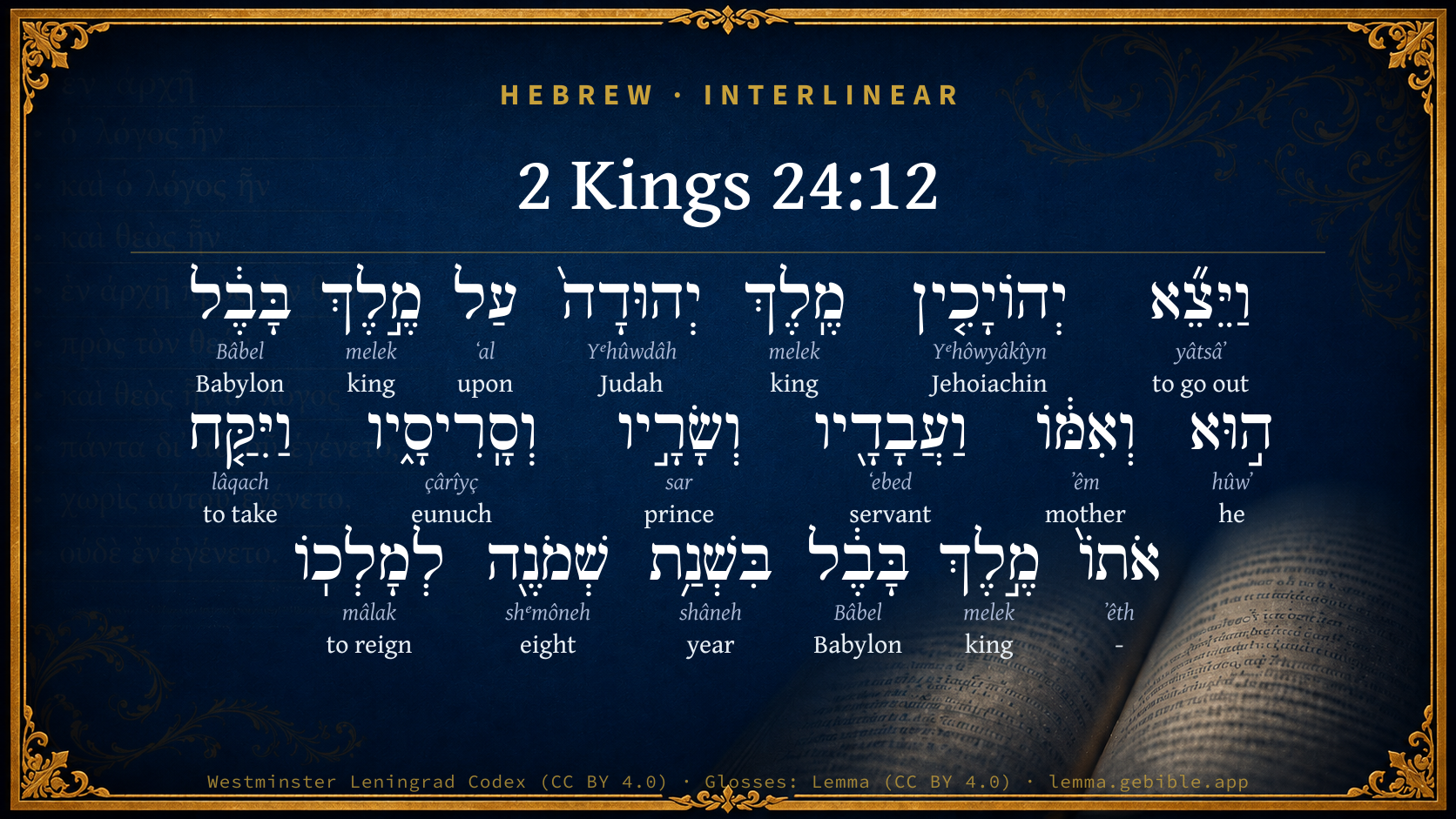
Hebrew (Westminster Leningrad Codex) 2 Kings 24:12 appears in the Hebrew Old Testament. The text above is from the Westminster Leningrad Codex. Each word links to its Strong’s number, a concise gloss, and parsing drawn from the Open Scriptures Hebrew Bible morphology. Click any word for its full Brown-Driver-Briggs (BDB) entry.
Download image
Cite this verse

2 Kings 24:12 (World English Bible). Public Domain. Lemma interlinear Bible study tool, https://lemma.gebible.app/v/2-kings/24/12.

Show BibTeX & RIS
BibTeX
RIS
English Translation
and Jehoiachin the king of Judah went out to the king of Babylon, he, and his mother, and his servants, and his princes, and his officers: and the king of Babylon took him in the eighth year of his reign.
World English Bible · Public Domain
Download a study sheet

One document with this verse’s original text, its word-by-word gloss line, the meaning frame, cross-references with their text, attributed commentary, and full source and license credits — printable, and it pastes into notes with its structure intact.

This verse Autodidact and up

Study sheet (.html) Plain text (.txt)

A passage Seminary Student

Up to 50 verses in one chapter. A passage sheet keeps up to 6 commentary sources and 12 cross-references per verse, in the order this page ranks them, and says so on the sheet whenever that leaves anything out. Ask for a single verse and you get the Autodidact verse sheet above.

Everything on this page stays free to read, with no account — the sheet is a download of what is already on screen, not access to it.

Want to remove ads? Support Godless Engineer
Compare translations 3

The same verse in 3 English versions, stacked beneath the original-language interlinear above. Click any original word for its lexicon entry.

Each is an independent rendering of the whole verse — the interlinear is not word-aligned to these translations.

Highlighted words mark where these versions differ — a whole-verse word diff, not a word-by-word alignment.

  • World English Bible Public Domain
    and Jehoiachin the king of Judah went out to the king of Babylon, he, and his mother, and his servants, and his princes, and his officers: and the king of Babylon took him in the eighth year of his reign.
  • King James Version Public Domain
    And Jehoiachin the king of Judah went out to the king of Babylon, he, and his mother, and his servants, and his princes, and his officers: and the king of Babylon took him in the eighth year of his reign.
  • unfoldingWord Literal Text CC BY-SA 4.0
    And Jehoiachin, the king of Judah, went out to the king of Babylon, he and his mother and his servants and his commanders and his eunuchs. And the king of Babylon took him in the year of eight to his reigning.

unfoldingWord Literal Text — © unfoldingWord, licensed CC BY-SA 4.0. Word-aligned USFM3 via Door43 (git.door43.org/unfoldingWord/en_ult).

Versions to compare (up to 4)

3 of 4 selected

Show all 18 translations

Every available English version of this verse, each an independent rendering of the whole verse.

  • World English Bible Public Domain
    and Jehoiachin the king of Judah went out to the king of Babylon, he, and his mother, and his servants, and his princes, and his officers: and the king of Babylon took him in the eighth year of his reign.
  • Berean Standard Bible Public Domain
    Jehoiachin king of Judah, his mother, his servants, his commanders, and his officials all surrendered to the king of Babylon. So in the eighth year of his reign, the king of Babylon took him captive.
  • Majority Standard Bible Public Domain
    Jehoiachin king of Judah, his mother, his servants, his commanders, and his officials all surrendered to the king of Babylon. So in the eighth year of his reign, the king of Babylon took him captive.
  • King James Version Public Domain
    And Jehoiachin the king of Judah went out to the king of Babylon, he, and his mother, and his servants, and his princes, and his officers: and the king of Babylon took him in the eighth year of his reign.
  • American Standard Version (1901) Public Domain
    and Jehoiachin the king of Judah went out to the king of Babylon, he, and his mother, and his servants, and his princes, and his officers: and the king of Babylon took him in the eighth year of his reign.
  • Revised Version (1885) Public Domain
    and Jehoiachin the king of Judah went out to the king of Babylon, he, and his mother, and his servants, and his princes, and his officers: and the king of Babylon took him in the eighth year of his reign.
  • Geneva Bible (1599) Public Domain
    Then Iehoiachin the king of Iudah came out against the King of Babel, he, and his mother and his seruants, and his princes, and his eunuches: and the King of Babel tooke him in the eyght yeere of his reigne.
  • Douay-Rheims (1899) Public Domain
    And Joachin king of Juda went out to the king of Babylon, he end his mother, and his servants, and his nobles, and his eunuchs: and the king of Babylon received him in the eighth year of his reign.
  • Young's Literal Translation Public Domain
    and Jehoiachin king of Judah goeth out unto the king of Babylon, he, and his mother, and his servants, and his chiefs, and his eunuchs, and the king of Babylon taketh him in the eighth year of his reign,
  • Literal Standard Version CC BY-SA 4.0
    and Jehoiachin king of Judah goes out to the king of Babylon, he, and his mother, and his servants, and his chiefs, and his eunuchs, and the king of Babylon takes him in the eighth year of his reign,
  • Unlocked Literal Bible CC BY-SA 4.0
    and Jehoiachin the king of Judah went out to the king of Babylon, he, his mother, his servants, his princes, and his officers. The king of Babylon captured him in the eighth year of his own reign.
  • unfoldingWord Literal Text CC BY-SA 4.0
    And Jehoiachin, the king of Judah, went out to the king of Babylon, he and his mother and his servants and his commanders and his eunuchs. And the king of Babylon took him in the year of eight to his reigning.
  • Darby Bible Public Domain
    And Jehoiachin king of Judah went out to the king of Babylon, he, and his mother, and his servants, and his princes, and his chamberlains; and the king of Babylon took him in the eighth year of his reign.
  • World Messianic Bible Public Domain
    and Jehoiachin the king of Judah went out to the king of Babylon—he, his mother, his servants, his princes, and his officers; and the king of Babylon captured him in the eighth year of his reign.
  • Webster's Bible Public Domain
    And Jehoiachin the king of Judah went out to the king of Babylon, he, and his mother, and his servants, and his princes, and his officers: and the king of Babylon took him in the eighth year of his reign.
  • Free Bible Version CC BY-SA 4.0
    Jehoiachin, king of Israel, surrendered to the king of Babylon, along with his mother, his officers, his commanders, and his officials. It was in the eighth year of his reign that Nebuchadnezzar captured Jehoiachin.
  • Bible in Basic English Public Domain
    Then Jehoiachin, king of Judah, went out to the king of Babylon, with his mother and his servants and his chiefs and his unsexed servants; and in the eighth year of his rule the king of Babylon took him.
  • JPS Tanakh (1917) Public Domain
    And Jehoiachin the king of Judah went out to the king of Babylon, he, and his mother, and his servants, and his princes, and his officers; and the king of Babylon took him in the eighth year of his reign.

Literal Standard Version (2020), Covenant Press — licensed CC BY-SA 4.0. Text via the HelloAO Bible API (eBible.org). Unlocked Literal Bible (unfoldingWord) — licensed CC BY-SA 4.0. Text via the HelloAO Bible API (eBible.org). unfoldingWord Literal Text — © unfoldingWord, licensed CC BY-SA 4.0. Word-aligned USFM3 via Door43 (git.door43.org/unfoldingWord/en_ult). Free Bible Version, Dr. Jonathan Gallagher — licensed CC BY-SA 4.0. Text via the HelloAO Bible API (eBible.org).

Word by word

More ways to search: Search by grammar → Find every occurrence → Compare this word →

Practice this passage: Drill this verse → Learn its vocabulary →

יְהוֹיָכִ֤ין
Yᵉhôwyâkîyn
H3078
“Jehoiachin”
Noun, Proper
Part of Speech
Noun
Type
Proper
Full BDB Definition

Origin: from H3068 and H3559

TWOT: None

Jehoiachin = "Jehovah establishes" - king of Judah, son of Jehoiakim, and the next to last king of Judah before the Babylonian captivity; kingship lasted for 3 months and 10 days before he surrendered to Nebuchadnezzar who took him to Babylon and imprisoned him for 36 years when he was finally released
  1. וַיֵּצֵ֞א yâtsâʼ H3318 “and · to go out” Conjunction + Verb, Qal, Sequential Imperfect, 3rd Person, Masculine, Singular
  2. מֶֽלֶךְ melek H4428 “king of” Noun, Common, Masculine, Singular, Construct
  3. יְהוּדָה֙ Yᵉhûwdâh H3063 “Judah” Noun, Proper
  4. עַל ʻal H5921 “upon” Preposition
  5. מֶ֣לֶךְ melek H4428 “king of” Noun, Common, Masculine, Singular, Construct
  6. בָּבֶ֔ל Bâbel H894 “Babylon” Noun, Proper
  7. ה֣וּא hûwʼ H1931 “he” Pronoun, Personal, 3rd Person, Masculine, Singular
  8. וְאִמּ֔וֹ ʼêm H517 “and · mother · his” Conjunction + Noun, Common, Feminine, Singular, Construct + Suffix, Personal, 3rd Person, Masculine, Singular
  9. וַעֲבָדָ֖יו ʻebed H5650 “and · servants · his” Conjunction + Noun, Common, Masculine, Plural, Construct + Suffix, Personal, 3rd Person, Masculine, Singular
  10. וְשָׂרָ֣יו sar H8269 “and · princes · his” Conjunction + Noun, Common, Masculine, Plural, Construct + Suffix, Personal, 3rd Person, Masculine, Singular
  11. וְסָֽרִיסָ֑יו çârîyç H5631 “and · eunuchs · his” Conjunction + Noun, Common, Masculine, Plural, Construct + Suffix, Personal, 3rd Person, Masculine, Singular
  12. וַיִּקַּ֤ח lâqach H3947 “and · to take” Conjunction + Verb, Qal, Sequential Imperfect, 3rd Person, Masculine, Singular
  13. אֹתוֹ֙ ʼêth H853 “- · him” Particle, Direct Object + Suffix, Personal, 3rd Person, Masculine, Singular
  14. מֶ֣לֶךְ melek H4428 “king of” Noun, Common, Masculine, Singular, Construct
  15. בָּבֶ֔ל Bâbel H894 “Babylon” Noun, Proper
  16. בִּשְׁנַ֥ת shâneh H8141 “in/at · year of” Preposition + Noun, Common, Feminine, Singular, Construct
  17. שְׁמֹנֶ֖ה shᵉmôneh H8083 “eight” Adjective, Cardinal number, Feminine, Singular, Absolute
  18. לְמָלְכֽוֹ mâlak H4427 “to reign · him” Preposition + Verb, Qal, Infinitive Construct + Suffix, Personal, 3rd Person, Masculine, Singular

About this verse

These counts appear in no published source. They are computed here, from the morphology-tagged text and Lemma’s own curated glosses. What Lemma adds →

19
words
16
distinct lemmas
Historical
section

Notable vocabulary

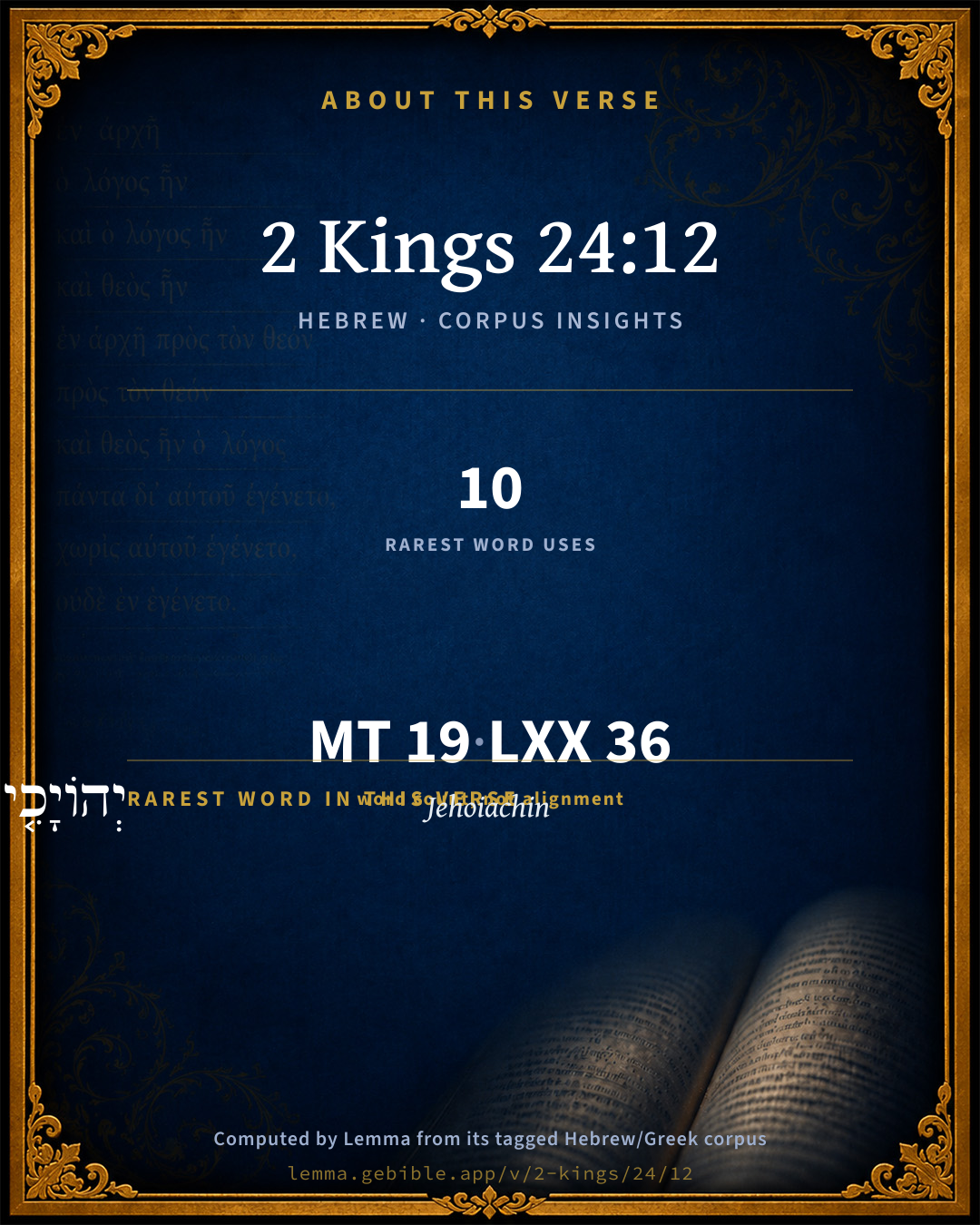
The rarest word here is יְהוֹיָכִ֤ין Jehoiachin H3078 — appearing just 10 times in the whole Hebrew Bible.

Shared distinctive vocabulary

יְהוֹיָכִ֤ין Jehoiachin H3078 occurs in 8 verses of the Hebrew Bible. Also found in:

Grammatical profile

  • 3 verbs
  • 12 nouns
  • 1 adjective
  • 1 pronoun
  • 1 preposition
  • 1 particle

Verb forms

  • וַיֵּצֵ֞א Qal · Sequential Imperfect
  • וַיִּקַּ֤ח Qal · Sequential Imperfect
  • לְמָלְכֽוֹ Qal · Infinitive Construct

Repetition

Words recur within this verse — often emphatic in Hebrew:

  • מֶֽלֶךְ king H4428 ×3
  • בָּבֶ֔ל Babylon H894 ×2

Hebrew & Septuagint length

In English translation the verse runs 40 words from the Hebrew and 39 from the Septuagint (LXX English) — closely comparable.

A rough comparison of the two English renderings, which tokenize alike — not a word-level alignment.

Word counts can differ between the Hebrew and the Greek without any difference in meaning — e.g. the Hebrew direct-object marker אֵת has no separate Greek word, and Greek often adds the article ὁ.

In the original languages it is 19 Hebrew tokens and 36 Greek tokens — but the two are counted differently (Hebrew bundles its prefixes and suffixes into one token; the Greek is in lemma form), so that isn’t a like-for-like length.

Cross-references

10

Topical passages linked to 2 Kings 24:12 in the Treasury of Scripture Knowledge — connected by theme and wording, ordered by reader-vote popularity; previews shown in the World English Bible.

  • Jeremiah 24:1 Yahweh shown me, and, behold, two baskets of figs set before the temple of Yahweh, after that Nebuchadrezzar king of Babylon had carried away captive Jeconiah the son of Jehoiakim, king of Judah, and the princes of Judah, with the craftsmen and smiths, from Jerusalem, and had brought them to Babylon.
  • Jeremiah 52:28 This is the people whom Nebuchadrezzar carried away captive: in the seventh year three thousand twenty-three Jews;
  • 2 Kings 25:27 It happened in the seven and thirtieth year of the captivity of Jehoiachin king of Judah, in the twelfth month, on the seven and twentieth day of the month, that Evilmerodach king of Babylon, in the year that he began to reign, did lift up the head of Jehoiachin king of Judah out of prison;
  • 2 Chronicles 36:10 At the return of the year king Nebuchadnezzar sent, and brought him to Babylon, with the goodly vessels of the house of Yahweh, and made Zedekiah his brother king over Judah and Jerusalem.
  • Jeremiah 29:1–2 Now these are the words of the letter that Jeremiah the prophet sent from Jerusalem to the residue of the elders of the captivity, and to the priests, and to the prophets, and to all the people, whom Nebuchadnezzar had carried away captive from Jerusalem to Babylon,
  • Jeremiah 25:1 The word that came to Jeremiah concerning all the people of Judah, in the fourth year of Jehoiakim the son of Josiah, king of Judah (the same was the first year of Nebuchadrezzar king of Babylon),
  • Ezekiel 17:12 Say now to the rebellious house, Don't you know what these things mean? tell them, Behold, the king of Babylon came to Jerusalem, and took the king of it, and the princes of it, and brought them to him to Babylon:
  • Jeremiah 22:24–30 As I live, says Yahweh, though Coniah the son of Jehoiakim king of Judah were the signet on my right hand, yet would I pluck you there;
  • Jeremiah 38:17–18 Then said Jeremiah to Zedekiah, Thus says Yahweh, the God of hosts, the God of Israel: If you will go forth to the king of Babylon's princes, then your soul shall live, and this city shall not be burned with fire; and you shall live, and your house.
  • Jeremiah 52:31 It happened in the seven and thirtieth year of the captivity of Jehoiachin king of Judah, in the twelfth month, in the five and twentieth day of the month, that Evilmerodach king of Babylon, in the [first] year of his reign, lifted up the head of Jehoiachin king of Judah, and brought him forth out of prison;

Cross-references courtesy of OpenBible.info (CC BY 4.0).

Hebrew and Greek witnesses Masoretic Hebrew ↔ Greek Septuagint

The same verse in the two great witnesses to the Old Testament, shown verse-for-verse.

These are two independent witnesses, not word-aligned to each other, and the Septuagint is shown in lemma (dictionary) form.

Hebrew 2 Kings 24:12 Masoretic · Westminster Leningrad Codex

וַיֵּצֵ֞א יְהוֹיָכִ֤ין מֶֽלֶךְ יְהוּדָה֙ עַל מֶ֣לֶךְ בָּבֶ֔ל ה֣וּא וְאִמּ֔וֹ וַעֲבָדָ֖יו וְשָׂרָ֣יו וְסָֽרִיסָ֑יו וַיִּקַּ֤ח אֹתוֹ֙ מֶ֣לֶךְ בָּבֶ֔ל בִּשְׁנַ֥ת שְׁמֹנֶ֖ה לְמָלְכֽוֹ

and Jehoiachin the king of Judah went out to the king of Babylon, he, and his mother, and his servants, and his princes, and his officers: and the king of Babylon took him in the eighth year of his reign.

World English Bible · Public Domain

Greek LXX 2 Kings 24:12 Septuagint · lemma form

καί ἐκἔρχομαι ιωακιμ βασιλεύς ιουδα ἐπί βασιλεύς βαβυλών αὐτός καί ὁ παῖς αὐτός καί ὁ μήτηρ αὐτός καί ὁ ἄρχων αὐτός καί ὁ εὐνοῦχος αὐτός καί λαμβάνω αὐτός βασιλεύς βαβυλών ἐν ἔτος ὄγδοος ὁ βασιλεία αὐτός

And Joachim king of Juda came forth to the king of Babylon, he and his servants, and his mother, and his princes, and his eunuchs; and the king of Babylon took him in the eighth year of his reign.

LXX2012 (modern English Septuagint) · Public Domain

Hebrew: Westminster Leningrad Codex (CC BY 4.0). Greek: Septuagint (public domain); English from LXX2012 (modern English Septuagint) (Public Domain). How the Septuagint differs from the Hebrew →

Targum (Aramaic paraphrase)

1

The Targum is the ancient Jewish Aramaic paraphrase of the Hebrew Scriptures — an interpretive translation, not the Hebrew text itself. Onkelos (literal) and Pseudo-Jonathan (expansive) render the Torah, and Jonathan the Prophets. Coverage is partial: where no permissively-licensed English translation exists for a verse, only the Aramaic is shown. This is verse-level text, not a word-by-word alignment to the Hebrew.

  1. Targum Jonathan Prophets (Joshua–Malachi)
    וּנְפַק יְהוֹיָכִין מֶלֶךְ שִׁבְטָא דְבֵית יְהוּדָה עַל מַלְכָּא דְבָבֶל הוּא וְאִמֵיהּ וְעַבְדוֹהִי וְרַבְרְבוֹהִי וְגִבָּרוֹהִי וּדְבַר יָתֵיהּ מַלְכָּא דְבָבֶל בִּשְׁנַת תַּמְנֵי לְמִמְלְכֵיהּ:

    (no public-domain English translation for this verse)

    Targum Jonathan — Aramaic: “Mikraot Gedolot” (public domain). English: “Sefaria Community Translation” (CC0 1.0 (public-domain dedication)); “London "Chaldee Paraphrase," 1871” (public domain). Text via Sefaria.

Commentary

Notes on 2 Kings 24:12 from classic Christian and Jewish commentators (each source and its license shown beneath its notes). The classic Christian expositions comment on the surrounding passage and are grouped to its opening verse, so a note may address several verses; the Jewish commentaries on the Tanakh (Rashi and others) are per-verse, so they appear only where the commentator wrote on this verse.

Lemma curates 59 commentaries, every one of them public domain or Creative Commons licensed, each selected and text-cleaned for this edition rather than reprinted as found. About our sources →

Trapp's Complete Commentary

John Trapp

2Ki 24:12 And Jehoiachin the king of Judah went out to the king of Babylon, he, and his mother, and his servants, and his princes, and his officers: and the king of Babylon took him in the eighth year of his reign.

Ver. 12. And the king of Babylon took him.] Suscepit eum; gratiose scilicet; he gave him quarter for his life, and in the end, for a reward of his obedience and piety towards his country, he was much advanced by Evilmerodaeh, Nebuchadnezsar’s successor. {2Ki 25:27}

John Trapp, A Commentary or Exposition upon All the Books of the Old and New Testament (1647–1656) — public domain. Text from a community e-Sword module.

Joseph Benson's Commentary

2Ki 24:12. Jehoiachin went out to the king of Babylon — Yielded up himself and the city into his hands; and this by the counsel of Jeremiah, and to his own good. In the eighth year of his reign — Of Nebuchadnezzar’s reign, as appears by comparing this with 2Ki 25:8; and because Jehoiachin reigned not half a year. Had he made his peace with God, and taken the method that Hezekiah did in the like case, he needed not to have feared the king of Babylon, but might have held out with courage, honour, and success. But, wanting the faith and piety of an Israelite, he had not the resolution of a man.

Joseph Benson's Commentary on the Old and New Testaments (1811–1818) — public domain. Text from a community e-Sword module.

Keil & Delitzsch

C. F. Keil & F. Delitzsch

Then Jehoiachin went out to the king of Babylon to yield himself up to him, because he perceived the impossibility of holding the city any longer against the besiegers, and probably hoped to secure the favour of Nebuchadnezzar, and perhaps to retain the throne as his vassal by a voluntary submission. Nebuchadnezzar, however, did not show favour any more, as he had done to Jehoiakim at the first taking of Jerusalem, but treated Jehoiachin as a rebel, made him prisoner, and led him away to Babylon, along with his mother, his wives (Kg2 24:15), his princes and his chamberlains, as Jeremiah had prophesied (Jer 22:24.), in the eighth year of his (Nebuchadnezzar's) reign. The reference to the king's mother in Kg2 24:12 and Kg2 24:15 is not to be explained on the ground that she still acted as guardian over the king, who was not yet of age (J. D. Mich.), but from the influential position which she occupied in the kingdom as הגּבירה (Jer 29:2 : see at Kg1 14:21). The eighth year of the reign of Nebuchadnezzar is reckoned from the time when his father had transferred to him the chief command over the army to make war upon Necho, according to which his first year coincides with the fourth year of Jehoiakim (Jer 25:1). As Nebuchadnezzar acted as king, so far as the Jews were concerned, from that time forward, although he conducted the war by command of his father, this is always reckoned as the point of time at which his reign commenced, both in our books and also in Jeremiah (cf. Kg2 25:8; Jer 32:1). According to this calculation, his reign lasted forty-four years, viz., the eight years of Jehoiakim and the thirty-six years of Jehoiachin's imprisonment, as is evident from Kg2 25:27.

Keil & Delitzsch — Biblical Commentary on the Old Testament (1861–1891) — public domain (CC PDM 1.0). Text via the HelloAO Bible API. (Old Testament only.)

Geneva Bible (1599)

Geneva Bible translators

That is, yielded himself unto him by the counsel of Jeremiah.

In the reign of the king of Babylon.

Geneva Bible (1599) marginal notes — public domain. Text via Bolls.life.

Adam Clarke's Commentary

Verse 12. Jehoiachin - went out] He saw that it was useless to attempt to defend himself any longer; and he therefore surrendered himself, hoping to obtain better terms.

Adam Clarke's Commentary on the Bible (1810–1826) — public domain. Text from a community e-Sword/MySword module.

Ellicott's Commentary for English Readers

(12) And Jehoiaehin the king of Judah went out . . .—Despairing of the defence, he threw himself upon the clemency of Nebuchadnezzar. The queen-mother (Jer_22:2) and all his grandees and courtiers accompanied the king, who probably hoped to be allowed to keep his throne as a vassal of Babylon.

Took him—i.e., as a prisoner.

In the eighth year of his (i.e., Nebuchadnezzar’s) reign.—This exactly tallies with the data of Jer_25:1; Jer_46:2.

A Bible Commentary for English Readers, edited by Charles John Ellicott (1878–1897) — public domain. Text from a community e-Sword module.

The Cambridge Bible for Schools and Colleges

gen. ed. J. J. S. Perowne

12. Jehoiachin … went out to the king of Babylon] He did as Rab-shakeh invited the people to do on a former occasion (2Ki_18:31) ‘Come out to me.’ This was to submit himself to Nebuchadnezzar, and in the hope of making an impression on the Babylonian king, Jehoiachin goes, taking with him the queen-mother, and all his chief men. On the influential position occupied in many Eastern states by the queen-mother, see note on 1Ki_2:19.

in the eighth year of his reign] i.e. Of Nebuchadnezzar’s reign. We know from Jeremiah (Jer_25:1) that the fourth year of Jehoiakim was the first year of Nebuchadnezzar. So the time just admits of the three months’ reign of Jehoiachin, as his father reigned eleven years (Jer_23:36). In connexion with this captivity should be read the prophecy of Jeremiah 24 where under the type of good and bad figs, he speaks of the fate of the two sorts of people, those that are sent into the land of the Chaldæans for their good, and the rest, who like Zedekiah inclined to a league with Egypt. To this time belongs also Jeremiah’s letter to the captives, full of wise advice and comforting promises (Jer_29:1-23).

The Cambridge Bible for Schools and Colleges (gen. ed. J. J. S. Perowne; Cambridge University Press, 1878–1918) — public domain. Text from a community e-Sword module.

John Gill's Exposition

And he carried away all Jerusalem,.... The inhabitants of it; not every individual of them, but the chief of them, the more honourable, rich, and useful; for the poorer sort were left, as afterwards expressed:

and all the princes, and all the mighty men of valour, even ten thousand captives; which was the number of them in the whole; the particulars are after delivered:

and all the craftsmen and smiths; besides the nobles and the soldiers, he took all the artificers that exercised any handicraft trade or business; carpenters and blacksmiths, as some interpret these two words; so that there were none left to make arms for them; the last word may be rendered "enclosers", and are by some interpreted of enclosers of jewels in metals, as gold and silver:

none remained, save the poorest sort of the people of the land; who were left to till it, and to dress the vines; see Kg2 25:12.

John Gill's Exposition of the Whole Bible (1746–1763) — public domain (CC PDM 1.0). Text via the HelloAO Bible API.

Albert Barnes' Notes on the Bible

The eighth year - Jeremiah calls it the seventh year Jer 52:28, a statement which implies only a different manner of counting regnal years.

Albert Barnes' Notes on the Bible (1834–1885) — public domain. Text from a community e-Sword/MySword module.

Haydock's Catholic Bible Commentary

Went out. Josephus (Jewish Wars vi. 8.) insinuates, to save the vessels of the temple. --- Jeremias had persuaded him to desist from making resistance. (Tirinus) --- Nabuchodonosor did not comply with his promise, (Menochius) but took the king and all the artificers (ver. 14.) to Babylon, that the former might not attempt to revenge the injuries done to his father, nor the latter contribute to fortify the towns. The Philistines had deprived the Israelites of blacksmiths, with the same design, 1 Kings vii., and xiii. (Angelomus.) (Tirinus) --- Eighth; commencing, or at the end of the seventh, Jeremias lii. (Du Hamel)

George Leo Haydock (1774–1849), Haydock's Catholic Family Bible and Commentary, 1859 edition — public domain. Excludes Psalms (Douay-Rheims chapter numbering differs from Protestant) and Deuterocanonical books (Catholic canon only).

Matthew Poole's English Annotations

Went out to the king of Babylon, i.e. yielded up himself and the city into his hands; and this by the counsel of Jeremiah, and to his own good.

Of his reign, i.e. of Nebuchadnezzar’s reign; as appears by comparing this with Jer 25:8, and because Jehoiachin reigned not half a year.

Matthew Poole's English Annotations on the Holy Bible (1683–1685) — public domain. Text from a community e-Sword/MySword module.

Whedon's Commentary on the Bible

Daniel D. Whedon

12. Jehoiachin… went out — To make a voluntary and complete surrender, probably hoping that such ready submission would secure for himself the favour of the Babylonian monarch, and the privilege granted by the same monarch to his father seven years before, (2Ki_24:1,) of continuing at Jerusalem as a vassal king. His mother… servants… princes…

officers — It was a complete and unconditional surrender, involving all the chief persons of the kingdom of Judah in the fate of the king. The word rendered officers is סריסי, eunuchs, showing that the kings of Jerusalem had at this time introduced this class of servants and officials into the Jewish court. They doubtless borrowed the custom from the eastern monarchs.

Took him — As a captive.

Eighth year of his reign — That is, of Nebuchadnezzar’s reign. The first year of Nebuchadnezzar was the fourth of Jehoiakim, (Jer_25:1,) and in that year he smote Carchemish (Jer_46:2) and received Jehoiakim’s submission. 2Ki_24:1, note. Jehoiakim reigned seven years after that event, (chap. xxiii, 36,) so that the surrender of Jehoiachin, who had ruled three months, must have fallen in the eighth year of Nebuchadnezzar.

Daniel D. Whedon (gen. ed.), Commentary on the Old and New Testaments (1874–1909) — public domain. Text from a community e-Sword module.

The Pulpit Commentary

And Jehoiachin the King of Judah went out to the King of Babylon (for the use of the expression, "went out to," in this sense of making a surrender, see 1Sa_11:3; Jer_21:9 Jer_38:17, etc.) he, and his mother (see the comment on ver. 8), and his servants, and his princes, and his officers rather, his eunuchs (see the comment on 2Ki_20:18) and the King of Babylon took him in the eighth year of his reign. Nebuchadnezzar succeeded his father, Nabopelassar, in B.C. 605; but his first year was not complete till late in B.C. 604. His"eighth year" was thus B.C. 597.

The Pulpit Commentary (1880–1919), ed. H.D.M. Spence-Jones & Joseph S. Exell — public domain. Text from a community e-Sword module.

John Wesley's Explanatory Notes

Went out - Yielded up himself and the city into his hands; and this by the counsel of Jeremiah, and to his own good. His reign - Of Nebuchadnezzar's reign; as appears by comparing this with chap. xxv, 8, and because Jehoiachin reigned not half a year. Had he made his peace with God, and taken the method that Hezekiah did in the like case, he needed not to have feared the king of Babylon, but might have held out with courage, honour and success. But wanting the faith and piety of an Israelite, he had not the resolution of a man.

John Wesley, Explanatory Notes Upon the Whole Bible (1754–1765) — public domain. Text via the GEBible commentary corpus.

Scofield Reference Notes

C. I. Scofield

the king

Nebuchadnezzar’s eighth year. Jer 25:1.

The Scofield Reference Bible (1917 edition), notes by C. I. Scofield — public domain. Text from a community e-Sword module.

Rashi

Rabbi Shlomo Yitzchaki (Rashi)

Yehoyachin king of Yehudah, came out to the king of Bavel. That he do to him as he wishes, and not for war.

Rashi on the Tanakh — English translations: “The Judaica Press complete Tanach with Rashi, translated by A. J. Rosenberg” (CC BY 4.0); “Pentateuch with Rashi's commentary by M. Rosenbaum and A.M. Silbermann, 1929-1934” (public domain); “The Metsudah Tanach series, Lakewood, N.J” (CC BY 4.0); and “The Book of Joshua, Metsudah Publications, 1997” (CC BY 4.0). Text via Sefaria.

Lesson kit

Teaching starters — assembled from the data on this page, not authored interpretation. Every prompt links to the verse data it draws on. Edit before teaching.

2 Kings, in the Historical, opens this verse with 19 words (16 distinct Hebrew lemmas). Its most distinctive word is Yᵉhôwyâkîyn (“Jehoiachin”). A historical commentator’s framing appears above. Read the whole chapter for the surrounding context.

Discussion questions

  1. How does “Jehoiachin” (Yᵉhôwyâkîyn) shape what this verse is saying?
  2. How does 2 Kings 24:6, which shares the word «Jehoiachin», read alongside this verse?
  3. What does the repetition of “king” (3× in this one verse) do in this verse?
  4. These translations render this verse differently; the difference is in the English rendering, not the original. What questions does that raise?
  5. «וַיֵּצֵ֞א» is a Qal Sequential Imperfect verb. How does that grammatical form shape the action described?
  6. Compare how Trapp's Complete Commentary and Joseph Benson's Commentary read this verse. Where do they agree or differ?

Things to notice

Reading settings

Reading text

Shown beneath each verse's original-language words.

Old Testament
Old Testament edition

Read the OT as the Masoretic Hebrew (MT) or the Greek Septuagint (LXX).

English shown for the Greek Septuagint (in the Hebrew ↔ Greek comparison).

Comparing translations? Open the Compare panel on any verse page to stack up to four side by side.