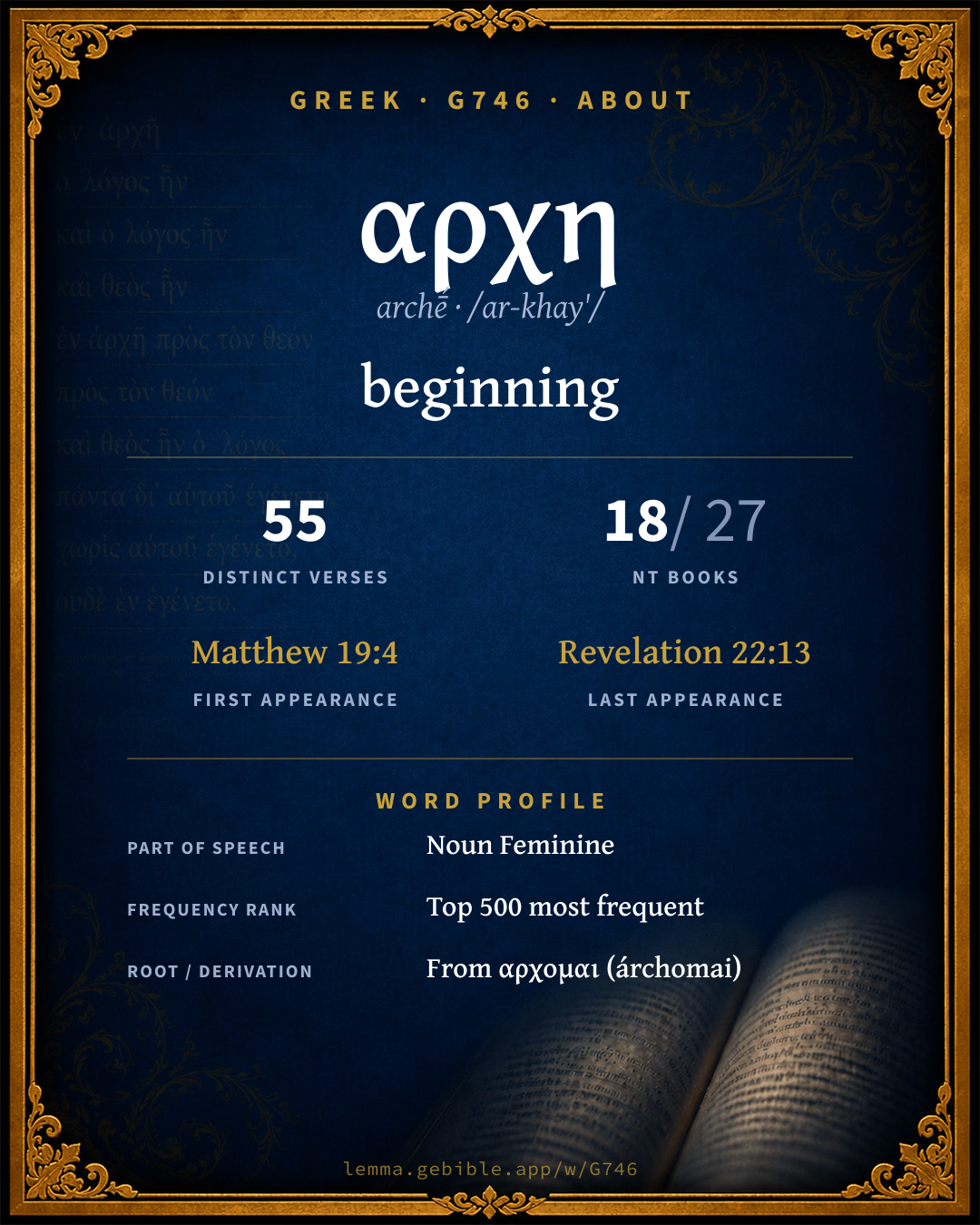
ἀρχή
beginning
‘beginning’ is one of 5 main senses fuller range ↓
Full lexicon entry — Thayer's Greek Lexicon
From Thayer's Greek Lexicon
Where this word appears
See every Accusative-case word in the Greek New Testament →
Grammar key — what these labels mean
Part of speech
- Noun
- A naming word — a person, place, thing, or idea.
Case
- Genitive
- The case of source, possession, or “of” — answers “whose / from what.”
- Accusative
- The case of the direct object and of extent.
- Nominative
- The case of the subject (and the predicate nominative).
- Dative
- The case of the indirect object, means, or location — “to / for / with / in.”
Gender
- Feminine
- Grammatically feminine.
Number
- Singular
- One.
- Plural
- More than one.
Every verse where G746 appears in the Book of Luke — 3 distinct verses. Click any verse to open its interlinear word-by-word view. Verse text shown in the World English Bible for context — . Each verse’s Greek form is shown with its reference; the English is not keyword-highlighted, since the data carries no word-level English alignment. Use “Compare translations” on any verse to read it across multiple English versions. This concordance covers the Greek New Testament; Septuagint (Greek Old Testament) occurrences of this word are not indexed here.
Luke
- Luke 1:2 ἀρχῆς n gen sg fem even as those who from the beginning were eyewitnesses and ministers of the word delivered them to us,
- Luke 12:11 ἀρχὰς n acc pl fem When they bring you before the synagogues, the rulers, and the authorities, don't be anxious how or what you will answer, or what you will say;
- Luke 20:20 ἀρχῇ n dat sg fem They watched him, and sent out spies, who pretended to be righteous, that they might trap him in something he said, so as to deliver him up to the power and authority of the governor.
About this entry
At a glance — auto-summarized from this page’s data, not written by a person. Every figure links to its source below. This summary describes the numbers; it doesn’t interpret them.
At its core, αρχη (archḗ) means “beginning.” Catalogued under 5 senses, its meaning is not single-sense. Spanning 55 verses in 18 books, it ranks among the moderately common words of the Greek New Testament. Scripture first uses it in Matthew 19:4. From the same root come αρχομαι, αρχαιος and αρχηγος. Each statement above links to its evidence; the full detail follows below.
Gloss history
Strong's 1890 vs modern scholarship

About this word
Strong's G746 catalogs a Greek word from the Greek New Testament.
These counts are not copied from any lexicon or concordance. They are computed here, from the morphology-tagged Greek New Testament. What Lemma adds →
- 55
- distinct verses
- The word appears in 55 distinct verses.
- 18 / 27
- NT books
- The word appears in 18 of 27 New Testament books.
- #286
- by frequency
- Top 500 most frequent Greek words (rank 286 of 5,347 Greek words by occurrence).
View all 55 occurrences in the concordance →
By section of the New Testament
By traditional corpus
Conventional, traditional groupings — biblical authorship is debated, so this is a traditional corpus grouping, not an authorship claim. Some books belong to more than one corpus (Luke is in both the Gospels and the Lukan corpus, and so on), so these shares overlap and need not total 100%. Each figure is a share of the word’s 55 distinct verses.
- Johannine 20 verses · 36%
- Gospels 19 verses · 35%
- Pauline corpus 12 verses · 22%
- General (Catholic) Epistles 11 verses · 20%
- Lukan (Luke–Acts) 7 verses · 13%
- Hebrews 6 verses · 11%
- Revelation 3 verses · 5%
How translations render this word
Counts come from each version’s own published word-to-Strong’s tagging or interlinear alignment — an approximate guide to how each version renders this word, not a word-level alignment the data otherwise carries. Because each total is that version’s own tagged count, the per-version totals vary from one another and need not match the appearance or distinct-verse counts above. These counts may also differ from a printed concordance because Lemma counts each distinctly tagged rendering and does not collapse phrase taggings into a single head-word total. This is a fixed set of word-tagged versions (KJV, ASV, BSB, ULT) and does not change with the reading translation you choose elsewhere. Each version’s license is shown beside its name below (and on Sources).
- King James Version: Beginning 38×, Principalities 6×, Corners 2×
- American Standard Version: Beginning 36×, Principalities 5×, Rule 3×
- Berean Standard Bible: Beginning 31×, Rulers 5×, First 3×
- unfoldingWord Literal Text: Beginning 37×, Rulers 5×, Rule 4×
King James Version Public Domain
Renders G746 across 58 tagged occurrences — most commonly:
Plus 8 renderings that appear only once — usually multi-word phrases or single function words the recovered tagging swept in, not distinct renderings.
American Standard Version Public Domain
Renders G746 across 58 tagged occurrences — most commonly:
Plus 8 renderings that appear only once — usually multi-word phrases or single function words the recovered tagging swept in, not distinct renderings.
Berean Standard Bible Public Domain
Renders G746 across 55 tagged occurrences — most commonly:
Plus 12 renderings that appear only once — usually multi-word phrases or single function words the recovered tagging swept in, not distinct renderings. Not rendered by a distinct English word in 1 further occurrence.
unfoldingWord Literal Text CC BY-SA 4.0
Renders G746 across 60 tagged occurrences — most commonly:
Plus 8 renderings that appear only once — usually multi-word phrases or single function words the recovered tagging swept in, not distinct renderings.
Senses in Thayer's
The 5 senses Thayer's distinguishes for this word, in lexicon order (not ranked by frequency or importance). The full entry — with sub-senses — is in the Lexicon Entry tab.
- beginning, origin
- the person or thing that commences, the first person or thing in a series, the leader
- that by which anything begins to be, the origin, the active cause
- of the corners of a sail
- the first place, principality, rule, magistracy
Word origin
Derived from αρχομαι (árchomai) (G756) — to lead.
From G756 ; (properly abstract) a commencement or (concrete) chief (in various applications of order time place or rank): - beginning corner (at the the) first (estate) magistrate power principality principle rule.
— Strong’s Exhaustive Concordance (1890), public domain.
Forms in the corpus
The 10 distinct written forms G746 takes in the Greek New Testament, most frequent first — each parse links to that case’s occurrences in the concordance.
| Form | Parsing | Example | Uses |
|---|---|---|---|
| ἀρχῆς archē̂s | Noun, Genitive, Singular, Feminine | Matthew 19:4 | 27 |
| ἀρχὴν archḕn | Noun, Accusative, Singular, Feminine | John 2:11 | 7 |
| ἀρχὴ archḕ | Noun, Nominative, Singular, Feminine | Matthew 24:8 | 5 |
| ἀρχῇ archē̂ | Noun, Dative, Singular, Feminine | Luke 20:20 | 5 |
| ἀρχαῖς archaîs | Noun, Dative, Plural, Feminine | Acts 10:11 | 4 |
| ἀρχάς archás | Noun, Accusative, Plural, Feminine | Ephesians 6:12 | 2 |
| ἀρχαὶ archaì | Noun, Nominative, Plural, Feminine | Romans 8:38 | 2 |
| ἀρχὰς archàs | Noun, Accusative, Plural, Feminine | Luke 12:11 | 2 |
| ἀρχή archḗ | Noun, Nominative, Singular, Feminine | Colossians 1:18 | 1 |
| Ἀρχὴ Archḕ | Noun, Nominative, Singular, Feminine | Mark 1:1 | 1 |
Same root — word family
Other Thayer's entries built from the same root as G746, grouped by Strong’s listed origin. These share a root / origin per the lexicon — not necessarily a shared meaning. Each links to that word’s own entry.
Derives from
Derived from this word
- αρχαιος archaîos G744 original
- αρχηγος archēgós G747 leader
- αρχιερατικος archieratikós G748 high priestly
- αρχιερευς archiereús G749 high priest
- αρχιποιμην archipoímēn G750 chief shepherd
- αρχισυναγωγος archisynágōgos G752 synagogue ruler
- αρχιτεκτων architéktōn G753 architect
- αρχιτελωνης architelṓnēs G754 chief tax collector
- αρχιτρικλινος architríklinos G755 table master
Proper names from this root
People and places named from this root — a name, not an additional meaning of the word.
Compare all same-root words → Showing 4 of 12 — not the complete family. 1 of the same-root words is a proper name (a person or place). They share a root, not necessarily a meaning.
Septuagint usage
The same Greek word αρχη appears 169 times in the Greek Old Testament (Septuagint), across 156 verses in 31 books.
- 169
- LXX occurrences
- Tagged occurrences of this Greek word in the Septuagint.
- 156
- verses
- Distinct Septuagint verses containing this word.
- 31 / 39
- OT books
- The word appears in 31 of the 39 Old Testament books.
Sample Septuagint occurrences
- Genesis 1:1 ἀρχή
- Exodus 6:25 ἀρχή
- Numbers 1:2 ἀρχή
- Deuteronomy 11:12 ἀρχή
- Joshua 24:2 ἀρχή
- Judges 7:11 ἀρχή
- Ruth 1:22 ἀρχή
- 1 Samuel 11:11 ἀρχή
- 2 Samuel 7:10 ἀρχή
- 1 Kings 7:21 ἀρχή
- 2 Kings 17:25 ἀρχή
- 1 Chronicles 12:33 ἀρχή
Septuagint occurrences (same lexeme)
Every verse where the same Strong’s number (G746) appears in the Greek Septuagint — showing the first 50 of 156. Verse text shown in the World English Bible for context; the Greek form is the matched word — the English is not keyword-highlighted.
- Genesis 1:1 ἀρχή In the beginning God created the heavens and the earth.
- Genesis 1:16 ἀρχή God made the two great lights: the greater light to rule the day, and the lesser light to rule the night. He also made the stars.
- Genesis 2:10 ἀρχή A river went out of Eden to water the garden; and from there it was parted, and became four heads.
- Genesis 10:10 ἀρχή The beginning of his kingdom was Babel, Erech, Accad, and Calneh, in the land of Shinar.
- Genesis 13:4 ἀρχή to the place of the altar, which he had made there at the first. There Abram called on the name of Yahweh.
- Genesis 40:13 ἀρχή Within three more days, Pharaoh will lift up your head, and restore you to your office. You will give Pharaoh's cup into his hand, the way you did when you were his cupbearer.
- Genesis 40:20 ἀρχή It happened the third day, which was Pharaoh's birthday, that he made a feast for all his servants, and he lifted up the head of the chief cupbearer and the head of the chief baker among his servants.
- Genesis 40:21 ἀρχή He restored the chief cupbearer to his position again, and he gave the cup into Pharaoh's hand;
- Genesis 41:13 ἀρχή It happened, as he interpreted to us, so it was: he restored me to my office, and he hanged him."
- Genesis 41:21 ἀρχή and when they had eaten them up, it couldn't be known that they had eaten them, but they were still ill-favored, as at the beginning. So I awoke.
- Genesis 43:18 ἀρχή The men were afraid, because they were brought to Joseph's house; and they said, "Because of the money that was returned in our sacks at the first time are we brought in; that he may seek occasion against us, and fall on us, and take us for bondservants, along with our donkeys."
- Genesis 43:20 ἀρχή and said, "Oh, my lord, we came indeed down at the first time to buy food:
- Genesis 49:3 ἀρχή "Reuben, you are my firstborn, my might, and the beginning of my strength; The pre-eminence of dignity, and the pre-eminence of power.
- Exodus 6:25 ἀρχή Eleazar Aaron's son took one of the daughters of Putiel as his wife; and she bore him Phinehas. These are the heads of the fathers' houses of the Levites according to their families.
- Exodus 12:2 ἀρχή "This month shall be to you the beginning of months. It shall be the first month of the year to you.
- Exodus 34:22 ἀρχή You shall observe the feast of weeks with the first fruits of wheat harvest, and the feast of harvest at the year's end.
- Exodus 36:23 ἀρχή He made the boards for the tent: twenty boards for the south side southward.
- Numbers 1:2 ἀρχή "Take a census of all the congregation of the children of Israel, by their families, by their fathers' houses, according to the number of the names, every male, one by one;
- Numbers 4:22 ἀρχή "Take a census of the sons of Gershon also, by their fathers' houses, by their families;
- Numbers 24:20 ἀρχή He looked at Amalek, and took up his parable, and said, Amalek was the first of the nations; But his latter end shall come to destruction.
- Numbers 26:2 ἀρχή Take the sum of all the congregation of the children of Israel, from twenty years old and upward, by their fathers' houses, all who are able to go forth to war in Israel.
- Deuteronomy 11:12 ἀρχή a land which Yahweh your God cares for: the eyes of Yahweh your God are always on it, from the beginning of the year even to the end of the year.
- Deuteronomy 17:18 ἀρχή It shall be, when he sits on the throne of his kingdom, that he shall write him a copy of this law in a book, out of [that which is] before the priests the Levites:
- Deuteronomy 17:20 ἀρχή that his heart not be lifted up above his brothers, and that he not turn aside from the commandment, to the right hand, or to the left: to the end that he may prolong his days in his kingdom, he and his children, in the midst of Israel.
- Deuteronomy 21:17 ἀρχή but he shall acknowledge the firstborn, the son of the hated, by giving him a double portion of all that he has; for he is the beginning of his strength; the right of the firstborn is his.
- Deuteronomy 33:15 ἀρχή For the chief things of the ancient mountains, For the precious things of the everlasting hills,
- Deuteronomy 33:27 ἀρχή The eternal God is [your] dwelling-place, Underneath are the everlasting arms. He thrust out the enemy from before you, Said, Destroy.
- Joshua 24:2 ἀρχή Joshua said to all the people, Thus says Yahweh, the God of Israel, Your fathers lived of old time beyond the River, even Terah, the father of Abraham, and the father of Nahor: and they served other gods.
- Judges 7:11 ἀρχή and you shall hear what they say; and afterward shall your hands be strengthened to go down into the camp. Then went he down with Purah his servant to the outermost part of the armed men who were in the camp.
- Judges 7:16 ἀρχή He divided the three hundred men into three companies, and he put into the hands of all of them trumpets, and empty pitchers, with torches within the pitchers.
- Judges 7:17 ἀρχή He said to them, Look on me, and do likewise: and, behold, when I come to the outermost part of the camp, it shall be that, as I do, so shall you do.
- Judges 7:19 ἀρχή So Gideon, and the hundred men who were with him, came to the outermost part of the camp in the beginning of the middle watch, when they had but newly set the watch: and they blew the trumpets, and broke in pieces the pitchers that were in their hands.
- Judges 7:20 ἀρχή The three companies blew the trumpets, and broke the pitchers, and held the torches in their left hands, and the trumpets in their right hands with which to blow; and they cried, The sword of Yahweh and of Gideon.
- Judges 9:34 ἀρχή Abimelech rose up, and all the people who were with him, by night, and they laid wait against Shechem in four companies.
- Judges 9:37 ἀρχή Gaal spoke again and said, Behold, there come people down by the middle of the land, and one company comes by the way of the oak of Meonenim.
- Judges 9:43 ἀρχή He took the people, and divided them into three companies, and laid wait in the field; and he looked, and, behold, the people came forth out of the city; He rose up against them, and struck them.
- Judges 9:44 ἀρχή Abimelech, and the companies that were with him, rushed forward, and stood in the entrance of the gate of the city: and the two companies rushed on all who were in the field, and struck them.
- Judges 20:18 ἀρχή The children of Israel arose, and went up to Bethel, and asked counsel of God; and they said, Who shall go up for us first to battle against the children of Benjamin? Yahweh said, Judah [shall go up] first.
- Ruth 1:22 ἀρχή So Naomi returned, and Ruth the Moabitess, her daughter-in-law, with her, who returned out of the country of Moab: and they came to Bethlehem in the beginning of barley harvest.
- 1 Samuel 11:11 ἀρχή It was so on the next day, that Saul put the people in three companies; and they came into the midst of the camp in the morning watch, and struck the Ammonites until the heat of the day: and it happened, that those who remained were scattered, so that no two of them were left together.
- 1 Samuel 13:17 ἀρχή The spoilers came out of the camp of the Philistines in three companies: one company turned to the way that leads to Ophrah, to the land of Shual;
- 1 Samuel 13:18 ἀρχή and another company turned the way to Beth Horon; and another company turned the way of the border that looks down on the valley of Zeboim toward the wilderness.
- 2 Samuel 7:10 ἀρχή I will appoint a place for my people Israel, and will plant them, that they may dwell in their own place, and be moved no more; neither shall the children of wickedness afflict them any more, as at the first,
- 2 Samuel 14:26 ἀρχή When he cut the hair of his head (now it was at every year's end that he cut it; because it was heavy on him, therefore he cut it); he weighed the hair of his head at two hundred shekels, after the king's weight.
- 2 Samuel 17:9 ἀρχή Behold, he is hid now in some pit, or in some [other] place: and it will happen, when some of them are fallen at the first, that whoever hears it will say, There is a slaughter among the people who follow Absalom.
- 2 Samuel 21:9 ἀρχή He delivered them into the hands of the Gibeonites, and they hanged them in the mountain before Yahweh, and they fell [all] seven together. They were put to death in the days of harvest, in the first days, at the beginning of barley harvest.
- 2 Samuel 21:10 ἀρχή Rizpah the daughter of Aiah took sackcloth, and spread it for her on the rock, from the beginning of harvest until water was poured on them from the sky; and she allowed neither the birds of the sky to rest on them by day, nor the animals of the field by night.
- 1 Kings 7:21 ἀρχή He set up the pillars at the porch of the temple: and he set up the right pillar, and called the name of it Jachin; and he set up the left pillar, and called the name of it Boaz.
- 1 Kings 20:9 ἀρχή Therefore he said to the messengers of Ben Hadad, Tell my lord the king, All that you did send for to your servant at the first I will do; but this thing I may not do. The messengers departed, and brought him word again.
- 1 Kings 20:12 ἀρχή It happened, when [Ben Hadad] heard this message, as he was drinking, he and the kings, in the pavilions, that he said to his servants, Set [yourselves in array]. They set [themselves in array] against the city.
These are occurrences of the same Greek lexeme (G746) in the Septuagint — not a translation of any one Hebrew word. The store carries no word-level Hebrew↔Greek alignment, so no Hebrew original is asserted here. Counts come from the recovered LXX Strong's tagging — high-frequency vocabulary is well covered, while rare or late forms may be untagged — so they reflect tagged occurrences and may slightly undercount.