
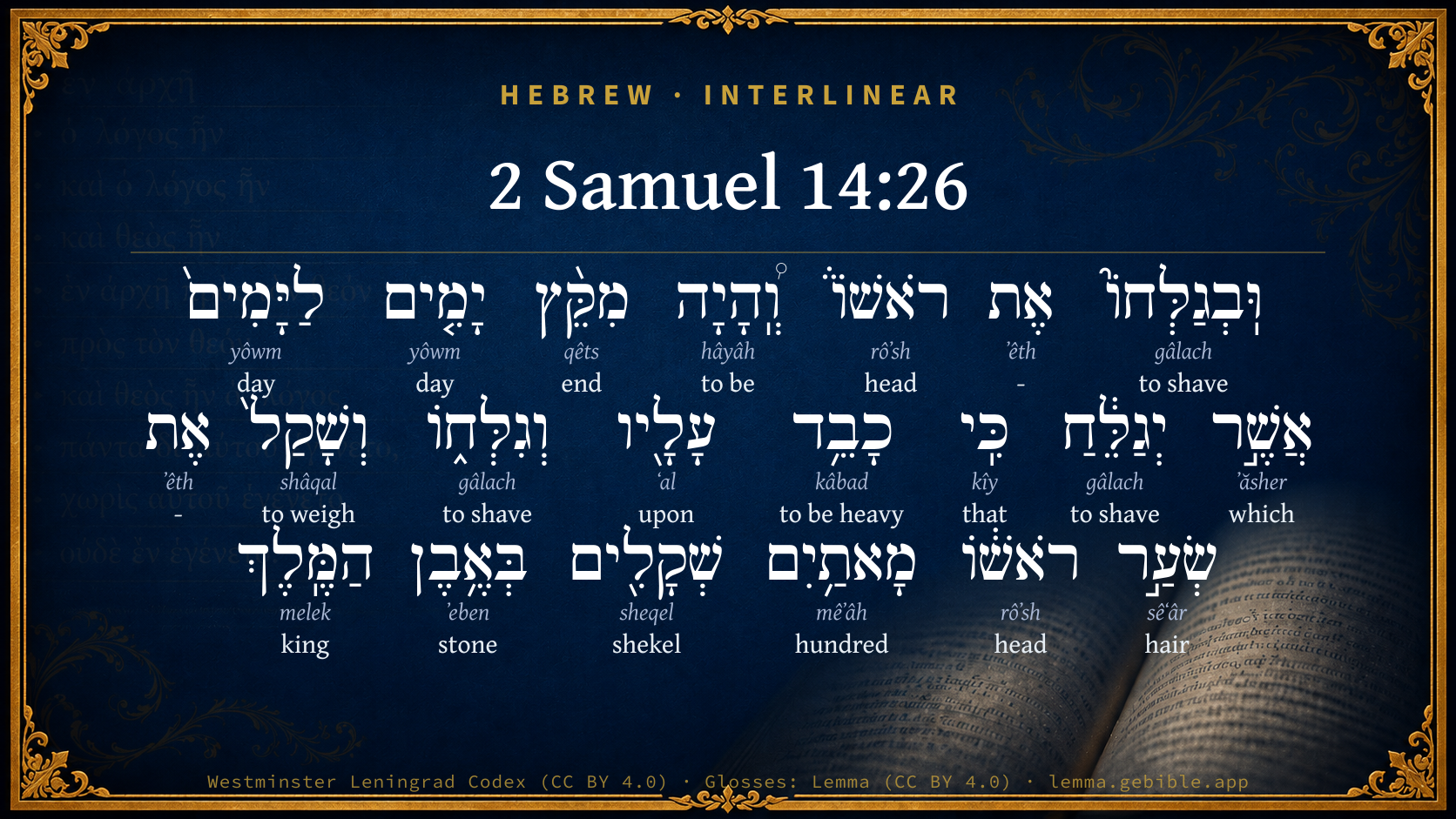
2 Samuel 14:26

Hebrew (Westminster Leningrad Codex) 2 Samuel 14:26 appears in the Hebrew Old Testament. The text above is from the Westminster Leningrad Codex. Each word links to its Strong’s number, a concise gloss, and parsing drawn from the Open Scriptures Hebrew Bible morphology. Click any word for its full Brown-Driver-Briggs (BDB) entry.
Download image
Cite this verse

2 Samuel 14:26 (World English Bible). Public Domain. Lemma interlinear Bible study tool, https://lemma.gebible.app/v/2-samuel/14/26.

Show BibTeX & RIS
BibTeX
RIS
English Translation
When he cut the hair of his head (now it was at every year's end that he cut it; because it was heavy on him, therefore he cut it); he weighed the hair of his head at two hundred shekels, after the king's weight.
World English Bible · Public Domain
Download a study sheet

One document with this verse’s original text, its word-by-word gloss line, the meaning frame, cross-references with their text, attributed commentary, and full source and license credits — printable, and it pastes into notes with its structure intact.

This verse Autodidact and up

Study sheet (.html) Plain text (.txt)

A passage Seminary Student

Up to 50 verses in one chapter. A passage sheet keeps up to 6 commentary sources and 12 cross-references per verse, in the order this page ranks them, and says so on the sheet whenever that leaves anything out. Ask for a single verse and you get the Autodidact verse sheet above.

Everything on this page stays free to read, with no account — the sheet is a download of what is already on screen, not access to it.

Want to remove ads? Support Godless Engineer
Compare translations 3

The same verse in 3 English versions, stacked beneath the original-language interlinear above. Click any original word for its lexicon entry.

Each is an independent rendering of the whole verse — the interlinear is not word-aligned to these translations.

Highlighted words mark where these versions differ — a whole-verse word diff, not a word-by-word alignment.

  • World English Bible Public Domain
    When he cut the hair of his head (now it was at every year's end that he cut it; because it was heavy on him, therefore he cut it); he weighed the hair of his head at two hundred shekels, after the king's weight.
  • King James Version Public Domain
    And when he polled his head, (for it was at every year's end that he polled it: because the hair was heavy on him, therefore he polled it:) he weighed the hair of his head at two hundred shekels after the king's weight.
  • unfoldingWord Literal Text CC BY-SA 4.0
    And when he shaved his head (and it was at the end of years to years that he would shave, because heavy on him, so he would shave it) and he weighed the hair of his head, 200 shekels by the stone of the king.

unfoldingWord Literal Text — © unfoldingWord, licensed CC BY-SA 4.0. Word-aligned USFM3 via Door43 (git.door43.org/unfoldingWord/en_ult).

Versions to compare (up to 4)

3 of 4 selected

Show all 18 translations

Every available English version of this verse, each an independent rendering of the whole verse.

  • World English Bible Public Domain
    When he cut the hair of his head (now it was at every year's end that he cut it; because it was heavy on him, therefore he cut it); he weighed the hair of his head at two hundred shekels, after the king's weight.
  • Berean Standard Bible Public Domain
    And when he cut the hair of his head—he shaved it every year because his hair got so heavy—he would weigh it out to be two hundred shekels, according to the royal standard.
  • Majority Standard Bible Public Domain
    And when he cut the hair of his head—he shaved it every year because his hair got so heavy—he would weigh it out to be two hundred shekels, according to the royal standard.
  • King James Version Public Domain
    And when he polled his head, (for it was at every year's end that he polled it: because the hair was heavy on him, therefore he polled it:) he weighed the hair of his head at two hundred shekels after the king's weight.
  • American Standard Version (1901) Public Domain
    And when he cut the hair of his head (now it was at every year's end that he cut it; because it was heavy on him, therefore he cut it); he weighed the hair of his head at two hundred shekels, after the king's weight.
  • Revised Version (1885) Public Domain
    And when he polled his head, (now it was at every year’s end that he polled it: because the hair was heavy on him, therefore he polled it:) he weighed the hair of his head at two hundred shekels, after the king’s weight.
  • Geneva Bible (1599) Public Domain
    And when he polled his head, (for at euery yeeres ende he polled it: because it was too heauie for him, therefore he polled it) he weyghed the heare of his head at two hundreth shekels by the Kings weight.
  • Douay-Rheims (1899) Public Domain
    And when he polled his hair (now he was polled once a year, because his hair was burdensome to him) he weighed the hair of his head at two hundred sicles, according to the common weight.
  • Young's Literal Translation Public Domain
    and in his polling his head -- and it hath been at the end of year by year that he polleth `it', for it `is' heavy on him, and he hath polled it -- he hath even weighed out the hair of his head -- two hundred shekels by the king's weight.
  • Literal Standard Version CC BY-SA 4.0
    and in his shaving his head—and it has been at the end of year by year that he shaves [it], for it [is] heavy on him, and he has shaved it—he has even weighed out the hair of his head—two hundred shekels by the king’s weight.
  • Unlocked Literal Bible CC BY-SA 4.0
    When he cut the hair of his head at the end of every year, because it was heavy on him, he weighed his hair; it would weigh about two hundred shekels, which is measured by the weight of the king's standard.
  • unfoldingWord Literal Text CC BY-SA 4.0
    And when he shaved his head (and it was at the end of years to years that he would shave, because heavy on him, so he would shave it) and he weighed the hair of his head, 200 shekels by the stone of the king.
  • Darby Bible Public Domain
    And when he shaved his head (for it was at every year's end that he shaved it, because it was heavy on him, therefore he shaved it), he weighed the hair of his head at two hundred shekels after the king's weight.
  • World Messianic Bible Public Domain
    When he cut the hair of his head (now it was at every year’s end that he cut it; because it was heavy on him, therefore he cut it), he weighed the hair of his head at two hundred shekels, after the king’s weight.
  • Webster's Bible Public Domain
    And when he polled his head, (for it was at every year's end that he polled it: because the hair was heavy on him, therefore he polled it:) he weighed the hair of his head at two hundred shekels after the king's weight.
  • Free Bible Version CC BY-SA 4.0
    He cut his hair every year because it got so heavy—it weighed two hundred royal shekels.
  • Bible in Basic English Public Domain
    And when he had his hair cut, (which he did at the end of every year, because of the weight of his hair;) the weight of the hair was two hundred shekels by the king's weight.
  • JPS Tanakh (1917) Public Domain
    And when he polled his head — now it was at every year's end that he polled it; because the hair was heavy on him, therefore he polled it — he weighed the hair of his head at two hundred shekels, after the king's weight.

Literal Standard Version (2020), Covenant Press — licensed CC BY-SA 4.0. Text via the HelloAO Bible API (eBible.org). Unlocked Literal Bible (unfoldingWord) — licensed CC BY-SA 4.0. Text via the HelloAO Bible API (eBible.org). unfoldingWord Literal Text — © unfoldingWord, licensed CC BY-SA 4.0. Word-aligned USFM3 via Door43 (git.door43.org/unfoldingWord/en_ult). Free Bible Version, Dr. Jonathan Gallagher — licensed CC BY-SA 4.0. Text via the HelloAO Bible API (eBible.org).

Word by word

More ways to search: Search by grammar → Find every occurrence → Compare this word →

Practice this passage: Drill this verse → Learn its vocabulary →

וּֽבְגַלְּחוֹ֮
gâlach
H1548
“and · in/at · to shave · him”
Conjunction + Preposition + Verb, Piel, Infinitive Construct + Suffix, Personal, 3rd Person, Masculine, Singular
Part of Speech
Conjunction + Preposition + Verb
Stem
Piel
Form
Infinitive Construct
Full BDB Definition

Origin: a primitive root

TWOT: 351

to poll, shave, shave off, be bald - (Piel) - to shave - to shave off - (figuratively of devastation) - (Pual) to be shaven - (Hithpael) to shave oneself
  1. אֶת ʼêth H853 “-” Particle, Direct Object
  2. רֹאשׁוֹ֒ rôʼsh H7218 “head · his” Noun, Common, Masculine, Singular, Construct + Suffix, Personal, 3rd Person, Masculine, Singular
  3. וְֽ֠הָיָה hâyâh H1961 “and · to be” Conjunction + Verb, Qal, Sequential Perfect, 3rd Person, Masculine, Singular
  4. מִקֵּ֨ץ qêts H7093 “from · end of” Preposition + Noun, Common, Masculine, Singular, Construct
  5. יָמִ֤ים yôwm H3117 “days” Noun, Common, Masculine, Plural, Absolute
  6. לַיָּמִים֙ yôwm H3117 “to/for the · days” Preposition, Determined + Noun, Common, Masculine, Plural, Absolute
  7. אֲשֶׁ֣ר ʼăsher H834 “which” Particle, Relative
  8. יְגַלֵּ֔חַ gâlach H1548 “to shave” Verb, Piel, Imperfect, 3rd Person, Masculine, Singular
  9. כִּֽי kîy H3588 “that” Conjunction
  10. כָבֵ֥ד kâbad H3513 “heavy” Adjective, Adjective, Masculine, Singular, Absolute
  11. עָלָ֖יו ʻal H5921 “upon · him” Preposition + Suffix, Personal, 3rd Person, Masculine, Singular
  12. וְגִלְּח֑וֹ gâlach H1548 “and · to shave · him” Conjunction + Verb, Piel, Sequential Perfect, 3rd Person, Masculine, Singular + Suffix, Personal, 3rd Person, Masculine, Singular
  13. וְשָׁקַל֙ shâqal H8254 “and · to weigh” Conjunction + Verb, Qal, Sequential Perfect, 3rd Person, Masculine, Singular
  14. אֶת ʼêth H853 “-” Particle, Direct Object
  15. שְׂעַ֣ר sêʻâr H8181 “hair of” Noun, Common, Masculine, Singular, Construct
  16. רֹאשׁ֔וֹ rôʼsh H7218 “head · his” Noun, Common, Masculine, Singular, Construct + Suffix, Personal, 3rd Person, Masculine, Singular
  17. מָאתַ֥יִם mêʼâh H3967 “hundred” Adjective, Cardinal number, Both, Dual, Absolute
  18. שְׁקָלִ֖ים sheqel H8255 “shekels” Noun, Common, Masculine, Plural, Absolute
  19. בְּאֶ֥בֶן ʼeben H68 “in/at · stone of” Preposition + Noun, Common, Feminine, Singular, Construct
  20. הַמֶּֽלֶךְ melek H4428 “the · king” Particle, Definite Article + Noun, Common, Masculine, Singular, Absolute

About this verse

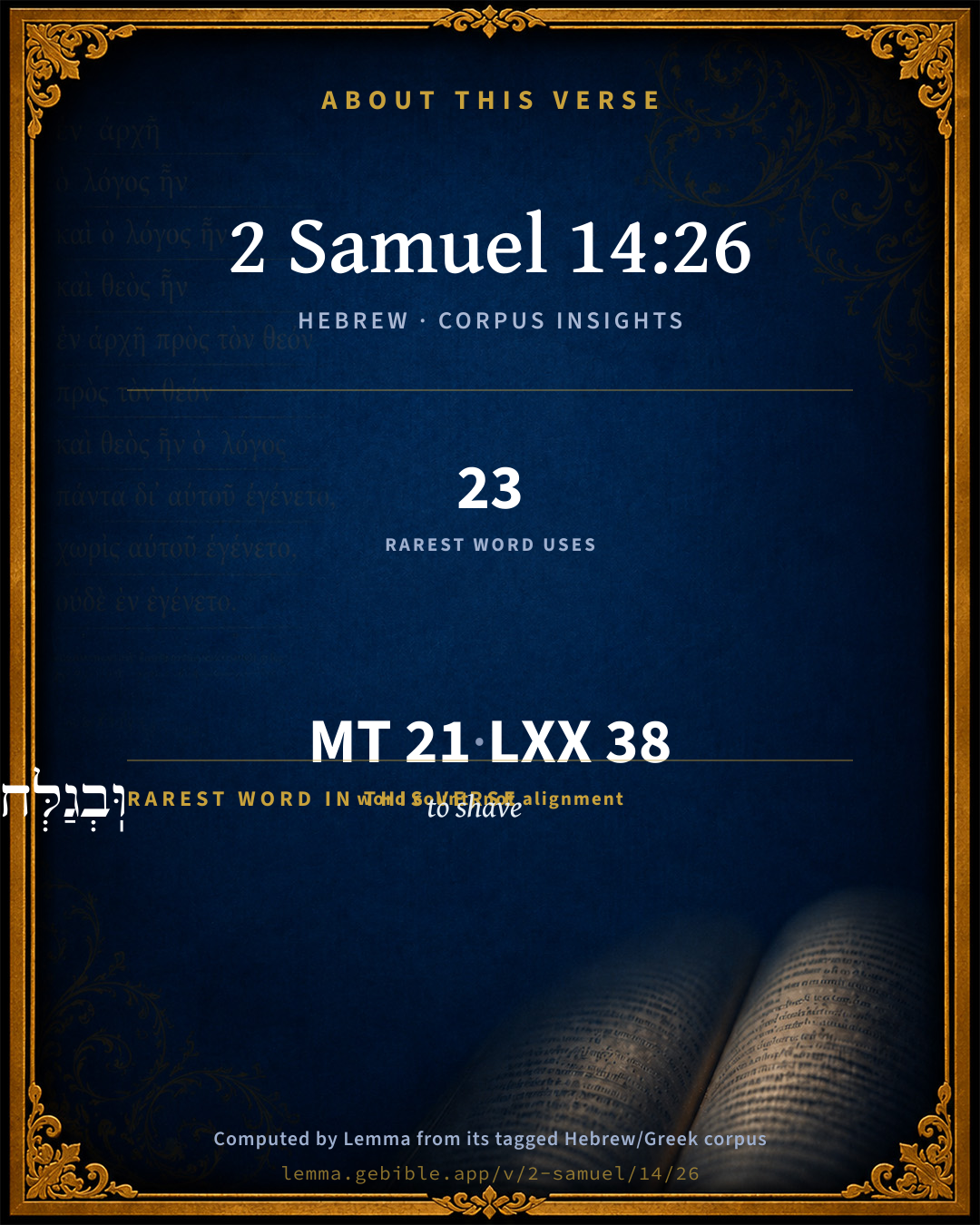
These counts appear in no published source. They are computed here, from the morphology-tagged text and Lemma’s own curated glosses. What Lemma adds →

21
words
16
distinct lemmas
Historical
section

Notable vocabulary

The rarest word here is וּֽבְגַלְּחוֹ֮ to shave H1548 — appearing just 23 times in the whole Hebrew Bible.

Shared distinctive vocabulary

וּֽבְגַלְּחוֹ֮ to shave H1548 occurs in 18 verses of the Hebrew Bible. Also found in:

Grammatical profile

  • 5 verbs
  • 9 nouns
  • 2 adjectives
  • 1 preposition
  • 1 conjunction
  • 3 particles

Verb forms

  • וּֽבְגַלְּחוֹ֮ Piel · Infinitive Construct
  • וְֽ֠הָיָה Qal · Sequential Perfect
  • יְגַלֵּ֔חַ Piel · Imperfect
  • וְגִלְּח֑וֹ Piel · Sequential Perfect
  • וְשָׁקַל֙ Qal · Sequential Perfect

Repetition

Words recur within this verse — often emphatic in Hebrew:

  • וּֽבְגַלְּחוֹ֮ to shave H1548 ×3
  • רֹאשׁוֹ֒ head H7218 ×2
  • יָמִ֤ים day H3117 ×2

Hebrew & Septuagint length

In English translation the verse runs 44 words from the Hebrew and 45 from the Septuagint (LXX English) — closely comparable.

A rough comparison of the two English renderings, which tokenize alike — not a word-level alignment.

Word counts can differ between the Hebrew and the Greek without any difference in meaning — e.g. the Hebrew direct-object marker אֵת has no separate Greek word, and Greek often adds the article ὁ.

In the original languages it is 21 Hebrew tokens and 38 Greek tokens — but the two are counted differently (Hebrew bundles its prefixes and suffixes into one token; the Greek is in lemma form), so that isn’t a like-for-like length.

Cross-references

7

Topical passages linked to 2 Samuel 14:26 in the Treasury of Scripture Knowledge — connected by theme and wording, ordered by reader-vote popularity; previews shown in the World English Bible.

  • Ezekiel 44:20 Neither shall they shave their heads, nor allow their locks to grow long; they shall only cut off the hair of their heads.
  • 2 Samuel 18:9 Absalom happened to meet the servants of David. Absalom was riding on his mule, and the mule went under the thick boughs of a great oak, and his head caught hold of the oak, and he was taken up between the sky and earth; and the mule that was under him went on.
  • 1 Corinthians 11:14 Doesn't even nature itself teach you that if a man has long hair, it is a dishonor to him?
  • Genesis 23:16 Abraham listened to Ephron. Abraham weighed to Ephron the silver which he had named in the audience of the children of Heth, four hundred shekels of silver, according to the current merchants' standard.
  • Leviticus 19:36 Just balances, just weights, a just ephah, and a just hin, shall you have. I am Yahweh your God, who brought you out of the land of Egypt.
  • Isaiah 3:24 It shall happen that instead of sweet spices, there shall be rottenness; Instead of a belt, a rope; Instead of well set hair, baldness; Instead of a robe, a girding of sackcloth; And branding instead of beauty.
  • Ezekiel 45:9–14 Thus says the Lord Yahweh: Let it suffice you, princes of Israel: remove violence and spoil, and execute justice and righteousness; dispossessing my people, says the Lord Yahweh.

Cross-references courtesy of OpenBible.info (CC BY 4.0).

Hebrew and Greek witnesses Masoretic Hebrew ↔ Greek Septuagint

The same verse in the two great witnesses to the Old Testament, shown verse-for-verse.

These are two independent witnesses, not word-aligned to each other, and the Septuagint is shown in lemma (dictionary) form.

Hebrew 2 Samuel 14:26 Masoretic · Westminster Leningrad Codex

וּֽבְגַלְּחוֹ֮ אֶת רֹאשׁוֹ֒ וְֽ֠הָיָה מִקֵּ֨ץ יָמִ֤ים לַיָּמִים֙ אֲשֶׁ֣ר יְגַלֵּ֔חַ כִּֽי כָבֵ֥ד עָלָ֖יו וְגִלְּח֑וֹ וְשָׁקַל֙ אֶת שְׂעַ֣ר רֹאשׁ֔וֹ מָאתַ֥יִם שְׁקָלִ֖ים בְּאֶ֥בֶן הַמֶּֽלֶךְ

When he cut the hair of his head (now it was at every year's end that he cut it; because it was heavy on him, therefore he cut it); he weighed the hair of his head at two hundred shekels, after the king's weight.

World English Bible · Public Domain

Greek LXX 2 Samuel 14:26 Septuagint · lemma form

καί ἐν ὁ κείρω αὐτός ὁ κεφαλή αὐτός καί γίγνομαι ἀπό ἀρχή ἡμέρα εἰς ἡμέρα ὡς ἄν κείρω ὅτι καταβαρύνω ἐπί αὐτός καί κείρω αὐτός ἵστημι ὁ θρίξ ὁ κεφαλή αὐτός διακόσιοι σίκλος ἐν ὁ σίκλος ὁ βασιλικός

And when he polled his head, (and it was at the beginning of every year that he polled it, because it grew, heavy upon him,) even when he polled it, he weighed the hair of his head, two hundred shekels according to the royal shekel.

LXX2012 (modern English Septuagint) · Public Domain

On this verse, Haydock's Catholic Bible Commentary discusses the Septuagint’s reading. Read the note in Commentary ↓

Hebrew: Westminster Leningrad Codex (CC BY 4.0). Greek: Septuagint (public domain); English from LXX2012 (modern English Septuagint) (Public Domain). How the Septuagint differs from the Hebrew →

Targum (Aramaic paraphrase)

1

The Targum is the ancient Jewish Aramaic paraphrase of the Hebrew Scriptures — an interpretive translation, not the Hebrew text itself. Onkelos (literal) and Pseudo-Jonathan (expansive) render the Torah, and Jonathan the Prophets. Coverage is partial: where no permissively-licensed English translation exists for a verse, only the Aramaic is shown. This is verse-level text, not a word-by-word alignment to the Hebrew.

  1. Targum Jonathan Prophets (Joshua–Malachi)
    וּבְסַפָּרוּתֵיהּ יַת רֵישֵׁיהּ וַהֲוָה מִזְמַן עִדַן לְעִדַן דִמְסַפֵר אֲרֵי יַקִיר עֲלוֹהִי וּמְסַפֵּר לֵיהּ וּתְקַל יַת סְעַר רֵישֵׁיהּ מָאתָן סִלְעִין בְּמַתְקְלָא דְמַלְכָּא:

    (no public-domain English translation for this verse)

    Targum Jonathan — Aramaic: “Mikraot Gedolot” (public domain). English: “Sefaria Community Translation” (CC0 1.0 (public-domain dedication)); “London "Chaldee Paraphrase," 1871” (public domain). Text via Sefaria.

Commentary

Notes on 2 Samuel 14:26 from classic Christian and Jewish commentators (each source and its license shown beneath its notes). The classic Christian expositions comment on the surrounding passage and are grouped to its opening verse, so a note may address several verses; the Jewish commentaries on the Tanakh (Rashi and others) are per-verse, so they appear only where the commentator wrote on this verse.

Lemma curates 59 commentaries, every one of them public domain or Creative Commons licensed, each selected and text-cleaned for this edition rather than reprinted as found. About our sources →

Trapp's Complete Commentary

John Trapp

2Sa 14:26 And when he polled his head, (for it was at every year’s end that he polled [it]: because [the hair] was heavy on him, therefore he polled it:) he weighed the hair of his head at two hundred shekels after the king’s weight.

Ver. 26. And when he polled his head.] He had a pride in his hair, and might well have feared some such fearful disease as is the Plica Polonica. The Romans abhorred those that wore long hair. Our Henry I repressed that vanity, though a gaiety of no charge, as undecent; and all other dissoluteness. {a}

He weighed the hair of his head.] It was not worth so much, as some sense it, but it weighed above three pounds, at sixteen ounces to the pound, when yearly polled.

{a} Dan., Hist.

John Trapp, A Commentary or Exposition upon All the Books of the Old and New Testament (1647–1656) — public domain. Text from a community e-Sword module.

Joseph Benson's Commentary

2Sa 14:26. When he polled his head, &c. — In those days hair was accounted a great ornament, and the longer it was, the more it was esteemed. And therefore it is no wonder that Absalom, who was proud, and courted popularity, should let his grow to a great length, as this rendered him still more beautiful in the people’s eyes. It was at every year’s end that he polled it — The Hebrew here,מקצ ימים לימים, mekets jamim lajamim, does not properly signify, at every year’s end, but rather, at the return of a certain season. Houbigant renders the passage, For there were certain seasons when he polled it, that he might deliver himself from the weight; and when he polled it, the weight was two hundred shekels. This weight of hair, if computed by the Jewish shekel, according to Bochart, amounts to three pounds two ounces of our weight, which certainly is prodigious, considering that only a part of it was cut off, on account of its being grown too long. Some, however, understand the expression, not of the weight, but of the price of his hair. But the remark of Bishop Patrick here seems worthy of notice: That, “when the books of Samuel were revised, after the Babylonish captivity, such weights were mentioned as were then known to them; and therefore, when the historian speaks of this weight of Absalom’s hair, he adds, by way of explanation, that it was after the king’s weight — That is, after the weight of the king of Babylon, whose shekel was only one-third of that of the Jews; and thus this large quantity of hair, which has given so much occasion to the enemies of revelation to ridicule the sacred text, is reduced so as not to seem at all enormous. Besides, we should recollect that the hair, being in those days reckoned a great ornament, was perfumed with large quantities of fragrant oils, and powdered with gold-dust, which would make it more heavy than we could otherwise imagine; and further we should remark, that it is very evident from the peculiar manner in which it is mentioned in the sacred text, that there must have been something extremely singular, even at that time, in this large quantity of Absalom’s hair.” — See Dr. Dodd, and Saurin’s 5th Dissert.

Joseph Benson's Commentary on the Old and New Testaments (1811–1818) — public domain. Text from a community e-Sword module.

Tyndale Open Study Notes

Tyndale Open Resources

14:26 cut his hair only once a year: Absalom’s hair, an aspect of his attractiveness, ended up being a deadly snare for him (see 18:9-15).

Tyndale Open Study Notes — © Tyndale Open Resources, licensed CC BY-SA 4.0. Text via the HelloAO Bible API.

Geneva Bible (1599)

Geneva Bible translators

Which weighed 6 pounds 4 ounces after half an ounce the shekel.

Geneva Bible (1599) marginal notes — public domain. Text via Bolls.life.

Adam Clarke's Commentary

Verse 26. When he polled his head] Not at any particular period, but when the hair became too heavy for him. On this account of the extraordinary weight of Absalom's hair, see the observations at the end of this chapter. 2Sa 14:30.

Adam Clarke's Commentary on the Bible (1810–1826) — public domain. Text from a community e-Sword/MySword module.

Ellicott's Commentary for English Readers

(26) Two hundred shekels.—The value of the shekel “after the king’s weight” is unknown. If it was the same with the shekel of the sanctuary, the weight mentioned would be about six pounds; if only half as much, the weight would still be very extraordinary. Some clerical error has probably arisen in copying the number in the MSS.

A Bible Commentary for English Readers, edited by Charles John Ellicott (1878–1897) — public domain. Text from a community e-Sword module.

The Cambridge Bible for Schools and Colleges

gen. ed. J. J. S. Perowne

25–27. Absalom’s person and family

26. polled] From poll, the head, comes the verb to poll, to cut the hair.

two hundred shekels after the king’s weight] If the royal shekel was the same as the sacred shekel, two hundred shekels would be about six pounds, an extraordinary weight. But perhaps the royal shekel was smaller, or as is so often the case with numbers, there may be some error in the text. It was not considered effeminate for men to wear their hair long: the Nazarites did so (Num_6:5), and Josephus says that Solomon’s body-guard had long flowing hair. Modern Arabs frequently allow the hair to grow to its natural length.

The Cambridge Bible for Schools and Colleges (gen. ed. J. J. S. Perowne; Cambridge University Press, 1878–1918) — public domain. Text from a community e-Sword module.

John Gill's Exposition

And when he polled his head,.... Or cut off the hair of it; for that was one thing, a good head of hair which he had, that made him look very comely and beautiful:

for it was at every year's end that he polled it; or cut it off once a year; but the Jews say (w) he was a perpetual Nazarite:

because the hair was heavy upon him, and therefore he polled it; it grew so very thick and long in one year's time, that he was obliged to cut it; and what might add to the weight of it, its being oiled and powdered; and, as some say, with the dust of gold, to make it look yellow and glistering:

he weighed the hair of his head at two hundred shekels, after the king's weight; and a shekel being the weight of half an ounce of avoirdupois weight, as Bishop Cumberland (x) has shown from various writers, the weight of his hair must be an hundred ounces; which was a very great weight indeed on his head. Some think that the price it was sold at, and not the weight of it, is meant; which they suppose was sold to women for ornament about their temples, and the money given either to the poor, or for the use of the sanctuary; and reckoning a shekel at two shillings and sixpence, as some do, the value of it came to twenty five pounds of our money; but the above mentioned writer (y) reduces it to about two shillings and four pence farthing; which makes the value somewhat less; but inasmuch as it is not so probable that a person of such rank should sell his hair, nor does it appear that any, such use was made of hair in those times as suggested; and this being said to be according to the king's weight or stone, by which all weights were to be regulated, it is best to understand this of the weight, and not of the price of his hair; which, according to Josephus (z), was five pounds; but, according to the above account, it must be six pounds and a quarter. The Jews say (a) this weight was according to what the inhabitants of Tiberias and Zippore used, but do not tell us what it was.

(w) Maimon. & Bartenora in Misn. Nazir, c 1. sect. 2. Bemidbar Rabba, sect. 9. fol. 194. 3. Gloss. T. Bab. Sotah, fol. 10. 2. (x) Scripture Weights and Measures, ch. 4. p. 103. (y) Ibid. p. 104. (z) Antiqu. l. 7. c. 8. sect. 5. (a) T. Bab. Sotah, fol. 10. 2.

John Gill's Exposition of the Whole Bible (1746–1763) — public domain (CC PDM 1.0). Text via the HelloAO Bible API.

Albert Barnes' Notes on the Bible

Two hundred shekels ... - The exact weight cannot be determined. If these “shekels after the king’s weight” were the same as “shekels of the sanctuary,” the weight would be about 6 lbs., which is incredible; “twenty” shekels is more probable.

Albert Barnes' Notes on the Bible (1834–1885) — public domain. Text from a community e-Sword/MySword module.

Haydock's Catholic Bible Commentary

A year. Hebrew and Septuagint, "from the end of the days to days." --- Chaldean, "as it was convenient." But the Vulgate seems the best, (Calmet) and is followed by the Protestant version. (Haydock) --- Sicles, including all his hair. The Hebrews wore their hair very long. It does not commonly grow above four inches in a year; so that the hair which was cut off could not weigh 200 sicles. (Calmet) --- Weight. Hebrew, "after the king’s stone," Beeben; but one manuscript has Boshkol, with the Septuagint, "after the king’s sicle (Kennicott) weight," at Babylon, as Pelletier supposes that this work was written towards the end of the captivity. He allows that Absalom’s hair might weigh almost 31 ounces. Some women wear above 32 ounces, if we may believe the hair-dressers. Some suppose that r (200) has been substituted instead of d (4) or c, (20) &c. But all are not convinced that the Hebrew formerly marked the numbers by letters. Septuagint have, "100 sicles," (Calmet) which some attempt to reconcile with the common reading, by saying, that they speak of the sicles of the sanctuary, which were double the weight of the king’s sicles. Yet the Alexandrian and Vatican copies agree with the Vulgate: (Haydock) and of this distinction of weights there is no proof. The Rabbins assert that the value, and not the weight, of Absalom’s hair is given; (Calmet) and that he made a present of his hair to some of his friends, who sold it to the ladies of Jerusalem, to adorn their heads. (Sanctius) --- Tirinus adopts this sentiment, and ridicules those who say that the weight is meant; as he says, 200 sicles would be equivalent to 8¾ Roman pounds, which comes near to Arbuthnot’s calculation in English. (Haydock) --- Bochart reduces the weight to four such pounds, each consisting of twelve ounces; and he supposes that the hair was so heavy, on account of the gold dust with which it was covered, according to the fashion of those times. (Josephus, [Antiquities?] viii. 1.) --- But this weight would be only accidental. (Calmet) --- Josephus ([Antiquities?] vii. 8.) intimates, that Absalom’s hair was "cut every eight days," or "for the space of eight days." It is quite incredible that it should weigh 200 sicles, or five minæ of Alexandria, each consisting of twelve ounces. The Latin interpreter reads, "every eight months." (Calmet) --- St. Epiphanius and Hero have 125 sicles, or about 31 ounces. (Haydock) --- The Babylonian sicle, here mentioned, was only the third part of that used by the Hebrews. (Du Hamel)

George Leo Haydock (1774–1849), Haydock's Catholic Family Bible and Commentary, 1859 edition — public domain. Excludes Psalms (Douay-Rheims chapter numbering differs from Protestant) and Deuterocanonical books (Catholic canon only).

Matthew Poole's English Annotations

Whereas ordinarily the hair of a man’s head which grows in a year’s space comes not to half so much. But some men’s hair grows much faster, and is much heavier, than others. But others understand this not of the weight, but of the price of his hair, which was sold by him that polled it at that rate.

Matthew Poole's English Annotations on the Holy Bible (1683–1685) — public domain. Text from a community e-Sword/MySword module.

Whedon's Commentary on the Bible

Daniel D. Whedon

26. Polled his head — Cut or clipped off the superabundant growth of the hair.

At every year’s end — Literally, from the end of days to days; that is, from time to time.

Two hundred shekels after the king’s weight — The king’s shekel is supposed to have been less than the common shekel, and Bochart makes the weight of two hundred shekels equal to three pounds and two ounces avoirdupois. Others think there is an error in the text caused by the former use of letters for numbers, and the transcriber’s mistaking one for another. Thus, ד=4, ר=200, ל=30; and one of these might easily have been mistaken for another. It is impossible positively to solve the difficulty, but in any case it is clear that the weight of Absalom’s hair was surprisingly great, and this was regarded as adding to his beauty. “The hair of men will grow as thick as that of women, and perhaps thicker; and if we may judge from the cues of the Chinese, which sometimes reach to the ground, it will grow as long; and such hair, if of proportionate bulk, must, one would think, weigh at least three or four pounds. Indeed, we have read the well known case of a lady whose hair reached the ground, and weighed upon her head (and therefore without including the weight of the parts nearest the scalp) upwards of four pounds.” — Kitto.

Daniel D. Whedon (gen. ed.), Commentary on the Old and New Testaments (1874–1909) — public domain. Text from a community e-Sword module.

The Pulpit Commentary

Two hundred shekels after the king"s weight. Unless the royal shekel was smaller than the shekel of the sanctuary, the weight of Absalom"s hair would be six pounds. But we cannot believe that the king"s shekel was not full weight; for to imagine this is to suppose that the king had tampered with the coinage; for the shekel was a coin as well as a weight, being originally a fixed quantity of silver. As a matter of fact, David had amassed too much silver to have need of resorting to what is the expedient of feeble and impoverished princes. Nor can we grant an error in the number; for the versions all agree with the Hebrew, so that any mistake must, at all events, be of great antiquity. Josephus says that Solomon"s body guard wore long hair powdered with gold dust, and undoubtedly Absalom"s hair was something extraordinary. (2Sa_18:9) But six pounds is so enormous a weight that it is just possible that some ancient copyist has enlarged the number, to make it accord with a legend current among the people, in which this feature of Absalom"s beauty had been exaggerated.

The Pulpit Commentary (1880–1919), ed. H.D.M. Spence-Jones & Joseph S. Exell — public domain. Text from a community e-Sword module.

John Wesley's Explanatory Notes

Weighed - Others understand this not of the weight, but of the price of his hair.

John Wesley, Explanatory Notes Upon the Whole Bible (1754–1765) — public domain. Text via the GEBible commentary corpus.

Lesson kit

Teaching starters — assembled from the data on this page, not authored interpretation. Every prompt links to the verse data it draws on. Edit before teaching.

2 Samuel, in the Historical, opens this verse with 21 words (16 distinct Hebrew lemmas). Its most distinctive word is gâlach (“to shave”). A historical commentator’s framing appears above. Read the whole chapter for the surrounding context.

Discussion questions

  1. What does “to shave” (gâlach) contribute to the verse as a whole?
  2. Genesis 41:14 shares the word «to shave» with this verse. How do the two illuminate each other?
  3. “to shave” occurs 3× in this one verse. What is the effect of the repetition?
  4. These translations render this verse differently. What is at stake in choosing one wording over another?
  5. The verb «וּֽבְגַלְּחוֹ֮» is Piel Infinitive Construct. How does its form color the action?
  6. Reading how Trapp's Complete Commentary and Joseph Benson's Commentary read this verse, where do the two commentators agree and where do they part?

Things to notice

Reading settings

Reading text

Shown beneath each verse's original-language words.

Old Testament
Old Testament edition

Read the OT as the Masoretic Hebrew (MT) or the Greek Septuagint (LXX).

English shown for the Greek Septuagint (in the Hebrew ↔ Greek comparison).

Comparing translations? Open the Compare panel on any verse page to stack up to four side by side.