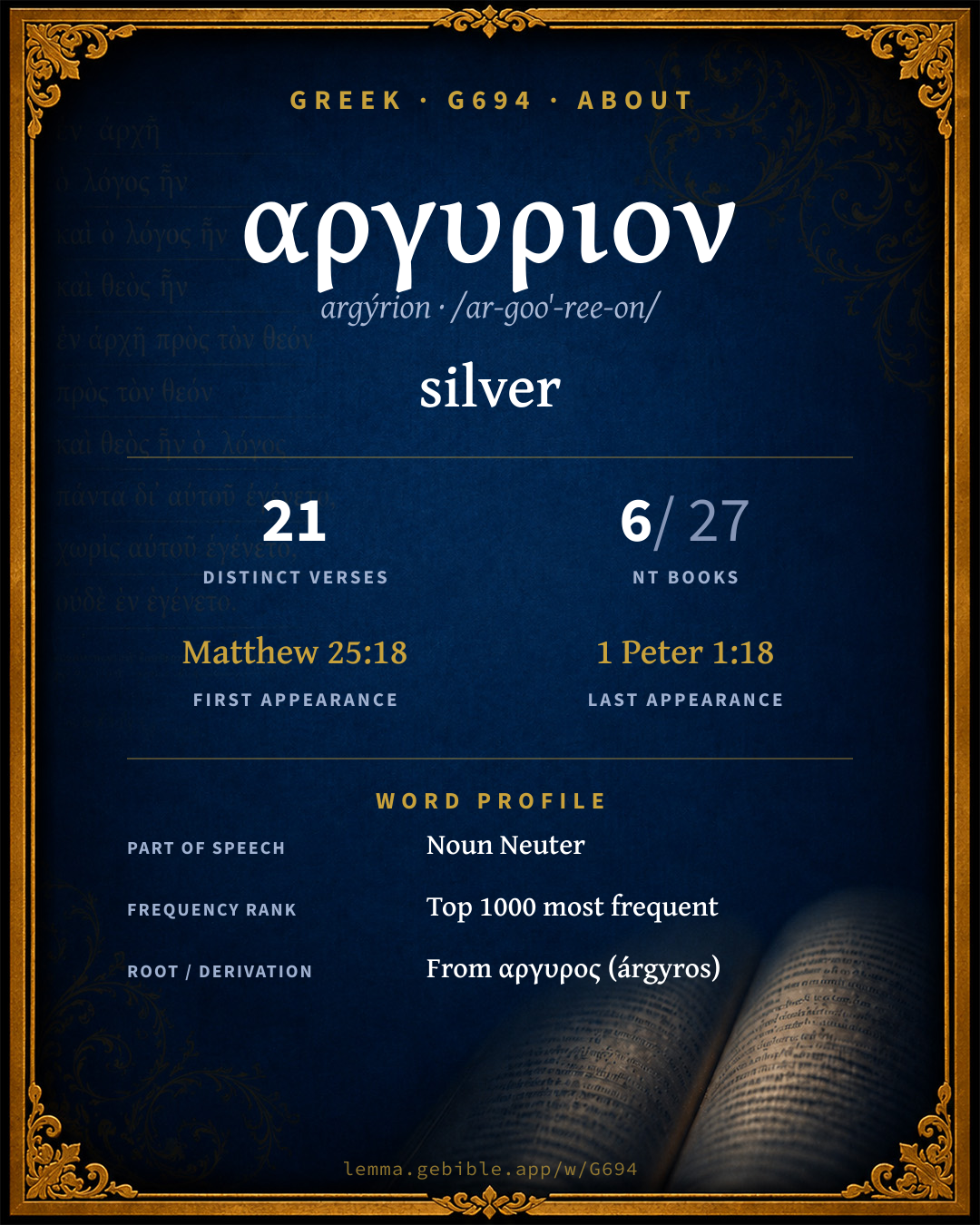
ἀργύριον
silver
‘silver’ is one of 3 main senses fuller range ↓
Full lexicon entry — Thayer's Greek Lexicon
From Thayer's Greek Lexicon
Where this word appears
Grammar key — what these labels mean
Part of speech
- Noun
- A naming word — a person, place, thing, or idea.
Case
- Accusative
- The case of the direct object and of extent.
- Genitive
- The case of source, possession, or “of” — answers “whose / from what.”
- Dative
- The case of the indirect object, means, or location — “to / for / with / in.”
- Nominative
- The case of the subject (and the predicate nominative).
Gender
- Neuter
- Grammatically neuter.
Number
- Plural
- More than one.
- Singular
- One.
Every verse where G694 appears in the Book of 1 Corinthians — 1 distinct verse. Click any verse to open its interlinear word-by-word view. Verse text shown in the World English Bible for context — . Each verse’s Greek form is shown with its reference; the English is not keyword-highlighted, since the data carries no word-level English alignment. Use “Compare translations” on any verse to read it across multiple English versions. This concordance covers the Greek New Testament; Septuagint (Greek Old Testament) occurrences of this word are not indexed here.
1 Corinthians
About this entry
At a glance — auto-summarized from this page’s data, not written by a person. Every figure links to its source below. This summary describes the numbers; it doesn’t interpret them.
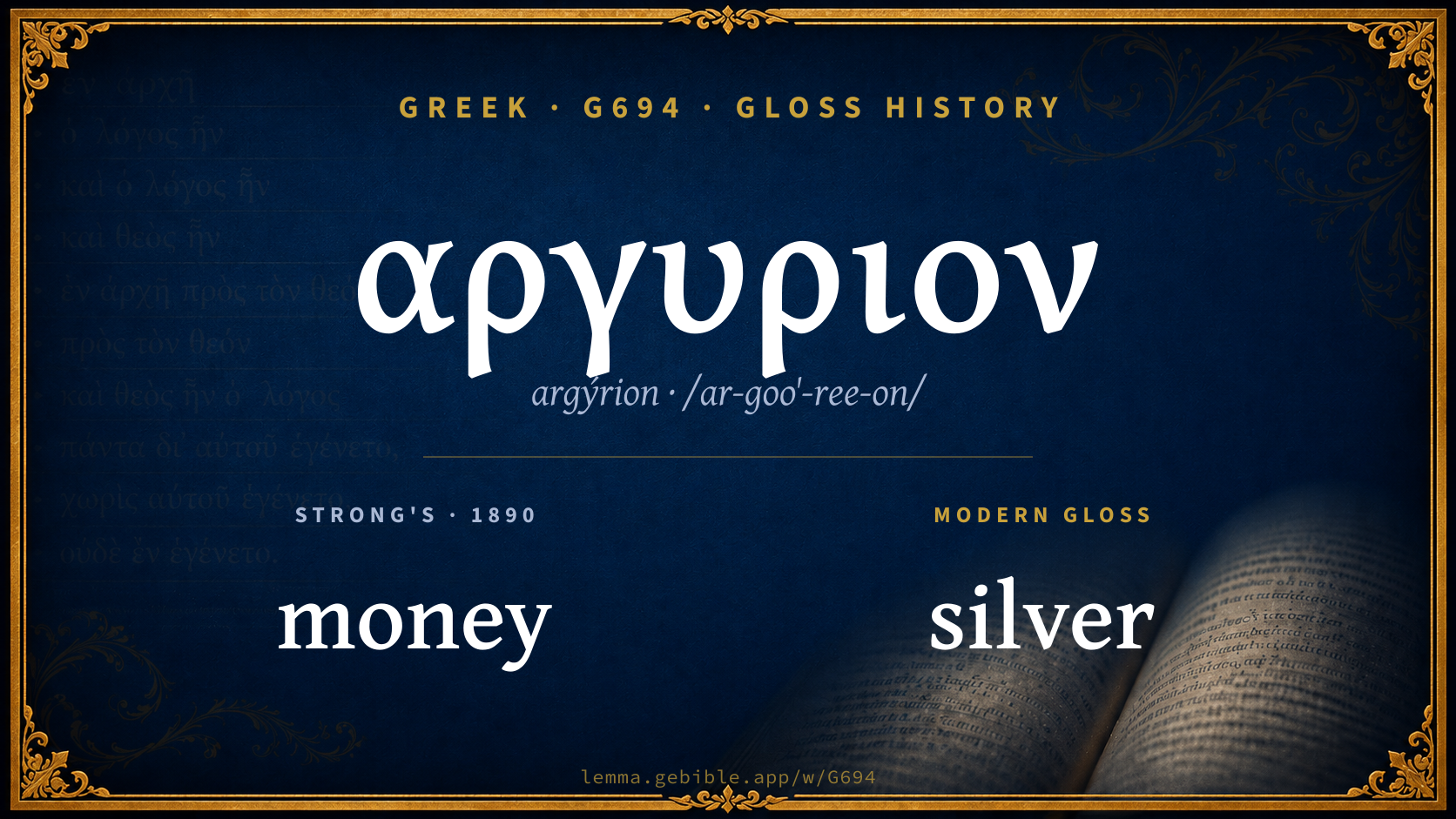
αργυριον — transliterated argýrion — is a Greek noun carrying the sense “silver.” Older and newer Bibles part ways — “money” in the King James Version, “silver” (unfoldingWord Literal Text) in modern versions. See the renderings breakdown. It appears 21 verses across 6 books of the Greek New Testament, among its uncommon vocabulary. More than a third of its appearances fall in Matthew. Thayer's distinguishes 3 senses for it. Each statement above links to its evidence; the full detail follows below.
Gloss history
Strong's 1890 vs modern scholarship
About this word
Strong's G694 catalogs a Greek word from the Greek New Testament.
These counts are not copied from any lexicon or concordance. They are computed here, from the morphology-tagged Greek New Testament. What Lemma adds →
- 21
- distinct verses
- The word appears in 21 distinct verses.
- 6 / 27
- NT books
- The word appears in 6 of 27 New Testament books.
- #607
- by frequency
- Top 1000 most frequent Greek words (rank 607 of 5,347 Greek words by occurrence).
View all 21 occurrences in the concordance →
By section of the New Testament
By traditional corpus
Conventional, traditional groupings — biblical authorship is debated, so this is a traditional corpus grouping, not an authorship claim. Some books belong to more than one corpus (Luke is in both the Gospels and the Lukan corpus, and so on), so these shares overlap and need not total 100%. Each figure is a share of the word’s 21 distinct verses.
- Gospels 14 verses · 67%
- Lukan (Luke–Acts) 9 verses · 43%
- Pauline corpus 1 verse · 5%
- General (Catholic) Epistles 1 verse · 5%
How translations render this word
Counts come from each version’s own published word-to-Strong’s tagging or interlinear alignment — an approximate guide to how each version renders this word, not a word-level alignment the data otherwise carries. Because each total is that version’s own tagged count, the per-version totals vary from one another and need not match the appearance or distinct-verse counts above. These counts may also differ from a printed concordance because Lemma counts each distinctly tagged rendering and does not collapse phrase taggings into a single head-word total. This is a fixed set of word-tagged versions (KJV, ASV, BSB, ULT) and does not change with the reading translation you choose elsewhere. Each version’s license is shown beside its name below (and on Sources).
- King James Version: Money 11×, Pieces of silver 5×, Silver 3×
- American Standard Version: Money 8×, Pieces of silver 5×, Silver 3×
- Berean Standard Bible: Money 8×, Silver 6×, Pieces of silver 4×
- unfoldingWord Literal Text: Silver 10×, Pieces of silver 8×, Money 2×
King James Version Public Domain
Renders G694 across 20 tagged occurrences — most commonly:
Plus 1 rendering that appears only once — usually multi-word phrases or single function words the recovered tagging swept in, not distinct renderings.
American Standard Version Public Domain
Renders G694 across 20 tagged occurrences — most commonly:
Plus 4 renderings that appear only once — usually multi-word phrases or single function words the recovered tagging swept in, not distinct renderings.
Berean Standard Bible Public Domain
Renders G694 across 20 tagged occurrences — most commonly:
Plus 2 renderings that appear only once — usually multi-word phrases or single function words the recovered tagging swept in, not distinct renderings.
unfoldingWord Literal Text CC BY-SA 4.0
Renders G694 across 20 tagged occurrences — most commonly:
Senses in Thayer's
The 3 senses Thayer's distinguishes for this word, in lexicon order (not ranked by frequency or importance). The full entry — with sub-senses — is in the Lexicon Entry tab.
- silver
- money
- a silver coin, silver piece, a shekel
Word origin
Derived from αργυρος (árgyros) (G696) — silver.
Neuter of a presumed derivative of G696 ; silvery that is (by implication) cash ; specifically a silverling (that is drachma or shekel ): - money (piece of) silver (piece).
— Strong’s Exhaustive Concordance (1890), public domain.
Forms in the corpus
The 6 distinct written forms G694 takes in the Greek New Testament, most frequent first — each parse links to that case’s occurrences in the concordance.
| Form | Parsing | Example | Uses |
|---|---|---|---|
| ἀργύριον argýrion | Noun, Accusative, Singular, Neuter | Matthew 25:18 | 8 |
| ἀργύρια argýria | Noun, Accusative, Plural, Neuter | Matthew 26:15 | 7 |
| ἀργυρίου argyríou | Noun, Genitive, Singular, Neuter | Acts 7:16 | 3 |
| ἀργυρίῳ argyríō | Noun, Dative, Singular, Neuter | 1 Peter 1:18 | 1 |
| ἀργύριά argýriá | Noun, Accusative, Plural, Neuter | Matthew 25:27 | 1 |
| ἀργύριόν argýrión | Noun, Nominative, Singular, Neuter | Acts 8:20 | 1 |
Same root — word family
Other Thayer's entries built from the same root as G694, grouped by Strong’s listed origin. These share a root / origin per the lexicon — not necessarily a shared meaning. Each links to that word’s own entry.
Derives from
Shares the same root
Compare all same-root words → They share a root, not necessarily a meaning.
Septuagint usage
The same Greek word αργυριον appears 309 times in the Greek Old Testament (Septuagint), across 276 verses in 35 books.
- 309
- LXX occurrences
- Tagged occurrences of this Greek word in the Septuagint.
- 276
- verses
- Distinct Septuagint verses containing this word.
- 35 / 39
- OT books
- The word appears in 35 of the 39 Old Testament books.
Sample Septuagint occurrences
- Genesis 13:2 ἀργύριον
- Exodus 21:11 ἀργύριον
- Leviticus 5:15 ἀργύριον
- Numbers 3:48 ἀργύριον
- Deuteronomy 2:6 ἀργύριον
- Joshua 6:19 ἀργύριον
- Judges 5:19 ἀργύριον
- 1 Samuel 2:36 ἀργύριον
- 2 Samuel 8:11 ἀργύριον
- 1 Kings 7:37 ἀργύριον
- 2 Kings 5:5 ἀργύριον
- 1 Chronicles 18:11 ἀργύριον
Septuagint occurrences (same lexeme)
Every verse where the same Strong’s number (G694) appears in the Greek Septuagint — showing the first 50 of 276. Verse text shown in the World English Bible for context; the Greek form is the matched word — the English is not keyword-highlighted.
- Genesis 13:2 ἀργύριον Abram was very rich in cattle, in silver, and in gold.
- Genesis 23:9 ἀργύριον that he may give me the cave of Machpelah, which he has, which is in the end of his field. For the full price let him give it to me in the midst of you for a possession of a burying-place."
- Genesis 23:13 ἀργύριον He spoke to Ephron in the audience of the people of the land, saying, "But if you will, please hear me. I will give the price of the field. Take it from me, and I will bury my dead there."
- Genesis 23:15 ἀργύριον "My lord, listen to me. What is a piece of land worth four hundred shekels of silver between me and you? Therefore bury your dead."
- Genesis 23:16 ἀργύριον Abraham listened to Ephron. Abraham weighed to Ephron the silver which he had named in the audience of the children of Heth, four hundred shekels of silver, according to the current merchants' standard.
- Genesis 24:35 ἀργύριον Yahweh has blessed my master greatly. He has become great. He has given him flocks and herds, silver and gold, men-servants and maid-servants, and camels and donkeys.
- Genesis 31:15 ἀργύριον Aren't we accounted by him as foreigners? For he has sold us, and has also quite devoured our money.
- Genesis 42:25 ἀργύριον Then Joseph commanded to fill their bags with grain, and to restore every man's money into his sack, and to give them food for the way. So it done to them.
- Genesis 42:27 ἀργύριον As one of them opened his sack to give his donkey food in the lodging-place, he saw his money. Behold, it was in the mouth of his sack.
- Genesis 42:28 ἀργύριον He said to his brothers, "My money is restored! Behold, it is even in my sack." Their hearts failed them, and they turned trembling one to another, saying, "What is this that God has done to us?"
- Genesis 42:35 ἀργύριον It happened as they emptied their sacks, that behold, every man's bundle of money was in his sack. When they and their father saw their bundles of money, they were afraid.
- Genesis 43:12 ἀργύριον and take double money in your hand, with the money that was returned in the mouth of your sacks carry again in your hand. Perhaps it was an oversight.
- Genesis 43:15 ἀργύριον The men took that present, and they took double money in their hand, and Benjamin; and rose up, went down to Egypt, and stood before Joseph.
- Genesis 43:18 ἀργύριον The men were afraid, because they were brought to Joseph's house; and they said, "Because of the money that was returned in our sacks at the first time are we brought in; that he may seek occasion against us, and fall on us, and take us for bondservants, along with our donkeys."
- Genesis 43:21 ἀργύριον and it happened, when we came to the lodging-place, that we opened our sacks, and, behold, every man's money was in the mouth of his sack, our money in full weight. We have brought it again in our hand.
- Genesis 43:22 ἀργύριον We have brought down other money in our hand to buy food. We don't know who put our money in our sacks."
- Genesis 43:23 ἀργύριον He said, "Peace be to you. Don't be afraid. Your God, and the God of your father, has given you treasure in your sacks. I received your money." He brought Simeon out to them.
- Genesis 44:1 ἀργύριον He commanded the steward of his house, saying, "Fill the men's sacks with food, as much as they can carry, and put every man's money in his sack's mouth.
- Genesis 44:8 ἀργύριον Behold, the money, which we found in our sacks' mouths, we brought again to you out of the land of Canaan. How then should we steal silver or gold out of your lord's house?
- Genesis 47:14 ἀργύριον Joseph gathered up all the money that was found in the land of Egypt, and in the land of Canaan, for the grain which they bought: and Joseph brought the money into Pharaoh's house.
- Genesis 47:15 ἀργύριον When the money was all spent in the land of Egypt, and in the land of Canaan, all the Egyptians came to Joseph, and said, "Give us bread, for why should we die in your presence? For our money fails."
- Genesis 47:16 ἀργύριον Joseph said, "Give your cattle; and I will give you food for your cattle, if money fails."
- Genesis 47:18 ἀργύριον When that year was ended, they came to him the second year, and said to him, "We will not hide from my lord how our money is all spent, and the herds of cattle are my lord's. There is nothing left in the sight of my lord, but our bodies, and our lands.
- Exodus 21:11 ἀργύριον If he doesn't do these three things for her, she may go free without paying any money.
- Exodus 21:21 ἀργύριον Notwithstanding, if he gets up after a day or two, he shall not be punished, for he is his property.
- Exodus 21:32 ἀργύριον If the bull gores a man-servant or a maid-servant, thirty shekels of silver shall be given to their master, and the ox shall be stoned.
- Exodus 21:34 ἀργύριον the owner of the pit shall make it good. He shall give money to its owner, and the dead animal shall be his.
- Exodus 21:35 ἀργύριον "If one man's bull injures another's, so that it dies, then they shall sell the live bull, and divide its price; and they shall also divide the dead animal.
- Exodus 22:6 ἀργύριον "If fire breaks out, and catches in thorns so that the shocks of grain, or the standing grain, or the field are consumed; he who kindled the fire shall surely make restitution.
- Exodus 22:16 ἀργύριον "If a man entices a virgin who isn't pledged to be married, and lies with her, he shall surely pay a dowry for her to be his wife.
- Exodus 22:24 ἀργύριον and my wrath will grow hot, and I will kill you with the sword; and your wives shall be widows, and your children fatherless.
- Exodus 25:3 ἀργύριον This is the offering which you shall take from them: gold, silver, brass,
- Exodus 27:17 ἀργύριον All the pillars of the court round about shall be filleted with silver; their hooks of silver, and their sockets of brass.
- Exodus 30:16 ἀργύριον You shall take the atonement money from the children of Israel, and shall appoint it for the service of the tent of meeting; that it may be a memorial for the children of Israel before Yahweh, to make atonement for your souls."
- Exodus 31:4 ἀργύριον to devise skillful works, to work in gold, and in silver, and in brass,
- Exodus 35:5 ἀργύριον 'Take from among you an offering to Yahweh. Whoever is of a willing heart, let him bring it, Yahweh's offering: gold, silver, brass,
- Exodus 35:24 ἀργύριον Everyone who did offer an offering of silver and brass brought Yahweh's offering; and everyone, with whom was found acacia wood for any work of the service, brought it.
- Exodus 35:32 ἀργύριον and to make skillful works, to work in gold, in silver, in brass,
- Exodus 37:15 ἀργύριον He made the poles of acacia wood, and overlaid them with gold, to carry the table.
- Exodus 37:17 ἀργύριον He made the lampstand of pure gold. He made the lampstand of beaten work. Its base, its shaft, its cups, its buds, and its flowers were of one piece with it.
- Exodus 37:18 ἀργύριον There were six branches going out of its sides: three branches of the lampstand out of its one side, and three branches of the lampstand out of its other side:
- Exodus 39:2 ἀργύριον He made the ephod of gold, blue, purple, scarlet, and fine twined linen.
- Exodus 39:4 ἀργύριον They made shoulder-pieces for it, joined together. At the two ends it was joined together.
- Leviticus 5:15 ἀργύριον "If anyone commits a trespass, and sins unwittingly, in the holy things of Yahweh; then he shall bring his trespass offering to Yahweh, a ram without blemish from the flock, according to your estimation in silver by shekels, after the shekel of the sanctuary, for a trespass offering.
- Leviticus 5:18 ἀργύριον He shall bring a ram without blemish from of the flock, according to your estimation, for a trespass offering, to the priest; and the priest shall make atonement for him concerning the thing in which he sinned and didn't know it, and he will be forgiven.
- Leviticus 22:11 ἀργύριον But if a priest buys a slave, purchased by his money, he shall eat of it; and such as are born in his house, they shall eat of his bread.
- Leviticus 25:37 ἀργύριον You shall not lend him your money at interest, nor give him your food for profit.
- Leviticus 25:50 ἀργύριον He shall reckon with him who bought him from the year that he sold himself to him to the Year of Jubilee: and the price of his sale shall be according to the number of years; according to the time of a hired servant shall he be with him.
- Leviticus 25:51 ἀργύριον If there are yet many years, according to them he shall give back the price of his redemption out of the money that he was bought for.
- Leviticus 27:3 ἀργύριον Your valuation shall be of a male from twenty years old even to sixty years old, even your valuation shall be fifty shekels of silver, after the shekel of the sanctuary.
These are occurrences of the same Greek lexeme (G694) in the Septuagint — not a translation of any one Hebrew word. The store carries no word-level Hebrew↔Greek alignment, so no Hebrew original is asserted here. Counts come from the recovered LXX Strong's tagging — high-frequency vocabulary is well covered, while rare or late forms may be untagged — so they reflect tagged occurrences and may slightly undercount.