

1 Peter 1:18
Greek (Tischendorf 8th ed.) 1 Peter 1:18 appears in the Greek New Testament. The text above is from the Tischendorf 8th edition. Each word links to its Strong’s number and a concise gloss. Click any word for its full Thayer’s Greek Lexicon entry.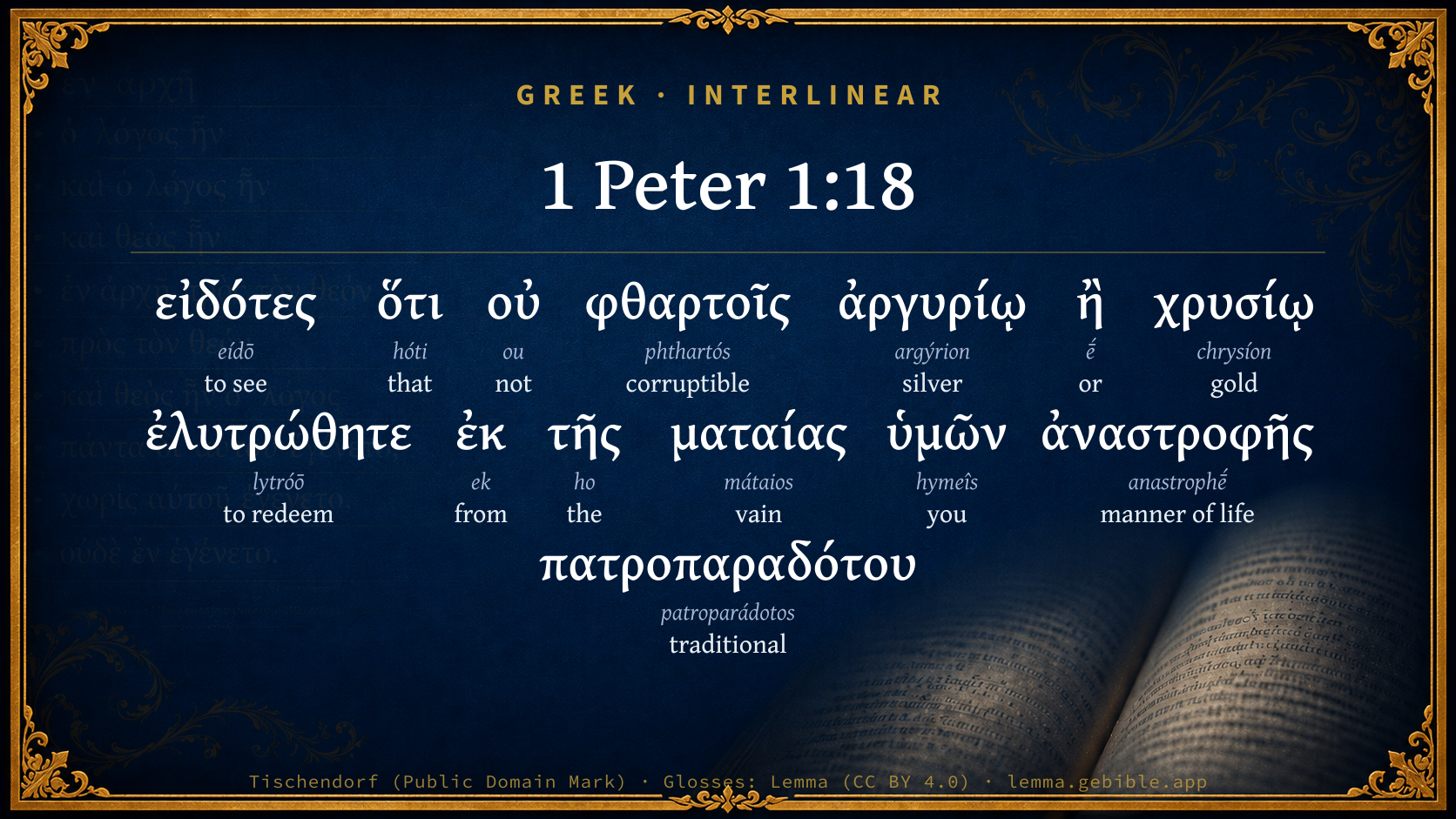
knowing that you were redeemed, not with corruptible things, with silver or gold, from the useless way of life handed down from your fathers,
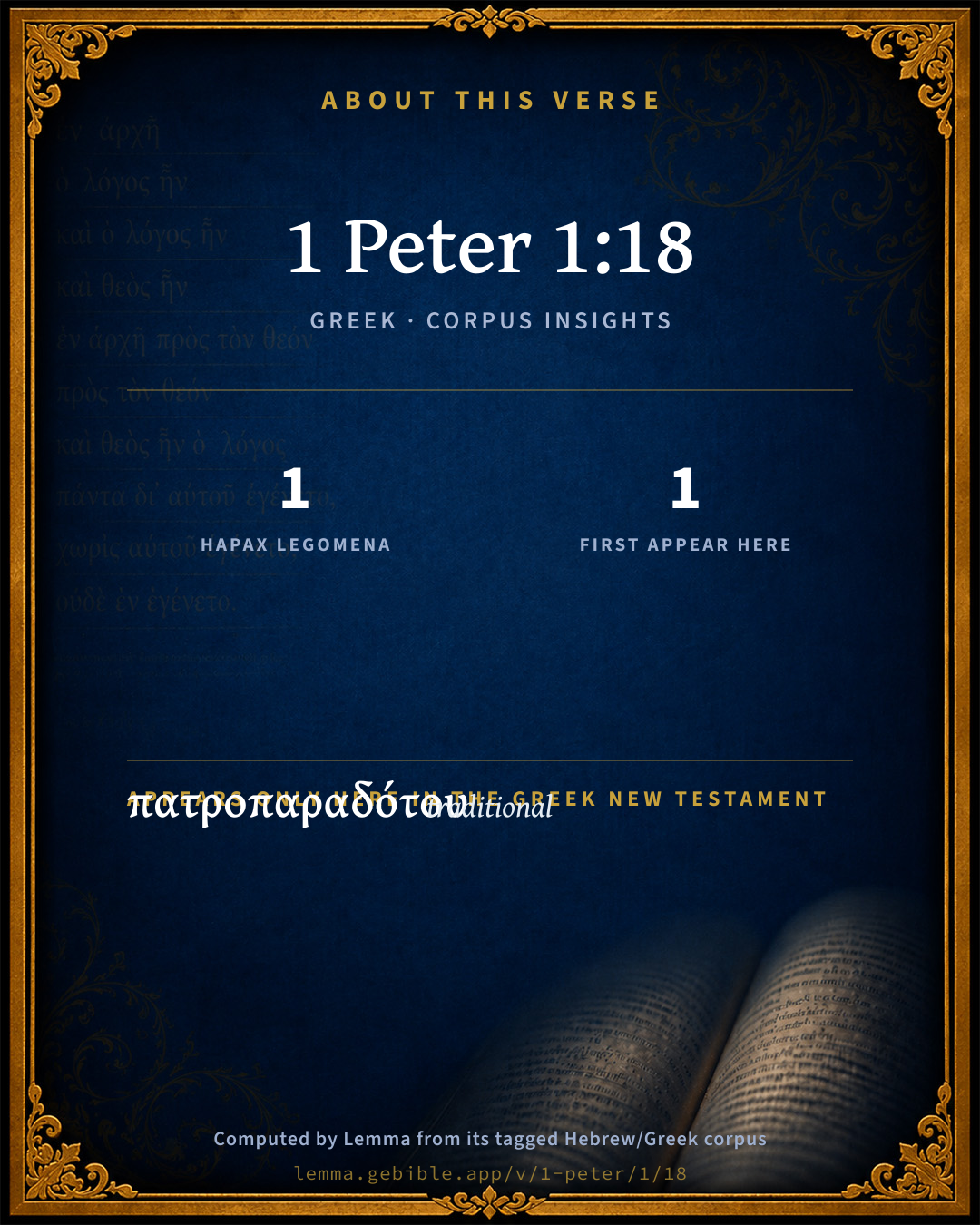
- 1 hapax legomenon — only here in the Greek New Testament
- 1 first appearance in the Greek New Testament
Download a study sheet
One document with this verse’s original text, its word-by-word gloss line, the meaning frame, cross-references with their text, attributed commentary, and full source and license credits — printable, and it pastes into notes with its structure intact.
This verse Autodidact and up
A passage Seminary Student
Up to 50 verses in one chapter. A passage sheet keeps up to 6 commentary sources and 12 cross-references per verse, in the order this page ranks them, and says so on the sheet whenever that leaves anything out. Ask for a single verse and you get the Autodidact verse sheet above.
Everything on this page stays free to read, with no account — the sheet is a download of what is already on screen, not access to it.
Compare translations 3
The same verse in 3 English versions, stacked beneath the original-language interlinear above. Click any original word for its lexicon entry.
Each is an independent rendering of the whole verse — the interlinear is not word-aligned to these translations.
Highlighted words mark where these versions differ — a whole-verse word diff, not a word-by-word alignment.
-
World English Bible Public Domain
knowing that you were redeemed, not with corruptible things, with silver or gold, from the useless way of life handed down from your fathers,
-
King James Version Public Domain
Forasmuch as ye know that ye were not redeemed with corruptible things, as silver and gold, from your vain conversation received by tradition from your fathers;
-
unfoldingWord Literal Text CC BY-SA 4.0
knowing that you have been redeemed not with perishable things, with silver or with gold, from your futile behavior handed down from your fathers,
unfoldingWord Literal Text — © unfoldingWord, licensed CC BY-SA 4.0. Word-aligned USFM3 via Door43 (git.door43.org/unfoldingWord/en_ult).
Show all 19 translations
Every available English version of this verse, each an independent rendering of the whole verse.
-
World English Bible Public Domain
knowing that you were redeemed, not with corruptible things, with silver or gold, from the useless way of life handed down from your fathers,
-
Berean Standard Bible Public Domain
For you know that it was not with perishable things such as silver or gold that you were redeemed from the empty way of life you inherited from your forefathers,
-
Majority Standard Bible Public Domain
For you know that it was not with perishable things such as silver or gold that you were redeemed from the empty way of life you inherited from your forefathers,
-
King James Version Public Domain
Forasmuch as ye know that ye were not redeemed with corruptible things, as silver and gold, from your vain conversation received by tradition from your fathers;
-
American Standard Version (1901) Public Domain
knowing that ye were redeemed, not with corruptible things, with silver or gold, from your vain manner of life handed down from your fathers;
-
Revised Version (1885) Public Domain
knowing that ye were redeemed, not with corruptible things, with silver or gold, from your vain manner of life handed down from your fathers;
-
Geneva Bible (1599) Public Domain
Knowing that yee were not redeemed with corruptible things, as siluer and golde, from your vaine conuersation, receiued by the traditions of the fathers,
-
Douay-Rheims (1899) Public Domain
Knowing that you were not redeemed with corruptible things as gold or silver, from your vain conversation of the tradition of your fathers:
-
Young's Literal Translation Public Domain
having known that, not with corruptible things -- silver or gold -- were ye redeemed from your foolish behaviour delivered by fathers,
-
Literal Standard Version CC BY-SA 4.0
having known that, not with corruptible things—silver or gold—were you redeemed from your foolish behavior inherited from our forefathers,
-
Unlocked Literal Bible CC BY-SA 4.0
You know that it was not with perishable silver or gold that you have been redeemed from the foolish behavior that you learned from your fathers.
-
unfoldingWord Literal Text CC BY-SA 4.0
knowing that you have been redeemed not with perishable things, with silver or with gold, from your futile behavior handed down from your fathers,
-
Darby Bible Public Domain
knowing that ye have been redeemed, not by corruptible [things, as] silver or gold, from your vain conversation handed down from [your] fathers,
-
World Messianic Bible Public Domain
knowing that you were redeemed, not with corruptible things like silver or gold, from the useless way of life handed down from your fathers,
-
Webster's Bible Public Domain
Forasmuch as ye know that ye were not redeemed with corruptible things, as silver and gold, from your vain course of life received by tradition from your fathers;
-
Free Bible Version CC BY-SA 4.0
You already know that you were not set free from your pointless way of living that you inherited from your forefathers by things that don't have lasting value, like silver or gold.
-
Bible in Basic English Public Domain
Being conscious that you have been made free from that foolish way of life which was your heritage from your fathers, not through a payment of things like silver or gold which come to destruction,
-
Text-Critical English NT CC BY 4.0
For you know that you were redeemed from the empty way of life handed down to you from your fathers, not with perishable things like silver or gold,
-
Tyndale New Testament (1534) Public Domain
For as moche as ye know how that ye were not redemed with corruptible sylver and golde from youre vayne conversacion which ye receaved by the tradicions of the fathers:
Literal Standard Version (2020), Covenant Press — licensed CC BY-SA 4.0. Text via the HelloAO Bible API (eBible.org). Unlocked Literal Bible (unfoldingWord) — licensed CC BY-SA 4.0. Text via the HelloAO Bible API (eBible.org). unfoldingWord Literal Text — © unfoldingWord, licensed CC BY-SA 4.0. Word-aligned USFM3 via Door43 (git.door43.org/unfoldingWord/en_ult). Free Bible Version, Dr. Jonathan Gallagher — licensed CC BY-SA 4.0. Text via the HelloAO Bible API (eBible.org).
Word by word
More ways to search: Search by grammar → Find every occurrence → Compare this word →
Practice this passage: Drill this verse → Learn its vocabulary →
- Appears 1× in the Greek New Testament
- First appears here
- Part of Speech
- Adjective
- Case
- Genitive
- Number
- Singular
- Gender
- Feminine
Full Thayer's Definition
- εἰδότες eídō G1492 “to see” Verb, Perfect, Active, Participle, Nominative, Plural, Masculine
- ὅτι hóti G3754 “that” Conjunction
- οὐ ou G3756 “not” Particle, Negative
- φθαρτοῖς phthartós G5349 “corruptible” Adjective, Dative, Plural, Neuter
- ἀργυρίῳ argýrion G694 “silver” Noun, Dative, Singular, Neuter
- ἢ ḗ G2228 “or” Particle
- χρυσίῳ chrysíon G5553 “gold” Noun, Dative, Singular, Neuter
- ἐλυτρώθητε lytróō G3084 “to redeem” Verb, Aorist, Passive, Indicative, 2nd person, Plural
- ἐκ ek G1537 “from” Preposition
- τῆς ho G3588 “the” Article, Genitive, Singular, Feminine
- ματαίας mátaios G3152 “vain” Adjective, Genitive, Singular, Feminine
- ὑμῶν hymeîs G5210 “you” Personal pronoun, 2nd person, Genitive, Plural
- ἀναστροφῆς anastrophḗ G391 “manner of life” Noun, Genitive, Singular, Feminine
- πατροπαραδότου patroparádotos G3970 “traditional” Adjective, Genitive, Singular, Feminine
About this verse
These counts appear in no published source. They are computed here, from the morphology-tagged text and Lemma’s own curated glosses. What Lemma adds →
- 14
- words
- 14
- distinct lemmas
- General Epistles
- section
Notable vocabulary
1 hapax legomenon — a word that appears only here in the entire Greek New Testament:
- πατροπαραδότου traditional G3970
First appearance in Scripture
This word makes its first canonical appearance in the Greek New Testament here:
- πατροπαραδότου traditional G3970
Shared distinctive vocabulary
ἐλυτρώθητε to redeem G3084 occurs in 3 verses of the Greek New Testament. Also found in:
Cross-references
22Topical passages linked to 1 Peter 1:18 in the Treasury of Scripture Knowledge — connected by theme and wording, ordered by reader-vote popularity; previews shown in the World English Bible.
- 1 Corinthians 6:20 for you were bought with a price. Therefore glorify God in your body and in your spirit, which are God's.
- Titus 2:14 who gave himself for us, that he might redeem us from all iniquity, and purify for himself a people for his own possession, zealous for good works.
- Psalms 49:7–8 None of them can by any means redeem his brother, Nor give God a ransom for him.
- 1 Corinthians 7:23 You were bought with a price. Don't become bondservants of men.
- Galatians 1:4 who gave himself for our sins, that he might deliver us out of this present evil age, according to the will of our God and Father--
- Ephesians 4:17 This I say therefore, and testify in the Lord, that you no longer walk as the rest of the Gentiles also walk, in the futility of their mind,
- Romans 1:21 Because, knowing God, they didn't glorify him as God, neither gave thanks, but became vain in their reasoning, and their senseless heart was darkened.
- 1 Peter 1:7 that the proof of your faith, which is more precious than gold that perishes even though it is tested by fire, may be found to result in praise, glory, and honor at the revelation of Jesus Christ--
- 1 Peter 4:3 For we have spent enough of our past time doing the desire of the Gentiles, and having walked in lewdness, lusts, drunken binges, orgies, carousings, and abominable idolatries.
- Psalms 39:6 "Surely every man walks like a shadow. Surely they busy themselves in vain. He heaps up, and doesn't know who shall gather.
- Amos 2:4 Thus says Yahweh: "For three transgressions of Judah, yes, for four, I will not turn away its punishment; Because they have rejected Yahweh's law, And have not kept his statutes, And their lies have led them astray, After which their fathers walked;
- Acts 19:34–35 But when they perceived that he was a Jew, all with one voice for a time of about two hours cried out, "Great is Artemis of the Ephesians!"
- Psalms 62:10 Don't trust in oppression. Don't become vain in robbery. If riches increase, Don't set your heart on them.
- Jeremiah 4:11 At that time shall it be said to this people and to Jerusalem, A hot wind from the bare heights in the wilderness toward the daughter of my people, not to winnow, nor to cleanse;
- Jeremiah 9:14 but have walked after the stubbornness of their own heart, and after the Baals, which their fathers taught them;
- Jeremiah 44:17 But we will certainly perform every word that is gone forth out of our mouth, to burn incense to the queen of the sky, and to pour out drink-offerings to her, as we have done, we and our fathers, our kings and our princes, in the cities of Judah, and in the streets of Jerusalem; for then had we plenty of food, and were well, and saw no evil.
- Ezekiel 20:18 I said to their children in the wilderness, Don't you walk in the statutes of your fathers, neither observe their ordinances, nor defile yourselves with their idols.
- Zechariah 1:4–6 Don't you be like your fathers, to whom the former prophets proclaimed, saying: Thus says Yahweh of hosts, 'Return now from your evil ways, and from your evil doings;' but they did not hear, nor listen to me, says Yahweh.
- Jeremiah 16:19 Yahweh, my strength, and my stronghold, and my refuge in the day of affliction, to you shall the nations come from the ends of the earth, and shall say, Our fathers have inherited nothing but lies, [even] vanity and things in which there is no profit.
- Acts 7:51–52 "You stiff-necked and uncircumcised in heart and ears, you always resist the Holy Spirit! As your fathers did, so you do.
- 1 Corinthians 3:20 And again, "The Lord knows the reasoning of the wise, that it is worthless."
- Matthew 15:2–3 "Why do your disciples disobey the tradition of the elders? For they don't wash their hands when they eat bread."
Cross-references courtesy of OpenBible.info (CC BY 4.0).
Lesson kit
Teaching starters — assembled from the data on this page, not authored interpretation. Every prompt links to the verse data it draws on. Edit before teaching.
1 Peter, in the General Epistles, opens this verse with 14 words (14 distinct Greek lemmas). Its most distinctive word is patroparádotos (“traditional”). A historical commentator’s framing appears above. Read the whole chapter for the surrounding context.
Discussion questions
- The word patroparádotos carries the sense “traditional.” How does it shape the verse?
- 1 word here appears nowhere else in the Greek New Testament. Why might the author reach for such rare wording?
- This is the first place “traditional” appears in Scripture (first appears here). What does its debut here establish?
- How does Luke 24:21, which shares the word «to redeem», read alongside this verse?
- These translations render this verse differently. What is at stake in choosing one wording over another?
- Compare how Joseph Benson's Commentary and Tyndale Open Study Notes read this verse. Where do they agree or differ?
Things to notice
- 1 word in this verse appears nowhere else in the Greek New Testament.
- 1 word makes its first canonical appearance in Scripture here.
- These translations choose different wording for 19 words in this verse.
- 14 distinct Greek lemmas span 14 words in this verse.
Commentary
Notes on 1 Peter 1:18 from classic Christian and Jewish commentators (each source and its license shown beneath its notes). The classic Christian expositions comment on the surrounding passage and are grouped to its opening verse, so a note may address several verses; the Jewish commentaries on the Tanakh (Rashi and others) are per-verse, so they appear only where the commentator wrote on this verse.
Lemma curates 59 commentaries, every one of them public domain or Creative Commons licensed, each selected and text-cleaned for this edition rather than reprinted as found. About our sources →
Joseph Benson's Commentary
Joseph Benson's Commentary on the Old and New Testaments (1811–1818) — public domain. Text from a community e-Sword module.
Tyndale Open Study Notes
Tyndale Open Resources
Tyndale Open Study Notes — © Tyndale Open Resources, licensed CC BY-SA 4.0. Text via the HelloAO Bible API.
Bengel's Gnomon
Johann Albrecht Bengel
Bengel's Gnomon of the New Testament — English translation (T&T Clark, Edinburgh, 1860) — public domain. Text from a community e-Sword module.
Meyer's Critical & Exegetical Commentary
Heinrich August Wilhelm Meyer
Meyer — Critical and Exegetical Commentary on the New Testament — English translation by Peter Christie, edited by Frederick Crombie (T&T Clark, 1880) — public domain. Text from a community e-Sword module.
Expositor's Greek Testament
ed. W. Robertson Nicoll
The Expositor's Greek Testament, edited by W. Robertson Nicoll (1897–1910) — public domain. Text from a community e-Sword module.
Geneva Bible (1599)
Geneva Bible translators
Geneva Bible (1599) marginal notes — public domain. Text via Bolls.life.
Jamieson, Fausset & Brown
Robert Jamieson, A. R. Fausset & David Brown
Jamieson, Fausset & Brown — Commentary Critical and Explanatory on the Whole Bible (1871) — public domain (CC PDM 1.0). Text via the HelloAO Bible API.
Adam Clarke's Commentary
Adam Clarke's Commentary on the Bible (1810–1826) — public domain. Text from a community e-Sword/MySword module.
John Calvin's Commentaries
John Calvin's Commentaries (1540-1563) — public domain. Text from the Calvin Translation Society English edition (1840s-50s) via the Christian Classics Ethereal Library (ccel.org). Calvin's coverage is partial (roughly two-thirds of the Bible); uncommented books and verses are honest gaps, never fabricated. The 19th-century editor's footnotes and remarks are omitted so the notes are faithfully Calvin's own voice.
Ellicott's Commentary for English Readers
A Bible Commentary for English Readers, edited by Charles John Ellicott (1878–1897) — public domain. Text from a community e-Sword module.
The Cambridge Bible for Schools and Colleges
gen. ed. J. J. S. Perowne
The Cambridge Bible for Schools and Colleges (gen. ed. J. J. S. Perowne; Cambridge University Press, 1878–1918) — public domain. Text from a community e-Sword module.
John Gill's Exposition
John Gill's Exposition of the Whole Bible (1746–1763) — public domain (CC PDM 1.0). Text via the HelloAO Bible API.
Trapp's Complete Commentary
John Trapp
John Trapp, A Commentary or Exposition upon All the Books of the Old and New Testament (1647–1656) — public domain. Text from a community e-Sword module.
Albert Barnes' Notes on the Bible
Albert Barnes' Notes on the Bible (1834–1885) — public domain. Text from a community e-Sword/MySword module.
Haydock's Catholic Bible Commentary
George Leo Haydock (1774–1849), Haydock's Catholic Family Bible and Commentary, 1859 edition — public domain. Excludes Psalms (Douay-Rheims chapter numbering differs from Protestant) and Deuterocanonical books (Catholic canon only).
Matthew Poole's English Annotations
Matthew Poole's English Annotations on the Holy Bible (1683–1685) — public domain. Text from a community e-Sword/MySword module.
Whedon's Commentary on the Bible
Daniel D. Whedon
Daniel D. Whedon (gen. ed.), Commentary on the Old and New Testaments (1874–1909) — public domain. Text from a community e-Sword module.
The Pulpit Commentary
The Pulpit Commentary (1880–1919), ed. H.D.M. Spence-Jones & Joseph S. Exell — public domain. Text from a community e-Sword module.
John Wesley's Explanatory Notes
John Wesley, Explanatory Notes Upon the Whole Bible (1754–1765) — public domain. Text via the GEBible commentary corpus.
Scofield Reference Notes
C. I. Scofield
The Scofield Reference Bible (1917 edition), notes by C. I. Scofield — public domain. Text from a community e-Sword module.
Burkitt's Expository Notes on the New Testament
William Burkitt
William Burkitt's Expository Notes on the New Testament (1700–1703) — public domain. Text from a community e-Sword module.
The People's New Testament
B. W. Johnson
B. W. Johnson's The People's New Testament with Notes (1889–1891) — public domain. Electronic text from the Christian Classics Ethereal Library (CCEL) ThML edition.
unfoldingWord translationNotes
Door43 World Missions Community
unfoldingWord translationNotes — © Distant Shores Media and the Door43 World Missions Community, licensed CC BY-SA 4.0. Source: git.door43.org/Door43/en_tn.
Cambridge Greek Testament for Schools and Colleges
Cambridge Greek Testament for Schools and Colleges (Cambridge University Press, 1896; 21 vols, various authors incl. Carr, Maclear, Plummer, Farrar, Lumby, Moule, M. R. James, Simcox) — public domain. Text from a community e-Sword module.
Alford’s Greek Testament
Henry Alford
Henry Alford, The Greek Testament (1849–1861) — public domain. Text from a community e-Sword module.
Vincent's Word Studies in the New Testament
Marvin R. Vincent
Marvin R. Vincent, Word Studies in the New Testament (1887–1900) — public domain. Text from a community e-Sword/MySword module.