Proverbs 23:5

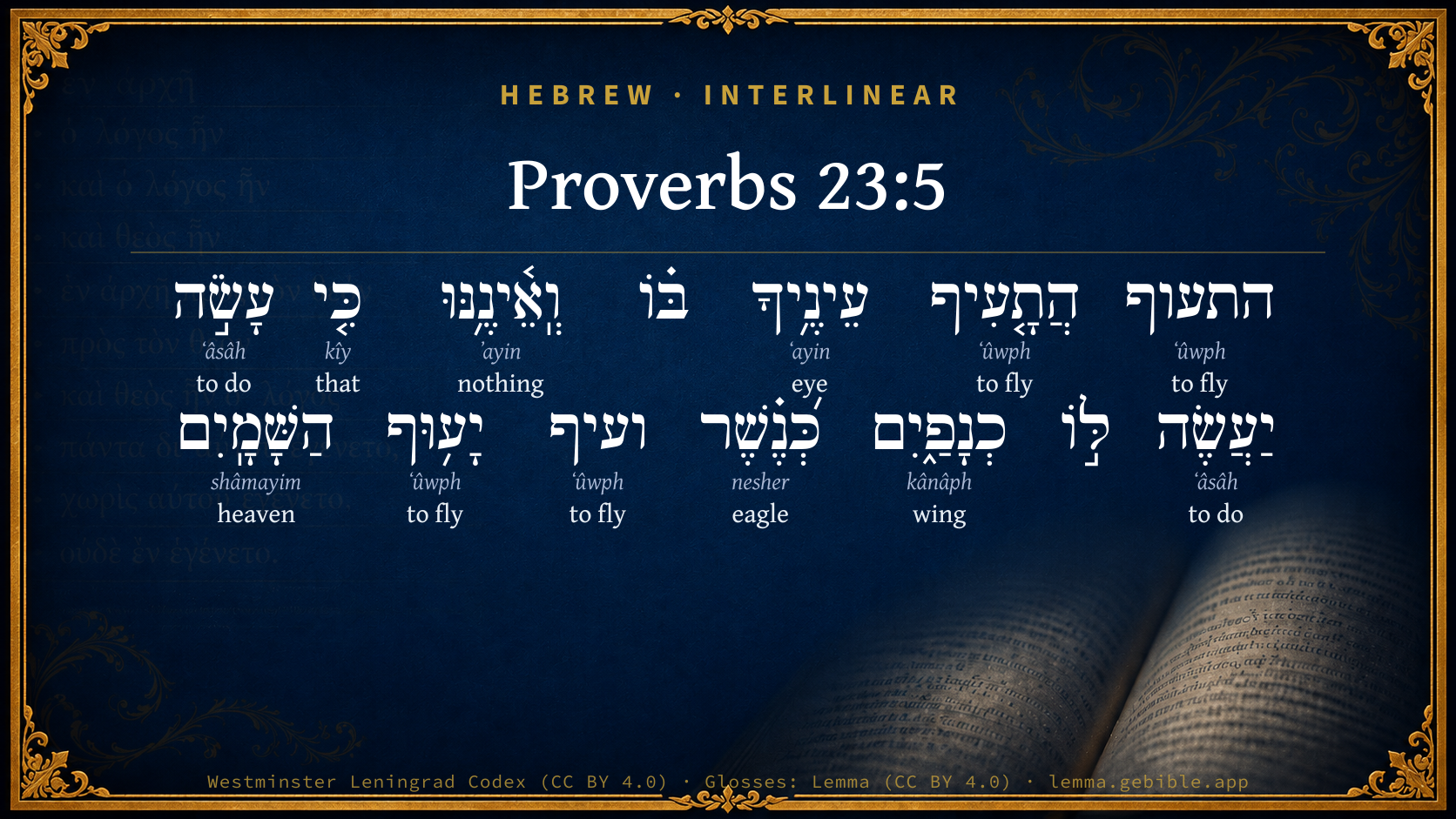
Hebrew (Westminster Leningrad Codex) Proverbs 23:5 appears in the Hebrew Old Testament. The text above is from the Westminster Leningrad Codex. Each word links to its Strong’s number, a concise gloss, and parsing drawn from the Open Scriptures Hebrew Bible morphology. Click any word for its full Brown-Driver-Briggs (BDB) entry.
Download image
Cite this verse

Proverbs 23:5 (World English Bible). Public Domain. Lemma interlinear Bible study tool, https://lemma.gebible.app/v/proverbs/23/5.

Show BibTeX & RIS
BibTeX
RIS
English Translation
Why do you set your eyes on that which is not? For it certainly sprouts wings like an eagle and flies in the sky.
World English Bible · Public Domain
Download a study sheet

One document with this verse’s original text, its word-by-word gloss line, the meaning frame, cross-references with their text, attributed commentary, and full source and license credits — printable, and it pastes into notes with its structure intact.

This verse Autodidact and up

Study sheet (.html) Plain text (.txt)

A passage Seminary Student

Up to 50 verses in one chapter. A passage sheet keeps up to 6 commentary sources and 12 cross-references per verse, in the order this page ranks them, and says so on the sheet whenever that leaves anything out. Ask for a single verse and you get the Autodidact verse sheet above.

Everything on this page stays free to read, with no account — the sheet is a download of what is already on screen, not access to it.

Want to remove ads? Support Godless Engineer
Compare translations 3

The same verse in 3 English versions, stacked beneath the original-language interlinear above. Click any original word for its lexicon entry.

Each is an independent rendering of the whole verse — the interlinear is not word-aligned to these translations.

Highlighted words mark where these versions differ — a whole-verse word diff, not a word-by-word alignment.

  • World English Bible Public Domain
    Why do you set your eyes on that which is not? For it certainly sprouts wings like an eagle and flies in the sky.
  • King James Version Public Domain
    Wilt thou set thine eyes upon that which is not? for riches certainly make themselves wings; they fly away as an eagle toward heaven.
  • unfoldingWord Literal Text CC BY-SA 4.0
    Will you cause your eyes to fly to it, but it is not there? For making, it will make wings for itself; like an eagle, it will fly the sky.

unfoldingWord Literal Text — © unfoldingWord, licensed CC BY-SA 4.0. Word-aligned USFM3 via Door43 (git.door43.org/unfoldingWord/en_ult).

Versions to compare (up to 4)

3 of 4 selected

Show all 18 translations

Every available English version of this verse, each an independent rendering of the whole verse.

  • World English Bible Public Domain
    Why do you set your eyes on that which is not? For it certainly sprouts wings like an eagle and flies in the sky.
  • Berean Standard Bible Public Domain
    When you glance at wealth, it disappears, for it makes wings for itself and flies like an eagle to the sky.
  • Majority Standard Bible Public Domain
    When you glance at wealth, it disappears, for it makes wings for itself and flies like an eagle to the sky.
  • King James Version Public Domain
    Wilt thou set thine eyes upon that which is not? for riches certainly make themselves wings; they fly away as an eagle toward heaven.
  • American Standard Version (1901) Public Domain
    Wilt thou set thine eyes upon that which is not? For `riches' certainly make themselves wings, Like an eagle that flieth toward heaven.
  • Revised Version (1885) Public Domain
    Wilt thou set thine eyes upon that which is not? for riches certainly make themselves wings, like an eagle that flieth toward heaven.
  • Geneva Bible (1599) Public Domain
    Wilt thou cast thine eyes vpon it, which is nothing? for riches taketh her to her wings, as an eagle, and flyeth into the heauen.
  • Douay-Rheims (1899) Public Domain
    Lift not up thy eyes to riches which thou canst not have: because they shall make themselves wings like those of an eagle, and shall fly towards heaven.
  • Young's Literal Translation Public Domain
    For wealth maketh to itself wings, As an eagle it flieth to the heavens.
  • Literal Standard Version CC BY-SA 4.0
    For wealth makes wings to itself, || It flies to the heavens as an eagle.
  • Unlocked Literal Bible CC BY-SA 4.0
    Will you let your eyes light upon it? It will be gone, for it will surely take up wings like an eagle and fly off to the sky.
  • unfoldingWord Literal Text CC BY-SA 4.0
    Will you cause your eyes to fly to it, but it is not there? For making, it will make wings for itself; like an eagle, it will fly the sky.
  • Darby Bible Public Domain
    wilt thou set thine eyes upon it, it is gone; for indeed it maketh itself wings and it flieth away as an eagle towards the heavens.
  • World Messianic Bible Public Domain
    Why do you set your eyes on that which is not? For it certainly sprouts wings like an eagle and flies in the sky.
  • Webster's Bible Public Domain
    Wilt thou set thy eyes upon that which is not? for riches certainly make to themselves wings; they fly away as an eagle towards heaven.
  • Free Bible Version CC BY-SA 4.0
    It disappears in the blink of an eye, suddenly growing wings and flying off into the sky like an eagle.
  • Bible in Basic English Public Domain
    Are your eyes lifted up to it? it is gone: for wealth takes to itself wings, like an eagle in flight up to heaven.
  • JPS Tanakh (1917) Public Domain
    Wilt thou set thine eyes upon it? it is gone; for riches certainly make themselves wings, like an eagle that flieth toward heaven.

Literal Standard Version (2020), Covenant Press — licensed CC BY-SA 4.0. Text via the HelloAO Bible API (eBible.org). Unlocked Literal Bible (unfoldingWord) — licensed CC BY-SA 4.0. Text via the HelloAO Bible API (eBible.org). unfoldingWord Literal Text — © unfoldingWord, licensed CC BY-SA 4.0. Word-aligned USFM3 via Door43 (git.door43.org/unfoldingWord/en_ult). Free Bible Version, Dr. Jonathan Gallagher — licensed CC BY-SA 4.0. Text via the HelloAO Bible API (eBible.org).

Word by word

More ways to search: Search by grammar → Find every occurrence → Compare this word →

Practice this passage: Drill this verse → Learn its vocabulary →

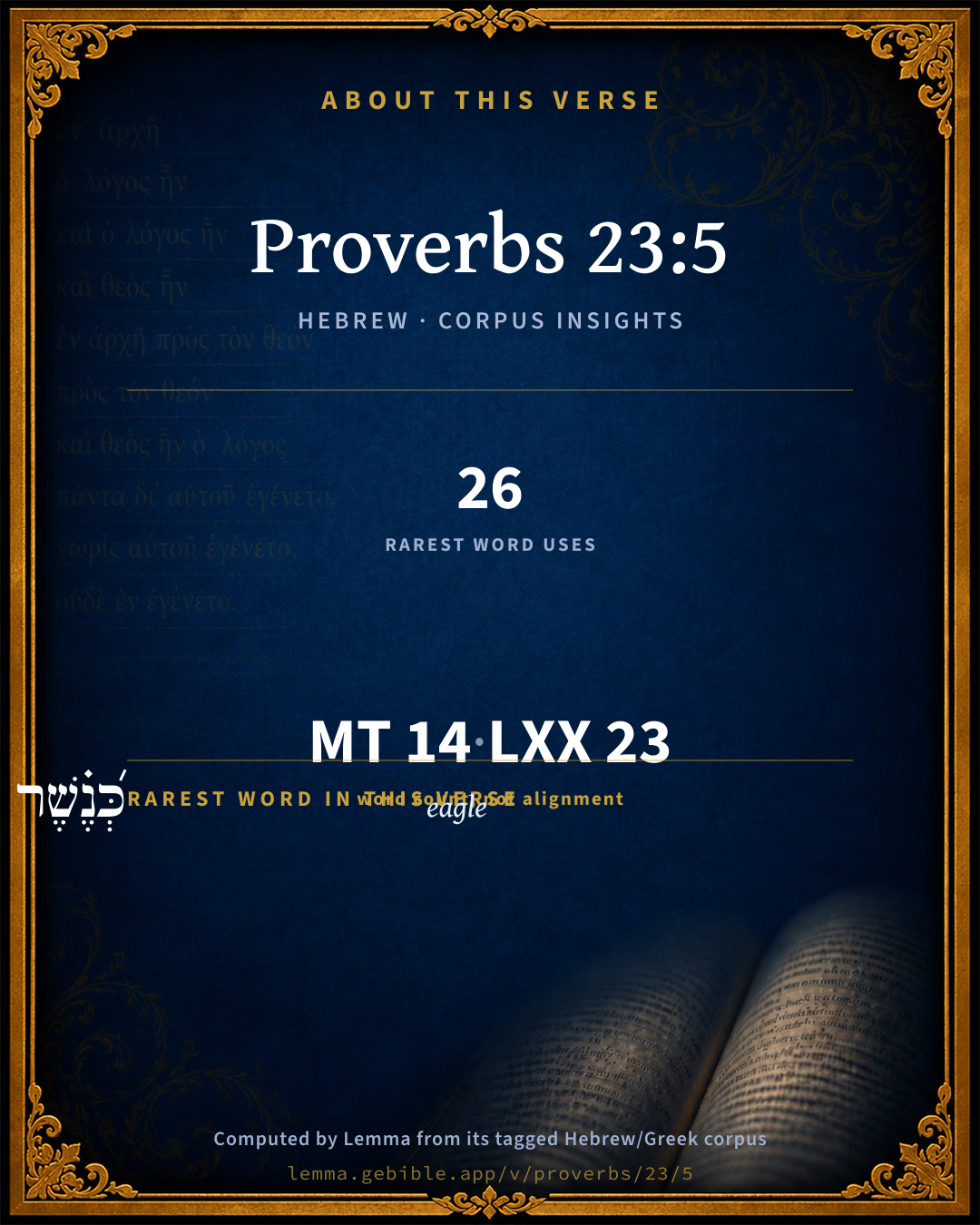
כְּ֝נֶ֗שֶׁר
nesher
H5404
“like/as · eagle”
Preposition + Noun, Common, Masculine, Singular, Absolute
Part of Speech
Preposition + Noun
Type
Common
Gender
Masculine
Number
Singular
State
Absolute
Full BDB Definition

Origin: from an unused root meaning to lacerate

TWOT: 1437

eagle, vulture, griffon-vulture
  1. התעוף ʻûwph H5774 “to fly” Particle, Interrogative + Verb, Qal, Imperfect, 2nd Person, Masculine, Singular
  2. הֲתָ֤עִיף ʻûwph H5774 “to fly” Particle, Interrogative + Verb, Hiphil, Imperfect, 2nd Person, Masculine, Singular
  3. עֵינֶ֥יךָ ʻayin H5869 “eyes · your” Noun, Common, Both, Dual, Construct + Suffix, Personal, 2nd Person, Masculine, Singular
  4. וְֽאֵ֫ינֶ֥נּוּ ʼayin H369 “and · nothing · him” Conjunction + Particle, Negative + Suffix, Personal, 3rd Person, Masculine, Singular
  5. כִּ֤י kîy H3588 “that” Conjunction
  6. עָשֹׂ֣ה ʻâsâh H6213 “to do” Verb, Qal, Infinitive Absolute
  7. יַעֲשֶׂה ʻâsâh H6213 “to do” Verb, Qal, Imperfect, 3rd Person, Masculine, Singular
  8. כְנָפַ֑יִם kânâph H3671 “wings” Noun, Common, Feminine, Dual, Absolute
  9. ועיף ʻûwph H5774 “and · to fly” Conjunction + Verb, Qal, Sequential Perfect, 3rd Person, Masculine, Singular
  10. יָע֥וּף ʻûwph H5774 “to fly” Verb, Qal, Imperfect, 3rd Person, Masculine, Singular
  11. הַשָּׁמָֽיִם shâmayim H8064 “the · heaven(s)” Particle, Definite Article + Noun, Common, Masculine, Plural, Absolute

About this verse

These counts appear in no published source. They are computed here, from the morphology-tagged text and Lemma’s own curated glosses. What Lemma adds →

14
words
8
distinct lemmas
Wisdom
section

Shared distinctive vocabulary

כְּ֝נֶ֗שֶׁר eagle H5404 occurs in 26 verses of the Hebrew Bible. Also found in:

Grammatical profile

  • 6 verbs
  • 4 nouns
  • 2 prepositions
  • 1 conjunction
  • 1 particle

Verb forms

  • התעוף Qal · Imperfect
  • הֲתָ֤עִיף Hiphil · Imperfect
  • עָשֹׂ֣ה Qal · Infinitive Absolute
  • יַעֲשֶׂה Qal · Imperfect
  • ועיף Qal · Sequential Perfect
  • יָע֥וּף Qal · Imperfect

Repetition

Words recur within this verse — often emphatic in Hebrew:

  • התעוף to fly H5774 ×4
  • עָשֹׂ֣ה to do H6213 ×2

Hebrew & Septuagint length

In English translation the verse runs 24 words from the Hebrew and 29 from the Septuagint (LXX English) — closely comparable.

A rough comparison of the two English renderings, which tokenize alike — not a word-level alignment.

Word counts can differ between the Hebrew and the Greek without any difference in meaning — e.g. the Hebrew direct-object marker אֵת has no separate Greek word, and Greek often adds the article ὁ.

In the original languages it is 14 Hebrew tokens and 23 Greek tokens — but the two are counted differently (Hebrew bundles its prefixes and suffixes into one token; the Greek is in lemma form), so that isn’t a like-for-like length.

Cross-references

15

Topical passages linked to Proverbs 23:5 in the Treasury of Scripture Knowledge — connected by theme and wording, ordered by reader-vote popularity; previews shown in the World English Bible.

  • Proverbs 27:24 For riches are not forever, Nor does even the crown endure to all generations.
  • 1 John 2:16 For all that is in the world, the lust of the flesh, the lust of the eyes, and the pride of life, isn't the Father's, but is the world's.
  • Matthew 6:19 "Don't lay up treasures for yourselves on the earth, where moth and rust consume, and where thieves break through and steal;
  • 1 Timothy 6:17 Charge those who are rich in this present world that they not be haughty, nor have their hope set on the uncertainty of riches, but on the living God, who richly provides us with everything to enjoy;
  • James 5:1–2 Come now, you rich, weep and howl for your miseries that are coming on you.
  • Psalms 119:36–37 Turn my heart toward your statutes, Not toward selfish gain.
  • Genesis 42:36 Jacob, their father, said to them, "You have bereaved me of my children! Joseph is no more, Simeon is no more, and you want to take Benjamin away. All these things are against me."
  • Ecclesiastes 12:8 Vanity of vanities, says the Preacher; All is vanity!
  • Job 1:14–17 that there came a messenger to Job, and said, "The oxen were plowing, and the donkeys feeding beside them,
  • Psalms 39:6 "Surely every man walks like a shadow. Surely they busy themselves in vain. He heaps up, and doesn't know who shall gather.
  • Ecclesiastes 1:2 "Vanity of vanities," says the Preacher; "Vanity of vanities, all is vanity."
  • Jeremiah 22:17 But your eyes and your heart are not but for your covetousness, and for shedding innocent blood, and for oppression, and for violence, to do it.
  • 1 Corinthians 7:29–31 But I say this, brothers: the time is short, that from now on, both those who have wives may be as though they had none;
  • Ecclesiastes 5:13–14 There is a grievous evil which I have seen under the sun: wealth kept by its owner to his harm.
  • Isaiah 55:2 Why do you spend money for that which is not bread? and your labor for that which doesn't satisfy? listen diligently to me, and eat you that which is good, and let your soul delight itself in fatness.

Cross-references courtesy of OpenBible.info (CC BY 4.0).

Hebrew and Greek witnesses Masoretic Hebrew ↔ Greek Septuagint

The same verse in the two great witnesses to the Old Testament, shown verse-for-verse.

These are two independent witnesses, not word-aligned to each other, and the Septuagint is shown in lemma (dictionary) form.

Hebrew Proverbs 23:5 Masoretic · Westminster Leningrad Codex

התעוף הֲתָ֤עִיף עֵינֶ֥יךָ בּ֗וֹ וְֽאֵ֫ינֶ֥נּוּ כִּ֤י עָשֹׂ֣ה יַעֲשֶׂה לּ֣וֹ כְנָפַ֑יִם כְּ֝נֶ֗שֶׁר ועיף יָע֥וּף הַשָּׁמָֽיִם

Why do you set your eyes on that which is not? For it certainly sprouts wings like an eagle and flies in the sky.

World English Bible · Public Domain

Greek LXX Proverbs 23:5 Septuagint · lemma form

ἐάν ἐπιἵστημι ὁ σός ὄμμα πρός αὐτός οὐδαμοῦ φαίνω κατασκευάζω γάρ αὐτός πτέρυξ ὥσπερ ἀετός καί ὑποστρέφω εἰς ὁ οἶκος ὁ προἵστημι αὐτός

If you should fix your eye upon him, he will disappear; for wings like an eagle's are prepared for him, and he returns to the house of his master.

LXX2012 (modern English Septuagint) · Public Domain

On this verse, John Gill's Exposition discusses the Septuagint’s reading. Read the note in Commentary ↓

Hebrew: Westminster Leningrad Codex (CC BY 4.0). Greek: Septuagint (public domain); English from LXX2012 (modern English Septuagint) (Public Domain). How the Septuagint differs from the Hebrew →

Commentary

Notes on Proverbs 23:5 from classic Christian and Jewish commentators (each source and its license shown beneath its notes). The classic Christian expositions comment on the surrounding passage and are grouped to its opening verse, so a note may address several verses; the Jewish commentaries on the Tanakh (Rashi and others) are per-verse, so they appear only where the commentator wrote on this verse.

Lemma curates 59 commentaries, every one of them public domain or Creative Commons licensed, each selected and text-cleaned for this edition rather than reprinted as found. About our sources →

Trapp's Complete Commentary

John Trapp

Pro 23:5 Wilt thou set thine eyes upon that which is not? for [riches] certainly make themselves wings; they fly away as an eagle toward heaven.

Ver. 5. Wilt thou set thine eyes, &c.] Heb., Wilt thou cause thine eyes to flee after? &c. Wilt thou flee a fool’s pitch, and go hawking after that which cannot be had? or, if had, will not pay for the pains - countervail the cost? Wilt thou cast a leering look after such vanities?

Upon that which is not.] That hath no solid subsistence, though the foolish world call it substance. "The fashion of this world passeth away." {1Co 7:31} The Greek word there used, οχημα, intimateth that there is nothing of any firmness or solid consistence in the creature. Heaven only hath a foundation. {Heb 11:10} Earth hath none, but is "hanged upon nothing," as Job speaketh. "Ye rejoice in a thing of nought," saith the prophet to them that "drank wine in bowls," &c. {Amo 6:6; Amo 6:13}

For riches certainly make themselves wings.] As the heathens feigned of their god Pluto. Under these wings let the master hide himself, as Isa 28:15; yet with those wings will they fly away, without once taking leave, leaving nothing but the print of talons in his heart to torment him. Riches, saith one, were never true to those that trusted them. To fly from us they make themselves great eagles’ wings; to fly to us, or after us, Ne passerinas quidem, {a} not so much as old sparrows’ wings. Temporals, saith another, {b} are as transitory as a hasty headlong torrent - a shadow, a ship, a bird, an arrow, a post that passeth by; or if you can name anything of swifter wing or sooner gone.

{a} Augustine.

{b} Mr Bolton.

John Trapp, A Commentary or Exposition upon All the Books of the Old and New Testament (1647–1656) — public domain. Text from a community e-Sword module.

Jamieson, Fausset & Brown

Robert Jamieson, A. R. Fausset & David Brown

Wilt . . . eyes--As the eyes fly after or seek riches, they are not, that is, either become transitory or unsatisfying; fully expressed by their flying away.

Jamieson, Fausset & Brown — Commentary Critical and Explanatory on the Whole Bible (1871) — public domain (CC PDM 1.0). Text via the HelloAO Bible API.

Ellicott's Commentary for English Readers

(5) They fly away.—Rather, As an eagle that flieth toward heaven, far beyond thy reach.

A Bible Commentary for English Readers, edited by Charles John Ellicott (1878–1897) — public domain. Text from a community e-Sword module.

The Cambridge Bible for Schools and Colleges

gen. ed. J. J. S. Perowne

5. Wilt thou set thine eyes] More literally and forcibly: Wilt thou cause thine eyes to fly (or, shall thine eyes fly) upon it (with eager glance, as a bird swoops upon its prey, Isa_11:14)? it is gone! It eludes even the swiftness of thy glance, and itself spreads its wings and flies away.

For riches (supplied from Pro_23:4) certainly make themselves wings, Like an eagle that flieth toward heaven.

Comp. for the sentiment πλούτου ἀδηλότης, 1Ti_6:17.

The Cambridge Bible for Schools and Colleges (gen. ed. J. J. S. Perowne; Cambridge University Press, 1878–1918) — public domain. Text from a community e-Sword module.

John Gill's Exposition

Wilt thou set thine eyes upon that which is not?.... The Vulgate Latin version is,

"do not lift up thine eyes to riches which thou canst not have;''

riches no doubt are intended, and which may be said to be "not"; they are not the true riches, have only the shadow and appearance of riches; they are not lasting and durable; in a little time they will not be; they are perishing things, they have no substance or solidity in them; they are not satisfying; they do not make them happy; they are rather nonentities than realities; and therefore the eyes of the mind and the affections of the heart should not be set on them: it may be rendered, "wilt thou cause thine eyes to fly upon that which is not?" (w) denoting the intenseness of the mind, and the eagerness of the affections, and with what rapidity and force they move towards them. The Targum is,

"if thou fixest thine eyes on him, he shall not appear to thee;''

meaning the rich man: and so the Septuagint, Syriac, and Arabic versions. Ben Melech makes mention of other senses very different; according to R. Judah, the word signifies darkness, "wilt thou make thine eyes dark?" two according to others, signifies light, "wilt thou make thine eyes to shine?" and, according to Jarchi, "wilt thou double?", or shut thine eyes?

for riches certainly make themselves wings; or, "it in making makes itself wings" (x); even that which is not, on which men cause their eyes to fly; no sooner are their eyes upon that, but that flies away from them like a bird with wings; see Hos 9:11. Either men are taken from that, or that from them, and sometimes very swiftly and suddenly;

they fly away as an eagle towards heaven; the eagle flies very swiftly, none more swiftly; it flies towards heaven, out of sight, and out of reach, and out of call; so riches flee away to God, the original giver of them, from whence they came, and who is the sole disposer of them; they own him as the proprietor and distributor of them; and they flee to heaven as it were for fresh orders where they should be, and into whose hands they should come next; they flee away, so as not to be seen any more, and be recovered by those who have formerly enjoyed them.

(w) "numquid involare facies", Michaelis; "ut involent", Junius & Tremellius; "ut volent", Piscator; "ad sineves volare", Cocceius. (x) "quis faciendo faciet", Montanus, Baynus.

John Gill's Exposition of the Whole Bible (1746–1763) — public domain (CC PDM 1.0). Text via the HelloAO Bible API.

Albert Barnes' Notes on the Bible

Set thine eyes - literally, as in the margin, i. e., “gaze eagerly upon;” and then we get an emphatic parallelism with the words that follow, “they fly away as an eagle toward heaven;” “certainly make themselves wings.”

Albert Barnes' Notes on the Bible (1834–1885) — public domain. Text from a community e-Sword/MySword module.

Haydock's Catholic Bible Commentary

Riches. Septuagint, "to him, the rich man, he no where appears. He has prepared," &c. (Haydock) --- Like. Hebrew, "as the eagle, it will fly," &c. (Haydock) --- We must therefore fix our hearts on more durable goods.

George Leo Haydock (1774–1849), Haydock's Catholic Family Bible and Commentary, 1859 edition — public domain. Excludes Psalms (Douay-Rheims chapter numbering differs from Protestant) and Deuterocanonical books (Catholic canon only).

Matthew Poole's English Annotations

Wilt thou set thine eyes upon that, i.e. look upon it with earnestness and greedy desire, employing the eyes of thy mind and body about it.

Which is not; which hath no solid and settled being; which is ours to have, but not to hold; which is always upon the wing, and ofttimes gone in the twinkling of an eye, so that the owner is frequently at a loss, and cannot tell whether he hath his estate, or whether he hath lost it.

They fly away as an eagle, swiftly, strongly, and irrevocably. We quickly lose the sight and possession of them. Their flying away from us is elegantly opposed to our eyes being set, or, as it is in the Hebrew, flying upon them, in the beginning of the verse.

Matthew Poole's English Annotations on the Holy Bible (1683–1685) — public domain. Text from a community e-Sword/MySword module.

Whedon's Commentary on the Bible

Daniel D. Whedon

5. That which is not — This assigns a reason for the preceding admonition. Why pursue so eagerly that which is so uncertain and evanescent? Stuart’s rendering is good: “Wilt thou suffer thine eyes to fly toward it.” “To flit over it.” — Conant. It is, indeed, no more, (Job_7:9;) for it will surely make itself wings and fly away.

As an eagle toward heaven — “As an eagle and the birds of heaven.” — Conant. Compare Mat_6:20.

Daniel D. Whedon (gen. ed.), Commentary on the Old and New Testaments (1874–1909) — public domain. Text from a community e-Sword module.

The Pulpit Commentary

Wilt thou sat thine eyes upon that which is not? more literally, wilt thou let thine eyes fly upon it, and it is gone? Why cast longing looks towards this wealth, and so prepare for yourself loss and disappointment? The pursuit is vain, and the result is never secure; what you gained by long toil and prudent care may be lost in an hour. Do you wish to incur this danger? Wordsworth quotes Persius, "Sat.," 3:61"An passim sequeris corvos testaque lutoque?

For riches certainly make themselves wings. The subject, unexpressed, is riches, and the Hebrew phrase implies absolute certainty: Making they will make for themselves. They fly away as an eagle toward heaven; or, like on eagle that flieth toward heaven, where not even sight can follow. Publ. Syr., 255, "Longinquum est omne quod cupiditas flagitat." The Telugu compares worldly prosperity to writing upon water. Says the Greek moralist Bebaion ouden en biw dokei pelein. "There"s naught in life that one can deem secure. Septuagint, "If thou fix thine eye upon him (the rich patron), he will nowhere be seen, for wings like an eagle"s are ready prepared for him, and he will return to the house of his master (tou proesthkotov ), and leave you to shift for yourself."

The Pulpit Commentary (1880–1919), ed. H.D.M. Spence-Jones & Joseph S. Exell — public domain. Text from a community e-Sword module.

John Wesley's Explanatory Notes

Set thine eyes - Look upon it with earnestness and desire. Is not - Which has no solid and settled being. Eagle - Swiftly, strongly, and irrecoverably.

John Wesley, Explanatory Notes Upon the Whole Bible (1754–1765) — public domain. Text via the GEBible commentary corpus.

Kretzmann's Popular Commentary

Paul E. Kretzmann

v. 5. Wilt thou set thine eyes upon that which is not, looking eagerly for, craving eagerly after, something which has no lasting substance? For riches certainly make themselves wings, they are not a dependable possession; they fly away as an eagle toward heaven, they are as unstable as a bird of the air, whence it follows that he who trusts in them is foolish.

Paul E. Kretzmann, Popular Commentary of the Bible (1921–1924) — public domain. Text from a community e-Sword module.

Rashi

Rabbi Shlomo Yitzchaki (Rashi)

Should you blink your eyes at it The moment you blink your eyes to close them, that study will no longer be found with you.

התעיף, like “and you shall fold” (Ex. 26:9), which Onkelos renders: ותעיף.

Rashi on the Tanakh — English translations: “The Judaica Press complete Tanach with Rashi, translated by A. J. Rosenberg” (CC BY 4.0); “Pentateuch with Rashi's commentary by M. Rosenbaum and A.M. Silbermann, 1929-1934” (public domain); “The Metsudah Tanach series, Lakewood, N.J” (CC BY 4.0); and “The Book of Joshua, Metsudah Publications, 1997” (CC BY 4.0). Text via Sefaria.

Lesson kit

Teaching starters — assembled from the data on this page, not authored interpretation. Every prompt links to the verse data it draws on. Edit before teaching.

Proverbs, in the Wisdom, opens this verse with 14 words (8 distinct Hebrew lemmas). Its most distinctive word is nesher (“eagle”). A historical commentator’s framing appears above. Read the whole chapter for the surrounding context.

Discussion questions

  1. The word nesher carries the sense “eagle.” How does it shape the verse?
  2. How does Exodus 19:4, which shares the word «eagle», read alongside this verse?
  3. What does the repetition of “to fly” (4× in this one verse) do in this verse?
  4. The translations on this page render this verse differently — a whole-verse word diff, not a word-by-word alignment. What might account for the different wordings?
  5. «התעוף» is a Qal Imperfect verb. How does that grammatical form shape the action described?
  6. Compare how Trapp's Complete Commentary and Jamieson, Fausset & Brown read this verse. Where do they agree or differ?

Things to notice

Reading settings

Reading text

Shown beneath each verse's original-language words.

Old Testament
Old Testament edition

Read the OT as the Masoretic Hebrew (MT) or the Greek Septuagint (LXX).

English shown for the Greek Septuagint (in the Hebrew ↔ Greek comparison).

Comparing translations? Open the Compare panel on any verse page to stack up to four side by side.