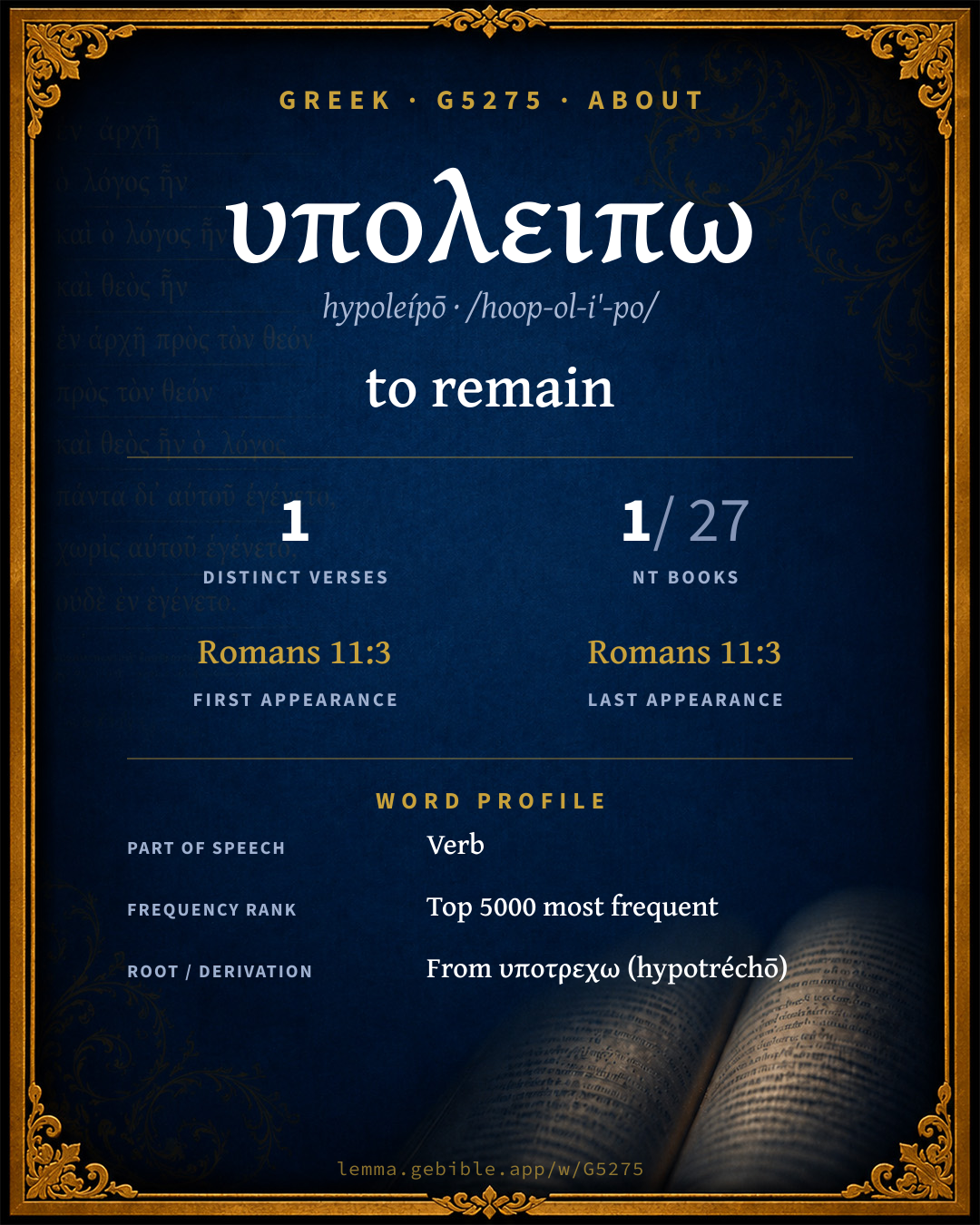
ὑπολείπω
to remain
‘to remain’ is one of 2 main senses fuller range ↓
Full lexicon entry — Thayer's Greek Lexicon
From Thayer's Greek Lexicon
Where this word appears
Grammar key — what these labels mean
Part of speech
- Verb
- An action or state-of-being word.
Tense
- Aorist
- Action viewed as a simple whole, without regard to duration — often past (perfective aspect).
Voice
- Passive
- The subject receives the action.
Mood
- Indicative
- States a fact or asks a factual question (the mood of reality).
Person
- 1st person
- The speaker (“I / we”).
Number
- Singular
- One.
Every verse where G5275 appears — 1 distinct verse across 1 book. Click any verse to open its interlinear word-by-word view. Verse text shown in the World English Bible for context — . Each verse’s Greek form is shown with its reference; the English is not keyword-highlighted, since the data carries no word-level English alignment. Use “Compare translations” on any verse to read it across multiple English versions. This concordance covers the Greek New Testament; Septuagint (Greek Old Testament) occurrences of this word are not indexed here.
Romans 1 verse
About this entry
At a glance — auto-summarized from this page’s data, not written by a person. Every figure links to its source below. This summary describes the numbers; it doesn’t interpret them.
υπολειπω — transliterated hypoleípō — is a Greek verb carrying the sense “to remain.” A scarce word — 1 verse in all of the Greek New Testament. More than three-quarters of its appearances fall in Romans. It occurs only once, in Romans 11:3. Thayer's distinguishes 2 senses for it. See the sense tree, 1-verse concordance, and the renderings breakdown below.
Gloss history
Strong's 1890 vs modern scholarship

About this word
Strong's G5275 catalogs a Greek word from the Greek New Testament.
These counts are not copied from any lexicon or concordance. They are computed here, from the morphology-tagged Greek New Testament. What Lemma adds →
- 1
- distinct verses
- The word appears in 1 distinct verse.
- 1 / 27
- NT books
- The word appears in 1 of 27 New Testament books.
- #3,503
- by frequency
- Top 5000 most frequent Greek words (rank 3,503 of 5,347 Greek words by occurrence).
View all 1 occurrence in the concordance →
Most concentrated in
- Romans 1 verse 100%
By section of the New Testament
By traditional corpus
Conventional, traditional groupings — biblical authorship is debated, so this is a traditional corpus grouping, not an authorship claim. Some books belong to more than one corpus (Luke is in both the Gospels and the Lukan corpus, and so on), so these shares overlap and need not total 100%. Each figure is a share of the word’s 1 distinct verse.
- Pauline corpus 1 verse · 100%
How translations render this word
Counts come from each version’s own published word-to-Strong’s tagging or interlinear alignment — an approximate guide to how each version renders this word, not a word-level alignment the data otherwise carries. Because each total is that version’s own tagged count, the per-version totals vary from one another and need not match the appearance or distinct-verse counts above. These counts may also differ from a printed concordance because Lemma counts each distinctly tagged rendering and does not collapse phrase taggings into a single head-word total. This is a fixed set of word-tagged versions (KJV, ASV, BSB, ULT) and does not change with the reading translation you choose elsewhere. Each version’s license is shown beside its name below (and on Sources).
- King James Version: Am left 1×
- American Standard Version: Am left 1×
- Berean Standard Bible: Left 1×, Remnant 1×
- unfoldingWord Literal Text: Leaving 1×, Was left behind 1×
King James Version Public Domain
Renders G5275 across 1 tagged occurrence — most commonly:
American Standard Version Public Domain
Renders G5275 across 1 tagged occurrence — most commonly:
Berean Standard Bible Public Domain
Renders G5275 across 2 tagged occurrences — most commonly:
unfoldingWord Literal Text CC BY-SA 4.0
Renders G5275 across 2 tagged occurrences — most commonly:
Senses in Thayer's
The 2 senses Thayer's distinguishes for this word, in lexicon order (not ranked by frequency or importance). The full entry — with sub-senses — is in the Lexicon Entry tab.
- to leave behind
- to be left behind, left remaining
Word origin
Derived from υποτρεχω (hypotréchō) (G5295) — to run under.
Same root — word family
Other Thayer's entries built from the same root as G5275, grouped by Strong’s listed origin. These share a root / origin per the lexicon — not necessarily a shared meaning. Each links to that word’s own entry.
Derives from
Derived from this word
Compare all same-root words → They share a root, not necessarily a meaning.
Septuagint usage
The same Greek word υπολειπω appears 77 times in the Greek Old Testament (Septuagint), across 71 verses in 22 books.
- 77
- LXX occurrences
- Tagged occurrences of this Greek word in the Septuagint.
- 71
- verses
- Distinct Septuagint verses containing this word.
- 22 / 39
- OT books
- The word appears in 22 of the 39 Old Testament books.
Sample Septuagint occurrences
- Genesis 27:36 ὑπολείπω
- Exodus 8:5 ὑπολείπω
- Leviticus 23:22 ὑπολείπω
- Joshua 10:8 ὑπολείπω
- Judges 7:3 ὑπολείπω
- 1 Samuel 5:4 ὑπολείπω
- 2 Samuel 8:4 ὑπολείπω
- 1 Kings 10:22 ὑπολείπω
- 2 Kings 7:13 ὑπολείπω
- 1 Chronicles 13:2 ὑπολείπω
- Psalms 105:11 ὑπολείπω
- Proverbs 2:21 ὑπολείπω
Septuagint occurrences (same lexeme)
Every verse where the same Strong’s number (G5275) appears in the Greek Septuagint — showing the first 50 of 71. Verse text shown in the World English Bible for context; the Greek form is the matched word — the English is not keyword-highlighted.
- Genesis 27:36 ὑπολείπω He said, "Isn't he rightly named Jacob? For he has supplanted me these two times. He took away my birthright. See, now he has taken away my blessing." He said, "Haven't you reserved a blessing for me?"
- Genesis 30:36 ὑπολείπω He set three days' journey between himself and Jacob, and Jacob fed the rest of Laban's flocks.
- Genesis 32:25 ὑπολείπω When he saw that he didn't prevail against him, he touched the hollow of his thigh, and the hollow of Jacob's thigh was strained, as he wrestled.
- Genesis 44:20 ὑπολείπω We said to my lord, 'We have a father, an old man, and a child of his old age, a little one; and his brother is dead, and he alone is left of his mother; and his father loves him.'
- Genesis 45:7 ὑπολείπω God sent me before you to preserve you a remnant in the earth, and to save you alive by a great deliverance.
- Genesis 47:18 ὑπολείπω When that year was ended, they came to him the second year, and said to him, "We will not hide from my lord how our money is all spent, and the herds of cattle are my lord's. There is nothing left in the sight of my lord, but our bodies, and our lands.
- Genesis 50:8 ὑπολείπω all the house of Joseph, his brothers, and his father's house. Only their little ones, their flocks, and their herds, they left in the land of Goshen.
- Exodus 8:5 ὑπολείπω Yahweh said to Moses, "Tell Aaron, 'Stretch forth your hand with your rod over the rivers, over the streams, and over the pools, and cause frogs to come up on the land of Egypt.'"
- Exodus 8:7 ὑπολείπω The magicians did in like manner with their enchantments, and brought up frogs on the land of Egypt.
- Exodus 10:12 ὑπολείπω Yahweh said to Moses, "Stretch out your hand over the land of Egypt for the locusts, that they may come up on the land of Egypt, and eat every herb of the land, even all that the hail has left."
- Exodus 10:15 ὑπολείπω For they covered the surface of the whole earth, so that the land was darkened, and they ate every herb of the land, and all the fruit of the trees which the hail had left. There remained nothing green, either tree or herb of the field, through all the land of Egypt.
- Exodus 10:19 ὑπολείπω Yahweh turned an exceeding strong west wind, which took up the locusts, and drove them into the Red Sea. There remained not one locust in all the borders of Egypt.
- Exodus 10:24 ὑπολείπω Pharaoh called to Moses, and said, "Go, serve Yahweh. Only let your flocks and your herds stay behind. Let your little ones also go with you."
- Exodus 10:26 ὑπολείπω Our cattle also shall go with us. There shall not a hoof be left behind, for of it we must take to serve Yahweh our God; and we don't know with what we must serve Yahweh, until we come there."
- Exodus 23:11 ὑπολείπω but the seventh year you shall let it rest and lie fallow, that the poor of your people may eat; and what they leave the animal of the field shall eat. In like manner you shall deal with your vineyard and with your olive grove.
- Exodus 26:12 ὑπολείπω The overhanging part that remains of the curtains of the tent, the half curtain that remains, shall hang over the back of the tent.
- Leviticus 23:22 ὑπολείπω "'When you reap the harvest of your land, you shall not wholly reap into the corners of your field, neither shall you gather the gleanings of your harvest: you shall leave them for the poor, and for the foreigner. I am Yahweh your God.'"
- Joshua 10:8 ὑπολείπω Yahweh said to Joshua, Don't fear them: for I have delivered them into your hands; there shall not a man of them stand before you.
- Joshua 12:4 ὑπολείπω and the border of Og king of Bashan, of the remnant of the Rephaim, who lived at Ashtaroth and at Edrei,
- Joshua 13:1 ὑπολείπω Now Joshua was old and well stricken in years; and Yahweh said to him, You are old and well stricken in years, and there remains yet very much land to be possessed.
- Joshua 21:26 ὑπολείπω All the cities of the families of the rest of the children of Kohath were ten with their suburbs.
- Joshua 23:12 ὑπολείπω Else if you do at all go back, and cleave to the remnant of these nations, even these who remain among you, and make marriages with them, and go in to them, and they to you;
- Judges 7:3 ὑπολείπω Now therefore proclaim in the ears of the people, saying, Whoever is fearful and trembling, let him return and depart from Mount Gilead. There returned of the people twenty-two thousand; and there remained ten thousand.
- Judges 21:7 ὑπολείπω How shall we do for wives for those who remain, seeing we have sworn by Yahweh that we will not give them of our daughters to wives?
- 1 Samuel 5:4 ὑπολείπω When they arose early on the next day morning, behold, Dagon was fallen on his face to the ground before the ark of Yahweh; and the head of Dagon and both the palms of his hands [lay] cut off on the threshold; only [the stump of] Dagon was left to him.
- 1 Samuel 11:11 ὑπολείπω It was so on the next day, that Saul put the people in three companies; and they came into the midst of the camp in the morning watch, and struck the Ammonites until the heat of the day: and it happened, that those who remained were scattered, so that no two of them were left together.
- 1 Samuel 14:36 ὑπολείπω Saul said, Let us go down after the Philistines by night, and take spoil among them until the morning light, and let us not leave a man of them. They said, Do whatever seems good to you. Then said the priest, Let us draw near here to God.
- 1 Samuel 25:22 ὑπολείπω God do so to the enemies of David, and more also, if I leave of all that belongs to him by the morning light so much as one man-child.
- 1 Samuel 25:34 ὑπολείπω For in very deed, as Yahweh, the God of Israel, lives, who has withheld me from hurting you, except you had hurried and come to meet me, surely there wouldn't have been left to Nabal by the morning light so much as one man-child.
- 2 Samuel 8:4 ὑπολείπω David took from him one thousand seven hundred horsemen, and twenty thousand footmen: and David hamstrung all the chariot horses, but reserved of them for one hundred chariots.
- 2 Samuel 9:1 ὑπολείπω David said, Is there yet any who is left of the house of Saul, that I may show him kindness for Jonathan's sake?
- 2 Samuel 9:3 ὑπολείπω The king said, Is there not yet any of the house of Saul, that I may show the kindness of God to him? Ziba said to the king, Jonathan has yet a son, who is lame of his feet.
- 2 Samuel 17:12 ὑπολείπω So shall we come on him in some place where he shall be found, and we will light on him as the dew falls on the ground; and of him and of all the men who are with him we will not leave so much as one.
- 1 Kings 10:22 ὑπολείπω For the king had at sea a navy of Tarshish with the navy of Hiram: once every three years came the navy of Tarshish, bringing gold, and silver, ivory, and apes, and peacocks.
- 1 Kings 15:29 ὑπολείπω It happened that, as soon as he was king, he struck all the house of Jeroboam: he didn't leave to Jeroboam any who breathed, until he had destroyed him; according to the saying of Yahweh, which he spoke by his servant Ahijah the Shilonite;
- 1 Kings 17:17 ὑπολείπω It happened after these things, that the son of the woman, the mistress of the house, fell sick; and his sickness was so sore, that there was no breath left in him.
- 1 Kings 18:22 ὑπολείπω Then Elijah said to the people, "I, even I only, am left a prophet of Yahweh; but Baal's prophets are four hundred fifty men.
- 1 Kings 19:10 ὑπολείπω He said, I have been very jealous for Yahweh, the God of hosts; for the children of Israel have forsaken your covenant, thrown down your altars, and slain your prophets with the sword: and I, even I only, am left; and they seek my life, to take it away.
- 1 Kings 19:14 ὑπολείπω He said, I have been very jealous for Yahweh, the God of hosts; for the children of Israel have forsaken your covenant, thrown down your altars, and slain your prophets with the sword; and I, even I only, am left; and they seek my life, to take it away.
- 2 Kings 7:13 ὑπολείπω One of his servants answered, Please let some take five of the horses that remain, which are left in the city (behold, they are as all the multitude of Israel who are left in it; behold, they are as all the multitude of Israel who are consumed); and let us send and see.
- 2 Kings 13:7 ὑπολείπω For he didn't leave to Jehoahaz of the people save fifty horsemen, and ten chariots, and ten thousand footmen; for the king of Syria destroyed them, and made them like the dust in threshing.
- 2 Kings 17:18 ὑπολείπω Therefore Yahweh was very angry with Israel, and removed them out of his sight: there was none left but the tribe of Judah only.
- 2 Kings 19:30 ὑπολείπω The remnant that has escaped of the house of Judah shall again take root downward, and bear fruit upward.
- 2 Kings 20:17 ὑπολείπω Behold, the days come, that all that is in your house, and that which your fathers have laid up in store to this day, shall be carried to Babylon: nothing shall be left, says Yahweh.
- 2 Kings 24:14 ὑπολείπω He carried away all Jerusalem, and all the princes, and all the mighty men of valor, even ten thousand captives, and all the craftsmen and the smiths; none remained, save the poorest sort of the people of the land.
- 2 Kings 25:12 ὑπολείπω But the captain of the guard left of the poorest of the land to work the vineyards and fields.
- 1 Chronicles 13:2 ὑπολείπω David said to all the assembly of Israel, If it seem good to you, and if it be of Yahweh our God, let us send abroad everywhere to our brothers who are left in all the land of Israel, with whom the priests and Levites are in their cities that have suburbs, that they may gather themselves to us;
- 1 Chronicles 18:4 ὑπολείπω David took from him one thousand chariots, and seven thousand horsemen, and twenty thousand footmen; and David hamstrung all the chariot horses, but reserved of them for one hundred chariots.
- Psalms 105:11 ὑπολείπω Saying, "To you I will give the land of Canaan, The lot of your inheritance;"
- Proverbs 2:21 ὑπολείπω For the upright will dwell in the land. The perfect will remain in it.
These are occurrences of the same Greek lexeme (G5275) in the Septuagint — not a translation of any one Hebrew word. The store carries no word-level Hebrew↔Greek alignment, so no Hebrew original is asserted here. Counts come from the recovered LXX Strong's tagging — high-frequency vocabulary is well covered, while rare or late forms may be untagged — so they reflect tagged occurrences and may slightly undercount.