
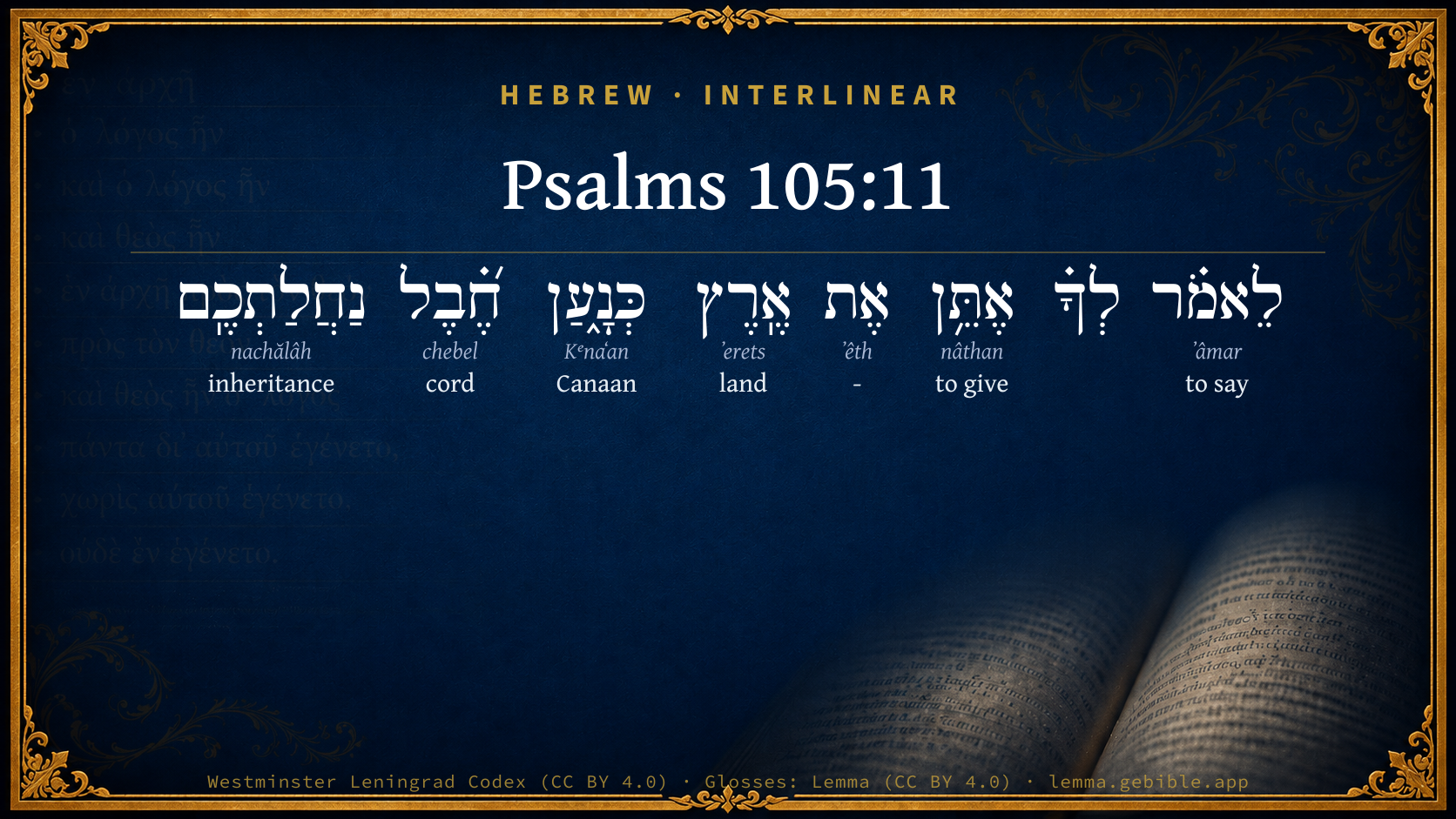
Psalms 105:11

Hebrew (Westminster Leningrad Codex) Psalms 105:11 appears in the Hebrew Old Testament. The text above is from the Westminster Leningrad Codex. Each word links to its Strong’s number, a concise gloss, and parsing drawn from the Open Scriptures Hebrew Bible morphology. Click any word for its full Brown-Driver-Briggs (BDB) entry.
Download image
Cite this verse

Psalms 105:11 (World English Bible). Public Domain. Lemma interlinear Bible study tool, https://lemma.gebible.app/v/psalms/105/11.

Show BibTeX & RIS
BibTeX
RIS
English Translation
Saying, "To you I will give the land of Canaan, The lot of your inheritance;"
World English Bible · Public Domain
Download a study sheet

One document with this verse’s original text, its word-by-word gloss line, the meaning frame, cross-references with their text, attributed commentary, and full source and license credits — printable, and it pastes into notes with its structure intact.

This verse Autodidact and up

Study sheet (.html) Plain text (.txt)

A passage Seminary Student

Up to 50 verses in one chapter. A passage sheet keeps up to 6 commentary sources and 12 cross-references per verse, in the order this page ranks them, and says so on the sheet whenever that leaves anything out. Ask for a single verse and you get the Autodidact verse sheet above.

Everything on this page stays free to read, with no account — the sheet is a download of what is already on screen, not access to it.

Want to remove ads? Support Godless Engineer
Compare translations 3

The same verse in 3 English versions, stacked beneath the original-language interlinear above. Click any original word for its lexicon entry.

Each is an independent rendering of the whole verse — the interlinear is not word-aligned to these translations.

Highlighted words mark where these versions differ — a whole-verse word diff, not a word-by-word alignment.

  • World English Bible Public Domain
    Saying, "To you I will give the land of Canaan, The lot of your inheritance;"
  • King James Version Public Domain
    Saying, Unto thee will I give the land of Canaan, the lot of your inheritance:
  • unfoldingWord Literal Text CC BY-SA 4.0
    saying, “I will give to you the land of Canaan the portion of your inheritance,”

unfoldingWord Literal Text — © unfoldingWord, licensed CC BY-SA 4.0. Word-aligned USFM3 via Door43 (git.door43.org/unfoldingWord/en_ult).

Versions to compare (up to 4)

3 of 4 selected

Show all 18 translations

Every available English version of this verse, each an independent rendering of the whole verse.

  • World English Bible Public Domain
    Saying, "To you I will give the land of Canaan, The lot of your inheritance;"
  • Berean Standard Bible Public Domain
    “I will give you the land of Canaan as the portion of your inheritance.”
  • Majority Standard Bible Public Domain
    “I will give you the land of Canaan as the portion of your inheritance.”
  • King James Version Public Domain
    Saying, Unto thee will I give the land of Canaan, the lot of your inheritance:
  • American Standard Version (1901) Public Domain
    Saying, Unto thee will I give the land of Canaan, The lot of your inheritance;
  • Revised Version (1885) Public Domain
    Saying, Unto thee will I give the land of Canaan, the lot of your inheritance:
  • Geneva Bible (1599) Public Domain
    Saying, Vnto thee will I giue the land of Canaan, the lot of your inheritance.
  • Douay-Rheims (1899) Public Domain
    Saying: To thee will I give the land of Chanaan, the lot of your inheritance.
  • Young's Literal Translation Public Domain
    Saying, `To thee I give the land of Canaan, The portion of your inheritance,'
  • Literal Standard Version CC BY-SA 4.0
    Saying, “I give the land of Canaan to you, || The portion of your inheritance,”
  • Unlocked Literal Bible CC BY-SA 4.0
    He said, “I will give you the land of Canaan as your share of your inheritance.”
  • unfoldingWord Literal Text CC BY-SA 4.0
    saying, “I will give to you the land of Canaan the portion of your inheritance,”
  • Darby Bible Public Domain
    Saying, Unto thee will I give the land of Canaan, the lot of your inheritance;
  • World Messianic Bible Public Domain
    saying, “To you I will give the land of Canaan, the lot of your inheritance,”
  • Webster's Bible Public Domain
    Saying, To thee will I give the land of Canaan, the lot of your inheritance:
  • Free Bible Version CC BY-SA 4.0
    saying to you, “I will give the land of Canaan for you to possess.”
  • Bible in Basic English Public Domain
    Saying, To you will I give the land of Canaan, the measured line of your heritage:
  • JPS Tanakh (1917) Public Domain
    Saying: 'Unto thee will I give the land of Canaan, the lot of your inheritance.'

Literal Standard Version (2020), Covenant Press — licensed CC BY-SA 4.0. Text via the HelloAO Bible API (eBible.org). Unlocked Literal Bible (unfoldingWord) — licensed CC BY-SA 4.0. Text via the HelloAO Bible API (eBible.org). unfoldingWord Literal Text — © unfoldingWord, licensed CC BY-SA 4.0. Word-aligned USFM3 via Door43 (git.door43.org/unfoldingWord/en_ult). Free Bible Version, Dr. Jonathan Gallagher — licensed CC BY-SA 4.0. Text via the HelloAO Bible API (eBible.org).

Word by word

More ways to search: Search by grammar → Find every occurrence → Compare this word →

Practice this passage: Drill this verse → Learn its vocabulary →

About this verse

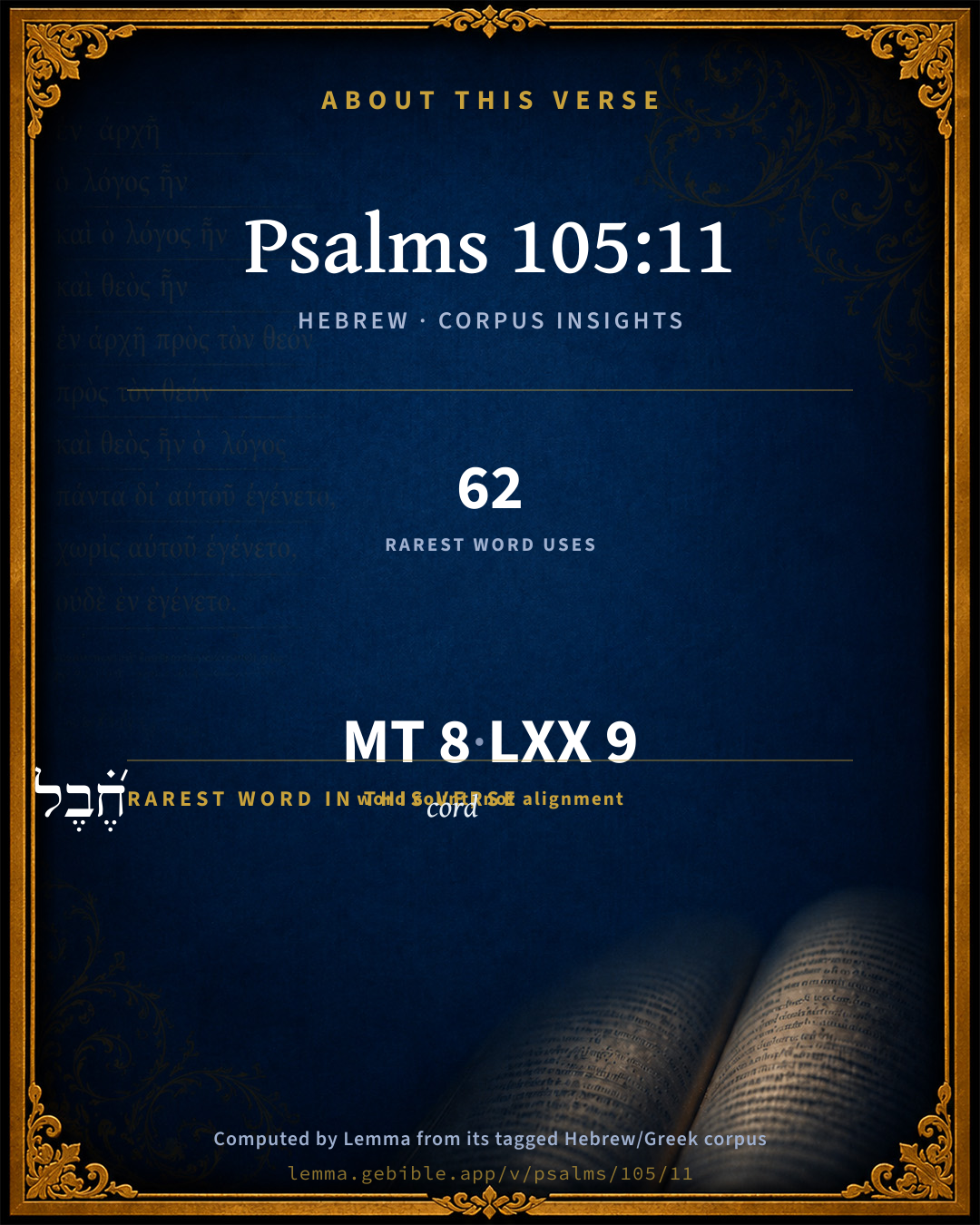
These counts appear in no published source. They are computed here, from the morphology-tagged text and Lemma’s own curated glosses. What Lemma adds →

8
words
7
distinct lemmas
Wisdom
section

Grammatical profile

  • 2 verbs
  • 4 nouns
  • 1 preposition
  • 1 particle

Verb forms

  • לֵאמֹ֗ר Qal · Infinitive Construct
  • אֶתֵּ֥ן Qal · Imperfect

Hebrew & Septuagint length

In English translation the verse runs 15 words from the Hebrew and 15 from the Septuagint (LXX English) — the same length.

A rough comparison of the two English renderings, which tokenize alike — not a word-level alignment.

Word counts can differ between the Hebrew and the Greek without any difference in meaning — e.g. the Hebrew direct-object marker אֵת has no separate Greek word, and Greek often adds the article ὁ.

In the original languages it is 8 Hebrew tokens and 9 Greek tokens — but the two are counted differently (Hebrew bundles its prefixes and suffixes into one token; the Greek is in lemma form), so that isn’t a like-for-like length.

Cross-references

6

Topical passages linked to Psalms 105:11 in the Treasury of Scripture Knowledge — connected by theme and wording, ordered by reader-vote popularity; previews shown in the World English Bible.

  • Genesis 13:15 for all the land which you see, I will give to you, and to your offspring forever.
  • Genesis 15:18 In that day Yahweh made a covenant with Abram, saying, "To your seed have I given this land, from the river of Egypt to the great river, the river Euphrates:
  • Psalms 78:55 He also drove out the nations before them, Allotted them for an inheritance by line, And made the tribes of Israel to dwell in their tents.
  • Genesis 12:7 Yahweh appeared to Abram, and said, "I will give this land to your seed." He built an altar there to Yahweh, who appeared to him.
  • Genesis 26:3–4 Sojourn in this land, and I will be with you, and will bless you. For to you, and to your seed, I will give all these lands, and I will establish the oath which I swore to Abraham your father.
  • Genesis 28:13 Behold, Yahweh stood above it, and said, "I am Yahweh, the God of Abraham your father, and the God of Isaac. The land whereon you lie, to you will I give it, and to your seed.

Cross-references courtesy of OpenBible.info (CC BY 4.0).

Hebrew and Greek witnesses Masoretic Hebrew ↔ Greek Septuagint

The same verse in the two great witnesses to the Old Testament, shown verse-for-verse.

You’re reading Greek Psalm 104 (Hebrew Psalm 105). The Septuagint counts the superscription, so verse numbers can differ from the Hebrew — chapter-level alignment, not verse-by-verse. Numbering follows Rahlfs.

These are two independent witnesses, not word-aligned to each other, and the Septuagint is shown in lemma (dictionary) form.

Hebrew Psalms 105:11 Masoretic · Westminster Leningrad Codex

לֵאמֹ֗ר לְךָ֗ אֶתֵּ֥ן אֶת אֶֽרֶץ כְּנָ֑עַן חֶ֝֗בֶל נַחֲלַתְכֶֽם

Saying, "To you I will give the land of Canaan, The lot of your inheritance;"

World English Bible · Public Domain

Greek LXX Greek Psalm 104:11 Septuagint · lemma form

λέγω σύ δίδωμι ὁ γῆ χανάαν σχοίνισμα κληρονομία σύ

saying To you will I give the land of Chanaan, the line of your inheritance:

LXX2012 (modern English Septuagint) · Public Domain

Hebrew: Westminster Leningrad Codex (CC BY 4.0). Greek: Septuagint (public domain); English from LXX2012 (modern English Septuagint) (Public Domain). How the Septuagint differs from the Hebrew →

Commentary

Notes on Psalms 105:11 from classic Christian and Jewish commentators (each source and its license shown beneath its notes). The classic Christian expositions comment on the surrounding passage and are grouped to its opening verse, so a note may address several verses; the Jewish commentaries on the Tanakh (Rashi and others) are per-verse, so they appear only where the commentator wrote on this verse.

Lemma curates 59 commentaries, every one of them public domain or Creative Commons licensed, each selected and text-cleaned for this edition rather than reprinted as found. About our sources →

Trapp's Complete Commentary

John Trapp

Psa 105:11 Saying, Unto thee will I give the land of Canaan, the lot of your inheritance:

Ver. 11. Unto thee will I give the land of Canaan] That most pleasant of all lands, Eze 20:6, a type and pledge of heaven to the faithful.

John Trapp, A Commentary or Exposition upon All the Books of the Old and New Testament (1647–1656) — public domain. Text from a community e-Sword module.

J. A. Alexander on Psalms

Joseph Addison Alexander

11. (Psa 105:11) Saying, To thee will I give the land of Canaan, as the portion of your heritage. The subject or substance of the promise is now more distinctly stated. The word translated portion primarily means a line, especially a measuring line, and then what is measured by it, to wit, a piece of land, a lot of ground. This was not to be given to the patriarchs in person, but to their descendants, as the portion of their heritage or their hereditary portion. The plural your may refer, however, to the patriarchs themselves, as the promise was repeated to Abraham, Isaac, and Jacob.

Joseph Addison Alexander, The Psalms Translated and Explained (1850) — public domain. Text from a community e-Sword module.

Tyndale Open Study Notes

Tyndale Open Resources

105:11 God promised the land of Canaan to Abraham’s descendants as their special possession, where they could live as God’s people (105:44-45; Gen 12:7; 15:7-21).

Tyndale Open Study Notes — © Tyndale Open Resources, licensed CC BY-SA 4.0. Text via the HelloAO Bible API.

Geneva Bible (1599)

Geneva Bible translators

He showeth that they should not enjoy the land of Canaan by any other means, but by reason of his covenant made with their fathers.

Geneva Bible (1599) marginal notes — public domain. Text via Bolls.life.

John Calvin's Commentaries

11. Saying, I will give thee the land of Canaan As this was only a small portion of the blessings offered to the fathers, the prophet seems at first view too much to limit the covenant of God, which extended even to the hope of an eternal inheritance. But he considered it enough to show, by the figure synecdoche, that a part of what God had promised to the fathers had received its complete accomplishment. His drift is to intimate that they did not possess the land of Canaan by any other right than because it was the legitimate inheritance of Abraham according to the covenant which God had made with him. If man exhibit the promised earnest of a contract, he does not violate the contract. When, therefore, the prophet proves by a visible symbol that God did not make a covenant with his servants in vain, and that he did not disappoint their hope, he does not take away or abolish the other blessings included in it. Nay, rather, when the Israelites heard that they possessed the land of Canaan by right of inheritance, because they were the chosen people of God, it became them to look beyond this, and to take comprehensive view of all the privileges by which He had vouchsafed to distinguish them. Hence it is to be noted, that when He in part fulfills his promises towards us, we are base and ungrateful if this experience does not conduce to the confirmation of our faith. Whenever he shows himself to be a father towards us, he undoubtedly really seals on our hearts the power and efficacy of his word. But if the land of Canaan ought to have led the children of Israel in their contemplations to heaven, since they knew that they had been brought into it on account of the covenant which God had made with them, the consideration that He has given to us his Christ, “in whom all the promises are yea and amen,” (2 Corinthians 1:20) ought to have much greater weight with us. When it is said, I will give thee the measuring line of Your inheritance, the change of the number points out that God made a covenant with all the people in general, though he spake the words only to a few individuals; even as we have seen a little before that it was a decree or an everlasting law. The holy patriarchs were the first and principal persons into whose hands the promise was committed; but they did not embrace the grace which was offered to them as what belonged only to themselves, but as what their posterity in common with them were to became sharers of.

John Calvin's Commentaries (1540-1563) — public domain. Text from the Calvin Translation Society English edition (1840s-50s) via the Christian Classics Ethereal Library (ccel.org). Calvin's coverage is partial (roughly two-thirds of the Bible); uncommented books and verses are honest gaps, never fabricated. The 19th-century editor's footnotes and remarks are omitted so the notes are faithfully Calvin's own voice.

Ellicott's Commentary for English Readers

(11) This verse marks the scope of the psalm, to show how the promise made to Abraham was fulfilled.

A Bible Commentary for English Readers, edited by Charles John Ellicott (1878–1897) — public domain. Text from a community e-Sword module.

The Cambridge Bible for Schools and Colleges

gen. ed. J. J. S. Perowne

11. The promise was made to the patriarchs individually (‘unto thee’), but in them to their descendants also; hence ‘your inheritance.’

the lot &c.] The Heb. chĕbĕl means (1) a measuring-cord, (2) a measured portion (cp. our ‘rod’): so, for your appointed inheritance. Cp. Psa_78:55.

The Cambridge Bible for Schools and Colleges (gen. ed. J. J. S. Perowne; Cambridge University Press, 1878–1918) — public domain. Text from a community e-Sword module.

John Gill's Exposition

Saying, unto thee will I give the land of Canaan,.... To each of the above persons, Abraham, Isaac, and Jacob, and to their posterity, the children of Israel. Not that the word "saying", as Gussetius (c) well observes, signifies that the words following it are expressive of the covenant, for that is expressed Psa 105:7, the main article, sum, and substance of it, being this, that the Lord was their God; but it only signifies that this earthly promise was pronounced when that everlasting covenant was given, Gen 17:7. Besides, this must be considered as typical of the heavenly inheritance; as that was a land of promise, so is this; it is the promise, the grand promise, which God has promised; as that was a land prepared and ready furnished with houses, fields, and vineyards, so is heaven a kingdom prepared by God the Father, and by the presence and mediation of his Son; as the Israelites passing through the wilderness met with many difficulties, and fought many battles, before possessed of it, so the people of God pass through the wilderness of this world, go through many tribulations, and fight the good fight of faith before they lay hold on eternal life; and as not Moses, but Joshua, led the people into the land, so not the law, but Jesus the Saviour, the great Captain of salvation, brings the many sons to glory; and as that was a land of rest after fatiguing travels, is heaven the sabbatism or rest for the people of God, a rest from all their toil and labour; and as the one was the pure gift of God, so is the other:

to thee will I give, &c. And as the land of Canaan is here called "the lot of your inheritance", it being divided and distributed by lot to the children of Israel, who find each their proper share and portion, Jos 14:1 so heaven is an inheritance, not purchased, nor acquired, but bequeathed by the will of God; comes through the death of the testator Christ, belongs only to children, and is, as inheritances are, for ever; this is also by lot, as the word is in Eph 1:11, not that it is a casual thing, for it is appointed by the Lord for his people, and they for that; it is what they are predestinated to, as in the aforementioned text; but it denotes that everyone shall have their part and portion in it.

(c) Ebr. Comment. p. 822.

John Gill's Exposition of the Whole Bible (1746–1763) — public domain (CC PDM 1.0). Text via the HelloAO Bible API.

Albert Barnes' Notes on the Bible

Saying, Unto thee will I give the land of Canaan - Gen 13:14-15.

The lot of your inheritance - Or, that shall be the lot of your inheritance; or, what you shall inherit. The margin is, “the cord.” The Hebrew word - חבל chebel - means properly a cord, a rope; and then, a measuring-line. Hence, it means a portion “measured out” and assigned to anyone as land, Jos 17:14; Jos 19:9. Compare Psa 16:6. The meaning is, that the land of Canaan was given by promise to the patriarchs as their lot or portion of the earth; as that which they and their descendants were to possess as their own.

Albert Barnes' Notes on the Bible (1834–1885) — public domain. Text from a community e-Sword/MySword module.

Matthew Poole's English Annotations

The portion assigned to you by lot and the designation of Divine Providence. See Poole "Deu 32:9"; See Poole "Psa 16:6".

Matthew Poole's English Annotations on the Holy Bible (1683–1685) — public domain. Text from a community e-Sword/MySword module.

The Treasury of David

Charles H. Spurgeon

Ver. 11. Saying, Unto thee will I give the land of Canaan, the lot of your inheritance. This repetition of the great covenant promise is recorded in Ge 35:9-12 in connection with the change of Jacob's name, and very soon after that slaughter of the Shechemites, which had put the patriarch into such great alarm and caused him to use language almost identical with that of the next verse.

When they were but a few men in number; yea, very few, and strangers in it. Jacob said to Simeon and Levi, "Ye have troubled me to make me to stink among the inhabitants of the land, among the Canaanites and the Perizzites: and I being few in number, they shall gather themselves together against me, and slay me, and I shall be destroyed, and my house." Thus the fears of the man of God declared themselves, and they were reasonable if we look only at the circumstances in which he was placed, but they are soon seen to be groundless when we remember that the covenant promise, which guaranteed the possession of the land, necessarily implied the preservation of the race to whom the promise was made. We often fear where no fear is.

The blessings promised to the seed of Abraham were not dependent upon the number of his descendants, or their position in this world. The covenant was made with one man, and consequently the number could never be less, and that one man was not the owner of a foot of soil in all the land, save only a cave in which to bury his dead, and therefore his seed could not have less inheritance than he. The smallness of a church, and the poverty of its members, are no barriers to the divine blessing, if it be sought earnestly by pleading the promise. Were not the apostles few, and the disciples feeble, when the good work began? Neither because we are strangers and foreigners here below, as our fathers were, are we in any the more danger: we are like sheep in the midst of wolves, but the wolves cannot hurt us, for our shepherd is near.

Ver. 11. The lot of your inheritance: literally lbh, the cord of your inheritance, an expression taken from the ancient method of measuring land by the cord or line; whence the measuring cord is metonymically put for the part measured, and divided by the cord. Thus, "the lines, Mylbx, the cords, are fallen unto me in pleasant places, "i.e., as the psalmist explains it: "I have a goodly heritage." Ps 16:6 Samuel Chandler.

Ver. 11. Your inheritance. The change of the number (from "thee" to "your") points out that God made a covenant with all the people in general, though lie spake the words only to a few individuals; even as we have seen a little before, that it was a decree or an everlasting law. The holy patriarchs were the first and principal persons into whose hands the promise was committed; but they did not embrace the grace which was offered to them as belonging only to themselves, but as a blessing which their posterity in common with them were to become sharers of. John Calvin.

Psalms 105:12*

Charles H. Spurgeon's The Treasury of David (1869–1885) — public domain. Psalms only. Text from a community e-Sword/MySword module.

Whedon's Commentary on the Bible

Daniel D. Whedon

11. Unto thee will I give the land of Canaan—This geographical position and isolation of the Hebrew Church was, historically, an essential element and starting point of the covenant, which has been more particularly described Psa_105:8-11. All divine revelation and manifestation are thus grafted into human history.

Daniel D. Whedon (gen. ed.), Commentary on the Old and New Testaments (1874–1909) — public domain. Text from a community e-Sword module.

The Pulpit Commentary

Saying, Unto thee will I give the land of Canaan. (see Gen_13:15 Gen_17:8 Gen_26:3 Gen_28:13) The lot of your inheritance; literally, the cord, or line, of your inheritance. (comp. Psa_78:55) The words are not found among the promises made to the patriarchs, but are perhaps regarded by the writer as implied in them. When the allotment of Canaan to the several tribes was made, recourse was doubtless had to the measuring line.

The Pulpit Commentary (1880–1919), ed. H.D.M. Spence-Jones & Joseph S. Exell — public domain. Text from a community e-Sword module.

John Wesley's Explanatory Notes

Lot - The portion assigned to you by lot.

John Wesley, Explanatory Notes Upon the Whole Bible (1754–1765) — public domain. Text via the GEBible commentary corpus.

Rashi

Rabbi Shlomo Yitzchaki (Rashi)

Saying, “To you I shall give, etc.” That is the covenant that He made for them.

Rashi on the Tanakh — English translations: “The Judaica Press complete Tanach with Rashi, translated by A. J. Rosenberg” (CC BY 4.0); “Pentateuch with Rashi's commentary by M. Rosenbaum and A.M. Silbermann, 1929-1934” (public domain); “The Metsudah Tanach series, Lakewood, N.J” (CC BY 4.0); and “The Book of Joshua, Metsudah Publications, 1997” (CC BY 4.0). Text via Sefaria.

Lesson kit

Teaching starters — assembled from the data on this page, not authored interpretation. Every prompt links to the verse data it draws on. Edit before teaching.

Psalms, in the Wisdom, opens this verse with 8 words (7 distinct Hebrew lemmas). Its most distinctive word is chebel (“cord”). A historical commentator’s framing appears above. Read the whole chapter for the surrounding context.

Discussion questions

  1. What does “cord” (chebel) contribute to the verse as a whole?
  2. Genesis 13:15 shares this passage’s theme. How do the two illuminate each other?
  3. These translations render this verse differently; the difference is in the English rendering, not the original. What questions does that raise?
  4. The verb «לֵאמֹ֗ר» is Qal Infinitive Construct. How does its form color the action?
  5. Reading how Trapp's Complete Commentary and J. A. Alexander on Psalms read this verse, where do the two commentators agree and where do they part?

Things to notice

Reading settings

Reading text

Shown beneath each verse's original-language words.

Old Testament
Old Testament edition

Read the OT as the Masoretic Hebrew (MT) or the Greek Septuagint (LXX).

English shown for the Greek Septuagint (in the Hebrew ↔ Greek comparison).

Comparing translations? Open the Compare panel on any verse page to stack up to four side by side.