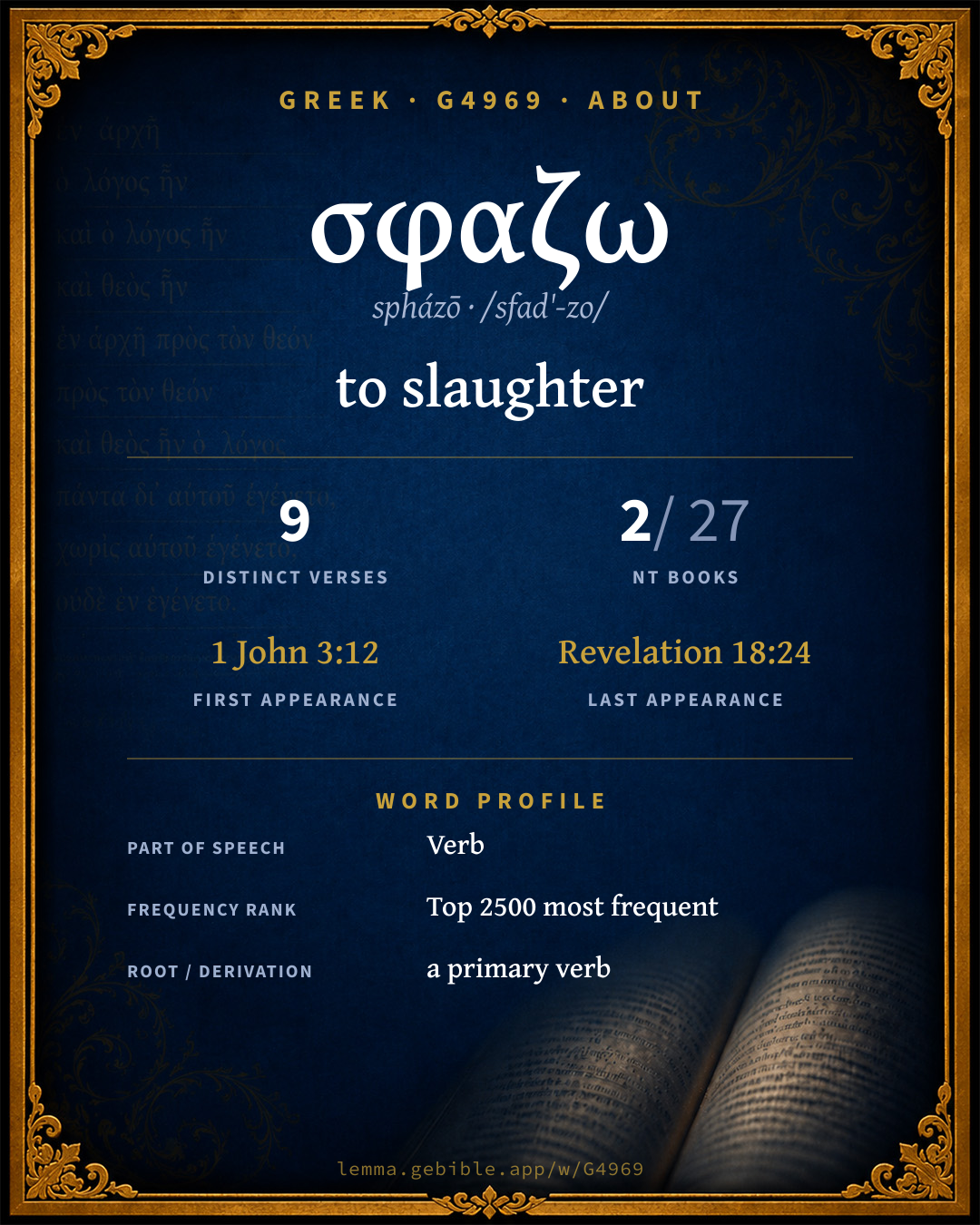
σφάζω
to slaughter
‘to slaughter’ is one of 3 main senses fuller range ↓
Full lexicon entry — Thayer's Greek Lexicon
From Thayer's Greek Lexicon
Where this word appears
See every Perfect-tense verb in the Greek New Testament →
Grammar key — what these labels mean
Part of speech
- Verb
- An action or state-of-being word.
Tense
- Aorist
- Action viewed as a simple whole, without regard to duration — often past (perfective aspect).
- Perfect
- A completed past action with continuing present results.
- Future
- Action expected in future time.
Voice
- Active
- The subject performs the action.
- Passive
- The subject receives the action.
Mood
- Indicative
- States a fact or asks a factual question (the mood of reality).
- Participle
- A verbal adjective (“writing,” “having written”).
Case
- Genitive
- The case of source, possession, or “of” — answers “whose / from what.”
- Accusative
- The case of the direct object and of extent.
- Nominative
- The case of the subject (and the predicate nominative).
Person
- 3rd person
- The one spoken about (“he / she / it / they”).
- 2nd person
- The one addressed (“you”).
Gender
- Masculine
- Grammatically masculine.
- Feminine
- Grammatically feminine.
- Neuter
- Grammatically neuter.
Number
- Singular
- One.
- Plural
- More than one.
Grammatical forms
- Verb, Aorist, Active, Indicative, 3rd person, Singular 2 times (20%)
- Verb, Perfect, Passive, Participle, Genitive, Plural, Masculine 2 times (20%)
- Verb, Aorist, Passive, Indicative, 2nd person, Singular 1 time (10%)
- Verb, Future, Active, Indicative, 3rd person, Plural 1 time (10%)
- Verb, Perfect, Passive, Participle, Accusative, Singular, Feminine 1 time (10%)
- Verb, Perfect, Passive, Participle, Accusative, Singular, Neuter 1 time (10%)
- Verb, Perfect, Passive, Participle, Genitive, Singular, Neuter 1 time (10%)
- Verb, Perfect, Passive, Participle, Nominative, Singular, Neuter 1 time (10%)
Parsed forms decoded from the imported morphology (Robinson–Tischendorf, public domain), counted across 10 parsed occurrences — not distinct verses.
Every verse where G4969 appears — 9 distinct verses across 2 books. Click any verse to open its interlinear word-by-word view. Verse text shown in the World English Bible for context — . Each verse’s Greek form is shown with its reference; the English is not keyword-highlighted, since the data carries no word-level English alignment. Use “Compare translations” on any verse to read it across multiple English versions. This concordance covers the Greek New Testament; Septuagint (Greek Old Testament) occurrences of this word are not indexed here.
1 John 1 verse
Revelation 8 verses
- Revelation 5:6 ἐσφαγμένον perf pass ptcp acc sg neut I saw in the midst of the throne and of the four living creatures, and in the midst of the elders, a Lamb standing, as though it had been slain, having seven horns, and seven eyes, which are the seven Spirits of God, sent out into all the earth.
- Revelation 5:9 ἐσφάγης aor pass ind 2sg They sang a new song, saying, "You are worthy to take the book, And to open its seals: For you were killed, And bought us for God with your blood, Out of every tribe, language, people, and nation,
- Revelation 5:12 ἐσφαγμένον perf pass ptcp nom sg neut saying with a loud voice, "Worthy is the Lamb who has been killed to receive the power, wealth, wisdom, strength, honor, glory, and blessing!"
- Revelation 6:4 σφάξουσιν fut act ind 3pl Another came forth, a red horse. To him who sat on it was given power to take peace from the earth, and that they should kill one another. There was given to him a great sword.
- Revelation 6:9 ἐσφαγμένων perf pass ptcp gen pl masc When he opened the fifth seal, I saw underneath the altar the souls of those who had been killed for the Word of God, and for the testimony of the Lamb which they had.
- Revelation 13:3 ἐσφαγμένην perf pass ptcp acc sg fem One of his heads looked like it had been wounded fatally. His fatal wound was healed, and the whole earth marveled at the beast.
- Revelation 13:8 ἐσφαγμένου perf pass ptcp gen sg neut All who dwell on the earth will worship him, everyone whose name has not been written from the foundation of the world in the book of life of the Lamb who has been killed.
- Revelation 18:24 ἐσφαγμένων perf pass ptcp gen pl masc In her was found the blood of prophets and of saints, and of all who have been slain on the earth."
About this entry
At a glance — auto-summarized from this page’s data, not written by a person. Every figure links to its source below. This summary describes the numbers; it doesn’t interpret them.
σφαζω (spházō) is a Greek verb most often rendered “to slaughter.” It clusters heavily in Revelation, which alone accounts for 89% of its uses. It turns up in 9 verses across 2 books, an uncommon footprint. It first appears in 1 John 3:12. Its lexical range runs to 3 senses. See the sense tree, 9-verse concordance, and the renderings breakdown below.
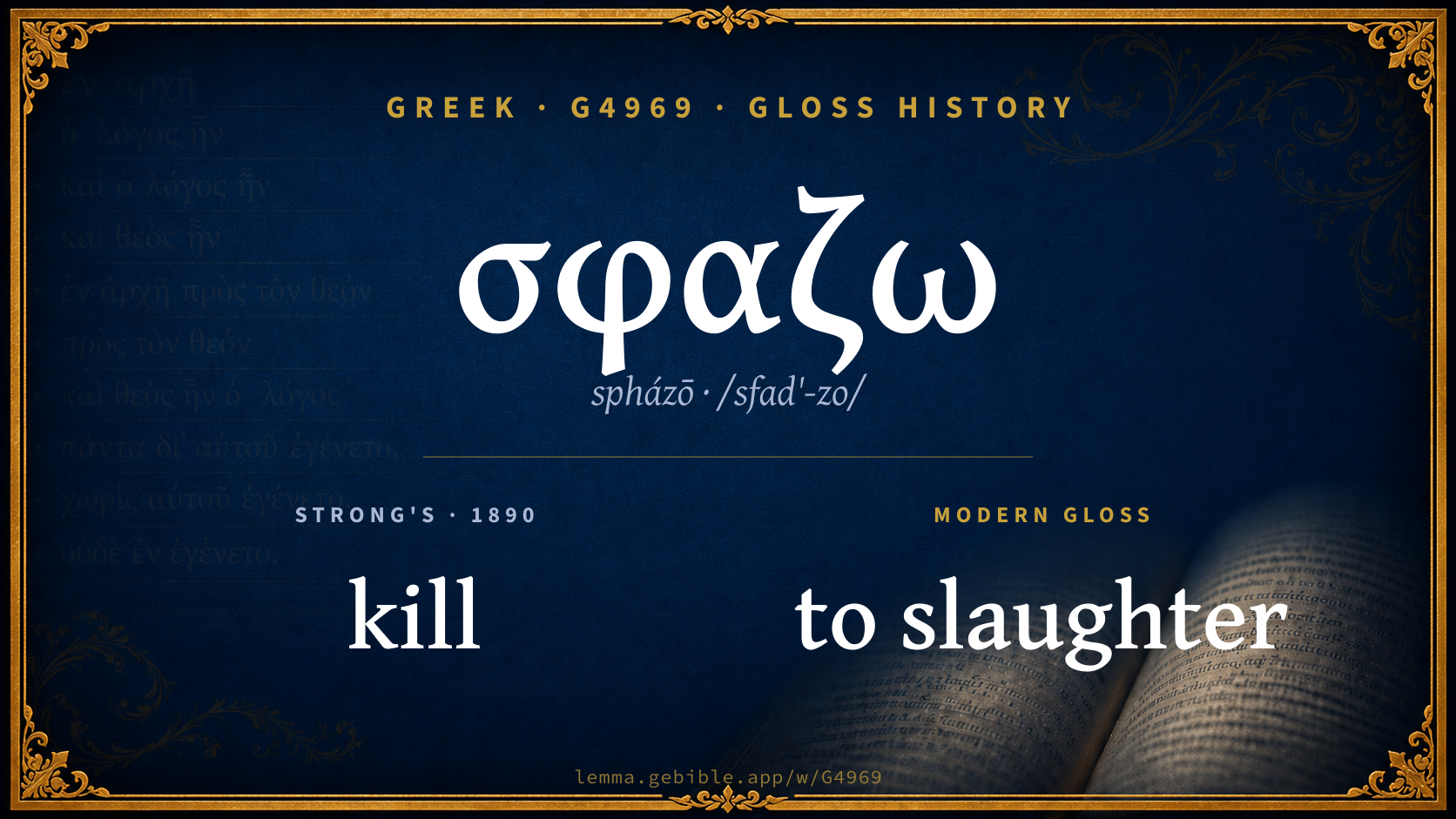
Gloss history
Strong's 1890 vs modern scholarship
About this word
Strong's G4969 catalogs a Greek word from the Greek New Testament.
These counts are not copied from any lexicon or concordance. They are computed here, from the morphology-tagged Greek New Testament. What Lemma adds →
- 9
- distinct verses
- The word appears in 9 distinct verses.
- 2 / 27
- NT books
- The word appears in 2 of 27 New Testament books.
- #1,056
- by frequency
- Top 2500 most frequent Greek words (rank 1,056 of 5,347 Greek words by occurrence).
View all 9 occurrences in the concordance →
Most concentrated in
- Revelation 8 verses 89%
- 1 John 1 verse 11%
By section of the New Testament
By traditional corpus
Conventional, traditional groupings — biblical authorship is debated, so this is a traditional corpus grouping, not an authorship claim. Some books belong to more than one corpus (Luke is in both the Gospels and the Lukan corpus, and so on), so these shares overlap and need not total 100%. Each figure is a share of the word’s 9 distinct verses.
- Johannine 9 verses · 100%
- Revelation 8 verses · 89%
- General (Catholic) Epistles 1 verse · 11%
How translations render this word
Counts come from each version’s own published word-to-Strong’s tagging or interlinear alignment — an approximate guide to how each version renders this word, not a word-level alignment the data otherwise carries. Because each total is that version’s own tagged count, the per-version totals vary from one another and need not match the appearance or distinct-verse counts above. These counts may also differ from a printed concordance because Lemma counts each distinctly tagged rendering and does not collapse phrase taggings into a single head-word total. This is a fixed set of word-tagged versions (KJV, ASV, BSB, ULT) and does not change with the reading translation you choose elsewhere. Each version’s license is shown beside its name below (and on Sources).
- King James Version: Slew 2×, Were slain 2×
- American Standard Version: Had been slain 2×, Hath been slain 2×
- Berean Standard Bible: Had been slain 2×, Was slain 2×
- unfoldingWord Literal Text: Did he kill 1×, Had been slain 1×, Having been 1×
King James Version Public Domain
Renders G4969 across 10 tagged occurrences — most commonly:
Plus 6 renderings that appear only once — usually multi-word phrases or single function words the recovered tagging swept in, not distinct renderings.
American Standard Version Public Domain
Renders G4969 across 10 tagged occurrences — most commonly:
Plus 6 renderings that appear only once — usually multi-word phrases or single function words the recovered tagging swept in, not distinct renderings.
Berean Standard Bible Public Domain
Renders G4969 across 10 tagged occurrences — most commonly:
Plus 6 renderings that appear only once — usually multi-word phrases or single function words the recovered tagging swept in, not distinct renderings.
unfoldingWord Literal Text CC BY-SA 4.0
Renders G4969 across 10 tagged occurrences — most commonly:
Senses in Thayer's
The 3 senses Thayer's distinguishes for this word, in lexicon order (not ranked by frequency or importance). The full entry — with sub-senses — is in the Lexicon Entry tab.
- to slay, slaughter, butcher
- to put to death by violence
- mortally wounded
Word origin
Origin: a primary verb
A primary verb; to butcher (especially an animal for food or in sacrifice) or (generally) to slaughter or (specifically) to maim (violently): - kill slay wound.
— Strong’s Exhaustive Concordance (1890), public domain.
Forms in the corpus
The 7 distinct written forms G4969 takes in the Greek New Testament, most frequent first — each parse links to that tense’s occurrences in the concordance.
| Form | Parsing | Example | Uses |
|---|---|---|---|
| ἐσφαγμένον esphagménon | Verb, Perfect, Passive, Participle, Accusative, Singular, Neuter | Revelation 5:6 | 2 |
| ἐσφαγμένων esphagménōn | Verb, Perfect, Passive, Participle, Genitive, Plural, Masculine | Revelation 6:9 | 2 |
| ἔσφαξεν ésphaxen | Verb, Aorist, Active, Indicative, 3rd person, Singular | 1 John 3:12 | 2 |
| σφάξουσιν spháxousin | Verb, Future, Active, Indicative, 3rd person, Plural | Revelation 6:4 | 1 |
| ἐσφάγης esphágēs | Verb, Aorist, Passive, Indicative, 2nd person, Singular | Revelation 5:9 | 1 |
| ἐσφαγμένην esphagménēn | Verb, Perfect, Passive, Participle, Accusative, Singular, Feminine | Revelation 13:3 | 1 |
| ἐσφαγμένου esphagménou | Verb, Perfect, Passive, Participle, Genitive, Singular, Neuter | Revelation 13:8 | 1 |
Same root — word family
Other Thayer's entries built from the same root as G4969, grouped by Strong’s listed origin. These share a root / origin per the lexicon — not necessarily a shared meaning. Each links to that word’s own entry.
Derived from this word
Compare all same-root words → They share a root, not necessarily a meaning.
Septuagint usage
The same Greek word σφαζω appears 80 times in the Greek Old Testament (Septuagint), across 69 verses in 14 books.
- 80
- LXX occurrences
- Tagged occurrences of this Greek word in the Septuagint.
- 69
- verses
- Distinct Septuagint verses containing this word.
- 14 / 39
- OT books
- The word appears in 14 of the 39 Old Testament books.
Sample Septuagint occurrences
- Genesis 22:10 σφάζω
- Exodus 12:6 σφάζω
- Leviticus 1:5 σφάζω
- Numbers 11:22 σφάζω
- Deuteronomy 28:31 σφάζω
- 1 Samuel 1:25 σφάζω
- 1 Kings 18:40 σφάζω
- 2 Kings 10:7 σφάζω
- Ezra 6:20 σφάζω
- Psalms 36:14 σφάζω
- Proverbs 9:2 σφάζω
- Isaiah 14:21 σφάζω
Septuagint occurrences (same lexeme)
Every verse where the same Strong’s number (G4969) appears in the Greek Septuagint — showing the first 50 of 69. Verse text shown in the World English Bible for context; the Greek form is the matched word — the English is not keyword-highlighted.
- Genesis 22:10 σφάζω Abraham stretched forth his hand, and took the knife to kill his son.
- Genesis 37:31 σφάζω They took Joseph's coat, and killed a male goat, and dipped the coat in the blood.
- Genesis 43:16 σφάζω When Joseph saw Benjamin with them, he said to the steward of his house, "Bring the men into the house, and butcher an animal, and make ready; for the men will dine with me at noon."
- Exodus 12:6 σφάζω and you shall keep it until the fourteenth day of the same month; and the whole assembly of the congregation of Israel shall kill it at evening.
- Exodus 21:37 σφάζω
- Exodus 29:11 σφάζω You shall kill the bull before Yahweh, at the door of the tent of meeting.
- Exodus 29:16 σφάζω You shall kill the ram, and you shall take its blood, and sprinkle it around on the altar.
- Exodus 29:20 σφάζω Then you shall kill the ram, and take some of its blood, and put it on the tip of the right ear of Aaron, and on the tip of the right ear of his sons, and on the thumb of their right hand, and on the big toe of their right foot, and sprinkle the blood on the altar round about.
- Exodus 34:25 σφάζω "You shall not offer the blood of my sacrifice with leavened bread; neither shall the sacrifice of the feast of the Passover be left to the morning.
- Leviticus 1:5 σφάζω He shall kill the bull before Yahweh. Aaron's sons, the priests, shall present the blood and sprinkle the blood around on the altar that is at the door of the Tent of Meeting.
- Leviticus 1:11 σφάζω He shall kill it on the north side of the altar before Yahweh. Aaron's sons, the priests, shall sprinkle its blood around on the altar.
- Leviticus 3:2 σφάζω He shall lay his hand on the head of his offering, and kill it at the door of the tent of meeting: and Aaron's sons the priests shall sprinkle the blood on the altar round about.
- Leviticus 3:8 σφάζω and he shall lay his hand on the head of his offering, and kill it before the tent of meeting: and Aaron's sons shall sprinkle its blood on the altar round about.
- Leviticus 3:13 σφάζω and he shall lay his hand on its head, and kill it before the tent of meeting; and the sons of Aaron shall sprinkle its blood on the altar round about.
- Leviticus 4:4 σφάζω He shall bring the bull to the door of the Tent of Meeting before Yahweh; and he shall lay his hand on the head of the bull, and kill the bull before Yahweh.
- Leviticus 4:15 σφάζω The elders of the congregation shall lay their hands on the head of the bull before Yahweh; and the bull shall be killed before Yahweh.
- Leviticus 4:24 σφάζω He shall lay his hand on the head of the goat, and kill it in the place where they kill the burnt offering before Yahweh. It is a sin offering.
- Leviticus 4:29 σφάζω He shall lay his hand on the head of the sin offering, and kill the sin offering in the place of burnt offering.
- Leviticus 4:33 σφάζω He shall lay his hand on the head of the sin offering, and kill it for a sin offering in the place where they kill the burnt offering.
- Leviticus 6:18 σφάζω Every male among the children of Aaron shall eat of it, as their portion forever throughout your generations, from the offerings of Yahweh made by fire. Whoever touches them shall be holy.'"
- Leviticus 7:2 σφάζω In the place where they kill the burnt offering, he shall kill the trespass offering; and its blood he shall sprinkle on the altar round about.
- Leviticus 8:15 σφάζω He killed it; and Moses took the blood, and put it on the horns of the altar round about with his finger, and purified the altar, and poured out the blood at the base of the altar, and sanctified it, to make atonement for it.
- Leviticus 8:19 σφάζω He killed it; and Moses sprinkled the blood on the altar round about.
- Leviticus 8:23 σφάζω He killed it; and Moses took some of its blood, and put it on the tip of Aaron's right ear, and on the thumb of his right hand, and on the great toe of his right foot.
- Leviticus 9:8 σφάζω So Aaron drew near to the altar, and killed the calf of the sin offering, which was for himself.
- Leviticus 9:12 σφάζω He killed the burnt offering; and Aaron's sons delivered the blood to him, and he sprinkled it on the altar round about.
- Leviticus 9:15 σφάζω He presented the people's offering, and took the goat of the sin offering which was for the people, and killed it, and offered it for sin, like the first.
- Leviticus 9:18 σφάζω He also killed the ox and the ram, the sacrifice of peace offerings, which was for the people: and Aaron's sons delivered to him the blood, which he sprinkled on the altar round about,
- Leviticus 14:5 σφάζω The priest shall command them to kill one of the birds in an earthen vessel over running water.
- Leviticus 14:6 σφάζω As for the living bird, he shall take it, and the cedar wood, and the scarlet, and the hyssop, and shall dip them and the living bird in the blood of the bird that was killed over the running water.
- Leviticus 14:13 σφάζω He shall kill the male lamb in the place where they kill the sin offering and the burnt offering, in the place of the sanctuary; for as the sin offering is the priest's, so is the trespass offering. It is most holy.
- Leviticus 14:19 σφάζω "The priest shall offer the sin offering, and make atonement for him who is to be cleansed because of his uncleanness: and afterward he shall kill the burnt offering;
- Leviticus 14:25 σφάζω He shall kill the lamb of the trespass offering. The priest shall take some of the blood of the trespass offering and put it on the tip of the right ear of him who is to be cleansed, and on the thumb of his right hand, and on the big toe of his right foot.
- Leviticus 14:50 σφάζω He shall kill one of the birds in an earthen vessel over running water.
- Leviticus 14:51 σφάζω He shall take the cedar wood, and the hyssop, and the scarlet, and the living bird, and dip them in the blood of the slain bird, and in the running water, and sprinkle the house seven times.
- Leviticus 16:11 σφάζω "Aaron shall present the bull of the sin offering, which is for himself, and shall make atonement for himself and for his house, and shall kill the bull of the sin offering which is for himself.
- Leviticus 16:15 σφάζω "Then he shall kill the goat of the sin offering, that is for the people, and bring his blood within the veil, and do with his blood as he did with the blood of the bull, and sprinkle it on the mercy seat, and before the mercy seat:
- Leviticus 17:3 σφάζω Whatever man there is of the house of Israel, who kills an ox, or lamb, or goat, in the camp, or who kills it outside the camp,
- Leviticus 17:4 σφάζω and hasn't brought it to the door of the Tent of Meeting, to offer it as an offering to Yahweh before the tabernacle of Yahweh: blood shall be imputed to that man. He has shed blood; and that man shall be cut off from among his people.
- Leviticus 17:5 σφάζω This is to the end that the children of Israel may bring their sacrifices, which they sacrifice in the open field, that they may bring them to Yahweh, to the door of the Tent of Meeting, to the priest, and sacrifice them for sacrifices of peace offerings to Yahweh.
- Leviticus 22:28 σφάζω Whether it is a cow or ewe, you shall not kill it and its young both in one day.
- Numbers 11:22 σφάζω Shall flocks and herds be slain for them, to suffice them? or shall all the fish of the sea be gathered together for them, to suffice them?
- Numbers 19:3 σφάζω You shall give her to Eleazar the priest, and he shall bring her forth outside of the camp, and one shall kill her before his face:
- Deuteronomy 28:31 σφάζω Your ox shall be slain before your eyes, and you shall not eat of it: your donkey shall be violently taken away from before your face, and shall not be restored to you: your sheep shall be given to your enemies, and you shall have none to save you.
- 1 Samuel 1:25 σφάζω They killed the bull, and brought the child to Eli.
- 1 Samuel 14:32 σφάζω and the people flew on the spoil, and took sheep, and oxen, and calves, and killed them on the ground; and the people ate them with the blood.
- 1 Samuel 14:34 σφάζω Saul said, Disperse yourselves among the people, and tell them, Bring me here every man his ox, and every man his sheep, and kill them here, and eat; and don't sin against Yahweh in eating with the blood. All the people brought every man his ox with him that night, and killed them there.
- 1 Samuel 15:33 σφάζω Samuel said, As your sword has made women childless, so shall your mother be childless among women. Samuel hewed Agag in pieces before Yahweh in Gilgal.
- 1 Kings 18:40 σφάζω and Elijah said to them, Take the prophets of Baal; don't let one of them escape. They took them; and Elijah brought them down to the brook Kishon, and killed them there.
- 2 Kings 10:7 σφάζω It happened, when the letter came to them, that they took the king's sons, and killed them, even seventy persons, and put their heads in baskets, and sent them to him to Jezreel.
These are occurrences of the same Greek lexeme (G4969) in the Septuagint — not a translation of any one Hebrew word. The store carries no word-level Hebrew↔Greek alignment, so no Hebrew original is asserted here. Counts come from the recovered LXX Strong's tagging — high-frequency vocabulary is well covered, while rare or late forms may be untagged — so they reflect tagged occurrences and may slightly undercount.