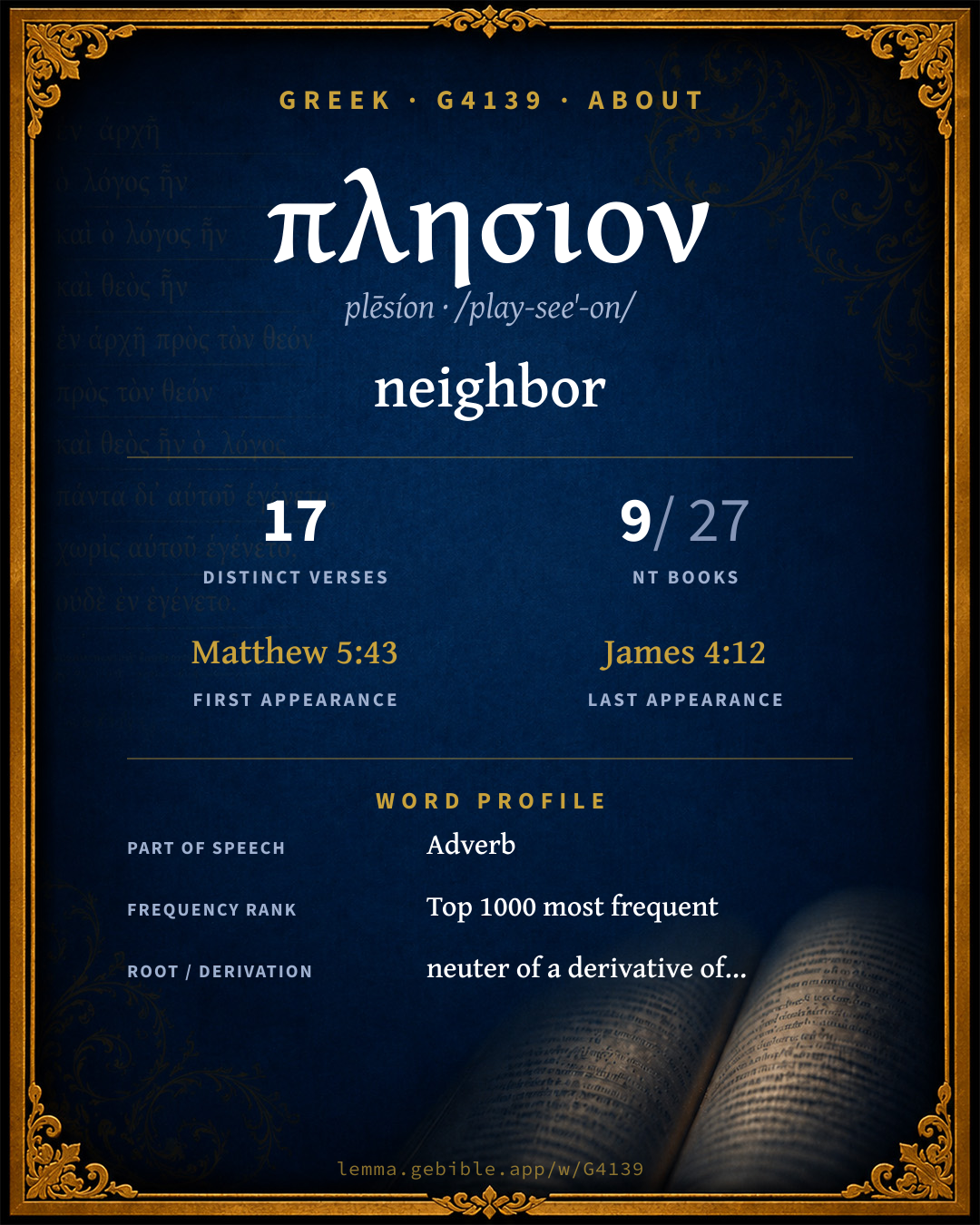
πλησίον
neighbor
‘neighbor’ is one of 3 main senses fuller range ↓
Full lexicon entry — Thayer's Greek Lexicon
From Thayer's Greek Lexicon
Where this word appears
Grammar key — what these labels mean
Part of speech
- Adverb
- A word that modifies a verb, adjective, or other adverb.
Every verse where G4139 appears — 17 distinct verses across 9 books. Click any verse to open its interlinear word-by-word view. Verse text shown in the World English Bible for context — . Each verse’s Greek form is shown with its reference; the English is not keyword-highlighted, since the data carries no word-level English alignment. Use “Compare translations” on any verse to read it across multiple English versions. This concordance covers the Greek New Testament; Septuagint (Greek Old Testament) occurrences of this word are not indexed here.
Matthew 3 verses
- Matthew 5:43 πλησίον adv "You have heard that it was said, 'You shall love your neighbor, and hate your enemy.'
- Matthew 19:19 πλησίον adv 'Honor your father and mother.' And, 'You shall love your neighbor as yourself.'"
- Matthew 22:39 πλησίον adv A second likewise is this, 'You shall love your neighbor as yourself.'
Mark 2 verses
- Mark 12:31 πλησίον adv The second is like this, 'You shall love your neighbor as yourself.' There is no other commandment greater than these."
- Mark 12:33 πλησίον adv and to love him with all the heart, and with all the understanding, with all the soul, and with all the strength, and to love his neighbor as himself, is more important than all whole burnt offerings and sacrifices."
Luke 3 verses
- Luke 10:27 πλησίον adv He answered, "You shall love the Lord your God with all your heart, with all your soul, with all your strength, and with all your mind; and your neighbor as yourself."
- Luke 10:29 πλησίον adv But he, desiring to justify himself, asked Jesus, "Who is my neighbor?"
- Luke 10:36 πλησίον adv Now which of these three do you think seemed to be a neighbor to him who fell among the robbers?"
John 1 verse
Acts 1 verse
Romans 3 verses
- Romans 13:9 πλησίον adv For the commandments, "You shall not commit adultery," "You shall not murder," "You shall not steal," "You shall not give false testimony," "You shall not covet," and whatever other commandments there are, are all summed up in this saying, namely, "You shall love your neighbor as yourself."
- Romans 13:10 πλησίον adv Love doesn't harm a neighbor. Love therefore is the fulfillment of the law.
- Romans 15:2 πλησίον adv Let each one of us please his neighbor for that which is good, to be building him up.
Galatians 1 verse
Ephesians 1 verse
James 2 verses
About this entry
At a glance — auto-summarized from this page’s data, not written by a person. Every figure links to its source below. This summary describes the numbers; it doesn’t interpret them.
At its core, πλησιον (plēsíon) means “neighbor.” The King James Version usually renders it “neighbour,” while modern versions prefer “neighbor” (Berean Standard Bible) — see the renderings breakdown. Spanning 17 verses in 9 books, it ranks among the uncommon words of the Greek New Testament. Scripture first uses it in Matthew 5:43. Catalogued under 3 senses, its meaning is not single-sense. Dig into 17-verse concordance and the renderings breakdown below.
Gloss history
Strong's 1890 vs modern scholarship

About this word
Strong's G4139 catalogs a Greek word from the Greek New Testament.
These counts are not copied from any lexicon or concordance. They are computed here, from the morphology-tagged Greek New Testament. What Lemma adds →
- 17
- distinct verses
- The word appears in 17 distinct verses.
- 9 / 27
- NT books
- The word appears in 9 of 27 New Testament books.
- #697
- by frequency
- Top 1000 most frequent Greek words (rank 697 of 5,347 Greek words by occurrence).
View all 17 occurrences in the concordance →
By section of the New Testament
By traditional corpus
Conventional, traditional groupings — biblical authorship is debated, so this is a traditional corpus grouping, not an authorship claim. Some books belong to more than one corpus (Luke is in both the Gospels and the Lukan corpus, and so on), so these shares overlap and need not total 100%. Each figure is a share of the word’s 17 distinct verses.
- Gospels 9 verses · 53%
- Pauline corpus 5 verses · 29%
- Lukan (Luke–Acts) 4 verses · 24%
- General (Catholic) Epistles 2 verses · 12%
- Johannine 1 verse · 6%
How translations render this word
Counts come from each version’s own published word-to-Strong’s tagging or interlinear alignment — an approximate guide to how each version renders this word, not a word-level alignment the data otherwise carries. Because each total is that version’s own tagged count, the per-version totals vary from one another and need not match the appearance or distinct-verse counts above. These counts may also differ from a printed concordance because Lemma counts each distinctly tagged rendering and does not collapse phrase taggings into a single head-word total. This is a fixed set of word-tagged versions (KJV, ASV, BSB, ULT) and does not change with the reading translation you choose elsewhere. Each version’s license is shown beside its name below (and on Sources).
- King James Version: Neighbour 16×
- American Standard Version: Neighbor 15×
- Berean Standard Bible: Neighbor 16×
- unfoldingWord Literal Text: Neighbor 16×
King James Version Public Domain
Renders G4139 across 17 tagged occurrences — most commonly:
Plus 1 rendering that appears only once — usually multi-word phrases or single function words the recovered tagging swept in, not distinct renderings.
American Standard Version Public Domain
Renders G4139 across 17 tagged occurrences — most commonly:
Plus 2 renderings that appear only once — usually multi-word phrases or single function words the recovered tagging swept in, not distinct renderings.
Berean Standard Bible Public Domain
Renders G4139 across 17 tagged occurrences — most commonly:
Plus 1 rendering that appears only once — usually multi-word phrases or single function words the recovered tagging swept in, not distinct renderings.
unfoldingWord Literal Text CC BY-SA 4.0
Renders G4139 across 17 tagged occurrences — most commonly:
Plus 1 rendering that appears only once — usually multi-word phrases or single function words the recovered tagging swept in, not distinct renderings.
Senses in Thayer's
The 3 senses Thayer's distinguishes for this word, in lexicon order (not ranked by frequency or importance). The full entry — with sub-senses — is in the Lexicon Entry tab.
- a friend
- any other person…
- according to Christ, any other man irrespective of nation or religion with whom we live or whom we chance to meet
Word origin
Origin: neuter of a derivative of pelas (near)
Neuter of a derivative of πέλας pelas ( near ); (adverb) close by; as noun a neighbor that is fellow (as man countryman Christian or friend): - near neighbour.
— Strong’s Exhaustive Concordance (1890), public domain.
Septuagint usage
The same Greek word πλησιον appears 161 times in the Greek Old Testament (Septuagint), across 146 verses in 27 books.
- 161
- LXX occurrences
- Tagged occurrences of this Greek word in the Septuagint.
- 146
- verses
- Distinct Septuagint verses containing this word.
- 27 / 39
- OT books
- The word appears in 27 of the 39 Old Testament books.
Sample Septuagint occurrences
- Genesis 11:3 πλησίον
- Exodus 2:13 πλησίον
- Leviticus 5:21 πλησίον
- Numbers 33:37 πλησίον
- Deuteronomy 1:1 πλησίον
- Joshua 9:2 πλησίον
- Judges 6:29 πλησίον
- Ruth 3:14 πλησίον
- 1 Samuel 10:11 πλησίον
- 2 Samuel 2:16 πλησίον
- 1 Kings 8:31 πλησίον
- 2 Kings 3:23 πλησίον
Septuagint occurrences (same lexeme)
Every verse where the same Strong’s number (G4139) appears in the Greek Septuagint — showing the first 50 of 146. Verse text shown in the World English Bible for context; the Greek form is the matched word — the English is not keyword-highlighted.
- Genesis 11:3 πλησίον They said one to another, "Come, let's make brick, and burn them thoroughly." They had brick for stone, and they used tar for mortar.
- Genesis 11:7 πλησίον Come, let's go down, and there confuse their language, that they may not understand one another's speech."
- Genesis 26:31 πλησίον They rose up some time in the morning, and swore one to another. Isaac sent them away, and they departed from him in peace.
- Exodus 2:13 πλησίον He went out the second day, and, behold, two men of the Hebrews were fighting with each other. He said to him who did the wrong, "Why do you strike your fellow?"
- Exodus 11:2 πλησίον Speak now in the ears of the people, and let them ask every man of his neighbor, and every woman of her neighbor, jewels of silver, and jewels of gold."
- Exodus 12:4 πλησίον and if the household be too little for a lamb, then he and his neighbor next to his house shall take one according to the number of the souls; according to what everyone can eat you shall make your count for the lamb.
- Exodus 20:16 πλησίον "You shall not give false testimony against your neighbor.
- Exodus 20:17 πλησίον "You shall not covet your neighbor's house. You shall not covet your neighbor's wife, nor his man-servant, nor his maid-servant, nor his ox, nor his donkey, nor anything that is your neighbor's."
- Exodus 21:14 πλησίον If a man schemes and comes presumptuously on his neighbor to kill him, you shall take him from my altar, that he may die.
- Exodus 21:18 πλησίον "If men quarrel and one strikes the other with a stone, or with his fist, and he doesn't die, but is confined to bed;
- Exodus 21:35 πλησίον "If one man's bull injures another's, so that it dies, then they shall sell the live bull, and divide its price; and they shall also divide the dead animal.
- Exodus 22:6 πλησίον "If fire breaks out, and catches in thorns so that the shocks of grain, or the standing grain, or the field are consumed; he who kindled the fire shall surely make restitution.
- Exodus 22:7 πλησίον "If a man delivers to his neighbor money or stuff to keep, and it is stolen out of the man's house; if the thief is found, he shall pay double.
- Exodus 22:8 πλησίον If the thief isn't found, then the master of the house shall come near to God, to find out if he hasn't put his hand to his neighbor's goods.
- Exodus 22:9 πλησίον For every matter of trespass, whether it be for ox, for donkey, for sheep, for clothing, or for any kind of lost thing, about which one says, 'This is mine,' the cause of both parties shall come before God. He whom God condemns shall pay double to his neighbor.
- Exodus 22:10 πλησίον "If a man delivers to his neighbor a donkey, an ox, a sheep, or any animal to keep, and it dies or is injured, or driven away, no man seeing it;
- Exodus 22:13 πλησίον If it is torn in pieces, let him bring it for evidence. He shall not make good that which was torn.
- Exodus 22:25 πλησίον "If you lend money to any of my people with you who is poor, you shall not be to him as a creditor; neither shall you charge him interest.
- Exodus 32:27 πλησίον He said to them, "Thus says Yahweh, the God of Israel, 'Every man put his sword on his thigh, and go back and forth from gate to gate throughout the camp, and every man kill his brother, and every man his companion, and every man his neighbor."
- Exodus 34:3 πλησίον No one shall come up with you; neither let anyone be seen throughout all the mountain; neither let the flocks nor herds feed before that mountain."
- Leviticus 5:21 πλησίον
- Leviticus 18:20 πλησίον "'You shall not lie carnally with your neighbor's wife, and defile yourself with her.
- Leviticus 19:11 πλησίον "'You shall not steal; neither shall you deal falsely, nor lie to one another.
- Leviticus 19:13 πλησίον "'You shall not oppress your neighbor, nor rob him. The wages of a hired servant shall not remain with you all night until the morning.
- Leviticus 19:15 πλησίον "'You shall do no injustice in judgment: you shall not be partial to the poor, nor show favoritism to the great; but in righteousness shall you judge your neighbor.
- Leviticus 19:16 πλησίον "'You shall not go up and down as a slanderer among your people; neither shall you stand against the life of your neighbor. I am Yahweh.
- Leviticus 19:17 πλησίον "'You shall not hate your brother in your heart. You shall surely rebuke your neighbor, and not bear sin because of him.
- Leviticus 19:18 πλησίον You shall not take vengeance, nor bear any grudge against the children of your people; but you shall love your neighbor as yourself. I am Yahweh.
- Leviticus 20:10 πλησίον "'The man who commits adultery with another man's wife, even he who commits adultery with his neighbor's wife, the adulterer and the adulteress shall surely be put to death.
- Leviticus 24:19 πλησίον If anyone injures his neighbor; as he has done, so shall it be done to him:
- Leviticus 25:14 πλησίον "'If you sell anything to your neighbor, or buy from your neighbor, you shall not wrong one another.
- Leviticus 25:15 πλησίον According to the number of years after the Jubilee you shall buy from your neighbor. According to the number of years of the crops he shall sell to you.
- Leviticus 25:17 πλησίον You shall not wrong one another; but you shall fear your God: for I am Yahweh your God.
- Numbers 33:37 πλησίον They traveled from Kadesh, and encamped in Mount Hor, in the edge of the land of Edom.
- Deuteronomy 1:1 πλησίον These are the words which Moses spoke to all Israel beyond the Jordan in the wilderness, in the Arabah over against Suph, between Paran, and Tophel, and Laban, and Hazeroth, and Dizahab.
- Deuteronomy 4:42 πλησίον that the manslayer might flee there, who kills his neighbor unawares, and didn't hate him in time past; and that fleeing to one of these cities he might live:
- Deuteronomy 5:20 πλησίον "Neither shall you give false testimony against your neighbor.
- Deuteronomy 5:21 πλησίον "Neither shall you covet your neighbor's wife; neither shall you desire your neighbor's house, his field, or his man-servant, or his maid-servant, his ox, or his donkey, or anything that is your neighbor's."
- Deuteronomy 11:30 πλησίον Aren't they beyond the Jordan, behind the way of the going down of the sun, in the land of the Canaanites who dwell in the Arabah, over against Gilgal, beside the oaks of Moreh?
- Deuteronomy 15:2 πλησίον This is the manner of the release: every creditor shall release that which he has lent to his neighbor; he shall not exact it of his neighbor and his brother; because Yahweh's release has been proclaimed.
- Deuteronomy 19:4 πλησίον This is the case of the manslayer, that shall flee there and live: whoever kills his neighbor unawares, and didn't hate him in time past;
- Deuteronomy 19:5 πλησίον as when a man goes into the forest with his neighbor to hew wood, and his hand fetches a stroke with the axe to cut down the tree, and the head slips from the handle, and lights on his neighbor, so that he dies; he shall flee to one of these cities and live:
- Deuteronomy 19:11 πλησίον But if any man hate his neighbor, and lie in wait for him, and rise up against him, and strike him mortally so that he dies, and he flee into one of these cities;
- Deuteronomy 19:14 πλησίον You shall not remove your neighbor's landmark, which they of old time have set, in your inheritance which you shall inherit, in the land that Yahweh your God gives you to possess it.
- Deuteronomy 22:24 πλησίον then you shall bring them both out to the gate of that city, and you shall stone them to death with stones; the lady, because she didn't cry, being in the city; and the man, because he has humbled his neighbor's wife: so you shall put away the evil from the midst of you.
- Deuteronomy 22:26 πλησίον but to the lady you shall do nothing; there is in the lady no sin worthy of death: for as when a man rises against his neighbor, and kills him, even so is this matter;
- Deuteronomy 23:25 πλησίον When you come into your neighbor's standing grain, then you may pluck the ears with your hand; but you shall not move a sickle to your neighbor's standing grain.
- Deuteronomy 23:26 πλησίον
- Deuteronomy 24:10 πλησίον When you do lend your neighbor any manner of loan, you shall not go into his house to get his pledge.
- Deuteronomy 27:17 πλησίον Cursed be he who removes his neighbor's landmark. All the people shall say, Amen.
These are occurrences of the same Greek lexeme (G4139) in the Septuagint — not a translation of any one Hebrew word. The store carries no word-level Hebrew↔Greek alignment, so no Hebrew original is asserted here. Counts come from the recovered LXX Strong's tagging — high-frequency vocabulary is well covered, while rare or late forms may be untagged — so they reflect tagged occurrences and may slightly undercount.