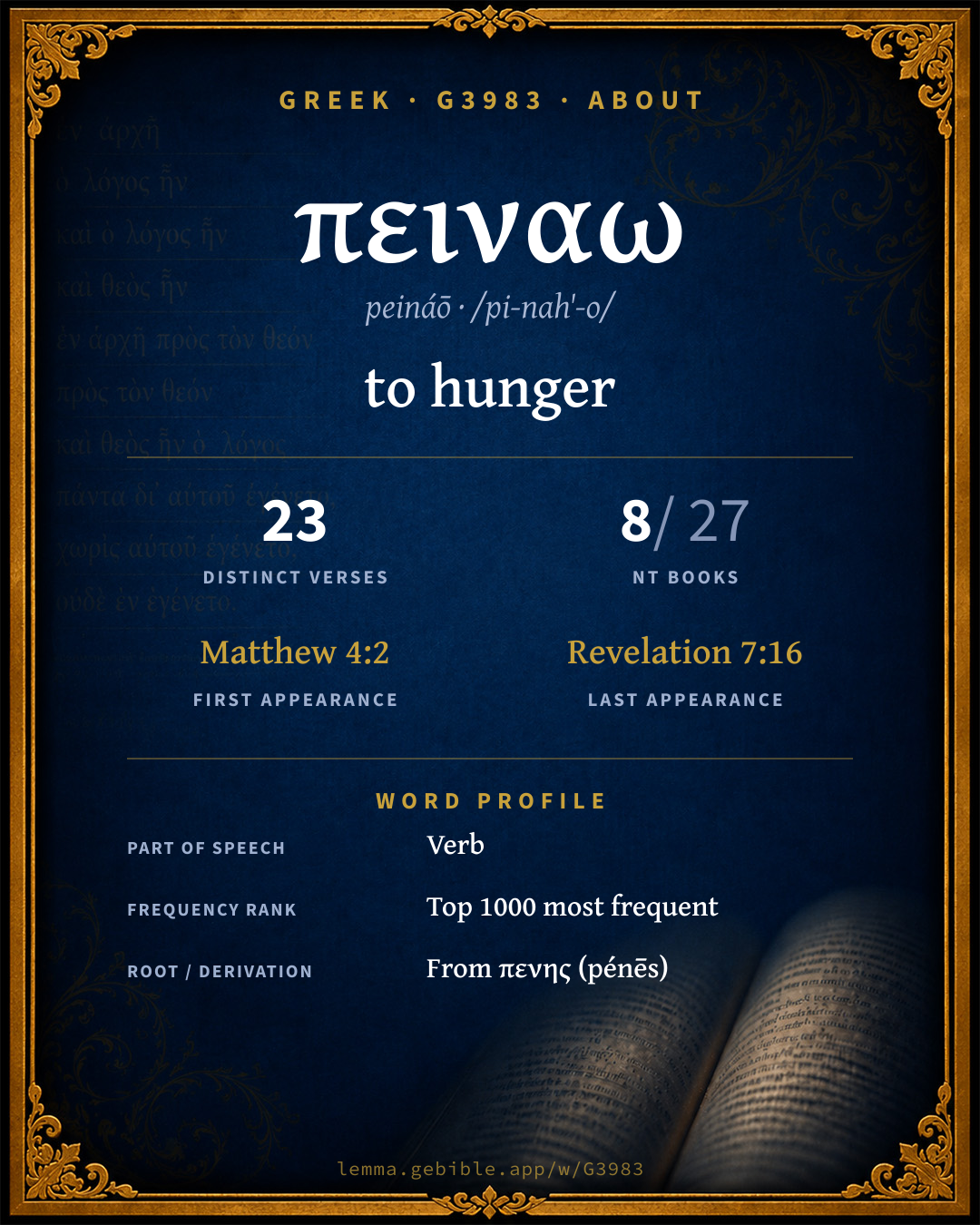
πεινάω
to hunger
‘to hunger’ is one of 3 main senses fuller range ↓
Full lexicon entry — Thayer's Greek Lexicon
From Thayer's Greek Lexicon
Where this word appears
See every Aorist-tense verb in the Greek New Testament →
Grammar key — what these labels mean
Part of speech
- Verb
- An action or state-of-being word.
Tense
- Aorist
- Action viewed as a simple whole, without regard to duration — often past (perfective aspect).
- Present
- Ongoing or general action in present time (imperfective aspect).
- Future
- Action expected in future time.
Voice
- Active
- The subject performs the action.
Mood
- Indicative
- States a fact or asks a factual question (the mood of reality).
- Participle
- A verbal adjective (“writing,” “having written”).
- Subjunctive
- Expresses probability, purpose, or possibility (the mood of contingency).
- Infinitive
- A verbal noun (“to write”), unmarked for person or number.
Case
- Accusative
- The case of the direct object and of extent.
- Nominative
- The case of the subject (and the predicate nominative).
Person
- 3rd person
- The one spoken about (“he / she / it / they”).
- 1st person
- The speaker (“I / we”).
- 2nd person
- The one addressed (“you”).
Gender
- Masculine
- Grammatically masculine.
Number
- Singular
- One.
- Plural
- More than one.
Grammatical forms 13 distinct
- Verb, Aorist, Active, Indicative, 3rd person, Singular 7 times (30%)
- Verb, Aorist, Active, Indicative, 1st person, Singular 2 times (9%)
- Verb, Present, Active, Indicative, 3rd person, Singular 2 times (9%)
- Verb, Present, Active, Participle, Accusative, Singular, Masculine 2 times (9%)
- Verb, Present, Active, Participle, Nominative, Plural, Masculine 2 times (9%)
- Verb, Aorist, Active, Indicative, 3rd person, Plural 1 time (4%)
- Verb, Aorist, Active, Subjunctive, 3rd person, Singular 1 time (4%)
- Verb, Future, Active, Indicative, 2nd person, Plural 1 time (4%)
+5 more forms (5 occurrences)
Parsed forms decoded from the imported morphology (Robinson–Tischendorf, public domain), counted across 23 parsed occurrences — not distinct verses.
Every verse where G3983 appears — 23 distinct verses across 8 books. Click any verse to open its interlinear word-by-word view. Verse text shown in the World English Bible for context — . Each verse’s Greek form is shown with its reference; the English is not keyword-highlighted, since the data carries no word-level English alignment. Use “Compare translations” on any verse to read it across multiple English versions. This concordance covers the Greek New Testament; Septuagint (Greek Old Testament) occurrences of this word are not indexed here.
Matthew 9 verses
- Matthew 4:2 ἐπείνασεν aor act ind 3sg When he had fasted forty days and forty nights, he was hungry afterward.
- Matthew 5:6 πεινῶντες pres act ptcp nom pl masc Blessed are those who hunger and thirst after righteousness, For they shall be filled.
- Matthew 12:1 ἐπείνασαν aor act ind 3pl At that time, Jesus went on the Sabbath day through the grain fields. His disciples were hungry and began to pluck heads of grain and to eat.
- Matthew 12:3 ἐπείνασεν aor act ind 3sg But he said to them, "Haven't you read what David did, when he was hungry, and those who were with him;
- Matthew 21:18 ἐπείνασεν aor act ind 3sg Now in the morning, as he returned to the city, he was hungry.
- Matthew 25:35 ἐπείνασα aor act ind 1sg for I was hungry, and you gave me food to eat; I was thirsty, and you gave me drink; I was a stranger, and you took me in;
- Matthew 25:37 πεινῶντα pres act ptcp acc sg masc "Then the righteous will answer him, saying, 'Lord, when did we see you hungry, and feed you; or thirsty, and give you a drink?
- Matthew 25:42 ἐπείνασα aor act ind 1sg for I was hungry, and you didn't give me food to eat; I was thirsty, and you gave me no drink;
- Matthew 25:44 πεινῶντα pres act ptcp acc sg masc "Then they will also answer, saying, 'Lord, when did we see you hungry, or thirsty, or a stranger, or naked, or sick, or in prison, and didn't help you?'
Mark 2 verses
Luke 5 verses
- Luke 1:53 πεινῶντας pres act ptcp acc pl masc He has filled the hungry with good things. He has sent the rich away empty.
- Luke 4:2 ἐπείνασεν aor act ind 3sg for forty days, being tempted by the devil. He ate nothing in those days. Afterward, when they were completed, he was hungry.
- Luke 6:3 ἐπείνασεν aor act ind 3sg Jesus, answering them, said, "Haven't you read what David did when he was hungry, he, and those who were with him;
- Luke 6:21 πεινῶντες pres act ptcp nom pl masc Blessed are you who hunger now, For you will be filled. Blessed are you who weep now, For you will laugh.
- Luke 6:25 πεινάσετε fut act ind 2pl Woe to you, you who are full now! For you will be hungry. Woe to you who laugh now! For you will mourn and weep.
John 1 verse
Romans 1 verse
1 Corinthians 3 verses
- 1 Corinthians 4:11 πεινῶμεν pres act ind 1pl Even to this present hour we hunger, thirst, are naked, are beaten, and have no certain dwelling place.
- 1 Corinthians 11:21 πεινᾷ pres act ind 3sg For in your eating each one takes his own supper before others. One is hungry, and another is drunken.
- 1 Corinthians 11:34 πεινᾷ pres act ind 3sg But if anyone is hungry, let him eat at home, lest your coming together be for judgment. The rest I will set in order whenever I come.
Philippians 1 verse
Revelation 1 verse
About this entry
At a glance — auto-summarized from this page’s data, not written by a person. Every figure links to its source below. This summary describes the numbers; it doesn’t interpret them.
πειναω — transliterated peináō — is a Greek verb carrying the sense “to hunger.” Its earliest occurrence is Matthew 4:2. Spanning 23 verses in 8 books, it ranks among the uncommon words of the Greek New Testament. Its uses concentrate in Matthew (39% of all occurrences). Thayer's distinguishes 3 senses for it. Each statement above links to its evidence; the full detail follows below.
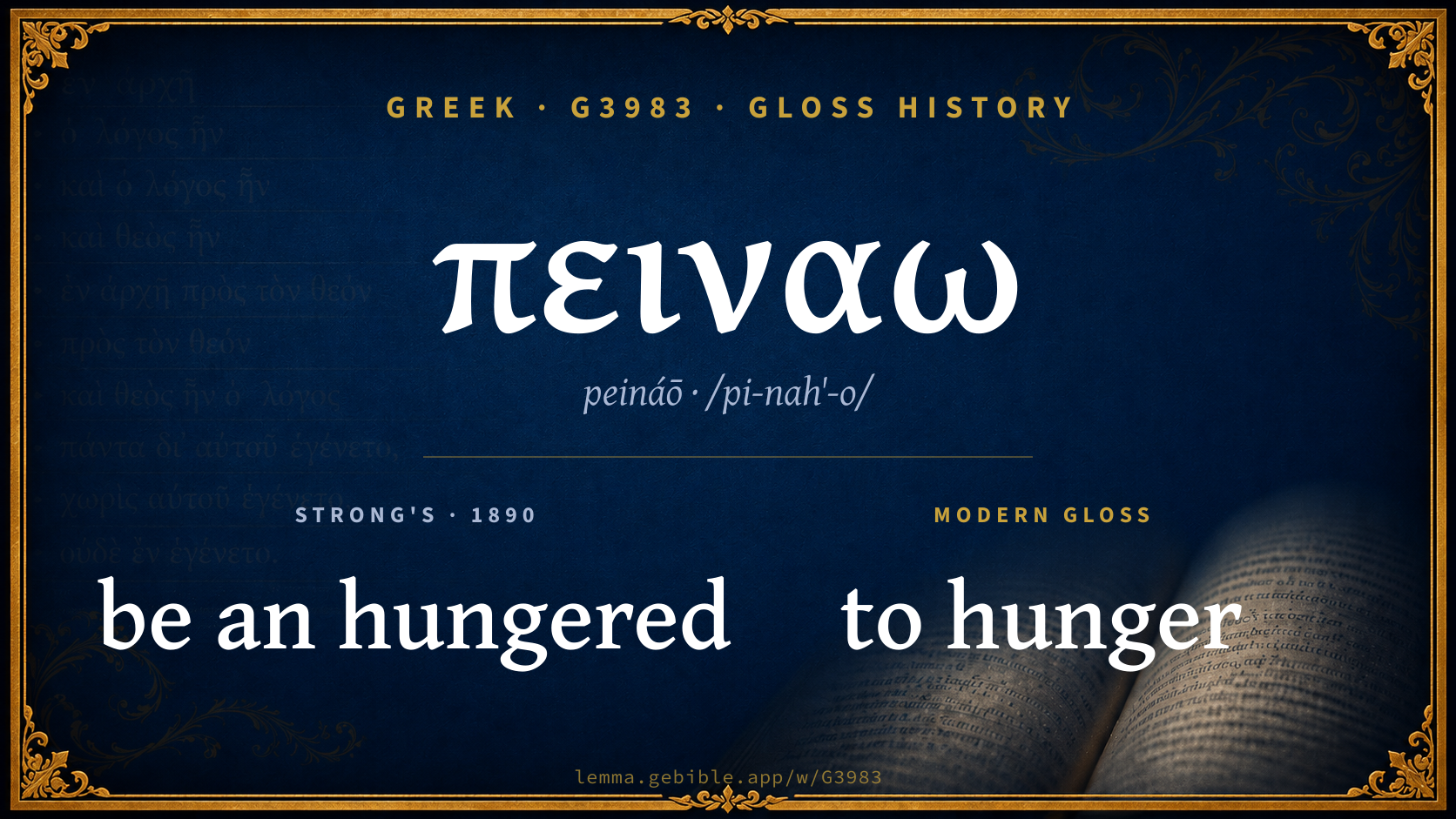
Gloss history
Strong's 1890 vs modern scholarship
About this word
Strong's G3983 catalogs a Greek word from the Greek New Testament.
These counts are not copied from any lexicon or concordance. They are computed here, from the morphology-tagged Greek New Testament. What Lemma adds →
- 23
- distinct verses
- The word appears in 23 distinct verses.
- 8 / 27
- NT books
- The word appears in 8 of 27 New Testament books.
- #563
- by frequency
- Top 1000 most frequent Greek words (rank 563 of 5,347 Greek words by occurrence).
View all 23 occurrences in the concordance →
Most concentrated in
- Matthew 9 verses 39%
- Luke 5 verses 22%
- 1 Corinthians 3 verses 13%
By section of the New Testament
By traditional corpus
Conventional, traditional groupings — biblical authorship is debated, so this is a traditional corpus grouping, not an authorship claim. Some books belong to more than one corpus (Luke is in both the Gospels and the Lukan corpus, and so on), so these shares overlap and need not total 100%. Each figure is a share of the word’s 23 distinct verses.
- Gospels 17 verses · 74%
- Lukan (Luke–Acts) 5 verses · 22%
- Pauline corpus 5 verses · 22%
- Johannine 2 verses · 9%
- Revelation 1 verse · 4%
How translations render this word
Counts come from each version’s own published word-to-Strong’s tagging or interlinear alignment — an approximate guide to how each version renders this word, not a word-level alignment the data otherwise carries. Because each total is that version’s own tagged count, the per-version totals vary from one another and need not match the appearance or distinct-verse counts above. These counts may also differ from a printed concordance because Lemma counts each distinctly tagged rendering and does not collapse phrase taggings into a single head-word total. This is a fixed set of word-tagged versions (KJV, ASV, BSB, ULT) and does not change with the reading translation you choose elsewhere. Each version’s license is shown beside its name below (and on Sources).
- King James Version: Hunger 4×, Hungred 3×, Was an hungred 3×
- American Standard Version: He hungered 3×, Hunger 3×, Hungry 3×
- Berean Standard Bible: Were hungry 4×, He was hungry 3×, Hungry 3×
- unfoldingWord Literal Text: He was hungry 6×, Hungry 4×, Being hungry 2×
King James Version Public Domain
Renders G3983 across 24 tagged occurrences — most commonly:
Plus 12 renderings that appear only once — usually multi-word phrases or single function words the recovered tagging swept in, not distinct renderings.
American Standard Version Public Domain
Renders G3983 across 25 tagged occurrences — most commonly:
Plus 12 renderings that appear only once — usually multi-word phrases or single function words the recovered tagging swept in, not distinct renderings.
Berean Standard Bible Public Domain
Renders G3983 across 23 tagged occurrences — most commonly:
Plus 7 renderings that appear only once — usually multi-word phrases or single function words the recovered tagging swept in, not distinct renderings.
unfoldingWord Literal Text CC BY-SA 4.0
Renders G3983 across 27 tagged occurrences — most commonly:
Plus 9 renderings that appear only once — usually multi-word phrases or single function words the recovered tagging swept in, not distinct renderings.
Senses in Thayer's
The 3 senses Thayer's distinguishes for this word, in lexicon order (not ranked by frequency or importance). The full entry — with sub-senses — is in the Lexicon Entry tab.
- to suffer want
- to be needy
- metaph. to crave ardently, to seek with eager desire
Word origin
Derived from πενης (pénēs) (G3993) — poor.
From the same as G3993 (through the idea of pinching toil ; pine); to famish (absolutely or comparatively); figuratively to crave : - be an hungered.
— Strong’s Exhaustive Concordance (1890), public domain.
Forms in the corpus
The 12 distinct written forms G3983 takes in the Greek New Testament, most frequent first — each parse links to that tense’s occurrences in the concordance.
Same root — word family
Other Thayer's entries built from the same root as G3983, grouped by Strong’s listed origin. These share a root / origin per the lexicon — not necessarily a shared meaning. Each links to that word’s own entry.
Derives from
Shares the same root
Compare all same-root words → They share a root, not necessarily a meaning.
Septuagint usage
The same Greek word πειναω appears 37 times in the Greek Old Testament (Septuagint), across 37 verses in 12 books.
- 37
- LXX occurrences
- Tagged occurrences of this Greek word in the Septuagint.
- 37
- verses
- Distinct Septuagint verses containing this word.
- 12 / 39
- OT books
- The word appears in 12 of the 39 Old Testament books.
Sample Septuagint occurrences
- Genesis 41:55 πεινάω
- Deuteronomy 25:18 πεινάω
- Judges 8:4 πεινάω
- 1 Samuel 2:5 πεινάω
- 2 Samuel 17:29 πεινάω
- 2 Kings 7:12 πεινάω
- Job 22:7 πεινάω
- Psalms 33:11 πεινάω
- Proverbs 18:8 πεινάω
- Isaiah 5:27 πεινάω
- Jeremiah 38:25 πεινάω
- Ezekiel 18:7 πεινάω
Septuagint occurrences (same lexeme)
Every verse where the same Strong’s number (G3983) appears in the Greek Septuagint. Verse text shown in the World English Bible for context; the Greek form is the matched word — the English is not keyword-highlighted.
- Genesis 41:55 πεινάω When all the land of Egypt was famished, the people cried to Pharaoh for bread, and Pharaoh said to all the Egyptians, "Go to Joseph. What he says to you, do."
- Deuteronomy 25:18 πεινάω how he met you by the way, and struck the hindmost of you, all who were feeble behind you, when you were faint and weary; and he didn't fear God.
- Judges 8:4 πεινάω Gideon came to the Jordan, [and] passed over, he, and the three hundred men who were with him, faint, yet pursuing.
- 1 Samuel 2:5 πεινάω Those who were full have hired out themselves for bread; Those who were hungry have ceased [to hunger]: Yes, the barren has borne seven; She who has many children languishes.
- 2 Samuel 17:29 πεινάω and honey, and butter, and sheep, and cheese of the herd, for David, and for the people who were with him, to eat: for they said, The people are hungry, and weary, and thirsty, in the wilderness.
- 2 Kings 7:12 πεινάω The king arose in the night, and said to his servants, I will now show you what the Syrians have done to us. They know that we are hungry; therefore are they gone out of the camp to hide themselves in the field, saying, When they come out of the city, we shall take them alive, and get into the city.
- Job 22:7 πεινάω You haven't given water to the weary to drink, And you have withheld bread from the hungry.
- Job 24:10 πεινάω So that they go around naked without clothing. Being hungry, they carry the sheaves.
- Psalms 33:11 πεινάω The counsel of Yahweh stands fast forever, The thoughts of his heart to all generations.
- Psalms 49:12 πεινάω But man, despite his riches, doesn't endure. He is like the animals that perish.
- Psalms 106:5 πεινάω That I may see the prosperity of your chosen, That I may rejoice in the gladness of your nation, That I may glory with your inheritance.
- Psalms 106:9 πεινάω He rebuked the Red Sea also, and it was dried up; So he led them through the depths, as through a desert.
- Psalms 106:36 πεινάω They served their idols, Which became a snare to them.
- Psalms 145:7 πεινάω They will utter the memory of your great goodness, And will sing of your righteousness.
- Proverbs 18:8 πεινάω The words of a gossip are like dainty morsels: They go down into a person's innermost parts.
- Proverbs 19:15 πεινάω Slothfulness casts into a deep sleep. The idle soul shall suffer hunger.
- Proverbs 25:21 πεινάω If your enemy is hungry, give him food to eat; If he is thirsty, give him water to drink:
- Proverbs 28:15 πεινάω As a roaring lion or a charging bear, So is a wicked ruler over helpless people.
- Isaiah 5:27 πεινάω None shall be weary nor stumble among them; None shall slumber nor sleep; Neither shall the belt of their loins be untied, Nor the latchet of their shoes be broken:
- Isaiah 8:21 πεινάω They shall pass through it, sore distressed and hungry; and it shall happen that when they shall be hungry, they shall fret themselves, and curse by their king and by their God, and turn their faces upward:
- Isaiah 9:19 πεινάω Through the wrath of Yahweh of hosts is the land burnt up; and the people are as the fuel of fire: no man spares his brother.
- Isaiah 28:12 πεινάω to whom he said, This is the rest, give you rest to him who is weary; and this is the refreshing: yet they would not hear.
- Isaiah 32:6 πεινάω For the fool will speak folly, and his heart will work iniquity, to practice profanity, and to utter error against Yahweh, to make empty the soul of the hungry, and to cause the drink of the thirsty to fail.
- Isaiah 40:28 πεινάω Have you not known? have you not heard? The everlasting God, Yahweh, the Creator of the ends of the earth, doesn't faint, neither is weary; there is no searching of his understanding.
- Isaiah 40:29 πεινάω He gives power to the faint; and to him who has no might he increases strength.
- Isaiah 40:30 πεινάω Even the youths shall faint and be weary, and the young men shall utterly fall:
- Isaiah 40:31 πεινάω but those who wait for Yahweh shall renew their strength; they shall mount up with wings as eagles; they shall run, and not be weary; they shall walk, and not faint.
- Isaiah 44:12 πεινάω The smith [makes] an axe, and works in the coals, and fashions it with hammers, and works it with his strong arm: yes, he is hungry, and his strength fails; he drinks no water, and is faint.
- Isaiah 46:2 πεινάω They stoop, they bow down together; they could not deliver the burden, but themselves are gone into captivity.
- Isaiah 49:10 πεινάω They shall not hunger nor thirst; neither shall the heat nor sun strike them: for he who has mercy on them will lead them, even by springs of water will he guide them.
- Isaiah 58:7 πεινάω Isn't it to deal your bread to the hungry, and that you bring the poor who are cast out to your house? when you see the naked, that you cover him; and that you not hide yourself from your own flesh?
- Isaiah 58:10 πεινάω and if you draw out your soul to the hungry, and satisfy the afflicted soul: then shall your light rise in darkness, and your obscurity be as the noonday;
- Isaiah 65:13 πεινάω Therefore thus says the Lord Yahweh, Behold, my servants shall eat, but you shall be hungry; behold, my servants shall drink, but you shall be thirsty; behold, my servants shall rejoice, but you shall be disappointed;
- Jeremiah 38:25 πεινάω But if the princes hear that I have talked with you, and they come to you, and tell you, Declare to us now what you have said to the king; don't hide it from us, and we will not put you to death; also what the king said to you:
- Jeremiah 49:14 πεινάω I have heard news from Yahweh, and an ambassador is sent among the nations, [saying], Gather yourselves together, and come against her, and rise up to the battle.
- Ezekiel 18:7 πεινάω and has not wronged any, but has restored to the debtor his pledge, has taken nothing by robbery, has given his bread to the hungry, and has covered the naked with a garment;
- Ezekiel 18:16 πεινάω neither has wronged any, has not taken anything to pledge, neither has taken by robbery, but has given his bread to the hungry, and has covered the naked with a garment;
These are occurrences of the same Greek lexeme (G3983) in the Septuagint — not a translation of any one Hebrew word. The store carries no word-level Hebrew↔Greek alignment, so no Hebrew original is asserted here. Counts come from the recovered LXX Strong's tagging — high-frequency vocabulary is well covered, while rare or late forms may be untagged — so they reflect tagged occurrences and may slightly undercount.