
Psalms 106:36

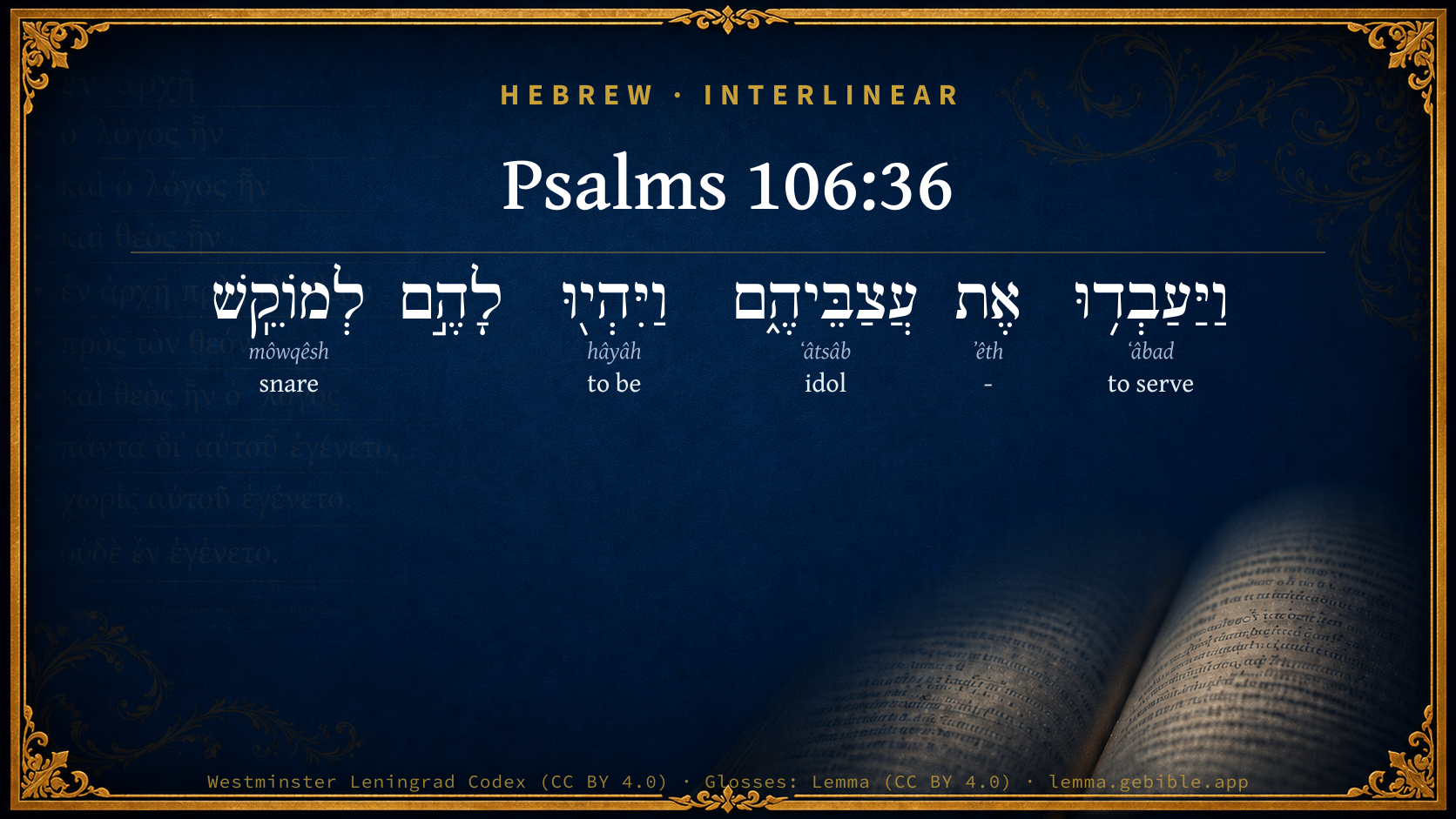
Hebrew (Westminster Leningrad Codex) Psalms 106:36 appears in the Hebrew Old Testament. The text above is from the Westminster Leningrad Codex. Each word links to its Strong’s number, a concise gloss, and parsing drawn from the Open Scriptures Hebrew Bible morphology. Click any word for its full Brown-Driver-Briggs (BDB) entry.
Download image
Cite this verse

Psalms 106:36 (World English Bible). Public Domain. Lemma interlinear Bible study tool, https://lemma.gebible.app/v/psalms/106/36.

Show BibTeX & RIS
BibTeX
RIS
English Translation
They served their idols, Which became a snare to them.
World English Bible · Public Domain
Download a study sheet

One document with this verse’s original text, its word-by-word gloss line, the meaning frame, cross-references with their text, attributed commentary, and full source and license credits — printable, and it pastes into notes with its structure intact.

This verse Autodidact and up

Study sheet (.html) Plain text (.txt)

A passage Seminary Student

Up to 50 verses in one chapter. A passage sheet keeps up to 6 commentary sources and 12 cross-references per verse, in the order this page ranks them, and says so on the sheet whenever that leaves anything out. Ask for a single verse and you get the Autodidact verse sheet above.

Everything on this page stays free to read, with no account — the sheet is a download of what is already on screen, not access to it.

Want to remove ads? Support Godless Engineer
Compare translations 3

The same verse in 3 English versions, stacked beneath the original-language interlinear above. Click any original word for its lexicon entry.

Each is an independent rendering of the whole verse — the interlinear is not word-aligned to these translations.

Highlighted words mark where these versions differ — a whole-verse word diff, not a word-by-word alignment.

  • World English Bible Public Domain
    They served their idols, Which became a snare to them.
  • King James Version Public Domain
    And they served their idols: which were a snare unto them.
  • unfoldingWord Literal Text CC BY-SA 4.0
    and served their idols, and they became a snare to them.

unfoldingWord Literal Text — © unfoldingWord, licensed CC BY-SA 4.0. Word-aligned USFM3 via Door43 (git.door43.org/unfoldingWord/en_ult).

Versions to compare (up to 4)

3 of 4 selected

Show all 18 translations

Every available English version of this verse, each an independent rendering of the whole verse.

  • World English Bible Public Domain
    They served their idols, Which became a snare to them.
  • Berean Standard Bible Public Domain
    They worshiped their idols, which became a snare to them.
  • Majority Standard Bible Public Domain
    They worshiped their idols, which became a snare to them.
  • King James Version Public Domain
    And they served their idols: which were a snare unto them.
  • American Standard Version (1901) Public Domain
    And served their idols, Which became a snare unto them.
  • Revised Version (1885) Public Domain
    And they served their idols; which became a snare unto them:
  • Geneva Bible (1599) Public Domain
    And serued their idoles, which were their ruine.
  • Douay-Rheims (1899) Public Domain
    and served their idols, and it became a stumblingblock to them.
  • Young's Literal Translation Public Domain
    And serve their idols, And they are to them for a snare.
  • Literal Standard Version CC BY-SA 4.0
    And serve their idols, || And they are for a snare to them.
  • Unlocked Literal Bible CC BY-SA 4.0
    and worshiped their idols, which became a snare to them.
  • unfoldingWord Literal Text CC BY-SA 4.0
    and served their idols, and they became a snare to them.
  • Darby Bible Public Domain
    And they served their idols; and they were a snare unto them:
  • World Messianic Bible Public Domain
    They served their idols, which became a snare to them.
  • Webster's Bible Public Domain
    And they served their idols: which were a snare to them.
  • Free Bible Version CC BY-SA 4.0
    They worshiped their pagan idols which became a trap for them.
  • Bible in Basic English Public Domain
    And they gave worship to images; which were a danger to them:
  • JPS Tanakh (1917) Public Domain
    And they served their idols, which became a snare unto them;

Literal Standard Version (2020), Covenant Press — licensed CC BY-SA 4.0. Text via the HelloAO Bible API (eBible.org). Unlocked Literal Bible (unfoldingWord) — licensed CC BY-SA 4.0. Text via the HelloAO Bible API (eBible.org). unfoldingWord Literal Text — © unfoldingWord, licensed CC BY-SA 4.0. Word-aligned USFM3 via Door43 (git.door43.org/unfoldingWord/en_ult). Free Bible Version, Dr. Jonathan Gallagher — licensed CC BY-SA 4.0. Text via the HelloAO Bible API (eBible.org).

Word by word

More ways to search: Search by grammar → Find every occurrence → Compare this word →

Practice this passage: Drill this verse → Learn its vocabulary →

About this verse

These counts appear in no published source. They are computed here, from the morphology-tagged text and Lemma’s own curated glosses. What Lemma adds →

6
words
5
distinct lemmas
Wisdom
section

Notable vocabulary

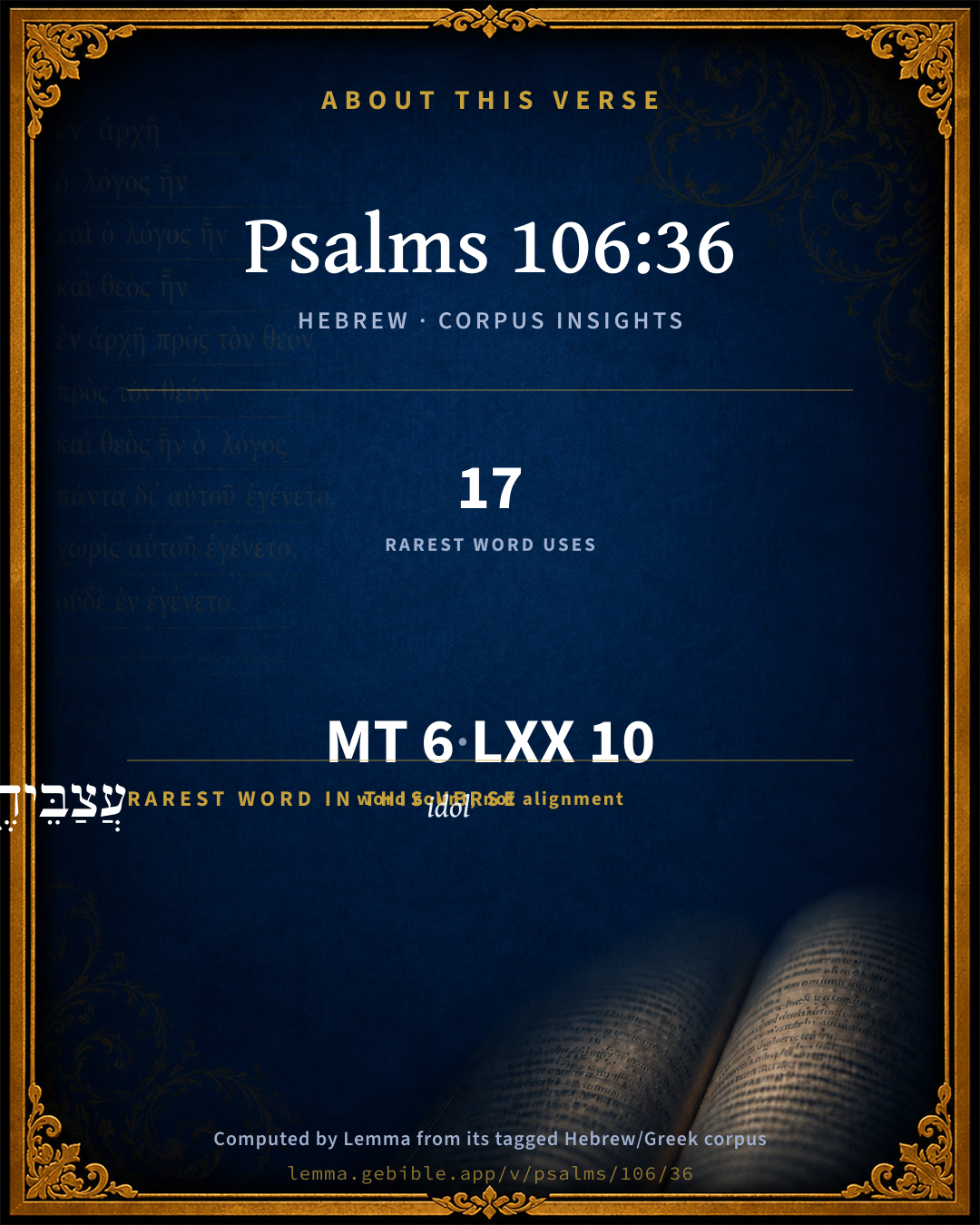
The rarest word here is עֲצַבֵּיהֶ֑ם idol H6091 — appearing just 17 times in the whole Hebrew Bible.

Shared distinctive vocabulary

עֲצַבֵּיהֶ֑ם idol H6091 occurs in 17 verses of the Hebrew Bible. Also found in:

Grammatical profile

  • 2 verbs
  • 2 nouns
  • 1 preposition
  • 1 particle

Verb forms

  • וַיַּעַבְד֥וּ Qal · Sequential Imperfect
  • וַיִּהְי֖וּ Qal · Sequential Imperfect

Hebrew & Septuagint length

In English translation the verse runs 10 words from the Hebrew and 13 from the Septuagint (LXX English) — closely comparable.

A rough comparison of the two English renderings, which tokenize alike — not a word-level alignment.

Word counts can differ between the Hebrew and the Greek without any difference in meaning — e.g. the Hebrew direct-object marker אֵת has no separate Greek word, and Greek often adds the article ὁ.

In the original languages it is 6 Hebrew tokens and 10 Greek tokens — but the two are counted differently (Hebrew bundles its prefixes and suffixes into one token; the Greek is in lemma form), so that isn’t a like-for-like length.

Cross-references

16

Topical passages linked to Psalms 106:36 in the Treasury of Scripture Knowledge — connected by theme and wording, ordered by reader-vote popularity; previews shown in the World English Bible.

  • Deuteronomy 7:16 You shall consume all the peoples who Yahweh your God shall deliver to you; your eye shall not pity them: neither shall you serve their gods; for that will be a snare to you.
  • Judges 2:3 Therefore I also said, I will not drive them out from before you; but they shall be [as thorns] in your sides, and their gods shall be a snare to you.
  • Exodus 23:33 They shall not dwell in your land, lest they make you sin against me, for if you serve their gods, it will surely be a snare to you."
  • Judges 2:12–15 and they forsook Yahweh, the God of their fathers, who brought them out of the land of Egypt, and followed other gods, of the gods of the peoples who were round about them, and bowed themselves down to them: and they provoked Yahweh to anger.
  • Psalms 78:58 For they provoked him to anger with their high places, And moved him to jealousy with their engraved images.
  • Exodus 34:15–16 Don't make a covenant with the inhabitants of the land, lest they play the prostitute after their gods, and sacrifice to their gods, and one call you and you eat of his sacrifice;
  • Joshua 23:13 know for a certainty that Yahweh your God will no more drive these nations from out of your sight; but they shall be a snare and a trap to you, and a scourge in your sides, and thorns in your eyes, until you perish from off this good land which Yahweh your God has given you.
  • Judges 2:17 Yet they didn't listen to their judges; for they played the prostitute after other gods, and bowed themselves down to them: they turned aside quickly out of the way in which their fathers walked, obeying the commandments of Yahweh; [but] they didn't do so.
  • Judges 2:19 But it happened, when the judge was dead, that they turned back, and dealt more corruptly than their fathers, in following other gods to serve them, and to bow down to them; they didn't cease from their doings, nor from their stubborn way.
  • Judges 3:5–7 The children of Israel lived among the Canaanites, the Hittites, and the Amorites, and the Perizzites, and the Hivites, and the Jebusites:
  • Judges 10:6 The children of Israel again did that which was evil in the sight of Yahweh, and served the Baals, and the Ashtaroth, and the gods of Syria, and the gods of Sidon, and the gods of Moab, and the gods of the children of Ammon, and the gods of the Philistines; and they forsook Yahweh, and didn't serve him.
  • 2 Kings 17:8–11 and walked in the statutes of the nations, whom Yahweh cast out from before the children of Israel, and of the kings of Israel, which they made.
  • 2 Kings 17:16–17 They forsook all the commandments of Yahweh their God, and made them molten images, even two calves, and made an Asherah, and worshiped all the host of the sky, and served Baal.
  • 2 Chronicles 33:2–9 He did that which was evil in the sight of Yahweh, after the abominations of the nations whom Yahweh cast out before the children of Israel.
  • Ezekiel 16:15–63 But you did trust in your beauty, and played the prostitute because of your renown, and poured out your prostitution on everyone who passed by; his it was.
  • Ezekiel 20:28–32 For when I had brought them into the land, which I swore to give to them, then they saw every high hill, and every thick tree, and they offered there their sacrifices, and there they presented the provocation of their offering; there also they made their sweet savor, and they poured out there their drink-offerings.

Cross-references courtesy of OpenBible.info (CC BY 4.0).

Hebrew and Greek witnesses Masoretic Hebrew ↔ Greek Septuagint

The same verse in the two great witnesses to the Old Testament, shown verse-for-verse.

You’re reading Greek Psalm 105 (Hebrew Psalm 106). The Septuagint counts the superscription, so verse numbers can differ from the Hebrew — chapter-level alignment, not verse-by-verse. Numbering follows Rahlfs.

These are two independent witnesses, not word-aligned to each other, and the Septuagint is shown in lemma (dictionary) form.

Hebrew Psalms 106:36 Masoretic · Westminster Leningrad Codex

וַיַּעַבְד֥וּ אֶת עֲצַבֵּיהֶ֑ם וַיִּהְי֖וּ לָהֶ֣ם לְמוֹקֵֽשׁ

They served their idols, Which became a snare to them.

World English Bible · Public Domain

Greek LXX Greek Psalm 105:36 Septuagint · lemma form

καί δουλεύω ὁ γλυπτός αὐτός καί γίγνομαι αὐτός εἰς σκάνδαλον

And they served their graven images; and it became an offense to them.

LXX2012 (modern English Septuagint) · Public Domain

Hebrew: Westminster Leningrad Codex (CC BY 4.0). Greek: Septuagint (public domain); English from LXX2012 (modern English Septuagint) (Public Domain). How the Septuagint differs from the Hebrew →

Commentary

Notes on Psalms 106:36 from classic Christian and Jewish commentators (each source and its license shown beneath its notes). The classic Christian expositions comment on the surrounding passage and are grouped to its opening verse, so a note may address several verses; the Jewish commentaries on the Tanakh (Rashi and others) are per-verse, so they appear only where the commentator wrote on this verse.

Lemma curates 59 commentaries, every one of them public domain or Creative Commons licensed, each selected and text-cleaned for this edition rather than reprinted as found. About our sources →

Trapp's Complete Commentary

John Trapp

Psa 106:36 And they served their idols: which were a snare unto them.

Ver. 36. And they served their idols] The devil is ειδωλοχαρης, saith Synesius, a lover of idolatry, and he speaks through idolaters as through his trunks, persuading people to like practice, as did Julian, whom an ancient, therefore, called Idolian.

Which were a snare unto them] Or, a ruin, as some render it; they were first drawn in, and then undone by them.

John Trapp, A Commentary or Exposition upon All the Books of the Old and New Testament (1647–1656) — public domain. Text from a community e-Sword module.

J. A. Alexander on Psalms

Joseph Addison Alexander

36. (Psa 106:36) And served their idols, and they were to them for a snare. The word translated idols, by its etymological affinities, suggests the idea of vexations, pains. See above, on Psa 16:4. A snare, i.e. a temptation to idolatry. Compare Deu 7:16.

Joseph Addison Alexander, The Psalms Translated and Explained (1850) — public domain. Text from a community e-Sword module.

Adam Clarke's Commentary

Verse 36. They served their idols] עצביהם atsabbeyhem, their labours or griefs-idols, so called because of the pains taken in forming them, the labor in worshipping them, and the grief occasioned by the Divine judgments against the people for their idolatry.

Adam Clarke's Commentary on the Bible (1810–1826) — public domain. Text from a community e-Sword/MySword module.

The Cambridge Bible for Schools and Colleges

gen. ed. J. J. S. Perowne

36. which were &c.] And they became a snare unto them, as they had been forewarned, Exo_23:33, &c. P.B.V. which turned to their own decay = which proved their ruin.

The Cambridge Bible for Schools and Colleges (gen. ed. J. J. S. Perowne; Cambridge University Press, 1878–1918) — public domain. Text from a community e-Sword module.

John Gill's Exposition

And they served their idols,.... Of gold and silver, wood and stone; the works of men's hands, senseless creatures; which are nothing in the world, and bring grief and sorrow to the worshippers of them, from whence they have their name here given them; see Psa 16:4. They served "their" idols, the idols of the Canaanites, who were dispossessed of their land for their idolatries and other sins; and these Israelites were put in their place. They served those which they were ordered to destroy; they who knew the true God, whose servants they were, or ought to have been, and professed to be, and were so called; and yet served the idols of the nations driven out before them. Which were a snare unto them; either the Canaanites were, who were left in the land, with whom they mixed, and whose works they learned; these ensnared them, and drew them into idolatry, Jos 23:13, or the idols they worshipped, which were the cause of many evils and calamities, Jdg 2:3, or the act of serving and worshipping them, Exo 23:33. They were by these means like a bird or beast in a snare, and brought into trouble and distress, out of which they could not extricate themselves.

. They were by these means like a bird or beast in a snare, and brought into trouble and distress, out of which they could not extricate themselves.

Psalms 106:37

psa 106:37

psa 106:37

psa 106:37Yea, they sacrificed their sons and their daughters unto devils. Who have their name here given them from a word that signifies to waste and destroy, they being the destroyers of mankind. So the Targum renders it by which signifies spirits noxious and hurtful; but R. Elias Levita, in his Tishbi, p. 233, says it is a mistake to derive it from the root which signifies to waste and destroy; for then he says the "daleth" should have a "dagesh"; but does not tell us from whence it is derived. De Dieu, on Mat 9:32, derives it from the Arabic word "to rule", for these demons were heroes, princes who ruled over others, and so were reckoned among the gods. As Satan, the head of them, was a murderer from the beginning, the cause of the ruin of our first parents, and of all their posterity; and may be truly called, as the king of the locusts is, "Apollyon" or "Abaddon", Joh 8:44 these the Israelites sacrificed unto, as the Gentiles did, Lev 17:7 and not lambs and rams, sheep, goats, and bullocks, but their sons and daughters; which they not only caused to pass through the fire to Moloch, which was a lustration of them by the flame, or causing them to pass between two fires; but they sacrificed them to be devoured, and actually burned them; see Jer 7:31. From whence we may see of what a hardening nature sin is, and how by degrees persons may be brought to commit things the most shocking to nature, and which they some time before shuddered at. First, these Israelites mix themselves with the Heathens they spared, whom they should have destroyed; then they learn, by being among them, to do as they did, to walk in the vanity of their minds like them; and then they are enticed to serve their idols, and at last to sacrifice their sons and daughters to devils; which was no other than murder, and that of the most heinous nature: as follows.

John Gill's Exposition of the Whole Bible (1746–1763) — public domain (CC PDM 1.0). Text via the HelloAO Bible API.

Albert Barnes' Notes on the Bible

And they served their idols - Jdg 2:12-13, Jdg 2:17, Jdg 2:19; Jdg 3:6-7.

Which were a snare unto them - Like the snares or toils by which birds and wild beasts are caught. That is, they were taken unawares; they were in danger when they did not perceive it; they fell when they thought themselves safe. The bird and the wild beast approach the snare, unconscious of danger; so the friend of God approaches the temptations which are spread out before him by the enemy of souls - and, ere he is aware, he is a captive, and has fallen. Nothing could better describe the way in which the people of God are led into sin than the arts by which birds are caught by the fowler, and wild beasts by the hunter.

Albert Barnes' Notes on the Bible (1834–1885) — public domain. Text from a community e-Sword/MySword module.

Matthew Poole's English Annotations

Which idols were an occasion of their falling both into further and greater sins, as it follows, Psa 106:37,38; and into utter ruin, as this phrase also notes, Exo 23:33; Jdg 2:12, &c.

Matthew Poole's English Annotations on the Holy Bible (1683–1685) — public domain. Text from a community e-Sword/MySword module.

The Treasury of David

Charles H. Spurgeon

Ver. 36. And they served their idols: which were a snare unto them. They were fascinated by the charms of idolatry, though it brings misery upon its votaries. A man cannot serve sin without being ensnared by it. It is like birdlime, and to touch it is to be taken by it. Samson laid his head in the Philistine woman's lap, but ere long he woke up shorn of his strength. Dalliance with sin is fatal to spiritual liberty.

Psalms 106:37*

Charles H. Spurgeon's The Treasury of David (1869–1885) — public domain. Psalms only. Text from a community e-Sword/MySword module.

Whedon's Commentary on the Bible

Daniel D. Whedon

36. They served their idols—This was but a natural result of such friendships as those against which they had been forewarned.

Daniel D. Whedon (gen. ed.), Commentary on the Old and New Testaments (1874–1909) — public domain. Text from a community e-Sword module.

The Pulpit Commentary

And they served their idols: which were a snare unto them; or, which became a snare unto them. The idols worshipped were especially Baal and Ashtoreth the nature-god and nature-goddess, sometimes identified with the sun and moon. These alone are mentioned in the time of the Judges. Afterwards, however, Chemosh, Molech, Remphan, the gods of Syria, and perhaps Ammon of Egypt, were added to the catalogue. (1Ki_11:7 2Ki_21:19 2Ch_28:23 Act_7:43)

The Pulpit Commentary (1880–1919), ed. H.D.M. Spence-Jones & Joseph S. Exell — public domain. Text from a community e-Sword module.

Lesson kit

Teaching starters — assembled from the data on this page, not authored interpretation. Every prompt links to the verse data it draws on. Edit before teaching.

Psalms, in the Wisdom, opens this verse with 6 words (5 distinct Hebrew lemmas). Its most distinctive word is ʻâtsâb (“idol”). A historical commentator’s framing appears above. Read the whole chapter for the surrounding context.

Discussion questions

  1. The word ʻâtsâb carries the sense “idol.” How does it shape the verse?
  2. 1 Samuel 31:9 shares the word «idol» with this verse. How do the two illuminate each other?
  3. The translations on this page render this verse differently — a whole-verse word diff, not a word-by-word alignment. What might account for the different wordings?
  4. The verb «וַיַּעַבְד֥וּ» is Qal Sequential Imperfect. How does its form color the action?
  5. Reading how Trapp's Complete Commentary and J. A. Alexander on Psalms read this verse, where do the two commentators agree and where do they part?

Things to notice

Reading settings

Reading text

Shown beneath each verse's original-language words.

Old Testament
Old Testament edition

Read the OT as the Masoretic Hebrew (MT) or the Greek Septuagint (LXX).

English shown for the Greek Septuagint (in the Hebrew ↔ Greek comparison).

Comparing translations? Open the Compare panel on any verse page to stack up to four side by side.