

Psalms 33:11

Hebrew (Westminster Leningrad Codex) Psalms 33:11 appears in the Hebrew Old Testament. The text above is from the Westminster Leningrad Codex. Each word links to its Strong’s number, a concise gloss, and parsing drawn from the Open Scriptures Hebrew Bible morphology. Click any word for its full Brown-Driver-Briggs (BDB) entry.
Download image
Cite this verse

Psalms 33:11 (World English Bible). Public Domain. Lemma interlinear Bible study tool, https://lemma.gebible.app/v/psalms/33/11.

Show BibTeX & RIS
BibTeX
RIS
English Translation
The counsel of Yahweh stands fast forever, The thoughts of his heart to all generations.
World English Bible · Public Domain
Download a study sheet

One document with this verse’s original text, its word-by-word gloss line, the meaning frame, cross-references with their text, attributed commentary, and full source and license credits — printable, and it pastes into notes with its structure intact.

This verse Autodidact and up

Study sheet (.html) Plain text (.txt)

A passage Seminary Student

Up to 50 verses in one chapter. A passage sheet keeps up to 6 commentary sources and 12 cross-references per verse, in the order this page ranks them, and says so on the sheet whenever that leaves anything out. Ask for a single verse and you get the Autodidact verse sheet above.

Everything on this page stays free to read, with no account — the sheet is a download of what is already on screen, not access to it.

Want to remove ads? Support Godless Engineer
Compare translations 3

The same verse in 3 English versions, stacked beneath the original-language interlinear above. Click any original word for its lexicon entry.

Each is an independent rendering of the whole verse — the interlinear is not word-aligned to these translations.

Highlighted words mark where these versions differ — a whole-verse word diff, not a word-by-word alignment.

  • World English Bible Public Domain
    The counsel of Yahweh stands fast forever, The thoughts of his heart to all generations.
  • King James Version Public Domain
    The counsel of the LORD standeth for ever, the thoughts of his heart to all generations.
  • unfoldingWord Literal Text CC BY-SA 4.0
    The counsel of Yahweh stands forever, the plans of his heart, to generation and generation.

unfoldingWord Literal Text — © unfoldingWord, licensed CC BY-SA 4.0. Word-aligned USFM3 via Door43 (git.door43.org/unfoldingWord/en_ult).

Versions to compare (up to 4)

3 of 4 selected

Show all 18 translations

Every available English version of this verse, each an independent rendering of the whole verse.

  • World English Bible Public Domain
    The counsel of Yahweh stands fast forever, The thoughts of his heart to all generations.
  • Berean Standard Bible Public Domain
    The counsel of the LORD stands forever, the purposes of His heart to all generations.
  • Majority Standard Bible Public Domain
    The counsel of the LORD stands forever, the purposes of His heart to all generations.
  • King James Version Public Domain
    The counsel of the LORD standeth for ever, the thoughts of his heart to all generations.
  • American Standard Version (1901) Public Domain
    The counsel of Jehovah standeth fast for ever, The thoughts of his heart to all generations.
  • Revised Version (1885) Public Domain
    The counsel of the LORD standeth fast for ever, the thoughts of his heart to all generations.
  • Geneva Bible (1599) Public Domain
    The counsell of the Lord shall stand for euer, and the thoughts of his heart throughout all ages.
  • Douay-Rheims (1899) Public Domain
    But the counsel of the Lord standeth for ever: the thoughts of his heart to all generations.
  • Young's Literal Translation Public Domain
    The counsel of Jehovah to the age standeth, The thoughts of His heart to all generations.
  • Literal Standard Version CC BY-SA 4.0
    The counsel of YHWH stands for all time, || The thoughts of His heart from generation to generation.
  • Unlocked Literal Bible CC BY-SA 4.0
    The plans of Yahweh stand forever, the plans of his heart for all generations.
  • unfoldingWord Literal Text CC BY-SA 4.0
    The counsel of Yahweh stands forever, the plans of his heart, to generation and generation.
  • Darby Bible Public Domain
    The counsel of Jehovah standeth for ever, the thoughts of his heart from generation to generation.
  • World Messianic Bible Public Domain
    The counsel of the LORD stands fast forever, the thoughts of his heart to all generations.
  • Webster's Bible Public Domain
    The counsel of the LORD standeth for ever, the thoughts of his heart to all generations.
  • Free Bible Version CC BY-SA 4.0
    But the Lord's plan stands forever—what he decides lasts for all generations.
  • Bible in Basic English Public Domain
    The Lord's purpose is eternal, the designs of his heart go on through all the generations of man.
  • JPS Tanakh (1917) Public Domain
    The counsel of the LORD standeth for ever, the thoughts of His heart to all generations.

Literal Standard Version (2020), Covenant Press — licensed CC BY-SA 4.0. Text via the HelloAO Bible API (eBible.org). Unlocked Literal Bible (unfoldingWord) — licensed CC BY-SA 4.0. Text via the HelloAO Bible API (eBible.org). unfoldingWord Literal Text — © unfoldingWord, licensed CC BY-SA 4.0. Word-aligned USFM3 via Door43 (git.door43.org/unfoldingWord/en_ult). Free Bible Version, Dr. Jonathan Gallagher — licensed CC BY-SA 4.0. Text via the HelloAO Bible API (eBible.org).

Word by word

More ways to search: Search by grammar → Find every occurrence → Compare this word →

Practice this passage: Drill this verse → Learn its vocabulary →

About this verse

These counts appear in no published source. They are computed here, from the morphology-tagged text and Lemma’s own curated glosses. What Lemma adds →

8
words
7
distinct lemmas
Wisdom
section

Shared distinctive vocabulary

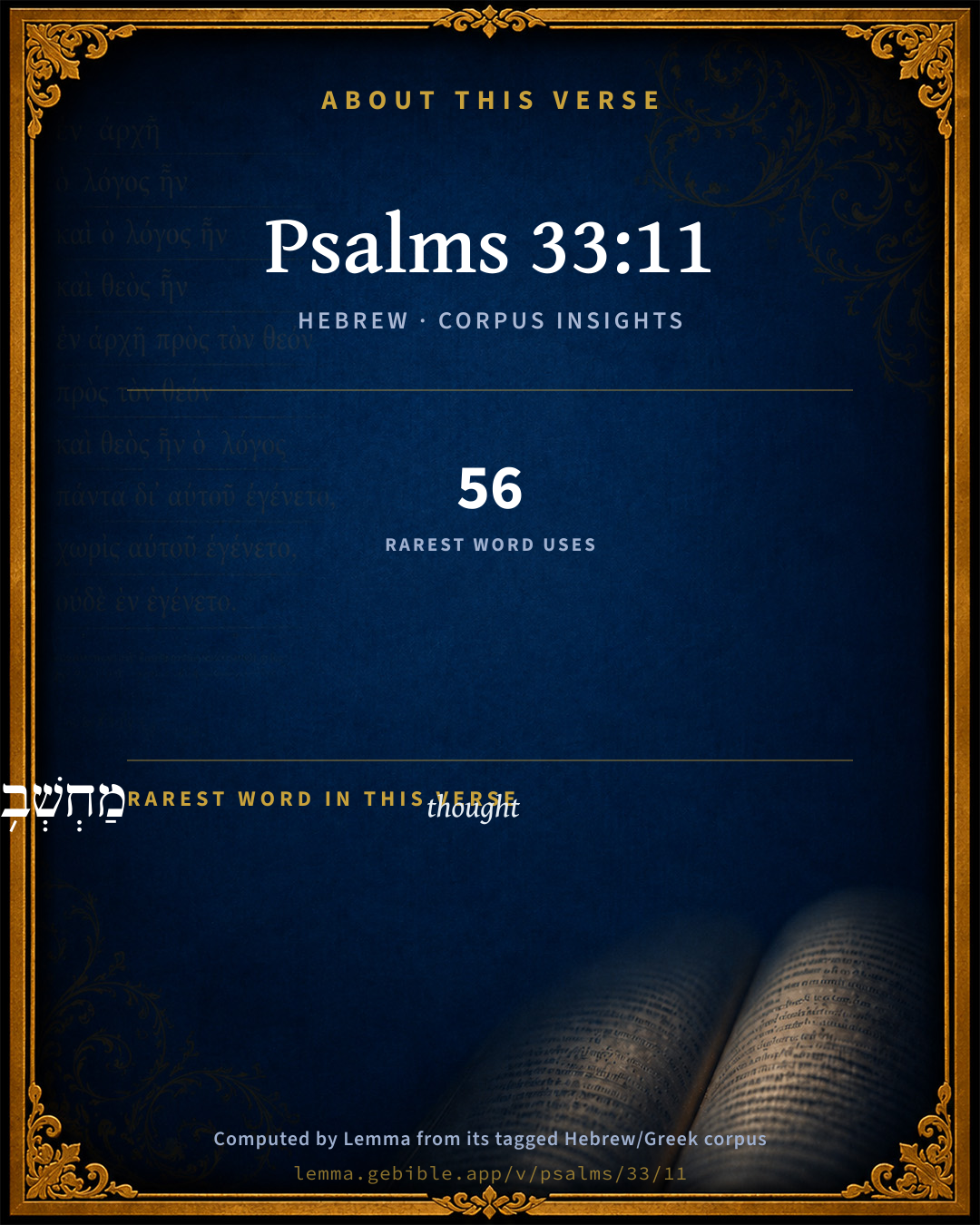
מַחְשְׁב֥וֹת thought H4284 occurs in 52 verses of the Hebrew Bible. Also found in:

Grammatical profile

  • 1 verb
  • 7 nouns

Verb forms

  • תַּעֲמֹ֑ד Qal · Imperfect

Repetition

A word recurs within this verse — often emphatic in Hebrew:

  • לְדֹ֣ר generation H1755 ×2

Hebrew & Septuagint length

In English translation the verse runs 15 words from the Hebrew and 18 from the Septuagint (LXX English) — closely comparable.

A rough comparison of the two English renderings, which tokenize alike — not a word-level alignment.

Word counts can differ between the Hebrew and the Greek without any difference in meaning — e.g. the Hebrew direct-object marker אֵת has no separate Greek word, and Greek often adds the article ὁ.

Cross-references

15

Topical passages linked to Psalms 33:11 in the Treasury of Scripture Knowledge — connected by theme and wording, ordered by reader-vote popularity; previews shown in the World English Bible.

  • Proverbs 19:21 There are many plans in a man's heart, But Yahweh's counsel will prevail.
  • Isaiah 46:10 declaring the end from the beginning, and from ancient times things that are not [yet] done; saying, My counsel shall stand, and I will do all my pleasure;
  • Job 23:13 But he stands alone, and who can oppose him? What his soul desires, even that he does.
  • Isaiah 14:24 Yahweh of Hosts has sworn, saying, Surely, as I have thought, so shall it happen; and as I have purposed, so shall it stand:
  • Isaiah 55:8–9 For my thoughts are not your thoughts, neither are your ways my ways, says Yahweh.
  • Jeremiah 29:11 For I know the thoughts that I think toward you, says Yahweh, thoughts of peace, and not of evil, to give you hope in your latter end.
  • Lamentations 3:37 Who is he who says, and it comes to pass, when the Lord doesn't command it?
  • Isaiah 14:27 For Yahweh of Hosts has purposed, and who shall annul it? and his hand is stretched out, and who shall turn it back?
  • Ephesians 1:11 in whom also we were assigned an inheritance, having been foreordained according to the purpose of him who works all things after the counsel of his will;
  • Daniel 4:37 Now I, Nebuchadnezzar, praise and extol and honor the King of heaven; for all his works are truth, and his ways justice; and those who walk in pride he is able to abase.
  • Psalms 92:5 How great are your works, Yahweh! Your thoughts are very deep.
  • Micah 4:12 But they don't know the thoughts of Yahweh, Neither do they understand his counsel; For he has gathered them like the sheaves to the threshing floor.
  • Acts 4:27–28 For truly, in this city against your holy servant, Jesus, whom you anointed, both Herod and Pontius Pilate, with the Gentiles and the people of Israel, were gathered together
  • Acts 15:18 All his works are known to God from eternity.'
  • Ezekiel 38:10–23 Thus says the Lord Yahweh: It shall happen in that day, that things shall come into your mind, and you shall devise an evil device:

Cross-references courtesy of OpenBible.info (CC BY 4.0).

Hebrew and Greek witnesses Masoretic Hebrew ↔ Greek Septuagint

The same verse in the two great witnesses to the Old Testament, shown verse-for-verse.

You’re reading Greek Psalm 32 (Hebrew Psalm 33). The Septuagint counts the superscription, so verse numbers can differ from the Hebrew — chapter-level alignment, not verse-by-verse. Numbering follows Rahlfs.

These are two independent witnesses, not word-aligned to each other, and the Septuagint is shown in lemma (dictionary) form.

Hebrew Psalms 33:11 Masoretic · Westminster Leningrad Codex

עֲצַ֣ת יְ֭הוָה לְעוֹלָ֣ם תַּעֲמֹ֑ד מַחְשְׁב֥וֹת לִ֝בּ֗וֹ לְדֹ֣ר וָדֹֽר

The counsel of Yahweh stands fast forever, The thoughts of his heart to all generations.

World English Bible · Public Domain

Greek LXX Greek Psalm 32:11 Septuagint · lemma form

ὁ δέ βουλή ὁ κύριος εἰς ὁ αἰών μένω λογισμός ὁ καρδία αὐτός εἰς γενεά καί γενεά

But the counsel of the Lord endures for ever, the thoughts of his heart from generation to generation.

LXX2012 (modern English Septuagint) · Public Domain

On this verse, The Cambridge Bible for Schools and Colleges discusses the Septuagint’s reading. Read the note in Commentary ↓

Hebrew: Westminster Leningrad Codex (CC BY 4.0). Greek: Septuagint (public domain); English from LXX2012 (modern English Septuagint) (Public Domain). How the Septuagint differs from the Hebrew →

Commentary

Notes on Psalms 33:11 from classic Christian and Jewish commentators (each source and its license shown beneath its notes). The classic Christian expositions comment on the surrounding passage and are grouped to its opening verse, so a note may address several verses; the Jewish commentaries on the Tanakh (Rashi and others) are per-verse, so they appear only where the commentator wrote on this verse.

Lemma curates 59 commentaries, every one of them public domain or Creative Commons licensed, each selected and text-cleaned for this edition rather than reprinted as found. About our sources →

The Cambridge Bible for Schools and Colleges

gen. ed. J. J. S. Perowne

11. The A.V. obscures the parallelism between Psa_33:10-11. The counsel of the nations and the thoughts of the peoples are contrasted with the counsel of Jehovah and the thoughts of his heart. His counsel stands fast like His work in creation (Psa_33:9). Cp. Jer_33:20-21. With Psa_33:10, cp. Isa_8:10; Neh_4:15; with Psa_33:11, cp. Isa_5:19; Isa_19:17; Isa_46:10-11; Mic_4:12; Isa_55:8-9; Jer_29:11; and generally, Pro_19:21; Pro_21:30. To us the words may suggest that “through the ages one increasing purpose runs,” and point forward to

“The one far-off divine event

To which the whole creation moves.”

The addition in P.B.V., and casteth out the counsels of princes, is derived through the Vulg. from the LXX.

The Cambridge Bible for Schools and Colleges (gen. ed. J. J. S. Perowne; Cambridge University Press, 1878–1918) — public domain. Text from a community e-Sword module.

Trapp's Complete Commentary

John Trapp

Psa 33:11 The counsel of the LORD standeth for ever, the thoughts of his heart to all generations.

Ver. 11. The counsel of the Lord standeth for ever] That counsel of his, whereby he hath decreed to maintain government among men, to relieve the oppressed, to punish the wicked, to uphold the Church, is firm and inviolable. Divinum consilium dum devitatur, impletur; humana sapientia dum reluctatur, comprehenditur, saith Gregory. There is a council in heaven that will dash the mould of all contrary counsels upon earth.

John Trapp, A Commentary or Exposition upon All the Books of the Old and New Testament (1647–1656) — public domain. Text from a community e-Sword module.

The Biblical Illustrator

Joseph S. Exell

Psa_33:11

The counsel of the Lord standeth for ever.

The immutability of Gods counsels

Let us make some remarks.

I. upon the divine counsels generally. There are such, and they show--

1. That God concerns Himself with our world.

2. They are of deliberation and wise purpose. Of the works of God in the material world we may indeed say, In wisdom hast Thou made them all. How vast and orderly is the frame of the world! But in Nature, wonderful as are these operations, there is nothing to resist, to repel, to dispute. All are His servants, and every thing fulfils His word. He saith to one, Go, and it goeth; to another, Come, and it cometh. But in His moral kingdom we see a world in rebellion. There is not a principle naturally in our hearts, but it is a rebel principle also. Every affection, every will, is ready to start up in defiance, wrestling with His authority, and pursuing a course contrary to His commands. If His government were one of rigid justice only, there would be no difficulty here. But judgment is His strange work, and mercy the delight of His administration. The counsel, in this case, is to make good triumph over evil, and evil itself the occasion of good. How adorable is that wisdom which, influenced by goodness, wins back a rebellious heart to love and obedience without violence to its freedom! which makes our very wickedness to correct us, and our backslidings to reprove us! and which, finally, although by the mysterious permission of evil, sin hath abounded, yet makes grace much more abound; so that, as sin hath reigned unto death, even so doth grace reign, through righteousness, unto eternal life, by Jesus Christ our Lord! Well may we say, with St. Paul, when one branch of this great subject was before him, O the depth of the riches both of the wisdom and knowledge of God! How unsearchable are His judgments, and His ways past finding out!

3. They are supreme and uncontrollable. This it is which gives to good men so entire and joyful a confidence: There is no wisdom, nor understanding, nor counsel against the Lord.

II. But our text calls us to consider the stability of the divine counsels. They shall stand for ever, the thoughts of his heart to all generations. We may illustrate this--

1. By ancient instances of the fulfilment of delayed purposes. See the birth of Isaac, long promised, given at last. The promised seed of the woman--how long before that appeared.

2. The steadfastness of His holy law. He never swerves from it. Go to the right hand or to the left, and you fall not only into a sin, but into a peril or a misery. Other maxims deceive: His never.

3. The constant connection of painful fear and misery with sin.

4. The established order of human salvation. I see man in all ages a sinner and miserable. But there is hope for him. He was forgiven, and assured, and became both a justified and a holy man. Ages have since elapsed, but every pardoned and accepted sinner has been saved in the same way. (R. Watson.)

The counsel of the Lord

I. How blessed is it to have a personal revelation of God in the character of his son. His majesty and mercy are revealed in Christ, tested in honour and ignominy, in power and in pain. There is uniformity and radiance, a joy and rest to man in this revelation of Gods character and counsel.

II. No knowledge is so important and so practical as that of Gods plan. None so personally, universally and eternally affects us. In this plan happiness is made to correspond with piety, sorrow with sin, and the plan works with certainty; inexorable, yet simple. The force that binds the moon to the earth and the earth to Sirius is simple but sure. So in the sweep of the ages, Gods truth standeth for ever and the thoughts of His heart to all generations. Eternity itself shall emphasize and illustrate it.

III. in the development of this plan we may expect surprises to us. The plan is eternal. We are of yesterday. You admire mosaic painting for the beauty of its tint, the free, flowing majesty and grace, the delicacy and beauty of its delineations. But should a child in the artists studio take up a bit of ruby, turquoise, agate or pearl, and ask you what its relation was to the scene depicted--the Crucifixion or Resurrection perhaps--it might not be easy for you to explain its use, or mark its place till the masters work was complete. When Jerusalem was razed, the early Christians were surprised and alarmed. But that event led to the spread of the Gospel, just as the Jewish act of homicide end decide instrumentally led to mans salvation. So each event in Gods plan has its place as each capital and gargoyle has its fitting location in the cathedral. (R. H. Storrs.)

The thoughts of His heart to all generations.--

Divine thoughts

God thinks of us, and He intends that we in return should think of Him. And for us to do this rightly is true religion. What condescension and kindness are shown in Gods thinking of us. I know the thoughts that I have toward you that they are good and not evil.

I. the nature of Gods thoughts. All existence is the embodiment of Gods thought, but it is only as He reveals His thoughts to us that we can form any conception of them. And He has done this. The Bible is the unfolding of Gods thoughts to us as they bear on our recovery from bondage and sin. And every one desires to know what are Gods thoughts upon our sin. The sense of guilt is universal. Now God tells us that His thoughts are set on our salvation. None but He could have introduced a plan of restoration like that which the Gospel brings. And His thought includes our regeneration and renewal as well as our forgiveness. For they include the promise of the Holy Ghost. How precious, then, are Gods thoughts unto us.

II. the permanence of Gods covenant. It standeth for ever. (John Glanville.)

Gods thoughts

I. God has thoughts.

1. Independent--in their origin, character, manifestation.

2. Complete: they grasp the whole of a thing, and the whole of all things.

3. Unsuccessive: one thought does not start another, as in our ease.

4. Harmonious.

II. God has thoughts for humanity. Three things are necessary before humanity can get any benefit from his thoughts--

1. God must reveal them. Unless He express them we shall never know them.

2. There must be a capacity to appreciate them. Without this capacity the revelation is useless.

3. There must be meditation. We cannot reach the great thoughts of a great man without study; how, then, can we expect to attain the thoughts of God without it?

III. Gods thoughts for humanity are permanent.

1. Because they embody absolute truths. They will always be what they are; they never can change.

2. Because they will ever be congruous with the moral nature. They are to the moral nature what air and water are to the body, fitted for it, and necessary to it, Without them it will die. (Homilist.)

The Biblical Illustrator, edited by Joseph S. Exell (c. 1880s–1900s) — public domain. Text from a community e-Sword module.

J. A. Alexander on Psalms

Joseph Addison Alexander

11. (Psa 33:11) The counsel of Jehovah to eternity shall stand; the thoughts of his heart to generation and generation. This is the converse of the proposition. For the same reason that no purpose of his creatures can succeed against his will, no opposition of the creature can affect the execution of his own designs.—Counsel, plan, purpose.—Thoughts of his heart, conceptions or intentions of his mind.—To generation and generation, a common idiomatic phrase meaning one generation after another, or indefinitely, all generations.

Joseph Addison Alexander, The Psalms Translated and Explained (1850) — public domain. Text from a community e-Sword module.

Tyndale Open Study Notes

Tyndale Open Resources

33:11 God’s word still orders creation and will do so forever. • God’s intentions are marvelous (40:5; 92:5).

Tyndale Open Study Notes — © Tyndale Open Resources, licensed CC BY-SA 4.0. Text via the HelloAO Bible API.

Adam Clarke's Commentary

Verse 11. The counsel of the Lord] What he has determined shall be done. He determined to make a world, and he made it; to create man, and he created him. He determined that at a certain period God should be manifested in the flesh, and it was so; that he should taste death for every man, and he did so; that his Gospel should be preached in all the world; and behold it has already nearly overrun the whole earth. All his other counsels and thoughts, which refer to the future, shall be accomplished in their times.

Adam Clarke's Commentary on the Bible (1810–1826) — public domain. Text from a community e-Sword/MySword module.

John Calvin's Commentaries

11. The counsel of Jehovah. The prophet extols the infinite power of God in such a manner as that he may build up our faith in its greatness; for he does not here commend a counsel of God which is hidden in heaven, and which he would have us to honor and revere at a distance. But as the Lord everywhere in Scripture testifies that he loveth righteousness and truth; that he cares for the righteous and good; and that he is ever inclined to succor his servants when they are wrongfully oppressed; — the prophet means, that all this shall remain sure and steadfast. Thus he declares for what end God bringeth to nought the counsels of the nations, namely, because without discrimination they run headlong into the violation of all order.

In the first place, then, let us learn to look at God’s counsel in the glass of his word; and when we have satisfied ourselves that he has promised nothing but what he has determined to perform, let us immediately call to mind the steadfastness of which the prophet here speaks. And as many, or rather whole, nations sometimes endeavor to impede its course by innumerable hinderances, let us also remember the preceding declaration, that when men have imagined many devices, it is in God’s power, and often his pleasure, to bring them to nought. The Holy Spirit unquestionably intended to have our faith exercised in this practical knowledge; otherwise what he here says of the counsel of God would be but cold and fruitless. But when we shall have once persuaded ourselves of this, that God will defend his servants who call upon his name, and rid them of all dangers; whatever mischief the wicked may practice against them, their endeavors and attempts shall in nowise terrify us, because, so soon as God sets himself in opposition to their machinations, no craft on their part will be able to defeat his counsel.

John Calvin's Commentaries (1540-1563) — public domain. Text from the Calvin Translation Society English edition (1840s-50s) via the Christian Classics Ethereal Library (ccel.org). Calvin's coverage is partial (roughly two-thirds of the Bible); uncommented books and verses are honest gaps, never fabricated. The 19th-century editor's footnotes and remarks are omitted so the notes are faithfully Calvin's own voice.

John Gill's Exposition

The counsel of the Lord standeth for ever,.... By which are meant, not the doctrines of the Gospel, nor the ordinances of it; though these will stand firm, and remain to the end of the world; but the purposes and decrees of God, which are wisely formed in himself, are eternal and unfrustrable, and relate to all things in providence and grace. The Lord does all things according to the counsel of his will in the government of the world, and in the salvation of men: the choice of persons to everlasting life is according to it; and so are their redemption, effectual calling, and glorification;

the thoughts of his heart to all generations; which, with respect to his own people, are thoughts of peace, grace, and mercy; these are many, and within himself, were very early, even from all eternity, and have their sure and certain effect, Isa 14:24; see Pro 19:21.

John Gill's Exposition of the Whole Bible (1746–1763) — public domain (CC PDM 1.0). Text via the HelloAO Bible API.

Albert Barnes' Notes on the Bible

The counsel of the Lord - The purpose of the Lord.

Standeth for ever - It will be carried out. It will never be changed. There can be no “superior” counsel or will to change it, as is the case with the plans of men; and no purposes of any beings “inferior” to himself - angels, men, or devils - can affect, defeat, or modify his eternal plans. No changes in human affairs can impede his plans; no opposition can defeat them; no progress can supersede them.

The thoughts of his heart - The things which he has “designed,” or which he intends shall be accomplished.

To all generations - Margin, as in Hebrew, “to generation and generation.” That is, from one generation of men to another; or, to all time. The plans of God are not changed by the passing off of one generation and the coming on of another; by new dynasties of kings, or by the revolutions that may occur in states and empires. Men can seldom cause their plans to be carried forward beyond the generation in which they live; and they can have no security that coming generations, with their own plans, will not abolish or change all that has been devised or purposed before. No man can make it certain that his own will, even in regard to “property,” will be carried out in the generation that succeeds him. No monarch can make it certain that his plans will be perfected by his successors. Schemes devised with the profoundest care and the highest wisdom may be set aside by those who are next in power; and no individual can hope that coming ages will feel sufficient interest in him or his memory to carry on his plans. Who feels now any obligation to carry out the projects of Caesar or Alexander? How long since have all their plans passed away! So it will be with all who are now playing their parts on the earth! But none of these things affect the purposes of Him who will continue to live and to carry out His own designs when all the generations of human beings shall have passed away.

Albert Barnes' Notes on the Bible (1834–1885) — public domain. Text from a community e-Sword/MySword module.

Matthew Poole's English Annotations

All his purposes and designs, and especially those which concern his chosen people, of whom he speaks in the next verse, are always successful and irresistible.

Matthew Poole's English Annotations on the Holy Bible (1683–1685) — public domain. Text from a community e-Sword/MySword module.

The Treasury of David

Charles H. Spurgeon

Ver. 11. The counsel of the Lord standeth for ever. He changes not his purpose, his decree is not frustrated, his designs are accomplished. God has a predestination according to the counsel of his will, and none of the devices of his foes can thwart his decree for a moment. Men's purposes are blown to and from like the thread of the gossamer or the down of the thistle, but the eternal purposes are firmer than the earth. The thoughts of his heart to all generations. Men come and go, sons follow their sires to the grave, but the undisturbed mind of God moves on in unbroken serenity, producing ordained results with unerring certainty. No man can expect his will or plan to be carried out from age to age; the wisdom of one period is the folly of another, but the Lord's wisdom is always wise, and his designs run on from century to century. His power to fulfil his purposes is by no means diminished by the lapse of years. He who was absolute over Pharaoh in Egypt is not one whit the less today the King of kings and Lord of lords; still do his chariot wheels roll onward in imperial grandeur, none being for a moment able to resist his eternal will.

Ver. 11. The counsel of the Lord. Note the contrast between the counsel of the heathen in the last verse, and the counsel of the Lord in this. C. H. S.

Ver. 11. The thoughts. The same word as devices in the preceding verse. William de Burgh, D.D., in loc.

Ver. 11. The wheels in a watch or a clock move contrary one to another, some one way, some another, yet all serve the intent of the workman, to show the time, or to make the clock strike. So in the world, the providence of God may seem to run cross to his promises; one man takes this way, another runs that way; good men go one way, wicked men another, yet all in conclusion accomplish the will, and centre in the purpose of God the great Creator of all things. Richard Sibbes.

Ver. 11. (last clause). Think not, brethren, because he said, The thoughts of his heart, that God as it were sitteth down and thinketh what he should do, and taketh counsel to do anything, or not to do anything. To thee, O man, belongs such tardiness. Augustine.

Ver. 11. The eternity, immutability, efficiency, and wisdom of the divine decrees. God's purposes, "the thoughts of his heart, " hence their wisdom, and yet more their love.

Psalms 33:12*

Charles H. Spurgeon's The Treasury of David (1869–1885) — public domain. Psalms only. Text from a community e-Sword/MySword module.

Whedon's Commentary on the Bible

Daniel D. Whedon

11. Counsel of the Lord—This stands opposed to the “counsel of the heathen,” and his thoughts to their “devices.” Psa_33:10.

For ever— Hebrew, to eternity. The word here applies to God’s “thoughts,” that is, his plans, purposes; in Psa_40:11, to his mercy and truth; in Psa_85:5, to his wrath; in Psa_102:24, to his existence; in Psa_145:13, to his dominion. In all such cases the subject determines the sense of unlimited duration. In the Hebrew it reads “to generation and generation,” a periphrasis for unlimited time.

Daniel D. Whedon (gen. ed.), Commentary on the Old and New Testaments (1874–1909) — public domain. Text from a community e-Sword module.

The Pulpit Commentary

The counsel of the Lord standeth for ever, the thoughts of his heart to all generations; or, the thoughts of his heart the same word as in the latter clause of the preceding verse. The contrast is made as complete as possible. Human counsels and devices fail and come to nought, the Divine counsels and devices abide, stand fast, and remain firm for ever. (comp. Pro_19:21 Isa_25:1 Jam_1:17)

Permanence of Divine purpose.

"The counsel... for ever." In this world of change what is there that abides. Can we count on anything as unchangeable; ? One generation passeth away, and another cometh. Laws, customs, lances, empires, races, decay and perish. Even "the everlasting mountains" are so only by comparison. "The waters wear the stones." "The mountain falling cometh to nought." The answer which our modern science gives to this question is summed up in the word "evolution;" i.e. unfolding , progress, development. Nothing abides; but all things advance to some higher stage, or decay and are dissipated. Scripture teaches the doctrine of evolution, only with this difference not development of a blind necessity, evolution of law without a Lawgiver, perpetual motion of a self-acting machine that is always winding itself up; but the carrying out of a Divine plan, the unfolding of the eternal thought and all-comprehending purpose of God (vers. 6, 9, 11).

I GOD ACTS ACCORDING TO SETTLED PLAN, UNCHANGEABLE PURPOSE.

1. Not according to the sudden exigency of occasion. "Known unto God,". (Act_15:18, Authorized Version) Nothing is more incomprehensible, yet nothing more certain, than that God knows the future as perfectly as the present and the past. (Heb_4:13) Else he neither could have made the world nor could rule it. One great use of Scripture prophecy is to make this plain etc. (Isa_45:21 Isa_46:10)

2. Not according to blind necessity. What we call "laws of nature" are the laws which man discovers in nature because God has long ago fixed them there. (Psa_119:89-91) They are unchangeable because he changes not. But to suppose that God"s laws interfere with God"s will is absurd; it is to make God less powerful than man. Men cannot break or suspend the least law of nature, but men use the laws of nature to carry out their will.

3. Not according to arbitrary caprice. The will of God, which we are to pray to have done, (Mat_6:10 Mat_26:39) is guided by perfect wisdom, righteousness, and love. Not simply "his will," but "the counsel of his will.". (Eph_1:11)

II THIS DIVINE PURPOSE IS UNCHANGEABLE. Change would imply imperfection in the plan or in God himself, want of foresight or instability of purpose. (Mal_3:6) But the manifestation of God"s purpose may and must change. The Bible is the history of this manifestation. (Eph_3:4, 5 Col_1:26) What we do not need, or could not bear, to know, God still hides. (Act_1:7)

III THIS DIVINE PURPOSE SHALL FINALLY TRIUMPH over all that oppose it. Even men"s wickedness is overruled to bring about (against their will) God"s purposes. (Act_2:23 Act_3:18 Psa_76:10) To reconcile this all-embracing, persistent, victorious purpose with human freedom and responsibility is beyond our limited power. True wisdom lies in accepting both. But a small part of the great circle of truth is above our horizon.

LESSONS.

1. This truth is the greatest encouragement to prayer. If all were not foreseen and provided for, prayer would be useless. Prayer avails, not to change God"s purposes, but as the appointed condition of the fulfilment of his promises. (1Jn_5:14, 1Jn_5:15)

2. The resting-place of faith. (Dan_4:35 Rom_8:28)

The Pulpit Commentary (1880–1919), ed. H.D.M. Spence-Jones & Joseph S. Exell — public domain. Text from a community e-Sword module.

John Wesley's Explanatory Notes

The Counsel - All his purposes and designs are always successful.

John Wesley, Explanatory Notes Upon the Whole Bible (1754–1765) — public domain. Text via the GEBible commentary corpus.

Lesson kit

Teaching starters — assembled from the data on this page, not authored interpretation. Every prompt links to the verse data it draws on. Edit before teaching.

Psalms, in the Wisdom, opens this verse with 8 words (7 distinct Hebrew lemmas). Its most distinctive word is machăshâbâh (“thought”). A historical commentator’s framing appears above. Read the whole chapter for the surrounding context.

Discussion questions

  1. What does “thought” (machăshâbâh) contribute to the verse as a whole?
  2. Genesis 6:5 shares the word «thought» with this verse. How do the two illuminate each other?
  3. “generation” occurs 2× in this one verse. What is the effect of the repetition?
  4. These translations render this verse differently; the difference is in the English rendering, not the original. What questions does that raise?
  5. The verb «תַּעֲמֹ֑ד» is Qal Imperfect. How does its form color the action?
  6. Reading how The Cambridge Bible for Schools and Colleges and Trapp's Complete Commentary read this verse, where do the two commentators agree and where do they part?

Things to notice

  • These translations choose different wording for 12 words in this verse.
  • “generation” occurs 2× in this single verse.
  • 7 distinct Hebrew lemmas span 8 words in this verse.

Reading settings

Reading text

Shown beneath each verse's original-language words.

Old Testament
Old Testament edition

Read the OT as the Masoretic Hebrew (MT) or the Greek Septuagint (LXX).

English shown for the Greek Septuagint (in the Hebrew ↔ Greek comparison).

Comparing translations? Open the Compare panel on any verse page to stack up to four side by side.