
Isaiah 32:6

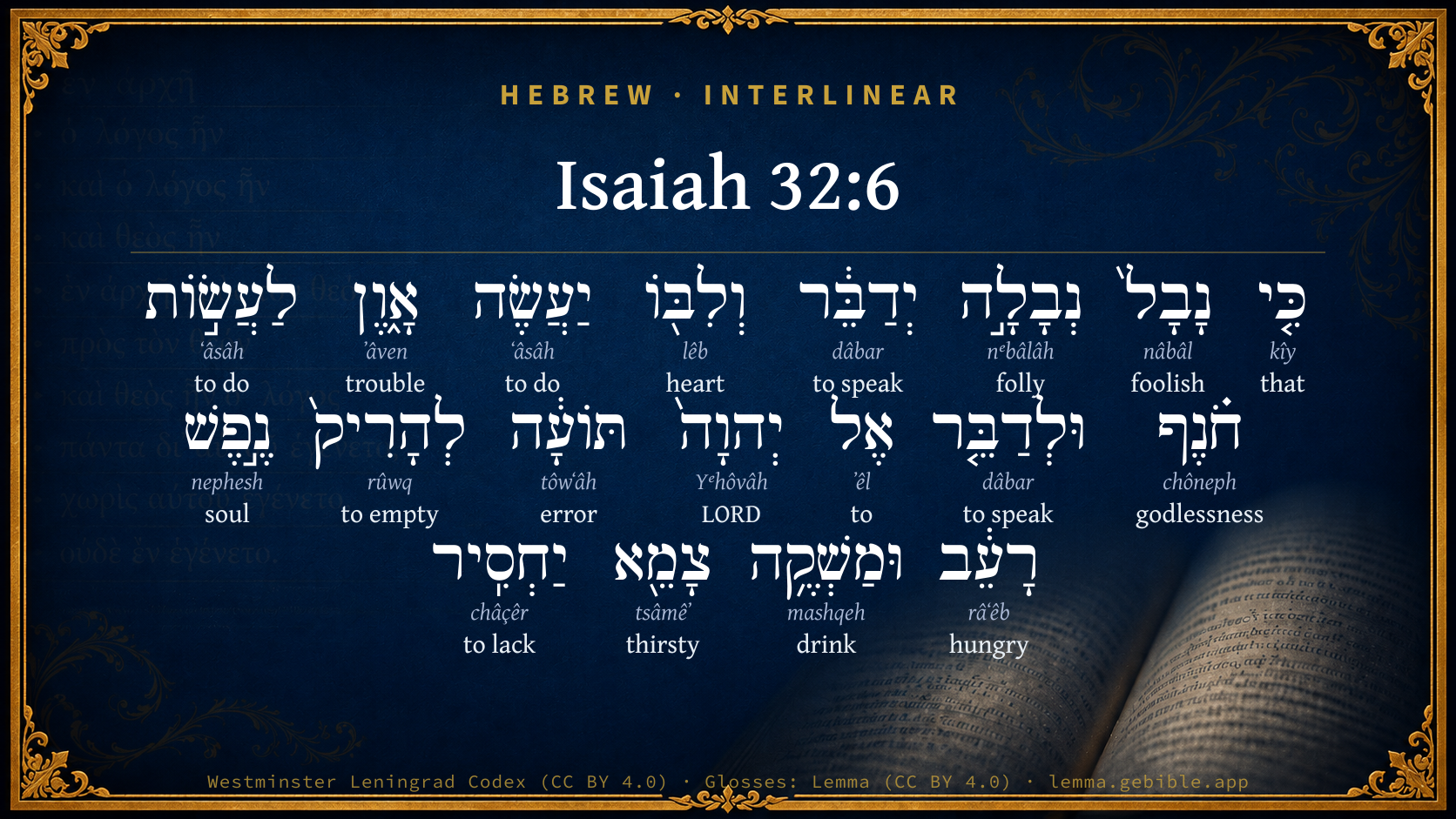
Hebrew (Westminster Leningrad Codex) Isaiah 32:6 appears in the Hebrew Old Testament. The text above is from the Westminster Leningrad Codex. Each word links to its Strong’s number, a concise gloss, and parsing drawn from the Open Scriptures Hebrew Bible morphology. Click any word for its full Brown-Driver-Briggs (BDB) entry.
Download image
Cite this verse

Isaiah 32:6 (World English Bible). Public Domain. Lemma interlinear Bible study tool, https://lemma.gebible.app/v/isaiah/32/6.

Show BibTeX & RIS
BibTeX
RIS
English Translation
For the fool will speak folly, and his heart will work iniquity, to practice profanity, and to utter error against Yahweh, to make empty the soul of the hungry, and to cause the drink of the thirsty to fail.
World English Bible · Public Domain
Highlights
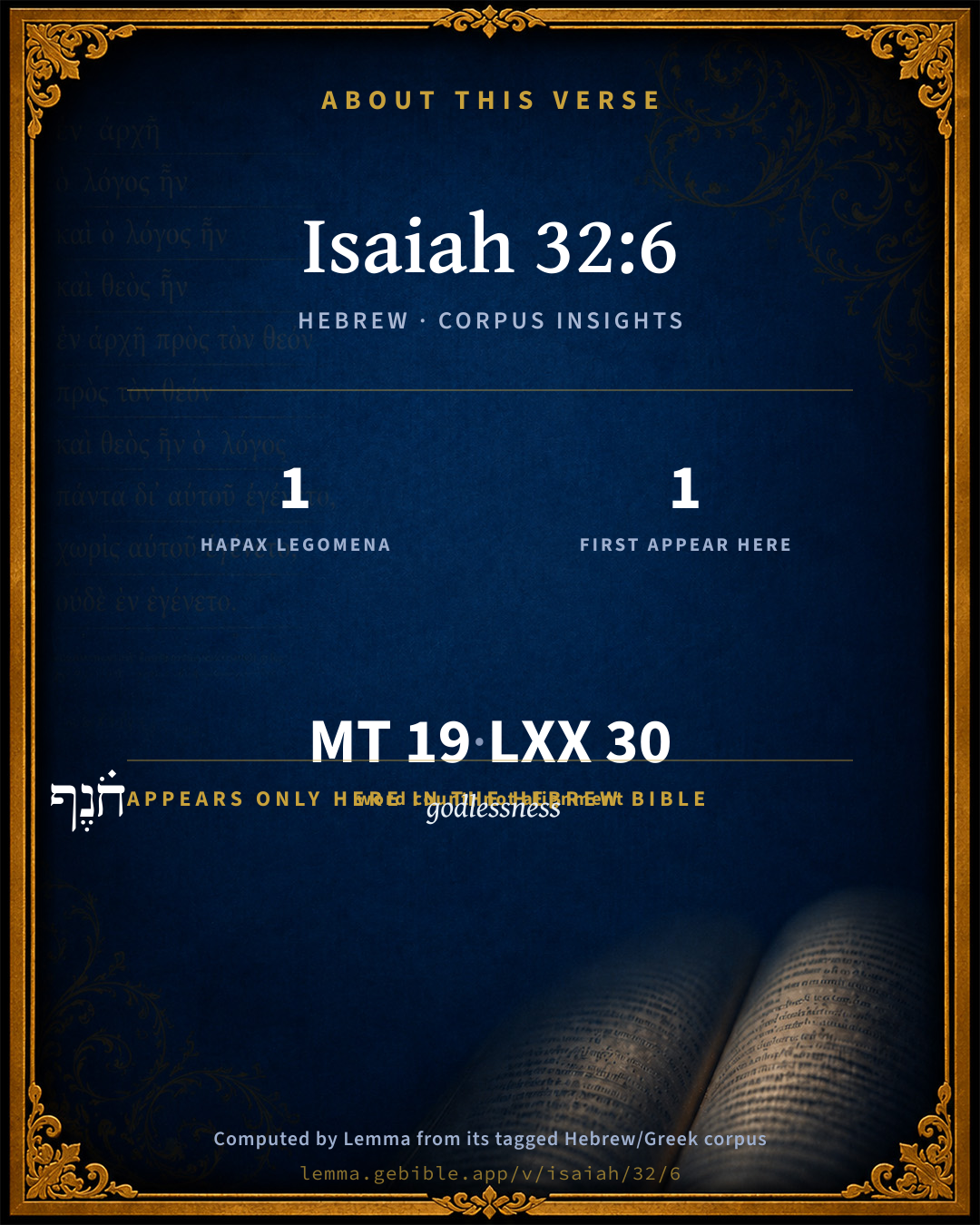
  • 1 hapax legomenon — only here in the Hebrew Bible
  • 1 first appearance in the Hebrew Bible
Full analysis ↓
Download a study sheet

One document with this verse’s original text, its word-by-word gloss line, the meaning frame, cross-references with their text, attributed commentary, and full source and license credits — printable, and it pastes into notes with its structure intact.

This verse Autodidact and up

Study sheet (.html) Plain text (.txt)

A passage Seminary Student

Up to 50 verses in one chapter. A passage sheet keeps up to 6 commentary sources and 12 cross-references per verse, in the order this page ranks them, and says so on the sheet whenever that leaves anything out. Ask for a single verse and you get the Autodidact verse sheet above.

Everything on this page stays free to read, with no account — the sheet is a download of what is already on screen, not access to it.

Want to remove ads? Support Godless Engineer
Compare translations 3

The same verse in 3 English versions, stacked beneath the original-language interlinear above. Click any original word for its lexicon entry.

Each is an independent rendering of the whole verse — the interlinear is not word-aligned to these translations.

Highlighted words mark where these versions differ — a whole-verse word diff, not a word-by-word alignment.

  • World English Bible Public Domain
    For the fool will speak folly, and his heart will work iniquity, to practice profanity, and to utter error against Yahweh, to make empty the soul of the hungry, and to cause the drink of the thirsty to fail.
  • King James Version Public Domain
    For the vile person will speak villany, and his heart will work iniquity, to practise hypocrisy, and to utter error against the LORD, to make empty the soul of the hungry, and he will cause the drink of the thirsty to fail.
  • unfoldingWord Literal Text CC BY-SA 4.0
    For the fool speaks folly, and his heart does iniquity, to do godlessness and to speak error against Yahweh, to make the soul of the hungry empty and he makes the thirsty lack drink.

unfoldingWord Literal Text — © unfoldingWord, licensed CC BY-SA 4.0. Word-aligned USFM3 via Door43 (git.door43.org/unfoldingWord/en_ult).

Versions to compare (up to 4)

3 of 4 selected

Show all 18 translations

Every available English version of this verse, each an independent rendering of the whole verse.

  • World English Bible Public Domain
    For the fool will speak folly, and his heart will work iniquity, to practice profanity, and to utter error against Yahweh, to make empty the soul of the hungry, and to cause the drink of the thirsty to fail.
  • Berean Standard Bible Public Domain
    For a fool speaks foolishness; his mind plots iniquity. He practices ungodliness and speaks falsely about the LORD; he leaves the hungry empty and deprives the thirsty of drink.
  • Majority Standard Bible Public Domain
    For a fool speaks foolishness; his mind plots iniquity. He practices ungodliness and speaks falsely about the LORD; he leaves the hungry empty and deprives the thirsty of drink.
  • King James Version Public Domain
    For the vile person will speak villany, and his heart will work iniquity, to practise hypocrisy, and to utter error against the LORD, to make empty the soul of the hungry, and he will cause the drink of the thirsty to fail.
  • American Standard Version (1901) Public Domain
    For the fool will speak folly, and his heart will work iniquity, to practise profaneness, and to utter error against Jehovah, to make empty the soul of the hungry, and to cause the drink of the thirsty to fail.
  • Revised Version (1885) Public Domain
    For the vile person will speak villany, and his heart will work iniquity, to practise profaneness, and to utter error against the LORD, to make empty the soul of the hungry, and to cause the drink of the thirsty to fail.
  • Geneva Bible (1599) Public Domain
    But the nigarde will speake of nigardnesse, and his heart will worke iniquitie, and do wickedly, and speake falsely against the Lord, to make emptie the hungrie soule, and to cause the drinke of the thirstie to faile.
  • Douay-Rheims (1899) Public Domain
    For the fool will speak foolish things, and his heart will work iniquity, to practise hypocrisy, and speak to the Lord deceitfully, and to make empty the soul of the hungry, and take away drink from the thirsty.
  • Young's Literal Translation Public Domain
    For a fool speaketh folly, And his heart doth iniquity, to do profanity, And to speak concerning Jehovah error, To empty the soul of the hungry, Yea, drink of the thirsty he causeth to lack.
  • Literal Standard Version CC BY-SA 4.0
    For a fool speaks folly, || And his heart does iniquity, to do profanity, || And to speak error concerning YHWH, || To empty the soul of the hungry, || Indeed, he causes the thirsty to lack [their] drink.
  • Unlocked Literal Bible CC BY-SA 4.0
    For the fool speaks folly, and his heart plans evil and godless actions, and he speaks wrongly against Yahweh. He makes the hungry empty, and the thirsty he causes to lack drink.
  • unfoldingWord Literal Text CC BY-SA 4.0
    For the fool speaks folly, and his heart does iniquity, to do godlessness and to speak error against Yahweh, to make the soul of the hungry empty and he makes the thirsty lack drink.
  • Darby Bible Public Domain
    for the vile man will speak villainy, and his heart will work iniquity, to practise hypocrisy, and to utter error against Jehovah, to make empty the soul of the hungry, and to cause the drink of the thirsty to fail.
  • World Messianic Bible Public Domain
    For the fool will speak folly, and his heart will work iniquity, to practice profanity, and to utter error against the LORD, to make empty the soul of the hungry, and to cause the drink of the thirsty to fail.
  • Webster's Bible Public Domain
    For the vile person will speak villainy, and his heart will work iniquity, to practice hypocrisy, and to utter error against the LORD, to make empty the soul of the hungry; and he will cause the drink of the thirsty to fail.
  • Free Bible Version CC BY-SA 4.0
    For fools only talk foolishness, thinking evil things. They act in opposition to the Lord, misrepresenting him in what they say. They refuse to give food to the hungry and deny water to the thirsty.
  • Bible in Basic English Public Domain
    For the foolish man will say foolish things, having evil thoughts in his heart, working what is unclean, and talking falsely about the Lord, to keep food from him who is in need of it, and water from him whose soul is desiring it.
  • JPS Tanakh (1917) Public Domain
    For the vile person will speak villainy, and his heart will work iniquity, to practise ungodliness, and to utter wickedness against the LORD, to make empty the soul of the hungry, and to cause the drink of the thirsty to fail.

Literal Standard Version (2020), Covenant Press — licensed CC BY-SA 4.0. Text via the HelloAO Bible API (eBible.org). Unlocked Literal Bible (unfoldingWord) — licensed CC BY-SA 4.0. Text via the HelloAO Bible API (eBible.org). unfoldingWord Literal Text — © unfoldingWord, licensed CC BY-SA 4.0. Word-aligned USFM3 via Door43 (git.door43.org/unfoldingWord/en_ult). Free Bible Version, Dr. Jonathan Gallagher — licensed CC BY-SA 4.0. Text via the HelloAO Bible API (eBible.org).

Word by word

More ways to search: Search by grammar → Find every occurrence → Compare this word →

Practice this passage: Drill this verse → Learn its vocabulary →

חֹ֗נֶף
chôneph
H2612
“godlessness”
Noun, Common, Masculine, Singular, Absolute
Part of Speech
Noun
Type
Common
Gender
Masculine
Number
Singular
State
Absolute
Full BDB Definition

Origin: from H2610

TWOT: 696a

hypocrisy, godlessness, hypocrite, profaneness
  1. כִּ֤י kîy H3588 “that” Conjunction
  2. נָבָל֙ nâbâl H5036 “foolish” Adjective, Adjective, Masculine, Singular, Absolute
  3. נְבָלָ֣ה nᵉbâlâh H5039 “folly” Noun, Common, Feminine, Singular, Absolute
  4. יְדַבֵּ֔ר dâbar H1696 “to speak” Verb, Piel, Imperfect, 3rd Person, Masculine, Singular
  5. וְלִבּ֖וֹ lêb H3820 “and · heart · his” Conjunction + Noun, Common, Masculine, Singular, Construct + Suffix, Personal, 3rd Person, Masculine, Singular
  6. יַעֲשֶׂה ʻâsâh H6213 “to do” Verb, Qal, Imperfect, 3rd Person, Masculine, Singular
  7. אָ֑וֶן ʼâven H205 “trouble” Noun, Common, Masculine, Singular, Absolute
  8. לַעֲשׂ֣וֹת ʻâsâh H6213 “to do” Preposition + Verb, Qal, Infinitive Construct
  9. וּלְדַבֵּ֤ר dâbar H1696 “and · to speak” Conjunction + Preposition + Verb, Piel, Infinitive Construct
  10. אֶל ʼêl H413 “to” Preposition
  11. יְהוָה֙ Yᵉhôvâh H3068 “LORD” Noun, Proper
  12. תּוֹעָ֔ה tôwʻâh H8442 “error” Noun, Common, Feminine, Singular, Absolute
  13. לְהָרִיק֙ rûwq H7324 “to empty” Preposition + Verb, Hiphil, Infinitive Construct
  14. נֶ֣פֶשׁ nephesh H5315 “soul of” Noun, Common, Both, Singular, Construct
  15. רָעֵ֔ב râʻêb H7457 “hungry” Adjective, Adjective, Masculine, Singular, Absolute
  16. וּמַשְׁקֶ֥ה mashqeh H4945 “and · drink” Conjunction + Noun, Common, Masculine, Singular, Absolute
  17. צָמֵ֖א tsâmêʼ H6771 “thirsty” Adjective, Adjective, Masculine, Singular, Absolute
  18. יַחְסִֽיר châçêr H2637 “to lack” Verb, Hiphil, Imperfect, 3rd Person, Masculine, Singular

About this verse

These counts appear in no published source. They are computed here, from the morphology-tagged text and Lemma’s own curated glosses. What Lemma adds →

19
words
17
distinct lemmas
Prophets
section

Notable vocabulary

1 hapax legomenon — a word that appears only here in the entire Hebrew Bible:

  • חֹ֗נֶף godlessness H2612

First appearance in Scripture

This word makes its first canonical appearance in the Hebrew Bible here:

  • חֹ֗נֶף godlessness H2612

Shared distinctive vocabulary

תּוֹעָ֔ה error H8442 occurs in 2 verses of the Hebrew Bible. Also found in:

Grammatical profile

  • 6 verbs
  • 8 nouns
  • 3 adjectives
  • 1 preposition
  • 1 conjunction

Verb forms

  • יְדַבֵּ֔ר Piel · Imperfect
  • יַעֲשֶׂה Qal · Imperfect
  • לַעֲשׂ֣וֹת Qal · Infinitive Construct
  • וּלְדַבֵּ֤ר Piel · Infinitive Construct
  • לְהָרִיק֙ Hiphil · Infinitive Construct
  • יַחְסִֽיר Hiphil · Imperfect

Repetition

Words recur within this verse — often emphatic in Hebrew:

  • יְדַבֵּ֔ר to speak H1696 ×2
  • יַעֲשֶׂה to do H6213 ×2

Hebrew & Septuagint length

In English translation the verse runs 39 words from the Hebrew and 39 from the Septuagint (LXX English) — the same length.

A rough comparison of the two English renderings, which tokenize alike — not a word-level alignment.

Word counts can differ between the Hebrew and the Greek without any difference in meaning — e.g. the Hebrew direct-object marker אֵת has no separate Greek word, and Greek often adds the article ὁ.

In the original languages it is 19 Hebrew tokens and 30 Greek tokens — but the two are counted differently (Hebrew bundles its prefixes and suffixes into one token; the Greek is in lemma form), so that isn’t a like-for-like length.

Cross-references

23

Topical passages linked to Isaiah 32:6 in the Treasury of Scripture Knowledge — connected by theme and wording, ordered by reader-vote popularity; previews shown in the World English Bible.

  • Matthew 15:19 For out of the heart come forth evil thoughts, murders, adulteries, sexual sins, thefts, false testimony, and blasphemies.
  • 1 Samuel 24:13 As says the proverb of the ancients, Out of the wicked comes forth wickedness; but my hand shall not be on you.
  • Proverbs 11:24–26 There is one who scatters, and increases yet more. There is one who withholds more than is appropriate, but gains poverty.
  • Isaiah 3:15 What do you mean that you crush my people, And grind the face of the poor?" says the Lord, Yahweh of Hosts.
  • Matthew 23:13 "Woe to you, scribes and Pharisees, hypocrites! For you devour widows' houses, and as a pretense you make long prayers. Therefore you will receive greater condemnation.
  • Acts 5:3–4 But Peter said, "Ananias, why has Satan filled your heart to lie to the Holy Spirit, and to keep back part of the price of the land?
  • Acts 8:21–22 You have neither part nor lot in this matter, for your heart isn't right before God.
  • 1 Samuel 25:10–11 Nabal answered David's servants, and said, Who is David? and who is the son of Jesse? there are many servants now-a-days who break away every man from his master.
  • Job 22:5–9 Isn't your wickedness great? Neither is there any end to your iniquities.
  • Job 24:2–16 There are people who remove the landmarks. They violently take away flocks, and feed them.
  • Psalms 58:1–2 Do you indeed speak righteousness, silent ones? Do you judge blamelessly, you sons of men?
  • Proverbs 19:3 The foolishness of man subverts his way; His heart rages against Yahweh.
  • Isaiah 9:17 Therefore the Lord will not rejoice over their young men, neither will he have compassion on their fatherless and widows; for everyone is profane and an evil-doer, and every mouth speaks folly. For all this his anger is not turned away, but his hand is stretched out still.
  • Jeremiah 13:23 Can the Ethiopian change his skin, or the leopard his spots? then may you also do good, who are accustomed to do evil.
  • Hosea 7:6–7 For they have made ready their heart like an oven, While they lie in wait. Their baker sleeps all the night. In the morning it burns as a flaming fire.
  • Amos 2:6–7 Thus says Yahweh: "For three transgressions of Israel, yes, for four, I will not turn away its punishment; Because they have sold the righteous for silver, And the needy for a pair of shoes;
  • Amos 8:6 That we may buy the poor for silver, And the needy for a pair of shoes, And sell the sweepings with the wheat?'"
  • Micah 2:1–2 Woe to those who devise iniquity And work evil on their beds! When the morning is light, they practice it, Because it is in the power of their hand.
  • Micah 3:1–3 I said, "Please listen, you heads of Jacob, And rulers of the house of Israel: Isn't it for you to know justice?
  • Matthew 12:34–36 You offspring of vipers, how can you, being evil, speak good things? For out of the abundance of the heart, the mouth speaks.
  • James 1:14–15 But each one is tempted, when he is drawn away by his own lust, and enticed.
  • James 1:27 Pure religion and undefiled before our God and Father is this: to visit the fatherless and widows in their affliction, and to keep oneself unstained by the world.
  • James 3:5–6 So the tongue is also a little member, and boasts great things. See how a small fire can spread to a large forest!

Cross-references courtesy of OpenBible.info (CC BY 4.0).

Hebrew and Greek witnesses Masoretic Hebrew ↔ Greek Septuagint

The same verse in the two great witnesses to the Old Testament, shown verse-for-verse.

These are two independent witnesses, not word-aligned to each other, and the Septuagint is shown in lemma (dictionary) form.

Hebrew Isaiah 32:6 Masoretic · Westminster Leningrad Codex

כִּ֤י נָבָל֙ נְבָלָ֣ה יְדַבֵּ֔ר וְלִבּ֖וֹ יַעֲשֶׂה אָ֑וֶן לַעֲשׂ֣וֹת חֹ֗נֶף וּלְדַבֵּ֤ר אֶל יְהוָה֙ תּוֹעָ֔ה לְהָרִיק֙ נֶ֣פֶשׁ רָעֵ֔ב וּמַשְׁקֶ֥ה צָמֵ֖א יַחְסִֽיר

For the fool will speak folly, and his heart will work iniquity, to practice profanity, and to utter error against Yahweh, to make empty the soul of the hungry, and to cause the drink of the thirsty to fail.

World English Bible · Public Domain

Greek LXX Isaiah 32:6 Septuagint · lemma form

ὁ γάρ μωρός μωρός λαλέω καί ὁ καρδία αὐτός μάταιος νοέω ὁ συντελέω ἄνομος καί λαλέω πρός κύριος πλάνησις ὁ διασπείρω ψυχή πεινάω καί ὁ ψυχή ὁ διψάω κενός ποιέω

For the fool shall speak foolish words, and his heart shall meditate vanities, and to perform lawless deeds and to speak error against the Lord, to scatter hungry souls, and he will cause the thirsty souls to be empty.

LXX2012 (modern English Septuagint) · Public Domain

On this verse, The Cambridge Bible for Schools and Colleges discusses the Septuagint’s reading. Read the note in Commentary ↓

Hebrew: Westminster Leningrad Codex (CC BY 4.0). Greek: Septuagint (public domain); English from LXX2012 (modern English Septuagint) (Public Domain). How the Septuagint differs from the Hebrew →

Targum (Aramaic paraphrase)

1

The Targum is the ancient Jewish Aramaic paraphrase of the Hebrew Scriptures — an interpretive translation, not the Hebrew text itself. Onkelos (literal) and Pseudo-Jonathan (expansive) render the Torah, and Jonathan the Prophets. Coverage is partial: where no permissively-licensed English translation exists for a verse, only the Aramaic is shown. This is verse-level text, not a word-by-word alignment to the Hebrew.

  1. Targum Jonathan Prophets (Joshua–Malachi)
    אֲרֵי רַשִׁיעַיָא רִשְׁעָה מְמַלְלִין וּבְלִיבְּהוֹן מִתְעַשְׁתִּין אוֹנֶס לְמֶעְבַּד שְׁקַר וּלְמַלָלָא קֳדָם יְיָ סַטְיָא לְשַׁלְהָאָה נֶפֶשׁ צַדִיקַיָא דִמְחַמְדִין לְאוּלְפָנָא הָא כְּכָפְנָא לְלַחְמָא וּפִתְגָמֵי אוֹרַיְתָא דְאִינוּן כְּמַיָא לְצַחָיָא מְדַמָן לְבַטָלָא:

    For the wicked will talk wickedness, and in their heart they meditate violence, to practise falsehood, and to speak revolt against the Lord, to weary the soul of the righteous, who long after instruction, as the hungry after bread; and after the words of the law, which are like water to him that is athirst, they purpose to make to cease.

    Targum Jonathan — Aramaic: “Mikraot Gedolot” (public domain). English: “Sefaria Community Translation” (CC0 1.0 (public-domain dedication)); “London "Chaldee Paraphrase," 1871” (public domain). Text via Sefaria.

Commentary

Notes on Isaiah 32:6 from classic Christian and Jewish commentators (each source and its license shown beneath its notes). The classic Christian expositions comment on the surrounding passage and are grouped to its opening verse, so a note may address several verses; the Jewish commentaries on the Tanakh (Rashi and others) are per-verse, so they appear only where the commentator wrote on this verse.

Lemma curates 59 commentaries, every one of them public domain or Creative Commons licensed, each selected and text-cleaned for this edition rather than reprinted as found. About our sources →

Trapp's Complete Commentary

John Trapp

Isa 32:6 For the vile person will speak villany, and his heart will work iniquity, to practise hypocrisy, and to utter error against the LORD, to make empty the soul of the hungry, and he will cause the drink of the thirsty to fail.

Ver. 6. For the vile person will speak villany.] Why then should he be advanced to great places why should he be smoothed and soothed up with high titles? "The adversary and the enemy is this wicked Haman," said Esther. {Isa 7:6} Before, some had styled him noble, others great, and some perhaps virtuous; only Esther giveth him his own - Pessimus iste, "That most wicked Haman"; so, "Go, tell that fox," saith our Saviour; and God shall smite thee, "thou whited wall," saith St Paul to Ananias, &c. Nomina rebus consentanea imponentur. A spade shall be called a spade, a fool a fool; there shall not be nomen inane, crimen immane, sedes prima et vita ima, ingens authoritas et nutans stabilitas, &c. {a}

And his heart will work iniquity.] Exegesis flagitiosi, the true portraiture of an evil magistrate, Iudex locusta civitatis est malus. An evil judge is the locust of the state.

{a} Bernard.

John Trapp, A Commentary or Exposition upon All the Books of the Old and New Testament (1647–1656) — public domain. Text from a community e-Sword module.

The Biblical Illustrator

Joseph S. Exell

Isa_32:6-7

For the vile person will speak villany

The outer life according to the inner

A vile person and a churl will do mischief; and the more if he be preferred, and have power in his hand.

His honours will make him worse, and not better. See the character of these base, ill-conditioned men.

1. They are always plotting some unjust thing or other; designing ill either to particular persons or to the public, and contriving how to bring it about; and so many silly piques they have to gratify, and mean revenges, that there appears not in them the least spark of generosity. Observe, there is the work of the heart, as well as the work of the hands. As thoughts are words to God, so designs are works in His account. See what pains sinners take in sin; they labour it, their hearts are intent upon it, and with a great deal of art and application they work iniquity. They devise wicked devices with all the subtlety of the old serpent.

2. They carry on their plots by trick and dissimulation. When they are meditating iniquity, they practise hypocrisy, feign themselves just men. The most abominable mischiefs shall be disguised with the most plausible pretences of devotion to God, regard to man, and concern for some common good. Those are the vilest of men that intend the worst mischief when they speak fair.

3. They speak villany. When they are in a passion, you will see what they are by the base, ill language they give to those about them, which no way becomes men of rank and honour. Or, in giving verdict or judgment, they villainously put false colours upon things to pervert justice.

4. They affront God, who is a righteous God and loveth righteousness. They utter error against the Lord, and therein they practise profaneness. They give an unjust sentence, and then profanely make use of the name of God for the ratification of it. Nothing can be more impudently done against God than to patronise wickedness with His name.

5. They abuse mankind, those particularly whom they are bound to protect and relieve.

6. These churls and vile persons have always ill instruments about them, that are ready to serve their villainous purposes--the instruments of the churl are evil. (M. Henry.)

The Biblical Illustrator, edited by Joseph S. Exell (c. 1880s–1900s) — public domain. Text from a community e-Sword module.

Tyndale Open Study Notes

Tyndale Open Resources

32:6 Because they do not care about God’s standards of justice and righteousness, fools have no regard for those who are hungry or thirsty (see 1:17; 58:7, 10).

Tyndale Open Study Notes — © Tyndale Open Resources, licensed CC BY-SA 4.0. Text via the HelloAO Bible API.

Jamieson, Fausset & Brown

Robert Jamieson, A. R. Fausset & David Brown

vile . . . villainy--rather, "the (irreligious) fool . . . (his) folly."

will speak--rather, "present"; for (so far is the "fool" from deserving the epithet "noble-minded") the fool "speaketh" folly and "worketh," &c.

hypocrisy--rather, "profligacy" [HORSLEY].

error--impiety, perverse arguments.

hungry--spiritually (Mat 5:6).

Jamieson, Fausset & Brown — Commentary Critical and Explanatory on the Whole Bible (1871) — public domain (CC PDM 1.0). Text via the HelloAO Bible API.

Adam Clarke's Commentary

Verse 6. The vile person will speak villany - "The fool will still utter folly"] A sort of proverbial saying, which Euripides (Bacchae, 369) has expressed in the very same manner and words: Μωρα γαρ μωρος λεγει· "The fool speaks folly." Of this kind of simple and unadorned proverb or parable, see De S. Poes, Hebr. Praelect. xxiv.

Against the Lord - "Against JEHOVAH"] For אל El, two MSS. read אל al, more properly; but both are of nearly the same meaning.

Adam Clarke's Commentary on the Bible (1810–1826) — public domain. Text from a community e-Sword/MySword module.

Ellicott's Commentary for English Readers

(6) The vile person will speak villany.—Another echo, like that of Isa_28:23-29, of the teaching of the Book of Proverbs. In that better day men would learn to see men as they are, and not as they pretend to be. “By their fruits ye shall know them” was to be one of the blessings of the reign of the true king (Mat_7:20).

To utter error against the Lord.—The “error” is either that of “heresy,” or of hollow profession, or of open scoffing. In either case it finds its practical outcome, like the hypocrisy of the Pharisees (Mat_23:14), in violence and wrong towards the poor and weak.

A Bible Commentary for English Readers, edited by Charles John Ellicott (1878–1897) — public domain. Text from a community e-Sword module.

The Cambridge Bible for Schools and Colleges

gen. ed. J. J. S. Perowne

6. The characteristics of the “fool.” Render: For a fool speaks folly and his heart works (LXX. “meditates”) mischief, to practise impiety (cf. Isa_9:17) and to speak error (Isa_29:24) against Jehovah, &c. The fool here depicted is a free thinker, a practical atheist, as in Psa_14:1; the baneful effect of his principles is seen in his conduct towards his fellow-men, in his pitiless and cruel selfishness.

to make empty …] to deprive the destitute of their scanty subsistence.

6–8. The two types contrasted in their conduct.

The Cambridge Bible for Schools and Colleges (gen. ed. J. J. S. Perowne; Cambridge University Press, 1878–1918) — public domain. Text from a community e-Sword module.

John Gill's Exposition

For the vile person will speak villainy,.... Or, "a fool will utter folly" (g); a man that has no understanding of Gospel truths himself can not deliver them to others; he will only speak foolish things, concerning the purity of human nature, the power of man's free will, the sufficiency of his own righteousness to justify him, and the merits of good works, and the like; and therefore such a man is a very improper one to be a guide and governor in the church of God:

and his heart will work iniquity; forge and devise it within himself; will form schemes of false doctrine, discipline, and worship, disagreeable to the word of God:

to practise hypocrisy; to make men believe he is a very devout and religious man, when he has no good thing in him, and to put others upon a profession of religion that have none; which things are commonly done by foolish and ignorant preachers:

and to utter error against the Lord; such doctrines as are contrary to the free, rich, sovereign grace of God; to the deity, personality, sonship, offices, blood, sacrifice, and righteousness of Christ, and so to the person and operations of the blessed Spirit:

to make empty the soul of the hungry; and he will cause the drink of the thirsty to fail; the "hungry" and "thirsty" are such as hunger and thirst after, and earnestly desire, the sincere milk of the word for their spiritual nourishment and growth; whose "souls" become "empty", and their "drink" fails, when the doctrines of grace are not dispensed unto them, but false and unedifying doctrines are delivered, so that their souls sink and faint, and are ready to die away, for want of the bread of the Gospel; agreeably to this sense, the Targum paraphrases the words thus,

"to make the soul of the righteous weary, who desire doctrine, as a hungry man bread; and the words of the law, which are as water to him that is thirsty, they think to cause to cease.''

(g) "nam stultus stultitiam loquetur", Pagninus, Montanus.

John Gill's Exposition of the Whole Bible (1746–1763) — public domain (CC PDM 1.0). Text via the HelloAO Bible API.

Albert Barnes' Notes on the Bible

For the vile person - Hebrew, ‘The fool.’ This word more properly expresses the idea than ‘vile person.’ The Hebrews Used the name fool to denote not only one destitute of understanding, but a knave, a dishonest man - regarding sin as the highest folly (see 1Sa 25:25; 2Sa 3:33; Job 2:10).

Will speak villainy - Hebrew, ‘Will speak folly.’ That is, he will act in accordance with his nature; it is his nature to speak folly, and he will do it. Under a wicked and unjust administration such persons might be the subjects flattery Isa 32:5, and might be raised to office and power. But under the administration of a virtuous king they would not be admitted to favor; and the reason was, that they would act out their nature, and would corrupt all around them. A monarch, therefore, who regarded the honor of his own throne, and the welfare of his subjects, would exclude them from his counsels.

To make empty the soul of the hungry - Probably this refers to spiritual hunger and thirst; and means that such a person would take away the means of knowledge from the people, and leave them to error, ignorance, and want. The sense is, that if such persons were raised to office, they would corrupt the nation and destroy their confidence in God; and this was a reason why a virtuous prince would exclude them from any participation in his government.

Albert Barnes' Notes on the Bible (1834–1885) — public domain. Text from a community e-Sword/MySword module.

Matthew Poole's English Annotations

For the vile person will speak villany: so this is a reason of the assertion, Isa 32:5; either thus, Such shall not be advanced to places of trust and dignity; for if they were, they would abuse them by unjust sentences and practices. Or thus, Men shall no longer be miscalled; for every one will discover what he is by his Words and actions; which also shall be narrowly observed. But these and the following words are and may be otherwise rendered: But (as this particle oft signifies) he shall be called or said to be (which words are easily understood out of the former verse, as is very frequent in Scripture) a fool, who (which relative particle is understood in very many places) shall speak villany, and whose heart shall work iniquity, &c.

His heart will work iniquity; he will, from time to time, be devising wickedness, that he may execute it when he hath opportunity.

To practise hypocrisy: to, do bad things, but with a pretence of religion and justice, which he shall use to keep himself from the disfavour of his prince, and from the lash of the law. Or, to practise profaneness or wickedness, as this word, at least sometimes, seems to signify.

To utter error against the Lord; to pass unjust sentences, which is directly contrary to the will and command of God.

To make empty the soul of the hungry, and he will cause the drink of the thirsty to fail; whereby they take away the bread and drink of the poor, and give it to their rich oppressors.

Matthew Poole's English Annotations on the Holy Bible (1683–1685) — public domain. Text from a community e-Sword/MySword module.

The Pulpit Commentary

For the vile person will speak villany, etc.; rather, for the fool speaketh folly, and his heart doeth wickedness, practising profanity and uttering error against Jehocab, making empty the soul of the hungry yea, the drink of the thirsty will he cause to fail. The prophet seems to have the portrait of Nabal in his mind, and to take him as the type of a class.

The correction of social confusions.

"When men"s eyes are opened, they will no longer confound the essential distinctions of moral character, because they will no longer be deceived by mere appearances (J. A. Alexander)." A due discrimination of character would be made in the times of the Messiah, and persons and things would be called by their appropriate names" (comp. Mal_3:18 Mat_23:13-33 Eph_5:5) (Henderson). "The differences between good and evil, virtue and vice, shall be kept up, and no more confounded by those who put darkness for light and light for darkness" (Matthew Henry). These sentences show that the subject introduced is the influence of a righteous reign in helping men to see things as they really are, and to estimate persons according to their true worth, and not according to the mere show they may make. We deal specially with those confusions which come by false judgments of persons, and these take the following, among other forms.

I ADMIRATION OF TALENTS BLINDS US TO BADNESS OF CHARACTER. What is thought to be "genius" is too often allowed to excuse all sorts of laxity. The men who can astonish and amuse us may be unclean, untruthful, injurious; but we readily pass all this by. When righteousness reigns, talent will have to go with character, or men will count it to be Satanic agency. What a man can do must never be separated from what the man is.

II THE COMMAND OF WEALTH BRINGS FLATTERERS TO BAD MEN. There is no more painful sign of the moral deterioration of a race, than its worship of the rich because they are rich. Money can never make goodness. Wealth is not the stability of a nation. Its hope lies wholly in its good men. Yet the rich man may be violent, rude, masterful, cruel; nevertheless, multitudes will fawn on him, and call the Vile person liberal." When righteousness reigns, that confusion will be rectified, and the rich man shall have worship only if he deserves it for what he is.

III THE RANK AND SOCIAL POSITION OF MEN NOW BEWILDER THEIR FELLOWS, AND MAKE TRUE ESTIMATES NEARLY IMPOSSIBLE. Well does Robert Burns remind us that "The rank is but the guinea-stamp, A man"s a man for a" that.

No word of bitterness need be spoken concerning those to whom God has entrusted talents, or wealth, or social position. The point to enforce is simply the peril of letting these things confuse our ideas of moral character and moral worth. Evil is evil, and must be denounced as evil, in the genius, the man of wealth, and the man of title. Let Christ reign, and sin will be called sin, wherever it is found. He will strip all disguises off, and show us things as they are, and men as they are. The Lord hasten his coming! R.T.

The Pulpit Commentary (1880–1919), ed. H.D.M. Spence-Jones & Joseph S. Exell — public domain. Text from a community e-Sword module.

John Wesley's Explanatory Notes

Villainy - Men shall no longer be miscalled; for every one will discover what he is by his words and actions. Will work - He will, from time to time, be advising wickedness, that he may execute it when he hath opportunity. To practice - To do bad things, tho' with a pretense of religion and justice. To utter - To pass unjust sentence, directly contrary to the command of God. Cause the drink - Whereby they take away the bread and the drink of the poor.

John Wesley, Explanatory Notes Upon the Whole Bible (1754–1765) — public domain. Text via the GEBible commentary corpus.

J. A. Alexander on Isaiah

Joseph Addison Alexander

The Prophet now defines his own expressions, or describes the characters which they denote. “The fool (is one who) will speak folly (in the strongest and worst sense), and his heart will do iniquity, to do wickedness and to speak error unto (or against) Jehovah (while at the same time he is merciless and cruel towards his fellow-men), to starve (or leave empty) the soul of the hungry, and the drink of the thirsty he will suffer to fail.” The futures in this verse express the idea of habitual action; he does and will do so. The infinitives convey the same idea in a different form, by making prominent the design and effect of their unlawful course. The common version, work and practice needlessly departs from the form of the original, in which the same verb is repeated.

Joseph Addison Alexander, The Prophecies of Isaiah (1846–1847; New York: Scribner, 1870–1878) — public domain. Text from a community e-Sword module.

Rashi

Rabbi Shlomo Yitzchaki (Rashi)

speaks villainy (יְדַבֵּר) like מְדַבֵּר, a present tense.

works iniquity (יַעֲשֶׂה) Gathers thoughts of iniquity. Comp. (Deut. 8:17) “Gathered (עָשָׂה) for me this wealth.”

to practice flattery (לֲַעֲשׂוֹת) He thinks thoughts how he can practice flattery. חֹנֵף is a noun; therefore, the accent is on the first syllable, it is vowelized with a ‘pattah’ (now called a ‘segol’).

and the drink of the thirsty he causes to fail According to the simple meaning, they rob the poor. The Targum, (however, paraphrases:) The words of the Torah, which are like water to the thirsty, they plan to nullify.

Rashi on the Tanakh — English translations: “The Judaica Press complete Tanach with Rashi, translated by A. J. Rosenberg” (CC BY 4.0); “Pentateuch with Rashi's commentary by M. Rosenbaum and A.M. Silbermann, 1929-1934” (public domain); “The Metsudah Tanach series, Lakewood, N.J” (CC BY 4.0); and “The Book of Joshua, Metsudah Publications, 1997” (CC BY 4.0). Text via Sefaria.

Ibn Ezra

Rabbi Abraham ibn Ezra

For the vile person, etc. This refers to the officers of Ahaz.

תועה Error. It is a noun; the forms of nouns are manifold.

Ibn Ezra on the Tanakh — English translations: “Sefaria Community Translation” (CC0 1.0 (public-domain dedication)); “Yalkut, Sifsei Chachomim Chumash, Metsudah Publications, 2009” (CC BY 4.0); and “Commentary of Ibn Ezra on Isaiah - trans. by M. Friedlander, 1873” (public domain). Text via Sefaria.

Lesson kit

Teaching starters — assembled from the data on this page, not authored interpretation. Every prompt links to the verse data it draws on. Edit before teaching.

Isaiah, in the Prophets, opens this verse with 19 words (17 distinct Hebrew lemmas). Its most distinctive word is chôneph (“godlessness”). A historical commentator’s framing appears above. Read the whole chapter for the surrounding context.

Discussion questions

  1. What does “godlessness” (chôneph) contribute to the verse as a whole?
  2. This verse holds 1 word here found nowhere else in the Hebrew Bible. What might the rare word draw attention to?
  3. The word “godlessness” first appears here in Scripture. What is being introduced at this debut?
  4. Nehemiah 4:8 shares the word «error» with this verse. How do the two illuminate each other?
  5. “to speak” occurs 2× in this one verse. What is the effect of the repetition?
  6. These translations render this verse differently. What is at stake in choosing one wording over another?
  7. The verb «יְדַבֵּ֔ר» is Piel Imperfect. How does its form color the action?
  8. Reading how Trapp's Complete Commentary and The Biblical Illustrator read this verse, where do the two commentators agree and where do they part?

Things to notice

  • 1 word in this verse appears nowhere else in the Hebrew Bible.
  • 1 word makes its first canonical appearance in Scripture here.
  • This verse counts 19 Hebrew ↔ 30 Greek words.
  • These translations choose different wording for 22 words in this verse.
  • “to speak” occurs 2× in this single verse.

Reading settings

Reading text

Shown beneath each verse's original-language words.

Old Testament
Old Testament edition

Read the OT as the Masoretic Hebrew (MT) or the Greek Septuagint (LXX).

English shown for the Greek Septuagint (in the Hebrew ↔ Greek comparison).

Comparing translations? Open the Compare panel on any verse page to stack up to four side by side.