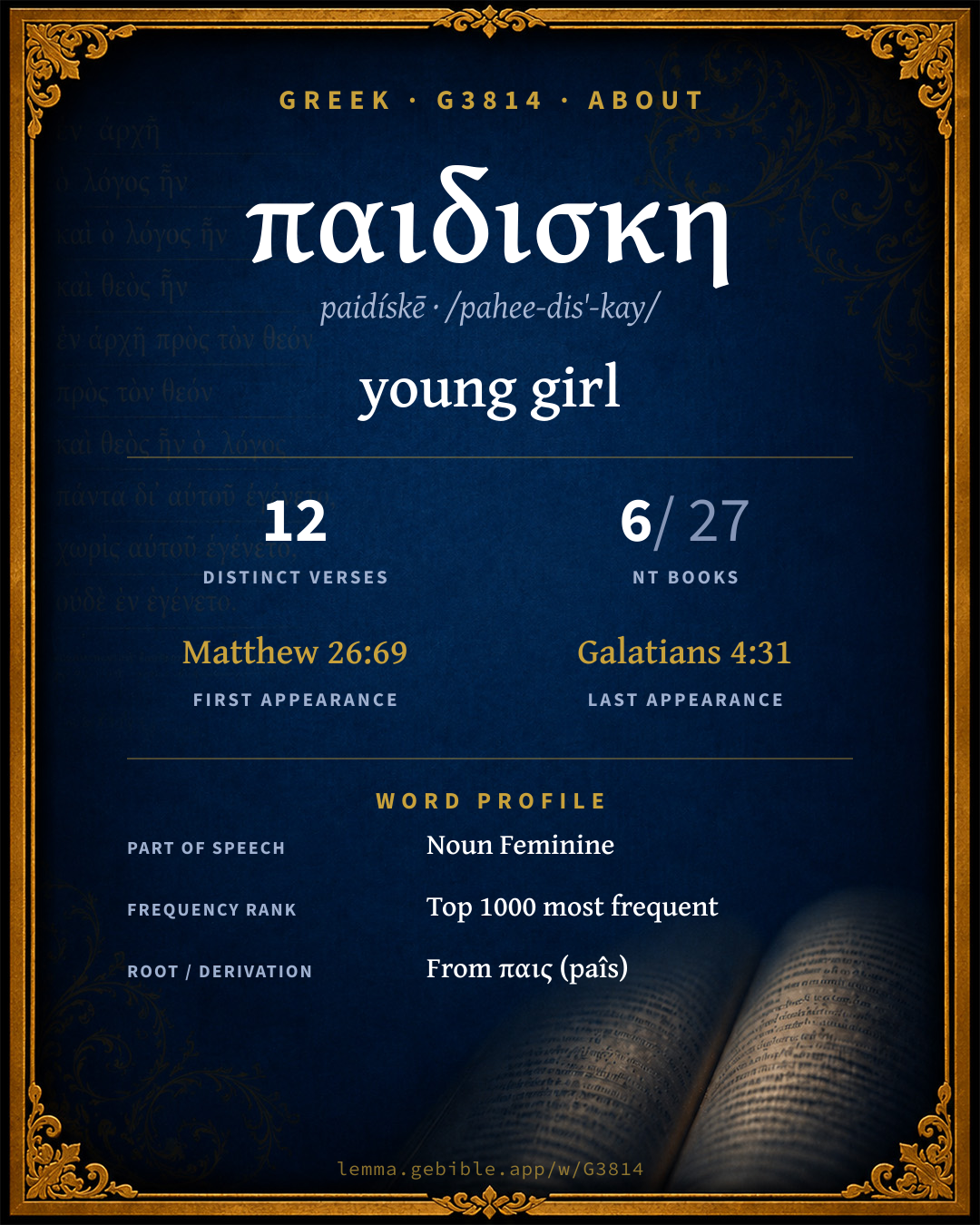
παιδίσκη
young girl
‘young girl’ is one of 2 main senses fuller range ↓
Full lexicon entry — Thayer's Greek Lexicon
From Thayer's Greek Lexicon
Where this word appears
Grammar key — what these labels mean
Part of speech
- Noun
- A naming word — a person, place, thing, or idea.
Case
- Nominative
- The case of the subject (and the predicate nominative).
- Genitive
- The case of source, possession, or “of” — answers “whose / from what.”
- Accusative
- The case of the direct object and of extent.
Gender
- Feminine
- Grammatically feminine.
Number
- Singular
- One.
- Plural
- More than one.
Every verse where G3814 appears in the Book of John — 1 distinct verse. Click any verse to open its interlinear word-by-word view. Verse text shown in the World English Bible for context — . Each verse’s Greek form is shown with its reference; the English is not keyword-highlighted, since the data carries no word-level English alignment. Use “Compare translations” on any verse to read it across multiple English versions. This concordance covers the Greek New Testament; Septuagint (Greek Old Testament) occurrences of this word are not indexed here.
John
About this entry
At a glance — auto-summarized from this page’s data, not written by a person. Every figure links to its source below. This summary describes the numbers; it doesn’t interpret them.
παιδισκη (paidískē) is a Greek noun most often rendered “young girl.” It first appears in Matthew 26:69. It turns up in 12 verses across 6 books, an uncommon footprint. It concentrates in Galatians, which alone accounts for 33% of its uses. Its lexical range runs to 2 senses. The sections below give every sense, occurrence, and version rendering.
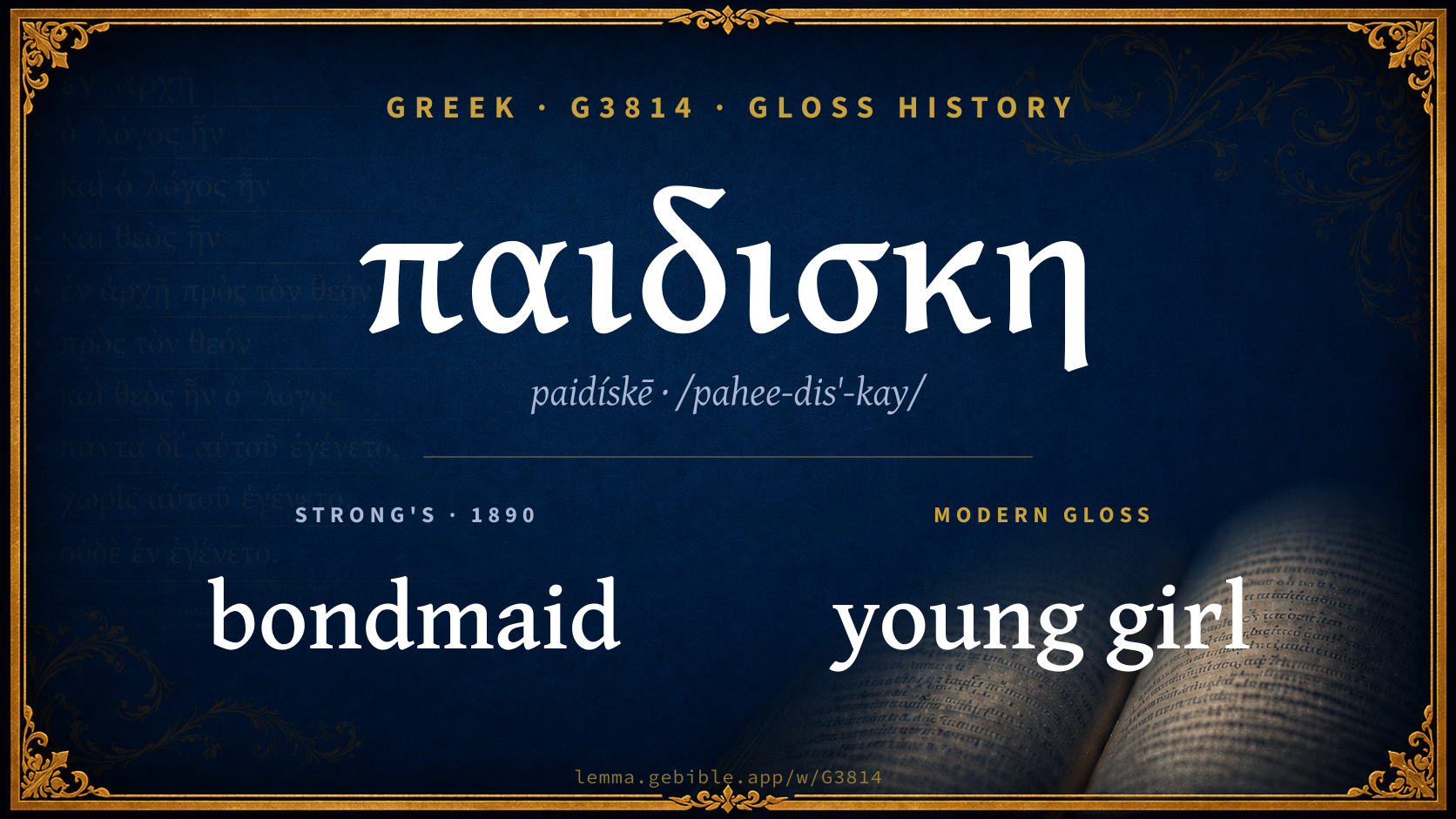
Gloss history
Strong's 1890 vs modern scholarship
About this word
Strong's G3814 catalogs a Greek word from the Greek New Testament.
These counts are not copied from any lexicon or concordance. They are computed here, from the morphology-tagged Greek New Testament. What Lemma adds →
- 12
- distinct verses
- The word appears in 12 distinct verses.
- 6 / 27
- NT books
- The word appears in 6 of 27 New Testament books.
- #863
- by frequency
- Top 1000 most frequent Greek words (rank 863 of 5,347 Greek words by occurrence).
View all 12 occurrences in the concordance →
By section of the New Testament
By traditional corpus
Conventional, traditional groupings — biblical authorship is debated, so this is a traditional corpus grouping, not an authorship claim. Some books belong to more than one corpus (Luke is in both the Gospels and the Lukan corpus, and so on), so these shares overlap and need not total 100%. Each figure is a share of the word’s 12 distinct verses.
- Gospels 6 verses · 50%
- Lukan (Luke–Acts) 4 verses · 33%
- Pauline corpus 4 verses · 33%
- Johannine 1 verse · 8%
How translations render this word
Counts come from each version’s own published word-to-Strong’s tagging or interlinear alignment — an approximate guide to how each version renders this word, not a word-level alignment the data otherwise carries. Because each total is that version’s own tagged count, the per-version totals vary from one another and need not match the appearance or distinct-verse counts above. These counts may also differ from a printed concordance because Lemma counts each distinctly tagged rendering and does not collapse phrase taggings into a single head-word total. This is a fixed set of word-tagged versions (KJV, ASV, BSB, ULT) and does not change with the reading translation you choose elsewhere. Each version’s license is shown beside its name below (and on Sources).
- King James Version: Bondwoman 4×, Damsel 4×, Maid 2×
- American Standard Version: Maid 6×, Handmaid 4×
- Berean Standard Bible: Servant girl 5×, Slave woman 4×
- unfoldingWord Literal Text: Slave girl 5×, Servant girl 4×, A 2×
King James Version Public Domain
Renders G3814 across 13 tagged occurrences — most commonly:
Plus 3 renderings that appear only once — usually multi-word phrases or single function words the recovered tagging swept in, not distinct renderings.
American Standard Version Public Domain
Renders G3814 across 12 tagged occurrences — most commonly:
Plus 2 renderings that appear only once — usually multi-word phrases or single function words the recovered tagging swept in, not distinct renderings.
Berean Standard Bible Public Domain
Renders G3814 across 13 tagged occurrences — most commonly:
Plus 4 renderings that appear only once — usually multi-word phrases or single function words the recovered tagging swept in, not distinct renderings.
unfoldingWord Literal Text CC BY-SA 4.0
Renders G3814 across 15 tagged occurrences — most commonly:
Plus 4 renderings that appear only once — usually multi-word phrases or single function words the recovered tagging swept in, not distinct renderings.
Senses in Thayer's
The 2 senses Thayer's distinguishes for this word, in lexicon order (not ranked by frequency or importance). The full entry — with sub-senses — is in the Lexicon Entry tab.
- a young girl, damsel
- a maid-servant, a young female slave
Word origin
Derived from παις (paîs) (G3816) — child.
Feminine diminutive of G3816 ; a girl that is (specifically) a female slave or servant : - bondmaid (-woman) damsel maid (-en).
— Strong’s Exhaustive Concordance (1890), public domain.
Forms in the corpus
The 5 distinct written forms G3814 takes in the Greek New Testament, most frequent first — each parse links to that case’s occurrences in the concordance.
| Form | Parsing | Example | Uses |
|---|---|---|---|
| παιδίσκη paidískē | Noun, Nominative, Singular, Feminine | Matthew 26:69 | 5 |
| παιδίσκης paidískēs | Noun, Genitive, Singular, Feminine | Galatians 4:22 | 4 |
| παιδίσκην paidískēn | Noun, Accusative, Singular, Feminine | Acts 16:16 | 2 |
| παιδίσκας paidískas | Noun, Accusative, Plural, Feminine | Luke 12:45 | 1 |
| παιδισκῶν paidiskō̂n | Noun, Genitive, Plural, Feminine | Mark 14:66 | 1 |
Same root — word family
Other Thayer's entries built from the same root as G3814, grouped by Strong’s listed origin. These share a root / origin per the lexicon — not necessarily a shared meaning. Each links to that word’s own entry.
Derives from
Shares the same root
- παιδαγωγος paidagōgós G3807 tutor
- παιδαριον paidárion G3808 boy
- παιδευω paideúō G3811 to discipline
- παιδιον paidíon G3813 small child
- παιζω paízō G3815 to play
Compare all same-root words → Showing 4 of 7 — not the complete family. They share a root, not necessarily a meaning.
Septuagint usage
The same Greek word παιδισκη appears 69 times in the Greek Old Testament (Septuagint), across 64 verses in 14 books.
- 69
- LXX occurrences
- Tagged occurrences of this Greek word in the Septuagint.
- 64
- verses
- Distinct Septuagint verses containing this word.
- 14 / 39
- OT books
- The word appears in 14 of the 39 Old Testament books.
Sample Septuagint occurrences
- Genesis 12:16 παιδίσκη
- Exodus 20:10 παιδίσκη
- Leviticus 25:6 παιδίσκη
- Deuteronomy 5:14 παιδίσκη
- Judges 9:18 παιδίσκη
- Ruth 4:12 παιδίσκη
- 1 Samuel 25:41 παιδίσκη
- 2 Samuel 17:17 παιδίσκη
- 2 Kings 5:26 παιδίσκη
- Esther 7:4 παιδίσκη
- Psalms 85:16 παιδίσκη
- Ecclesiastes 2:7 παιδίσκη
Septuagint occurrences (same lexeme)
Every verse where the same Strong’s number (G3814) appears in the Greek Septuagint — showing the first 50 of 64. Verse text shown in the World English Bible for context; the Greek form is the matched word — the English is not keyword-highlighted.
- Genesis 12:16 παιδίσκη He dealt well with Abram for her sake. He had sheep, and oxen, and male donkeys, and men-servants, and maid-servants, and female donkeys, and camels.
- Genesis 16:1 παιδίσκη Now Sarai, Abram's wife, bore him no children. She had a handmaid, an Egyptian, whose name was Hagar.
- Genesis 16:2 παιδίσκη Sarai said to Abram," See now, Yahweh has restrained me from bearing. Please go in to my handmaid. It may be that I will obtain children by her." Abram listened to the voice of Sarai.
- Genesis 16:3 παιδίσκη Sarai, Abram's wife, took Hagar the Egyptian, her handmaid, after Abram had lived ten years in the land of Canaan, and gave her to Abram her husband to be his wife.
- Genesis 16:5 παιδίσκη Sarai said to Abram, "This wrong is your fault. I gave my handmaid into your bosom, and when she saw that she had conceived, I was despised in her eyes. Yahweh judge between me and you."
- Genesis 16:6 παιδίσκη But Abram said to Sarai, "Behold, your maid is in your hand. Do to her whatever is good in your eyes." Sarai dealt harshly with her, and she fled from her face.
- Genesis 16:8 παιδίσκη He said, "Hagar, Sarai's handmaid, where did you come from? Where are you going?" She said, "I am fleeing from the face of my mistress Sarai."
- Genesis 20:14 παιδίσκη Abimelech took sheep and oxen, men-servants and women-servants, and gave them to Abraham, and restored Sarah, his wife to him.
- Genesis 20:17 παιδίσκη Abraham prayed to God. God healed Abimelech, and his wife, and his maid-servants, and they bore children.
- Genesis 21:10 παιδίσκη Therefore she said to Abraham, "Cast out this handmaid and her son! For the son of this handmaid will not be heir with my son, even with Isaac."
- Genesis 21:12 παιδίσκη God said to Abraham, "Don't let it be grievous in your sight because of the boy, and because of your handmaid. In all that Sarah says to you, listen to her voice. For from Isaac will your seed be called.
- Genesis 21:13 παιδίσκη Also of the son of the handmaid will I make a nation, because he is your seed."
- Genesis 24:35 παιδίσκη Yahweh has blessed my master greatly. He has become great. He has given him flocks and herds, silver and gold, men-servants and maid-servants, and camels and donkeys.
- Genesis 25:12 παιδίσκη Now this is the history of the generations of Ishmael, Abraham's son, whom Hagar the Egyptian, Sarah's handmaid, bore to Abraham.
- Genesis 29:24 παιδίσκη Laban gave Zilpah his handmaid to his daughter Leah for a handmaid.
- Genesis 29:29 παιδίσκη Laban gave to Rachel his daughter Bilhah, his handmaid, to be her handmaid.
- Genesis 30:3 παιδίσκη She said, "Behold, my maid Bilhah. Go in to her, that she may bear on my knees, and I also may obtain children by her."
- Genesis 30:4 παιδίσκη She gave him Bilhah her handmaid as wife, and Jacob went in to her.
- Genesis 30:5 παιδίσκη Bilhah conceived, and bore Jacob a son.
- Genesis 30:7 παιδίσκη Bilhah, Rachel's handmaid, conceived again, and bore Jacob a second son.
- Genesis 30:9 παιδίσκη When Leah saw that she had finished bearing, she took Zilpah, her handmaid, and gave her to Jacob as a wife.
- Genesis 30:10 παιδίσκη Zilpah, Leah's handmaid, bore Jacob a son.
- Genesis 30:12 παιδίσκη Zilpah, Leah's handmaid, bore Jacob a second son.
- Genesis 30:18 παιδίσκη Leah said, "God has given me my hire, because I gave my handmaid to my husband." She named him Issachar.
- Genesis 30:43 παιδίσκη The man increased exceedingly, and had large flocks, maid-servants and men-servants, and camels and donkeys.
- Genesis 32:6 παιδίσκη The messengers returned to Jacob, saying, "We came to your brother Esau. Not only that, but he comes to meet you, and four hundred men with him."
- Genesis 32:23 παιδίσκη He took them, and sent them over the stream, and sent over that which he had.
- Genesis 33:1 παιδίσκη Jacob lifted up his eyes, and looked, and, behold, Esau was coming, and with him four hundred men. He divided the children between Leah, Rachel, and to the two handmaids.
- Genesis 33:2 παιδίσκη He put the handmaids and their children in front, Leah and her children after, and Rachel and Joseph at the rear.
- Genesis 33:6 παιδίσκη Then the handmaids came near with their children, and they bowed themselves.
- Genesis 34:4 παιδίσκη Shechem spoke to his father, Hamor, saying, "Get me this young lady as a wife."
- Genesis 35:25 παιδίσκη The sons of Bilhah (Rachel's handmaid): Dan and Naphtali.
- Genesis 35:26 παιδίσκη The sons of Zilpah (Leah's handmaid): Gad and Asher. These are the sons of Jacob, who were born to him in Paddan Aram.
- Exodus 20:10 παιδίσκη but the seventh day is a Sabbath to Yahweh your God. You shall not do any work in it, you, nor your son, nor your daughter, your man-servant, nor your maid-servant, nor your cattle, nor your stranger who is within your gates;
- Exodus 20:17 παιδίσκη "You shall not covet your neighbor's house. You shall not covet your neighbor's wife, nor his man-servant, nor his maid-servant, nor his ox, nor his donkey, nor anything that is your neighbor's."
- Exodus 21:20 παιδίσκη "If a man strikes his servant or his maid with a rod, and he dies under his hand, he shall surely be punished.
- Exodus 21:32 παιδίσκη If the bull gores a man-servant or a maid-servant, thirty shekels of silver shall be given to their master, and the ox shall be stoned.
- Exodus 23:12 παιδίσκη "Six days you shall do your work, and on the seventh day you shall rest, that your ox and your donkey may have rest, and the son of your handmaid, and the alien may be refreshed.
- Leviticus 25:6 παιδίσκη The Sabbath of the land shall be for food for you; for yourself, for your servant, for your maid, for your hired servant, and for your stranger, who lives as a foreigner with you.
- Leviticus 25:44 παιδίσκη "'As for your male and your female slaves, whom you may have; of the nations that are around you, from them you may buy male and female slaves.
- Deuteronomy 5:14 παιδίσκη but the seventh day is a Sabbath to Yahweh your God: [in it] you shall not do any work, you, nor your son, nor your daughter, nor your man-servant, nor your maid-servant, nor your ox, nor your donkey, nor any of your cattle, nor your stranger who is within your gates; that your man-servant and your maid-servant may rest as well as you.
- Deuteronomy 5:21 παιδίσκη "Neither shall you covet your neighbor's wife; neither shall you desire your neighbor's house, his field, or his man-servant, or his maid-servant, his ox, or his donkey, or anything that is your neighbor's."
- Deuteronomy 12:12 παιδίσκη You shall rejoice before Yahweh your God, you, and your sons, and your daughters, and your men-servants, and your maid-servants, and the Levite who is within your gates, because he has no portion nor inheritance with you.
- Deuteronomy 12:18 παιδίσκη but you shall eat them before Yahweh your God in the place which Yahweh your God shall choose, you, and your son, and your daughter, and your man-servant, and your maid-servant, and the Levite who is within your gates: and you shall rejoice before Yahweh your God in all that you put your hand to.
- Deuteronomy 15:17 παιδίσκη then you shall take an awl, and thrust it through his ear to the door, and he shall be your servant forever. Also to your maid-servant you shall do likewise.
- Deuteronomy 16:11 παιδίσκη and you shall rejoice before Yahweh your God, you, and your son, and your daughter, and your man-servant, and your maid-servant, and the Levite who is within your gates, and the foreigner, and the fatherless, and the widow, who are in the midst of you, in the place which Yahweh your God shall choose, to cause his name to dwell there.
- Deuteronomy 16:14 παιδίσκη and you shall rejoice in your feast, you, and your son, and your daughter, and your man-servant, and your maid-servant, and the Levite, and the foreigner, and the fatherless, and the widow, who are within your gates.
- Deuteronomy 28:68 παιδίσκη Yahweh will bring you into Egypt again with ships, by the way of which I said to you, You shall see it no more again: and there you shall sell yourselves to your enemies for bondservants and for bondmaids, and no man shall buy you.
- Judges 9:18 παιδίσκη and you are risen up against my father's house this day, and have slain his sons, seventy persons, on one stone, and have made Abimelech, the son of his maid-servant, king over the men of Shechem, because he is your brother);
- Judges 19:19 παιδίσκη Yet there is both straw and provender for our donkeys; and there is bread and wine also for me, and for your handmaid, and for the young man who is with your servants: there is no want of anything.
These are occurrences of the same Greek lexeme (G3814) in the Septuagint — not a translation of any one Hebrew word. The store carries no word-level Hebrew↔Greek alignment, so no Hebrew original is asserted here. Counts come from the recovered LXX Strong's tagging — high-frequency vocabulary is well covered, while rare or late forms may be untagged — so they reflect tagged occurrences and may slightly undercount.