Galatians 4:22

Greek (Tischendorf 8th ed.) Galatians 4:22 appears in the Greek New Testament. The text above is from the Tischendorf 8th edition. Each word links to its Strong’s number and a concise gloss. Click any word for its full Thayer’s Greek Lexicon entry.
Download image
Cite this verse

Galatians 4:22 (World English Bible). Public Domain. Lemma interlinear Bible study tool, https://lemma.gebible.app/v/galatians/4/22.

Show BibTeX & RIS
BibTeX
RIS
English Translation
For it is written that Abraham had two sons, one by the handmaid, and one by the free woman.
World English Bible · Public Domain
Download a study sheet

One document with this verse’s original text, its word-by-word gloss line, the meaning frame, cross-references with their text, attributed commentary, and full source and license credits — printable, and it pastes into notes with its structure intact.

This verse Autodidact and up

Study sheet (.html) Plain text (.txt)

A passage Seminary Student

Up to 50 verses in one chapter. A passage sheet keeps up to 6 commentary sources and 12 cross-references per verse, in the order this page ranks them, and says so on the sheet whenever that leaves anything out. Ask for a single verse and you get the Autodidact verse sheet above.

Everything on this page stays free to read, with no account — the sheet is a download of what is already on screen, not access to it.

Want to remove ads? Support Godless Engineer
Compare translations 3

The same verse in 3 English versions, stacked beneath the original-language interlinear above. Click any original word for its lexicon entry.

Each is an independent rendering of the whole verse — the interlinear is not word-aligned to these translations.

Highlighted words mark where these versions differ — a whole-verse word diff, not a word-by-word alignment.

  • World English Bible Public Domain
    For it is written that Abraham had two sons, one by the handmaid, and one by the free woman.
  • King James Version Public Domain
    For it is written, that Abraham had two sons, the one by a bondmaid, the other by a freewoman.
  • unfoldingWord Literal Text CC BY-SA 4.0
    For it is written that Abraham had two sons, one by the slave girl and one by the free woman.

unfoldingWord Literal Text — © unfoldingWord, licensed CC BY-SA 4.0. Word-aligned USFM3 via Door43 (git.door43.org/unfoldingWord/en_ult).

Versions to compare (up to 4)

3 of 4 selected

Show all 19 translations

Every available English version of this verse, each an independent rendering of the whole verse.

  • World English Bible Public Domain
    For it is written that Abraham had two sons, one by the handmaid, and one by the free woman.
  • Berean Standard Bible Public Domain
    For it is written that Abraham had two sons, one by the slave woman and the other by the free woman.
  • Majority Standard Bible Public Domain
    For it is written that Abraham had two sons, one by the slave woman and the other by the free woman.
  • King James Version Public Domain
    For it is written, that Abraham had two sons, the one by a bondmaid, the other by a freewoman.
  • American Standard Version (1901) Public Domain
    For it is written, that Abraham had two sons, one by the handmaid, and one by the freewoman.
  • Revised Version (1885) Public Domain
    For it is written, that Abraham had two sons, one by the handmaid, and one by the freewoman.
  • Geneva Bible (1599) Public Domain
    For it is written, that Abraham had two sonnes, one by a seruant, and one by a free woman.
  • Douay-Rheims (1899) Public Domain
    For it is written that Abraham had two sons: the one by a bondwoman, and the other by a free woman.
  • Young's Literal Translation Public Domain
    for it hath been written, that Abraham had two sons, one by the maid-servant, and one by the free-woman,
  • Literal Standard Version CC BY-SA 4.0
    For it has been written that Abraham had two sons, one by the maidservant and one by the free [woman],
  • Unlocked Literal Bible CC BY-SA 4.0
    For it is written that Abraham had two sons, one by the slave girl and one by the free woman.
  • unfoldingWord Literal Text CC BY-SA 4.0
    For it is written that Abraham had two sons, one by the slave girl and one by the free woman.
  • Darby Bible Public Domain
    For it is written that Abraham had two sons; one of the maid servant, and one of the free woman.
  • World Messianic Bible Public Domain
    For it is written that Abraham had two sons, one by the servant, and one by the free woman.
  • Webster's Bible Public Domain
    For it is written, that Abraham had two sons; the one by a bond-maid, the other by a free-woman.
  • Free Bible Version CC BY-SA 4.0
    As Scripture says, Abraham had two sons, one from the servant girl, and one from the free woman.
  • Bible in Basic English Public Domain
    Because it is in the Writings, that Abraham had two sons, one by the servant-woman, and one by the free woman.
  • Text-Critical English NT CC BY 4.0
    For it is written that Abraham had two sons, one by the slave woman and one by the free woman.
  • Tyndale New Testament (1534) Public Domain
    For it is written that Abraham had two sonnes the one by a bonde mayde the other by a fre woman.

Literal Standard Version (2020), Covenant Press — licensed CC BY-SA 4.0. Text via the HelloAO Bible API (eBible.org). Unlocked Literal Bible (unfoldingWord) — licensed CC BY-SA 4.0. Text via the HelloAO Bible API (eBible.org). unfoldingWord Literal Text — © unfoldingWord, licensed CC BY-SA 4.0. Word-aligned USFM3 via Door43 (git.door43.org/unfoldingWord/en_ult). Free Bible Version, Dr. Jonathan Gallagher — licensed CC BY-SA 4.0. Text via the HelloAO Bible API (eBible.org).

Word by word

More ways to search: Search by grammar → Find every occurrence → Compare this word →

Practice this passage: Drill this verse → Learn its vocabulary →

παιδίσκης
paidískē
G3814
“young girl”
Noun, Genitive, Singular, Feminine
Part of Speech
Noun
Case
Genitive
Number
Singular
Gender
Feminine
Full Thayer's Definition

Origin: from diminutive of G3816

TDNT: None

1. a young girl, damsel 2. a maid-servant, a young female slave a. a maid servant who has charge of the door
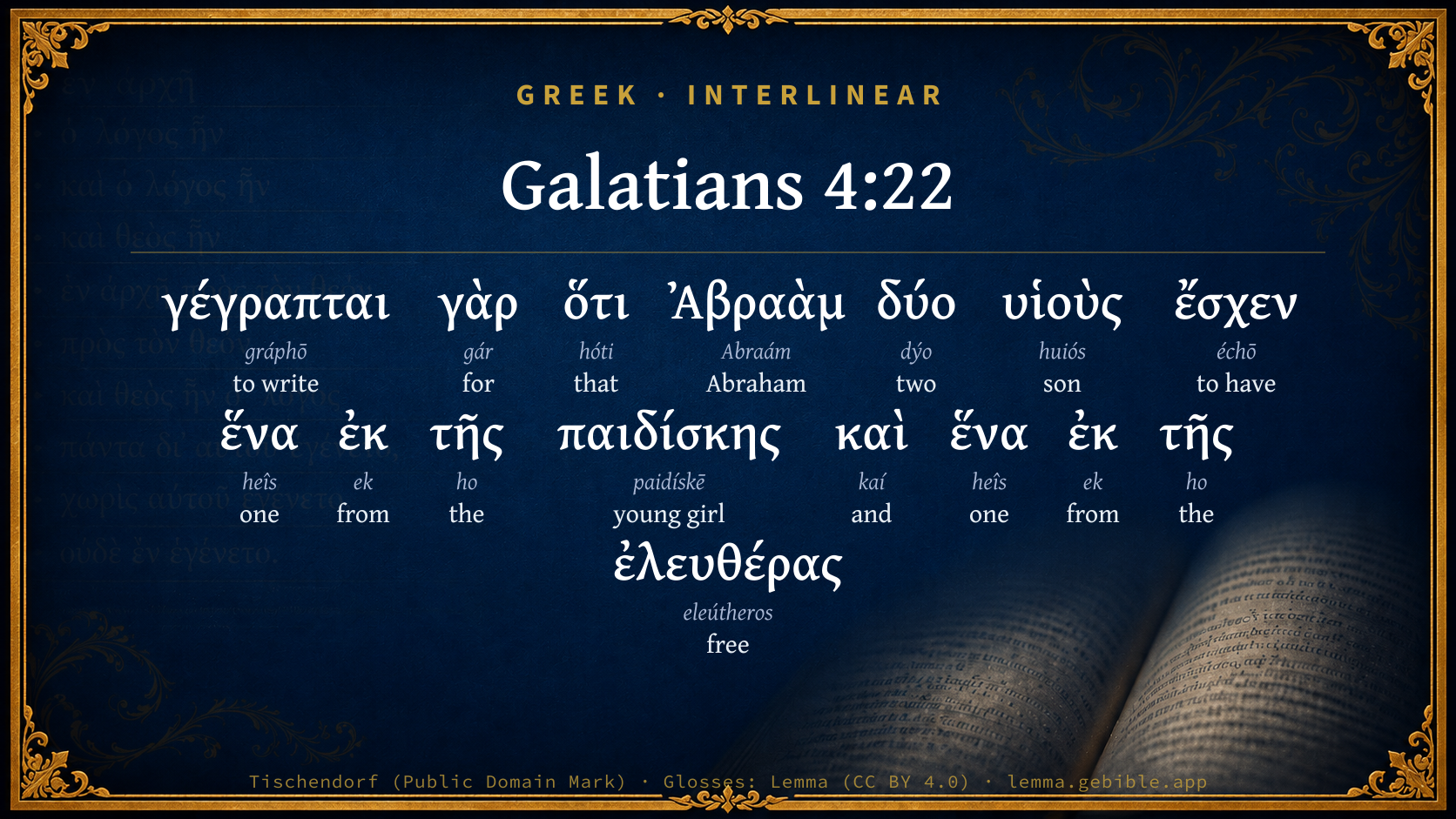
  1. γέγραπται gráphō G1125 “to write” Verb, Perfect, Passive, Indicative, 3rd person, Singular
  2. γὰρ gár G1063 “for” Conjunction
  3. ὅτι hóti G3754 “that” Conjunction
  4. Ἀβραὰμ Abraám G11 “Abraham” Noun, Proper, indeclinable
  5. δύο dýo G1417 “two” Adjective, Numeral (indeclinable)
  6. υἱοὺς huiós G5207 “son” Noun, Accusative, Plural, Masculine
  7. ἔσχεν échō G2192 “to have” Verb, Aorist, Active, Indicative, 3rd person, Singular
  8. ἕνα heîs G1520 “one” Adjective, Accusative, Singular, Masculine
  9. ἐκ ek G1537 “from” Preposition
  10. τῆς ho G3588 “the” Article, Genitive, Singular, Feminine
  11. καὶ kaí G2532 “and” Conjunction
  12. ἕνα heîs G1520 “one” Adjective, Accusative, Singular, Masculine
  13. ἐκ ek G1537 “from” Preposition
  14. τῆς ho G3588 “the” Article, Genitive, Singular, Feminine
  15. ἐλευθέρας eleútheros G1658 “free” Adjective, Genitive, Singular, Feminine

About this verse

These counts appear in no published source. They are computed here, from the morphology-tagged text and Lemma’s own curated glosses. What Lemma adds →

16
words
13
distinct lemmas
Pauline Epistles
section

Notable vocabulary

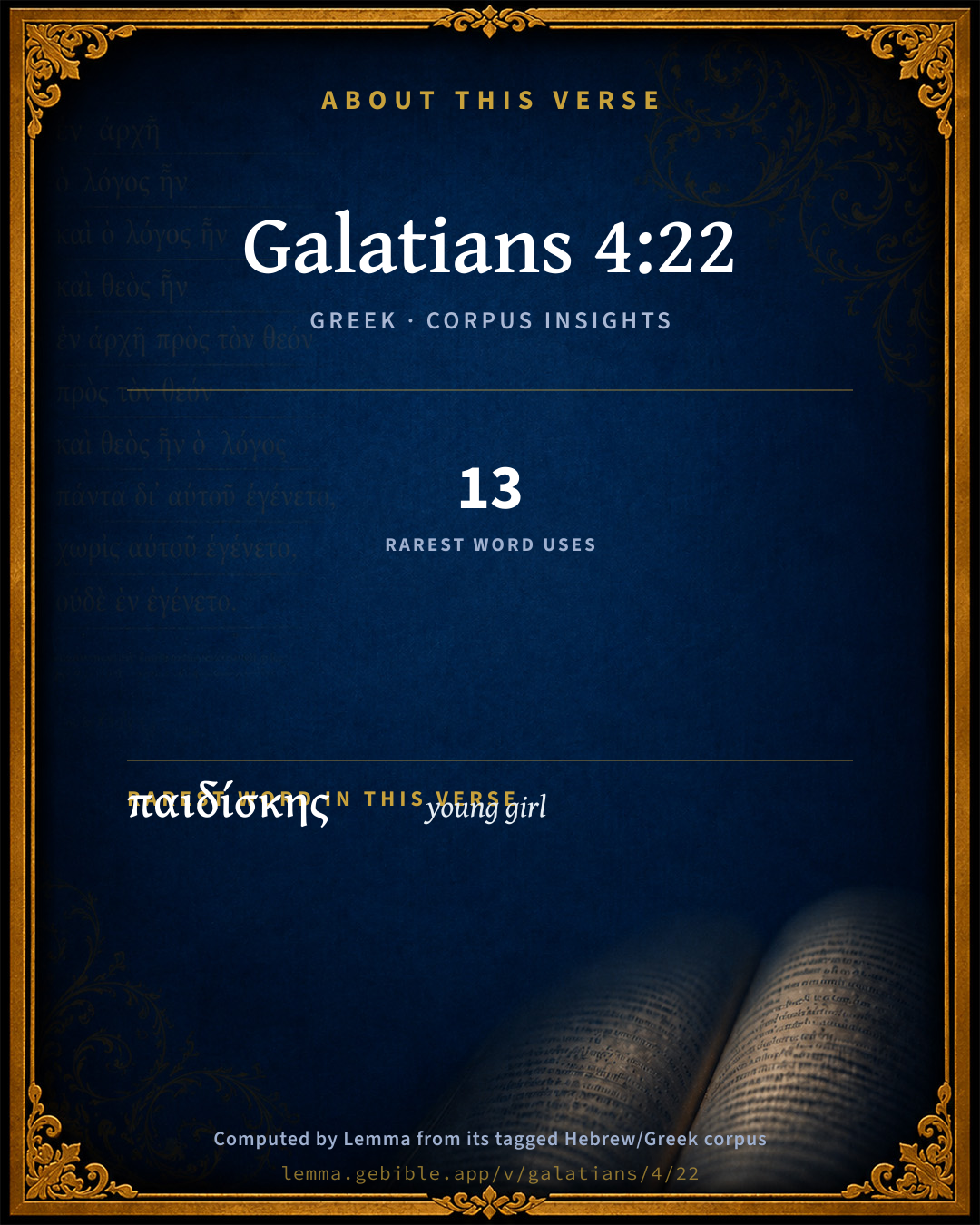
The rarest word here is παιδίσκης young girl G3814 — appearing just 13 times in the whole Greek New Testament.

Shared distinctive vocabulary

παιδίσκης young girl G3814 occurs in 12 verses of the Greek New Testament. Also found in:

Repetition

Words recur within this verse:

Cross-references

4

Topical passages linked to Galatians 4:22 in the Treasury of Scripture Knowledge — connected by theme and wording, ordered by reader-vote popularity; previews shown in the World English Bible.

  • Genesis 16:15 Hagar bore a son for Abram. Abram called the name of his son, whom Hagar bore, Ishmael.
  • Genesis 21:10 Therefore she said to Abraham, "Cast out this handmaid and her son! For the son of this handmaid will not be heir with my son, even with Isaac."
  • Genesis 16:2–4 Sarai said to Abram," See now, Yahweh has restrained me from bearing. Please go in to my handmaid. It may be that I will obtain children by her." Abram listened to the voice of Sarai.
  • Genesis 21:1–2 Yahweh visited Sarah as he had said, and Yahweh did to Sarah as he had spoken.

Cross-references courtesy of OpenBible.info (CC BY 4.0).

Commentary

Notes on Galatians 4:22 from classic Christian and Jewish commentators (each source and its license shown beneath its notes). The classic Christian expositions comment on the surrounding passage and are grouped to its opening verse, so a note may address several verses; the Jewish commentaries on the Tanakh (Rashi and others) are per-verse, so they appear only where the commentator wrote on this verse.

Lemma curates 59 commentaries, every one of them public domain or Creative Commons licensed, each selected and text-cleaned for this edition rather than reprinted as found. About our sources →

The Biblical Illustrator

Joseph S. Exell

Gal_4:22-23

That Abraham had two sons, the one by a bondmaid, the other by a free woman.

St. Pauls outlook and vision

The principle from which he views the Old Testament history may be compared to those lines of light which, on a misty day, open up glimpses among the mountains, in which that which is definitely seen is as nothing to the crowded and mysterious shapes suggested to the imagination. First his mind turns to the tents of the patriarchs, to that simple and pathetic tale--Sarah and Hagar--Isaac and Ishmael. Concentrated in them he sees the spirit of the two covenants. First the Egyptian slave, which gendereth unto bondage, which is Mount Sinai. But this covenant reminds him of Jerusalem which now is in miserable bondage. But then, high above all, the apostles spirit rises to another Jerusalem, where the fetters fall from the soul of every slave that sets foot upon that soil. Jerusalem which is above is free. (Bishop Alexander.)

Points of parallelism

Jewish Church.

The bondwoman, Hagar.

Son of the bondwoman, Ishmael.

Natural birth (the flesh).

Mount Sinai.

The Law.

The earthly Jerusalem.

Enslaved.

Fruitful.

Small offspring.

Persecuting.

Expulsion.

The Jewish Church is enslaved.

Christian Church.

The freewoman, Sarah.

Son of the freewoman, Isaac.

Supernatural birth (the promise).

Mount Zion.

The Promise.

The heavenly Jerusalem.

Free.

Barren.

Large offspring.

Persecuted.

Inheritance.

The Christian Church is free.

(W. Sanday, D. D.)

Bond and free

Look at the two covenants as represented by Hagar and Sarah.

I. Their points of connection.

1. They have the same origin. Those who are outside the covenant of promise are still children of the Heavenly Father.

2. They have to a great extent the same elements. Promise on Gods part and conditions on mans. Ishmael got promises, and Isaac was subjected to conditions. Sinai had its promises; the gospel has its conditions.

3. For a time they largely influence each other. Ishmael and Isaac live together. The law was permeated by the gospel; the gospel by the law.

II. The points of difference.

1. The degrees of prominence in those elements which they possess in common. The covenant becomes under the new dispensation also a testament with large bequests.

2. In the absence or presence of one great vital element--grace, forgiveness.

3. In their effects on mens natures. The law, like Hagar, bringeth forth children of bondage; the gospel, like Sarah, children of freedom. (Clerical World, 3, 441.)

The Biblical Illustrator, edited by Joseph S. Exell (c. 1880s–1900s) — public domain. Text from a community e-Sword module.

Tyndale Open Study Notes

Tyndale Open Resources

4:22-23 The son of the slave wife was Ishmael, born to Sarah’s servant Hagar (see Gen 16:15). Sarah gave Hagar to Abraham in a human attempt to obtain the heir (see Gen 16:1-4) that God had promised (see Gen 15:1-6). Sarah’s son, Isaac, was the son of the freeborn wife (see Gen 21:2-3); he was miraculously conceived as God’s own fulfillment of his promise (see Gen 17:15-21).

Tyndale Open Study Notes — © Tyndale Open Resources, licensed CC BY-SA 4.0. Text via the HelloAO Bible API.

Bengel's Gnomon

Johann Albrecht Bengel

Gal 4:22. Γέγραπται, it is written) Genesis 21—Ἀβραὰμ, Abraham) whose sons you wish to be.

Bengel's Gnomon of the New Testament — English translation (T&T Clark, Edinburgh, 1860) — public domain. Text from a community e-Sword module.

Meyer's Critical & Exegetical Commentary

Heinrich August Wilhelm Meyer

Gal_4:22. Γάρ] now gives the explanation of and warrant for that question, by citing the history, narrated in the law, of Ishmael and Isaac, the two sons of the ancestor of the theocratic people. See Gen_16:15 f., Gen_21:2 f.

ἐκ τῆς παιδίσκης] by the (well-known) bondswoman, Hagar. See Gen_16:3. As to the word itself (which might also denote a free maiden), see Wetstein, I. p. 526 f.; Lobeck, ad Phryn. p. 259 f.

ἐκ τῆς ἐλευθ.] Sarah.

Meyer — Critical and Exegetical Commentary on the New Testament — English translation by Peter Christie, edited by Frederick Crombie (T&T Clark, 1880) — public domain. Text from a community e-Sword module.

Expositor's Greek Testament

ed. W. Robertson Nicoll

Gal 4:22 . γέγραπται ὅτι . The statement which follows is not a quotation, but a summary of recorded facts.

Hagar and Sarah are entitled the handmaid and the freewoman because they are accepted types of each class in Scripture. In the LXX παιδίσκη denotes any young woman ( e.g. , Ruth) as it does in Attic Greek, but in the N.T. παιδίσκη , a handmaid , corresponds to παῖς , a male servant.

The Expositor's Greek Testament, edited by W. Robertson Nicoll (1897–1910) — public domain. Text from a community e-Sword module.

Jamieson, Fausset & Brown

Robert Jamieson, A. R. Fausset & David Brown

(Gen 16:3-16; Gen 21:2).

Abraham--whose sons ye wish to be (compare Rom 9:7-9).

a bond maid . . . a free woman--rather, as Greek, "the bond maid . . . the free woman."

Jamieson, Fausset & Brown — Commentary Critical and Explanatory on the Whole Bible (1871) — public domain (CC PDM 1.0). Text via the HelloAO Bible API.

Adam Clarke's Commentary

Verse 22. For it is written] Viz. in Ge 16:15; Ge 22:1, c., that Abraham had two sons, Ishmael and Isaac the one; Ishmael, by a bond maid, Hagar; the other, Isaac, by a free woman, Sarah.

Adam Clarke's Commentary on the Bible (1810–1826) — public domain. Text from a community e-Sword/MySword module.

John Calvin's Commentaries

22. For it is written. No man who has a choice given him will be so mad as to despise freedom, and prefer slavery. But here the apostle teaches us, that they who are under the law are slaves. Unhappy men! who willingly choose this condition, when God desires to make them free. He gives a representation of this in the two sons of Abraham, one of whom, the son of a slave, held by his mother’s condition; while the other, the son of a free woman, obtained the inheritance. He afterwards applies the whole history to his purpose, and illustrates it in an elegant manner.

In the first place, as the other party armed themselves with the authority of the law, the apostle quotes the law on the other side. The law was the name usually given to the Five Books of Moses. Again, as the history which he quotes appeared to have no bearing on the question, he gives to it an allegorical interpretation. But as the apostle declares that these things are allegorized, (ἀλληγορούμενα,) Origen, and many others along with him, have seized the occasion of torturing Scripture, in every possible manner, away from the true sense. They concluded that the literal sense is too mean and poor, and that, under the outer bark of the letter, there lurk deeper mysteries, which cannot be extracted but by beating out allegories. And this they had no difficulty in accomplishing; for speculations which appear to be ingenious have always been preferred, and always will be preferred, by the world to solid doctrine.

With such approbation the licentious system gradually attained such a height, that he who handled Scripture for his own amusement not only was suffered to pass unpunished, but even obtained the highest applause. For many centuries no man was considered to be ingenious, who had not the skill and daring necessary for changing into a variety of curious shapes the sacred word of God. This was undoubtedly a contrivance of Satan to undermine the authority of Scripture, and to take away from the reading of it the true advantage. God visited this profanation by a just judgment, when he suffered the pure meaning of the Scripture to be buried under false interpretations.

Scripture, they say, is fertile, and thus produces a variety of meanings. I acknowledge that Scripture is a most rich and inexhaustible fountain of all wisdom; but I deny that its fertility consists in the various meanings which any man, at his pleasure, may assign. Let us know, then, that the true meaning of Scripture is the natural and obvious meaning; and let us embrace and abide by it resolutely. Let us not only neglect as doubtful, but boldly set aside as deadly corruptions, those pretended expositions, which lead us away from the natural meaning.

But what reply shall we make to Paul’s assertion, that these things are allegorical? Paul certainly does not mean that Moses wrote the history for the purpose of being turned into an allegory, but points out in what way the history may be made to answer the present subject. This is done by observing a figurative representation of the Church there delineated. And a mystical interpretation of this sort (ἀναγωγή) was not inconsistent with the true and literal meaning, when a comparison was drawn between the Church and the family of Abraham. As the house of Abraham was then a true Church, so it is beyond all doubt that the principal and most memorable events which happened in it are so many types to us. As in circumcision, in sacrifices, in the whole Levitical priesthood, there was an allegory, as there is an allegory at the present day in our sacraments, — so was there likewise in the house of Abraham; but this does not involve a departure from the literal meaning. In a word, Paul adduces the history, as containing a figurative representation of the two covenants in the two wives of Abraham, and of the two nations in his two sons. And Chrysostom, indeed, acknowledges that the word allegory points out the present application to be (κατάχρησις) different from the natural meaning; which is perfectly true.

John Calvin's Commentaries (1540-1563) — public domain. Text from the Calvin Translation Society English edition (1840s-50s) via the Christian Classics Ethereal Library (ccel.org). Calvin's coverage is partial (roughly two-thirds of the Bible); uncommented books and verses are honest gaps, never fabricated. The 19th-century editor's footnotes and remarks are omitted so the notes are faithfully Calvin's own voice.

Ellicott's Commentary for English Readers

(22) For.—This particle would naturally not be expressed in English. It was a reason for the question which had been asked just before: “For the Law does supply a case in point.”

The one by a bondmaid.—Hagar, it seems from Gen_16:1, was an Egyptian. The word for “bondmaid” was not confined to this sense in earlier Greek, but was used for any young girl.

A Bible Commentary for English Readers, edited by Charles John Ellicott (1878–1897) — public domain. Text from a community e-Sword module.

The Cambridge Bible for Schools and Colleges

gen. ed. J. J. S. Perowne

22. it is written] This is not a quotation of any particular passage. ‘It is recorded in Scripture’.

a bondmaid] Lit. ‘the bondmaid’, Hagar; so ‘the free woman’, Sarah. Hagar was an Egyptian slave in the house of Abraham. God having promised to Abraham that in his seed all nations should be blessed, Sarah, becoming impatient because the fulfilment of the promise was delayed, gave Hagar as a concubine to her husband. This resulted in the birth of Ishmael (Gen_16:1-3; Gen_16:15.) Thirteen years later the Lord promised that Abraham should have a son by Sarah when she was past the age of child-bearing. This was fulfilled in the birth of Isaac.

The marked features of contrast in this narrative, which have their counterparts in the antitype are:

The bond maid and her son.

The free woman and her son.

Birth in the ordinary course of nature (‘after the flesh’).

Birth out of the course of nature, ‘through the promise’.

Ishmael, born a slave.

Isaac, born free.

Hagar and her son driven forth into the desert.

Sarah and her son abiding in the home.

To these correspond

The Old Covenant (or dispensation) given on Mt Sinai.

The New Covenant, the Gospel.

The earthly Jerusalem.

The Heavenly Jerusalem.

Natural birth into bondage.

Spiritual birth to freedom.

Persecuting.

Persecuted.

Expulsion.

Inheritance.

The Cambridge Bible for Schools and Colleges (gen. ed. J. J. S. Perowne; Cambridge University Press, 1878–1918) — public domain. Text from a community e-Sword module.

John Gill's Exposition

But he who was of the bondwoman,.... Ishmael, who was begotten and born of Hagar,

was born after the flesh; after the common order and course of nature, through the copulation of two persons, the one able to procreate, and the other fit for the conception of children; and was typical of the Jews, the natural descendants of Abraham, who, as such, and upon that account, were not the children of God, nor heirs of the eternal inheritance:

but he of the free woman was by promise; by a previous promise made by God to Abraham, that he should have a son in his old age, when his body was now dead, and when Sarah his wife, who had always been barren, was now grown old, and past the time of bearing children; so that Isaac was born out of the common order and course of nature; his conception and birth were owing to the promise and power of God, and to his free grace and favour to Abraham. This son of promise was a type of the spiritual seed of Abraham, whether Jews or Gentiles, the children of the promise that are counted for the seed; who are born again of the will, power, and grace of God, and are heirs, according to the promise, both of grace and glory, when they that are of the law, and the works of it, are not. All which is further illustrated in the following verses.

John Gill's Exposition of the Whole Bible (1746–1763) — public domain (CC PDM 1.0). Text via the HelloAO Bible API.

Trapp's Complete Commentary

John Trapp

22 For it is written, that Abraham had two sons, the one by a bondmaid, the other by a freewoman.

Ver. 22. For it is written] It was enough of old to say, "It is written;" there was no need to quote chapter and verse, as now. Men were so ready (skilled) in the Scriptures, they could tell where to turn to anything at first hearing.

John Trapp, A Commentary or Exposition upon All the Books of the Old and New Testament (1647–1656) — public domain. Text from a community e-Sword module.

Albert Barnes' Notes on the Bible

For it is written - Gen. 16; 21.

Abraham had two sons - Ishmael and Isaac. Abraham subsequently had several sons by Keturah after the death of Sarah; Gen 26:1-6. But the two sons by Hagar and Sarah were the most prominent, and the events of their lives furnished the particular illustration which Paul desired.

The one by a bond-maid - Ishmael, the son of Hagar. Hagar was an Egyptian slave, whom Sarah gave to Abraham in order that he might not be wholly without posterity; Gen 16:3.

The other by a free woman - Isaac, the son of Sarah; Gen 21:1-2.

Albert Barnes' Notes on the Bible (1834–1885) — public domain. Text from a community e-Sword/MySword module.

Haydock's Catholic Bible Commentary

It is written in the law, that is, in Genesis, (chap. xvi. and chap. xxi.) that Abraham had two sons, &c. that his two sons, Ismael, born of his servant, Agar, and Isaac of his wife, Sara, in an allegorical sense, represent the two testaments or covenants, which God made with his people: that by Ismael was represented that covenant of the former law delivered to Moses on Mount Sina, by which the Jews were made his elect people, yet as it were his servants, to be kept to their duty by fear of punishments; but by Isaac is represented the new covenant or testament of Christ, given at Jerusalem, where he suffered, where the new law was first published; by which law, they who believe in Christ were made the spiritual children of Abraham, the sons of God, and heirs of the blessings promised to Abraham: that Sina, the mountain in Arabia, hath[3] an affinity with Jerusalem, and with here children, who remain under the servitude of the law of Moses: we cannot understand a conjunction, or an affinity, as to place and situation, Sina and Jerusalem being nearly twenty days’ journey distant from each other; therefore it can only be an affinity in a mystical signification, inasmuch as Jerusalem was the capital of the Jews, where the children of those who received the law on Mount Sina lived still under the servitude of the same law: but Christians, who believe in Christ, must look upon themselves as belonging to Jerusalem, and not to the city of Jerusalem upon earth, but to the celestial Jerusalem in heaven, which is our mother, now no longer servants and slaves to the former law, but free, being made the sons of God by the grace of Christ, and heirs of heaven. And these blessings were promised to all nations, not only to the Jews, of which the much greater part remained obstinate, and refused to believe in Christ, but also particularly to the Gentiles, according to the prophecy of Isaias, (chap. liv.) rejoice thou that hast been barren, like Sara, for a long time; i.e. rejoice, you Gentiles, hitherto left in idolatry, without knowledge or worship of the true God, now you shall have more children among you than among the Jews, who were his chosen people. (Witham)

George Leo Haydock (1774–1849), Haydock's Catholic Family Bible and Commentary, 1859 edition — public domain. Excludes Psalms (Douay-Rheims chapter numbering differs from Protestant) and Deuterocanonical books (Catholic canon only).

Matthew Poole's English Annotations

The substance of this is written, Gen 16:1-16, where we read of Abraham’s having Ishmael by Hagar his bondwoman; and Gen 21:2, where we read of the birth of Isaac, whom he had by Sarah, who was his wife.

Matthew Poole's English Annotations on the Holy Bible (1683–1685) — public domain. Text from a community e-Sword/MySword module.

Whedon's Commentary on the Bible

Daniel D. Whedon

22. It is written—The ordinary deferential form of quotation from the old canon. Genesis 16, 21.

Abraham—The great representative of the covenants, both old and new.

Two sons—That Ishmael. the natural-born, as distinguished from Isaac, as miracle-born, represents the unregenerate as distinguished from the Church of the regenerate, and especially represents the falsely regenerate, who seek salvation by work and law as distinguished from the truly regenerate, who seek salvation by faith in Christ, we have explicitly shown in our note on Rom_9:8. And it is from this standpoint that the false expositions of Stuart, and Calvinistic interpreters in general, of Rom_9:8, is clearly shown; and by consequence the falseness of their entire interpretation of the book of Romans.

The correspondent points between the outer and inner meaning of the history appear in the following synopsis:

HAGAR, the old covenant. SARAH, the new covenant.

ISHMAEL and the legalists. ISAAC and the justified by faith.

Sinai. Zion?

Old Jerusalem. Heavenly Jerusalem. In bondage. In freedom.

Cast out of heirship. Heirs with the Son.

The doctrine of this programme is equally clear and true. Isaac, as miraculously, under promise, born of Sarah, is type of all the faithful, who are freely justified by faith, and heirs of the new Jerusalem; while Ishmael, as born of the alien bond-woman, is palpable type of the falsely regenerate by law and works, who are still adhering to old Jerusalem, are in legal bondage, and bound to be cast out of the inheritance. And St. Paul has as much right to frame this into a full allegory, giving it a conceptual form to occupy the imagination and memory of his readers, as any man would to shape it into a metaphor, a poem, or a parable.

Daniel D. Whedon (gen. ed.), Commentary on the Old and New Testaments (1874–1909) — public domain. Text from a community e-Sword module.

The Pulpit Commentary

For it is written (gegraptai gar); for the Scripture saith.

The phrase does not here, as it does usually, introduce the citation of a text, but prefaces a brief summary of facts; these facts being recited in words gathered out of the Septuagint Version of Genesis 16. and 21., in much the same way as the story of Melchisedec is sketched in Heb_7:1-4. That Abraham had two sons (oti jAbraao uiJouv e) that Abraham had gotten two sons; for escen is not exactly equivalent to ei+cen. Attention has been drawn to other sons born of Keturah, (Gen_25:1, Gen_25:2) who both in ancient and in modern days (see Windisch-mann) have been very plausibly interpreted as analogously pointing forward allegorically to those heretical bodies, now vanished, which threatened such danger to the Church in the first centuries. But the apostle"s concern here is exclusively with the posture of affairs subsisting at the time of Hagar"s and Ishmael"s expulsion from the patriarch"s family, quoted in ver. 30 from Genesis 21. Even if he had seen fit by allegorical exposition to apply Scripture to those dire forms of utterly perverted Christianity, which he certainly did look forward to as about to arise, it is very questionable whether he would have conceded to them so venerable a parentage as having Abraham for their forefather. Mosaism in its place was a thing of Divine origin, even as Christianity itself was, both of them "covenants" of God; not so the monstrous forms of Gnostic and Manichean teaching which horrified the primitive Church. In fact, typology, that is to say, the interpretation of Old Testament Scripture as bearing a designed allegorical sense, requires very cautious handling. The tracing of analogies is an interesting and pleasing exercise of theological ingenuity; but it is one thing to trace a parallelism, and a quite different thing to detect a latent predictive sense intended by the Holy Spirit. The one by a bondmaid (ena ejk thv paidiskhv); one by the handmaid; the expression pointing to the individual mother known from the sacred history. The word paidiskh in classical Greek means a girl either slave or free. In the Septuagint it is generally a slave (not, however, in Rth_4:12, where it renders the Hebrew na"arah in the New Testament it is always a maidservant. St. Paul borrows the word from the Septuagint of Genesis 15. and 21., where it renders the Hebrew shiphehah. Hagar was the personal property of Sarah. The other by a freewoman (kairav); and one by the freewoman. The word "freewoman" is never applied to Sarah in the story in Genesis; not even in the passage freely quoted in ver. 30; but it was an obviously true description, and with perfect fairness introduced in antithesis to Hagar. As applied to one holding so princessly a position in the story as Sarah, the idea of a freewoman stands coloured with a deep tincture of dignity.

The Pulpit Commentary (1880–1919), ed. H.D.M. Spence-Jones & Joseph S. Exell — public domain. Text from a community e-Sword module.

John Wesley's Explanatory Notes

Gen. xxi, 2, 9.

John Wesley, Explanatory Notes Upon the Whole Bible (1754–1765) — public domain. Text via the GEBible commentary corpus.

Luther on Galatians

Martin Luther

VERSES 22, 23. For it is written, that Abraham had two sons, the one by a bondmaid, the other by a freewoman. But he who was of the bondwoman was born after the flesh; but he of the freewoman was by promise.

This is Paul’s allegory. Abraham had two sons: Ishmael by Hagar, and Isaac by Sarah. They were both the true sons of Abraham, with this difference, that Ishmael was born after the flesh, i.e., without the commandment and promise of God, while Isaac was born according to the promise.

With the permission of Sarah, Abraham took Hagar, Sarah’s bondwoman, to wife. Sarah knew that God had promised to make her husband Abraham the father of a nation, and she hoped that she would be the mother of this promised nation. But with the passage of the years her hope died out. In order that the promise of God should not be annulled by her barrenness this holy woman resigned her right and honor to her maid. This was no easy thing for her to do. She abased herself. She thought: "God is no liar. What He has promised He will perform. But perhaps God does not want me to be the mother of Abraham’s posterity. Perhaps He prefers Hagar for the honor."

Ishmael was thus born without a special word or promise of God, at the mere request of Sarah. God did not command Abraham to take Hagar, nor did God promise to bless the coalition. It is evident that Ishmael was the son of Abraham after the flesh, and not after the promise.

In the ninth chapter of the Epistle to the Romans St. Paul advances the same argument which he amplifies into an allegory in writing to the Galatians. There he argues that all the children of Abraham are not the children of God. For Abraham had two kinds of children, children born of the promise, like Isaac, and other children born without the promise, as Ishmael. With this argument Paul squelched the proud Jews who gloried that they were the children of God because they were the seed and the children of Abraham. Paul makes it clear enough that it takes more than an Abrahamic pedigree to be a child of God. To be a child of God requires faith in Christ.

Martin Luther — Commentary on the Epistle to the Galatians (1535), English translation by Theodore Graebner (Zondervan, 1939) — public domain (U.S. copyright not renewed). Text from a community e-Sword module.

McGarvey & Pendleton's Commentaries

J. W. McGarvey

For it is written [ Gen_16:15 ; Gen_21:2 ], that Abraham had two sons, one by the handmaid, and one by the free woman.

J. W. McGarvey (with Philip Y. Pendleton), Commentaries on the New Testament (The Fourfold Gospel, 1914; Acts; and the epistles) — public domain. Text from a community e-Sword/MySword module.

The People's New Testament

B. W. Johnson

22. A bondmaid. Hagar, whose child was Ishmael. A freewoman. Sarah, whose child was Isaac.

B. W. Johnson's The People's New Testament with Notes (1889–1891) — public domain. Electronic text from the Christian Classics Ethereal Library (CCEL) ThML edition.

Cambridge Greek Testament for Schools and Colleges

22. ἔσχεν, “got,” not εἷχεν.

ἐκ τῆς παιδίσκης, “of the maidservant.” As apparently there were no free servants in early days she would necessarily be a δουλή. The article = the one mentioned in Scripture.

Cambridge Greek Testament for Schools and Colleges (Cambridge University Press, 1896; 21 vols, various authors incl. Carr, Maclear, Plummer, Farrar, Lumby, Moule, M. R. James, Simcox) — public domain. Text from a community e-Sword module.

Alford’s Greek Testament

Henry Alford

22.] γάρ answers to a tacit assumption of a negative answer to the foregoing question—‘nay, ye do not: for,’ &c. Phrynichus says on παιδίσκη, τοῦτο ἐπὶ τῆς θεραπαίνης οἱ νῦν τιθέασιν, οἱ δʼ ἀρχαῖοι ἐπὶ τῆς νεάνιδος, οἷς ἀκολουθητέον.

Henry Alford, The Greek Testament (1849–1861) — public domain. Text from a community e-Sword module.

International Critical Commentary

22. γέγραπται γὰρ ὅτι Ἀβραὰμ δύο υἱοὺς ἔσχεν, ἕνα ἐκ τῆς παιδίσκης καὶ ἕνα ἐκ τῆς ἐλευθέρας· “For it is written that Abraham had two sons, one by the maid servant, and one by the freewoman.” See Gen., chaps. 16, 17. παιδίσκη, properly referring to a young woman, and denoting age, not status, became among the Greeks a term for a female slave (see L.&S.) and is frequently so used in the Lxx.

International Critical Commentary — older volumes (1896–1929), various authors — public domain. Text from a community e-Sword module.

Vincent's Word Studies in the New Testament

Marvin R. Vincent

For [γαρ] . Your determination to be under the law is opposed by Scripture, if you will understand it, for it is written, etc.

A bondmaid [της παιδισκης] . The bondmaid, indicating a well known character, Hagar, Gen 16:3. The word in Class. means also a free maiden; but in N. T. always a slave. So almost always in LXX; but see Rut 4:12; Judith 12 13.

Marvin R. Vincent, Word Studies in the New Testament (1887–1900) — public domain. Text from a community e-Sword/MySword module.

Lesson kit

Teaching starters — assembled from the data on this page, not authored interpretation. Every prompt links to the verse data it draws on. Edit before teaching.

Galatians, in the Pauline Epistles, opens this verse with 16 words (13 distinct Greek lemmas). Its most distinctive word is paidískē (“young girl”). A historical commentator’s framing appears above. Read the whole chapter for the surrounding context.

Discussion questions

  1. How does “young girl” (paidískē) shape what this verse is saying?
  2. Matthew 26:69 shares the word «young girl» with this verse. How do the two illuminate each other?
  3. “one” occurs 2× in this one verse. What is the effect of the repetition?
  4. These translations render this verse differently; the difference is in the English rendering, not the original. What questions does that raise?
  5. Reading how The Biblical Illustrator and Tyndale Open Study Notes read this verse, where do the two commentators agree and where do they part?

Things to notice

Reading settings

Reading text

Shown beneath each verse's original-language words.

Old Testament
Old Testament edition

Read the OT as the Masoretic Hebrew (MT) or the Greek Septuagint (LXX).

English shown for the Greek Septuagint (in the Hebrew ↔ Greek comparison).

Comparing translations? Open the Compare panel on any verse page to stack up to four side by side.