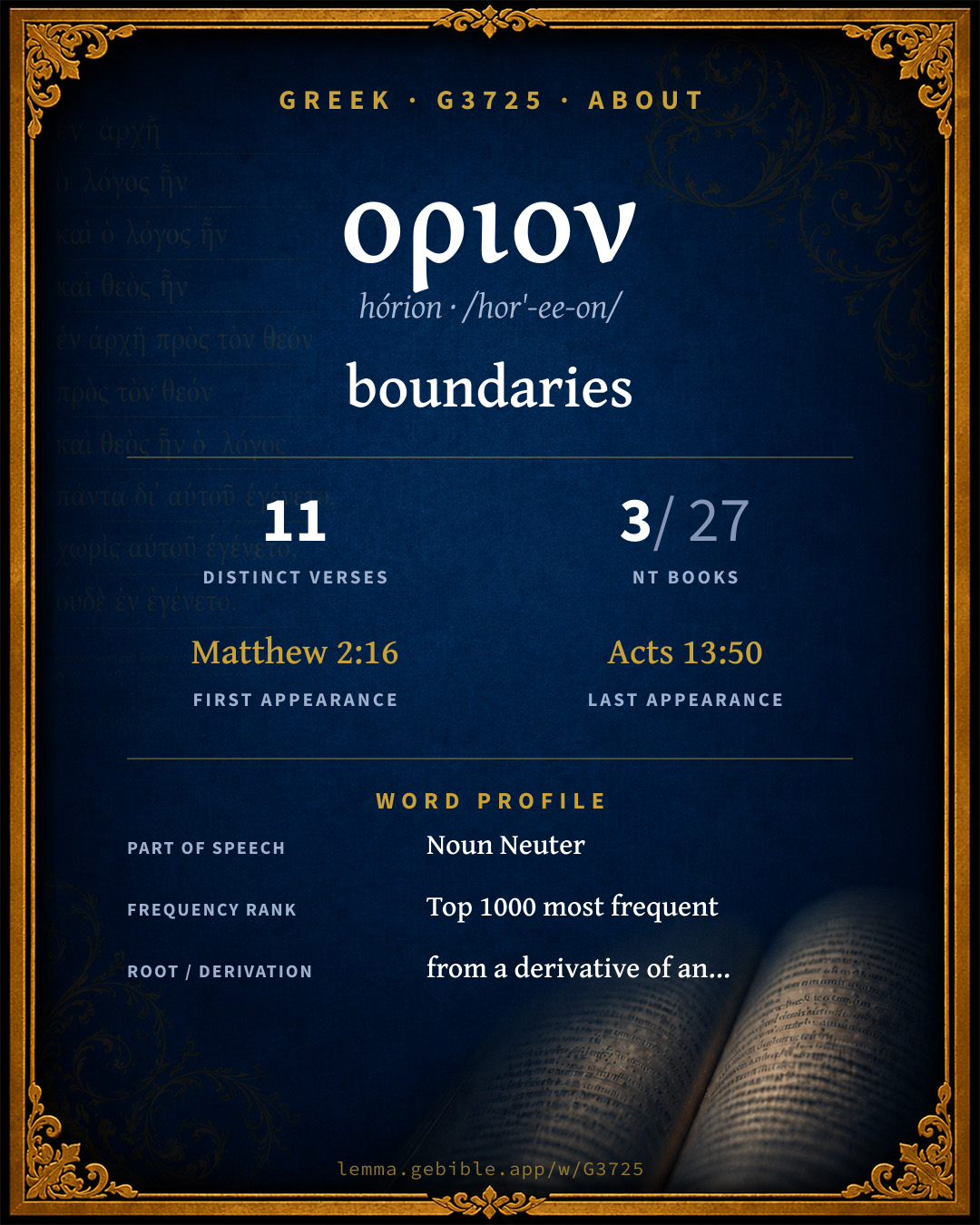
ὅριον
boundaries
Full lexicon entry — Thayer's Greek Lexicon
From Thayer's Greek Lexicon
Where this word appears
See every Genitive-case word in the Greek New Testament →
Grammar key — what these labels mean
Part of speech
- Noun
- A naming word — a person, place, thing, or idea.
Case
- Genitive
- The case of source, possession, or “of” — answers “whose / from what.”
- Accusative
- The case of the direct object and of extent.
- Dative
- The case of the indirect object, means, or location — “to / for / with / in.”
Gender
- Neuter
- Grammatically neuter.
Number
- Plural
- More than one.
2 distinct verses where G3725 appears in the Dative case, across 1 book. Filtered view — show all forms. Click any verse to open its interlinear word-by-word view. Verse text shown in the World English Bible for context — . Each verse’s Greek form is shown with its reference; the English is not keyword-highlighted, since the data carries no word-level English alignment. Use “Compare translations” on any verse to read it across multiple English versions. This concordance covers the Greek New Testament; Septuagint (Greek Old Testament) occurrences of this word are not indexed here.
Matthew 2 verses
- Matthew 2:16 ὁρίοις n dat pl neut Then Herod, when he saw that he was mocked by the wise men, was exceedingly angry, and sent out, and killed all the male children who were in Bethlehem and in all the surrounding countryside, from two years old and under, according to the exact time which he had learned from the wise men.
- Matthew 4:13 ὁρίοις n dat pl neut Leaving Nazareth, he came and lived in Capernaum, which is by the sea, in the region of Zebulun and Naphtali,
About this entry
At a glance — auto-summarized from this page’s data, not written by a person. Every figure links to its source below. This summary describes the numbers; it doesn’t interpret them.
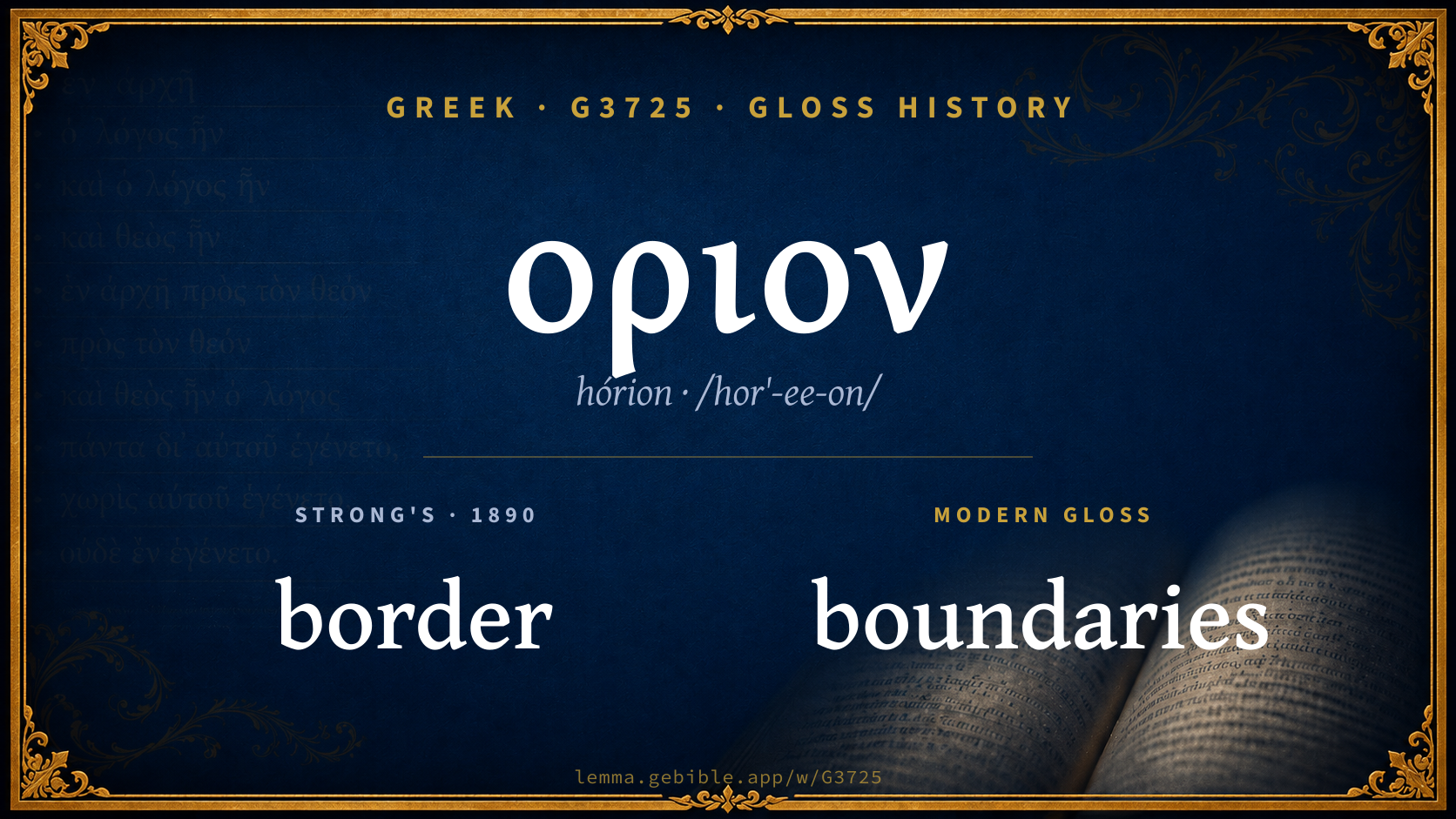
οριον (hórion) is a Greek noun most often rendered “boundaries.” Matthew dominates its distribution — 6 of 11 verses. The Greek New Testament uses it across 11 verses — uncommon. It first appears in Matthew 2:16. Its English rendering has broadened — “coasts” classically, “region” (Berean Standard Bible) in modern versions; see the renderings breakdown. The sections below give every sense, occurrence, and version rendering.
Gloss history
Strong's 1890 vs modern scholarship
About this word
Strong's G3725 catalogs a Greek word from the Greek New Testament.
These counts are not copied from any lexicon or concordance. They are computed here, from the morphology-tagged Greek New Testament. What Lemma adds →
- 11
- distinct verses
- The word appears in 11 distinct verses.
- 3 / 27
- NT books
- The word appears in 3 of 27 New Testament books.
- #904
- by frequency
- Top 1000 most frequent Greek words (rank 904 of 5,347 Greek words by occurrence).
View all 11 occurrences in the concordance →
By section of the New Testament
By traditional corpus
Conventional, traditional groupings — biblical authorship is debated, so this is a traditional corpus grouping, not an authorship claim. Some books belong to more than one corpus (Luke is in both the Gospels and the Lukan corpus, and so on), so these shares overlap and need not total 100%. Each figure is a share of the word’s 11 distinct verses.
- Gospels 10 verses · 91%
- Lukan (Luke–Acts) 1 verse · 9%
How translations render this word
Counts come from each version’s own published word-to-Strong’s tagging or interlinear alignment — an approximate guide to how each version renders this word, not a word-level alignment the data otherwise carries. Because each total is that version’s own tagged count, the per-version totals vary from one another and need not match the appearance or distinct-verse counts above. These counts may also differ from a printed concordance because Lemma counts each distinctly tagged rendering and does not collapse phrase taggings into a single head-word total. This is a fixed set of word-tagged versions (KJV, ASV, BSB, ULT) and does not change with the reading translation you choose elsewhere. Each version’s license is shown beside its name below (and on Sources).
- King James Version: Coasts 10×
- American Standard Version: Borders 11×
- Berean Standard Bible: Region 10×
- unfoldingWord Literal Text: Region 6×, Regions 4×
King James Version Public Domain
Renders G3725 across 11 tagged occurrences — most commonly:
Plus 1 rendering that appears only once — usually multi-word phrases or single function words the recovered tagging swept in, not distinct renderings.
American Standard Version Public Domain
Renders G3725 across 12 tagged occurrences — most commonly:
Plus 1 rendering that appears only once — usually multi-word phrases or single function words the recovered tagging swept in, not distinct renderings.
Berean Standard Bible Public Domain
Renders G3725 across 12 tagged occurrences — most commonly:
Plus 2 renderings that appear only once — usually multi-word phrases or single function words the recovered tagging swept in, not distinct renderings.
unfoldingWord Literal Text CC BY-SA 4.0
Renders G3725 across 12 tagged occurrences — most commonly:
Plus 2 renderings that appear only once — usually multi-word phrases or single function words the recovered tagging swept in, not distinct renderings.
Senses in Thayer's
The 1 sense Thayer's distinguishes for this word, in lexicon order (not ranked by frequency or importance). The full entry — with sub-senses — is in the Lexicon Entry tab.
- boundaries
Word origin
Origin: from a derivative of an apparently primary horos (a bound or limit)
Neuter of a derivative of an apparently primary word ὅρος horos (a bound or limit ); a boundary line that is (by implication) a frontier ( region ): - border coast.
— Strong’s Exhaustive Concordance (1890), public domain.
Forms in the corpus
The 3 distinct written forms G3725 takes in the Greek New Testament, most frequent first — each parse links to that case’s occurrences in the concordance.
| Form | Parsing | Example | Uses |
|---|---|---|---|
| ὁρίων horíōn | Noun, Genitive, Plural, Neuter | Matthew 8:34 | 6 |
| ὅρια hória | Noun, Accusative, Plural, Neuter | Matthew 15:39 | 4 |
| ὁρίοις horíois | Noun, Dative, Plural, Neuter | Matthew 2:16 | 2 |
Same root — word family
Other Thayer's entries built from the same root as G3725, grouped by Strong’s listed origin. These share a root / origin per the lexicon — not necessarily a shared meaning. Each links to that word’s own entry.
Derived from this word
Compare all same-root words → They share a root, not necessarily a meaning.
Septuagint usage
The same Greek word οριον appears 250 times in the Greek Old Testament (Septuagint), across 210 verses in 26 books.
- 250
- LXX occurrences
- Tagged occurrences of this Greek word in the Septuagint.
- 210
- verses
- Distinct Septuagint verses containing this word.
- 26 / 39
- OT books
- The word appears in 26 of the 39 Old Testament books.
Sample Septuagint occurrences
- Genesis 10:19 ὅριον
- Exodus 7:27 ὅριον
- Numbers 20:16 ὅριον
- Deuteronomy 2:4 ὅριον
- Joshua 1:4 ὅριον
- Judges 1:18 ὅριον
- 1 Samuel 5:3 ὅριον
- 2 Samuel 21:5 ὅριον
- 1 Kings 1:3 ὅριον
- 2 Kings 3:21 ὅριον
- 1 Chronicles 4:10 ὅριον
- 2 Chronicles 9:26 ὅριον
Septuagint occurrences (same lexeme)
Every verse where the same Strong’s number (G3725) appears in the Greek Septuagint — showing the first 50 of 210. Verse text shown in the World English Bible for context; the Greek form is the matched word — the English is not keyword-highlighted.
- Genesis 10:19 ὅριον The border of the Canaanites was from Sidon, as you go toward Gerar, to Gaza; as you go toward Sodom, Gomorrah, Admah, and Zeboiim, to Lasha.
- Genesis 23:17 ὅριον So the field of Ephron, which was in Machpelah, which was before Mamre, the field, the cave which was therein, and all the trees that were in the field, that were in all the border of it round about, were made sure
- Genesis 47:21 ὅριον As for the people, he moved them to the cities from one end of the border of Egypt even to the other end of it.
- Exodus 7:27 ὅριον
- Exodus 10:4 ὅριον Or else, if you refuse to let my people go, behold, tomorrow I will bring locusts into your country,
- Exodus 10:14 ὅριον The locusts went up over all the land of Egypt, and rested in all the borders of Egypt. They were very grievous. Before them there were no such locusts as they, neither after them shall be such.
- Exodus 13:7 ὅριον Unleavened bread shall be eaten throughout the seven days; and no leavened bread shall be seen with you, neither shall there be yeast seen with you, in all your borders.
- Exodus 23:18 ὅριον "You shall not offer the blood of my sacrifice with leavened bread, neither shall the fat of my feast remain all night until the morning.
- Exodus 23:31 ὅριον I will set your border from the Red Sea even to the sea of the Philistines, and from the wilderness to the River; for I will deliver the inhabitants of the land into your hand, and you shall drive them out before you.
- Exodus 34:24 ὅριον For I will drive out nations before you and enlarge your borders; neither shall any man desire your land when you go up to appear before Yahweh, your God, three times in the year.
- Numbers 20:16 ὅριον and when we cried to Yahweh, he heard our voice, and sent an angel, and brought us forth out of Egypt: and, behold, we are in Kadesh, a city in the uttermost of your border.
- Numbers 20:17 ὅριον Please let us pass through your land: we will not pass through field or through vineyard, neither will we drink of the water of the wells: we will go along the king's highway; we will not turn aside to the right hand nor to the left, until we have passed your border.
- Numbers 20:21 ὅριον Thus Edom refused to give Israel passage through his border: why Israel turned away from him.
- Numbers 20:23 ὅριον Yahweh spoke to Moses and Aaron in Mount Hor, by the border of the land of Edom, saying,
- Numbers 21:13 ὅριον From there they traveled, and encamped on the other side of the Arnon, which is in the wilderness, that comes out of the border of the Amorites: for the Arnon is the border of Moab, between Moab and the Amorites.
- Numbers 21:15 ὅριον The slope of the valleys That inclines toward the dwelling of Ar, Leans on the border of Moab.
- Numbers 21:22 ὅριον Let me pass through your land: we will not turn aside into field, or into vineyard; we will not drink of the water of the wells: we will go by the king's highway, until we have passed your border.
- Numbers 21:23 ὅριον Sihon would not allow Israel to pass through his border: but Sihon gathered all his people together, and went out against Israel into the wilderness, and came to Jahaz; and he fought against Israel.
- Numbers 21:24 ὅριον Israel struck him with the edge of the sword, and possessed his land from the Arnon to the Jabbok, even to the children of Ammon; for the border of the children of Ammon was strong.
- Numbers 22:36 ὅριον When Balak heard that Balaam was come, he went out to meet him to the City of Moab, which is on the border of the Arnon, which is in the utmost part of the border.
- Numbers 32:33 ὅριον Moses gave to them, even to the children of Gad, and to the children of Reuben, and to the half-tribe of Manasseh the son of Joseph, the kingdom of Sihon king of the Amorites, and the kingdom of Og king of Bashan, the land, according to the cities of it with [their] borders, even the cities of the land round about.
- Numbers 33:44 ὅριον They traveled from Oboth, and encamped in Iye-abarim, in the border of Moab.
- Numbers 34:2 ὅριον Command the children of Israel, and tell them, When you come into the land of Canaan (this is the land that shall fall to you for an inheritance, even the land of Canaan according to the borders of it),
- Numbers 34:3 ὅριον then your south quarter shall be from the wilderness of Zin along by the side of Edom, and your south border shall be from the end of the Salt Sea eastward;
- Numbers 34:4 ὅριον and your border shall turn about southward of the ascent of Akrabbim, and pass along to Zin; and the goings out of it shall be southward of Kadesh-barnea; and it shall go forth to Hazar Addar, and pass along to Azmon;
- Numbers 34:5 ὅριον and the border shall turn about from Azmon to the brook of Egypt, and the goings out of it shall be at the sea.
- Numbers 34:6 ὅριον For the western border, you shall have the great sea and the border [of it]: this shall be your west border.
- Numbers 34:7 ὅριον This shall be your north border: from the great sea you shall mark out for you Mount Hor;
- Numbers 34:8 ὅριον from Mount Hor you shall mark out to the entrance of Hamath; and the goings out of the border shall be at Zedad;
- Numbers 34:9 ὅριον and the border shall go forth to Ziphron, and the goings out of it shall be at Hazar Enan: this shall be your north border.
- Numbers 34:10 ὅριον You shall mark out your east border from Hazar Enan to Shepham;
- Numbers 34:11 ὅριον and the border shall go down from Shepham to Riblah, on the east side of Ain; and the border shall go down, and shall reach to the side of the sea of Chinnereth eastward;
- Numbers 34:12 ὅριον and the border shall go down to the Jordan, and the goings out of it shall be at the Salt Sea. This shall be your land according to the borders of it round about.
- Numbers 35:26 ὅριον But if the manslayer shall at any time go beyond the border of his city of refuge, where he flees,
- Numbers 35:27 ὅριον and the avenger of blood find him outside of the border of his city of refuge, and the avenger of blood kill the manslayer; he shall not be guilty of blood,
- Deuteronomy 2:4 ὅριον Command you the people, saying, You are to pass through the border of your brothers the children of Esau, who dwell in Seir; and they will be afraid of you: take good heed to yourselves therefore;
- Deuteronomy 2:18 ὅριον You are this day to pass over Ar, the border of Moab:
- Deuteronomy 3:14 ὅριον Jair the son of Manasseh took all the region of Argob, to the border of the Geshurites and the Maacathites, and called them, even Bashan, after his own name, Havvoth Jair, to this day.)
- Deuteronomy 3:16 ὅριον To the Reubenites and to the Gadites I gave from Gilead even to the valley of the Arnon, the middle of the valley, and the border [of it], even to the river Jabbok, which is the border of the children of Ammon;
- Deuteronomy 3:17 ὅριον the Arabah also, and the Jordan and the border [of it], from Chinnereth even to the sea of the Arabah, the Salt Sea, under the slopes of Pisgah eastward.
- Deuteronomy 11:24 ὅριον Every place whereon the sole of your foot shall tread shall be yours: from the wilderness, and Lebanon, from the river, the river Euphrates, even to the hinder sea shall be your border.
- Deuteronomy 12:20 ὅριον When Yahweh your God shall enlarge your border, as he has promised you, and you shall say, I will eat flesh, because your soul desires to eat flesh; you may eat flesh, after all the desire of your soul.
- Deuteronomy 16:4 ὅριον There shall be no yeast seen with you in all your borders seven days; neither shall any of the flesh, which you sacrifice the first day at even, remain all night until the morning.
- Deuteronomy 19:3 ὅριον You shall prepare you the way, and divide the borders of your land, which Yahweh your God causes you to inherit, into three parts, that every manslayer may flee there.
- Deuteronomy 19:8 ὅριον If Yahweh your God enlarge your border, as he has sworn to your fathers, and give you all the land which he promised to give to your fathers;
- Deuteronomy 19:14 ὅριον You shall not remove your neighbor's landmark, which they of old time have set, in your inheritance which you shall inherit, in the land that Yahweh your God gives you to possess it.
- Deuteronomy 27:17 ὅριον Cursed be he who removes his neighbor's landmark. All the people shall say, Amen.
- Deuteronomy 28:40 ὅριον You shall have olive trees throughout all your borders, but you shall not anoint yourself with the oil; for your olive shall cast [its fruit].
- Deuteronomy 32:8 ὅριον When the Most High gave to the nations their inheritance, When he separated the children of men, He set the bounds of the peoples According to the number of the children of Israel.
- Joshua 1:4 ὅριον From the wilderness, and this Lebanon, even to the great river, the river Euphrates, all the land of the Hittites, and to the great sea toward the going down of the sun, shall be your border.
These are occurrences of the same Greek lexeme (G3725) in the Septuagint — not a translation of any one Hebrew word. The store carries no word-level Hebrew↔Greek alignment, so no Hebrew original is asserted here. Counts come from the recovered LXX Strong's tagging — high-frequency vocabulary is well covered, while rare or late forms may be untagged — so they reflect tagged occurrences and may slightly undercount.