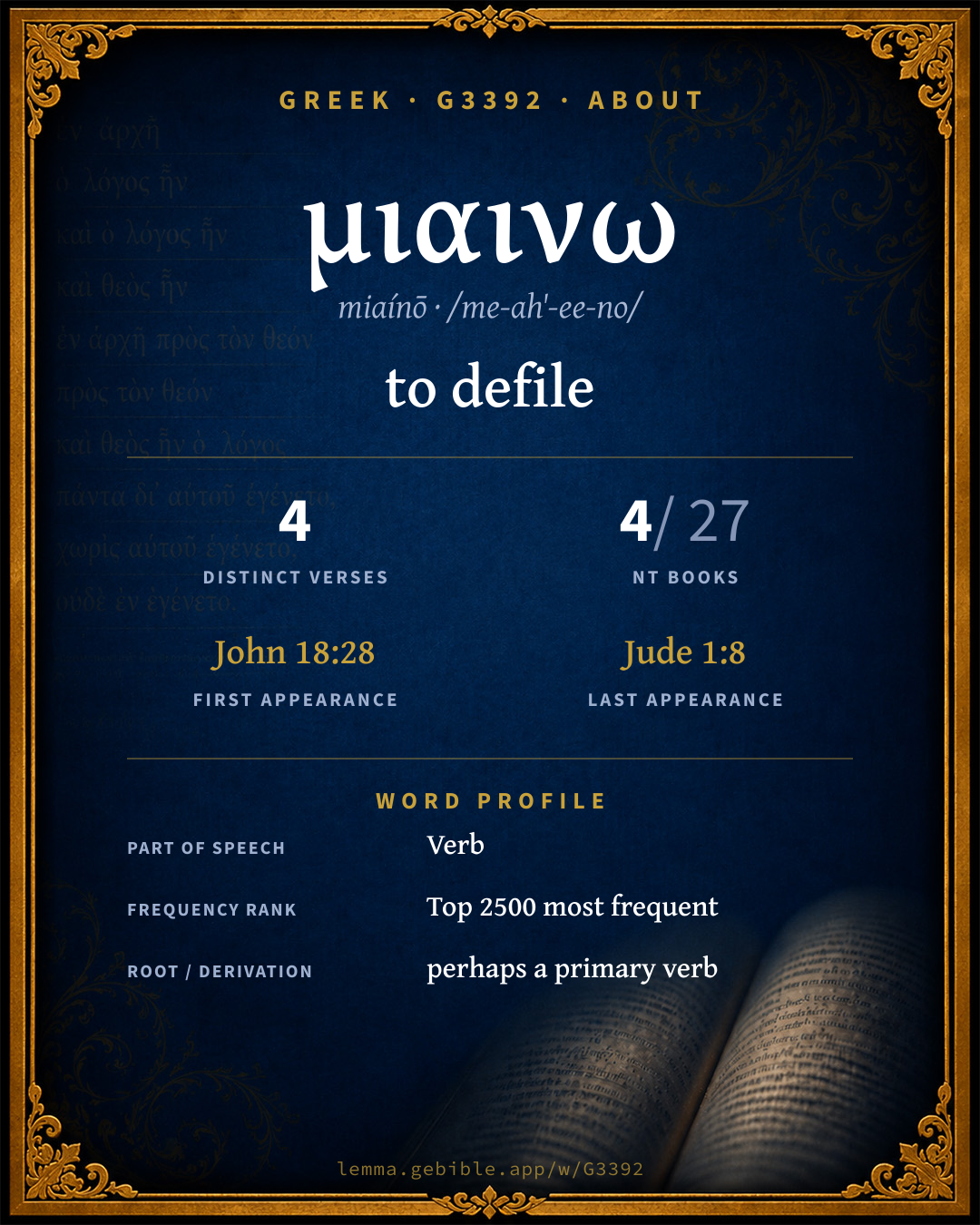
μιαίνω
to defile
‘to defile’ is one of 2 main senses fuller range ↓
Full lexicon entry — Thayer's Greek Lexicon
From Thayer's Greek Lexicon
Where this word appears
See every Aorist-tense verb in the Greek New Testament →
Grammar key — what these labels mean
Part of speech
- Verb
- An action or state-of-being word.
Tense
- Aorist
- Action viewed as a simple whole, without regard to duration — often past (perfective aspect).
- Present
- Ongoing or general action in present time (imperfective aspect).
- Perfect
- A completed past action with continuing present results.
Voice
- Passive
- The subject receives the action.
- Active
- The subject performs the action.
Mood
- Subjunctive
- Expresses probability, purpose, or possibility (the mood of contingency).
- Indicative
- States a fact or asks a factual question (the mood of reality).
- Participle
- A verbal adjective (“writing,” “having written”).
Case
- Dative
- The case of the indirect object, means, or location — “to / for / with / in.”
Person
- 3rd person
- The one spoken about (“he / she / it / they”).
Gender
- Masculine
- Grammatically masculine.
Number
- Plural
- More than one.
- Singular
- One.
Grammatical forms
- Verb, Aorist, Passive, Subjunctive, 3rd person, Plural 2 times (40%)
- Verb, Present, Active, Indicative, 3rd person, Plural 1 time (20%)
- Verb, Perfect, Passive, Indicative, 3rd person, Singular 1 time (20%)
- Verb, Perfect, Passive, Participle, Dative, Plural, Masculine 1 time (20%)
Parsed forms decoded from the imported morphology (Robinson–Tischendorf, public domain), counted across 5 parsed occurrences — not distinct verses.
Every verse where G3392 appears — 4 distinct verses across 4 books. Click any verse to open its interlinear word-by-word view. Verse text shown in the World English Bible for context — . Each verse’s Greek form is shown with its reference; the English is not keyword-highlighted, since the data carries no word-level English alignment. Use “Compare translations” on any verse to read it across multiple English versions. This concordance covers the Greek New Testament; Septuagint (Greek Old Testament) occurrences of this word are not indexed here.
John 1 verse
Titus 1 verse
Hebrews 1 verse
Jude 1 verse
About this entry
At a glance — auto-summarized from this page’s data, not written by a person. Every figure links to its source below. This summary describes the numbers; it doesn’t interpret them.
At its core, μιαινω (miaínō) means “to defile.” A scarce word — 4 verses in all of the Greek New Testament. The word gravitates to John (25%), then Titus and Hebrews. It first appears in John 18:28. Ranging over 2 senses, it is not a single-sense word. Each statement above links to its evidence; the full detail follows below.
Gloss history
Strong's 1890 vs modern scholarship

About this word
Strong's G3392 catalogs a Greek word from the Greek New Testament.
These counts are not copied from any lexicon or concordance. They are computed here, from the morphology-tagged Greek New Testament. What Lemma adds →
- 4
- distinct verses
- The word appears in 4 distinct verses.
- 4 / 27
- NT books
- The word appears in 4 of 27 New Testament books.
- #1,648
- by frequency
- Top 2500 most frequent Greek words (rank 1,648 of 5,347 Greek words by occurrence).
View all 4 occurrences in the concordance →
By section of the New Testament
By traditional corpus
Conventional, traditional groupings — biblical authorship is debated, so this is a traditional corpus grouping, not an authorship claim. Some books belong to more than one corpus (Luke is in both the Gospels and the Lukan corpus, and so on), so these shares overlap and need not total 100%. Each figure is a share of the word’s 4 distinct verses.
- Gospels 1 verse · 25%
- Johannine 1 verse · 25%
- Pauline corpus 1 verse · 25%
- Hebrews 1 verse · 25%
- General (Catholic) Epistles 1 verse · 25%
How translations render this word
Counts come from each version’s own published word-to-Strong’s tagging or interlinear alignment — an approximate guide to how each version renders this word, not a word-level alignment the data otherwise carries. Because each total is that version’s own tagged count, the per-version totals vary from one another and need not match the appearance or distinct-verse counts above. These counts may also differ from a printed concordance because Lemma counts each distinctly tagged rendering and does not collapse phrase taggings into a single head-word total. This is a fixed set of word-tagged versions (KJV, ASV, BSB, ULT) and does not change with the reading translation you choose elsewhere. Each version’s license is shown beside its name below (and on Sources).
- King James Version: Are defiled 1×, Be defiled 1×, Defile 1×
- American Standard Version: Are defiled 2×, Be defiled 2×
- Berean Standard Bible: Defile 2×
- unfoldingWord Literal Text: Be defiled 1×, Defile 1×, Have been corrupted 1×
King James Version Public Domain
Renders G3392 across 5 tagged occurrences — most commonly:
American Standard Version Public Domain
Renders G3392 across 5 tagged occurrences — most commonly:
Plus 1 rendering that appears only once — usually multi-word phrases or single function words the recovered tagging swept in, not distinct renderings.
Berean Standard Bible Public Domain
Renders G3392 across 5 tagged occurrences — most commonly:
Plus 3 renderings that appear only once — usually multi-word phrases or single function words the recovered tagging swept in, not distinct renderings.
unfoldingWord Literal Text CC BY-SA 4.0
Renders G3392 across 6 tagged occurrences — most commonly:
Senses in Thayer's
The 2 senses Thayer's distinguishes for this word, in lexicon order (not ranked by frequency or importance). The full entry — with sub-senses — is in the Lexicon Entry tab.
- to dye with another colour, to stain
- to defile, pollute, sully, contaminate, soil
Word origin
Origin: perhaps a primary verb
Perhaps a primary verb; to sully or taint that is contaminate (ceremonially or morally): - defile.
— Strong’s Exhaustive Concordance (1890), public domain.
Forms in the corpus
The 4 distinct written forms G3392 takes in the Greek New Testament, most frequent first — each parse links to that tense’s occurrences in the concordance.
| Form | Parsing | Example | Uses |
|---|---|---|---|
| μιανθῶσιν mianthō̂sin | Verb, Aorist, Passive, Subjunctive, 3rd person, Plural | John 18:28 | 2 |
| μεμίανται memíantai | Verb, Perfect, Passive, Indicative, 3rd person, Singular | Titus 1:15 | 1 |
| μεμιαμμένοις memiamménois | Verb, Perfect, Passive, Participle, Dative, Plural, Masculine | Titus 1:15 | 1 |
| μιαίνουσιν miaínousin | Verb, Present, Active, Indicative, 3rd person, Plural | Jude 1:8 | 1 |
Same root — word family
Other Thayer's entries built from the same root as G3392, grouped by Strong’s listed origin. These share a root / origin per the lexicon — not necessarily a shared meaning. Each links to that word’s own entry.
Derived from this word
Compare all same-root words → They share a root, not necessarily a meaning.
Septuagint usage
The same Greek word μιαινω appears 113 times in the Greek Old Testament (Septuagint), across 103 verses in 15 books.
- 113
- LXX occurrences
- Tagged occurrences of this Greek word in the Septuagint.
- 103
- verses
- Distinct Septuagint verses containing this word.
- 15 / 39
- OT books
- The word appears in 15 of the 39 Old Testament books.
Sample Septuagint occurrences
- Genesis 34:5 μιαίνω
- Exodus 20:25 μιαίνω
- Leviticus 5:3 μιαίνω
- Numbers 5:3 μιαίνω
- Deuteronomy 21:23 μιαίνω
- 2 Kings 23:8 μιαίνω
- 2 Chronicles 29:19 μιαίνω
- Job 31:11 μιαίνω
- Psalms 78:1 μιαίνω
- Isaiah 43:28 μιαίνω
- Jeremiah 2:7 μιαίνω
- Ezekiel 4:14 μιαίνω
Septuagint occurrences (same lexeme)
Every verse where the same Strong’s number (G3392) appears in the Greek Septuagint — showing the first 50 of 103. Verse text shown in the World English Bible for context; the Greek form is the matched word — the English is not keyword-highlighted.
- Genesis 34:5 μιαίνω Now Jacob heard that he had defiled Dinah, his daughter; and his sons were with his cattle in the field. Jacob held his peace until they came.
- Genesis 34:13 μιαίνω The sons of Jacob answered Shechem and Hamor his father with deceit, and spoke, because he had defiled Dinah their sister,
- Genesis 34:27 μιαίνω Jacob's sons came on the dead, and plundered the city, because they had defiled their sister.
- Genesis 49:4 μιαίνω Boiling over as water, you shall not have the pre-eminence; Because you went up to your father's bed; Then defiled it. He went up to my couch.
- Exodus 20:25 μιαίνω If you make me an altar of stone, you shall not build it of hewn stones; for if you lift up your tool on it, you have polluted it.
- Leviticus 5:3 μιαίνω "'Or if he touches the uncleanness of man, whatever his uncleanness is with which he is unclean, and it is hidden from him; when he knows of it, then he shall be guilty.
- Leviticus 11:24 μιαίνω "'By these you will become unclean: whoever touches the carcass of them shall be unclean until the evening.
- Leviticus 11:43 μιαίνω You shall not make yourselves abominable with any creeping thing that creeps, neither shall you make yourselves unclean with them, that you should be defiled thereby.
- Leviticus 11:44 μιαίνω For I am Yahweh your God. Sanctify yourselves therefore, and be holy; for I am holy: neither shall you defile yourselves with any kind of creeping thing that moves on the earth.
- Leviticus 13:3 μιαίνω and the priest shall examine the plague in the skin of the body: and if the hair in the plague has turned white, and the appearance of the plague is deeper than the body's skin, it is the plague of leprosy; and the priest shall examine him, and pronounce him unclean.
- Leviticus 13:8 μιαίνω The priest shall examine him; and, behold, if the scab has spread on the skin, then the priest shall pronounce him unclean. It is leprosy.
- Leviticus 13:11 μιαίνω it is a chronic leprosy in the skin of his body, and the priest shall pronounce him unclean. He shall not isolate him, for he is unclean.
- Leviticus 13:14 μιαίνω But whenever raw flesh appears in him, he shall be unclean.
- Leviticus 13:15 μιαίνω The priest shall examine the raw flesh, and pronounce him unclean: the raw flesh is unclean. It is leprosy.
- Leviticus 13:20 μιαίνω and the priest shall examine it; and, behold, if the appearance of it is lower than the skin, and the hair of it has turned white, then the priest shall pronounce him unclean. It is the plague of leprosy. It has broken out in the boil.
- Leviticus 13:22 μιαίνω If it spreads in the skin, then the priest shall pronounce him unclean. It is a plague.
- Leviticus 13:25 μιαίνω then the priest shall examine it; and, behold, if the hair in the bright spot has turned white, and the appearance of it is deeper than the skin; it is leprosy. It has broken out in the burning, and the priest shall pronounce him unclean. It is the plague of leprosy.
- Leviticus 13:27 μιαίνω The priest shall examine him on the seventh day. If it has spread in the skin, then the priest shall pronounce him unclean. It is the plague of leprosy.
- Leviticus 13:30 μιαίνω then the priest shall examine the plague; and, behold, if the appearance of it is deeper than the skin, and the hair in it is yellow and thin, then the priest shall pronounce him unclean: it is an itch, it is leprosy of the head or of the beard.
- Leviticus 13:44 μιαίνω he is a leprous man. He is unclean. The priest shall surely pronounce him unclean. His plague is on his head.
- Leviticus 13:59 μιαίνω This is the law of the plague of mildew in a garment of wool or linen, either in the warp, or the woof, or in anything of skin, to pronounce it clean, or to pronounce it unclean.
- Leviticus 15:31 μιαίνω "'Thus you shall separate the children of Israel from their uncleanness, so they will not die in their uncleanness, when they defile my tabernacle that is in their midst.'"
- Leviticus 15:32 μιαίνω This is the law of him who has a discharge, and of him who has an emission of semen, so that he is unclean thereby;
- Leviticus 18:24 μιαίνω "'Don't defile yourselves in any of these things: for in all these the nations which I am casting out before you were defiled.
- Leviticus 18:25 μιαίνω The land was defiled: therefore I punished its iniquity, and the land vomitted out her inhabitants.
- Leviticus 18:27 μιαίνω (for all these abominations have the men of the land done, that were before you, and the land became defiled);
- Leviticus 18:28 μιαίνω that the land not vomit you out also, when you defile it, as it vomited out the nation that was before you.
- Leviticus 18:30 μιαίνω Therefore you shall keep my charge, that you do not practice any of these abominable customs, which were practiced before you, and that you do not defile yourselves with them: I am Yahweh your God.'"
- Leviticus 20:3 μιαίνω I also will set my face against that person, and will cut him off from among his people because he has given of his seed to Molech, to defile my sanctuary, and to profane my holy name.
- Leviticus 21:1 μιαίνω Yahweh said to Moses, "Speak to the priests, the sons of Aaron, and say to them, 'A priest shall not defile himself for the dead among his people;
- Leviticus 21:3 μιαίνω and for his virgin sister who is near to him, who has had no husband; for her he may defile himself.
- Leviticus 21:4 μιαίνω He shall not defile himself, being a chief man among his people, to profane himself.
- Leviticus 21:11 μιαίνω neither shall he go in to any dead body, nor defile himself for his father, or for his mother;
- Leviticus 22:5 μιαίνω or whoever touches any creeping thing, whereby he may be made unclean, or a man of whom he may take uncleanness, whatever uncleanness he has;
- Leviticus 22:8 μιαίνω That which dies of itself, or is torn by animals, he shall not eat, defiling himself by it. I am Yahweh.
- Numbers 5:3 μιαίνω Both male and female shall you put out, outside of the camp shall you put them; that they not defile their camp, in the midst of which I dwell."
- Numbers 5:13 μιαίνω and a man lies with her carnally, and it is hidden from the eyes of her husband, and is kept close, and she is defiled, and there is no witness against her, and she isn't taken in the act;
- Numbers 5:14 μιαίνω and the spirit of jealousy comes on him, and he is jealous of his wife, and she is defiled: or if the spirit of jealousy comes on him, and he is jealous of his wife, and she isn't defiled:
- Numbers 5:19 μιαίνω The priest shall cause her to swear, and shall tell the woman, 'If no man has lain with you, and if you haven't gone aside to uncleanness, being under your husband, be free from this water of bitterness that brings a curse.
- Numbers 5:20 μιαίνω But if you have gone astray, being under your husband, and if you are defiled, and some man has lain with you besides your husband:'
- Numbers 5:27 μιαίνω When he has made her drink the water, then it shall happen, if she is defiled, and has committed a trespass against her husband, that the water that causes the curse will enter into her and become bitter, and her body will swell, and her thigh will fall away: and the woman will be a curse among her people.
- Numbers 5:28 μιαίνω If the woman isn't defiled, but is clean; then she shall be free, and shall conceive seed.
- Numbers 5:29 μιαίνω "This is the law of jealousy, when a wife, being under her husband, goes astray, and is defiled;
- Numbers 6:7 μιαίνω He shall not make himself unclean for his father, or for his mother, for his brother, or for his sister, when they die; because his separation to God is on his head.
- Numbers 6:9 μιαίνω "If any man dies very suddenly beside him, and he defiles the head of his separation; then he shall shave his head in the day of his cleansing. On the seventh day he shall shave it.
- Numbers 6:12 μιαίνω He shall separate to Yahweh the days of his separation, and shall bring a male lamb a year old for a trespass offering; but the former days shall be void, because his separation was defiled.
- Numbers 19:13 μιαίνω Whoever touches a dead person, the body of a man who has died, and doesn't purifies himself, defiles the tent of Yahweh; and that soul shall be cut off from Israel: because the water for impurity was not sprinkled on him, he shall be unclean; his uncleanness is yet on him.
- Numbers 19:20 μιαίνω But the man who shall be unclean, and shall not purify himself, that soul shall be cut off from the midst of the assembly, because he has defiled the sanctuary of Yahweh: the water for impurity has not been sprinkled on him; he is unclean.
- Numbers 35:34 μιαίνω You shall not defile the land which you inhabit, in the midst of which I dwell: for I, Yahweh, dwell in the midst of the children of Israel.
- Deuteronomy 21:23 μιαίνω his body shall not remain all night on the tree, but you shall surely bury him the same day; for he who is hanged is accursed of God; that you don't defile your land which Yahweh your God gives you for an inheritance.
These are occurrences of the same Greek lexeme (G3392) in the Septuagint — not a translation of any one Hebrew word. The store carries no word-level Hebrew↔Greek alignment, so no Hebrew original is asserted here. Counts come from the recovered LXX Strong's tagging — high-frequency vocabulary is well covered, while rare or late forms may be untagged — so they reflect tagged occurrences and may slightly undercount.