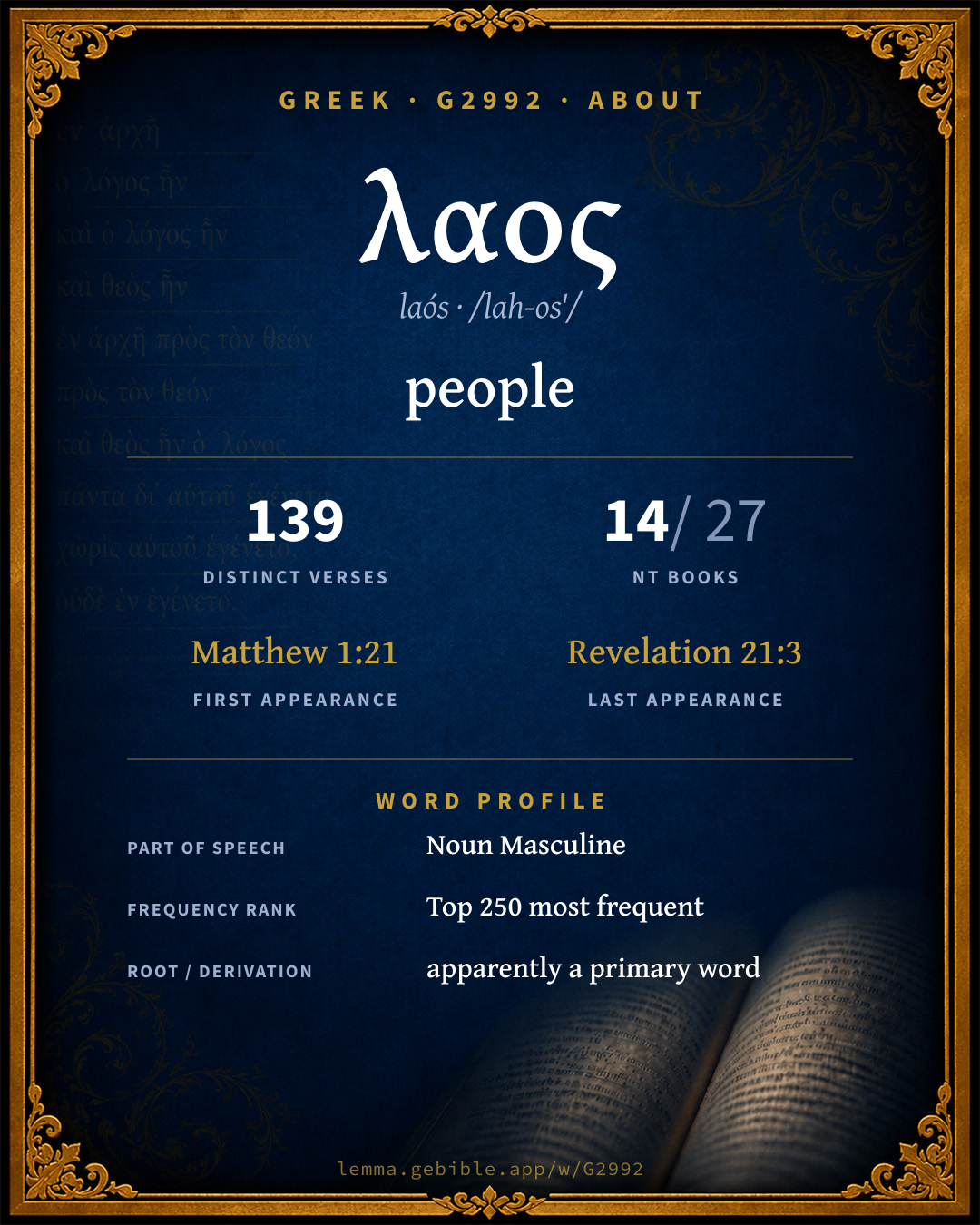
λαός
people
also: people group, tribe, nation fuller range ↓
Full lexicon entry — Thayer's Greek Lexicon
From Thayer's Greek Lexicon
Where this word appears
See every Accusative-case word in the Greek New Testament →
Grammar key — what these labels mean
Part of speech
- Noun
- A naming word — a person, place, thing, or idea.
Case
- Accusative
- The case of the direct object and of extent.
- Genitive
- The case of source, possession, or “of” — answers “whose / from what.”
- Dative
- The case of the indirect object, means, or location — “to / for / with / in.”
- Nominative
- The case of the subject (and the predicate nominative).
Gender
- Masculine
- Grammatically masculine.
Number
- Singular
- One.
- Plural
- More than one.
1 verse where G2992 appears in the Genitive case in the Book of Romans. Filtered view — show all forms. Click any verse to open its interlinear word-by-word view. Verse text shown in the World English Bible for context — . Each verse’s Greek form is shown with its reference; the English is not keyword-highlighted, since the data carries no word-level English alignment. Use “Compare translations” on any verse to read it across multiple English versions. This concordance covers the Greek New Testament; Septuagint (Greek Old Testament) occurrences of this word are not indexed here.
Romans
About this entry
At a glance — auto-summarized from this page’s data, not written by a person. Every figure links to its source below. This summary describes the numbers; it doesn’t interpret them.
The Greek noun λαος centers on the idea of “people.” Its earliest occurrence is Matthew 1:21. Spanning 139 verses in 14 books, it ranks among the common words of the Greek New Testament. Acts dominates its distribution — 47 of 139 verses. Lexicons map it across 2 senses — beyond “people” it also covers “people group”, “tribe”, and “nation”. Dig into 139-verse concordance and the renderings breakdown below.
Gloss history
Strong's 1890 vs modern scholarship
About this word
Strong's G2992 catalogs a Greek word from the Greek New Testament.
These counts are not copied from any lexicon or concordance. They are computed here, from the morphology-tagged Greek New Testament. What Lemma adds →
- 139
- distinct verses
- The word appears in 139 distinct verses.
- 14 / 27
- NT books
- The word appears in 14 of 27 New Testament books.
- #115
- by frequency
- Top 250 most frequent Greek words (rank 115 of 5,347 Greek words by occurrence).
View all 139 occurrences in the concordance →
By section of the New Testament
By traditional corpus
Conventional, traditional groupings — biblical authorship is debated, so this is a traditional corpus grouping, not an authorship claim. Some books belong to more than one corpus (Luke is in both the Gospels and the Lukan corpus, and so on), so these shares overlap and need not total 100%. Each figure is a share of the word’s 139 distinct verses.
- Lukan (Luke–Acts) 83 verses · 60%
- Gospels 56 verses · 40%
- Johannine 12 verses · 9%
- Hebrews 12 verses · 9%
- Pauline corpus 11 verses · 8%
- Revelation 9 verses · 6%
- General (Catholic) Epistles 4 verses · 3%
How translations render this word
Counts come from each version’s own published word-to-Strong’s tagging or interlinear alignment — an approximate guide to how each version renders this word, not a word-level alignment the data otherwise carries. Because each total is that version’s own tagged count, the per-version totals vary from one another and need not match the appearance or distinct-verse counts above. These counts may also differ from a printed concordance because Lemma counts each distinctly tagged rendering and does not collapse phrase taggings into a single head-word total. This is a fixed set of word-tagged versions (KJV, ASV, BSB, ULT) and does not change with the reading translation you choose elsewhere. Each version’s license is shown beside its name below (and on Sources).
- King James Version: People 138×, People's 2×, Peoples 2×
- American Standard Version: People 121×, Peoples 9×, Of 3×
- Berean Standard Bible: People 129×, Peoples 5×, People’s 2×
- unfoldingWord Literal Text: People 137×, To 8×, Of 6×
King James Version Public Domain
Renders G2992 across 143 tagged occurrences — most commonly:
Plus 1 rendering that appears only once — usually multi-word phrases or single function words the recovered tagging swept in, not distinct renderings.
American Standard Version Public Domain
Renders G2992 across 144 tagged occurrences — most commonly:
Plus 9 renderings that appear only once — usually multi-word phrases or single function words the recovered tagging swept in, not distinct renderings.
Berean Standard Bible Public Domain
Renders G2992 across 139 tagged occurrences — most commonly:
Plus 3 renderings that appear only once — usually multi-word phrases or single function words the recovered tagging swept in, not distinct renderings. Not rendered by a distinct English word in 2 further occurrences.
unfoldingWord Literal Text CC BY-SA 4.0
Renders G2992 across 162 tagged occurrences — most commonly:
Plus 2 renderings that appear only once — usually multi-word phrases or single function words the recovered tagging swept in, not distinct renderings.
Senses in Thayer's
The 2 senses Thayer's distinguishes for this word, in lexicon order (not ranked by frequency or importance). The full entry — with sub-senses — is in the Lexicon Entry tab.
- a people, people group, tribe, nation, all those who are of the same stock and language
- of a great part of the population gathered together anywhere
Word origin
Origin: apparently a primary word
Apparently a primary word; a people (in general; thus differing from G1218 which denotes one´ s own populace): - people.
— Strong’s Exhaustive Concordance (1890), public domain.
Forms in the corpus
The 10 distinct written forms G2992 takes in the Greek New Testament, most frequent first — each parse links to that case’s occurrences in the concordance.
| Form | Parsing | Example | Uses |
|---|---|---|---|
| λαοῦ laoû | Noun, Genitive, Singular, Masculine | Matthew 2:4 | 38 |
| λαῷ laō̂ | Noun, Dative, Singular, Masculine | Matthew 4:23 | 26 |
| λαὸν laòn | Noun, Accusative, Singular, Masculine | Matthew 1:21 | 24 |
| λαόν laón | Noun, Accusative, Singular, Masculine | Matthew 2:6 | 21 |
| λαὸς laòs | Noun, Nominative, Singular, Masculine | Matthew 4:16 | 20 |
| λαός laós | Noun, Nominative, Singular, Masculine | Acts 5:13 | 5 |
| λαοὶ laoì | Noun, Nominative, Plural, Masculine | Acts 4:25 | 3 |
| λαῶν laō̂n | Noun, Genitive, Plural, Masculine | Luke 2:31 | 3 |
| λαοῖς laoîs | Noun, Dative, Plural, Masculine | Acts 4:27 | 2 |
| λαοί laoí | Noun, Nominative, Plural, Masculine | Romans 15:11 | 1 |
Same root — word family
Other Thayer's entries built from the same root as G2992, grouped by Strong’s listed origin. These share a root / origin per the lexicon — not necessarily a shared meaning. Each links to that word’s own entry.
Derived from this word
Proper names from this root
People and places named from this root — a name, not an additional meaning of the word.
Compare all same-root words → 1 of the same-root words is a proper name (a person or place). They share a root, not necessarily a meaning.
Septuagint usage
The same Greek word λαος appears 1,696 times in the Greek Old Testament (Septuagint), across 1,499 verses in 37 books.
- 1,696
- LXX occurrences
- Tagged occurrences of this Greek word in the Septuagint.
- 1,499
- verses
- Distinct Septuagint verses containing this word.
- 37 / 39
- OT books
- The word appears in 37 of the 39 Old Testament books.
Sample Septuagint occurrences
- Genesis 14:16 λαός
- Exodus 1:20 λαός
- Leviticus 4:3 λαός
- Numbers 5:21 λαός
- Deuteronomy 2:4 λαός
- Joshua 1:2 λαός
- Judges 1:16 λαός
- Ruth 1:6 λαός
- 1 Samuel 2:8 λαός
- 2 Samuel 1:2 λαός
- 1 Kings 1:39 λαός
- 2 Kings 3:7 λαός
Septuagint occurrences (same lexeme)
Every verse where the same Strong’s number (G2992) appears in the Greek Septuagint — showing the first 50 of 1,499. Verse text shown in the World English Bible for context; the Greek form is the matched word — the English is not keyword-highlighted.
- Genesis 14:16 λαός He brought back all the goods, and also brought back his relative, Lot, and his goods, and the women also, and the people.
- Genesis 19:4 λαός But before they lay down, the men of the city, the men of Sodom, surrounded the house, both young and old, all the people from every quarter.
- Genesis 23:7 λαός Abraham rose up, and bowed himself to the people of the land, even to the children of Heth.
- Genesis 23:12 λαός Abraham bowed himself down before the people of the land.
- Genesis 23:13 λαός He spoke to Ephron in the audience of the people of the land, saying, "But if you will, please hear me. I will give the price of the field. Take it from me, and I will bury my dead there."
- Genesis 25:8 λαός Abraham gave up the spirit, and died in a good old age, an old man, and full of years, and was gathered to his people.
- Genesis 25:23 λαός Yahweh said to her, Two nations are in your womb, Two peoples will be separated from your body. The one people will be stronger than the other people. The elder will serve the younger.
- Genesis 26:11 λαός Abimelech charged all the people, saying, "He who touches this man or his wife will surely be put to death."
- Genesis 32:8 λαός and he said, "If Esau comes to the one company, and strikes it, then the company which is left will escape."
- Genesis 33:15 λαός Esau said, "Let me now leave with you some of the folk who are with me." He said, "Why? Let me find favor in the sight of my lord."
- Genesis 34:22 λαός Only on this condition will the men consent to us to dwell with us, to become one people, if every male among us be circumcised, as they are circumcised.
- Genesis 35:6 λαός So Jacob came to Luz, which is in the land of Canaan (the same is Bethel), he and all the people who were with him.
- Genesis 41:40 λαός You shall be over my house, and according to your word will all my people be ruled. Only in the throne I will be greater than you."
- Genesis 41:55 λαός When all the land of Egypt was famished, the people cried to Pharaoh for bread, and Pharaoh said to all the Egyptians, "Go to Joseph. What he says to you, do."
- Genesis 42:6 λαός Joseph was the governor over the land. It was he who sold to all the people of the land. Joseph's brothers came, and bowed themselves down to him with their faces to the earth.
- Genesis 47:21 λαός As for the people, he moved them to the cities from one end of the border of Egypt even to the other end of it.
- Genesis 48:19 λαός His father refused, and said, "I know, my son, I know. He also will become a people, and he also will be great. However, his younger brother will be greater than he, and his seed will become a multitude of nations."
- Genesis 49:16 λαός "Dan will judge his people, As one of the tribes of Israel.
- Genesis 49:29 λαός He charged them, and said to them, "I am to be gathered to my people. Bury me with my fathers in the cave that is in the field of Ephron the Hittite,
- Genesis 49:33 λαός When Jacob made an end of charging his sons, he gathered up his feet into the bed, and yielded up the spirit, and was gathered to his people.
- Genesis 50:20 λαός As for you, you meant evil against me, but God meant it for good, to bring to pass, as it is this day, to save many people alive.
- Exodus 1:20 λαός God dealt well with the midwives, and the people multiplied, and grew very mighty.
- Exodus 1:22 λαός Pharaoh charged all his people, saying, "You shall cast every son who is born into the river, and every daughter you shall save alive."
- Exodus 3:7 λαός Yahweh said, "I have surely seen the affliction of my people who are in Egypt, and have heard their cry because of their taskmasters, for I know their sorrows.
- Exodus 3:10 λαός Come now therefore, and I will send you to Pharaoh, that you may bring forth my people, the children of Israel, out of Egypt."
- Exodus 3:12 λαός He said, "Certainly I will be with you. This will be the token to you, that I have sent you: when you have brought forth the people out of Egypt, you shall serve God on this mountain."
- Exodus 3:21 λαός I will give this people favor in the sight of the Egyptians, and it will happen that when you go, you shall not go empty-handed.
- Exodus 4:16 λαός He will be your spokesman to the people; and it will happen, that he will be to you a mouth, and you will be to him as God.
- Exodus 4:21 λαός Yahweh said to Moses, "When you go back into Egypt, see that you do before Pharaoh all the wonders which I have put in your hand, but I will harden his heart and he will not let the people go.
- Exodus 4:23 λαός and I have said to you, "Let my son go, that he may serve me;" and you have refused to let him go. Behold, I will kill your son, your firstborn.'"
- Exodus 4:30 λαός Aaron spoke all the words which Yahweh had spoken to Moses, and did the signs in the sight of the people.
- Exodus 4:31 λαός The people believed, and when they heard that Yahweh had visited the children of Israel, and that he had seen their affliction, then they bowed their heads and worshiped.
- Exodus 5:1 λαός Afterward Moses and Aaron came, and said to Pharaoh, "This is what Yahweh, the God of Israel, says, 'Let my people go, that they may hold a feast to me in the wilderness.'"
- Exodus 5:4 λαός The king of Egypt said to them, "Why do you, Moses and Aaron, take the people from their work? Get back to your burdens!"
- Exodus 5:5 λαός Pharaoh said, "Behold, the people of the land are now many, and you make them rest from their burdens."
- Exodus 5:6 λαός The same day Pharaoh commanded the taskmasters of the people, and their officers, saying,
- Exodus 5:7 λαός "You shall no longer give the people straw to make brick, as before. Let them go and gather straw for themselves.
- Exodus 5:10 λαός The taskmasters of the people went out, and their officers, and they spoke to the people, saying, This is what Pharaoh says: "I will not give you straw.
- Exodus 5:12 λαός So the people were scattered abroad throughout all the land of Egypt to gather stubble for straw.
- Exodus 5:16 λαός No straw is given to your servants, and they tell us, 'Make brick!' and, behold, your servants are beaten; but the fault is in your own people."
- Exodus 5:22 λαός Moses returned to Yahweh, and said, "Lord, why have you brought trouble on this people? Why is it that you have sent me?
- Exodus 5:23 λαός For since I came to Pharaoh to speak in your name, he has brought trouble on this people; neither have you delivered your people at all."
- Exodus 6:7 λαός and I will take you to me for a people, and I will be to you a God; and you shall know that I am Yahweh your God, who brings you out from under the burdens of the Egyptians.
- Exodus 7:4 λαός But Pharaoh will not listen to you, and I will lay my hand on Egypt, and bring forth my hosts, my people the children of Israel, out of the land of Egypt by great judgments.
- Exodus 7:14 λαός Yahweh said to Moses, "Pharaoh's heart is stubborn. He refuses to let the people go.
- Exodus 7:16 λαός You shall tell him, 'Yahweh, the God of the Hebrews, has sent me to you, saying, "Let my people go, that they may serve me in the wilderness:" and, behold, until now you haven't listened.
- Exodus 7:26 λαός
- Exodus 7:28 λαός
- Exodus 7:29 λαός
- Exodus 8:4 λαός and the frogs shall come up both on you, and on your people, and on all your servants.'"
These are occurrences of the same Greek lexeme (G2992) in the Septuagint — not a translation of any one Hebrew word. The store carries no word-level Hebrew↔Greek alignment, so no Hebrew original is asserted here. Counts come from the recovered LXX Strong's tagging — high-frequency vocabulary is well covered, while rare or late forms may be untagged — so they reflect tagged occurrences and may slightly undercount.