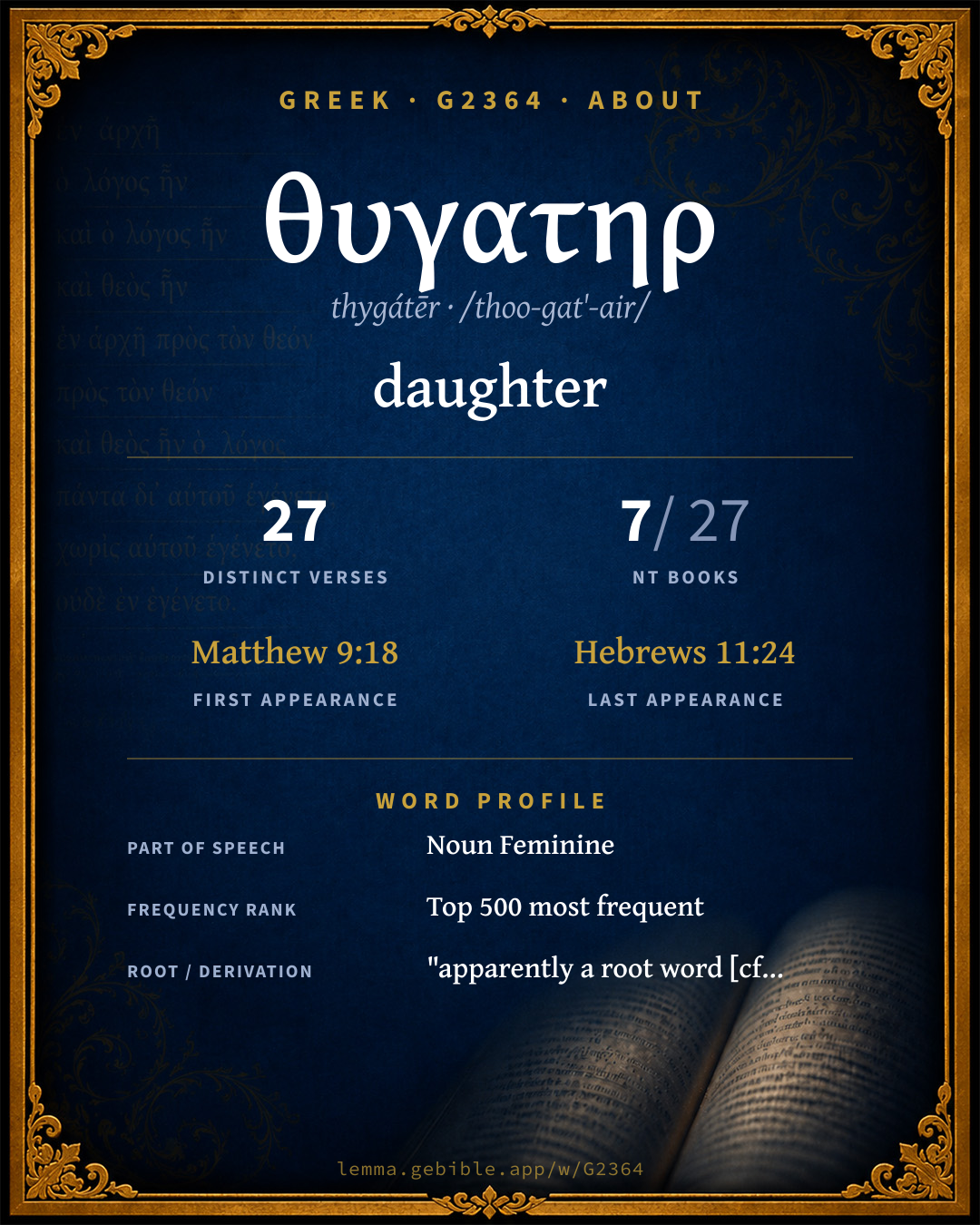
θυγάτηρ
daughter
‘daughter’ is one of 3 main senses fuller range ↓
Full lexicon entry — Thayer's Greek Lexicon
From Thayer's Greek Lexicon
Where this word appears
See every Genitive-case word in the Greek New Testament →
Grammar key — what these labels mean
Part of speech
- Noun
- A naming word — a person, place, thing, or idea.
Case
- Nominative
- The case of the subject (and the predicate nominative).
- Accusative
- The case of the direct object and of extent.
- Genitive
- The case of source, possession, or “of” — answers “whose / from what.”
- Vocative
- The case of direct address (“O Lord”).
- Dative
- The case of the indirect object, means, or location — “to / for / with / in.”
Gender
- Feminine
- Grammatically feminine.
Number
- Singular
- One.
- Plural
- More than one.
3 verses where G2364 appears in the Genitive case in the Book of Mark. Filtered view — show all forms. Click any verse to open its interlinear word-by-word view. Verse text shown in the World English Bible for context — . Each verse’s Greek form is shown with its reference; the English is not keyword-highlighted, since the data carries no word-level English alignment. Use “Compare translations” on any verse to read it across multiple English versions. This concordance covers the Greek New Testament; Septuagint (Greek Old Testament) occurrences of this word are not indexed here.
Mark
- Mark 6:22 θυγατρὸς n gen sg fem When the daughter of Herodias herself came in and danced, she pleased Herod and those sitting with him. The king said to the young lady, "Ask me whatever you want, and I will give it to you."
- Mark 7:26 θυγατρὸς n gen sg fem Now the woman was a Greek, a Syrophoenician by race. She begged him that he would cast the demon out of her daughter.
- Mark 7:29 θυγατρός n gen sg fem He said to her, "For this saying, go your way. The demon has gone out of your daughter."
About this entry
At a glance — auto-summarized from this page’s data, not written by a person. Every figure links to its source below. This summary describes the numbers; it doesn’t interpret them.
The Greek noun θυγατηρ centers on the idea of “daughter.” First canonically at Matthew 9:18, it enters the text early. The Greek New Testament uses it across 27 verses — moderately common. Matthew dominates its distribution — 8 of 27 verses. Lexicons map it across 3 senses. Dig into 27-verse concordance and the renderings breakdown below.
Gloss history
Strong's 1890 vs modern scholarship
About this word
Strong's G2364 catalogs a Greek word from the Greek New Testament.
These counts are not copied from any lexicon or concordance. They are computed here, from the morphology-tagged Greek New Testament. What Lemma adds →
- 27
- distinct verses
- The word appears in 27 distinct verses.
- 7 / 27
- NT books
- The word appears in 7 of 27 New Testament books.
- #485
- by frequency
- Top 500 most frequent Greek words (rank 485 of 5,347 Greek words by occurrence).
View all 27 occurrences in the concordance →
By section of the New Testament
By traditional corpus
Conventional, traditional groupings — biblical authorship is debated, so this is a traditional corpus grouping, not an authorship claim. Some books belong to more than one corpus (Luke is in both the Gospels and the Lukan corpus, and so on), so these shares overlap and need not total 100%. Each figure is a share of the word’s 27 distinct verses.
- Gospels 22 verses · 81%
- Lukan (Luke–Acts) 11 verses · 41%
- Johannine 1 verse · 4%
- Pauline corpus 1 verse · 4%
- Hebrews 1 verse · 4%
How translations render this word
Counts come from each version’s own published word-to-Strong’s tagging or interlinear alignment — an approximate guide to how each version renders this word, not a word-level alignment the data otherwise carries. Because each total is that version’s own tagged count, the per-version totals vary from one another and need not match the appearance or distinct-verse counts above. These counts may also differ from a printed concordance because Lemma counts each distinctly tagged rendering and does not collapse phrase taggings into a single head-word total. This is a fixed set of word-tagged versions (KJV, ASV, BSB, ULT) and does not change with the reading translation you choose elsewhere. Each version’s license is shown beside its name below (and on Sources).
- King James Version: Daughter 24×, Daughters 5×
- American Standard Version: Daughter 21×, Daughters 5×, 's daughter 2×
- Berean Standard Bible: Daughter 23×, Daughters 4×
- unfoldingWord Literal Text: Daughter 23×, Daughters 5×
King James Version Public Domain
Renders G2364 across 29 tagged occurrences — most commonly:
American Standard Version Public Domain
Renders G2364 across 30 tagged occurrences — most commonly:
Berean Standard Bible Public Domain
Renders G2364 across 28 tagged occurrences — most commonly:
Plus 1 rendering that appears only once — usually multi-word phrases or single function words the recovered tagging swept in, not distinct renderings.
unfoldingWord Literal Text CC BY-SA 4.0
Renders G2364 across 30 tagged occurrences — most commonly:
Plus 2 renderings that appear only once — usually multi-word phrases or single function words the recovered tagging swept in, not distinct renderings.
Senses in Thayer's
The 3 senses Thayer's distinguishes for this word, in lexicon order (not ranked by frequency or importance). The full entry — with sub-senses — is in the Lexicon Entry tab.
- a daughter of God
- with the name of a place, city, or region
- a female descendant
Word origin
Origin: "apparently a root word [cf "daughter"]"
Apparently a primary word (compare daughter); a female child or (by hebraism) descendant (or inhabitant ): - daughter.
— Strong’s Exhaustive Concordance (1890), public domain.
Forms in the corpus
The 10 distinct written forms G2364 takes in the Greek New Testament, most frequent first — each parse links to that case’s occurrences in the concordance.
| Form | Parsing | Example | Uses |
|---|---|---|---|
| θυγάτηρ thygátēr | Noun, Nominative, Singular, Feminine | Matthew 9:18 | 11 |
| θυγατέρα thygatéra | Noun, Accusative, Singular, Feminine | Matthew 10:35 | 4 |
| θυγατέρες thygatéres | Noun, Nominative, Plural, Feminine | Acts 2:17 | 3 |
| θυγατρὸς thygatròs | Noun, Genitive, Singular, Feminine | Mark 6:22 | 3 |
| θύγατερ thýgater | Noun, Vocative, Singular, Feminine | Matthew 9:22 | 2 |
| θυγάτερ thygáter | Noun, Vocative, Singular, Feminine | Luke 8:48 | 1 |
| θυγατέρας thygatéras | Noun, Accusative, Plural, Feminine | 2 Corinthians 6:18 | 1 |
| θυγατέρων thygatérōn | Noun, Genitive, Plural, Feminine | Luke 1:5 | 1 |
| θυγατρός thygatrós | Noun, Genitive, Singular, Feminine | Mark 7:29 | 1 |
| θυγατρὶ thygatrì | Noun, Dative, Singular, Feminine | Matthew 21:5 | 1 |
Same root — word family
Other Thayer's entries built from the same root as G2364, grouped by Strong’s listed origin. These share a root / origin per the lexicon — not necessarily a shared meaning. Each links to that word’s own entry.
Derived from this word
Compare all same-root words → They share a root, not necessarily a meaning.
Septuagint usage
The same Greek word θυγατηρ appears 527 times in the Greek Old Testament (Septuagint), across 459 verses in 32 books.
- 527
- LXX occurrences
- Tagged occurrences of this Greek word in the Septuagint.
- 459
- verses
- Distinct Septuagint verses containing this word.
- 32 / 39
- OT books
- The word appears in 32 of the 39 Old Testament books.
Sample Septuagint occurrences
- Genesis 5:4 θυγάτηρ
- Exodus 2:1 θυγάτηρ
- Leviticus 10:15 θυγάτηρ
- Numbers 18:11 θυγάτηρ
- Deuteronomy 5:14 θυγάτηρ
- Joshua 7:24 θυγάτηρ
- Judges 1:12 θυγάτηρ
- Ruth 1:11 θυγάτηρ
- 1 Samuel 1:4 θυγάτηρ
- 2 Samuel 1:20 θυγάτηρ
- 1 Kings 2:35 θυγάτηρ
- 2 Kings 8:18 θυγάτηρ
Septuagint occurrences (same lexeme)
Every verse where the same Strong’s number (G2364) appears in the Greek Septuagint — showing the first 50 of 459. Verse text shown in the World English Bible for context; the Greek form is the matched word — the English is not keyword-highlighted.
- Genesis 5:4 θυγάτηρ The days of Adam after he became the father of Seth were eight hundred years, and he became the father of sons and daughters.
- Genesis 5:7 θυγάτηρ Seth lived after he became the father of Enosh eight hundred seven years, and became the father of sons and daughters.
- Genesis 5:10 θυγάτηρ Enosh lived after he became the father of Kenan, eight hundred fifteen years, and became the father of sons and daughters.
- Genesis 5:13 θυγάτηρ Kenan lived after he became the father of Mahalalel eight hundred forty years, and became the father of sons and daughters
- Genesis 5:16 θυγάτηρ Mahalalel lived after he became the father of Jared eight hundred thirty years, and became the father of sons and daughters.
- Genesis 5:19 θυγάτηρ Jared lived after he became the father of Enoch eight hundred years, and became the father of sons and daughters.
- Genesis 5:22 θυγάτηρ Enoch walked with God after he became the father of Methuselah three hundred years, and became the father of sons and daughters.
- Genesis 5:26 θυγάτηρ Methuselah lived after he became the father of Lamech seven hundred eighty-two years, and became the father of sons and daughters.
- Genesis 5:30 θυγάτηρ Lamech lived after he became the father of Noah five hundred ninety-five years, and became the father of sons and daughters.
- Genesis 6:1 θυγάτηρ It happened, when men began to multiply on the surface of the ground, and daughters were born to them,
- Genesis 6:2 θυγάτηρ that God's sons saw that men's daughters were beautiful, and they took for themselves wives of all that they chose.
- Genesis 6:4 θυγάτηρ The Nephilim were in the earth in those days, and also after that, when God's sons came to men's daughters. They bore children to them: the same were the mighty men who were of old, men of renown.
- Genesis 11:11 θυγάτηρ Shem lived after he became the father of Arpachshad five hundred years, and became the father of sons and daughters.
- Genesis 11:13 θυγάτηρ Arpachshad lived after he became the father of Shelah four hundred three years, and became the father of sons and daughters.
- Genesis 11:15 θυγάτηρ and Shelah lived after he became the father of Eber four hundred three years, and became the father of sons and daughters.
- Genesis 11:17 θυγάτηρ Eber lived after he became the father of Peleg four hundred thirty years, and became the father of sons and daughters.
- Genesis 11:19 θυγάτηρ Peleg lived after he became the father of Reu two hundred nine years, and became the father of sons and daughters.
- Genesis 11:21 θυγάτηρ Reu lived after he became the father of Serug two hundred seven years, and became the father of sons and daughters.
- Genesis 11:23 θυγάτηρ Serug lived after he became the father of Nahor two hundred years, and became the father of sons and daughters.
- Genesis 11:25 θυγάτηρ Nahor lived after he became the father of Terah one hundred nineteen years, and became the father of sons and daughters.
- Genesis 11:29 θυγάτηρ Abram and Nahor took wives. The name of Abram's wife was Sarai, and the name of Nahor's wife, Milcah, the daughter of Haran who was also the father of Iscah.
- Genesis 19:8 θυγάτηρ See now, I have two virgin daughters. Please let me bring them out to you, and do you to them as is good in your eyes. Only don't do anything to these men, because they have come under the shadow of my roof."
- Genesis 19:12 θυγάτηρ The men said to Lot, "Do you have anybody else here? Sons-in-law, your sons, your daughters, and whoever you have in the city, bring them out of the place:
- Genesis 19:14 θυγάτηρ Lot went out, and spoke to his sons-in-law, who were pledged to marry his daughters, and said, "Get up! Get out of this place, for Yahweh will destroy the city." But he seemed to his sons-in-law to be joking.
- Genesis 19:15 θυγάτηρ When the morning arose, then the angels hurried Lot, saying, "Arise, take your wife, and your two daughters who are here, lest you be consumed in the iniquity of the city."
- Genesis 19:16 θυγάτηρ But he lingered; and the men laid hold on his hand, and on the hand of his wife, and on the hand of his two daughters, Yahweh being merciful to him; and they took him out, and set him outside of the city.
- Genesis 19:30 θυγάτηρ Lot went up out of Zoar, and lived in the mountain, and his two daughters with him; for he was afraid to live in Zoar. He lived in a cave with his two daughters.
- Genesis 19:36 θυγάτηρ Thus both of Lot's daughters were with child by their father.
- Genesis 24:3 θυγάτηρ I will make you swear by Yahweh, the God of heaven and the God of the earth, that you shall not take a wife for my son of the daughters of the Canaanites, among whom I live.
- Genesis 24:13 θυγάτηρ Behold, I am standing by the spring of water. The daughters of the men of the city are coming out to draw water.
- Genesis 24:23 θυγάτηρ and said, "Whose daughter are you? Please tell me. Is there room in your father's house for us to lodge in?"
- Genesis 24:24 θυγάτηρ She said to him, "I am the daughter of Bethuel the son of Milcah, whom she bore to Nahor."
- Genesis 24:37 θυγάτηρ My master made me swear, saying, 'You shall not take a wife for my son of the daughters of the Canaanites, in whose land I live,
- Genesis 24:43 θυγάτηρ Behold, I am standing by the spring of water. Let it happen, that the maiden who comes forth to draw, to whom I will say, Give me, I pray you, a little water from your pitcher to drink.
- Genesis 24:47 θυγάτηρ I asked her, and said, 'Whose daughter are you?' She said, 'The daughter of Bethuel, Nahor's son, whom Milcah bare to him.' I put the ring on her nose, and the bracelets on her hands.
- Genesis 24:48 θυγάτηρ I bowed my head, and worshiped Yahweh, and blessed Yahweh, the God of my master Abraham, who had led me in the right way to take my master's brother's daughter for his son.
- Genesis 25:20 θυγάτηρ Isaac was forty years old when he took Rebekah, the daughter of Bethuel the Syrian of Paddan Aram, the sister of Laban the Syrian, to be his wife.
- Genesis 26:34 θυγάτηρ When Esau was forty years old, he took as wife Judith, the daughter of Beeri the Hittite, and Basemath, the daughter of Elon the Hittite.
- Genesis 27:46 θυγάτηρ Rebekah said to Isaac, "I am weary of my life because of the daughters of Heth. If Jacob takes a wife of the daughters of Heth, such as these, of the daughters of the land, what good will my life do me?"
- Genesis 28:1 θυγάτηρ Isaac called Jacob, blessed him, and commanded him, "You shall not take a wife of the daughters of Canaan.
- Genesis 28:2 θυγάτηρ Arise, go to Paddan Aram, to the house of Bethuel your mother's father. Take a wife from there from the daughters of Laban, your mother's brother.
- Genesis 28:6 θυγάτηρ Now Esau saw that Isaac had blessed Jacob and sent him away to Paddan Aram, to take him a wife from there, and that as he blessed him he gave him a charge, saying, "You shall not take a wife of the daughters of Canaan,"
- Genesis 28:8 θυγάτηρ Esau saw that the daughters of Canaan didn't please Isaac, his father.
- Genesis 28:9 θυγάτηρ Esau went to Ishmael, and took, besides the wives that he had, Mahalath the daughter of Ishmael, Abraham's son, the sister of Nebaioth, to be his wife.
- Genesis 29:6 θυγάτηρ He said to them, "Is it well with him?" They said, "It is well. See, Rachel, his daughter, is coming with the sheep."
- Genesis 29:9 θυγάτηρ While he was yet speaking with them, Rachel came with her father's sheep, for she kept them.
- Genesis 29:10 θυγάτηρ It happened, when Jacob saw Rachel the daughter of Laban, his mother's brother, and the sheep of Laban, his mother's brother, that Jacob went near, and rolled the stone from the well's mouth, and watered the flock of Laban his mother's brother.
- Genesis 29:16 θυγάτηρ Laban had two daughters. The name of the elder was Leah, and the name of the younger was Rachel.
- Genesis 29:18 θυγάτηρ Jacob loved Rachel. He said, "I will serve you seven years for Rachel, your younger daughter."
- Genesis 29:23 θυγάτηρ It happened in the evening, that he took Leah his daughter, and brought her to him. He went in to her.
These are occurrences of the same Greek lexeme (G2364) in the Septuagint — not a translation of any one Hebrew word. The store carries no word-level Hebrew↔Greek alignment, so no Hebrew original is asserted here. Counts come from the recovered LXX Strong's tagging — high-frequency vocabulary is well covered, while rare or late forms may be untagged — so they reflect tagged occurrences and may slightly undercount.