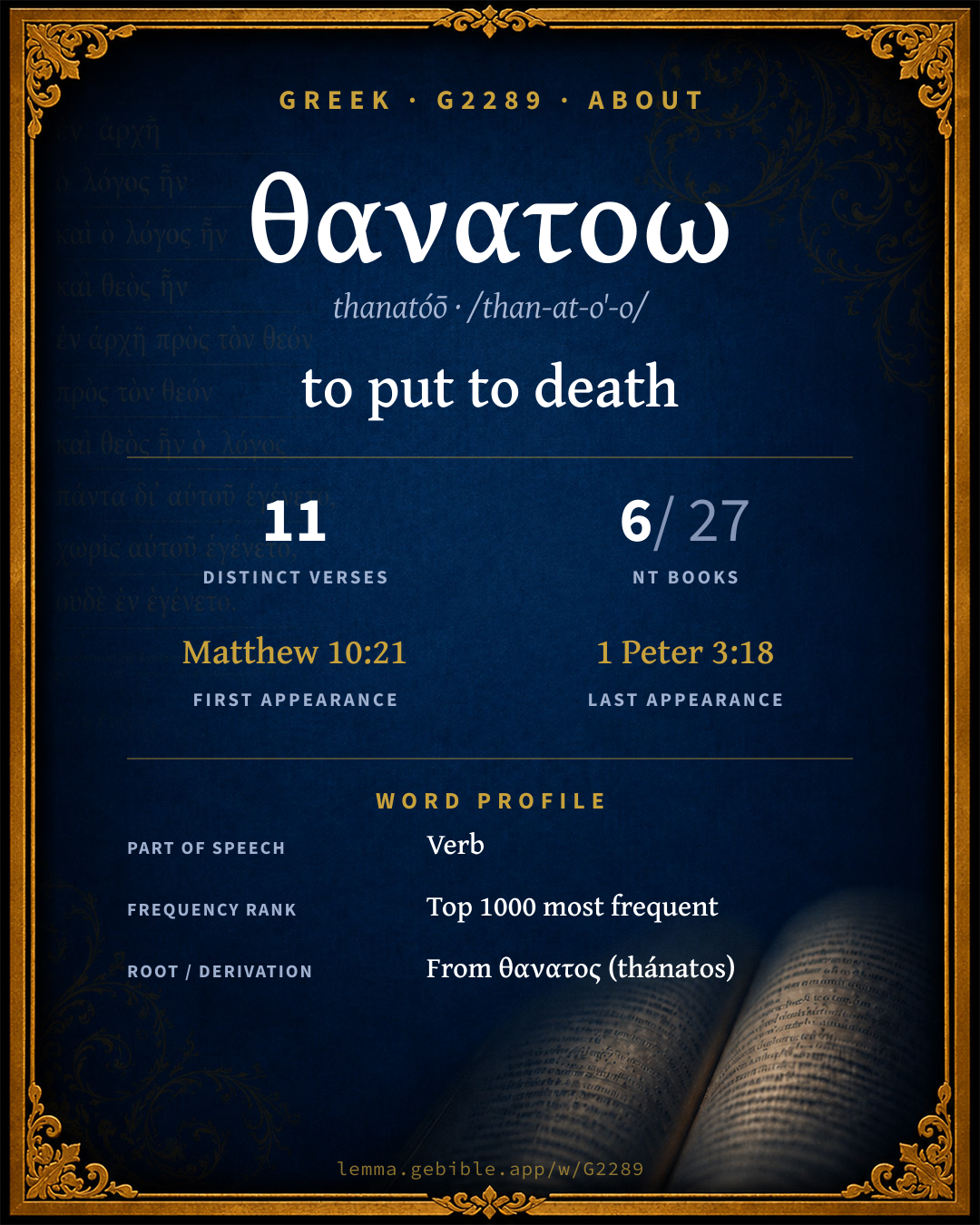
θανατόω
to put to death
‘to put to death’ is one of 2 main senses fuller range ↓
Full lexicon entry — Thayer's Greek Lexicon
From Thayer's Greek Lexicon
Where this word appears
See every Present-tense verb in the Greek New Testament →
Grammar key — what these labels mean
Part of speech
- Verb
- An action or state-of-being word.
Tense
- Future
- Action expected in future time.
- Aorist
- Action viewed as a simple whole, without regard to duration — often past (perfective aspect).
- Present
- Ongoing or general action in present time (imperfective aspect).
- Perfect
- A completed past action with continuing present results.
Voice
- Active
- The subject performs the action.
- Passive
- The subject receives the action.
Mood
- Indicative
- States a fact or asks a factual question (the mood of reality).
- Infinitive
- A verbal noun (“to write”), unmarked for person or number.
- Participle
- A verbal adjective (“writing,” “having written”).
Case
- Nominative
- The case of the subject (and the predicate nominative).
Person
- 3rd person
- The one spoken about (“he / she / it / they”).
- 2nd person
- The one addressed (“you”).
- 1st person
- The speaker (“I / we”).
Gender
- Masculine
- Grammatically masculine.
Number
- Plural
- More than one.
- Singular
- One.
2 verses where G2289 appears in the Present tense in the Book of Romans. Filtered view — show all forms. Click any verse to open its interlinear word-by-word view. Verse text shown in the World English Bible for context — . Each verse’s Greek form is shown with its reference; the English is not keyword-highlighted, since the data carries no word-level English alignment. Use “Compare translations” on any verse to read it across multiple English versions. This concordance covers the Greek New Testament; Septuagint (Greek Old Testament) occurrences of this word are not indexed here.
Romans
- Romans 8:13 θανατοῦτε pres act ind 2pl For if you live after the flesh, you must die; but if by the Spirit you put to death the deeds of the body, you will live.
- Romans 8:36 θανατούμεθα pres pass ind 1pl Even as it is written, "For your sake we are killed all day long. We were accounted as sheep for the slaughter."
About this entry
At a glance — auto-summarized from this page’s data, not written by a person. Every figure links to its source below. This summary describes the numbers; it doesn’t interpret them.
The Greek verb θανατοω centers on the idea of “to put to death.” First canonically at Matthew 10:21, it enters the text early. It turns up in 11 verses across 6 books, an uncommon footprint. The word gravitates to Matthew (27%), then Romans and Mark. Lexicons map it across 2 senses. For the data behind this summary, explore the sense tree and the renderings breakdown below.
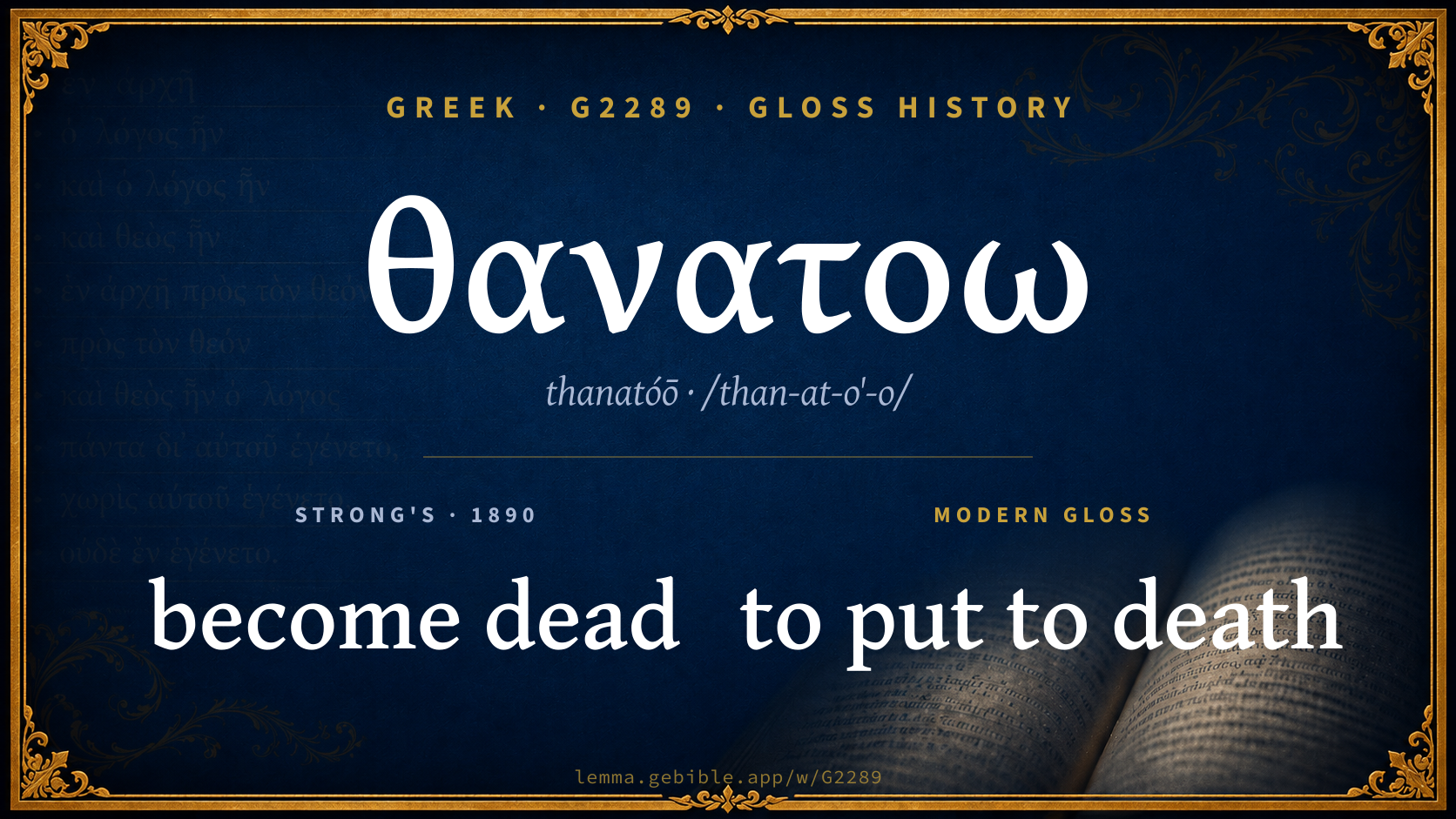
Gloss history
Strong's 1890 vs modern scholarship
About this word
Strong's G2289 catalogs a Greek word from the Greek New Testament.
These counts are not copied from any lexicon or concordance. They are computed here, from the morphology-tagged Greek New Testament. What Lemma adds →
- 11
- distinct verses
- The word appears in 11 distinct verses.
- 6 / 27
- NT books
- The word appears in 6 of 27 New Testament books.
- #978
- by frequency
- Top 1000 most frequent Greek words (rank 978 of 5,347 Greek words by occurrence).
View all 11 occurrences in the concordance →
By section of the New Testament
By traditional corpus
Conventional, traditional groupings — biblical authorship is debated, so this is a traditional corpus grouping, not an authorship claim. Some books belong to more than one corpus (Luke is in both the Gospels and the Lukan corpus, and so on), so these shares overlap and need not total 100%. Each figure is a share of the word’s 11 distinct verses.
- Gospels 6 verses · 55%
- Pauline corpus 4 verses · 36%
- Lukan (Luke–Acts) 1 verse · 9%
- General (Catholic) Epistles 1 verse · 9%
How translations render this word
Counts come from each version’s own published word-to-Strong’s tagging or interlinear alignment — an approximate guide to how each version renders this word, not a word-level alignment the data otherwise carries. Because each total is that version’s own tagged count, the per-version totals vary from one another and need not match the appearance or distinct-verse counts above. These counts may also differ from a printed concordance because Lemma counts each distinctly tagged rendering and does not collapse phrase taggings into a single head-word total. This is a fixed set of word-tagged versions (KJV, ASV, BSB, ULT) and does not change with the reading translation you choose elsewhere. Each version’s license is shown beside its name below (and on Sources).
- King James Version: Death 3×, Put 3×, Be put to death 2×
- American Standard Version: Death 3×, Be put to death 2×, Cause 2×
- Berean Standard Bible: Put him to death 3×, Have them put to death 2×
- unfoldingWord Literal Text: Death 5×, Put 4×
King James Version Public Domain
Renders G2289 across 17 tagged occurrences — most commonly:
Plus 9 renderings that appear only once — usually multi-word phrases or single function words the recovered tagging swept in, not distinct renderings.
American Standard Version Public Domain
Renders G2289 across 17 tagged occurrences — most commonly:
Plus 8 renderings that appear only once — usually multi-word phrases or single function words the recovered tagging swept in, not distinct renderings.
Berean Standard Bible Public Domain
Renders G2289 across 11 tagged occurrences — most commonly:
Plus 6 renderings that appear only once — usually multi-word phrases or single function words the recovered tagging swept in, not distinct renderings.
unfoldingWord Literal Text CC BY-SA 4.0
Renders G2289 across 19 tagged occurrences — most commonly:
Plus 10 renderings that appear only once — usually multi-word phrases or single function words the recovered tagging swept in, not distinct renderings.
Senses in Thayer's
The 2 senses Thayer's distinguishes for this word, in lexicon order (not ranked by frequency or importance). The full entry — with sub-senses — is in the Lexicon Entry tab.
- to put to death
- metaph.
Word origin
Derived from θανατος (thánatos) (G2288) — death.
From G2288 ; to kill (literally or figuratively): - become dead (cause to be) put to death kill mortify.
— Strong’s Exhaustive Concordance (1890), public domain.
Forms in the corpus
The 7 distinct written forms G2289 takes in the Greek New Testament, most frequent first — each parse links to that tense’s occurrences in the concordance.
| Form | Parsing | Example | Uses |
|---|---|---|---|
| θανατώσουσιν thanatṓsousin | Verb, Future, Active, Indicative, 3rd person, Plural | Matthew 10:21 | 4 |
| θανατῶσαι thanatō̂sai | Verb, Aorist, Active, Infinitive | Matthew 27:1 | 2 |
| θανατούμεθα thanatoúmetha | Verb, Present, Passive, Indicative, 1st person, Plural | Romans 8:36 | 1 |
| θανατούμενοι thanatoúmenoi | Verb, Present, Passive, Participle, Nominative, Plural, Masculine | 2 Corinthians 6:9 | 1 |
| θανατοῦτε thanatoûte | Verb, Present, Active, Indicative, 2nd person, Plural | Romans 8:13 | 1 |
| θανατωθεὶς thanatōtheìs | Verb, Perfect, Passive, Participle, Nominative, Singular, Masculine | 1 Peter 3:18 | 1 |
| ἐθανατώθητε ethanatṓthēte | Verb, Aorist, Passive, Indicative, 2nd person, Plural | Romans 7:4 | 1 |
Same root — word family
Other Thayer's entries built from the same root as G2289, grouped by Strong’s listed origin. These share a root / origin per the lexicon — not necessarily a shared meaning. Each links to that word’s own entry.
Derives from
Shares the same root
Compare all same-root words → They share a root, not necessarily a meaning.
Septuagint usage
The same Greek word θανατοω appears 143 times in the Greek Old Testament (Septuagint), across 137 verses in 17 books.
- 143
- LXX occurrences
- Tagged occurrences of this Greek word in the Septuagint.
- 137
- verses
- Distinct Septuagint verses containing this word.
- 17 / 39
- OT books
- The word appears in 17 of the 39 Old Testament books.
Sample Septuagint occurrences
- Genesis 38:10 θανατόω
- Exodus 14:11 θανατόω
- Leviticus 20:2 θανατόω
- Numbers 15:35 θανατόω
- Deuteronomy 17:7 θανατόω
- Judges 6:31 θανατόω
- 1 Samuel 2:6 θανατόω
- 2 Samuel 1:9 θανατόω
- 1 Kings 1:51 θανατόω
- 2 Kings 5:7 θανατόω
- 2 Chronicles 22:11 θανατόω
- Job 5:2 θανατόω
Septuagint occurrences (same lexeme)
Every verse where the same Strong’s number (G2289) appears in the Greek Septuagint — showing the first 50 of 137. Verse text shown in the World English Bible for context; the Greek form is the matched word — the English is not keyword-highlighted.
- Genesis 38:10 θανατόω The thing which he did was evil in the sight of Yahweh, and he killed him also.
- Exodus 14:11 θανατόω They said to Moses, "Because there were no graves in Egypt, have you taken us away to die in the wilderness? Why have you treated us this way, to bring us forth out of Egypt?
- Exodus 21:12 θανατόω "One who strikes a man so that he dies shall surely be put to death,
- Exodus 21:14 θανατόω If a man schemes and comes presumptuously on his neighbor to kill him, you shall take him from my altar, that he may die.
- Exodus 21:15 θανατόω "Anyone who attacks his father or his mother shall be surely put to death.
- Exodus 31:14 θανατόω You shall keep the Sabbath therefore; for it is holy to you. Everyone who profanes it shall surely be put to death; for whoever does any work therein, that soul shall be cut off from among his people.
- Exodus 31:15 θανατόω Six days shall work be done, but on the seventh day is a Sabbath of solemn rest, holy to Yahweh. Whoever does any work on the Sabbath day shall surely be put to death.
- Leviticus 20:2 θανατόω "Moreover, you shall tell the children of Israel, 'Anyone of the children of Israel, or of the strangers who live as foreigners in Israel, who gives any of his seed to Molech; he shall surely be put to death. The people of the land shall stone him with stones.
- Leviticus 20:9 θανατόω "'For everyone who curses his father or his mother shall surely be put to death: he has cursed his father or his mother; his blood shall be upon him.
- Leviticus 20:10 θανατόω "'The man who commits adultery with another man's wife, even he who commits adultery with his neighbor's wife, the adulterer and the adulteress shall surely be put to death.
- Leviticus 20:11 θανατόω The man who lies with his father's wife has uncovered his father's nakedness: both of them shall surely be put to death; their blood shall be upon them.
- Leviticus 20:12 θανατόω "'If a man lies with his daughter-in-law, both of them shall surely be put to death: they have committed a perversion; their blood shall be upon them.
- Leviticus 20:13 θανατόω If a man lies with a male, as with a woman, both of them have committed an abomination: they shall surely be put to death; their blood shall be upon them.
- Leviticus 20:15 θανατόω "'If a man lies with an animal, he shall surely be put to death; and you shall kill the animal.
- Leviticus 20:16 θανατόω "'If a woman approaches any animal, and lies down with it, you shall kill the woman, and the animal: they shall surely be put to death; their blood shall be upon them.
- Leviticus 20:27 θανατόω "'A man or a woman that is a medium, or is a wizard, shall surely be put to death: they shall stone them with stones; their blood shall be upon them.'"
- Leviticus 24:16 θανατόω He who blasphemes the name of Yahweh, he shall surely be put to death; all the congregation shall certainly stone him: the foreigner as well as the native-born, when he blasphemes the Name, shall be put to death.
- Leviticus 24:17 θανατόω "'He who strikes any man mortally shall surely be put to death.
- Leviticus 24:21 θανατόω He who kills an animal shall make it good; and he who kills a man shall be put to death.
- Leviticus 27:29 θανατόω "'No one devoted, who shall be devoted from among men, shall be ransomed; he shall surely be put to death.
- Numbers 15:35 θανατόω Yahweh said to Moses, The man shall surely be put to death: all the congregation shall stone him with stones outside of the camp.
- Numbers 21:6 θανατόω Yahweh sent fiery serpents among the people, and they bit the people; and much people of Israel died.
- Numbers 35:16 θανατόω But if he struck him with an instrument of iron, so that he died, he is a murderer: the murderer shall surely be put to death.
- Numbers 35:17 θανατόω If he struck him with a stone in the hand, by which a man may die, and he died, he is a murderer: the murderer shall surely be put to death.
- Numbers 35:18 θανατόω Or if he struck him with a weapon of wood in the hand, by which a man may die, and he died, he is a murderer: the murderer shall surely be put to death.
- Numbers 35:21 θανατόω or in enmity struck him with his hand, so that he died; he who struck him shall surely be put to death; he is a murderer: the avenger of blood shall put the murderer to death, when he meets him.
- Numbers 35:31 θανατόω Moreover you shall take no ransom for the life of a murderer who is guilty of death; but he shall surely be put to death.
- Deuteronomy 17:7 θανατόω The hand of the witnesses shall be first on him to put him to death, and afterward the hand of all the people. So you shall put away the evil from the midst of you.
- Judges 6:31 θανατόω Joash said to all who stood against him, Will you contend for Baal? Or will you save him? he who will contend for him, let him be put to death while [it is yet] morning: if he be a god, let him contend for himself, because one has broken down his altar.
- Judges 9:54 θανατόω Then he called hastily to the young man his armor bearer, and said to him, Draw your sword, and kill me, that men not say of me, A woman killed him. His young man thrust him through, and he died.
- Judges 13:23 θανατόω But his wife said to him, If Yahweh were pleased to kill us, he wouldn't have received a burnt offering and a meal-offering at our hand, neither would he have shown us all these things, nor would at this time have told such things as these.
- Judges 15:13 θανατόω They spoke to him, saying, No; but we will bind you fast, and deliver you into their hand: but surely we will not kill you. They bound him with two new ropes, and brought him up from the rock.
- Judges 16:30 θανατόω Samson said, Let me die with the Philistines. He bowed himself with all his might; and the house fell on the lords, and on all the people who were therein. So the dead that he killed at his death were more than those who he killed in his life.
- Judges 20:13 θανατόω Now therefore deliver up the men, the base fellows, who are in Gibeah, that we may put them to death, and put away evil from Israel. But Benjamin would not listen to the voice of their brothers the children of Israel.
- Judges 21:5 θανατόω The children of Israel said, Who is there among all the tribes of Israel who didn't come up in the assembly to Yahweh? For they had made a great oath concerning him who didn't come up to Yahweh to Mizpah, saying, He shall surely be put to death.
- 1 Samuel 2:6 θανατόω Yahweh kills, and makes alive: He brings down to Sheol, and brings up.
- 1 Samuel 5:10 θανατόω So they sent the ark of God to Ekron. It happened, as the ark of God came to Ekron, that the Ekronites cried out, saying, They have brought about the ark of the God of Israel to us, to kill us and our people.
- 1 Samuel 5:11 θανατόω They sent therefore and gathered together all the lords of the Philistines, and they said, Send away the ark of the God of Israel, and let it go again to its own place, that it not kill us and our people. For there was a deadly confusion throughout all the city; the hand of God was very heavy there.
- 1 Samuel 11:12 θανατόω The people said to Samuel, Who is he who said, Shall Saul reign over us? bring the men, that we may put them to death.
- 1 Samuel 14:45 θανατόω The people said to Saul, Shall Jonathan die, who has worked this great salvation in Israel? Far from it: as Yahweh lives, there shall not one hair of his head fall to the ground; for he has worked with God this day. So the people rescued Jonathan, that he didn't die.
- 1 Samuel 17:15 θανατόω Now David went back and forth from Saul to feed his father's sheep at Bethlehem.
- 1 Samuel 17:31 θανατόω When the words were heard which David spoke, they rehearsed them before Saul; and he sent for him.
- 1 Samuel 19:1 θανατόω Saul spoke to Jonathan his son, and to all his servants, that they should kill David. But Jonathan, Saul's son, delighted much in David.
- 1 Samuel 19:2 θανατόω Jonathan told David, saying, Saul my father seeks to kill you: now therefore, please take care of yourself in the morning, and live in a secret place, and hide yourself:
- 1 Samuel 19:5 θανατόω for he put his life in his hand, and struck the Philistine, and Yahweh worked a great victory for all Israel: you saw it, and did rejoice; why then will you sin against innocent blood, to kill David without a cause?
- 1 Samuel 19:11 θανατόω Saul sent messengers to David's house, to watch him, and to kill him in the morning: and Michal, David's wife, told him, saying, If you don't save your life tonight, tomorrow you will be slain.
- 1 Samuel 19:15 θανατόω Saul sent the messengers to see David, saying, Bring him up to me in the bed, that I may kill him.
- 1 Samuel 19:17 θανατόω Saul said to Michal, Why have you deceived me thus, and let my enemy go, so that he is escaped? Michal answered Saul, He said to me, Let me go; why should I kill you?
- 1 Samuel 20:8 θανατόω Therefore deal kindly with your servant; for you have brought your servant into a covenant of Yahweh with you: but if there be in me iniquity, kill me yourself; for why should you bring me to your father?
- 1 Samuel 20:33 θανατόω Saul cast his spear at him to strike him. By this Jonathan knew that his father was determined to put David to death.
These are occurrences of the same Greek lexeme (G2289) in the Septuagint — not a translation of any one Hebrew word. The store carries no word-level Hebrew↔Greek alignment, so no Hebrew original is asserted here. Counts come from the recovered LXX Strong's tagging — high-frequency vocabulary is well covered, while rare or late forms may be untagged — so they reflect tagged occurrences and may slightly undercount.