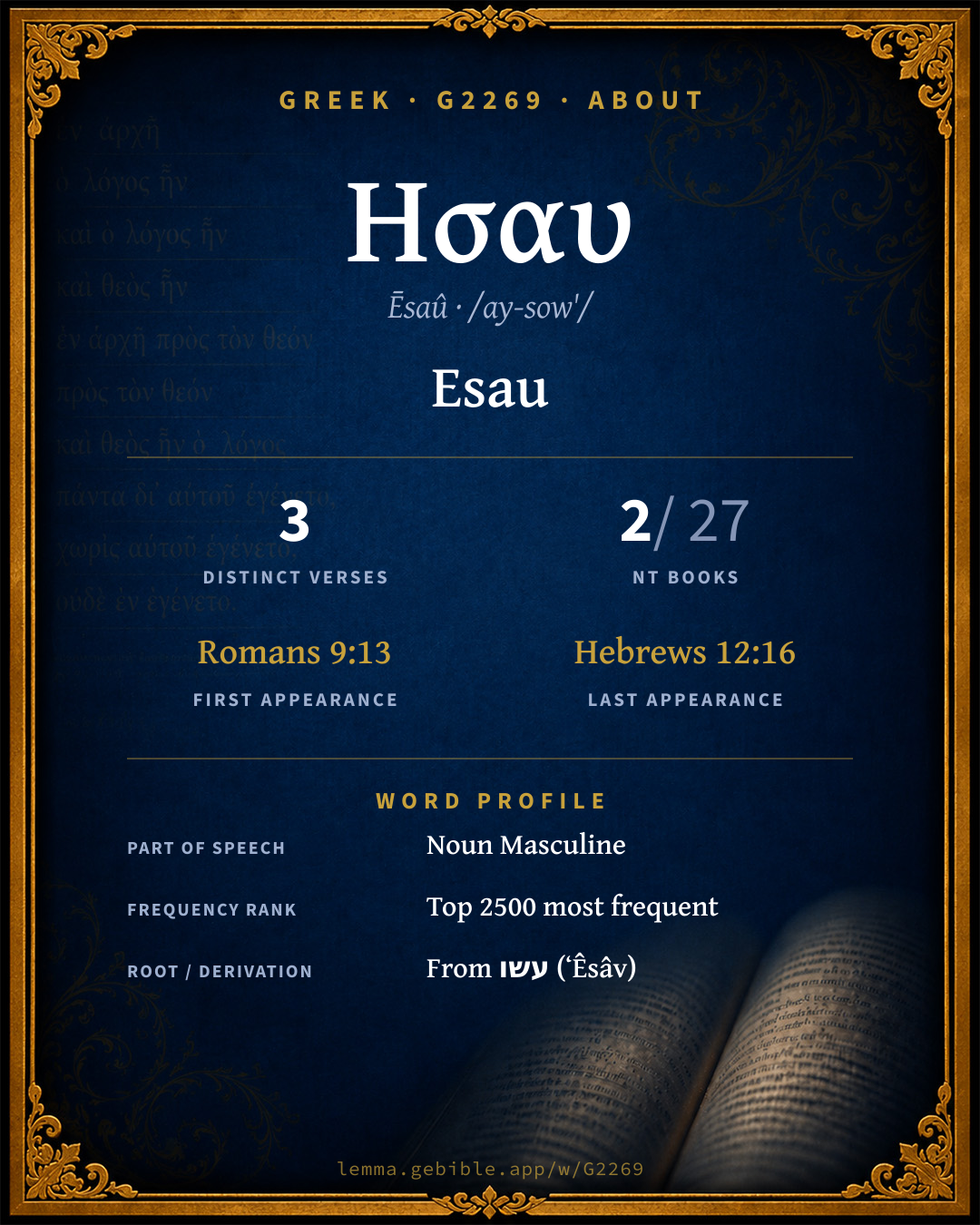
Ἠσαῦ
Esau
Thayer's lists 2 entries for ‘Esau’ fuller range ↓
Full lexicon entry — Thayer's Greek Lexicon
From Thayer's Greek Lexicon
Where this word appears
Every verse where G2269 appears in the Book of Hebrews — 2 distinct verses. Click any verse to open its interlinear word-by-word view. Verse text shown in the World English Bible for context — . Each verse’s Greek form is shown with its reference; the English is not keyword-highlighted, since the data carries no word-level English alignment. Use “Compare translations” on any verse to read it across multiple English versions. This concordance covers the Greek New Testament; Septuagint (Greek Old Testament) occurrences of this word are not indexed here.
Hebrews
About this entry
At a glance — auto-summarized from this page’s data, not written by a person. Every figure links to its source below. This summary describes the numbers; it doesn’t interpret them.
The Greek name Ησαυ centers on the idea of “Esau.” With only 3 verses it sits in the long tail of Greek New Testament vocabulary. Hebrews dominates its distribution — 2 of 3 verses. First canonically at Romans 9:13, it enters the text early. For the data behind this summary, explore 3-verse concordance and the renderings breakdown below.
Gloss history
Strong's 1890 vs modern scholarship
About this word
Strong's G2269 catalogs a Greek word from the Greek New Testament.
These counts are not copied from any lexicon or concordance. They are computed here, from the morphology-tagged Greek New Testament. What Lemma adds →
- 3
- distinct verses
- The word appears in 3 distinct verses.
- 2 / 27
- NT books
- The word appears in 2 of 27 New Testament books.
- #2,203
- by frequency
- Top 2500 most frequent Greek words (rank 2,203 of 5,347 Greek words by occurrence).
View all 3 occurrences in the concordance →
By traditional corpus
Conventional, traditional groupings — biblical authorship is debated, so this is a traditional corpus grouping, not an authorship claim. Some books belong to more than one corpus (Luke is in both the Gospels and the Lukan corpus, and so on), so these shares overlap and need not total 100%. Each figure is a share of the word’s 3 distinct verses.
- Hebrews 2 verses · 67%
- Pauline corpus 1 verse · 33%
How translations render this word
Counts come from each version’s own published word-to-Strong’s tagging or interlinear alignment — an approximate guide to how each version renders this word, not a word-level alignment the data otherwise carries. Because each total is that version’s own tagged count, the per-version totals vary from one another and need not match the appearance or distinct-verse counts above. These counts may also differ from a printed concordance because Lemma counts each distinctly tagged rendering and does not collapse phrase taggings into a single head-word total. This is a fixed set of word-tagged versions (KJV, ASV, BSB, ULT) and does not change with the reading translation you choose elsewhere. Each version’s license is shown beside its name below (and on Sources).
- King James Version: Esau 3×
- American Standard Version: Esau 3×
- Berean Standard Bible: Esau 3×
- unfoldingWord Literal Text: Esau 3×
King James Version Public Domain
Renders G2269 across 3 tagged occurrences — most commonly:
American Standard Version Public Domain
Renders G2269 across 3 tagged occurrences — most commonly:
Berean Standard Bible Public Domain
Renders G2269 across 3 tagged occurrences — most commonly:
unfoldingWord Literal Text CC BY-SA 4.0
Renders G2269 across 3 tagged occurrences — most commonly:
Senses in Thayer's
The 2 senses Thayer's distinguishes for this word, in lexicon order (not ranked by frequency or importance). The full entry — with sub-senses — is in the Lexicon Entry tab.
- Esau = "hairy"
- was the eldest son of Isaac and twin brother of Jacob
Word origin
Derived from עשו (ʻÊsâv) (H6215) — Esau.
Of hebrew origin [ H6215 ]; Esau an Edomite : - Esau.
— Strong’s Exhaustive Concordance (1890), public domain.
Bible dictionary
Public-domain dictionary articles matched to this entry by name (Esau). A biblical name can be shared by more than one person or place, so an article may treat several.
Easton's Bible Dictionary · M. G. Easton, 1897
Hairy, Rebekah's first-born twin son (Gen. 25:25). The name of Edom, "red", was also given to him from his conduct in connection with the red lentil "pottage" for which he sold his birthright (30, 31). The circumstances connected with his birth foreshadowed the enmity which afterwards subsisted between the twin brothers and the nations they founded (25:22, 23, 26). In process of time Jacob, following his natural bent, became a shepherd; while Esau, a "son of the desert," devoted himself to the perilous and toilsome life of a huntsman. On a certain occasion, on returning from the chase, urged by the cravings of hunger, Esau sold his birthright to his brother, Jacob, who thereby obtained the covenant blessing (Gen. 27:28, 29, 36; Heb. 12:16, 17). He afterwards tried to regain what he had so recklessly parted with, but was defeated in his attempts through the stealth of his brother (Gen. 27:4, 34, 38).
At the age of forty years, to the great grief of his parents, he married (Gen. 26:34, 35) two Canaanitish maidens, Judith, the daughter of Beeri, and Bashemath, the daughter of Elon. When Jacob was sent away to Padan-aram, Esau tried to conciliate his parents (Gen. 28:8, 9) by marrying his cousin Mahalath, the daughter of Ishmael. This led him to cast in his lot with the Ishmaelite tribes; and driving the Horites out of Mount Seir, he settled in that region. After some thirty years' sojourn in Padan-aram Jacob returned to Canaan, and was reconciled to Esau, who went forth to meet him (33:4). Twenty years after this, Isaac their father died, when the two brothers met, probably for the last time, beside his grave (35:29). Esau now permanently left Canaan, and established himself as a powerful and wealthy chief in the land of Edom (q.v.).
Long after this, when the descendants of Jacob came out of Egypt, the Edomites remembered the old quarrel between the brothers, and with fierce hatred they warred against Israel.
Smith's Bible Dictionary · William Smith, 1863
(hairy), the eldest son of Isaac, and twin-brother of Jacob. The singular appearance of the child at his birth originated the name. (Genesis 25:25) Esau's robust frame and "rough" aspect were the types of a wild and daring nature. He was a thorough Bedouin, a "son of the desert." He was much loved by his father, and was of course his heir, but was induced to sell his birthright to Jacob. Mention of his unhappy marriages may be found in (Genesis 26:34) The next episode in the life of Esau is the loss of his father's covenant blessing, which Jacob secured through the craft of his mother, and the anger of Esau, who vows vengeance. (Genesis 27:1) ... Later he marries a daughter of Ishmael, (Genesis 28:8,9) and soon after establishes himself in Mount Seir, where he was living when Jacob returned from Padan-aram rich and powerful, and the two brothers were reconciled. (Genesis 33:4) Twenty years thereafter they united in burying Isaac's body in the cave of Machpelah. Of Esau's subsequent history nothing is known; for that of his descendants see Edom, Idumaea Or Idumea.
Hitchcock's Bible Names Dictionary · Roswell D. Hitchcock, 1869
he that acts or finishes
Classic public-domain reference works; full attribution on Sources.
Septuagint usage
The same Greek word Ησαυ appears 104 times in the Greek Old Testament (Septuagint), across 89 verses in 9 books.
- 104
- LXX occurrences
- Tagged occurrences of this Greek word in the Septuagint.
- 89
- verses
- Distinct Septuagint verses containing this word.
- 9 / 39
- OT books
- The word appears in 9 of the 39 Old Testament books.
Sample Septuagint occurrences
- Genesis 25:25 ησαυ
- Numbers 24:18 ησαυ
- Deuteronomy 2:4 ησαυ
- Joshua 24:4 ησαυ
- 1 Chronicles 1:22 ησαυ
- Job 42:17 ησαυ
- Jeremiah 30:4 ησαυ
- Obadiah 1:6 ησαυ
- Malachi 1:2 ησαυ
Septuagint occurrences (same lexeme)
Every verse where the same Strong’s number (G2269) appears in the Greek Septuagint — showing the first 50 of 89. Verse text shown in the World English Bible for context; the Greek form is the matched word — the English is not keyword-highlighted.
- Genesis 25:25 ησαυ The first came out red all over, like a hairy garment. They named him Esau.
- Genesis 25:26 ησαυ After that, his brother came out, and his hand had hold on Esau's heel. He was named Jacob. Isaac was sixty years old when she bore them.
- Genesis 25:27 ησαυ The boys grew. Esau was a skillful hunter, a man of the field. Jacob was a quiet man, living in tents.
- Genesis 25:28 ησαυ Now Isaac loved Esau, because he ate his venison. Rebekah loved Jacob.
- Genesis 25:29 ησαυ Jacob boiled stew. Esau came in from the field, and he was famished.
- Genesis 25:30 ησαυ Esau said to Jacob, "Please feed me with that same red stew, for I am famished." Therefore his name was called Edom.
- Genesis 25:31 ησαυ Jacob said, "First, sell me your birthright."
- Genesis 25:32 ησαυ Esau said, "Behold, I am about to die. What good is the birthright to me?"
- Genesis 25:33 ησαυ Jacob said, "Swear to me first." He swore to him. He sold his birthright to Jacob.
- Genesis 25:34 ησαυ Jacob gave Esau bread and stew of lentils. He ate and drank, rose up, and went his way. So Esau despised his birthright.
- Genesis 26:34 ησαυ When Esau was forty years old, he took as wife Judith, the daughter of Beeri the Hittite, and Basemath, the daughter of Elon the Hittite.
- Genesis 27:1 ησαυ It happened, that when Isaac was old, and his eyes were dim, so that he could not see, he called Esau his elder son, and said to him, "My son?" He said to him, "Here I am."
- Genesis 27:5 ησαυ Rebekah heard when Isaac spoke to Esau his son. Esau went to the field to hunt for venison, and to bring it.
- Genesis 27:6 ησαυ Rebekah spoke to Jacob her son, saying, "Behold, I heard your father speak to Esau your brother, saying,
- Genesis 27:11 ησαυ Jacob said to Rebekah his mother, "Behold, Esau my brother is a hairy man, and I am a smooth man.
- Genesis 27:15 ησαυ Rebekah took the good clothes of Esau, her elder son, which were with her in the house, and put them on Jacob, her younger son.
- Genesis 27:19 ησαυ Jacob said to his father, "I am Esau your firstborn. I have done what you asked me to do. Please arise, sit and eat of my venison, that your soul may bless me."
- Genesis 27:21 ησαυ Isaac said to Jacob, "Please come near, that I may feel you, my son, whether you are really my son Esau or not."
- Genesis 27:22 ησαυ Jacob went near to Isaac his father. He felt him, and said, "The voice is Jacob's voice, but the hands are the hands of Esau."
- Genesis 27:23 ησαυ He didn't recognize him, because his hands were hairy, like his brother, Esau's hands. So he blessed him.
- Genesis 27:24 ησαυ He said, "Are you really my son Esau?" He said, "I am."
- Genesis 27:30 ησαυ It happened, as soon as Isaac had made an end of blessing Jacob, and Jacob had just gone out from the presence of Isaac his father, that Esau his brother came in from his hunting.
- Genesis 27:32 ησαυ Isaac his father said to him, "Who are you?" He said, "I am your son, your firstborn, Esau."
- Genesis 27:34 ησαυ When Esau heard the words of his father, he cried with an exceeding great and bitter cry, and said to his father, "Bless me, even me also, my father."
- Genesis 27:36 ησαυ He said, "Isn't he rightly named Jacob? For he has supplanted me these two times. He took away my birthright. See, now he has taken away my blessing." He said, "Haven't you reserved a blessing for me?"
- Genesis 27:37 ησαυ Isaac answered Esau, "Behold, I have made him your lord, and all his brothers have I given to him for servants. With grain and new wine have I sustained him. What then will I do for you, my son?"
- Genesis 27:38 ησαυ Esau said to his father, "Have you but one blessing, my father? Bless me, even me also, my father." Esau lifted up his voice, and wept.
- Genesis 27:41 ησαυ Esau hated Jacob because of the blessing with which his father blessed him. Esau said in his heart, "The days of mourning for my father are at hand. Then I will kill my brother Jacob."
- Genesis 27:42 ησαυ The words of Esau, her elder son, were told to Rebekah. She sent and called Jacob her younger son, and said to him, "Behold, your brother Esau comforts himself about you by planning to kill you.
- Genesis 28:5 ησαυ Isaac sent Jacob away. He went to Paddan Aram to Laban, son of Bethuel the Syrian, Rebekah's brother, Jacob's and Esau's mother.
- Genesis 28:6 ησαυ Now Esau saw that Isaac had blessed Jacob and sent him away to Paddan Aram, to take him a wife from there, and that as he blessed him he gave him a charge, saying, "You shall not take a wife of the daughters of Canaan,"
- Genesis 28:8 ησαυ Esau saw that the daughters of Canaan didn't please Isaac, his father.
- Genesis 28:9 ησαυ Esau went to Ishmael, and took, besides the wives that he had, Mahalath the daughter of Ishmael, Abraham's son, the sister of Nebaioth, to be his wife.
- Genesis 29:1 ησαυ Then Jacob went on his journey, and came to the land of the children of the east.
- Genesis 32:4 ησαυ He commanded them, saying, "This is what you shall tell my lord, Esau: 'This is what your servant, Jacob, says. I have lived as a foreigner with Laban, and stayed until now.
- Genesis 32:5 ησαυ I have oxen, donkeys, flocks, men-servants, and maid-servants. I have sent to tell my lord, that I may find favor in your sight.'"
- Genesis 32:6 ησαυ The messengers returned to Jacob, saying, "We came to your brother Esau. Not only that, but he comes to meet you, and four hundred men with him."
- Genesis 32:7 ησαυ Then Jacob was greatly afraid and was distressed: and he divided the people who were with him, and the flocks, and the herds, and the camels, into two companies;
- Genesis 32:9 ησαυ Jacob said, "God of my father Abraham, and God of my father Isaac, Yahweh, who said to me, 'Return to your country, and to your relatives, and I will do you good.'
- Genesis 32:12 ησαυ You said, 'I will surely do you good, and make your seed as the sand of the sea, which can't be numbered because there are so many.'"
- Genesis 32:14 ησαυ two hundred female goats and twenty male goats, two hundred ewes and twenty rams,
- Genesis 32:18 ησαυ Then you shall say, 'They are your servant, Jacob's. It is a present sent to my lord, Esau. Behold, he also is behind us.'"
- Genesis 32:19 ησαυ He commanded also the second, and the third, and all that followed the herds, saying, "This is how you shall speak to Esau, when you find him.
- Genesis 32:20 ησαυ You shall say, 'Not only that, but behold, your servant, Jacob, is behind us.'" For, he said, "I will appease him with the present that goes before me, and afterward I will see his face. Perhaps he will accept me."
- Genesis 33:1 ησαυ Jacob lifted up his eyes, and looked, and, behold, Esau was coming, and with him four hundred men. He divided the children between Leah, Rachel, and to the two handmaids.
- Genesis 33:4 ησαυ Esau ran to meet him, embraced him, fell on his neck, kissed him, and they wept.
- Genesis 33:9 ησαυ Esau said, "I have enough, my brother; let that which you have be yours."
- Genesis 33:15 ησαυ Esau said, "Let me now leave with you some of the folk who are with me." He said, "Why? Let me find favor in the sight of my lord."
- Genesis 33:16 ησαυ So Esau returned that day on his way to Seir.
- Genesis 35:1 ησαυ God said to Jacob, "Arise, go up to Bethel, and live there. Make there an altar to God, who appeared to you when you fled from the face of Esau your brother."
These are occurrences of the same Greek lexeme (G2269) in the Septuagint — not a translation of any one Hebrew word. The store carries no word-level Hebrew↔Greek alignment, so no Hebrew original is asserted here. Counts come from the recovered LXX Strong's tagging — high-frequency vocabulary is well covered, while rare or late forms may be untagged — so they reflect tagged occurrences and may slightly undercount.