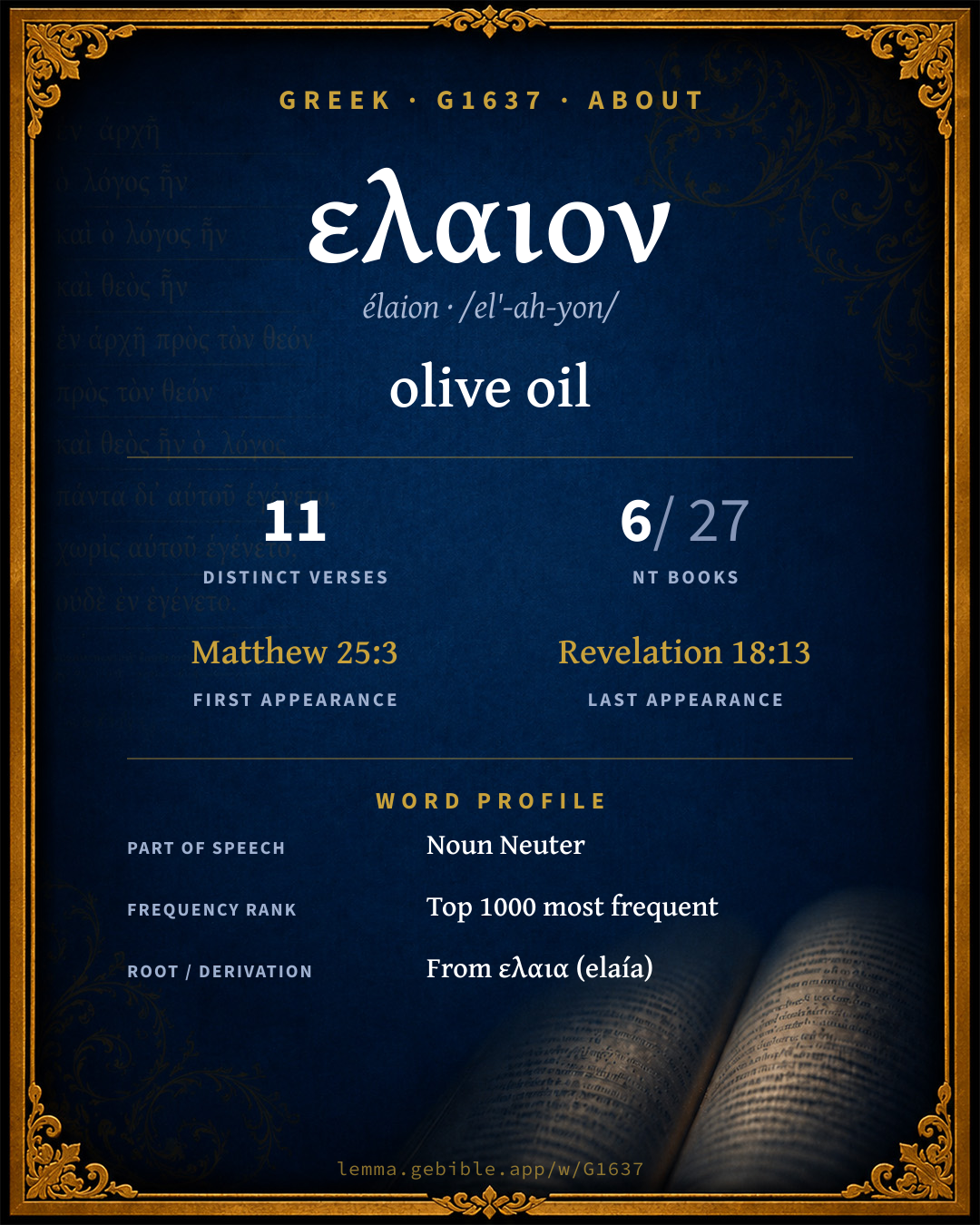
ἔλαιον
olive oil
Full lexicon entry — Thayer's Greek Lexicon
From Thayer's Greek Lexicon
Where this word appears
Grammar key — what these labels mean
Part of speech
- Noun
- A naming word — a person, place, thing, or idea.
Case
- Accusative
- The case of the direct object and of extent.
- Dative
- The case of the indirect object, means, or location — “to / for / with / in.”
- Genitive
- The case of source, possession, or “of” — answers “whose / from what.”
Gender
- Neuter
- Grammatically neuter.
Number
- Singular
- One.
Every verse where G1637 appears in the Book of Revelation — 2 distinct verses. Click any verse to open its interlinear word-by-word view. Verse text shown in the World English Bible for context — . Each verse’s Greek form is shown with its reference; the English is not keyword-highlighted, since the data carries no word-level English alignment. Use “Compare translations” on any verse to read it across multiple English versions. This concordance covers the Greek New Testament; Septuagint (Greek Old Testament) occurrences of this word are not indexed here.
Revelation
- Revelation 6:6 ἔλαιον n acc sg neut I heard a voice in the midst of the four living creatures saying, "A choenix of wheat for a denarius, and three choenix of barley for a denarius! Don't damage the oil and the wine!"
- Revelation 18:13 ἔλαιον n acc sg neut and cinnamon, incense, perfume, frankincense, wine, olive oil, fine flour, wheat, sheep, horses, chariots, bodies, and people's souls.
About this entry
At a glance — auto-summarized from this page’s data, not written by a person. Every figure links to its source below. This summary describes the numbers; it doesn’t interpret them.
The Greek noun ελαιον centers on the idea of “olive oil.” Its earliest occurrence is Matthew 25:3. The Greek New Testament uses it across 11 verses — uncommon. Matthew dominates its distribution — 3 of 11 verses. Sharing its root, it stands alongside ελαια and ελαιων. For the data behind this summary, explore the sense tree and the renderings breakdown below.
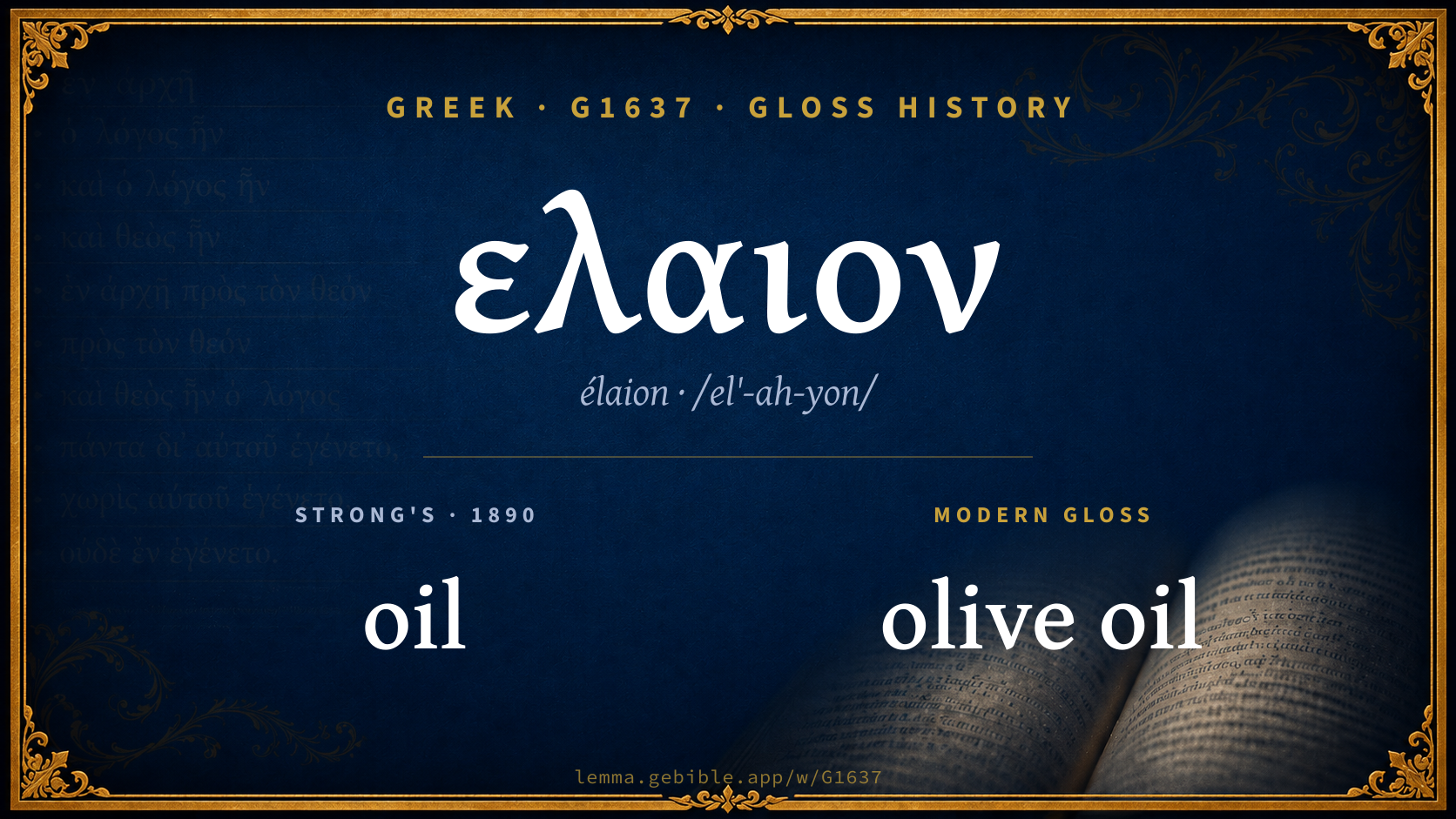
Gloss history
Strong's 1890 vs modern scholarship
About this word
Strong's G1637 catalogs a Greek word from the Greek New Testament.
These counts are not copied from any lexicon or concordance. They are computed here, from the morphology-tagged Greek New Testament. What Lemma adds →
- 11
- distinct verses
- The word appears in 11 distinct verses.
- 6 / 27
- NT books
- The word appears in 6 of 27 New Testament books.
- #978
- by frequency
- Top 1000 most frequent Greek words (rank 978 of 5,347 Greek words by occurrence).
View all 11 occurrences in the concordance →
Most concentrated in
- Matthew 3 verses 27%
- Luke 3 verses 27%
- Revelation 2 verses 18%
By section of the New Testament
By traditional corpus
Conventional, traditional groupings — biblical authorship is debated, so this is a traditional corpus grouping, not an authorship claim. Some books belong to more than one corpus (Luke is in both the Gospels and the Lukan corpus, and so on), so these shares overlap and need not total 100%. Each figure is a share of the word’s 11 distinct verses.
- Gospels 7 verses · 64%
- Lukan (Luke–Acts) 3 verses · 27%
- Johannine 2 verses · 18%
- Revelation 2 verses · 18%
- Hebrews 1 verse · 9%
- General (Catholic) Epistles 1 verse · 9%
How translations render this word
Counts come from each version’s own published word-to-Strong’s tagging or interlinear alignment — an approximate guide to how each version renders this word, not a word-level alignment the data otherwise carries. Because each total is that version’s own tagged count, the per-version totals vary from one another and need not match the appearance or distinct-verse counts above. These counts may also differ from a printed concordance because Lemma counts each distinctly tagged rendering and does not collapse phrase taggings into a single head-word total. This is a fixed set of word-tagged versions (KJV, ASV, BSB, ULT) and does not change with the reading translation you choose elsewhere. Each version’s license is shown beside its name below (and on Sources).
- King James Version: Oil 11×
- American Standard Version: Oil 11×
- Berean Standard Bible: Oil 9×, Olive oil 2×
- unfoldingWord Literal Text: Oil 10×
King James Version Public Domain
Renders G1637 across 11 tagged occurrences — most commonly:
American Standard Version Public Domain
Renders G1637 across 11 tagged occurrences — most commonly:
Berean Standard Bible Public Domain
Renders G1637 across 11 tagged occurrences — most commonly:
unfoldingWord Literal Text CC BY-SA 4.0
Renders G1637 across 11 tagged occurrences — most commonly:
Plus 1 rendering that appears only once — usually multi-word phrases or single function words the recovered tagging swept in, not distinct renderings.
Senses in Thayer's
The 1 sense Thayer's distinguishes for this word, in lexicon order (not ranked by frequency or importance). The full entry — with sub-senses — is in the Lexicon Entry tab.
- olive oil
Word origin
Derived from ελαια (elaía) (G1636) — olive tree.
Neuter of the same as G1636 ; olive oil : - oil.
— Strong’s Exhaustive Concordance (1890), public domain.
Forms in the corpus
The 3 distinct written forms G1637 takes in the Greek New Testament, most frequent first — each parse links to that case’s occurrences in the concordance.
| Form | Parsing | Example | Uses |
|---|---|---|---|
| ἔλαιον élaion | Noun, Accusative, Singular, Neuter | Matthew 25:3 | 6 |
| ἐλαίῳ elaíō | Noun, Dative, Singular, Neuter | Mark 6:13 | 3 |
| ἐλαίου elaíou | Noun, Genitive, Singular, Neuter | Matthew 25:8 | 2 |
Same root — word family
Other Thayer's entries built from the same root as G1637, grouped by Strong’s listed origin. These share a root / origin per the lexicon — not necessarily a shared meaning. Each links to that word’s own entry.
Derives from
Shares the same root
Compare all same-root words → They share a root, not necessarily a meaning.
Septuagint usage
The same Greek word ελαιον appears 190 times in the Greek Old Testament (Septuagint), across 176 verses in 24 books.
- 190
- LXX occurrences
- Tagged occurrences of this Greek word in the Septuagint.
- 176
- verses
- Distinct Septuagint verses containing this word.
- 24 / 39
- OT books
- The word appears in 24 of the 39 Old Testament books.
Sample Septuagint occurrences
- Genesis 28:18 ἔλαιον
- Exodus 27:20 ἔλαιον
- Leviticus 2:1 ἔλαιον
- Numbers 4:9 ἔλαιον
- Deuteronomy 7:13 ἔλαιον
- 1 Samuel 10:1 ἔλαιον
- 2 Samuel 1:21 ἔλαιον
- 1 Kings 1:39 ἔλαιον
- 2 Kings 4:2 ἔλαιον
- 1 Chronicles 9:29 ἔλαιον
- 2 Chronicles 2:9 ἔλαιον
- Ezra 3:7 ἔλαιον
Septuagint occurrences (same lexeme)
Every verse where the same Strong’s number (G1637) appears in the Greek Septuagint — showing the first 50 of 176. Verse text shown in the World English Bible for context; the Greek form is the matched word — the English is not keyword-highlighted.
- Genesis 28:18 ἔλαιον Jacob rose up early in the morning, and took the stone that he had put under his head, and set it up for a pillar, and poured oil on the top of it.
- Genesis 35:14 ἔλαιον Jacob set up a pillar in the place where he spoke with him, a pillar of stone. He poured out a drink-offering on it, and poured oil on it.
- Exodus 27:20 ἔλαιον "You shall command the children of Israel, that they bring to you pure olive oil beaten for the light, to cause a lamp to burn continually.
- Exodus 29:2 ἔλαιον unleavened bread, unleavened cakes mixed with oil, and unleavened wafers anointed with oil: you shall make them of fine wheat flour.
- Exodus 29:7 ἔλαιον Then you shall take the anointing oil, and pour it on his head, and anoint him.
- Exodus 29:21 ἔλαιον You shall take of the blood that is on the altar, and of the anointing oil, and sprinkle it on Aaron, and on his garments, and on his sons, and on the garments of his sons with him: and he shall be made holy, and his garments, and his sons, and his sons' garments with him.
- Exodus 29:23 ἔλαιον and one loaf of bread, one cake of oiled bread, and one wafer out of the basket of unleavened bread that is before Yahweh.
- Exodus 29:40 ἔλαιον and with the one lamb a tenth part of an ephah of fine flour mixed with the fourth part of a hin of beaten oil, and the fourth part of a hin of wine for a drink-offering.
- Exodus 30:24 ἔλαιον and of cassia five hundred, after the shekel of the sanctuary; and a hin of olive oil.
- Exodus 30:25 ἔλαιον You shall make it a holy anointing oil, a perfume compounded after the art of the perfumer: it shall be a holy anointing oil.
- Exodus 30:31 ἔλαιον You shall speak to the children of Israel, saying, 'This shall be a holy anointing oil to me throughout your generations.
- Exodus 31:11 ἔλαιον the anointing oil, and the incense of sweet spices for the holy place: according to all that I have commanded you they shall do."
- Exodus 35:12 ἔλαιον the ark, and its poles, the mercy seat, the veil of the screen;
- Exodus 35:19 ἔλαιον the finely worked garments, for ministering in the holy place, the holy garments for Aaron the priest, and the garments of his sons, to minister in the priest's office.'"
- Exodus 35:28 ἔλαιον and the spice, and the oil for the light, for the anointing oil, and for the sweet incense.
- Exodus 38:25 ἔλαιον The silver of those who were numbered of the congregation was one hundred talents, and one thousand seven hundred seventy-five shekels, after the shekel of the sanctuary:
- Exodus 39:15 ἔλαιον They made on the breastplate chains like cords, of braided work of pure gold.
- Exodus 39:16 ἔλαιον They made two settings of gold, and two gold rings, and put the two rings on the two ends of the breastplate.
- Exodus 40:9 ἔλαιον You shall take the anointing oil, and anoint the tent, and all that is in it, and shall make it holy, and all its furniture: and it will be holy.
- Leviticus 2:1 ἔλαιον "'When anyone offers an offering of a meal offering to Yahweh, his offering shall be of fine flour; and he shall pour oil on it, and put frankincense on it.
- Leviticus 2:2 ἔλαιον He shall bring it to Aaron's sons the priests; and he shall take his handful of its fine flour, and of its oil, with all its frankincense; and the priest shall burn the memorial of it on the altar, an offering made by fire, of a sweet savor to Yahweh.
- Leviticus 2:4 ἔλαιον "'When you offer an offering of a meal offering baked in the oven, it shall be unleavened cakes of fine flour mixed with oil, or unleavened wafers anointed with oil.
- Leviticus 2:5 ἔλαιον If your offering is a meal offering of the baking pan, it shall be of unleavened fine flour, mixed with oil.
- Leviticus 2:6 ἔλαιον You shall cut it in pieces, and pour oil on it. It is a meal offering.
- Leviticus 2:7 ἔλαιον If your offering is a meal offering of the frying pan, it shall be made of fine flour with oil.
- Leviticus 2:15 ἔλαιον You shall put oil on it, and lay frankincense on it: it is a meal offering.
- Leviticus 2:16 ἔλαιον The priest shall burn as its memorial, part of its bruised grain, and part of its oil, along with all its frankincense: it is an offering made by fire to Yahweh.
- Leviticus 5:11 ἔλαιον "'But if he can't afford two turtledoves, or two young pigeons, then he shall bring his offering for that in which he has sinned, the tenth part of an ephah of fine flour for a sin offering. He shall put no oil on it, neither shall he put any frankincense on it, for it is a sin offering.
- Leviticus 6:8 ἔλαιον Yahweh spoke to Moses, saying,
- Leviticus 6:14 ἔλαιον "'This is the law of the meal offering: the sons of Aaron shall offer it before Yahweh, before the altar.
- Leviticus 7:10 ἔλαιον Every meal offering, mixed with oil or dry, belongs to all the sons of Aaron, one as well as another.
- Leviticus 7:12 ἔλαιον If he offers it for a thanksgiving, then he shall offer with the sacrifice of thanksgiving unleavened cakes mixed with oil, and unleavened wafers anointed with oil, and cakes mixed with oil.
- Leviticus 8:2 ἔλαιον "Take Aaron and his sons with him, and the garments, and the anointing oil, and the bull of the sin offering, and the two rams, and the basket of unleavened bread;
- Leviticus 8:10 ἔλαιον Moses took the anointing oil, and anointed the tabernacle and all that was in it, and sanctified them.
- Leviticus 8:12 ἔλαιον He poured some of the anointing oil on Aaron's head, and anointed him, to sanctify him.
- Leviticus 8:26 ἔλαιον and out of the basket of unleavened bread, that was before Yahweh, he took one unleavened cake, and one cake of oiled bread, and one wafer, and placed them on the fat, and on the right thigh.
- Leviticus 8:30 ἔλαιον Moses took some of the anointing oil, and some of the blood which was on the altar, and sprinkled it on Aaron, on his garments, and on his sons, and on his sons' garments with him, and sanctified Aaron, his garments, and his sons, and his sons' garments with him.
- Leviticus 9:4 ἔλαιον and an ox and a ram for peace offerings, to sacrifice before Yahweh; and a meal offering mixed with oil: for today Yahweh appears to you.'"
- Leviticus 10:7 ἔλαιον You shall not go out from the door of the Tent of Meeting, lest you die; for the anointing oil of Yahweh is on you." They did according to the word of Moses.
- Leviticus 14:10 ἔλαιον "On the eighth day he shall take two male lambs without blemish, and one ewe lamb a year old without blemish, and three tenths of an ephah of fine flour for a meal offering, mingled with oil, and one log of oil.
- Leviticus 14:12 ἔλαιον "The priest shall take one of the male lambs, and offer him for a trespass offering, with the log of oil, and wave them for a wave offering before Yahweh.
- Leviticus 14:15 ἔλαιον The priest shall take some of the log of oil, and pour it into the palm of his own left hand.
- Leviticus 14:16 ἔλαιον The priest shall dip his right finger in the oil that is in his left hand, and shall sprinkle some of the oil with his finger seven times before Yahweh.
- Leviticus 14:17 ἔλαιον The priest shall put some of the rest of the oil that is in his hand on the tip of the right ear of him who is to be cleansed, and on the thumb of his right hand, and on the big toe of his right foot, upon the blood of the trespass offering.
- Leviticus 14:18 ἔλαιον The rest of the oil that is in the priest's hand he shall put on the head of him who is to be cleansed, and the priest shall make atonement for him before Yahweh.
- Leviticus 14:21 ἔλαιον "If he is poor, and can't afford so much, then he shall take one male lamb for a trespass offering to be waved, to make atonement for him, and one tenth of an ephah of fine flour mingled with oil for a meal offering, and a log of oil;
- Leviticus 14:24 ἔλαιον The priest shall take the lamb of the trespass offering, and the log of oil, and the priest shall wave them for a wave offering before Yahweh.
- Leviticus 14:26 ἔλαιον The priest shall pour some of the oil into the palm of his own left hand;
- Leviticus 14:27 ἔλαιον and the priest shall sprinkle with his right finger some of the oil that is in his left hand seven times before Yahweh.
- Leviticus 14:28 ἔλαιον Then the priest shall put some of the oil that is in his hand on the tip of the right ear of him who is to be cleansed, and on the thumb of his right hand, and on the big toe of his right foot, on the place of the blood of the trespass offering.
These are occurrences of the same Greek lexeme (G1637) in the Septuagint — not a translation of any one Hebrew word. The store carries no word-level Hebrew↔Greek alignment, so no Hebrew original is asserted here. Counts come from the recovered LXX Strong's tagging — high-frequency vocabulary is well covered, while rare or late forms may be untagged — so they reflect tagged occurrences and may slightly undercount.