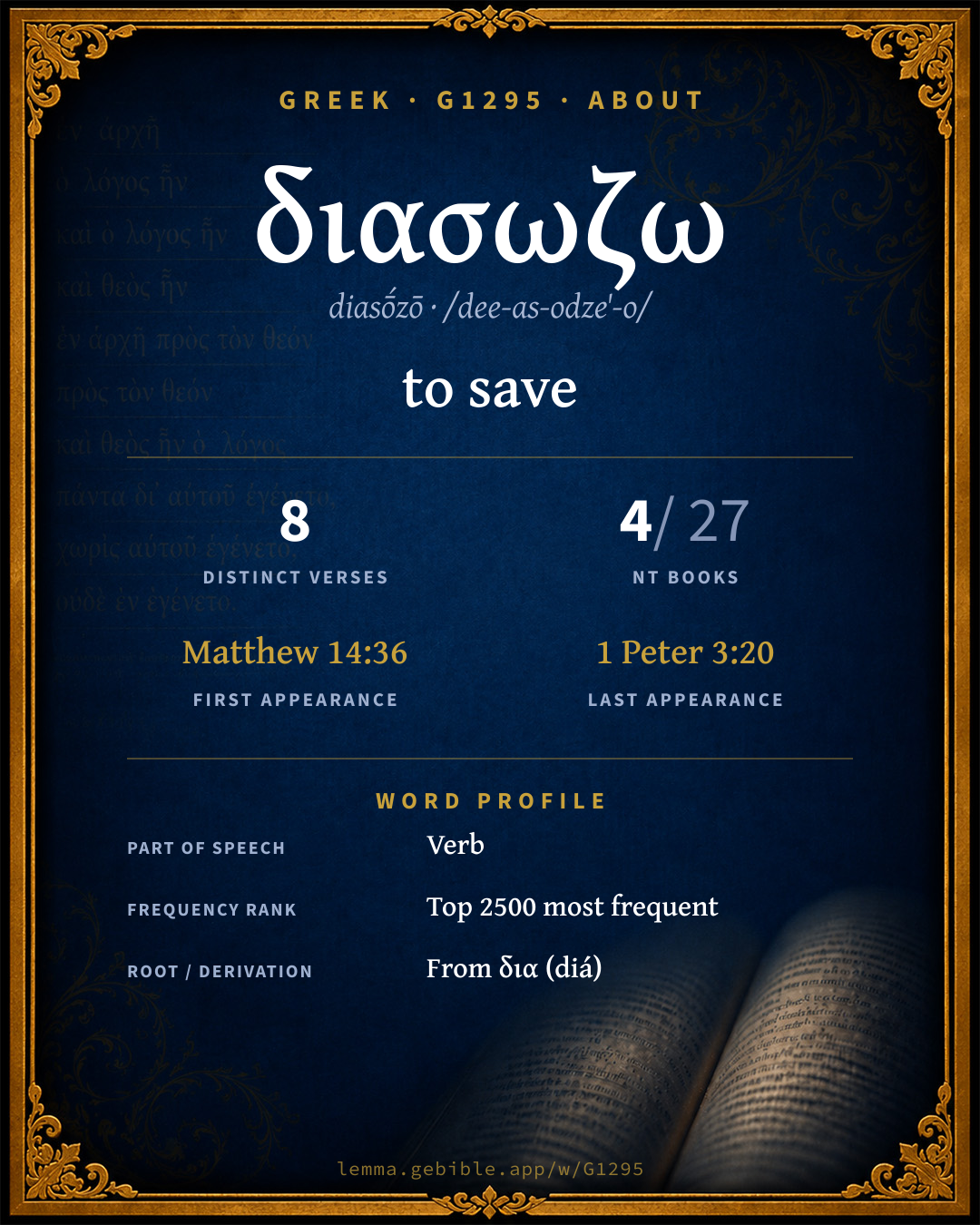
διασώζω
to save
‘to save’ is one of 3 main senses fuller range ↓
Full lexicon entry — Thayer's Greek Lexicon
From Thayer's Greek Lexicon
Where this word appears
Grammar key — what these labels mean
Part of speech
- Verb
- An action or state-of-being word.
Tense
- Aorist
- Action viewed as a simple whole, without regard to duration — often past (perfective aspect).
Voice
- Passive
- The subject receives the action.
- Active
- The subject performs the action.
Mood
- Indicative
- States a fact or asks a factual question (the mood of reality).
- Infinitive
- A verbal noun (“to write”), unmarked for person or number.
- Subjunctive
- Expresses probability, purpose, or possibility (the mood of contingency).
- Participle
- A verbal adjective (“writing,” “having written”).
Case
- Accusative
- The case of the direct object and of extent.
- Nominative
- The case of the subject (and the predicate nominative).
Person
- 3rd person
- The one spoken about (“he / she / it / they”).
Gender
- Masculine
- Grammatically masculine.
Number
- Plural
- More than one.
- Singular
- One.
Grammatical forms
- Verb, Aorist, Passive, Indicative, 3rd person, Plural 2 times (25%)
- Verb, Aorist, Active, Infinitive 1 time (13%)
- Verb, Aorist, Active, Subjunctive, 3rd person, Plural 1 time (13%)
- Verb, Aorist, Active, Subjunctive, 3rd person, Singular 1 time (13%)
- Verb, Aorist, Passive, Infinitive 1 time (13%)
- Verb, Aorist, Passive, Participle, Accusative, Singular, Masculine 1 time (13%)
- Verb, Aorist, Passive, Participle, Nominative, Plural, Masculine 1 time (13%)
Parsed forms decoded from the imported morphology (Robinson–Tischendorf, public domain), counted across 8 parsed occurrences — not distinct verses.
Every verse where G1295 appears — 8 distinct verses across 4 books. Click any verse to open its interlinear word-by-word view. Verse text shown in the World English Bible for context — . Each verse’s Greek form is shown with its reference; the English is not keyword-highlighted, since the data carries no word-level English alignment. Use “Compare translations” on any verse to read it across multiple English versions. This concordance covers the Greek New Testament; Septuagint (Greek Old Testament) occurrences of this word are not indexed here.
Matthew 1 verse
Luke 1 verse
Acts 5 verses
- Acts 23:24 διασώσωσι aor act subj 3pl He asked them to provide animals, that they might set Paul on one, and bring him safely to Felix the governor.
- Acts 27:43 διασῶσαι aor act inf But the centurion, desiring to save Paul, stopped them from their purpose, and commanded that those who could swim should throw themselves overboard first to go toward the land;
- Acts 27:44 διασωθῆναι aor pass inf and the rest should follow, some on planks, and some on other things from the ship. So it happened that they all escaped safely to the land.
- Acts 28:1 διασωθέντες aor pass ptcp nom pl masc When we had escaped, then they learned that the island was called Malta.
- Acts 28:4 διασωθέντα aor pass ptcp acc sg masc When the natives saw the creature hanging from his hand, they said one to another, "No doubt this man is a murderer, whom, though he has escaped from the sea, yet Justice has not allowed to live."
1 Peter 1 verse
About this entry
At a glance — auto-summarized from this page’s data, not written by a person. Every figure links to its source below. This summary describes the numbers; it doesn’t interpret them.
“to save” is the headline sense of the Greek verb διασωζω (diasṓzō). More than half of its appearances fall in Acts. It appears 8 verses across 4 books of the Greek New Testament, among its uncommon vocabulary. First canonically at Matthew 14:36, it enters the text early. Lexicons map it across 3 senses. The sections below give every sense, occurrence, and version rendering.
Gloss history
Strong's 1890 vs modern scholarship

About this word
Strong's G1295 catalogs a Greek word from the Greek New Testament.
These counts are not copied from any lexicon or concordance. They are computed here, from the morphology-tagged Greek New Testament. What Lemma adds →
- 8
- distinct verses
- The word appears in 8 distinct verses.
- 4 / 27
- NT books
- The word appears in 4 of 27 New Testament books.
- #1,240
- by frequency
- Top 2500 most frequent Greek words (rank 1,240 of 5,347 Greek words by occurrence).
View all 8 occurrences in the concordance →
By section of the New Testament
By traditional corpus
Conventional, traditional groupings — biblical authorship is debated, so this is a traditional corpus grouping, not an authorship claim. Some books belong to more than one corpus (Luke is in both the Gospels and the Lukan corpus, and so on), so these shares overlap and need not total 100%. Each figure is a share of the word’s 8 distinct verses.
- Lukan (Luke–Acts) 6 verses · 75%
- Gospels 2 verses · 25%
- General (Catholic) Epistles 1 verse · 13%
How translations render this word
Counts come from each version’s own published word-to-Strong’s tagging or interlinear alignment — an approximate guide to how each version renders this word, not a word-level alignment the data otherwise carries. Because each total is that version’s own tagged count, the per-version totals vary from one another and need not match the appearance or distinct-verse counts above. These counts may also differ from a printed concordance because Lemma counts each distinctly tagged rendering and does not collapse phrase taggings into a single head-word total. This is a fixed set of word-tagged versions (KJV, ASV, BSB, ULT) and does not change with the reading translation you choose elsewhere. Each version’s license is shown beside its name below (and on Sources).
- King James Version: Bring him safe 1×, He hath escaped 1×, Heal 1×
- American Standard Version: Safe 2×, Save 2×
- Berean Standard Bible: Heal 1×, Spare 1×, Take safely 1×
- unfoldingWord Literal Text: Having been brought safely through 1×, Having been saved 1×, He might save 1×
King James Version Public Domain
Renders G1295 across 9 tagged occurrences — most commonly:
American Standard Version Public Domain
Renders G1295 across 10 tagged occurrences — most commonly:
Plus 6 renderings that appear only once — usually multi-word phrases or single function words the recovered tagging swept in, not distinct renderings.
Berean Standard Bible Public Domain
Renders G1295 across 8 tagged occurrences — most commonly:
unfoldingWord Literal Text CC BY-SA 4.0
Renders G1295 across 8 tagged occurrences — most commonly:
Senses in Thayer's
The 3 senses Thayer's distinguishes for this word, in lexicon order (not ranked by frequency or importance). The full entry — with sub-senses — is in the Lexicon Entry tab.
- to preserve through danger, to bring safely through
- to save, keep from perishing
- to save out of danger, rescue
Word origin
Derived from δια (diá) (G1223) — through.
Forms in the corpus
The 7 distinct written forms G1295 takes in the Greek New Testament, most frequent first — each parse links to that tense’s occurrences in the concordance.
| Form | Parsing | Example | Uses |
|---|---|---|---|
| διεσώθησαν diesṓthēsan | Verb, Aorist, Passive, Indicative, 3rd person, Plural | Matthew 14:36 | 2 |
| διασωθέντα diasōthénta | Verb, Aorist, Passive, Participle, Accusative, Singular, Masculine | Acts 28:4 | 1 |
| διασωθέντες diasōthéntes | Verb, Aorist, Passive, Participle, Nominative, Plural, Masculine | Acts 28:1 | 1 |
| διασωθῆναι diasōthē̂nai | Verb, Aorist, Passive, Infinitive | Acts 27:44 | 1 |
| διασώσωσι diasṓsōsi | Verb, Aorist, Active, Subjunctive, 3rd person, Plural | Acts 23:24 | 1 |
| διασώσῃ diasṓsē | Verb, Aorist, Active, Subjunctive, 3rd person, Singular | Luke 7:3 | 1 |
| διασῶσαι diasō̂sai | Verb, Aorist, Active, Infinitive | Acts 27:43 | 1 |
Same root — word family
Other Thayer's entries built from the same root as G1295, grouped by Strong’s listed origin. These share a root / origin per the lexicon — not necessarily a shared meaning. Each links to that word’s own entry.
Derives from
Shares the same root
- διαβαινω diabaínō G1224 to pass through
- διαβαλλω diabállō G1225 to slander
- διαβεβαιοομαι diabebaióomai G1226 to affirm strongly
- διαβλεπω diablépō G1227 to look through
- διαγγελλω diangéllō G1229 to proclaim
- διαγινομαι diagínomai G1230 to continue
- διαγινωσκω diaginṓskō G1231 to ascertain
- διαγογγυζω diagongýzō G1234 to murmur
- διαγρηγορεω diagrēgoréō G1235 to watch through
- διαγω diágō G1236 to lead through
- διαδεχομαι diadéchomai G1237 to receive in succession
- διαδημα diádēma G1238 diadem
- διαδιδωμι diadídōmi G1239 to distribute
- διαζωννυμι diazṓnnymi G1241 to gird around
- διαιρεω diairéō G1244 to divide
- διακαθαριζω diakatharízō G1245 to cleanse thoroughly
- διακατελεγχομαι diakatelénchomai G1246 to confute
- διακουομαι diakoúomai G1251 to hear fully
- διακρινω diakrínō G1252 to distinguish
- διακωλυω diakōlýō G1254 to hinder
- διαλαλεω dialaléō G1255 to converse
- διαλεγομαι dialégomai G1256 to discuss
- διαλειπω dialeípō G1257 to intermit
- διαλλασσω diallássō G1259 to reconcile
+62 more words share this root (not shown).
Compare all same-root words → Showing 4 of 88 — not the complete family. They share a root, not necessarily a meaning.
Septuagint usage
The same Greek word διασωζω appears 51 times in the Greek Old Testament (Septuagint), across 48 verses in 21 books.
- 51
- LXX occurrences
- Tagged occurrences of this Greek word in the Septuagint.
- 48
- verses
- Distinct Septuagint verses containing this word.
- 21 / 39
- OT books
- The word appears in 21 of the 39 Old Testament books.
Sample Septuagint occurrences
- Genesis 19:19 διασώζω
- Numbers 10:9 διασώζω
- Deuteronomy 20:4 διασώζω
- Joshua 6:26 διασώζω
- Judges 3:26 διασώζω
- 1 Samuel 19:10 διασώζω
- 2 Samuel 1:3 διασώζω
- 2 Kings 10:24 διασώζω
- Ezra 9:14 διασώζω
- Job 21:10 διασώζω
- Proverbs 10:5 διασώζω
- Ecclesiastes 8:8 διασώζω
Septuagint occurrences (same lexeme)
Every verse where the same Strong’s number (G1295) appears in the Greek Septuagint. Verse text shown in the World English Bible for context; the Greek form is the matched word — the English is not keyword-highlighted.
- Genesis 19:19 διασώζω See now, your servant has found favor in your sight, and you have magnified your loving kindness, which you have shown to me in saving my life. I can't escape to the mountain, lest evil overtake me, and I die.
- Genesis 35:3 διασώζω Let us arise, and go up to Bethel. I will make there an altar to God, who answered me in the day of my distress, and was with me in the way which I went."
- Numbers 10:9 διασώζω When you go to war in your land against the adversary who oppresses you, then you shall sound an alarm with the trumpets; and you shall be remembered before Yahweh your God, and you shall be saved from your enemies.
- Numbers 21:29 διασώζω Woe to you, Moab! You are undone, people of Chemosh: He has given his sons as fugitives, His daughters into captivity, To Sihon king of the Amorites.
- Deuteronomy 20:4 διασώζω for Yahweh your God is he who goes with you, to fight for you against your enemies, to save you.
- Joshua 6:26 διασώζω Joshua charged them with an oath at that time, saying, Cursed be the man before Yahweh, that rises up and builds this city Jericho: with the loss of his firstborn shall he lay the foundation of it, and with the loss of his youngest son shall he set up the gates of it.
- Joshua 9:15 διασώζω Joshua made peace with them, and made a covenant with them, to let them live: and the princes of the congregation swore to them.
- Joshua 10:20 διασώζω It happened, when Joshua and the children of Israel had made an end of killing them with a very great slaughter, until they were consumed, and the remnant which remained of them had entered into the fortified cities,
- Joshua 10:28 διασώζω Joshua took Makkedah on that day, and struck it with the edge of the sword, and the king of it: he utterly destroyed them and all the souls who were therein; he left none remaining; and he did to the king of Makkedah as he had done to the king of Jericho.
- Joshua 10:30 διασώζω and Yahweh delivered it also, and the king of it, into the hand of Israel; and he struck it with the edge of the sword, and all the souls who were therein; he left none remaining in it; and he did to the king of it as he had done to the king of Jericho.
- Joshua 10:37 διασώζω and they took it, and struck it with the edge of the sword, and the king of it, and all the cities of it, and all the souls who were therein; he left none remaining, according to all that he had done to Eglon; but he utterly destroyed it, and all the souls who were therein.
- Joshua 10:39 διασώζω and he took it, and the king of it, and all the cities of it; and they struck them with the edge of the sword, and utterly destroyed all the souls who were therein; he left none remaining: as he had done to Hebron, so he did to Debir, and to the king of it; as he had done also to Libnah, and to the king of it.
- Joshua 11:8 διασώζω Yahweh delivered them into the hand of Israel, and they struck them, and chased them to great Sidon, and to Misrephoth Maim, and to the valley of Mizpeh eastward; and they struck them, until they left them none remaining.
- Judges 3:26 διασώζω Ehud escaped while they waited, and passed beyond the quarries, and escaped to Seirah.
- Judges 3:29 διασώζω They struck of Moab at that time about ten thousand men, every lusty man, and every man of valor; and there escaped not a man.
- Judges 12:4 διασώζω Then Jephthah gathered together all the men of Gilead, and fought with Ephraim; and the men of Gilead struck Ephraim, because they said, You are fugitives of Ephraim, you Gileadites, in the midst of Ephraim, [and] in the midst of Manasseh.
- Judges 12:5 διασώζω The Gileadites took the fords of the Jordan against the Ephraimites. It was so, that when [any of] the fugitives of Ephraim said, Let me go over, the men of Gilead said to him, Are you an Ephraimite? If he said, No;
- Judges 21:17 διασώζω They said, There must be an inheritance for those who are escaped of Benjamin, that a tribe not be blotted out from Israel.
- 1 Samuel 19:10 διασώζω Saul sought to strike David even to the wall with the spear; but he slipped away out of Saul's presence, and he struck the spear into the wall: and David fled, and escaped that night.
- 1 Samuel 19:17 διασώζω Saul said to Michal, Why have you deceived me thus, and let my enemy go, so that he is escaped? Michal answered Saul, He said to me, Let me go; why should I kill you?
- 1 Samuel 19:18 διασώζω Now David fled, and escaped, and came to Samuel to Ramah, and told him all that Saul had done to him. He and Samuel went and lived in Naioth.
- 1 Samuel 20:29 διασώζω and he said, Please let me go, for our family has a sacrifice in the city; and my brother, he has commanded me [to be there]: and now, if I have found favor in your eyes, let me get away, I pray you, and see my brothers. Therefore he is not come to the king's table.
- 1 Samuel 22:1 διασώζω David therefore departed there, and escaped to the cave of Adullam: and when his brothers and all his father's house heard it, they went down there to him.
- 1 Samuel 22:20 διασώζω One of the sons of Ahimelech, the son of Ahitub, named Abiathar, escaped, and fled after David.
- 1 Samuel 23:13 διασώζω Then David and his men, who were about six hundred, arose and departed out of Keilah, and went wherever they could go. It was told Saul that David was escaped from Keilah; and he gave up going there.
- 2 Samuel 1:3 διασώζω David said to him, From whence come you? He said to him, Out of the camp of Israel am I escaped.
- 2 Kings 10:24 διασώζω They went in to offer sacrifices and burnt offerings. Now Jehu had appointed him eighty men outside, and said, If any of the men whom I bring into your hands escape, [he who lets him go], his life shall be for the life of him.
- 2 Kings 19:30 διασώζω The remnant that has escaped of the house of Judah shall again take root downward, and bear fruit upward.
- Ezra 9:14 διασώζω shall we again break your commandments, and join in affinity with the peoples that do these abominations? would not you be angry with us until you had consumed us, so that there should be no remnant, nor any to escape?
- Ezra 9:15 διασώζω Yahweh, the God of Israel, you are righteous; for we are left a remnant that is escaped, as it is this day: behold, we are before you in our guiltiness; for none can stand before you because of this.
- Job 21:10 διασώζω Their bulls breed without fail. Their cows calve, and don't miscarry.
- Job 21:20 διασώζω Let his own eyes see his destruction. Let him drink of the wrath of the Almighty.
- Job 22:30 διασώζω He will even deliver him who is not innocent; Yes, he shall be delivered through the cleanness of your hands."
- Job 29:12 διασώζω Because I delivered the poor who cried, And the fatherless also, who had none to help him.
- Job 36:12 διασώζω But if they don't listen, they shall perish by the sword; They shall die without knowledge.
- Proverbs 10:5 διασώζω He who gathers in summer is a wise son, But he who sleeps during the harvest is a son who causes shame.
- Ecclesiastes 8:8 διασώζω There is no man who has power over the spirit to contain the spirit; neither does he have power over the day of death. There is no discharge in war; neither shall wickedness deliver those who practice it.
- Ecclesiastes 9:15 διασώζω Now a poor wise man was found in it, and he by his wisdom delivered the city; yet no man remembered that same poor man.
- Isaiah 37:38 διασώζω It happened, as he was worshipping in the house of Nisroch his god, that Adrammelech and Sharezer his sons struck him with the sword; and they escaped into the land of Ararat. Esar Haddon his son reigned in his place.
- Jeremiah 8:20 διασώζω The harvest is past, the summer is ended, and we are not saved.
- Ezekiel 17:15 διασώζω But he rebelled against him in sending his ambassadors into Egypt, that they might give him horses and much people. Shall he prosper? shall he escape who does such things? shall he break the covenant, and yet escape?
- Daniel 11:42 διασώζω He shall stretch forth his hand also on the countries; and the land of Egypt shall not escape.
- Hosea 13:10 διασώζω Where is your king now, that he may save you in all your cities? And your judges, of whom you said, 'Give me a king and princes?'
- Amos 2:15 διασώζω Neither shall he stand who handles the bow; And he who is swift of foot won't escape; Neither shall he who rides the horse deliver himself;
- Amos 9:1 διασώζω I saw the Lord standing beside the altar, and he said, "Strike the tops of the pillars, that the thresholds may shake; and break them in pieces on the head of all of them; and I will kill the last of them with the sword: there shall not one of them flee away, and there shall not one of them escape.
- Jonah 1:6 διασώζω So the shipmaster came to him, and said to him, "What do you mean, sleeper? Arise, call on your gods! Maybe the gods will notice us, so that we won't perish."
- Micah 6:14 διασώζω You shall eat, but not be satisfied. Your humiliation will be in your midst. You will store up, but not save; And that which you save I will give up to the sword.
- Zechariah 8:13 διασώζω It shall come to pass that, as you were a curse among the nations, house of Judah and house of Israel, so will I save you, and you shall be a blessing. Don't be afraid. Let your hands be strong."
These are occurrences of the same Greek lexeme (G1295) in the Septuagint — not a translation of any one Hebrew word. The store carries no word-level Hebrew↔Greek alignment, so no Hebrew original is asserted here. Counts come from the recovered LXX Strong's tagging — high-frequency vocabulary is well covered, while rare or late forms may be untagged — so they reflect tagged occurrences and may slightly undercount.