Micah 6:14

Hebrew (Westminster Leningrad Codex) Micah 6:14 appears in the Hebrew Old Testament. The text above is from the Westminster Leningrad Codex. Each word links to its Strong’s number, a concise gloss, and parsing drawn from the Open Scriptures Hebrew Bible morphology. Click any word for its full Brown-Driver-Briggs (BDB) entry.
Download image
Cite this verse

Micah 6:14 (World English Bible). Public Domain. Lemma interlinear Bible study tool, https://lemma.gebible.app/v/micah/6/14.

Show BibTeX & RIS
BibTeX
RIS
English Translation
You shall eat, but not be satisfied. Your humiliation will be in your midst. You will store up, but not save; And that which you save I will give up to the sword.
World English Bible · Public Domain
Highlights
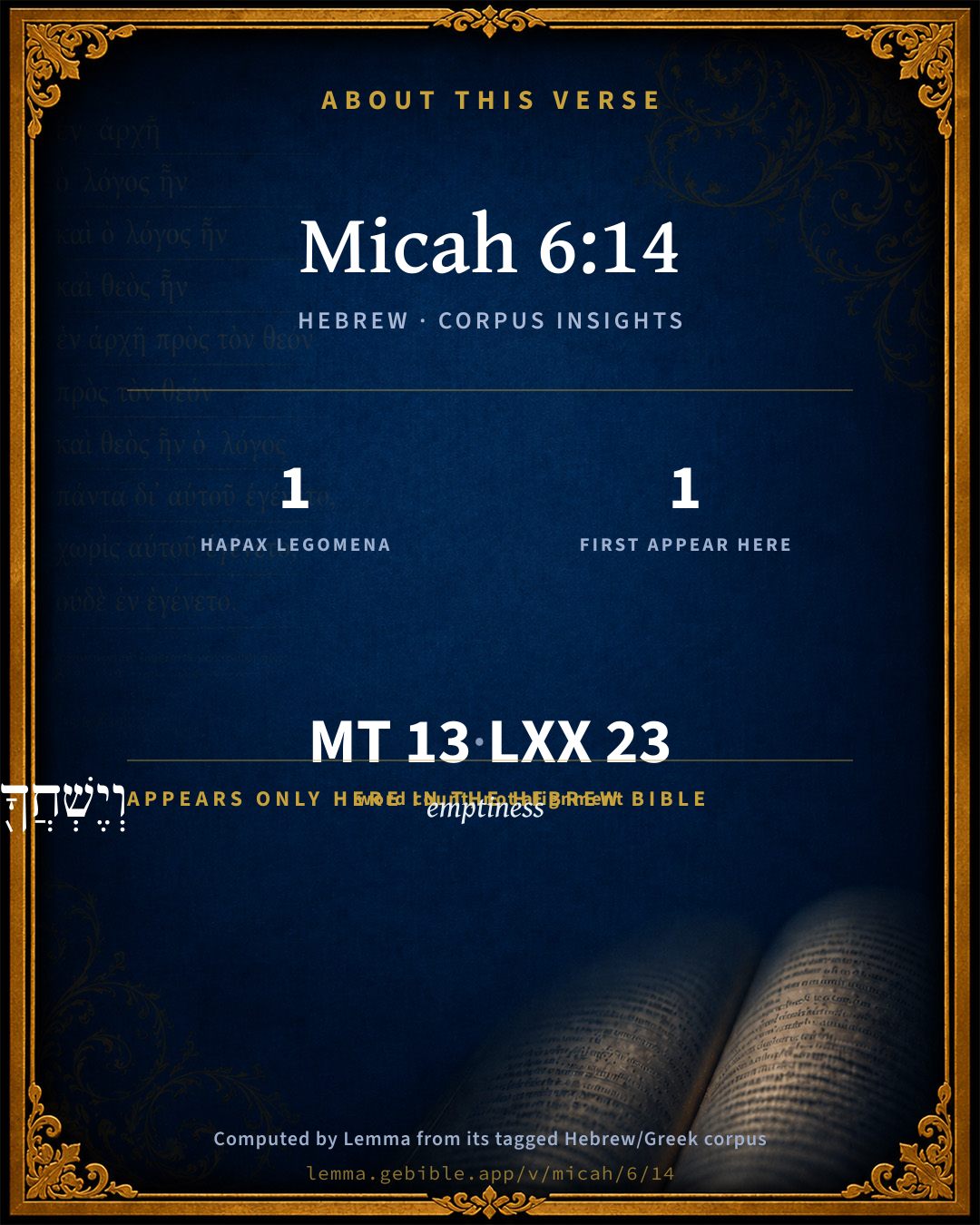
  • 1 hapax legomenon — only here in the Hebrew Bible
  • 1 first appearance in the Hebrew Bible
Full analysis ↓
Download a study sheet

One document with this verse’s original text, its word-by-word gloss line, the meaning frame, cross-references with their text, attributed commentary, and full source and license credits — printable, and it pastes into notes with its structure intact.

This verse Autodidact and up

Study sheet (.html) Plain text (.txt)

A passage Seminary Student

Up to 50 verses in one chapter. A passage sheet keeps up to 6 commentary sources and 12 cross-references per verse, in the order this page ranks them, and says so on the sheet whenever that leaves anything out. Ask for a single verse and you get the Autodidact verse sheet above.

Everything on this page stays free to read, with no account — the sheet is a download of what is already on screen, not access to it.

Want to remove ads? Support Godless Engineer
Compare translations 3

The same verse in 3 English versions, stacked beneath the original-language interlinear above. Click any original word for its lexicon entry.

Each is an independent rendering of the whole verse — the interlinear is not word-aligned to these translations.

Highlighted words mark where these versions differ — a whole-verse word diff, not a word-by-word alignment.

  • World English Bible Public Domain
    You shall eat, but not be satisfied. Your humiliation will be in your midst. You will store up, but not save; And that which you save I will give up to the sword.
  • King James Version Public Domain
    Thou shalt eat, but not be satisfied; and thy casting down shall be in the midst of thee; and thou shalt take hold, but shalt not deliver; and that which thou deliverest will I give up to the sword.
  • unfoldingWord Literal Text CC BY-SA 4.0
    You will eat but not be satisfied, and your emptiness in your midst. You will put aside but not rescue, and what you do rescue, I will give to the sword.

unfoldingWord Literal Text — © unfoldingWord, licensed CC BY-SA 4.0. Word-aligned USFM3 via Door43 (git.door43.org/unfoldingWord/en_ult).

Versions to compare (up to 4)

3 of 4 selected

Show all 18 translations

Every available English version of this verse, each an independent rendering of the whole verse.

  • World English Bible Public Domain
    You shall eat, but not be satisfied. Your humiliation will be in your midst. You will store up, but not save; And that which you save I will give up to the sword.
  • Berean Standard Bible Public Domain
    You will eat but not be satisfied, and your hunger will remain with you. What you acquire, you will not preserve; and what you save, I will give to the sword.
  • Majority Standard Bible Public Domain
    You will eat but not be satisfied, and your hunger will remain with you. What you acquire, you will not preserve; and what you save, I will give to the sword.
  • King James Version Public Domain
    Thou shalt eat, but not be satisfied; and thy casting down shall be in the midst of thee; and thou shalt take hold, but shalt not deliver; and that which thou deliverest will I give up to the sword.
  • American Standard Version (1901) Public Domain
    Thou shalt eat, but not be satisfied; and thy humiliation shall be in the midst of thee: and thou shalt put away, but shalt not save; and that which thou savest will I give up to the sword.
  • Revised Version (1885) Public Domain
    Thou shalt eat, but not be satisfied; and thy humiliation shall be in the midst of thee: and thou shalt remove, but shalt not carry away safe; and that which thou carriest away will I give up to the sword.
  • Geneva Bible (1599) Public Domain
    Thou shalt eate and not be satisfied, and thy casting downe shall be in the mids of thee, and thou shalt take holde, but shalt not deliuer: and that which thou deliuerest, will I giue vp to the sworde.
  • Douay-Rheims (1899) Public Domain
    By which her rich men were filled with iniquity, and the inhabitants thereof have spoken lies, and their tongue was deceitful in their mouth.
  • Young's Literal Translation Public Domain
    Thou -- thou eatest, and thou art not satisfied, And thy pit `is' in thy midst, And thou removest, and dost not deliver, And that which thou deliverest, to a sword I give.
  • Literal Standard Version CC BY-SA 4.0
    You eat, and you are not satisfied, || And your pit [is] in your midst, || And you remove, and do not deliver, || And that which you deliver, I give to a sword.
  • Unlocked Literal Bible CC BY-SA 4.0
    You will eat but not be satisfied; your emptiness will remain inside you. You will store goods away but not save, and what you do save I will give to the sword.
  • unfoldingWord Literal Text CC BY-SA 4.0
    You will eat but not be satisfied, and your emptiness in your midst. You will put aside but not rescue, and what you do rescue, I will give to the sword.
  • Darby Bible Public Domain
    Thou shalt eat, and not be satisfied, and thine emptiness [shall remain] in the midst of thee; and thou shalt take away, and not save; and what thou savest will I give up to the sword.
  • World Messianic Bible Public Domain
    You shall eat, but not be satisfied. Your hunger will be within you. You will store up, but not save, and that which you save I will give up to the sword.
  • Webster's Bible Public Domain
    Thou shalt eat, but not be satisfied; and thy casting down shall be in the midst of thee; and thou shalt take hold, but shalt not deliver; and that which thou deliverest will I give up to the sword.
  • Free Bible Version CC BY-SA 4.0
    You will eat, but never be satisfied; inside you will still feel hungry. Even though you try to save money, what you save won't be worth anything because I will give it to the sword.
  • Bible in Basic English Public Domain
    You will have food, but not enough; your shame will be ever with you: you will get your goods moved, but you will not take them away safely; and what you do take away I will give to the sword.
  • JPS Tanakh (1917) Public Domain
    Thou shalt eat, but not be satisfied; and thy sickness shall be in thine inward parts; and thou shalt conceive, but shalt not bring forth; and whomsoever thou bringest forth will I give up to the sword.

Literal Standard Version (2020), Covenant Press — licensed CC BY-SA 4.0. Text via the HelloAO Bible API (eBible.org). Unlocked Literal Bible (unfoldingWord) — licensed CC BY-SA 4.0. Text via the HelloAO Bible API (eBible.org). unfoldingWord Literal Text — © unfoldingWord, licensed CC BY-SA 4.0. Word-aligned USFM3 via Door43 (git.door43.org/unfoldingWord/en_ult). Free Bible Version, Dr. Jonathan Gallagher — licensed CC BY-SA 4.0. Text via the HelloAO Bible API (eBible.org).

Word by word

More ways to search: Search by grammar → Find every occurrence → Compare this word →

Practice this passage: Drill this verse → Learn its vocabulary →

וְיֶשְׁחֲךָ֖
yeshach
H3445
“and · emptiness · your”
Conjunction + Noun, Common, Masculine, Singular, Construct + Suffix, Personal, 2nd Person, Masculine, Singular
Part of Speech
Conjunction + Noun
Type
Common
Gender
Masculine
Number
Singular
State
Construct
Full BDB Definition

Origin: from an unused root meaning to gape (as the empty stomach)

TWOT: 924

a sinking feeling, emptiness
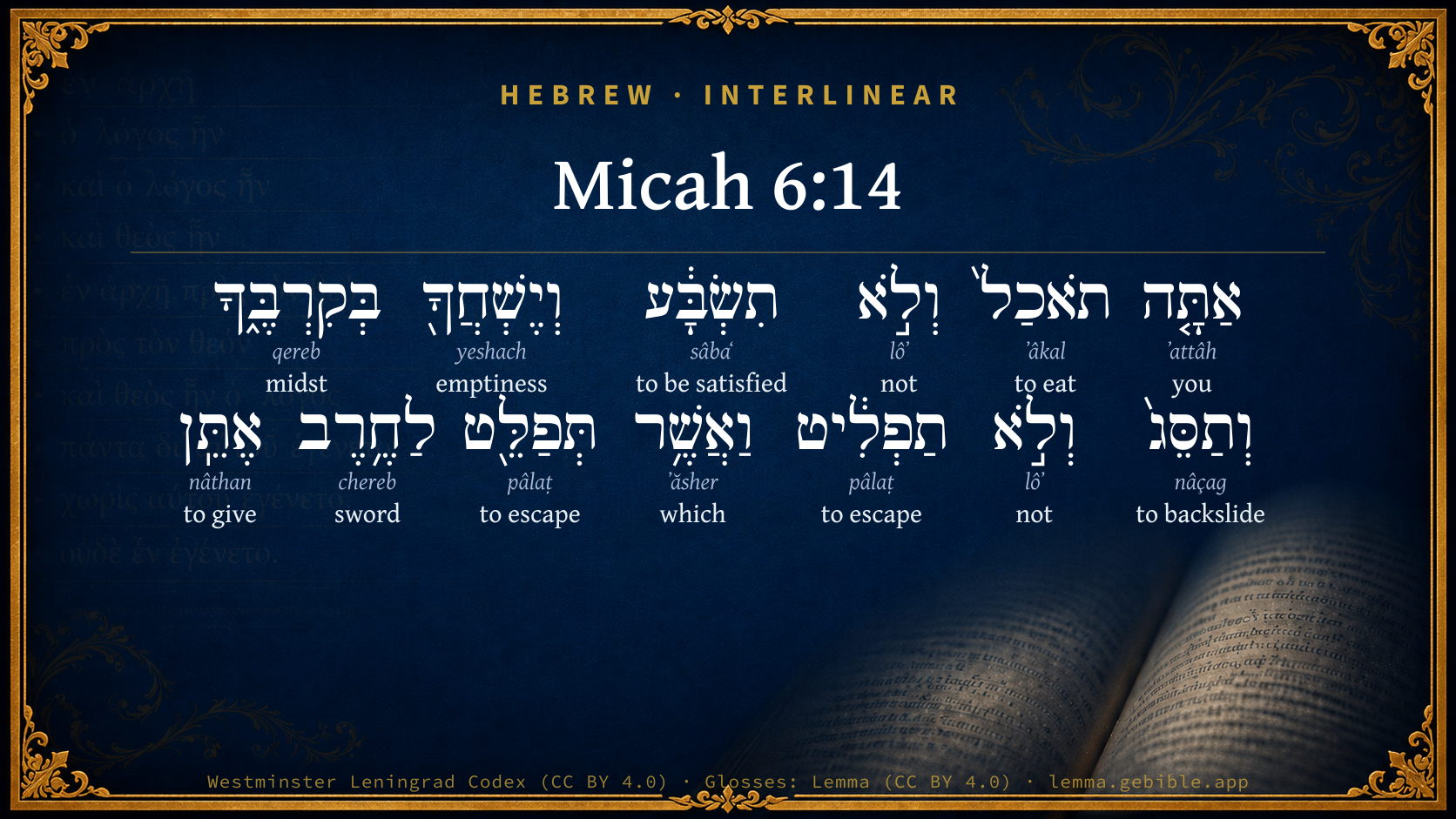
  1. אַתָּ֤ה ʼattâh H859 “you” Pronoun, Personal, 2nd Person, Masculine, Singular
  2. תֹאכַל֙ ʼâkal H398 “to eat” Verb, Qal, Imperfect, 2nd Person, Masculine, Singular
  3. וְלֹ֣א lôʼ H3808 “and · not” Conjunction + Particle, Negative
  4. תִשְׂבָּ֔ע sâbaʻ H7646 “to be satisfied” Verb, Qal, Imperfect, 2nd Person, Masculine, Singular
  5. בְּקִרְבֶּ֑ךָ qereb H7130 “in/at · midst · your” Preposition + Noun, Common, Masculine, Singular, Construct + Suffix, Personal, 2nd Person, Masculine, Singular
  6. וְתַסֵּג֙ nâçag H5253 “and · to backslide” Conjunction + Verb, Hiphil, Imperfect, 2nd Person, Masculine, Singular
  7. וְלֹ֣א lôʼ H3808 “and · not” Conjunction + Particle, Negative
  8. תַפְלִ֔יט pâlaṭ H6403 “to escape” Verb, Hiphil, Imperfect, 2nd Person, Masculine, Singular
  9. וַאֲשֶׁ֥ר ʼăsher H834 “and · which” Conjunction + Particle, Relative
  10. תְּפַלֵּ֖ט pâlaṭ H6403 “to escape” Verb, Piel, Imperfect, 2nd Person, Masculine, Singular
  11. לַחֶ֥רֶב chereb H2719 “to/for the · sword” Preposition, Determined + Noun, Common, Feminine, Singular, Absolute
  12. אֶתֵּֽן nâthan H5414 “to give” Verb, Qal, Imperfect, 1st Person, Common, Singular

About this verse

These counts appear in no published source. They are computed here, from the morphology-tagged text and Lemma’s own curated glosses. What Lemma adds →

13
words
11
distinct lemmas
Prophets
section

Notable vocabulary

1 hapax legomenon — a word that appears only here in the entire Hebrew Bible:

  • וְיֶשְׁחֲךָ֖ emptiness H3445

First appearance in Scripture

This word makes its first canonical appearance in the Hebrew Bible here:

  • וְיֶשְׁחֲךָ֖ emptiness H3445

Shared distinctive vocabulary

וְתַסֵּג֙ to backslide H5253 occurs in 9 verses of the Hebrew Bible. Also found in:

Grammatical profile

  • 6 verbs
  • 3 nouns
  • 1 pronoun
  • 3 particles

Verb forms

  • תֹאכַל֙ Qal · Imperfect
  • תִשְׂבָּ֔ע Qal · Imperfect
  • וְתַסֵּג֙ Hiphil · Imperfect
  • תַפְלִ֔יט Hiphil · Imperfect
  • תְּפַלֵּ֖ט Piel · Imperfect
  • אֶתֵּֽן Qal · Imperfect

Repetition

Words recur within this verse — often emphatic in Hebrew:

  • תַפְלִ֔יט to escape H6403 ×2
  • וְלֹ֣א not H3808 ×2

Hebrew & Septuagint length

In English translation the verse runs 33 words from the Hebrew and 38 from the Septuagint (LXX English) — closely comparable.

A rough comparison of the two English renderings, which tokenize alike — not a word-level alignment.

Word counts can differ between the Hebrew and the Greek without any difference in meaning — e.g. the Hebrew direct-object marker אֵת has no separate Greek word, and Greek often adds the article ὁ.

In the original languages it is 13 Hebrew tokens and 23 Greek tokens — but the two are counted differently (Hebrew bundles its prefixes and suffixes into one token; the Greek is in lemma form), so that isn’t a like-for-like length.

Cross-references

15

Topical passages linked to Micah 6:14 in the Treasury of Scripture Knowledge — connected by theme and wording, ordered by reader-vote popularity; previews shown in the World English Bible.

  • Hosea 4:10 They will eat, and not have enough. They will play the prostitute, and will not increase; Because they have abandoned giving to Yahweh.
  • Isaiah 65:13 Therefore thus says the Lord Yahweh, Behold, my servants shall eat, but you shall be hungry; behold, my servants shall drink, but you shall be thirsty; behold, my servants shall rejoice, but you shall be disappointed;
  • Leviticus 26:26 When I break your staff of bread, ten women shall bake your bread in one oven, and they shall deliver your bread again by weight: and you shall eat, and not be satisfied.
  • Isaiah 9:20 One shall snatch on the right hand, and be hungry; and he shall eat on the left hand, and they shall not be satisfied: they shall eat every man the flesh of his own arm:
  • Isaiah 30:6 The burden of the animals of the South. Through the land of trouble and anguish, from whence come the lioness and the lion, the viper and fiery flying serpent, they carry their riches on the shoulders of young donkeys, and their treasures on the humps of camels, to a people that shall not profit [them].
  • Jeremiah 48:44 He who flees from the fear shall fall into the pit; and he who gets up out of the pit shall be taken in the snare: for I will bring on him, even on Moab, the year of their visitation, says Yahweh.
  • Ezekiel 4:16–17 Moreover he said to me, Son of man, behold, I will break the staff of bread in Jerusalem: and they shall eat bread by weight, and with fearfulness; and they shall drink water by measure, and in dismay:
  • Ezekiel 5:12 A third part of you shall die with the pestilence, and with famine shall they be consumed in the midst of you; and a third part shall fall by the sword round about you; and a third part I will scatter to all the winds, and will draw out a sword after them.
  • Amos 2:14–16 Flight will perish from the swift; And the strong won't strengthen his force; Neither shall the mighty deliver himself;
  • Haggai 1:6 You have sown much, and bring in little. You eat, but you don't have enough. You drink, but you aren't filled with drink. You clothe yourselves, but no one is warm, and he who earns wages earns wages to put them into a bag with holes in it."
  • Haggai 2:16 Through all that time, when one came to a heap of twenty measures, there were only ten. When one came to the wine vat to draw out fifty, there were only twenty.
  • Deuteronomy 32:22–25 For a fire is kindled in my anger, Burns to the lowest Sheol, Devours the earth with its increase, Sets on fire the foundations of the mountains.
  • Isaiah 3:6–8 Indeed a man shall take hold of his brother in the house of his father, saying, "You have clothing, you be our ruler, And let this ruin be under your hand."
  • Isaiah 24:17–20 Fear, and the pit, and the snare, are on you, O inhabitant of the earth.
  • Amos 9:1–4 I saw the Lord standing beside the altar, and he said, "Strike the tops of the pillars, that the thresholds may shake; and break them in pieces on the head of all of them; and I will kill the last of them with the sword: there shall not one of them flee away, and there shall not one of them escape.

Cross-references courtesy of OpenBible.info (CC BY 4.0).

Hebrew and Greek witnesses Masoretic Hebrew ↔ Greek Septuagint

The same verse in the two great witnesses to the Old Testament, shown verse-for-verse.

These are two independent witnesses, not word-aligned to each other, and the Septuagint is shown in lemma (dictionary) form.

Hebrew Micah 6:14 Masoretic · Westminster Leningrad Codex

אַתָּ֤ה תֹאכַל֙ וְלֹ֣א תִשְׂבָּ֔ע וְיֶשְׁחֲךָ֖ בְּקִרְבֶּ֑ךָ וְתַסֵּג֙ וְלֹ֣א תַפְלִ֔יט וַאֲשֶׁ֥ר תְּפַלֵּ֖ט לַחֶ֥רֶב אֶתֵּֽן

You shall eat, but not be satisfied. Your humiliation will be in your midst. You will store up, but not save; And that which you save I will give up to the sword.

World English Bible · Public Domain

Greek LXX Micah 6:14 Septuagint · lemma form

σύ ἐσθίω καί οὐ μή ἐνπίμπλημι καί σκοτάζω ἐν σύ καί ἐκνεύω καί οὐ μή διασώζω καί ὅσος ἐάν διασώζω εἰς ῥομφαία παραδίδωμι

You shall eat, and shall not be satisfied; and there shall be darkness upon you; and he shall depart from you, and you shall not escape; and all that shall escape shall be delivered over to the sword.

LXX2012 (modern English Septuagint) · Public Domain

On this verse, Adam Clarke's Commentary discusses the Septuagint’s reading. Read the note in Commentary ↓

Hebrew: Westminster Leningrad Codex (CC BY 4.0). Greek: Septuagint (public domain); English from LXX2012 (modern English Septuagint) (Public Domain). How the Septuagint differs from the Hebrew →

Targum (Aramaic paraphrase)

1

The Targum is the ancient Jewish Aramaic paraphrase of the Hebrew Scriptures — an interpretive translation, not the Hebrew text itself. Onkelos (literal) and Pseudo-Jonathan (expansive) render the Torah, and Jonathan the Prophets. Coverage is partial: where no permissively-licensed English translation exists for a verse, only the Aramaic is shown. This is verse-level text, not a word-by-word alignment to the Hebrew.

  1. Targum Jonathan Prophets (Joshua–Malachi)
    אַתְּ תֵּיכוּל וְלָא תִסְבַּע וִיהֵי לָךְ לִמְרַע בִמְעָךְ וְתַדְבֵּיק וְלָא תְשֵׁיזֵיב וְדִי תְשֵׁיזֵיב לְחַרְבָּא אֶמְסַר:

    (no public-domain English translation for this verse)

    Targum Jonathan — Aramaic: “Mikraot Gedolot” (public domain). English: “Sefaria Community Translation” (CC0 1.0 (public-domain dedication)); “London "Chaldee Paraphrase," 1871” (public domain). Text via Sefaria.

Commentary

Notes on Micah 6:14 from classic Christian and Jewish commentators (each source and its license shown beneath its notes). The classic Christian expositions comment on the surrounding passage and are grouped to its opening verse, so a note may address several verses; the Jewish commentaries on the Tanakh (Rashi and others) are per-verse, so they appear only where the commentator wrote on this verse.

Lemma curates 59 commentaries, every one of them public domain or Creative Commons licensed, each selected and text-cleaned for this edition rather than reprinted as found. About our sources →

Trapp's Complete Commentary

John Trapp

Mic 6:14 Thou shalt eat, but not be satisfied; and thy casting down [shall be] in the midst of thee; and thou shalt take hold, but shalt not deliver; and [that] which thou deliverest will I give up to the sword.

Ver. 14. Thou shall eat, but not be satisfied] Either as not having enough to satisfy, but prisoner’s pittance, so much only as will keep life and soul together; or else, troubled with a bulimy, an appetitus caninus, desire of a dog, a weakness of the digestive faculty, so that thy meat feeds thee not: the staff of it being also broken by God, the nutritive property of it being taken away. {See Trapp on "Hag 1:6"}

And thy casting down shall be in the midst of thee] Thou shalt be laid low enough by civil and intestine discords, which as a fire feedeth upon the people, Isa 9:19, no man shall spare his brother. Or like as a hungry man snatcheth on the right hand and eateth on the left hand, and yet is not satisfied, Isa 9:20, till thine unnatural convulsions end in a deadly consumption.

And thou shalt take hold, but shall not deliver] Thou shalt catch up thy children, thy jewels, and think to secure them from the enemy, but shalt not be able. Of this misery we had overly woeful experience in our late unnatural garboils.

And that which thou deliverest will I give up to the sword] Other judgments forerun the sword; which, when they will not do, the sword will then contemn the rod, Eze 21:10, that is, it will set at nought whatever the rod hath done, and come furbished and sharpened for the slaughter.

John Trapp, A Commentary or Exposition upon All the Books of the Old and New Testament (1647–1656) — public domain. Text from a community e-Sword module.

The Biblical Illustrator

Joseph S. Exell

Mic_6:14-15

Thou shalt sow, but thou shalt not reap

Useless labour

Mark the vexation of it--sowing and not reaping; sowing, and somebody else reaping.

Here is the uncontrollable element in life. A man says, I certainly did tread out the olives, and I have not a small vessel full of oil with which to anoint myself; working for others, the slave of slaves. We see this every day. We need not invoke the supernatural in any merely metaphysical sense in order to substantiate this as a fact. It is the common experience of life. Men put money into bags, and go for the money, and it is not there. Why is it not there? The prophet explains that there were holes in the bag, and the money went right through. You have heard of a man all day long trying to draw water with a sieve. How industrious he is! See, the sieve goes down, the wheel is turned, and the sieve is brought up, and there is no water in it. It is a mystery. Not at all. Why is there no water? Because the vessel is a sieve; the water runs out as quickly as it runs in. Yon have heard of one who was rolling a stone up the hill all day, and the more it was rolled up the more it rolled down, and at night it was exactly where it was before the process of rolling began. Worthless labour, useless labour, vexatious labour. Thus doth God puzzle and bewilder and perplex men. (Joseph Parker, D. D.)

The Biblical Illustrator, edited by Joseph S. Exell (c. 1880s–1900s) — public domain. Text from a community e-Sword module.

Geneva Bible (1599)

Geneva Bible translators

Meaning, that the city should go about to save her men, as they that lay hold on that which they would preserve.

Thou shalt be consumed with inward grief and evils.

Geneva Bible (1599) marginal notes — public domain. Text via Bolls.life.

Jamieson, Fausset & Brown

Robert Jamieson, A. R. Fausset & David Brown

eat . . . not be satisfied--fulfiling the threat, Lev 26:26.

thy casting down shall be in the midst of thee--Thou shalt be cast down, not merely on My borders, but in the midst of thee, thy metropolis and temple being overthrown [TIRINUS]. Even though there should be no enemy, yet thou shalt be consumed with intestine evils [CALVIN]. MAURER translates as from an Arabic root, "there shall be emptiness in thy belly." Similarly GROTIUS, "there shall be a sinking of thy belly (once filled with food), through hunger." This suits the parallelism to the first clause. But English Version maintains the parallelism sufficiently. The casting down in the midst of the land, including the failure of food, through the invasion thus answering to, "Thou shalt eat, and not be satisfied."

thou shalt take hold, but . . . not deliver--Thou shalt take hold (with thine arms), in order to save [CALVIN] thy wives, children and goods. MAURER, from a different root, translates, "thou shalt remove them," in order to save them from the foe. But thou shalt fail in the attempt to deliver them (Jer 50:37).

that which thou deliverest--If haply thou dost rescue aught, it will be for a time: I will give it up to the foe's sword.

Jamieson, Fausset & Brown — Commentary Critical and Explanatory on the Whole Bible (1871) — public domain (CC PDM 1.0). Text via the HelloAO Bible API.

Adam Clarke's Commentary

Verse 14. Thou shalt eat, but not be satisfied] All thy possessions are cursed, because of thy sins; and thou hast no real good in all thy enjoyments.

And thy casting down] For וישחך veyeshchacha, "thy casting down," Newcome, by transposing the ח and ש, reads ויחשך veyechshach, "and it shall be dark;" and this is probably the true reading. The Arabic and Septuagint have read the same. "There shall be calamity in the midst of thee." It shall have its seat and throne among you.

Adam Clarke's Commentary on the Bible (1810–1826) — public domain. Text from a community e-Sword/MySword module.

John Calvin's Commentaries

And he points out what sort of punishment it would be; and he mentions even two kinds in this verse. He says first, Thou shalt eat, and shalt not be satisfied. One of God’s plagues, we know, is famine: and so the Prophet here declares, that the people would be famished, but not through the sterility of the fields. God indeed brings a famine in two ways: now the land yields no fruit; the corn withers, or, being smitten with hail, gives no fruit; and thus God by the sterility of the fields often reduces men to want and famine: then another mode is adopted, by which he can consume men with want, namely, when he breaks the staff of bread, when he takes away from bread its nourishing virtues so that it can no more support men, whatever quantity they may swallow; and this is what experience proves, if only we have eyes to observe the judgments of God. We now see the meaning of this clause, when he says, Thou shalt eat, and shalt not be satisfied; as though he said, “I can indeed, whenever it pleases me, deprive you of all food; the earth itself will become barren at my command: but that ye may more clearly understand that your life is in my hand, a good supply of fruit shall be produced, but it shall not satisfy you. Ye shall then perceive that bread is not sufficient to support you; for by eating ye shall not be able to derive from bread any nourishment.”

He then adds, And thy dejection shall be in the midst of thee; that is, though no man from without disturb or afflict thee yet thou shalt pine away with intestine evils. This is the real meaning; and interpreters have not sufficiently considered what the Prophet means, through too much negligence. But the passage ought to be noticed: for the Prophet, after having threatened a famine, not from want, but from the secret curse of God, now adds, Thy dejection shall be in the midst of thee; that is “Though I should rouse against thee no enemies, though evidences of my wrath should not appear, so as to be seen at a distance, yea, though no one should disturb thee, yet thy dejection, thy calamity, shall be in the midst of thee, as though it were cleaving to thy bowels; for thou shalt pine away through a hidden malady, when God shall pronounce his curse on thee.”

He now subjoins another kind of punishment, Thou shalt take hold, but shalt not deliver, and what thou shalt deliver, I will give up to the sword Some read, “A woman shall lay hold,” that is, conceive seed, “and shall not preserve it;” and then, “though she may bring forth in due time, I will yet give up what may be born to the sword.” But this meaning is too strained. Others apply the words to fathers, “Thou, father, shalt lay hold;” that is thou shalt endeavor to preserve thy children, “and thou shalt not preserve them.” But I wonder that interpreters have thus toiled in vain in a matter so simple and plain. For he addresses here the land, or he addresses the city: as though he said, “The city shall take hold,” or embrace, as every one does who wishes to preserve or keep any thing; for what we wish to keep safe, we lay hold on it, and keep it as it were in our arms; “and what thou shalt preserve, I will give up to the sword: thou wilt try all means to preserve thyself and thy people, but thou shalt not succeed: thou shalt then lose all thy labor, for though thou shouldest preserve some, yet the preserved shall not escape destruction.”

If any one prefers to refer what is said to women, with regard to conception, as the third person of the feminine gender is used, let him have his own opinion; for this sense may certainly be admitted, that is, that the Lord would render the women barren, and that what they might bring forth would be given up to the slaughter, inasmuch as the Lord would at length destroy with the sword both the parents and their children.

John Calvin's Commentaries (1540-1563) — public domain. Text from the Calvin Translation Society English edition (1840s-50s) via the Christian Classics Ethereal Library (ccel.org). Calvin's coverage is partial (roughly two-thirds of the Bible); uncommented books and verses are honest gaps, never fabricated. The 19th-century editor's footnotes and remarks are omitted so the notes are faithfully Calvin's own voice.

Ellicott's Commentary for English Readers

(14) Thy casting down.—The Hebrew word is found only in this passage. It comes from an unused root, meaning to be void, empty. Hence it may be translated hunger.

Thou shalt take hold.—Thou shalt collect thy property for flight, to save it from the enemy; but in vain: it shall be captured.

A Bible Commentary for English Readers, edited by Charles John Ellicott (1878–1897) — public domain. Text from a community e-Sword module.

The Cambridge Bible for Schools and Colleges

gen. ed. J. J. S. Perowne

14, 15. Thou shalt eat, but not be satisfied] The description in these two verses again reminds us of Deuteronomy, and of that portion of Leviticus which most recalls Deuteronomy (see Deu_28:39, and Lev_26:25-26).

thy casting down] The meaning of the Hebrew is very uncertain. Thy emptiness is the rendering which has the best support of recent authorities; if we adopt it, we must substitute ‘remain’ for ‘be’—it is emptiness of the stomach which is meant. But the rendering is precarious, and the text, as so often, is probably corrupt. We might restore, ‘thy leanness shall be in the midst of thee’ (i.e. of the people).

thou shalt take hold] Rather, thou shalt remove (thy goods). The prospect held out is that the enemy will fall so suddenly upon the Jews, that they will not be able to remove their property or family to a place of security; or if they should, by a rare good fortune, succeed in saving a little, it should soon become the prey of the foe (comp. Isa_23:12, Jer_44:12).

The Cambridge Bible for Schools and Colleges (gen. ed. J. J. S. Perowne; Cambridge University Press, 1878–1918) — public domain. Text from a community e-Sword module.

John Gill's Exposition

Thou shalt eat, but not be satisfied,.... Either not having enough to eat, for the refreshing and satisfying of nature; or else a blessing being withheld from food, though eaten, and so not nourishing; or a voracious and insatiable appetite being given as a curse; the first sense seems best:

and thy casting down shall be in the midst of thee; meaning they should be humbled and brought down, either by civil discords and wars among themselves, or through the enemy being suffered to come into the midst of their country, and make havoc there; which would be as a sickness and disease in their bowels. So the Targum,

"thou shalt have an illness in thy bowels.''

The Syriac version is,

"a dysentery shall be in thine intestines;''

a secret judgment wasting and destroying them;

and thou shall take hold, but shall not deliver; and that which thou deliverest will I give up to the sword; the sense is, that they should take hold of their wives and children, and endeavour to save them from the sword of the enemy, and being carried captive: or should "remove" them (p), as the word is sometimes used, in order to secure them from them; or should "overtake" (q); the enemy, carrying them captive; but should not be able by either of these methods to save them from being destroyed, or carried away by them; and even such as they should preserve or rescue for a while, yet these should be given up to the sword of the enemy, the same or another. Aben Ezra and Kimchi interpret this of their women conceiving, and not bringing forth; and, if they should, yet what they brought forth should be slain by the sword (r). But the Targum and Jarchi incline to the former sense.

(p) "et amovebis", Junius & Tremellius, Piscator, Tarnovius; "summovebis", Drusius, so Ben Melech; "et removebis", Burkius. (q) "Assequeris", Syr. (r) R. Sol. Urbin. Ohel Moed, fol. 35. 2.

John Gill's Exposition of the Whole Bible (1746–1763) — public domain (CC PDM 1.0). Text via the HelloAO Bible API.

Albert Barnes' Notes on the Bible

Thou shalt eat, but not be satisfied - The correspondence of the punishment with the sin shall shew that it is not by chance, but from the just judgment of God. The curse of God shall go with what they eat, and it shall not nourish them. The word, thou, is thrice repeated . As God had just said, I too, so here, Thou. Thou, the same who hast plundered others, shalt thyself eat, and not be satisfied; “thou shalt sow, and not reap; thou shalt tread the olive, and thou shalt not anoint thee with oil.” “Upon extreme but ill-gotten abundance, there followeth extreme want. And whose,” adds one, , “seeth not this in our ways and our times is absolutely blind. For in no period have we ever read that there was so much gold and silver, or so much discomfort and indigence, so that those most true words of Christ Jesus seem to have been especially spoken of us, “Take heed, for a man’s life consisteth not in the abundance of the things which he possesseth” Luk 12:15. And is not this true of us now?

Thy casting down shall be in the midst of thee - Where thou hast laid up thy treasures, or rather thy wickedness, there thou shalt sink down, or give way, from inward decay, in the very center of thy wealth and thy sin. They had said, “Is not the Lord in the midst of us? None evil can come upon us” Mic 3:11. Micah tells them of a different indweller. God had departed from them, and left them to their inherent nothingness. God had been their stay; without God, human strength collapses. Scarcely any destruction is altogether hopeless save that which cometh from within. Most storms pass over, tear off boughs and leaves, but the stem remains. inward decay or excision alone are humanly irrecoverable. The political death of the people was, in God’s hands, to be the instrument of their regeneration.

Morally too, and at all times, inward emptiness is the fruit of unrighteous fullness. It is disease, not strength; as even pagan proverbs said; “the love of money is a dropsy; to drink increaseth the thirst,” and “amid mighty wealth, poor;” and Holy Scripture, “The rich He sendeth empty away” (Luk 1:53, compare 1Sa 2:5). “And truly they must be empty. For what can fill the soul, save God?” Rib.: “This is true too of such as, like the Bishop of Sardis, ‘have a name that they live and are dead’ Rev 3:1,” Dionysius, “such as do some things good, feed on the word of God, but attain to no fruit of righteousness;” “who corrupt natural and seeming good by inward decay; who appear righteous before men, are active and zealous for good ends, but spoil all by some secret sin or wrong end, as vain-glory or praise of men, whereby they lose the praise of God. Their casting down shall be in the midst of them. The meaning of the whole is the same, whether the word be rendered casting down, that is, downfall (literally, sinking down) or emptiness, especially of the stomach, perhaps from the feeling of “sinking.”

Thou shalt take hold - To rescue or remove to a safe place from the enemy, those whom he would take from thee, “but shalt not” wholly deliver; “and that which thou deliverest for a time, will I give up to the sword,” that is, the children for whose sake they pleaded that they got together this wealth; as, now too, the idols, for whose sake men toil wrongly all their life, are often suddenly taken away. Their goods too may be said to be given to the sword, that is, to the enemy.

Albert Barnes' Notes on the Bible (1834–1885) — public domain. Text from a community e-Sword/MySword module.

Haydock's Catholic Bible Commentary

CHAPTER VI.

And thy. Septuagint, "I will cast thee away into thyself." (Haydock) --- Hold of some fruit. (Calmet) --- Thy wife shall miscarry; (Vatable, &c.) or if she bring forth, the children shall perish by the sword.

Ver 15. New. Septuagint, "grave." (Haydock) --- "It is good for thee, when thou knowest thy error, to have no disciples." (St. Jerome)

George Leo Haydock (1774–1849), Haydock's Catholic Family Bible and Commentary, 1859 edition — public domain. Excludes Psalms (Douay-Rheims chapter numbering differs from Protestant) and Deuterocanonical books (Catholic canon only).

Matthew Poole's English Annotations

Thou shalt eat; both literally and figuratively taken, for using what they have. So God threatens, Lev 26:26. So God did punish the Jews, See Poole "Hag 1.6". But not be satisfied; not be filled with sweetness or strength in the eating, or using of what thou hast; thy sins shall bring either bitterness or insufficiency upon all thou hast, by both all shall be made useless to thee.

Thy casting down; thy destruction, partly by thy dissensions, conspiracies, and violences within thyself, and partly by the enemies breaking in upon thee, and bringing the war into thine own bowels.

Shall be in the midst of thee; thou shalt be weakened at home by thine own hands, and be wasted utterly by thine enemy, besieging thee in thy cities, and taking them.

Thou shalt take hold: though there is some variety of readings here, yet the plainest and most obvious sense is as we render it, whether you refer this laying hold to persons, as wife, children, or friends, whom (though they endeavour to save out of the enemies’ hand, yet) they shall not be able to save; or if referred to things, goods, their most valuable and most portable goods and wealth: as men in distress and fleeing out of the reach of enemies, pack up their best movables, lay hold on their children, and carry them away into some remoter place, or strong hold; so it is likely this people did when invaded, Jer 35:11.

But shalt not deliver: where thou lodgest thy children, and layest up thy wealth thither the enemy shall pursue thee, there besiege thee and thine; or if thou flee into other countries, it shall not be a safe refuge to thee.

That which thou deliverest; which thou dost for a little while, for a few weeks or months, preserve from the enemy, that thou thinkest is safe.

Will I give up, by unexpected and unthought of accidents to you, yet guided by the unerring and unresistible hand of Divine wisdom and power; shall be given up, fall into the hands of enemies, so that any considerate eye may see God’s hand in it.

To the sword; to be cut off by either domestic and civil wars, or by the invading, conquering, and wasting troops of the Assyrians.

Matthew Poole's English Annotations on the Holy Bible (1683–1685) — public domain. Text from a community e-Sword/MySword module.

The Pulpit Commentary

Thou shalt eat, etc. The punishment answers to the sin. (which proves that it comes from God), and recalls the threats of the Law Lev_26:25, etc.; Deu_28:29, etc.; comp. Hag_1:6) Thy casting down shall be in the midst of thee; i.e. thy humiliation, thy decay and downfall, shall occur in the very centre of thy wealth and strength, where thou hast laid up thy treasure and practised thy wickedness. But the meaning of the Hebrew is very uncertain, and the text may be corrupt. The LXX had a different reading, suskotasei en soi , "darkness shall be in thee." The Syriac and Chaldee interpret the word rendered "casting down" (j which is found nowhere else) of some disease like dysentery. It is most suitable to understand this clause as connected with the preceding threat of hunger, and to take the unusual word in the sense of "emptiness." Thus, "Thy emptiness (of stomach) shall remain in thee." Jeremiah (Jer_52:6) speaks of the famine in the city at the time of its siege. Thou shalt take hold; rather, thou shalt remove (thy goods). This is the second chastisement. They should try to take their goods and families out of the reach of the enemy, but should not be able to save them. The LXX interprets the verb of escaping by flight. That which thou deliverest. If by chance anything is carried away, it shall fall into the hands of the enemy. (comp. 2Ki_25:4, 5 Jer_52:7, Jer_52:8)

The Pulpit Commentary (1880–1919), ed. H.D.M. Spence-Jones & Joseph S. Exell — public domain. Text from a community e-Sword module.

John Wesley's Explanatory Notes

In the midst of thee - Thou shalt be cast down at home by thy own hands. Thou shalt take hold - This may refer either to persons or things, on which we lay hold in order to save them. Shalt not deliver - Where thou lodgest thy children, and layest up thy wealth, thither the enemy shall pursue thee; or if thou fly into other countries, it shall not be a safe refuge to thee. Which thou deliverest - For a little while.

John Wesley, Explanatory Notes Upon the Whole Bible (1754–1765) — public domain. Text via the GEBible commentary corpus.

Rashi

Rabbi Shlomo Yitzchaki (Rashi)

and it shall bend you over in your innards Heb. וְיֶשְׁחֲךָ. The food that you eat - I will bring a curse into it within your intestines, and it will cause you illness, that you will be ill and walk bent over. So it is explained in Sifre: How do we know that, even within the intestines? Scripture states: “And it shall bend you over in your innards.” In the parashah of Ekev, in expounding (Deut. 11:12) “The eyes of the Lord your God are upon it,” Jonathan, too, renders [our verse] in this manner: And it shall be to you for illness and a wound in your intestines.

and you shall overtake—your enemies who lead your sons and daughters away, into captivity; but you shall not rescue them, and if you rescue them, their end will be to the sword. In the name of Rabbi Menahem I heard: You shall gain your desire for sexual intercourse, but you shall not ejaculate. You shall not have the strength to ejaculate semen; and, if you do ejaculate them [and beget children], their end will be that I will deliver them to the sword [of the enemy].

Rashi on the Tanakh — English translations: “The Judaica Press complete Tanach with Rashi, translated by A. J. Rosenberg” (CC BY 4.0); “Pentateuch with Rashi's commentary by M. Rosenbaum and A.M. Silbermann, 1929-1934” (public domain); “The Metsudah Tanach series, Lakewood, N.J” (CC BY 4.0); and “The Book of Joshua, Metsudah Publications, 1997” (CC BY 4.0). Text via Sefaria.

Lesson kit

Teaching starters — assembled from the data on this page, not authored interpretation. Every prompt links to the verse data it draws on. Edit before teaching.

Micah, in the Prophets, opens this verse with 13 words (11 distinct Hebrew lemmas). Its most distinctive word is yeshach (“emptiness”). A historical commentator’s framing appears above. Read the whole chapter for the surrounding context.

Discussion questions

  1. The word yeshach carries the sense “emptiness.” How does it shape the verse?
  2. 1 word here appears nowhere else in the Hebrew Bible. Why might the author reach for such rare wording?
  3. This is the first place “emptiness” appears in Scripture (first appears here). What does its debut here establish?
  4. How does Deuteronomy 19:14, which shares the word «to backslide», read alongside this verse?
  5. What does the repetition of “to escape” (2× in this one verse) do in this verse?
  6. These translations render this verse differently. What is at stake in choosing one wording over another?
  7. «תֹאכַל֙» is a Qal Imperfect verb. How does that grammatical form shape the action described?
  8. Compare how Trapp's Complete Commentary and The Biblical Illustrator read this verse. Where do they agree or differ?

Things to notice

  • 1 word in this verse appears nowhere else in the Hebrew Bible.
  • 1 word makes its first canonical appearance in Scripture here.
  • This verse counts 13 Hebrew ↔ 23 Greek words.
  • These translations choose different wording for 19 words in this verse.
  • “to escape” occurs 2× in this single verse.

Reading settings

Reading text

Shown beneath each verse's original-language words.

Old Testament
Old Testament edition

Read the OT as the Masoretic Hebrew (MT) or the Greek Septuagint (LXX).

English shown for the Greek Septuagint (in the Hebrew ↔ Greek comparison).

Comparing translations? Open the Compare panel on any verse page to stack up to four side by side.