

Ephesians 4:14
Greek (Tischendorf 8th ed.) Ephesians 4:14 appears in the Greek New Testament. The text above is from the Tischendorf 8th edition. Each word links to its Strong’s number and a concise gloss. Click any word for its full Thayer’s Greek Lexicon entry.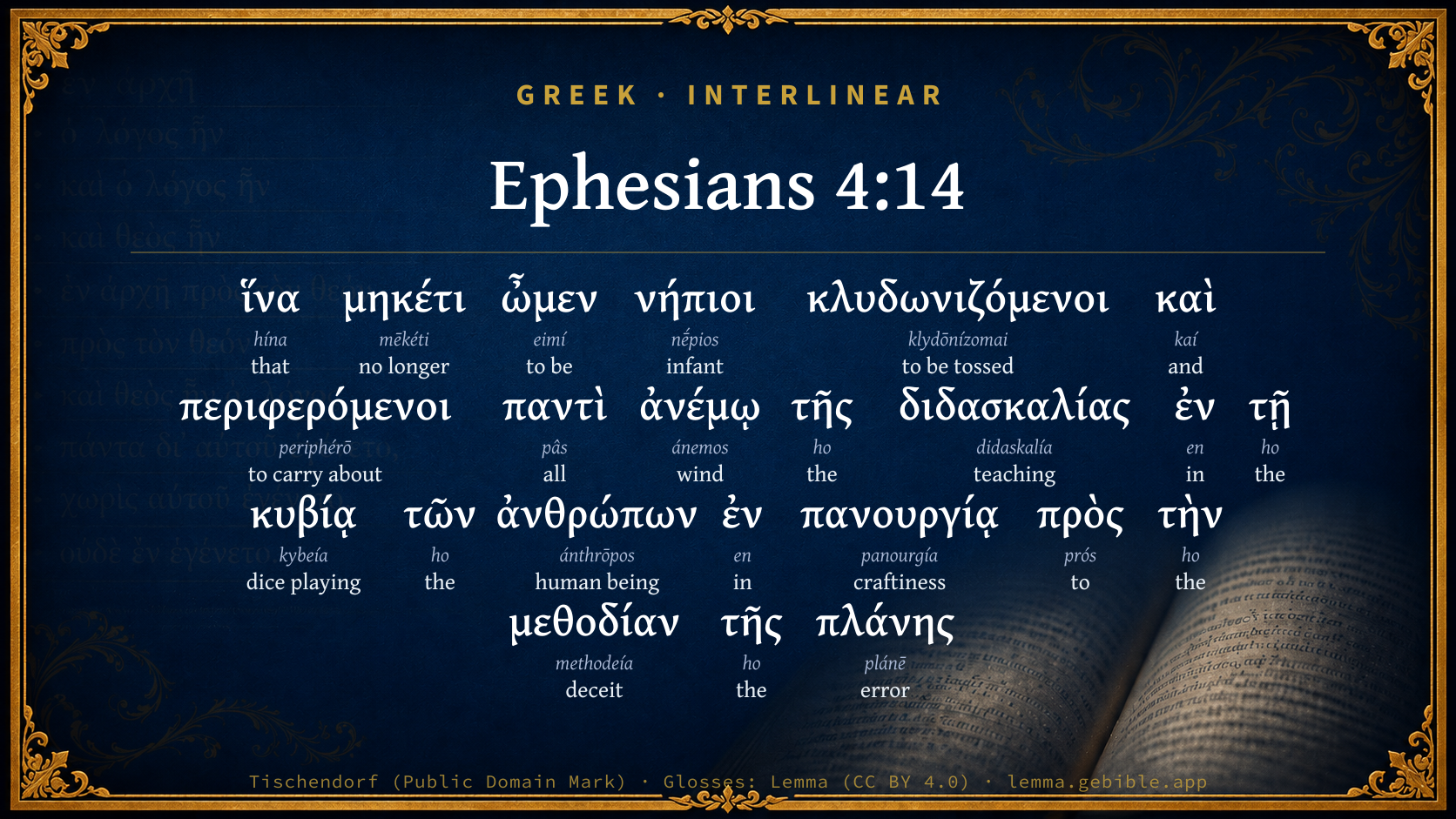
that we may no longer be children, tossed back and forth and carried about with every wind of doctrine, by the trickery of men, in craftiness, after the wiles of error;
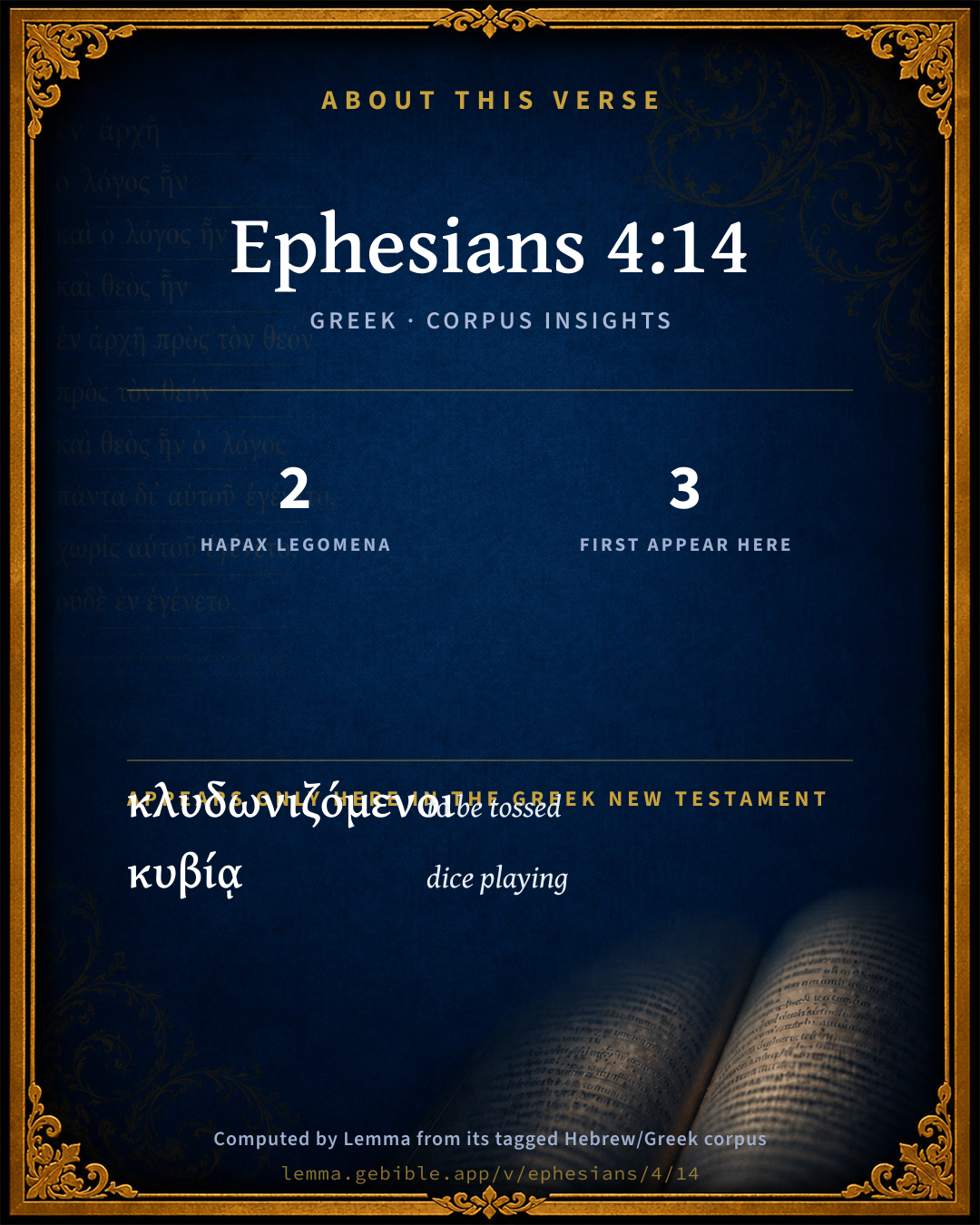
- 2 hapax legomena — only here in the Greek New Testament
- 3 first appearances in the Greek New Testament
Download a study sheet
One document with this verse’s original text, its word-by-word gloss line, the meaning frame, cross-references with their text, attributed commentary, and full source and license credits — printable, and it pastes into notes with its structure intact.
This verse Autodidact and up
A passage Seminary Student
Up to 50 verses in one chapter. A passage sheet keeps up to 6 commentary sources and 12 cross-references per verse, in the order this page ranks them, and says so on the sheet whenever that leaves anything out. Ask for a single verse and you get the Autodidact verse sheet above.
Everything on this page stays free to read, with no account — the sheet is a download of what is already on screen, not access to it.
Compare translations 3
The same verse in 3 English versions, stacked beneath the original-language interlinear above. Click any original word for its lexicon entry.
Each is an independent rendering of the whole verse — the interlinear is not word-aligned to these translations.
Highlighted words mark where these versions differ — a whole-verse word diff, not a word-by-word alignment.
-
World English Bible Public Domain
that we may no longer be children, tossed back and forth and carried about with every wind of doctrine, by the trickery of men, in craftiness, after the wiles of error;
-
King James Version Public Domain
That we henceforth be no more children, tossed to and fro, and carried about with every wind of doctrine, by the sleight of men, and cunning craftiness, whereby they lie in wait to deceive;
-
unfoldingWord Literal Text CC BY-SA 4.0
so that we may no longer be children tossed back and forth by the waves and carried away by every wind of teaching through the trickery of men in cleverness for deceitful scheming.
unfoldingWord Literal Text — © unfoldingWord, licensed CC BY-SA 4.0. Word-aligned USFM3 via Door43 (git.door43.org/unfoldingWord/en_ult).
Show all 19 translations
Every available English version of this verse, each an independent rendering of the whole verse.
-
World English Bible Public Domain
that we may no longer be children, tossed back and forth and carried about with every wind of doctrine, by the trickery of men, in craftiness, after the wiles of error;
-
Berean Standard Bible Public Domain
Then we will no longer be infants, tossed about by the waves and carried around by every wind of teaching and by the clever cunning of men in their deceitful scheming.
-
Majority Standard Bible Public Domain
Then we will no longer be infants, tossed about by the waves and carried around by every wind of teaching and by the clever cunning of men in their deceitful scheming.
-
King James Version Public Domain
That we henceforth be no more children, tossed to and fro, and carried about with every wind of doctrine, by the sleight of men, and cunning craftiness, whereby they lie in wait to deceive;
-
American Standard Version (1901) Public Domain
that we may be no longer children, tossed to and fro and carried about with every wind of doctrine, by the sleight of men, in craftiness, after the wiles of error;
-
Revised Version (1885) Public Domain
that we may be no longer children, tossed to and fro and carried about with every wind of doctrine, by the sleight of men, in craftiness, after the wiles of error;
-
Geneva Bible (1599) Public Domain
That we henceforth be no more children, wauering and caried about with euery winde of doctrine, by the deceit of men, and with craftines, whereby they lay in wait to deceiue.
-
Douay-Rheims (1899) Public Domain
That henceforth we be no more children tossed to and fro, and carried about with every wind of doctrine by the wickedness of men, by cunning craftiness, by which they lie in wait to deceive
-
Young's Literal Translation Public Domain
that we may no more be babes, tossed and borne about by every wind of the teaching, in the sleight of men, in craftiness, unto the artifice of leading astray,
-
Literal Standard Version CC BY-SA 4.0
that we may no longer be children, being tossed by waves and being carried around by every wind of the teaching, in the cunning of men, in craftiness, to the scheming of leading astray,
-
Unlocked Literal Bible CC BY-SA 4.0
Christ builds us up so that we should no longer be children who are tossed back and forth by the waves, and carried away by every wind of teaching and by the trickery of people in their deceitful schemes.
-
unfoldingWord Literal Text CC BY-SA 4.0
so that we may no longer be children tossed back and forth by the waves and carried away by every wind of teaching through the trickery of men in cleverness for deceitful scheming.
-
Darby Bible Public Domain
in order that we may be no longer babes, tossed and carried about by every wind of *that* teaching [which is] in the sleight of men, in unprincipled cunning with a view to systematized error;
-
World Messianic Bible Public Domain
that we may no longer be children, tossed back and forth and carried about with every wind of doctrine, by the trickery of men, in craftiness, after the wiles of error;
-
Webster's Bible Public Domain
That we henceforth be no more children, tossed to and fro, and carried about with every wind of doctrine, by the sleight of men, and cunning craftiness, by which they lie in wait to deceive:
-
Free Bible Version CC BY-SA 4.0
We shouldn't be little children any more, tossed about and blown along by every passing breeze of doctrine, confused by human trickery, led into error by crafty people who deceitfully scheme.
-
Bible in Basic English Public Domain
So that we may be no longer children, sent this way and that, turned about by every wind of teaching, by the twisting and tricks of men, by the deceits of error;
-
Text-Critical English NT CC BY 4.0
So we must no longer be infants, tossed back and forth by waves and carried about by every wind of doctrine, by the trickery of men and their craftiness in deceitful scheming.
-
Tyndale New Testament (1534) Public Domain
That we hence forth be no moare chyldren wauerynge and caryed with every wynde of doctryne by the wylynes of men and craftynes wherby they laye a wayte for vs to deceave vs.
Literal Standard Version (2020), Covenant Press — licensed CC BY-SA 4.0. Text via the HelloAO Bible API (eBible.org). Unlocked Literal Bible (unfoldingWord) — licensed CC BY-SA 4.0. Text via the HelloAO Bible API (eBible.org). unfoldingWord Literal Text — © unfoldingWord, licensed CC BY-SA 4.0. Word-aligned USFM3 via Door43 (git.door43.org/unfoldingWord/en_ult). Free Bible Version, Dr. Jonathan Gallagher — licensed CC BY-SA 4.0. Text via the HelloAO Bible API (eBible.org).
Word by word
More ways to search: Search by grammar → Find every occurrence → Compare this word →
Practice this passage: Drill this verse → Learn its vocabulary →
- Appears 1× in the Greek New Testament
- First appears here
- Part of Speech
- Verb
- Tense
- Present
- Voice
- Middle or Passive deponent
- Mood
- Participle
- Case
- Nominative
- Number
- Plural
- Gender
- Masculine
Full Thayer's Definition
- ἵνα hína G2443 “that” Conjunction
- μηκέτι mēkéti G3371 “no longer” Adverb, Negative
- ὦμεν eimí G1510 “to be” Verb, Present, Active, Subjunctive, 1st person, Plural
- νήπιοι nḗpios G3516 “infant” Adjective, Nominative, Plural, Masculine
- κλυδωνιζόμενοι klydōnízomai G2831 “to be tossed” Verb, Present, Middle or Passive deponent, Participle, Nominative, Plural, Masculine
- καὶ kaí G2532 “and” Conjunction
- περιφερόμενοι periphérō G4064 “to carry about” Verb, Present, Passive, Participle, Nominative, Plural, Masculine
- παντὶ pâs G3956 “all” Adjective, Dative, Singular, Masculine
- ἀνέμῳ ánemos G417 “wind” Noun, Dative, Singular, Masculine
- τῆς ho G3588 “the” Article, Genitive, Singular, Feminine
- διδασκαλίας didaskalía G1319 “teaching” Noun, Genitive, Singular, Feminine
- ἐν en G1722 “in” Preposition
- τῇ ho G3588 “the” Article, Dative, Singular, Feminine
- κυβίᾳ kybeía G2940 “dice playing” Noun, Dative, Singular, Feminine
- τῶν ho G3588 “the” Article, Genitive, Plural, Masculine
- ἀνθρώπων ánthrōpos G444 “human being” Noun, Genitive, Plural, Masculine
- ἐν en G1722 “in” Preposition
- πανουργίᾳ panourgía G3834 “craftiness” Noun, Dative, Singular, Feminine
- πρὸς prós G4314 “to” Preposition
- τὴν ho G3588 “the” Article, Accusative, Singular, Feminine
- μεθοδίαν methodeía G3180 “deceit” Noun, Accusative, Singular, Feminine
- τῆς ho G3588 “the” Article, Genitive, Singular, Feminine
- πλάνης plánē G4106 “error” Noun, Genitive, Singular, Feminine
About this verse
These counts appear in no published source. They are computed here, from the morphology-tagged text and Lemma’s own curated glosses. What Lemma adds →
- 23
- words
- 18
- distinct lemmas
- Pauline Epistles
- section
Notable vocabulary
2 hapax legomena — words that appear only here in the entire Greek New Testament:
First appearance in Scripture
These words make their first canonical appearance in the Greek New Testament here:
Shared distinctive vocabulary
μεθοδίαν deceit G3180 occurs in 2 verses of the Greek New Testament. Also found in:
Cross-references
42Topical passages linked to Ephesians 4:14 in the Treasury of Scripture Knowledge — connected by theme and wording, ordered by reader-vote popularity; previews shown in the World English Bible.
- Hebrews 13:9 Don't be carried away by various and strange teachings, for it is good that the heart be established by grace, not by food, through which those who were so occupied were not benefited.
- Romans 16:17–18 Now I beg you, brothers, look out for those who are causing the divisions and occasions of stumbling, contrary to the doctrine which you learned, and turn away from them.
- 1 Corinthians 14:20 Brothers, don't be children in thoughts, yet in malice be babies, but in thoughts be mature.
- 1 John 4:1 Beloved, don't believe every spirit, but test the spirits, whether they are of God, because many false prophets have gone out into the world.
- Hebrews 5:12–14 For when by reason of the time you ought to be teachers, you again need to have someone teach you the rudiments of the first principles of the oracles of God. You have come to need milk, and not solid food.
- James 1:6 But let him ask in faith, without any doubting, for he who doubts is like a wave of the sea, driven by the wind and tossed.
- 2 Corinthians 2:17 For we are not as so many, peddling the word of God. But as of sincerity, but as of God, in the sight of God, we speak in Christ.
- Ephesians 6:11 Put on the whole armor of God, that you may be able to stand against the wiles of the devil.
- Colossians 2:4–8 Now this I say that no one may delude you with persuasiveness of speech.
- 2 Peter 2:1–3 But there also arose false prophets among the people, as among you also there will be false teachers, who will secretly bring in destructive heresies, denying even the Master who bought them, bringing on themselves swift destruction.
- Matthew 24:24 For there will arise false christs, and false prophets, and they will show great signs and wonders, so as to lead astray, if possible, even the chosen ones.
- 2 Timothy 4:3 For the time will come when they will not listen to the sound doctrine, but, having itching ears, will heap up for themselves teachers after their own lusts;
- 1 Timothy 4:6–7 If you instruct the brothers of these things, you will be a good servant of Christ Jesus, nourished in the words of the faith, and of the good doctrine which you have followed.
- Galatians 3:1 Foolish Galatians, who has bewitched you not to obey the truth, before whose eyes Jesus Christ was openly set forth among you as crucified?
- 2 Timothy 3:13 But evil men and impostors will grow worse and worse, deceiving and being deceived.
- Matthew 24:11 Many false prophets will arise, and will lead many astray.
- Acts 20:30–31 Men will arise from among your own selves, speaking perverse things, to draw away the disciples after them.
- 2 Corinthians 11:13–15 For such men are false apostles, deceitful workers, masquerading as Christ's apostles.
- 2 Timothy 3:6–9 For of these are those who creep into houses, and take captive gullible women loaded down with sins, led away by various lusts,
- Jude 1:12 These are hidden rocky reefs in your love feasts when they feast with you, shepherds who without fear feed themselves; clouds without water, carried along by winds; autumn leaves without fruit, twice dead, plucked up by the roots;
- Isaiah 28:9 Whom will he teach knowledge? and whom will he make to understand the message? those who are weaned from the milk, and drawn from the breasts?
- 1 John 2:26 These things I have written to you concerning those who would lead you astray.
- Revelation 19:20 The beast was taken, and with him the false prophet who worked the signs in his sight, with which he deceived those who had received the mark of the beast and those who worshiped his image. These two were thrown alive into the lake of fire that burns with sulfur.
- Galatians 1:6–7 I marvel that you are so quickly deserting him who called you in the grace of Christ to a different gospel;
- Matthew 11:7 As these went their way, Jesus began to say to the multitudes concerning John, "What did you go out into the wilderness to see? A reed shaken by the wind?
- 2 Corinthians 4:2 But we have renounced the hidden things of shame, not walking in craftiness, nor handling the word of God deceitfully; but by the manifestation of the truth commending ourselves to every man's conscience in the sight of God.
- 2 Corinthians 11:3–4 But I am afraid that somehow, as the serpent deceived Eve in his craftiness, so your minds might be corrupted from the simplicity that is in Christ.
- 2 Timothy 2:17–18 and their word will consume like gangrene, of whom is Hymenaeus and Philetus;
- Psalms 10:9 He lurks in secret as a lion in his ambush. He lies in wait to catch the helpless. He catches the helpless, when he draws him in his net.
- Psalms 59:3 For, behold, they lie in wait for my soul. The mighty gather themselves together against me, Not for my disobedience, nor for my sin, Yahweh.
- Micah 7:2 The godly man has perished out of the earth, And there is no one upright among men. They all lie in wait for blood; Every man hunts his brother with a net.
- Matthew 18:3–4 and said, "Most assuredly I tell you, unless you turn, and become as little children, you will in no way enter into the Kingdom of Heaven.
- Acts 23:21 Therefore don't yield to them, for more than forty men lie in wait for him, who have bound themselves under a curse neither to eat nor to drink until they have killed him. Now they are ready, looking for the promise from you."
- 1 Corinthians 3:1–2 Brothers, I couldn't speak to you as to spiritual, but as to fleshly, as to babies in Christ.
- 1 Corinthians 12:2 You know that when you were heathen, you were led away to those mute idols, however you might be led.
- 2 Thessalonians 2:2–5 not to be quickly shaken in your mind, nor yet be troubled, either by spirit, or by word, or by letter as from us, saying that the day of Christ had come.
- 2 Thessalonians 2:9–10 even he whose coming is according to the working of Satan with all power and signs and lying wonders,
- 1 Timothy 3:6 not a new convert, lest being puffed up he fall into the same condemnation as the devil.
- James 3:4 Behold, the ships also, though they are so big and are driven by fierce winds, are yet guided by a very small rudder, wherever the pilot desires.
- 2 Peter 2:18 For, uttering great swelling words of emptiness, they entice in the lusts of the flesh, by licentiousness, those who are indeed escaping from those who live in error;
- 1 John 2:19 They went out from us, but they didn't belong to us; for if they had belonged to us, they would have continued with us. But they left, that they might be revealed that none of them belong to us.
- Revelation 13:11–14 I saw another beast coming up out of the earth. He had two horns like a lamb, and he spoke like a dragon.
Cross-references courtesy of OpenBible.info (CC BY 4.0).
Lesson kit
Teaching starters — assembled from the data on this page, not authored interpretation. Every prompt links to the verse data it draws on. Edit before teaching.
Ephesians, in the Pauline Epistles, opens this verse with 23 words (18 distinct Greek lemmas). Its most distinctive word is klydōnízomai (“to be tossed”). A historical commentator’s framing appears above. Read the whole chapter for the surrounding context.
Discussion questions
- The word klydōnízomai carries the sense “to be tossed.” How does it shape the verse?
- 2 words here appear nowhere else in the Greek New Testament. Why might the author reach for such rare wording?
- 3 words make their first appearance in Scripture here. What does this debut establish?
- How does Ephesians 6:11, which shares the word «deceit», read alongside this verse?
- What does the repetition of “the” (5× in this one verse) do in this verse?
- These translations render this verse differently; the difference is in the English rendering, not the original. What questions does that raise?
- Compare how The Biblical Illustrator and Joseph Benson's Commentary read this verse. Where do they agree or differ?
Things to notice
- 2 words in this verse appear nowhere else in the Greek New Testament.
- 3 words make their first canonical appearance in Scripture here.
- These translations choose different wording for 27 words in this verse.
- “the” occurs 5× in this single verse.
- 18 distinct Greek lemmas span 23 words in this verse.
Commentary
Notes on Ephesians 4:14 from classic Christian and Jewish commentators (each source and its license shown beneath its notes). The classic Christian expositions comment on the surrounding passage and are grouped to its opening verse, so a note may address several verses; the Jewish commentaries on the Tanakh (Rashi and others) are per-verse, so they appear only where the commentator wrote on this verse.
Lemma curates 59 commentaries, every one of them public domain or Creative Commons licensed, each selected and text-cleaned for this edition rather than reprinted as found. About our sources →
The Biblical Illustrator
Joseph S. Exell
The Biblical Illustrator, edited by Joseph S. Exell (c. 1880s–1900s) — public domain. Text from a community e-Sword module.
Joseph Benson's Commentary
Joseph Benson's Commentary on the Old and New Testaments (1811–1818) — public domain. Text from a community e-Sword module.
Tyndale Open Study Notes
Tyndale Open Resources
Tyndale Open Study Notes — © Tyndale Open Resources, licensed CC BY-SA 4.0. Text via the HelloAO Bible API.
Bengel's Gnomon
Johann Albrecht Bengel
Bengel's Gnomon of the New Testament — English translation (T&T Clark, Edinburgh, 1860) — public domain. Text from a community e-Sword module.
Meyer's Critical & Exegetical Commentary
Heinrich August Wilhelm Meyer
Meyer — Critical and Exegetical Commentary on the New Testament — English translation by Peter Christie, edited by Frederick Crombie (T&T Clark, 1880) — public domain. Text from a community e-Sword module.
Expositor's Greek Testament
ed. W. Robertson Nicoll
The Expositor's Greek Testament, edited by W. Robertson Nicoll (1897–1910) — public domain. Text from a community e-Sword module.
Hodge's Commentary on Romans, Ephesians & First Corinthians
Charles Hodge
Charles Hodge — Commentary on Romans (1835), First Corinthians (1857), and Ephesians (1856) — public domain. Text from a community e-Sword module.
Geneva Bible (1599)
Geneva Bible translators
Geneva Bible (1599) marginal notes — public domain. Text via Bolls.life.
Jamieson, Fausset & Brown
Robert Jamieson, A. R. Fausset & David Brown
Jamieson, Fausset & Brown — Commentary Critical and Explanatory on the Whole Bible (1871) — public domain (CC PDM 1.0). Text via the HelloAO Bible API.
Adam Clarke's Commentary
Adam Clarke's Commentary on the Bible (1810–1826) — public domain. Text from a community e-Sword/MySword module.
John Calvin's Commentaries
John Calvin's Commentaries (1540-1563) — public domain. Text from the Calvin Translation Society English edition (1840s-50s) via the Christian Classics Ethereal Library (ccel.org). Calvin's coverage is partial (roughly two-thirds of the Bible); uncommented books and verses are honest gaps, never fabricated. The 19th-century editor's footnotes and remarks are omitted so the notes are faithfully Calvin's own voice.
Ellicott's Commentary for English Readers
A Bible Commentary for English Readers, edited by Charles John Ellicott (1878–1897) — public domain. Text from a community e-Sword module.
The Cambridge Bible for Schools and Colleges
gen. ed. J. J. S. Perowne
The Cambridge Bible for Schools and Colleges (gen. ed. J. J. S. Perowne; Cambridge University Press, 1878–1918) — public domain. Text from a community e-Sword module.
John Gill's Exposition
John Gill's Exposition of the Whole Bible (1746–1763) — public domain (CC PDM 1.0). Text via the HelloAO Bible API.
Trapp's Complete Commentary
John Trapp
John Trapp, A Commentary or Exposition upon All the Books of the Old and New Testament (1647–1656) — public domain. Text from a community e-Sword module.
Albert Barnes' Notes on the Bible
Albert Barnes' Notes on the Bible (1834–1885) — public domain. Text from a community e-Sword/MySword module.
Haydock's Catholic Bible Commentary
George Leo Haydock (1774–1849), Haydock's Catholic Family Bible and Commentary, 1859 edition — public domain. Excludes Psalms (Douay-Rheims chapter numbering differs from Protestant) and Deuterocanonical books (Catholic canon only).
Matthew Poole's English Annotations
Matthew Poole's English Annotations on the Holy Bible (1683–1685) — public domain. Text from a community e-Sword/MySword module.
Whedon's Commentary on the Bible
Daniel D. Whedon
Daniel D. Whedon (gen. ed.), Commentary on the Old and New Testaments (1874–1909) — public domain. Text from a community e-Sword module.
The Pulpit Commentary
The Pulpit Commentary (1880–1919), ed. H.D.M. Spence-Jones & Joseph S. Exell — public domain. Text from a community e-Sword module.
John Wesley's Explanatory Notes
John Wesley, Explanatory Notes Upon the Whole Bible (1754–1765) — public domain. Text via the GEBible commentary corpus.
Burkitt's Expository Notes on the New Testament
William Burkitt
William Burkitt's Expository Notes on the New Testament (1700–1703) — public domain. Text from a community e-Sword module.
Godbey's Commentary on the New Testament
William B. Godbey
William B. Godbey, Commentary on the New Testament (1896–1900) — public domain. Text from a community e-Sword module.
The People's New Testament
B. W. Johnson
B. W. Johnson's The People's New Testament with Notes (1889–1891) — public domain. Electronic text from the Christian Classics Ethereal Library (CCEL) ThML edition.
unfoldingWord translationNotes
Door43 World Missions Community
unfoldingWord translationNotes — © Distant Shores Media and the Door43 World Missions Community, licensed CC BY-SA 4.0. Source: git.door43.org/Door43/en_tn.
Cambridge Greek Testament for Schools and Colleges
Cambridge Greek Testament for Schools and Colleges (Cambridge University Press, 1896; 21 vols, various authors incl. Carr, Maclear, Plummer, Farrar, Lumby, Moule, M. R. James, Simcox) — public domain. Text from a community e-Sword module.
International Critical Commentary
International Critical Commentary — older volumes (1896–1929), various authors — public domain. Text from a community e-Sword module.
Vincent's Word Studies in the New Testament
Marvin R. Vincent
Marvin R. Vincent, Word Studies in the New Testament (1887–1900) — public domain. Text from a community e-Sword/MySword module.