
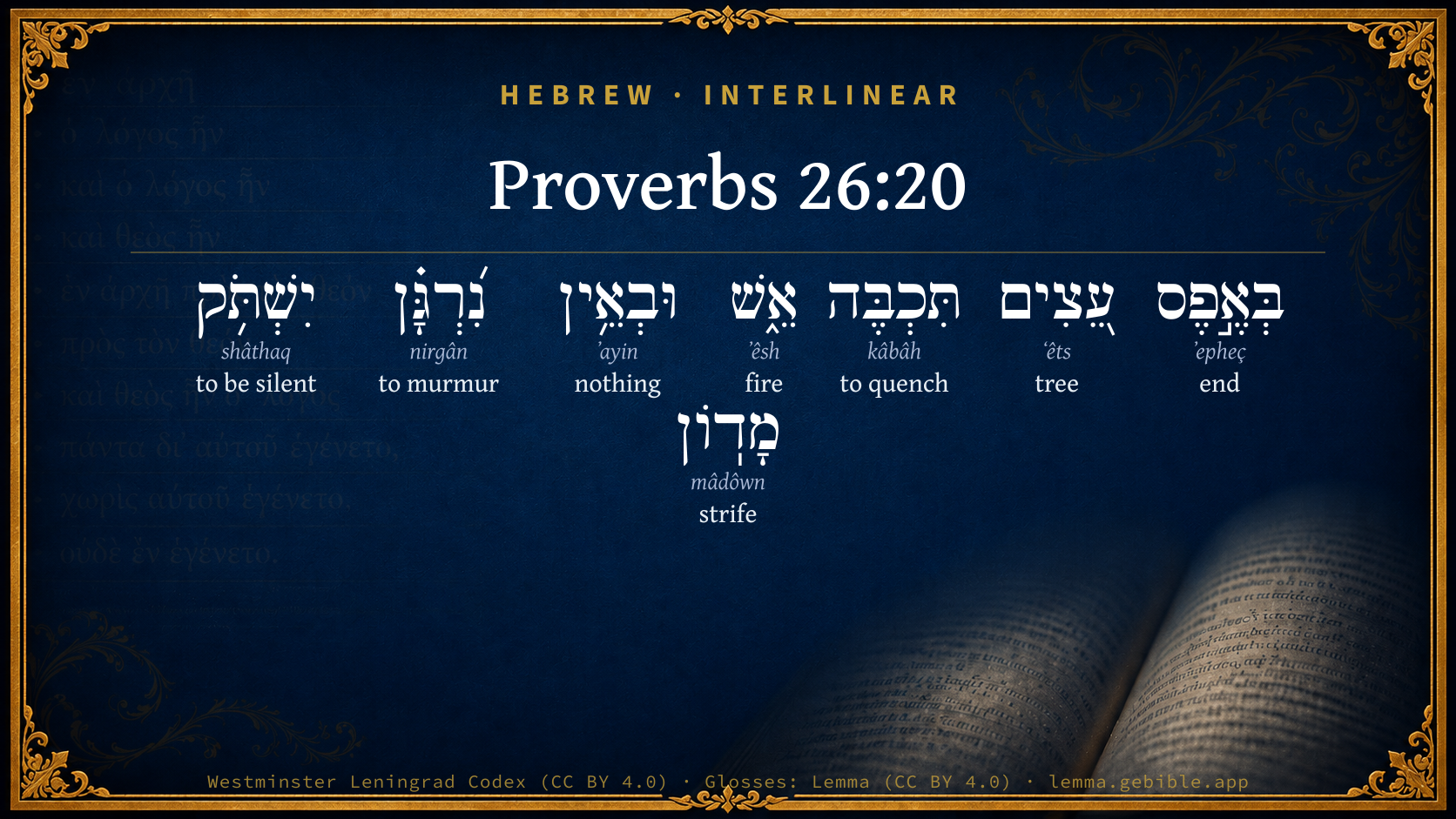
Proverbs 26:20

Hebrew (Westminster Leningrad Codex) Proverbs 26:20 appears in the Hebrew Old Testament. The text above is from the Westminster Leningrad Codex. Each word links to its Strong’s number, a concise gloss, and parsing drawn from the Open Scriptures Hebrew Bible morphology. Click any word for its full Brown-Driver-Briggs (BDB) entry.
Download image
Cite this verse

Proverbs 26:20 (World English Bible). Public Domain. Lemma interlinear Bible study tool, https://lemma.gebible.app/v/proverbs/26/20.

Show BibTeX & RIS
BibTeX
RIS
English Translation
For lack of wood a fire goes out; Without gossip, a quarrel dies down.
World English Bible · Public Domain
Download a study sheet

One document with this verse’s original text, its word-by-word gloss line, the meaning frame, cross-references with their text, attributed commentary, and full source and license credits — printable, and it pastes into notes with its structure intact.

This verse Autodidact and up

Study sheet (.html) Plain text (.txt)

A passage Seminary Student

Up to 50 verses in one chapter. A passage sheet keeps up to 6 commentary sources and 12 cross-references per verse, in the order this page ranks them, and says so on the sheet whenever that leaves anything out. Ask for a single verse and you get the Autodidact verse sheet above.

Everything on this page stays free to read, with no account — the sheet is a download of what is already on screen, not access to it.

Want to remove ads? Support Godless Engineer
Compare translations 3

The same verse in 3 English versions, stacked beneath the original-language interlinear above. Click any original word for its lexicon entry.

Each is an independent rendering of the whole verse — the interlinear is not word-aligned to these translations.

Highlighted words mark where these versions differ — a whole-verse word diff, not a word-by-word alignment.

  • World English Bible Public Domain
    For lack of wood a fire goes out; Without gossip, a quarrel dies down.
  • King James Version Public Domain
    Where no wood is, there the fire goeth out: so where there is no talebearer, the strife ceaseth.
  • unfoldingWord Literal Text CC BY-SA 4.0
    With the end of wood pieces a fire goes out, and when there is no murmurer, a quarrel becomes silent.

unfoldingWord Literal Text — © unfoldingWord, licensed CC BY-SA 4.0. Word-aligned USFM3 via Door43 (git.door43.org/unfoldingWord/en_ult).

Versions to compare (up to 4)

3 of 4 selected

Show all 18 translations

Every available English version of this verse, each an independent rendering of the whole verse.

  • World English Bible Public Domain
    For lack of wood a fire goes out; Without gossip, a quarrel dies down.
  • Berean Standard Bible Public Domain
    Without wood, a fire goes out; without gossip, a conflict ceases.
  • Majority Standard Bible Public Domain
    Without wood, a fire goes out; without gossip, a conflict ceases.
  • King James Version Public Domain
    Where no wood is, there the fire goeth out: so where there is no talebearer, the strife ceaseth.
  • American Standard Version (1901) Public Domain
    For lack of wood the fire goeth out; And where there is no whisperer, contention ceaseth.
  • Revised Version (1885) Public Domain
    For lack of wood the fire goeth out: and where there is no whisperer, contention ceaseth.
  • Geneva Bible (1599) Public Domain
    Without wood the fire is quenched, and without a talebearer strife ceaseth.
  • Douay-Rheims (1899) Public Domain
    When the wood faileth, the fire shall go out: and when the talebearer is taken away, contentions shall cease.
  • Young's Literal Translation Public Domain
    Without wood is fire going out, And without a tale-bearer, contention ceaseth,
  • Literal Standard Version CC BY-SA 4.0
    Fire is going out without wood, || And contention ceases without a tale-bearer,
  • Unlocked Literal Bible CC BY-SA 4.0
    For lack of wood, the fire goes out; and where there is no gossiper quarreling ceases.
  • unfoldingWord Literal Text CC BY-SA 4.0
    With the end of wood pieces a fire goes out, and when there is no murmurer, a quarrel becomes silent.
  • Darby Bible Public Domain
    Where no wood is, the fire goeth out; and where there is no talebearer, the contention ceaseth.
  • World Messianic Bible Public Domain
    For lack of wood a fire goes out. Without gossip, a quarrel dies down.
  • Webster's Bible Public Domain
    Where no wood is, there the fire goeth out: so where there is no tale-bearer, the strife ceaseth.
  • Free Bible Version CC BY-SA 4.0
    Without wood, the fire goes out; and without gossips, arguments stop.
  • Bible in Basic English Public Domain
    Without wood, the fire goes out; and where there is no secret talk, argument is ended.
  • JPS Tanakh (1917) Public Domain
    Where no wood is, the fire goeth out; and where there is no whisperer, contention ceaseth.

Literal Standard Version (2020), Covenant Press — licensed CC BY-SA 4.0. Text via the HelloAO Bible API (eBible.org). Unlocked Literal Bible (unfoldingWord) — licensed CC BY-SA 4.0. Text via the HelloAO Bible API (eBible.org). unfoldingWord Literal Text — © unfoldingWord, licensed CC BY-SA 4.0. Word-aligned USFM3 via Door43 (git.door43.org/unfoldingWord/en_ult). Free Bible Version, Dr. Jonathan Gallagher — licensed CC BY-SA 4.0. Text via the HelloAO Bible API (eBible.org).

Word by word

More ways to search: Search by grammar → Find every occurrence → Compare this word →

Practice this passage: Drill this verse → Learn its vocabulary →

About this verse

These counts appear in no published source. They are computed here, from the morphology-tagged text and Lemma’s own curated glosses. What Lemma adds →

8
words
8
distinct lemmas
Wisdom
section

Notable vocabulary

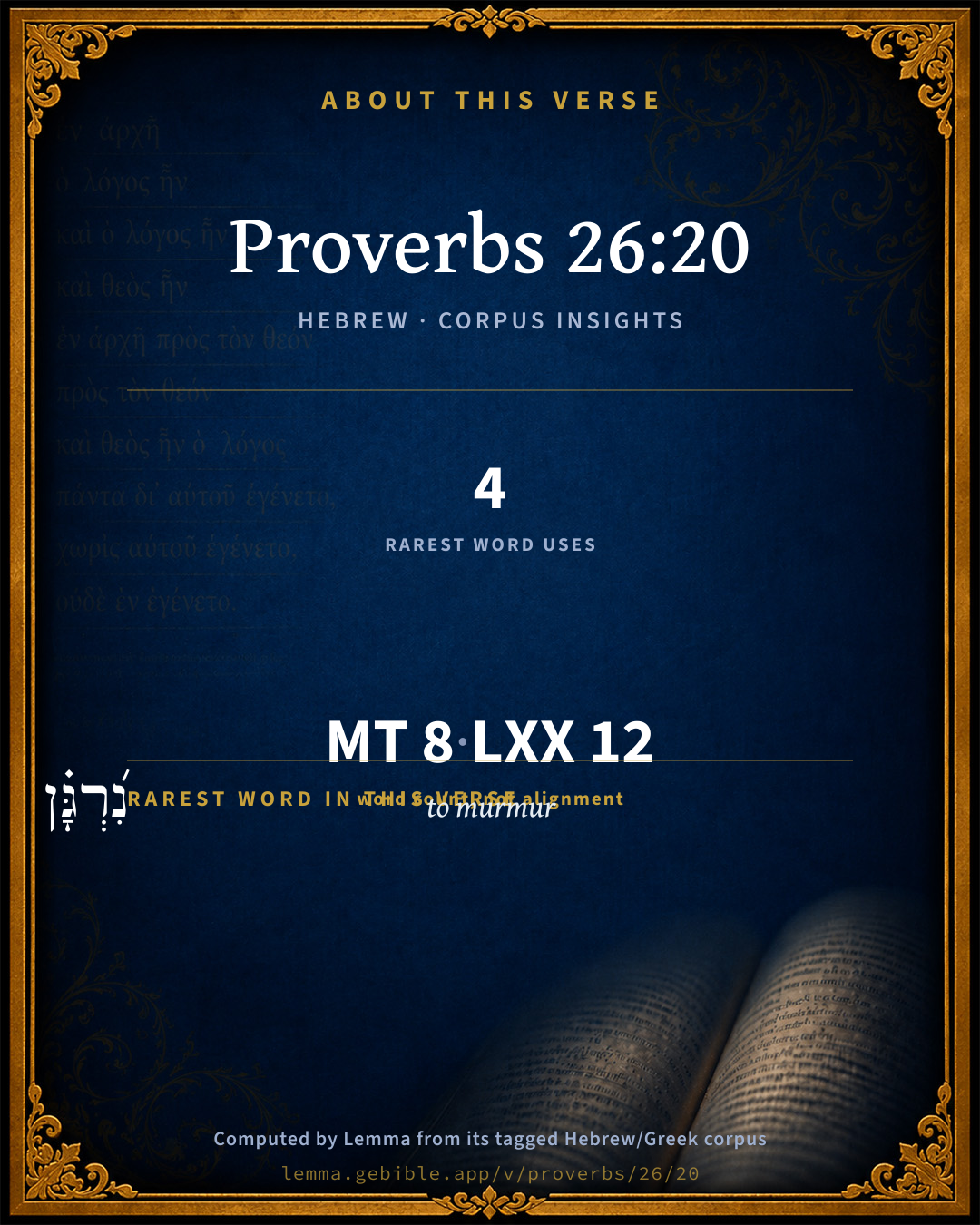
The rarest word here is נִ֝רְגָּ֗ן to murmur H5372 — appearing just 4 times in the whole Hebrew Bible.

Shared distinctive vocabulary

נִ֝רְגָּ֗ן to murmur H5372 occurs in 4 verses of the Hebrew Bible. Also found in:

Grammatical profile

  • 3 verbs
  • 4 nouns
  • 1 particle

Verb forms

  • תִּכְבֶּה Qal · Imperfect
  • נִ֝רְגָּ֗ן Niphal · Participle Active
  • יִשְׁתֹּ֥ק Qal · Imperfect

Hebrew & Septuagint length

In English translation the verse runs 14 words from the Hebrew and 15 from the Septuagint (LXX English) — closely comparable.

A rough comparison of the two English renderings, which tokenize alike — not a word-level alignment.

Word counts can differ between the Hebrew and the Greek without any difference in meaning — e.g. the Hebrew direct-object marker אֵת has no separate Greek word, and Greek often adds the article ὁ.

In the original languages it is 8 Hebrew tokens and 12 Greek tokens — but the two are counted differently (Hebrew bundles its prefixes and suffixes into one token; the Greek is in lemma form), so that isn’t a like-for-like length.

Cross-references

4

Topical passages linked to Proverbs 26:20 in the Treasury of Scripture Knowledge — connected by theme and wording, ordered by reader-vote popularity; previews shown in the World English Bible.

  • Proverbs 16:28 A perverse man stirs up strife. A whisperer separates close friends.
  • Proverbs 22:10 Drive out the mocker, and strife will go out; Yes, quarrels and insults will stop.
  • James 3:6 And the tongue is a fire. The world of iniquity among our members is the tongue, which defiles the whole body, and sets on fire the course of nature, and is set on fire by Gehenna.
  • Proverbs 26:22 The words of a whisperer are as dainty morsels, They go down into the innermost parts.

Cross-references courtesy of OpenBible.info (CC BY 4.0).

Hebrew and Greek witnesses Masoretic Hebrew ↔ Greek Septuagint

The same verse in the two great witnesses to the Old Testament, shown verse-for-verse.

These are two independent witnesses, not word-aligned to each other, and the Septuagint is shown in lemma (dictionary) form.

Hebrew Proverbs 26:20 Masoretic · Westminster Leningrad Codex

בְּאֶ֣פֶס עֵ֭צִים תִּכְבֶּה אֵ֑שׁ וּבְאֵ֥ין נִ֝רְגָּ֗ן יִשְׁתֹּ֥ק מָדֽוֹן

For lack of wood a fire goes out; Without gossip, a quarrel dies down.

World English Bible · Public Domain

Greek LXX Proverbs 26:20 Septuagint · lemma form

ἐν πολύς ξύλον θάλλω πῦρ ὅπου δέ οὐ εἰμί δίθυμος ἡσυχάζω μάχη

With much wood fire increases; but where there is not a double-minded man, strife ceases.

LXX2012 (modern English Septuagint) · Public Domain

On this verse, The Cambridge Bible for Schools and Colleges discusses the Septuagint’s reading. Read the note in Commentary ↓

Hebrew: Westminster Leningrad Codex (CC BY 4.0). Greek: Septuagint (public domain); English from LXX2012 (modern English Septuagint) (Public Domain). How the Septuagint differs from the Hebrew →

Commentary

Notes on Proverbs 26:20 from classic Christian and Jewish commentators (each source and its license shown beneath its notes). The classic Christian expositions comment on the surrounding passage and are grouped to its opening verse, so a note may address several verses; the Jewish commentaries on the Tanakh (Rashi and others) are per-verse, so they appear only where the commentator wrote on this verse.

Lemma curates 59 commentaries, every one of them public domain or Creative Commons licensed, each selected and text-cleaned for this edition rather than reprinted as found. About our sources →

Trapp's Complete Commentary

John Trapp

Pro 26:20 Where no wood is, [there] the fire goeth out: so where [there is] no talebearer, the strife ceaseth.

Ver. 20. Where no wood is, there the fire goeth out.] Lignis ignis conservatur. So is strife by evil tongues; these are the devil’s bellows and boutefeaus. "Ye shall conceive chaff, ye shall bring forth stubble, your breath as fire shall devour you." {Isa 33:11} Such is the breath of tale bearers. A curfew bell would do well for these incendiaries, that else may "set on fire the whole course of nature." {Jas 3:6} {See Trapp on "Pro 16:28"}

John Trapp, A Commentary or Exposition upon All the Books of the Old and New Testament (1647–1656) — public domain. Text from a community e-Sword module.

Joseph Benson's Commentary

Pro 26:20-22. Where no wood is, the fire goeth out: &c. — As the fire will soon be extinguished if you take away the fuel that feeds it; so, where there is no tale-bearer — To carry such reports from one to another as may provoke them to mutual anger, enmity, and contention; the strife ceaseth — Animosity, hatred, and quarrels will die away. As coals to burning coals, &c. — As dead coals laid on burning coals, and wood on fire, increase the heat and flame; so is a contentious man — Hebrew, אישׁ מדונים, a man of contentions, that is, who loveth and giveth himself up to contentions; or, who is hard to please, and apt to find fault with every person and thing; to kindle strife — For unkind tempers and provoking words quickly produce quarrels and enmities, which destroy all peace, unanimity, and concord, and embroil people in endless hostilities against one another. The words of a tale-bearer are as wounds — This was observed before, Pro 18:8, (on which see the note,) and is here repeated, as being a point of great importance to the peace and welfare of all societies, and proper to be often and earnestly pressed upon the consciences of men, because of their great and general proneness to this sin.

Joseph Benson's Commentary on the Old and New Testaments (1811–1818) — public domain. Text from a community e-Sword module.

Tyndale Open Study Notes

Tyndale Open Resources

26:20-21 A gossip and a quarrelsome person are both like fuel to the fire of trouble and discord.

Tyndale Open Study Notes — © Tyndale Open Resources, licensed CC BY-SA 4.0. Text via the HelloAO Bible API.

Matthew Henry's Commentary

Contention is as a fire; it heats the spirit, burns up all that is good, and puts families and societies into a flame. Now here we are told how that fire is commonly kindled and kept burning, that we may avoid the occasions of strife and so prevent the mischievous consequences of it. If then we would keep the peace, 1. We must not give ear to talebearers, for they feed the fire of contention with fuel; nay, they spread it with combustible matter; the tales they carry are fireballs. Those who by insinuating base characters, revealing secrets, and misrepresenting words and actions, do what they can to make relations, friends, and neighbours, jealous one of another, to alienate them one from another, and sow discord among them, are to be banished out of families and all societies, and then strife will as surely cease as the fire will go out when it has no fuel; the contenders will better understand one another and come to a better temper; old stories will soon be forgotten when there are no new ones told to keep up the remembrance of them, and both sides will see how they have been imposed upon by a common enemy. Whisperers and backbiters are incendiaries not to be suffered. To illustrate this, he repeats (Pro 26:22) what he had said before (Pro 18:8), that the words of a tale-bearer are as wounds, deep and dangerous wounds, wounds in the vitals. They wound the reputation of him who is belied, and perhaps the wound proves incurable, and even the plaster of a recantation (which yet can seldom be obtained) may not prove wide enough for it. They wound the love and charity which he to whom they are spoken ought to have for his neighbour and give a fatal stab to friendship and Christian fellowship. We must therefore not only not be tale-bearers ourselves at any time, nor ever do any ill offices, but we should not give the least countenance to those that are. 2. We must not associate with peevish passionate people, that are exceptions, and apt to put the worst constructions upon everything, that pick quarrels upon the least occasion, and are quick, and high, and hot, in resenting affronts. These are contentious men, that kindle strife, Pro 26:21. The less we have to do with such the better, for it will be very difficult to avoid quarrelling with those that are quarrelsome.

Matthew Henry's Commentary on the Whole Bible (1708–1710) — public domain (CC PDM 1.0). Text via the HelloAO Bible API.

Jamieson, Fausset & Brown

Robert Jamieson, A. R. Fausset & David Brown

The talebearers foster (Pro 16:28), and the contentious excite, strife.

Jamieson, Fausset & Brown — Commentary Critical and Explanatory on the Whole Bible (1871) — public domain (CC PDM 1.0). Text via the HelloAO Bible API.

Adam Clarke's Commentary

Verse 20. Where no wood is, there the fire goeth out] The tale-receiver and the tale-bearer are the agents of discord. If none received the slander in the first instance, it could not be propagated. Hence our proverb, "The receiver is as bad as the thief." And our laws treat them equally; for the receiver of stolen goods, knowing them to be stolen, is hanged, as well as he who stole them.

Adam Clarke's Commentary on the Bible (1810–1826) — public domain. Text from a community e-Sword/MySword module.

The Cambridge Bible for Schools and Colleges

gen. ed. J. J. S. Perowne

20. talebearer] Rather, whisperer, as the word is rendered in Pro_16:28. The Vulg. has susurro here and in Pro_26:22 below, but verbosus in Pro_16:28, and bilinguis in Pro_18:8. The LXX. have here δίθυμος, a man of strife or discord, but in Pro_26:22, κέρκωψ, a jackanapes.

The Cambridge Bible for Schools and Colleges (gen. ed. J. J. S. Perowne; Cambridge University Press, 1878–1918) — public domain. Text from a community e-Sword module.

John Gill's Exposition

Where no wood is, there the fire goeth out,.... Or "woods" (h); where there is a large quantity of wood or fuel, the fire is kept up; but where there is little, scarce any or none at all, it goes out of course;

So where there is no talebearer, the strife ceaseth; or is silent (i): men cease to quarrel one with another; they hold their peace and are silent, when there are none to bring tales from one to another, or any whisperer or backbiter to suggest evil things of each other; or when such are discouraged on both sides, and their tales are not listened to; or when they are detected and thrust out of doors, as they deserve, then strife subsides, and peace ensues. Contention is like a fire, the flame of which is blown up by talebearers and whisperers, who are as incendiaries, and as such are to be treated.

(h) "deficientibus lignis", Junius & Tremellius, Piscator; "in deficientia lignorum", Michaelis; "quum expirarunt ligna", Schultens. (i) "silebit", Pagninus, Montanus, Mercerus, Gejerus; "silet", Junius & Tremellius, Piscator; "consilescit", Cocceius, Schultens.

John Gill's Exposition of the Whole Bible (1746–1763) — public domain (CC PDM 1.0). Text via the HelloAO Bible API.

Haydock's Catholic Bible Commentary

Faileth. Hebrew, Symmachus, Calmet, "aboundeth, the fire is bright, or flourisheth" (Septuagint) (Haydock)

George Leo Haydock (1774–1849), Haydock's Catholic Family Bible and Commentary, 1859 edition — public domain. Excludes Psalms (Douay-Rheims chapter numbering differs from Protestant) and Deuterocanonical books (Catholic canon only).

Matthew Poole's English Annotations

Tale-bearer, to carry such reports from one to another as may provoke them to mutual rage and strife.

Matthew Poole's English Annotations on the Holy Bible (1683–1685) — public domain. Text from a community e-Sword/MySword module.

Whedon's Commentary on the Bible

Daniel D. Whedon

20. No wood is — No more wood, that is, when wood fails.

Talebearer — A tattler, whisperer, or garrulous person.

Daniel D. Whedon (gen. ed.), Commentary on the Old and New Testaments (1874–1909) — public domain. Text from a community e-Sword module.

The Pulpit Commentary

Some proverbs follow concerning the slanderer. Where no wood is, there the fire goeth out. Where the wood fails, and that was the only fuel then used, the fire must go out. So where there is no talebearer, the strife ceaseth; comes to silence. (Pro_22:10) (For nirgan," whisper," see on Pro_16:28) Septuagint, "With much wood fire groweth, but where there is not one discordant (diyumov ), strife is at rest.

The fuel of strife.

I STRIFE WILL DIE OUT IF IT BE NOT SUPPLIED WITH FRESH FUEL. The fire will not burn after the stock of wood is all exhausted. The quarrel will not continue if the angry feelings that rage in it are not fed by fresh provocations. The unhappy experience of most quarrels is that these provocations are too readily supplied. But if one party to a quarrel really wishes for peace, he can often obtain it by simply abstaining from maintaining his contention. His opponent will tire of a one-sided war. Patience, meekness, and quiet endurance will thus make peace in the end. This was Christ"s method. He brought peace by peaceably submitting to wrong.

II STRIFE IS TOO OFTEN MAINTAINED WITH THE FRESH FUEL ADDED BY STRANGERS. If the two principals in a quarrel were left to themselves, they might tire of perpetual disputes. But a third party interferes, not as a peacemaker, but to take one side; or to meddle in pure mischief making, delighting to stir up the embers of strife; or to show his own power and importance. This conduct is the opposite of that of one who serves the Prince of Peace.

III TALE BEARING ADDS FUEL TO STRIFE.

1. It may be true. We may hear something of one party in a quarrel which we know to be correct, and report it to the other, though it was never intended to be repeated. This rouses angry passions and renews the old battle. Immense harm is done by merely inconsiderate gossip. When an element of spite is added and there is a deliberate attempt to aggravate a quarrel, the conduct of the tale bearer is simply diabolical.

2. It is likely to be exaggerated. Most tales, like snowballs, grow as they proceed. Passing from one to another, they are unintentionally exaggerated. Surmise and inference are mixed up with the original narrative as part of the story. Rhetorical point is gained at the expense of accuracy.

a. IT IS THE DUTY OF THE CHRISTIAN TO ALLAY STRIFE. His should be the blessedness of the peacemaker. (Mat_5:9) If we have Christian love we shall desire to do this, for chanty covers a multitude of sins. (1Pe_4:8) Immense harm would he prevented by the merely negative course of refraining from repeating all words that have the slightest tendency to provoke ill will between other people. There is virtue in reticence. Silence here is indeed golden. But sometimes we should go further, and endeavour to make the best of people to one another, and so to heal quarrels.

b. NO TALE BEARER CAN REVIVE THE STRIFE BETWEEN THE SOUL AND GOD. If there be no more fuel, this will vanish. God desires to be reconciled with his children. If they will but lay down their arms, the old quarrel will cease at once.

1. God knows the worst of us. He knows all. Therefore he never makes discoveries that will rouse his wrath against our pardoned past.

2. He cannot be misled by deceivers. Tale bearers may malign our character before men, never before God.

3. The only thing to continue our strife with God is to continue our rebellious lives. While we seek peace, peace is secure.

Vers. 20-28. Spite, cunning, and deceit.

I THE TALE BEARER AND MISCHIEF MAKER. (Vers. 20-22)

1. His inflammatory character. (Vers. 20, 21) He keeps alive quarrels which, but for his vice, would die down for want of fuel. It is easy to fire the imagination with tales of evil, not so easy to quench the flames thus kindled. If the character is odious, let us beware of countenancing it by opening our ears to scandal. Personal gossip has in our day become an offence in the public press. But were there no receivers, there would be no thieves. If we cannot stop the scandalmonger"s month, we can stop our own ears; and "let him see in our face that he has no room in our heart.

2. The pain he causes. (Ver. 22) Slander is deadly it "out venoms all the worms of Nile." "A whispered word may stab a gentle heart." "What weapon can be nearer to nothing than the sting of a wasp? yet what a painful wound may it give! The scarce-visible point how it envenoms and rankles and swells up the flesh! The tenderness of the part adds much to the grief." If God has given us a sting, or turn for satire, may we use it for its proper work to cover evil with contempt, and folly with ridicule, and not at the devilish instigation of envy and spite. Let us dread and discourage the character of the amusing social slanderer.

II THE BAD HEART. (Vers. 23-25)

1. It may be varnished over, but is still the bad heart. It is like the common sherd covered with impure silver, the common wood with veneer. The burning lips seem here to mean glowing professions of friendship. like the kiss of Judas.

2. Duplicity is the sign of the bad heart. The dissembler smiles, and murders while he smiles. The fair face hides what the false heart doth know. "Neither man nor angel can discern Hypocrisy, the only evil that walks Invisible, except to God alone. Oft, though wisdom wakes, suspicion sleeps At wisdom"s gate, and to simplicity Resigns her charge, while goodness thinks no ill Where no ill seems.

3. The need of prudence and reserve. "Trust not him that seems to be a saint." Indeed, it is an error to place perfect trust in anything human or finite. But the special warning here is against suffering flattery to blind us to the real character of one who has once been revealed in his true colours.

III THE EXPOSURE OF WICKEDNESS. (Vers. 26, 27) Vain is the attempt of men to conceal for any length of time their real character. What they say and what they do not say, do and do not do, reveals them sooner or later. And the revelation brings its retribution. The intriguer falls into his own pit, is crushed beneath the stone he set in motion. Curses come home to roost; the biter is bitten; and the villain suffers from the recoil of his own weapon. This appears also to be the sense of ver. 28. Though a lie has no legs, it has wings, and may fly far and wide, but it "hates its own master" (according to one rendering), and flies back to perch on his shoulder and betray him to his ruin. J.

The Pulpit Commentary (1880–1919), ed. H.D.M. Spence-Jones & Joseph S. Exell — public domain. Text from a community e-Sword module.

Keil & Delitzsch

C. F. Keil & F. Delitzsch

There now follow proverbs regarding the nirgân, the slanderer (vid., regarding the formation and import of this word at Pro 26:28):

20 Where the wood faileth, the fire goeth out;

And where no tale-bearer, discord cometh to silence.

Wood, as material for building or for burning, is called, with the plur. of its product, עצים. Since אפס is the absolute end of a thing, and thus expresses its no longer existing, so it was more appropriate to wood (Fleischer: consumtis lignis) than to the tale-bearer, of whom the proverb says the same thing as Pro 22:10 says of the mocker.

Keil & Delitzsch — Biblical Commentary on the Old Testament (1861–1891) — public domain (CC PDM 1.0). Text via the HelloAO Bible API. (Old Testament only.)

Bridges on Proverbs

Charles Bridges

20 Where no wood is, there the fire goeth out: so where there is no talebearer, the strife ceaseth. {Where no...: Heb. Without wood} {talebearer: or, whisperer} {ceaseth: Heb. is silent} 21 As coals are to burning coals, and wood to fire; so is a contentious man to kindle strife. 22 The words of a talebearer are as wounds, and they go down into the innermost parts of the belly. (Pro 18:8 .) {innermost...: Heb. chambers}

The busy tongue makes work, where it does not find it. Such is the despicable trade of the talebearer — employing his time in prying into other people’s business, ferreting out secrets, diving into family histories, intermeddling with their concerns; all this with the view of putting himself forward, as a keen, intelligent, and active man. Thus in every way where he can please himself ’man is naturally his own grand idol. He would be esteemed and honored by any means; and to magnify that idol self, he kills the name and esteem of others in sacrifice to it.’†1 Real virtue revolts from this base selfishness.

The fire of holy zeal seizes on things nearest home. This is a wildfire scattering its destruction abroad. The talebearer should be looked on as an incendiary. For his "tongue is a fire, itself set on fire of hell."†2 His raking up of old and forgotten tales supplies the fuel, without which the fire of strife, as where no wood is, goeth out. To quench the flame, we must take away the fuel. We must remove the talebearer; stop him in his words; compel him to produce his authority; face him, if possible, with the subject of his tales. This decisive course will prevent a mass of slander, and put him to shame.†3

Near akin is the contentious man. His mischief indeed is more open. His determination to have the last word is as coals to burning coals, and wood to the fire.†4 It keeps up the flame, kindled perhaps by a mere angry word or a contemptuous look; and which, but for this constant succession of fuel, might quickly have been extinguished. Do we never aim at the wit of a sharp answer, that "stirreth up anger," rather than at the wisdom and grace of "a soft answer, that turneth away wrath"? (Pro 15:1 .)

The talebearer’s wounds are however the most dangerous. They go down into the chambers — the vitals of the heart. One noiseless word may be the stab of death. But, if he escape for a while, his secret sins shall "be set before his eyes," and his wanton trifling with his brother’s character be justly recompensed. (Psa 50:20 ; Psa 52:1-5 .)

Are we closely watching against these sins? Do we carefully damp the rising flame of contention?†5 Do we resist the temptation to speak needlessly of the faults of others? Do we dread the character of a polished, well-educated, amusing slanderer? Should we be ready to give up the eclat of telling a good story, from the fear of wounding a good name? We may feel indignant at the charge of talebearing. Yet it requires no ordinary exercise of Christian discipline to maintain the silence of charity, and to regulate both the tongue and the ear within its well-advised limits.

Footnotes:

†1 Leighton on 1Pe 2:17 . Compare Jer 9:4 .

†2 Jas 3:6. Compare Pro 16:27 .

†3 Pro 25:23. Compare Pro 22:10 .

†4 Pro 15:18; Pro 16:28 ; Pro 29:22 . 2Co 12:20 .

†5 Pro 17:14. Gen 13:8-9 .

Charles Bridges, An Exposition of the Book of Proverbs (1846) — public domain. Text from a community e-Sword module.

unfoldingWord translationNotes

Door43 World Missions Community

gossiper

a person who gossips a lot

As charcoal is to burning coals and wood is to fire

What charcoal does to coals and what wood does to fire can be stated clearly. AT: "As charcoal helps coals burn and as wood helps fire burn" (See: Assumed Knowledge and Implicit Information)

kindling strife

To kindle something means to set it on fire. Setting strife on fire is a metaphor for causing people to fight or argue. AT: "causing people to fight" or "causing people to argue" (See: Metaphor)

translationWords

fire

gossip

strife

unfoldingWord translationNotes — © Distant Shores Media and the Door43 World Missions Community, licensed CC BY-SA 4.0. Source: git.door43.org/Door43/en_tn.

Rashi

Rabbi Shlomo Yitzchaki (Rashi)

without wood That is to say: These two things are analogous; just as without wood the fire goes out, so without a grumbler, who slanders and incites quarrelers, strife quiets down.

Rashi on the Tanakh — English translations: “The Judaica Press complete Tanach with Rashi, translated by A. J. Rosenberg” (CC BY 4.0); “Pentateuch with Rashi's commentary by M. Rosenbaum and A.M. Silbermann, 1929-1934” (public domain); “The Metsudah Tanach series, Lakewood, N.J” (CC BY 4.0); and “The Book of Joshua, Metsudah Publications, 1997” (CC BY 4.0). Text via Sefaria.

Lesson kit

Teaching starters — assembled from the data on this page, not authored interpretation. Every prompt links to the verse data it draws on. Edit before teaching.

Proverbs, in the Wisdom, opens this verse with 8 words (8 distinct Hebrew lemmas). Its most distinctive word is nirgân (“to murmur”). A historical commentator’s framing appears above. Read the whole chapter for the surrounding context.

Discussion questions

  1. The word nirgân carries the sense “to murmur.” How does it shape the verse?
  2. How does Proverbs 16:28, which shares the word «to murmur», read alongside this verse?
  3. The translations on this page render this verse differently — a whole-verse word diff, not a word-by-word alignment. What might account for the different wordings?
  4. «תִּכְבֶּה» is a Qal Imperfect verb. How does that grammatical form shape the action described?
  5. Compare how Trapp's Complete Commentary and Joseph Benson's Commentary read this verse. Where do they agree or differ?

Things to notice

Reading settings

Reading text

Shown beneath each verse's original-language words.

Old Testament
Old Testament edition

Read the OT as the Masoretic Hebrew (MT) or the Greek Septuagint (LXX).

English shown for the Greek Septuagint (in the Hebrew ↔ Greek comparison).

Comparing translations? Open the Compare panel on any verse page to stack up to four side by side.