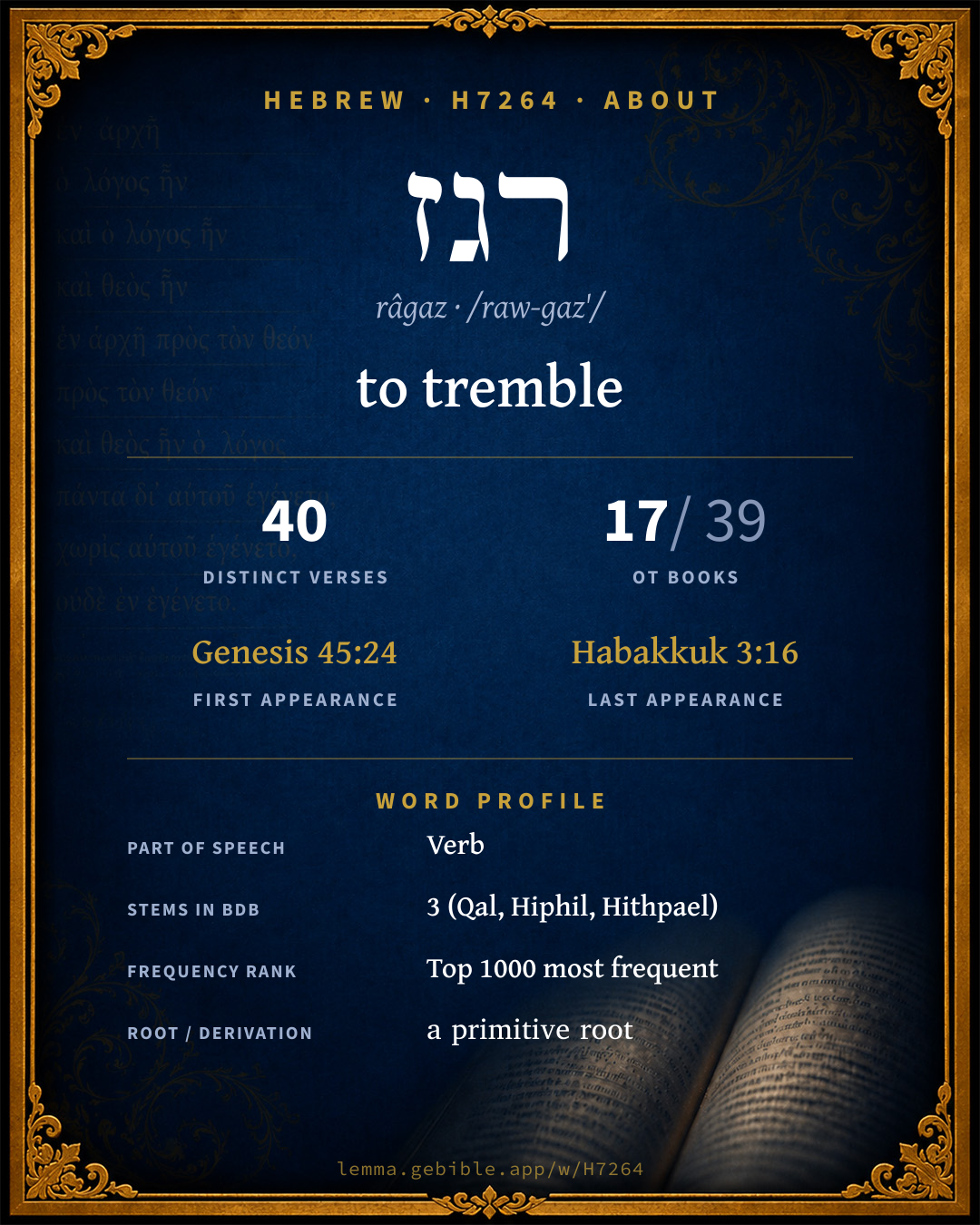
רָגַז
to tremble
‘to tremble’ is one of 4 main senses fuller range ↓
Full lexicon entry — Brown-Driver-Briggs (BDB)
From Brown-Driver-Briggs (BDB)
Where this word appears
See every Qal verb in the Hebrew Bible →
Grammar key — what these labels mean
Part of speech
- Verb
- An action or state-of-being word.
Stem
- Qal
- The basic, simple active stem — the plain form of the verb (“he wrote”).
- Hithpael
- The reflexive or reciprocal stem (the subject acts on itself). Here: ‘excite oneself’
- Hiphil
- The causative active stem (“he caused / brought about”).
Form
- Imperfect
- An incomplete, ongoing, or future action (“he will / would write”).
- Perfect
- A completed action or state — Hebrew marks aspect (completeness) more than strict tense (“he wrote”).
- Infinitive Construct
- A bound verbal noun, frequently with prepositions (“to write / in writing”).
- Sequential Perfect
- A perfect with prefixed waw continuing a preceding imperfect or command (waw-consecutive perfect).
- Sequential Imperfect
- An imperfect with prefixed waw — the standard past-narrative form (waw-consecutive imperfect).
- Participle Active
- A verbal adjective expressing ongoing or characteristic action (“writing / one who writes”).
- Jussive
- A third- or second-person volitional form expressing wish or command (“let him write”).
- Imperative
- A direct command (“write!”).
State
- Construct
- A noun bound to a following noun in a possessive / “of” relationship (the construct chain).
- Absolute
- The independent form of a noun, not bound to a following word.
Person
- 3rd Person
- The one spoken about (“he / she / it / they”).
- 2nd Person
- The one addressed (“you”).
- 1st Person
- The speaker (“I / we”).
Gender
- Masculine
- Grammatically masculine.
- Feminine
- Grammatically feminine.
- Common
- Either gender — not distinguished for this form.
Number
- Plural
- More than one (in Hebrew, generally three or more).
- Singular
- One.
Grammatical forms 23 distinct
- Verb, Qal, Imperfect, 3rd Person, Masculine, Plural 8 times (20%)
- Verb, Qal, Perfect, 3rd Person, Feminine, Singular 4 times (10%)
- Verb, Hithpael, Infinitive Construct 4 times (10%)
- Verb, Qal, Imperfect, 3rd Person, Masculine, Singular 3 times (7%)
- Verb, Qal, Sequential Perfect, 3rd Person, Common, Plural 2 times (5%)
- Verb, Qal, Sequential Imperfect, 3rd Person, Feminine, Singular 2 times (5%)
- Verb, Hiphil, Participle Active, Masculine, Singular, Absolute 2 times (5%)
- Verb, Hiphil, Infinitive Construct 1 time (2%)
+15 more forms (15 occurrences)
Parsed forms decoded from the imported morphology (morphhb / Westminster Leningrad Codex — WLC text public domain, morphhb tagging CC BY 4.0), counted across 41 parsed occurrences — not distinct verses.
Every verse where H7264 appears — 40 distinct verses across 17 books. Click any verse to open its interlinear word-by-word view. Verse text shown in the World English Bible for context — . Each verse’s Hebrew form is shown with its reference; the English is not keyword-highlighted, since the data carries no word-level English alignment. Use “Compare translations” on any verse to read it across multiple English versions. This concordance covers the Hebrew Bible; Septuagint (Greek Old Testament) occurrences are not indexed here.
Genesis 1 verse
Exodus 1 verse
Deuteronomy 1 verse
1 Samuel 2 verses
- 1 Samuel 14:15 וַ/תִּרְגַּ֣ז conj + Qal wimpf 3fs There was a trembling in the camp, in the field, and among all the people; the garrison, and the spoilers, they also trembled; and the earth quaked: so there was an exceeding great trembling.
- 1 Samuel 28:15 הִרְגַּזְתַּ֖/נִי Hiphil pf 2ms + sfx pers 1cs Samuel said to Saul, Why have you disquieted me, to bring me up? Saul answered, I am sore distressed; for the Philistines make war against me, and God is departed from me, and answers me no more, neither by prophets, nor by dreams: therefore I have called you, that you may make known to me what I shall do.
2 Samuel 3 verses
- 2 Samuel 7:10 יִרְגַּ֖ז Qal impf 3ms I will appoint a place for my people Israel, and will plant them, that they may dwell in their own place, and be moved no more; neither shall the children of wickedness afflict them any more, as at the first,
- 2 Samuel 18:33 וַ/יִּרְגַּ֣ז conj + Qal wimpf 3ms The king was much moved, and went up to the chamber over the gate, and wept: and as he went, thus he said, my son Absalom, my son, my son Absalom! would I had died for you, Absalom, my son, my son!
- 2 Samuel 22:8 יִרְגָּ֑זוּ Qal impf 3mp Then the earth shook and trembled, The foundations of heaven quaked Were shaken, because he was angry.
2 Kings 2 verses
- 2 Kings 19:27 הִֽתְרַגֶּזְ/ךָ֥ Hithpael inf.cs + sfx pers 2ms But I know your sitting down, and your going out, and your coming in, and your raging against me.
- 2 Kings 19:28 הִתְרַגֶּזְ/ךָ֣ Hithpael inf.cs + sfx pers 2ms Because of your raging against me, and because your arrogance is come up into my ears, therefore will I put my hook in your nose, and my bridle in your lips, and I will turn you back by the way by which you came.
1 Chronicles 1 verse
Job 2 verses
Psalms 5 verses
- Psalms 4:4 רִגְז֗וּ Qal impv 2mp Stand in awe, and don't sin. Search your own heart on your bed, and be still. Selah.
- Psalms 18:7 יִרְגָּ֑זוּ Qal impf 3mp Then the earth shook and trembled. The foundations also of the mountains quaked and were shaken, Because he was angry.
- Psalms 77:16 יִרְגְּז֥וּ Qal impf 3mp The waters saw you, God. The waters saw you, and they writhed. The depths also convulsed.
- Psalms 77:18 רָגְזָ֖ה Qal pf 3fs The voice of your thunder was in the whirlwind. The lightnings lit up the world. The earth trembled and shook.
- Psalms 99:1 יִרְגְּז֣וּ Qal impf 3mp Yahweh reigns! Let the peoples tremble. He sits enthroned among the cherubim. Let the earth be moved.
Proverbs 2 verses
Isaiah 11 verses
- Isaiah 5:25 וַֽ/יִּרְגְּזוּ֙ conj + Qal wimpf 3mp Therefore Yahweh's anger burns against his people, And he has stretched out his hand against them, and has struck them. The mountains tremble, And their dead bodies are as refuse in the midst of the streets. For all this, his anger is not turned away, But his hand is still stretched out.
- Isaiah 13:13 אַרְגִּ֔יז Hiphil impf 1cs Therefore I will make the heavens to tremble, and the earth shall be shaken out of its place, in the wrath of Yahweh of hosts, and in the day of his fierce anger.
- Isaiah 14:9 רָגְזָ֥ה Qal pf 3fs Sheol from beneath is moved for you to meet you at your coming; it stirs up the dead for you, even all the chief ones of the earth; it has raised up from their thrones all the kings of the nations.
- Isaiah 14:16 מַרְגִּ֣יז Hiphil ptcp.act ms Those who see you shall gaze at you, they shall consider you, [saying], "Is this the man who made the earth to tremble, who shook kingdoms;
- Isaiah 23:11 הִרְגִּ֖יז Hiphil pf 3ms He has stretched out his hand over the sea, he has shaken the kingdoms: Yahweh has given commandment concerning Canaan, to destroy the strongholds of it.
- Isaiah 28:21 יִרְגָּ֑ז Qal impf 3ms For Yahweh will rise up as on Mount Perazim, he will be angry as in the valley of Gibeon; that he may do his work, his strange work, and bring to pass his act, his strange act.
- Isaiah 32:10 תִּרְגַּ֖זְנָה Qal impf 2fp For days beyond a year shall you be troubled, you careless women; for the vintage shall fail, the harvest shall not come.
- Isaiah 32:11 רְגָ֖זָה Qal impv 2fp Tremble, you women who are at ease; be troubled, you careless ones; strip yourselves, and make yourselves naked, and gird [sackcloth] on your loins.
- Isaiah 37:28 הִֽתְרַגֶּזְ/ךָ֥ Hithpael inf.cs + sfx pers 2ms But I know your sitting down, and your going out, and your coming in, and your raging against me.
- Isaiah 37:29 הִתְרַגֶּזְ/ךָ֣ Hithpael inf.cs + sfx pers 2ms Because of your raging against me, and because your arrogance is come up into my ears, therefore will I put my hook in your nose, and my bridle in your lips, and I will turn you back by the way by which you came.
- Isaiah 64:2 יִרְגָּֽזוּ Qal impf 3mp as when fire kindles the brushwood, [and] the fire causes the waters to boil; to make your name known to your adversaries, that the nations may tremble at your presence!
Jeremiah 2 verses
- Jeremiah 33:9 וְ/רָֽגְז֗וּ conj + Qal wpf 3cp [This city] shall be to me for a name of joy, for a praise and for a glory, before all the nations of the earth, which shall hear all the good that I do to them, and shall fear and tremble for all the good and for all the peace that I procure to it.
- Jeremiah 50:34 וְ/הִרְגִּ֖יז conj + Hiphil inf.cs Their Redeemer is strong; Yahweh of Hosts is his name: he will thoroughly plead their cause, that he may give rest to the earth, and disquiet the inhabitants of Babylon.
Ezekiel 1 verse
Joel 2 verses
- Joel 2:1 יִרְגְּז֕וּ Qal juss 3mp Blow you the trumpet in Zion, And sound an alarm in my holy mountain! Let all the inhabitants of the land tremble, For the day of Yahweh comes, For it is close at hand:
- Joel 2:10 רָ֣גְזָה Qal pf 3fs The earth quakes before them. The heavens tremble. The sun and the moon are darkened, And the stars withdraw their shining.
Amos 1 verse
Micah 1 verse
Habakkuk 2 verses
- Habakkuk 3:7 יִרְגְּז֕וּ/ן Qal impf 3mp + sfx n I saw the tents of Cushan in affliction. The dwellings of the land of Midian trembled.
- Habakkuk 3:16 וַ/תִּרְגַּ֣ז אֶרְגָּ֑ז conj + Qal wimpf 3fs Qal impf 1cs I heard, and my body trembled. My lips quivered at the voice. Rottenness enters into my bones, and I tremble in my place, Because I must wait quietly for the day of trouble, For the coming up of the people who invade us.
About this entry
At a glance — auto-summarized from this page’s data, not written by a person. Every figure links to its source below. This summary describes the numbers; it doesn’t interpret them.
“to tremble” is the headline sense of the Hebrew verb רגז (râgaz). Its earliest occurrence is Genesis 45:24. The Hebrew Bible uses it across 40 verses — moderately common. More than a quarter of its appearances fall in Isaiah. The verb spans 3 stems, from Qal to Hiphil. See the sense tree, 40-verse concordance, and the renderings breakdown below.
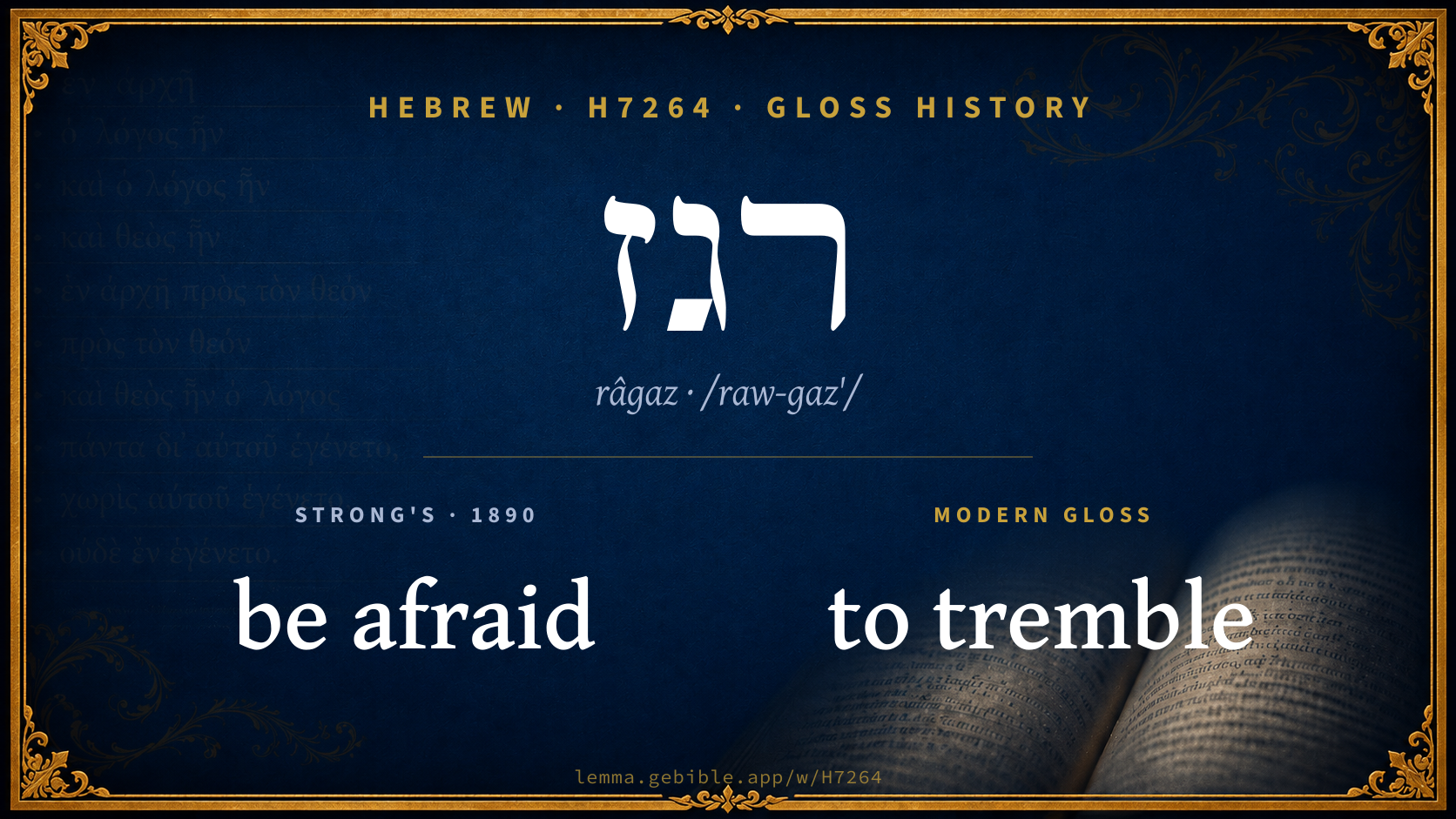
Gloss history
Strong's 1890 vs modern scholarship
About this word
Strong's H7264 catalogs a Hebrew word from the Hebrew Old Testament.
These counts are not copied from any lexicon or concordance. They are computed here, from the morphology-tagged Hebrew Old Testament. What Lemma adds →
- 40
- distinct verses
- The word appears in 40 distinct verses.
- 17 / 39
- OT books
- The word appears in 17 of 39 Old Testament books.
- #891
- by frequency
- Top 1000 most frequent Hebrew words (rank 891 of 8,640 Hebrew words by occurrence).
View all 40 occurrences in the concordance →
By section of the Old Testament
By traditional corpus
Conventional, traditional groupings — biblical authorship is debated, so this is a traditional corpus grouping, not an authorship claim. Each share is this word’s portion of its verses in that division of the Hebrew canon. Each figure is a share of the word’s 40 distinct verses.
- Prophets (Nevi'im) 27 verses · 68%
- Writings (Ketuvim) 10 verses · 25%
- Torah (Pentateuch) 3 verses · 8%
How translations render this word
Counts come from each version’s own published word-to-Strong’s tagging or interlinear alignment — an approximate guide to how each version renders this word, not a word-level alignment the data otherwise carries. Because each total is that version’s own tagged count, the per-version totals vary from one another and need not match the appearance or distinct-verse counts above. These counts may also differ from a printed concordance because Lemma counts each distinctly tagged rendering and does not collapse phrase taggings into a single head-word total. This is a fixed set of word-tagged versions (KJV, ASV, BSB, ULT) and does not change with the reading translation you choose elsewhere. Each version’s license is shown beside its name below (and on Sources).
- King James Version: Tremble 5×, Rage 4×, Did tremble 2×
- American Standard Version: Tremble 5×, Quaked 3×, Trembled 3×
- Berean Standard Bible: Tremble 7×, Trembled 4×, Be disturbed 2×
- unfoldingWord Literal Text: Tremble 8×, And 4×, Raging 4×
King James Version Public Domain
Renders H7264 across 41 tagged occurrences — most commonly:
Plus 26 renderings that appear only once — usually multi-word phrases or single function words the recovered tagging swept in, not distinct renderings.
American Standard Version Public Domain
Renders H7264 across 41 tagged occurrences — most commonly:
Plus 24 renderings that appear only once — usually multi-word phrases or single function words the recovered tagging swept in, not distinct renderings.
Berean Standard Bible Public Domain
Renders H7264 across 41 tagged occurrences — most commonly:
Plus 22 renderings that appear only once — usually multi-word phrases or single function words the recovered tagging swept in, not distinct renderings.
unfoldingWord Literal Text CC BY-SA 4.0
Renders H7264 across 48 tagged occurrences — most commonly:
Plus 21 renderings that appear only once — usually multi-word phrases or single function words the recovered tagging swept in, not distinct renderings.
Senses in the full BDB
Hebrew verbs can shift meaning by stem (binyan): Qal is the basic action, Niphal is often passive or reflexive, Piel often intensifies or makes it factitive, and Hiphil is typically causative. The senses below are grouped under the stem BDB assigns to each. This entry also uses Hithpael (reflexive or reciprocal).
What do BDB’s symbols mean?
BDB uses these scholarly abbreviations:
| Symbol | Meaning |
|---|---|
| 𝔊 | the Septuagint (the ancient Greek translation, LXX) |
| 𝔙 | the Vulgate (the Latin translation) |
| 𝔖 | the Syriac version (the Peshitta) |
| 𝔗 | the Targum (the Aramaic translation) |
| ψ | the Psalms |
| √ | root (the underlying root or stem) |
| ‖ | parallel passage (a synonymous or contrasted parallel) |
| † | the dagger: every passage where the word occurs is cited |
The 3 senses and sub-senses the full Brown-Driver-Briggs lexicon distinguishes for this word, in lexicon order (not ranked by frequency), with BDB’s own verbatim wording and sub-sense lettering. Shown in Hebrew script with BDB’s own scholarly abbreviations. The condensed entry is in the Lexicon Entry tab. See also the Forms in the corpus table below.
Qal
- Pf. 3 ms. consec. וְרָגַז Pr 29:9, 3 fs. רָֽגְזָה Is 14:9 +, etc.; Impf. 3 ms. יִרְגַּז 2 S 7:10; 1 Ch 17:9, 2 fs. וַתִּרְגְּזִי Ez 16:43 (but v. infr.); 3 mpl. יִרְגְּזוּן Hb 3:7, יִרְגָּז֑וּן Ex 15:14, etc.; Imv. ms. רְגָ֫זָה (Ges§ 48 i) Is 32:11, mpl. רִגְזוּ ψ 4:5;—quake, subj. אֶרֶץ 1 S 14:15 Am 8:8 (עַל rei), ψ 77:19 (+ רָעַשׁ), Jo 2:10 (לִפְנֵי of locusts; ‖ רעשׁ), Pr 30:21 (תַּחַת pers.); subj. מוֹסְדֵי הָרִים ψ 18:8 (‖ רעשׁ), = 2 S 22:8 (מוֹסְדוֹת הַשָּׁמַיִם; ‖ id.); הֶהָרִים Is 5:25; תְּהֹמוֹת ψ 77:17; of tent-curtains Hb 3:7 (fig. of terror of tent-dwellers); of people, in dread, c. מִפְּנֵי pers. Dt 2:25 (‖ חול), Is 64:1; c. עַל rei Je 33:9 (+ פָּחַד); abs., Ex 15:14 (‖ חִיל אָחַז וגו׳), ψ 99:1 Jo 2:1; pregn. = come quivering Mi 7:17 (מִן loc.); of pers., in fear, awe, Gn 45:24 (ב loc.), Is 32:11 (‖ חָרַד), v 10 ψ 4:5, Hb 3:16 (תַּחְתַּי), cf. of בִּטְנִי Hb 3:16; quarrel Gn 45:24; be disquieted, 2 S 7:10 = 1 Ch 17:9; be excited, perturbed, of pers. 2 S 19:1 (by grief; cf. Dr). שְׁאוֹל Is 14:9 (surprise; ל pers.); in rage, c. ל at, Ez 16:43 (of Jerus. personif.; but read Hiph. (i.e. didst enrage me) 𝔊 𝔖 𝔙 𝔗 Hi Sm Co Berthol Toy Krae); prob. also וְר׳ וְשָׂחַק Pr 29:9; of י׳ Is 28:21. e.g. Proverbs 29:9
Hiphil
- Pf. 3 ms. הִרְגִּיו Is 23:11; 2 ms. sf. הִרְגַּוְתַּנִי 1 S 28:15; Impf. 1 s. אַרְגִּיו Is 13:13; Inf. cstr. הִרְגִּיז (Ges§ 53 l) Je 50:34; Pt. מַרְגִּיז Is 14:16; Jb 9:6, pl. cstr. מַרְגִּיזֵי 12:6;—cause to quake, disquiet, enrage: cause earth to quake Is 14:16 (fig.; ‖ רעשׁ), Jb 9:6 shake earth מִמְּקוֹמָהּ; heavens Is 13:13 (‖ רעשׁ); kingdoms 23:11; cause disquiet, c. ל pers., Je 50:34 (‖ רגע); = disturb 1 S 28:15 (cf. Ph. תרגזן, Inscr. Tabn.4 DrSm xxviii); = enrage, provoke, מַרְגִּיזֵי אֵל Jb 12:6; so also prob. Ez 16:43 (reading תַּרְגִּזִי לִי), v. Qal ad fin. e.g. Isaiah 23:11
Hithpael
- excite oneself, only Inf. cstr. sf. הִתְרַגֶּזְךָ אלי thine exciting thyself (to rage) against me, 2 K 19:27, 28 = Is 37:28, 29. e.g. 2 Kings 19:27
Senses from the full Brown-Driver-Briggs lexicon (Brown, Driver, Briggs; Oxford 1906 — public domain), digitized via Sefaria, supplemented by the OpenScriptures HebrewLexicon (CC BY 4.0). Full attribution on Sources.
Word origin
vb. be agitated, quiver, quake, be excited, perturbed (Ph. Iph. (+ Inf. abs. Qal) disquiet, disturb, Inscr. Tabn.4.6.7; NH Hiph. provoke to wrath; رجز tremble (with rage, fear, Dozy); v, viii, rumble (of thunder, Frey), رَجَزٌ a trembling disease (of camels), etc.; Aramaic רְגַז tremble, rage, ܪܓܰܙ be enraged; Zinj. רגז wrath, Lzb 367);—
— Brown-Driver-Briggs (Oxford 1906, public domain), digitized via Sefaria, supplemented by the OpenScriptures HebrewLexicon (CC BY 4.0). See Sources.
Origin: a primitive root
Jastrow Dictionary
A second Hebrew/Aramaic lexicon for comparison, covering Aramaic and post-biblical (Talmudic, Targumic, Midrashic) usage that the biblical-Hebrew BDB does not. Matched by lemma rather than by Strong’s number, so a lemma may carry more than one Jastrow headword (shown separately below), and the entries cover usage well beyond the Bible.
רָגַז
- to be unsteady, restless; to be agitated. Taan. 10ᵇ (ref. to Gen. XLV, 24) שמא תִרְגּוֹז עליכם הדרך lest the road become unsteady for you (you lose your way); Yalk. Gen. 152 תִרְגַּז. e.g. Genesis 45:24
- 1. to stir, excite, incite to anger. Ruth R. end אַרְגֵּיו יצרך (= הַרְגֵּיז), v. כָּעַס; Midr. Till. to Ps. IV, 5; Yalk. ib. 627; Pesik. Shub., p. 158ᵃ. Midr. Till. l. c. עד מתי … ומַרְגִּיזִין וכ׳ how long will you sin and create anger by saying &c.?; Yalk. l. c. ומְרַגְּזִים (v. infra). Ber. 5ᵃ (ref. to Ps. l. c.) לעולם יַרְגִּיז וכ׳ at all times let man stir up his good inclination against his evil inclination. B. Bath. 16ᵃ יורד … ומַרְגִּיז וכ׳ Satan comes down and leads (men) astray, and goes up and arouses (the Lord’s) anger, takes permission and takes life. Tanḥ. Emor 2 לא היה לך להַרְגִּיז לבוראך וכ׳ hadst thou no other means to provoke thy Creator to anger than through me, making me an object of worship?; Lev. R. s. 26. Esth. R. to IV, 15 וידע המרגיז וכ׳ and let this provoker (Haman) know that thou hast not forgotten &c.; a. e.
- 2. to be excited, fear. Tanḥ. l. c. הייתי מרגיז שמא וכ׳ I (Samuel) was frightened, lest it be the judgment day, and I feared myself.
- to be excited; to quarrel. Nidd. 16ᵇ שר הנִרְגָּז (בבית המשתאות) a chief officer (or scholar) that gets excited in the drinking house (a variant to הנרגן), v. רָגַל a. רָגַן.
- to rage. Mekh. B’shall., Shir., s. 9 התחילו מְרַגְּזִין they began to rage. Yalk. Ps. l. c., v. supra.
- same. Mekh. l. c. מִתְרַגְּזִין; Yalk. Ex. 251.
רְגַז I
- , to tremble; to be agitated, angry. Targ. Ps. LXXVII, 19. Targ. II Sam. XIX, 1. Targ. O. Gen. XL, 2. Targ. Ps. II, 12; a. fr.—Part. רָגֵיז. Targ. Zech. I, 15; a. e.
- to be shaken; to be excited. Targ. Ps. LXXVII, 17. Targ. Y. Ex. XV, 14.
- 1. to shake; to excite; to scandalize, make angry. Targ. Job IX, 6. Targ. Ps. LXXVIII, 8. Targ. O. a. Y. I Deut. XXXII, 21. Targ. Is. III, 16 (h. text תעכסנה!); a. fr.—Esp. to blaspheme. Targ. O. Lev. XXIV, 11. Targ. Prov. XXII, 14; a. fr. e.g. Deuteronomy 32:21
- 2. to be angry. Targ. Ps. LXXVIII, 62 (h. text התעבר).—[Midr. Till. to Ps. XXV, 4 מרגזין, read: מזגין, v. מְזַג.]
רֹגֶז
- , v. רוֹגֶז
רְגַז II
- (preced.) anger, wrath. Targ. Deut. IX, 20. Ib. XXIX, 27; a. e.
רַגָּז
- preced. wds.) trembling, fearful. Cant. R. to VIII, 9 (ref. to Lev. XXVIII, 65) שמה לב ר׳ וכ׳ there (in Babylonian captivity) a fearful heart, but &c.
A Dictionary of the Targumim, the Talmud Babli and Yerushalmi, and the Midrashic Literature (Marcus Jastrow; London, Luzac, 1903) — Public Domain. Digitized via Sefaria. Digitized via Sefaria. Full attribution on Sources.
Forms in the corpus
The 35 distinct written forms H7264 takes in the Hebrew Bible, most frequent first — each parse links to that stem’s occurrences in the concordance. Hebrew forms include their vowel points and cantillation, so a single lemma takes many written forms.
Same root — word family
Other BDB entries built from the same root as H7264, grouped by Strong’s listed origin. These share a root / origin per the lexicon — not necessarily a shared meaning. Each links to that word’s own entry.
Derived from this word
Compare all same-root words → Showing 4 of 5 — not the complete family. They share a root, not necessarily a meaning.
Septuagint verse parallels
This word appears in 38 verses that also exist in the Greek Old Testament (Septuagint), out of the 40 Hebrew verses it occurs in. You can read those verses in Greek by switching the Old Testament edition to the Septuagint.
Read these verses in the Septuagint
- Genesis 45:24
- Exodus 15:14
- Deuteronomy 2:25
- 1 Samuel 14:15
- 2 Samuel 7:10
- 2 Kings 19:27
- 1 Chronicles 17:9
- Job 9:6
- Psalms 4:4
- Proverbs 29:9
- Isaiah 5:25
- Jeremiah 33:9
This is a verse-level parallel only — the same verses exist in both the Hebrew and Greek Old Testaments. No word-level Hebrew↔Greek correspondence is claimed: the data carries no such alignment, so no Greek word is shown as this Hebrew word’s translation. Coverage is not total — the Septuagint omits the deuterocanon and renumbers the Psalms, so some Hebrew verses have no direct Greek parallel.