
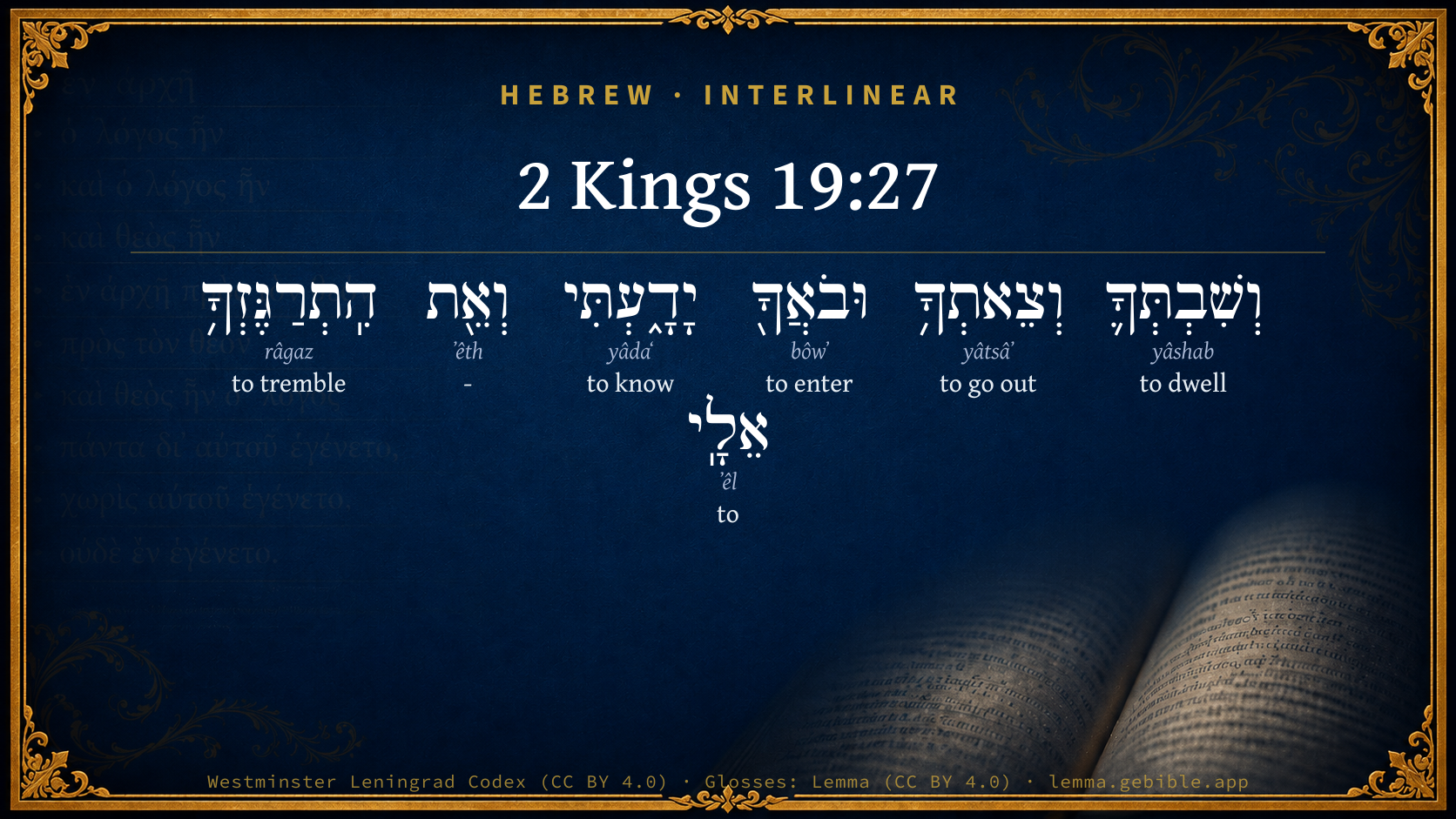
2 Kings 19:27

Hebrew (Westminster Leningrad Codex) 2 Kings 19:27 appears in the Hebrew Old Testament. The text above is from the Westminster Leningrad Codex. Each word links to its Strong’s number, a concise gloss, and parsing drawn from the Open Scriptures Hebrew Bible morphology. Click any word for its full Brown-Driver-Briggs (BDB) entry.
Download image
Cite this verse

2 Kings 19:27 (World English Bible). Public Domain. Lemma interlinear Bible study tool, https://lemma.gebible.app/v/2-kings/19/27.

Show BibTeX & RIS
BibTeX
RIS
English Translation
But I know your sitting down, and your going out, and your coming in, and your raging against me.
World English Bible · Public Domain
Download a study sheet

One document with this verse’s original text, its word-by-word gloss line, the meaning frame, cross-references with their text, attributed commentary, and full source and license credits — printable, and it pastes into notes with its structure intact.

This verse Autodidact and up

Study sheet (.html) Plain text (.txt)

A passage Seminary Student

Up to 50 verses in one chapter. A passage sheet keeps up to 6 commentary sources and 12 cross-references per verse, in the order this page ranks them, and says so on the sheet whenever that leaves anything out. Ask for a single verse and you get the Autodidact verse sheet above.

Everything on this page stays free to read, with no account — the sheet is a download of what is already on screen, not access to it.

Want to remove ads? Support Godless Engineer
Compare translations 3

The same verse in 3 English versions, stacked beneath the original-language interlinear above. Click any original word for its lexicon entry.

Each is an independent rendering of the whole verse — the interlinear is not word-aligned to these translations.

Highlighted words mark where these versions differ — a whole-verse word diff, not a word-by-word alignment.

  • World English Bible Public Domain
    But I know your sitting down, and your going out, and your coming in, and your raging against me.
  • King James Version Public Domain
    But I know thy abode, and thy going out, and thy coming in, and thy rage against me.
  • unfoldingWord Literal Text CC BY-SA 4.0
    But I know your dwelling and your going out and your coming in and your raging against me.

unfoldingWord Literal Text — © unfoldingWord, licensed CC BY-SA 4.0. Word-aligned USFM3 via Door43 (git.door43.org/unfoldingWord/en_ult).

Versions to compare (up to 4)

3 of 4 selected

Show all 18 translations

Every available English version of this verse, each an independent rendering of the whole verse.

  • World English Bible Public Domain
    But I know your sitting down, and your going out, and your coming in, and your raging against me.
  • Berean Standard Bible Public Domain
    But I know your sitting down, your going out and coming in, and your raging against Me.
  • Majority Standard Bible Public Domain
    But I know your sitting down, your going out and coming in, and your raging against Me.
  • King James Version Public Domain
    But I know thy abode, and thy going out, and thy coming in, and thy rage against me.
  • American Standard Version (1901) Public Domain
    But I know thy sitting down, and thy going out, and thy coming in, and thy raging against me.
  • Revised Version (1885) Public Domain
    But I know thy sitting down, and thy going out, and thy coming in, and thy raging against me.
  • Geneva Bible (1599) Public Domain
    I knowe thy dwelling, yea, thy going out, and thy comming in, and thy furie against me.
  • Douay-Rheims (1899) Public Domain
    Thy dwelling and thy going out, and thy coming in, and thy way I knew before, and thy rage against me.
  • Young's Literal Translation Public Domain
    And thy sitting down, and thy going out, And thy coming in, I have known, And thine anger towards Me;
  • Literal Standard Version CC BY-SA 4.0
    And your sitting down, and your going out, || And your coming in, I have known, || And your anger toward Me;
  • Unlocked Literal Bible CC BY-SA 4.0
    But I know your sitting down, your going out, your coming in, and your raging against me.
  • unfoldingWord Literal Text CC BY-SA 4.0
    But I know your dwelling and your going out and your coming in and your raging against me.
  • Darby Bible Public Domain
    But I know thine abode, and thy going out, and thy coming in, And thy raging against me.
  • World Messianic Bible Public Domain
    But I know your sitting down, your going out, your coming in, and your raging against me.
  • Webster's Bible Public Domain
    But I know thy abode, and thy going out, and thy coming in, and thy rage against me.
  • Free Bible Version CC BY-SA 4.0
    But I know you very well—where you live, when you come in, when you leave, and your furious anger against me.
  • Bible in Basic English Public Domain
    But I have knowledge of your getting up and your resting, of your going out and your coming in.
  • JPS Tanakh (1917) Public Domain
    But I know thy sitting down, and thy going out, and thy coming in, and thy raging against Me.

Literal Standard Version (2020), Covenant Press — licensed CC BY-SA 4.0. Text via the HelloAO Bible API (eBible.org). Unlocked Literal Bible (unfoldingWord) — licensed CC BY-SA 4.0. Text via the HelloAO Bible API (eBible.org). unfoldingWord Literal Text — © unfoldingWord, licensed CC BY-SA 4.0. Word-aligned USFM3 via Door43 (git.door43.org/unfoldingWord/en_ult). Free Bible Version, Dr. Jonathan Gallagher — licensed CC BY-SA 4.0. Text via the HelloAO Bible API (eBible.org).

Word by word

More ways to search: Search by grammar → Find every occurrence → Compare this word →

Practice this passage: Drill this verse → Learn its vocabulary →

הִֽתְרַגֶּזְךָ֥
râgaz
H7264
“to tremble · you”
Verb, Hithpael, Infinitive Construct + Suffix, Personal, 2nd Person, Masculine, Singular
Part of Speech
Verb
Stem
Hithpael
Form
Infinitive Construct
Full BDB Definition

Origin: a primitive root

TWOT: 2112

tremble, quake, rage, quiver, be agitated, be excited, be perturbed - (Qal) to quake, be disquieted, be excited, be perturbed - (Hiphil) to cause to quake, disquiet, enrage, disturb - (Hithpael) to excite oneself
  1. וְשִׁבְתְּךָ֛ yâshab H3427 “and · to dwell · you” Conjunction + Verb, Qal, Infinitive Construct + Suffix, Personal, 2nd Person, Masculine, Singular
  2. וְצֵאתְךָ֥ yâtsâʼ H3318 “and · to go out · you” Conjunction + Verb, Qal, Infinitive Construct + Suffix, Personal, 2nd Person, Masculine, Singular
  3. וּבֹאֲךָ֖ bôwʼ H935 “and · to enter · you” Conjunction + Verb, Qal, Infinitive Construct + Suffix, Personal, 2nd Person, Masculine, Singular
  4. יָדָ֑עְתִּי yâdaʻ H3045 “to know” Verb, Qal, Perfect, 1st Person, Common, Singular
  5. וְאֵ֖ת ʼêth H853 “and · -” Conjunction + Particle, Direct Object
  6. אֵלָֽי ʼêl H413 “to · me” Preposition + Suffix, Personal, 1st Person, Common, Singular

About this verse

These counts appear in no published source. They are computed here, from the morphology-tagged text and Lemma’s own curated glosses. What Lemma adds →

7
words
7
distinct lemmas
Historical
section

Shared distinctive vocabulary

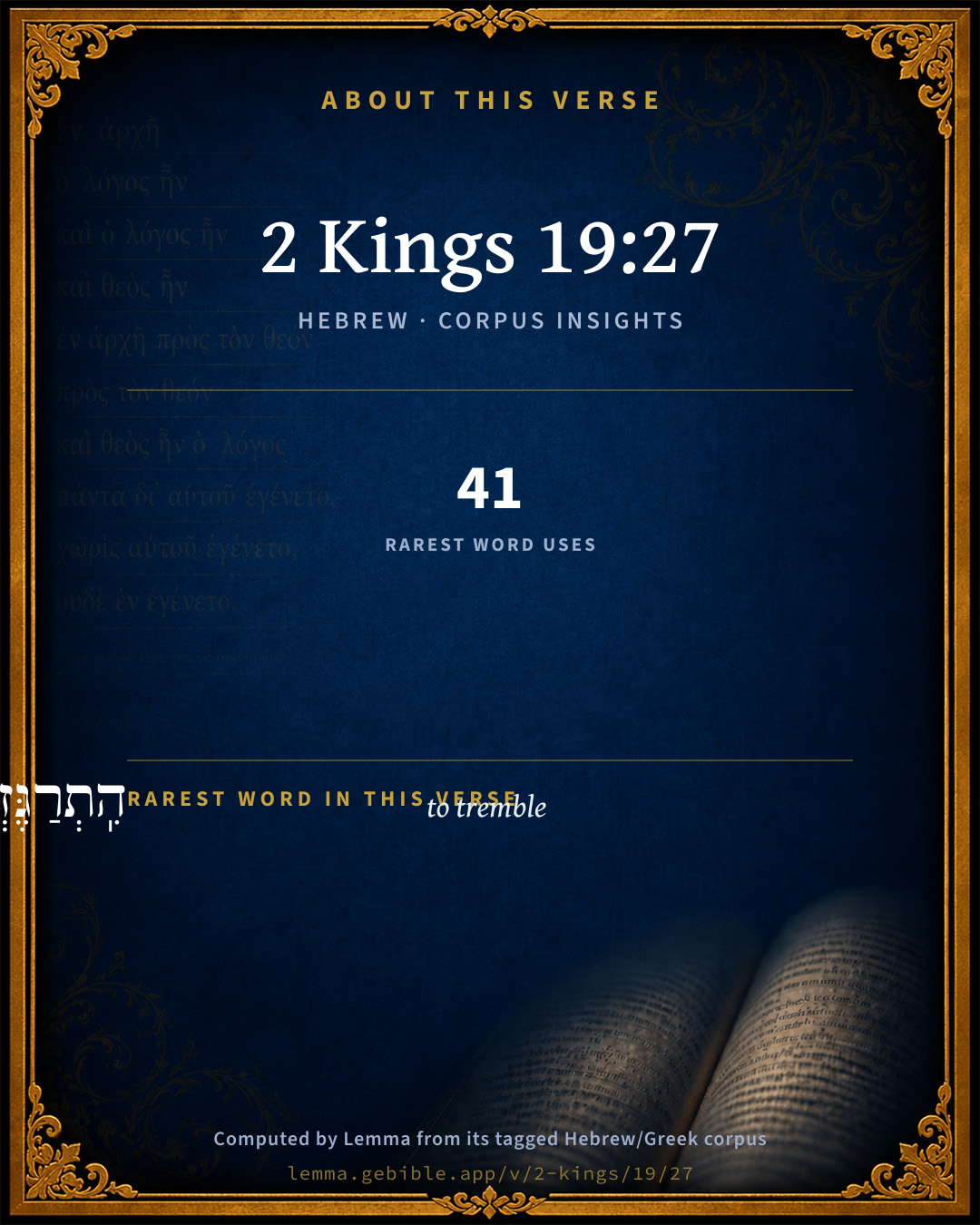
הִֽתְרַגֶּזְךָ֥ to tremble H7264 occurs in 40 verses of the Hebrew Bible. Also found in:

Grammatical profile

  • 5 verbs
  • 1 preposition
  • 1 particle

Verb forms

  • וְשִׁבְתְּךָ֛ Qal · Infinitive Construct
  • וְצֵאתְךָ֥ Qal · Infinitive Construct
  • וּבֹאֲךָ֖ Qal · Infinitive Construct
  • יָדָ֑עְתִּי Qal · Perfect
  • הִֽתְרַגֶּזְךָ֥ Hithpael · Infinitive Construct

Hebrew & Septuagint length

In English translation the verse runs 19 words from the Hebrew and 14 from the Septuagint (LXX English) — closely comparable.

A rough comparison of the two English renderings, which tokenize alike — not a word-level alignment.

Word counts can differ between the Hebrew and the Greek without any difference in meaning — e.g. the Hebrew direct-object marker אֵת has no separate Greek word, and Greek often adds the article ὁ.

Cross-references

6

Topical passages linked to 2 Kings 19:27 in the Treasury of Scripture Knowledge — connected by theme and wording, ordered by reader-vote popularity; previews shown in the World English Bible.

  • Isaiah 37:28–29 But I know your sitting down, and your going out, and your coming in, and your raging against me.
  • Jeremiah 23:23–24 Am I a God at hand, says Yahweh, and not a God afar off?
  • Deuteronomy 28:6 Blessed shall you be when you come in, and blessed shall you be when you go out.
  • Psalms 121:8 Yahweh will keep your going out and your coming in, From this time forth, and forevermore.
  • Psalms 139:1–11 Yahweh, you have searched me, And you know me.
  • Deuteronomy 28:19 Cursed shall you be when you come in, and cursed shall you be when you go out.

Cross-references courtesy of OpenBible.info (CC BY 4.0).

Hebrew and Greek witnesses Masoretic Hebrew ↔ Greek Septuagint

The same verse in the two great witnesses to the Old Testament, shown verse-for-verse.

These are two independent witnesses, not word-aligned to each other, and the Septuagint is shown in lemma (dictionary) form.

Hebrew 2 Kings 19:27 Masoretic · Westminster Leningrad Codex

וְשִׁבְתְּךָ֛ וְצֵאתְךָ֥ וּבֹאֲךָ֖ יָדָ֑עְתִּי וְאֵ֖ת הִֽתְרַגֶּזְךָ֥ אֵלָֽי

But I know your sitting down, and your going out, and your coming in, and your raging against me.

World English Bible · Public Domain

Greek LXX 2 Kings 19:27 Septuagint · lemma form

καί ὁ καθέδρα σύ καί ὁ ἔξοδος σύ καί ὁ εἴσοδος σύ γιγνώσκω καί ὁ θυμός σύ ἐπί ἐγώ

But I know your down-sitting, and your going forth, and your rage against me.

LXX2012 (modern English Septuagint) · Public Domain

Hebrew: Westminster Leningrad Codex (CC BY 4.0). Greek: Septuagint (public domain); English from LXX2012 (modern English Septuagint) (Public Domain). How the Septuagint differs from the Hebrew →

Targum (Aramaic paraphrase)

1

The Targum is the ancient Jewish Aramaic paraphrase of the Hebrew Scriptures — an interpretive translation, not the Hebrew text itself. Onkelos (literal) and Pseudo-Jonathan (expansive) render the Torah, and Jonathan the Prophets. Coverage is partial: where no permissively-licensed English translation exists for a verse, only the Aramaic is shown. This is verse-level text, not a word-by-word alignment to the Hebrew.

  1. Targum Jonathan Prophets (Joshua–Malachi)
    וּמִיתְבָךְ בְּעֵיצָה וּמִיפְקָךְ לְאַגָחָא קְרָבָא וּמֵיתָךְ לְאַרְעָא דְיִשְׂרָאֵל גְלֵי קֳדָמַי וְיַת דְאַרְגֵיזְתָּא קֳדָמַי גְלֵי:

    (no public-domain English translation for this verse)

    Targum Jonathan — Aramaic: “Mikraot Gedolot” (public domain). English: “Sefaria Community Translation” (CC0 1.0 (public-domain dedication)); “London "Chaldee Paraphrase," 1871” (public domain). Text via Sefaria.

Commentary

Notes on 2 Kings 19:27 from classic Christian and Jewish commentators (each source and its license shown beneath its notes). The classic Christian expositions comment on the surrounding passage and are grouped to its opening verse, so a note may address several verses; the Jewish commentaries on the Tanakh (Rashi and others) are per-verse, so they appear only where the commentator wrote on this verse.

Lemma curates 59 commentaries, every one of them public domain or Creative Commons licensed, each selected and text-cleaned for this edition rather than reprinted as found. About our sources →

Trapp's Complete Commentary

John Trapp

2Ki 19:27 But I know thy abode, and thy going out, and thy coming in, and thy rage against me.

Ver. 27. But I know thine abode, &c.] Figurative terms taken from huntsmen, saith Diodate; the meaning is, I know all thy designs, and do overrule them.

John Trapp, A Commentary or Exposition upon All the Books of the Old and New Testament (1647–1656) — public domain. Text from a community e-Sword module.

Joseph Benson's Commentary

2Ki 19:27. But I know thy abode, &c. — Though thou dost not know me, yet I thoroughly know thee, and all thy designs and actions, all thy secret contrivances in the place of thy abode, in thy own kingdom and court; and the execution of thy designs abroad, what thou intendest in thy going out, and with what farther thoughts thou comest in, or returnest to thy own land. And thy rage against me — Against Hezekiah my servant, and my people, because they will not deliver up Jerusalem to thee, and against my temple, to destroy it. Things are frequently said to be done against God which are only done against his people, his cause, and worship, because of that near relation and union which are between them.

Joseph Benson's Commentary on the Old and New Testaments (1811–1818) — public domain. Text from a community e-Sword module.

Tyndale Open Study Notes

Tyndale Open Resources

19:27-28 I know you well: See Pss 44:21; 94:11. • hook . . . bit: The Assyrian annals mention similar mistreatment of prisoners; the Lord would do to Sennacherib what he and his predecessors had done to those they subjugated.

Tyndale Open Study Notes — © Tyndale Open Resources, licensed CC BY-SA 4.0. Text via the HelloAO Bible API.

Ellicott's Commentary for English Readers

(27) But I know thy abode . . .—Literally, and thy down sitting, and thy going out, and thy coming in I know. Clearly something has fallen out at the opening of the sentence. Probably the words before me is thine uprising have been omitted by some copyist, owing to their resemblance to the words which end the last verse. So Wellhausen. (See Psa_139:2.) The thought thus expressed is this: I know all thy plans and thy doings; I see also thy present rebellion against me. What thou hast hitherto done was done because I willed it: now I will check thee.

A Bible Commentary for English Readers, edited by Charles John Ellicott (1878–1897) — public domain. Text from a community e-Sword module.

The Cambridge Bible for Schools and Colleges

gen. ed. J. J. S. Perowne

27. But I know thy abode] R.V. sitting down. The verse expresses to the full, but with wonderful conciseness, how God has observed and is observing every action of Sennacherib. His dwelling, his movements to and fro, and the spirit which actuates them are all open before God’s eyes, and He identifies Himself so completely with Hezekiah and Jerusalem as to call the rage of the Assyrian against them rage against Himself.

The Cambridge Bible for Schools and Colleges (gen. ed. J. J. S. Perowne; Cambridge University Press, 1878–1918) — public domain. Text from a community e-Sword module.

Albert Barnes' Notes on the Bible

See 1Ki 3:7 note.

Albert Barnes' Notes on the Bible (1834–1885) — public domain. Text from a community e-Sword/MySword module.

Haydock's Catholic Bible Commentary

In. All thy actions. (Menochius) --- I knew, or disposed of, for wise purposes. Nothing shews more forcibly the dominion of God, even over the most impious. They cannot frustrate the divine decrees.

George Leo Haydock (1774–1849), Haydock's Catholic Family Bible and Commentary, 1859 edition — public domain. Excludes Psalms (Douay-Rheims chapter numbering differs from Protestant) and Deuterocanonical books (Catholic canon only).

Matthew Poole's English Annotations

Though thou dost not know me, yet I thoroughly know thee, and all thy designs and actions, all thy secret and subtle contrivances in the place of

thy abode, in thy own kingdom and court, and the execution of thy designs abroad, what thou intendest in thy going out, and with what successes or former thoughts thou comest in, or returnest to thy own land. For the phrase, compare Deu 31:2; Psa 139:2,3.

And thy rage against me, i.e. against my servant Hezekiah, and my people, against whom he was engaged, because they would not deliver up Jerusalem to him, which he demanded. Things are frequently said to be done against God, which are only done against his people, because of that near union and relation which is between them. See Zec 2:8; Act 9:4,5. But the words may well be rendered, and thy rage is with me, or before me, as the Syriac hath it; or, is manifest to me, as the Chaldee renders it. And so this branch of the verse answers to the former, I know, &c., and it is before me.

Matthew Poole's English Annotations on the Holy Bible (1683–1685) — public domain. Text from a community e-Sword/MySword module.

Whedon's Commentary on the Bible

Daniel D. Whedon

27. Thy abode — Rather, thy sitting down. The expressions sitting down, going out, coming in, are often used to denote all the actions of men.

Psa_139:2. Jehovah was fully acquainted with all the works and life of the impious Sennacherib.

Daniel D. Whedon (gen. ed.), Commentary on the Old and New Testaments (1874–1909) — public domain. Text from a community e-Sword module.

The Pulpit Commentary

But I know thy abode, and thy going out, and thy coming in. "Resting in peace, going out, and coming in, cover all the activity of a man" (Bahr), or rather, cover his whole life, active and passive. Jehovah claims an absolute knowledge of all that Sennacherib does or thinks, both when he is in action and when he is at rest. Nothing is hid from him. (comp. Psa_139:1-16) Human pride should stand abashed before such absolute knowledge. And thy rage against me. Opposition to their will fills violent men with fury and rage. Sennacherib"s anger was primarily against Hezekiah, but when once he was convinced that Hezekiah really trusted in Jehovah (ver. 10), his fury would turn against God himself. (see Psa_2:1-3, where the Lord"s anointed is primarily David)

The Pulpit Commentary (1880–1919), ed. H.D.M. Spence-Jones & Joseph S. Exell — public domain. Text from a community e-Sword module.

John Wesley's Explanatory Notes

I know - Though thou dost not know me, yet I throughly know thee, and all thy designs and actions, all thy secret contrivances in the place of thy abode, in thy own kingdom and court; and the execution of thy designs abroad, what thou intendest in thy going out, and with what farther thoughts thou comest in, or returnest to thy own land.

John Wesley, Explanatory Notes Upon the Whole Bible (1754–1765) — public domain. Text via the GEBible commentary corpus.

unfoldingWord translationNotes

Door43 World Missions Community

General Information:

This continues the message from Yahweh, given by Isaiah, the prophet, for King Hezekiah concerning King Sennecherib. It uses parallelism throughout. (See: Parallelism)

raging against me

"angry shouting about me"

because your arrogance has reached my ears

"Ears" are metonymy for listening or hearing. AT: "because I have heard your proud words" (See: Metonymy)

I will put my hook in your nose, and my bit in your mouth

A "hook" and a "bit" (to control a horse) are metaphors for Yahweh's control of Sennacherib. AT: "I will lead you like an animal" (See: Metaphor)

I will turn you back the way you came

That Sennacherib will return home before he can conquer Jerusalem can be stated clearly. AT: "I will make you return to your own country the same way you came, without conquering Jerusalem" (See: Assumed Knowledge and Implicit Information)

translationWords

rage

arrogant

turn

unfoldingWord translationNotes — © Distant Shores Media and the Door43 World Missions Community, licensed CC BY-SA 4.0. Source: git.door43.org/Door43/en_tn.

Rashi

Rabbi Shlomo Yitzchaki (Rashi)

Your sitting and your going out and your coming in. [Targum] Yonoson rendered, ”And your sitting in counsel, and your going out to wage war, and your coming to the land of Yisroel, is revealed to Me;” it emanated from Me.

And your raging against Me. And that ultimately you will become arrogant and aroused against Me with anger and tumult, estorimir, in O.F..

Rashi on the Tanakh — English translations: “The Judaica Press complete Tanach with Rashi, translated by A. J. Rosenberg” (CC BY 4.0); “Pentateuch with Rashi's commentary by M. Rosenbaum and A.M. Silbermann, 1929-1934” (public domain); “The Metsudah Tanach series, Lakewood, N.J” (CC BY 4.0); and “The Book of Joshua, Metsudah Publications, 1997” (CC BY 4.0). Text via Sefaria.

Lesson kit

Teaching starters — assembled from the data on this page, not authored interpretation. Every prompt links to the verse data it draws on. Edit before teaching.

2 Kings, in the Historical, opens this verse with 7 words (7 distinct Hebrew lemmas). Its most distinctive word is râgaz (“to tremble”). A historical commentator’s framing appears above. Read the whole chapter for the surrounding context.

Discussion questions

  1. What does “to tremble” (râgaz) contribute to the verse as a whole?
  2. How does Genesis 45:24, which shares the word «to tremble», read alongside this verse?
  3. These translations render this verse differently. What is at stake in choosing one wording over another?
  4. «וְשִׁבְתְּךָ֛» is a Qal Infinitive Construct verb. How does that grammatical form shape the action described?
  5. Compare how Trapp's Complete Commentary and Joseph Benson's Commentary read this verse. Where do they agree or differ?

Things to notice

Reading settings

Reading text

Shown beneath each verse's original-language words.

Old Testament
Old Testament edition

Read the OT as the Masoretic Hebrew (MT) or the Greek Septuagint (LXX).

English shown for the Greek Septuagint (in the Hebrew ↔ Greek comparison).

Comparing translations? Open the Compare panel on any verse page to stack up to four side by side.