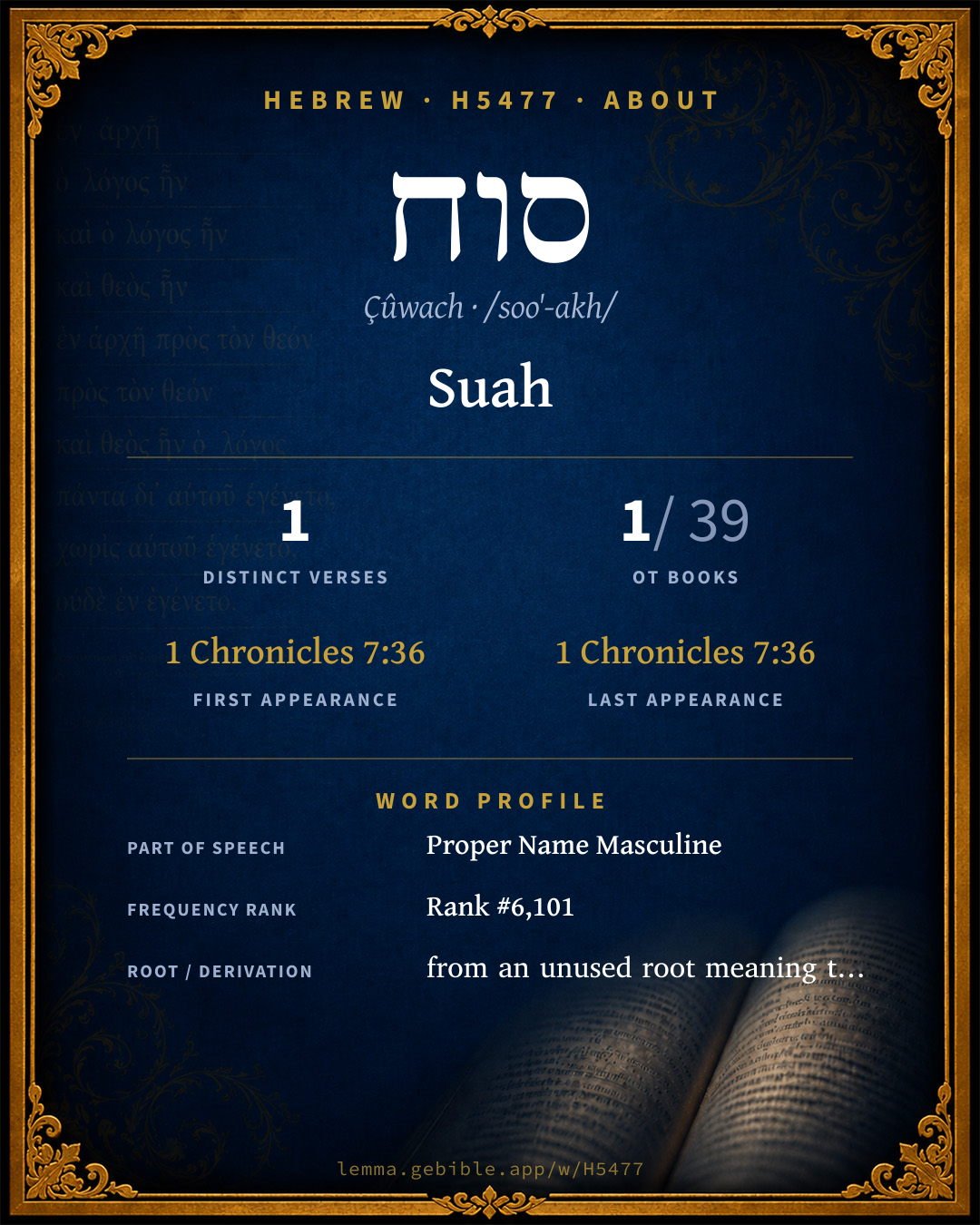
סוּחַ
Suah
BDB lists 2 entries for ‘Suah’ fuller range ↓
Full lexicon entry — Brown-Driver-Briggs (BDB)
From Brown-Driver-Briggs (BDB)
Where this word appears
Grammar key — what these labels mean
Part of speech
- Noun
- A naming word — a person, place, thing, or idea.
Noun type
- Proper
- A name of a specific person, place, or people (e.g. Abraham, Zion, Israel).
Every verse where H5477 appears — 1 distinct verse across 1 book. Click any verse to open its interlinear word-by-word view. Verse text shown in the World English Bible for context — . Each verse’s Hebrew form is shown with its reference; the English is not keyword-highlighted, since the data carries no word-level English alignment. Use “Compare translations” on any verse to read it across multiple English versions. This concordance covers the Hebrew Bible; Septuagint (Greek Old Testament) occurrences are not indexed here.
1 Chronicles 1 verse
About this entry
At a glance — auto-summarized from this page’s data, not written by a person. Every figure links to its source below. This summary describes the numbers; it doesn’t interpret them.
סוח — transliterated Çûwach — is a Hebrew name carrying the sense “Suah.” With only 1 verse it sits in the long tail of Hebrew Bible vocabulary. Its uses cluster heavily in 1 Chronicles (100% of all occurrences). Its lone occurrence is 1 Chronicles 7:36. Each statement above links to its evidence; the full detail follows below.
Gloss history
Strong's 1890 vs modern scholarship
About this word
Strong's H5477 catalogs a Hebrew word from the Hebrew Old Testament.
These counts are not copied from any lexicon or concordance. They are computed here, from the morphology-tagged Hebrew Old Testament. What Lemma adds →
- 1
- distinct verses
- The word appears in 1 distinct verse.
- 1 / 39
- OT books
- The word appears in 1 of 39 Old Testament books.
- #6,101
- by frequency
- Rank #6,101 (rank 6,101 of 8,640 Hebrew words by occurrence).
View all 1 occurrence in the concordance →
Most concentrated in
- 1 Chronicles 1 verse 100%
By section of the Old Testament
By traditional corpus
Conventional, traditional groupings — biblical authorship is debated, so this is a traditional corpus grouping, not an authorship claim. Each share is this word’s portion of its verses in that division of the Hebrew canon. Each figure is a share of the word’s 1 distinct verse.
- Writings (Ketuvim) 1 verse · 100%
How translations render this word
Counts come from each version’s own published word-to-Strong’s tagging or interlinear alignment — an approximate guide to how each version renders this word, not a word-level alignment the data otherwise carries. Because each total is that version’s own tagged count, the per-version totals vary from one another and need not match the appearance or distinct-verse counts above. These counts may also differ from a printed concordance because Lemma counts each distinctly tagged rendering and does not collapse phrase taggings into a single head-word total. This is a fixed set of word-tagged versions (KJV, ASV, BSB, ULT) and does not change with the reading translation you choose elsewhere. Each version’s license is shown beside its name below (and on Sources).
- King James Version: Suah 1×
- American Standard Version: Suah 1×
- Berean Standard Bible: Suah 1×
- unfoldingWord Literal Text: Suah 1×
King James Version Public Domain
Renders H5477 across 1 tagged occurrence — most commonly:
American Standard Version Public Domain
Renders H5477 across 1 tagged occurrence — most commonly:
Berean Standard Bible Public Domain
Renders H5477 across 1 tagged occurrence — most commonly:
unfoldingWord Literal Text CC BY-SA 4.0
Renders H5477 across 1 tagged occurrence — most commonly:
Senses in BDB
The 2 senses BDB distinguishes for this word, in lexicon order (not ranked by frequency or importance). The full entry — with sub-senses — is in the Lexicon Entry tab.
- Suah = "sweeping"
- an Asherite, son of Zophah
Word origin
n.pr.m. an Asherite 1 Ch 7:36; 𝔊 Χουχι, A 𝔊L Σουε.
— Brown-Driver-Briggs (Oxford 1906, public domain), digitized via Sefaria, supplemented by the OpenScriptures HebrewLexicon (CC BY 4.0). See Sources.
Origin: from an unused root meaning to wipe away
Jastrow Dictionary
A second Hebrew/Aramaic lexicon for comparison, covering Aramaic and post-biblical (Talmudic, Targumic, Midrashic) usage that the biblical-Hebrew BDB does not. Matched by lemma rather than by Strong’s number, so a lemma may carry more than one Jastrow headword (shown separately below), and the entries cover usage well beyond the Bible.
סוּחַ
- [to think,] to talk; to tell. Shebu. VII, 3; 6 איני יודע מה אתה סָח (Y. ed. שָׂח) I do not know what you are talking about. Ber. 51ᵃ סח לי told me. Sot. 44ᵇ שח בין תפילה וכ׳ if one talks between putting on the T’fillin of the arm and of the head; Men. 36ᵃ סח; a. fr.—Ḥull. 27ᵃ, v. חָטָא I.—[Yalk. Ps. 755, read: שָׁח, v. שׁוּחַ.]
- same. Ber. 51ᵇ אין מְסִיחִין על כוס וכ׳ you must not converse while holding up the cup of benediction. Sabb. 13ᵇ והיתה מְסִיחָה וכ׳ and she told (me) all that happened to her. Y. Gitt. IX, end, 50ᵈ מסיחין, מש׳, v. סִיחָה. Pesik. R. s. 31 עומד ומֵסִיחַ וכ׳ (the text, Is. XLIX, 8 sq.) stands and speaks (is a standing prophecy) of the king Messiah. Deut. R. s. 1 מי אתה מסיח עמי וכ׳ who art thou that art talking to me &c.?—Gen. R. s. 13, beg. (ref. to שיח, Gen. II, 5) כל … כאילו מְשִׂיחִין אלו וכ׳ all trees speak to one another as it were; מש׳ עם הבריות speak to men; Yalk. ib. 20. Ex. R. s. 1 להָשִׂיחַ עלינו to talk against us. Tanḥ. T’rum. 9; Yalk. Mal. 587, v. קָבַע I; a. fr.—מסיח לפי תומו, v. תּוֹם.—Yoma 75ᵃ (ref. to ישחנה, Prov. XII, 25) חד אמר יִשְּׂחֶנָּה מדעתו וחד אמר יְשִׂיחֶנָה לאחרים one says, let him dismiss it (fr. נָשַׂח = נָסַח; Ms. M. 2 יַסִּיחֶנָּה) from his mind; the other says, let him speak it out to others; Sot. 42ᵇ; Snh. 100ᵇ; Yalk. Prov. 950; v. נָסַח. e.g. Isaiah 49:8
סוּחַ ²
- Ḥag. 5ᵇ שמעיה דסַח וכ׳ heard him talk and laugh.—Part. סָיֵיח. Lev. R. s. 26 גחין וס׳ יתה bending down and talking to her (rebuking her in a persuasive way; prob. to be read: ומפייס).
- same. Targ. Job VII, 11. Targ. Y. I Num. XXI, 27 (not מְשִׁיחַ). Ib. 28 (not מְשִׁיחִין); a. e.—[Targ. Prov. VIII, 15 אנא משיחין ed. Lag. (ed. Wil. מָשְׁחָא), fr. מְשַׁח I.]
A Dictionary of the Targumim, the Talmud Babli and Yerushalmi, and the Midrashic Literature (Marcus Jastrow; London, Luzac, 1903) — Public Domain. Digitized via Sefaria. Digitized via Sefaria. Full attribution on Sources.
Same root — word family
Other BDB entries built from the same root as H5477, grouped by Strong’s listed origin. These share a root / origin per the lexicon — not necessarily a shared meaning. Each links to that word’s own entry.
Derived from this word
Proper names from this root
People and places named from this root — a name, not an additional meaning of the word.
Compare all same-root words → 1 of the same-root words is a proper name (a person or place). They share a root, not necessarily a meaning.
Bible dictionary
Public-domain dictionary articles matched to this entry by name (Suah). A biblical name can be shared by more than one person or place, so an article may treat several.
Smith's Bible Dictionary · William Smith, 1863
(sweeping), son of Zophah an Asherite. (1 Chronicles 7:36) (B.C. about 1020.)
Hitchcock's Bible Names Dictionary · Roswell D. Hitchcock, 1869
speaking; entreating; ditch
Classic public-domain reference works; full attribution on Sources.
Septuagint verse parallels
This word appears in 1 verse that also exists in the Greek Old Testament (Septuagint), out of the 1 Hebrew verse it occurs in. You can read those verses in Greek by switching the Old Testament edition to the Septuagint.
Read these verses in the Septuagint
This is a verse-level parallel only — the same verses exist in both the Hebrew and Greek Old Testaments. No word-level Hebrew↔Greek correspondence is claimed: the data carries no such alignment, so no Greek word is shown as this Hebrew word’s translation. Coverage is not total — the Septuagint omits the deuterocanon and renumbers the Psalms, so some Hebrew verses have no direct Greek parallel.