
Psalms 114:7

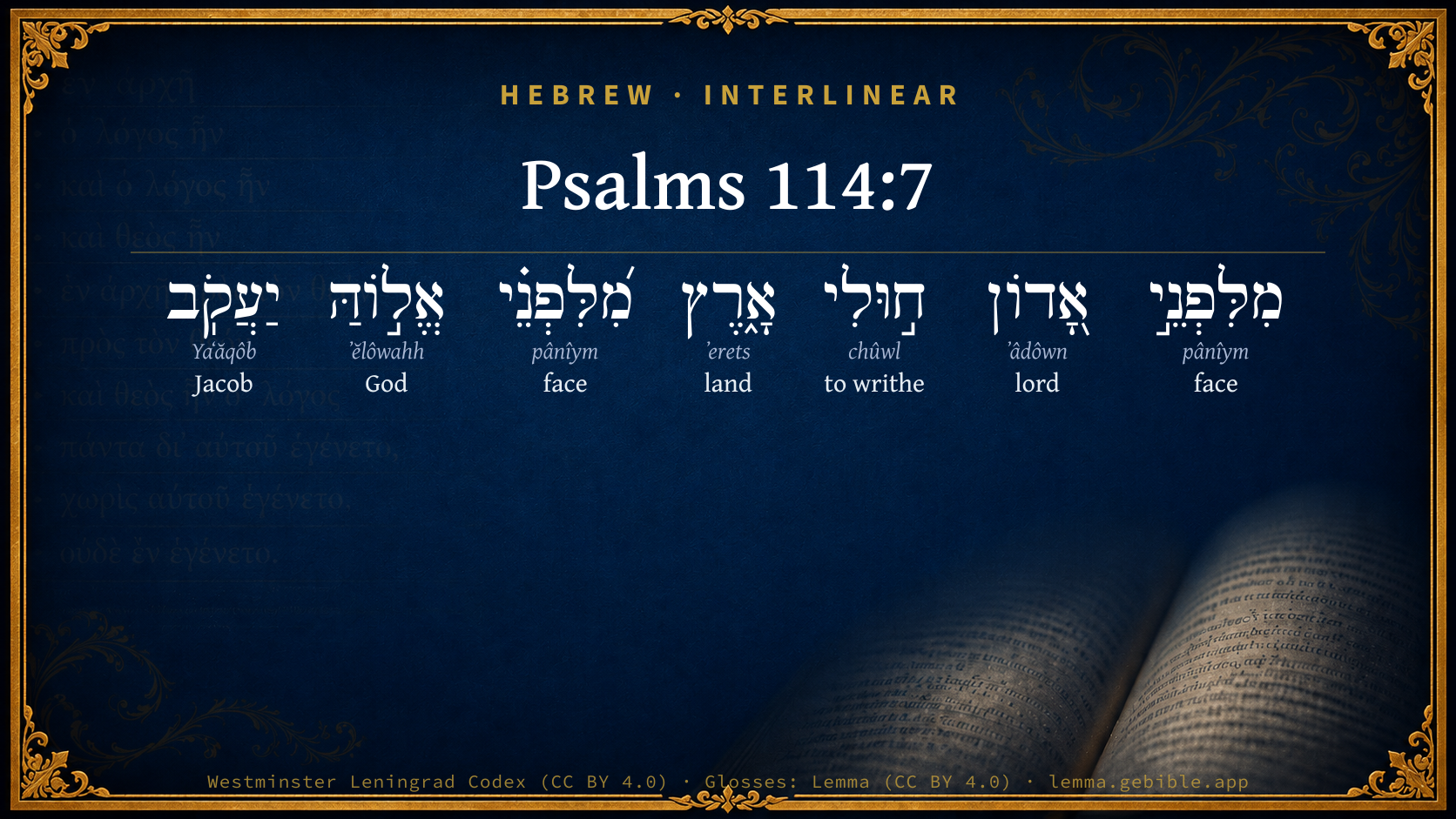
Hebrew (Westminster Leningrad Codex) Psalms 114:7 appears in the Hebrew Old Testament. The text above is from the Westminster Leningrad Codex. Each word links to its Strong’s number, a concise gloss, and parsing drawn from the Open Scriptures Hebrew Bible morphology. Click any word for its full Brown-Driver-Briggs (BDB) entry.
Download image
Cite this verse

Psalms 114:7 (World English Bible). Public Domain. Lemma interlinear Bible study tool, https://lemma.gebible.app/v/psalms/114/7.

Show BibTeX & RIS
BibTeX
RIS
English Translation
Tremble, you earth, at the presence of the Lord, At the presence of the God of Jacob,
World English Bible · Public Domain
Download a study sheet

One document with this verse’s original text, its word-by-word gloss line, the meaning frame, cross-references with their text, attributed commentary, and full source and license credits — printable, and it pastes into notes with its structure intact.

This verse Autodidact and up

Study sheet (.html) Plain text (.txt)

A passage Seminary Student

Up to 50 verses in one chapter. A passage sheet keeps up to 6 commentary sources and 12 cross-references per verse, in the order this page ranks them, and says so on the sheet whenever that leaves anything out. Ask for a single verse and you get the Autodidact verse sheet above.

Everything on this page stays free to read, with no account — the sheet is a download of what is already on screen, not access to it.

Want to remove ads? Support Godless Engineer
Compare translations 3

The same verse in 3 English versions, stacked beneath the original-language interlinear above. Click any original word for its lexicon entry.

Each is an independent rendering of the whole verse — the interlinear is not word-aligned to these translations.

Highlighted words mark where these versions differ — a whole-verse word diff, not a word-by-word alignment.

  • World English Bible Public Domain
    Tremble, you earth, at the presence of the Lord, At the presence of the God of Jacob,
  • King James Version Public Domain
    Tremble, thou earth, at the presence of the Lord, at the presence of the God of Jacob;
  • unfoldingWord Literal Text CC BY-SA 4.0
    Tremble, earth, from to the face of the Lord, from to the face of the God of Jacob,

unfoldingWord Literal Text — © unfoldingWord, licensed CC BY-SA 4.0. Word-aligned USFM3 via Door43 (git.door43.org/unfoldingWord/en_ult).

Versions to compare (up to 4)

3 of 4 selected

Show all 18 translations

Every available English version of this verse, each an independent rendering of the whole verse.

  • World English Bible Public Domain
    Tremble, you earth, at the presence of the Lord, At the presence of the God of Jacob,
  • Berean Standard Bible Public Domain
    Tremble, O earth, at the presence of the Lord, at the presence of the God of Jacob,
  • Majority Standard Bible Public Domain
    Tremble, O earth, at the presence of the Lord, at the presence of the God of Jacob,
  • King James Version Public Domain
    Tremble, thou earth, at the presence of the Lord, at the presence of the God of Jacob;
  • American Standard Version (1901) Public Domain
    Tremble, thou earth, at the presence of the Lord, At the presence of the God of Jacob,
  • Revised Version (1885) Public Domain
    Tremble, thou earth, at the presence of the Lord, at the presence of the God of Jacob;
  • Geneva Bible (1599) Public Domain
    The earth trembled at the presence of the Lord, at the presence of the God of Iaakob,
  • Douay-Rheims (1899) Public Domain
    At the presence of the Lord the earth was moved, at the presence of the God of Jacob:
  • Young's Literal Translation Public Domain
    From before the Lord be afraid, O earth, From before the God of Jacob,
  • Literal Standard Version CC BY-SA 4.0
    From before the Lord be afraid, O earth, || From before the God of Jacob,
  • Unlocked Literal Bible CC BY-SA 4.0
    Tremble, earth, before the Lord, at the presence of the God of Jacob.
  • unfoldingWord Literal Text CC BY-SA 4.0
    Tremble, earth, from to the face of the Lord, from to the face of the God of Jacob,
  • Darby Bible Public Domain
    Tremble, thou earth, at the presence of the Lord, at the presence of the +God of Jacob,
  • World Messianic Bible Public Domain
    Tremble, you earth, at the presence of the Lord, at the presence of the God of Jacob,
  • Webster's Bible Public Domain
    Tremble, thou earth, at the presence of the Lord, at the presence of the God of Jacob;
  • Free Bible Version CC BY-SA 4.0
    Earth, tremble in the presence of the Lord, tremble in the presence of the God of Jacob!
  • Bible in Basic English Public Domain
    Be troubled, O earth, before the Lord, before the God of Jacob;
  • JPS Tanakh (1917) Public Domain
    Tremble, thou earth, at the presence of the Lord, at the presence of the God of Jacob;

Literal Standard Version (2020), Covenant Press — licensed CC BY-SA 4.0. Text via the HelloAO Bible API (eBible.org). Unlocked Literal Bible (unfoldingWord) — licensed CC BY-SA 4.0. Text via the HelloAO Bible API (eBible.org). unfoldingWord Literal Text — © unfoldingWord, licensed CC BY-SA 4.0. Word-aligned USFM3 via Door43 (git.door43.org/unfoldingWord/en_ult). Free Bible Version, Dr. Jonathan Gallagher — licensed CC BY-SA 4.0. Text via the HelloAO Bible API (eBible.org).

Word by word

More ways to search: Search by grammar → Find every occurrence → Compare this word →

Practice this passage: Drill this verse → Learn its vocabulary →

About this verse

These counts appear in no published source. They are computed here, from the morphology-tagged text and Lemma’s own curated glosses. What Lemma adds →

7
words
6
distinct lemmas
Wisdom
section

Shared distinctive vocabulary

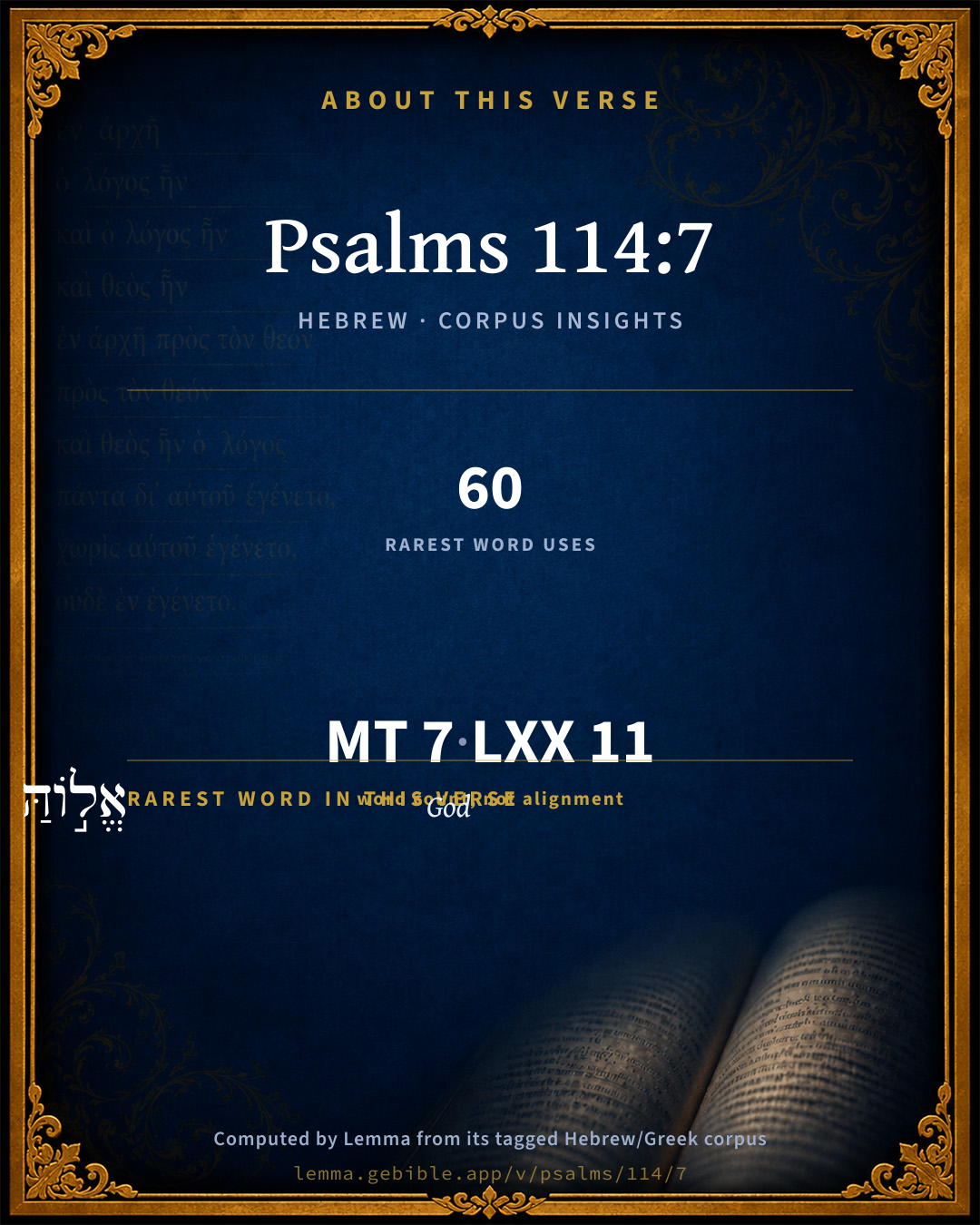
אֱל֣וֹהַּ God H433 occurs in 59 verses of the Hebrew Bible. Also found in:

Grammatical profile

  • 1 verb
  • 6 nouns

Verb forms

  • ח֣וּלִי Qal · Imperative

Repetition

A word recurs within this verse — often emphatic in Hebrew:

  • מִלִּפְנֵ֣י face H6440 ×2

Hebrew & Septuagint length

In English translation the verse runs 17 words from the Hebrew and 17 from the Septuagint (LXX English) — the same length.

A rough comparison of the two English renderings, which tokenize alike — not a word-level alignment.

Word counts can differ between the Hebrew and the Greek without any difference in meaning — e.g. the Hebrew direct-object marker אֵת has no separate Greek word, and Greek often adds the article ὁ.

In the original languages it is 7 Hebrew tokens and 11 Greek tokens — but the two are counted differently (Hebrew bundles its prefixes and suffixes into one token; the Greek is in lemma form), so that isn’t a like-for-like length.

Cross-references

9

Topical passages linked to Psalms 114:7 in the Treasury of Scripture Knowledge — connected by theme and wording, ordered by reader-vote popularity; previews shown in the World English Bible.

  • Jeremiah 5:22 Don't you fear me? says Yahweh: won't you tremble at my presence, who have placed the sand for the bound of the sea, by a perpetual decree, that it can't pass it? and though the waves of it toss themselves, yet they can't prevail; though they roar, yet they can't pass over it.
  • Job 26:11 The pillars of heaven tremble And are astonished at his rebuke.
  • Psalms 104:32 He looks at the earth, and it trembles. He touches the mountains, and they smoke.
  • Isaiah 64:1–3 Oh that you would tear the heavens, that you would come down, that the mountains might quake at your presence,
  • Psalms 96:9 Worship Yahweh in holy array. Tremble before him, all the earth.
  • Psalms 97:4–5 His lightning lights up the world. The earth sees, and trembles.
  • Micah 6:1–2 Listen now to what Yahweh says: "Arise, plead your case before the mountains, And let the hills hear what you have to say.
  • Job 9:6 Who shakes the earth out of its place; The pillars of it tremble;
  • Psalms 77:18 The voice of your thunder was in the whirlwind. The lightnings lit up the world. The earth trembled and shook.

Cross-references courtesy of OpenBible.info (CC BY 4.0).

Hebrew and Greek witnesses Masoretic Hebrew ↔ Greek Septuagint

The same verse in the two great witnesses to the Old Testament, shown verse-for-verse.

You’re reading Greek Psalm 113 (Hebrew Psalm 114). The Septuagint counts the superscription, so verse numbers can differ from the Hebrew — chapter-level alignment, not verse-by-verse. Numbering follows Rahlfs.

These are two independent witnesses, not word-aligned to each other, and the Septuagint is shown in lemma (dictionary) form.

Hebrew Psalms 114:7 Masoretic · Westminster Leningrad Codex

מִלִּפְנֵ֣י אָ֭דוֹן ח֣וּלִי אָ֑רֶץ מִ֝לִּפְנֵ֗י אֱל֣וֹהַּ יַעֲקֹֽב

Tremble, you earth, at the presence of the Lord, At the presence of the God of Jacob,

World English Bible · Public Domain

Greek LXX Greek Psalm 113:7 Septuagint · lemma form

ἀπό πρόσωπον κύριος σαλεύω ὁ γῆ ἀπό πρόσωπον ὁ θεός ἰακώβ

The earth trembled at the presence of the Lord, at the presence of the God of Jacob;

LXX2012 (modern English Septuagint) · Public Domain

On this verse, John Gill's Exposition discusses the Septuagint’s reading. Read the note in Commentary ↓

Hebrew: Westminster Leningrad Codex (CC BY 4.0). Greek: Septuagint (public domain); English from LXX2012 (modern English Septuagint) (Public Domain). How the Septuagint differs from the Hebrew →

Commentary

Notes on Psalms 114:7 from classic Christian and Jewish commentators (each source and its license shown beneath its notes). The classic Christian expositions comment on the surrounding passage and are grouped to its opening verse, so a note may address several verses; the Jewish commentaries on the Tanakh (Rashi and others) are per-verse, so they appear only where the commentator wrote on this verse.

Lemma curates 59 commentaries, every one of them public domain or Creative Commons licensed, each selected and text-cleaned for this edition rather than reprinted as found. About our sources →

Trapp's Complete Commentary

John Trapp

Psa 114:7 Tremble, thou earth, at the presence of the Lord, at the presence of the God of Jacob;

Ver. 7. Tremble, thou earth, &c.] Heb. Be in pain, as a travailing woman; for if the giving of the law had such dreadful effects, what should the breaking thereof have?

At the presence of the God of Jacob] Whom Jacob, that is, God’s covenanted people, knoweth and confideth in amidst all his austerities, Isa 63:16, and can boldly say, as Hab 1:12, "Art not thou from everlasting, O Lord my God, mine Holy One? we shall not die."

John Trapp, A Commentary or Exposition upon All the Books of the Old and New Testament (1647–1656) — public domain. Text from a community e-Sword module.

Joseph Benson's Commentary

Psa 114:7-8. Tremble, thou earth, at the presence of the Lord — But why do I ask these questions? Ye mountains and hills were no further moved than was quite just and proper, at the approach and presence of the great Jehovah. Yea, the whole earth had reason to tremble and quake on such an occasion. Which turned the rock into a standing water, &c. — For what cannot he do, who performs such an astonishing wonder as to turn rocks into streams and rivers, and flints into fountains of water? Well may we stand in awe of this God of almighty power, and well may we put our trust in this Being of boundless goodness, who, rather than his people should want what is necessary for their sustenance, will bring substantial bread out of the airy clouds, and refreshing waters out of the dry and flinty rocks!

Joseph Benson's Commentary on the Old and New Testaments (1811–1818) — public domain. Text from a community e-Sword module.

J. A. Alexander on Psalms

Joseph Addison Alexander

7. (Psa 114:7) From before the Lord tremble, 0 earth, from before the God of Jacob. As in other cases of rhetorical interrogation, the writer or speaker answers his own question. The imperative mood is here peculiarly significant, including both a recollection and prediction; as if he had said, the earth might well tremble at the presence of the Lord, and may well tremble at it still, From before is better than at the presence of, because the very form of the expression necessarily suggests the ideas of recoil and flight. Before is itself a compound term in Hebrew, meaning to the face of. The word translated Lord is the simple or primitive form of Adhonai, and is applied both to God and man, in the sense of lord or master. See Exo 23:17, Mal 3:1.

Joseph Addison Alexander, The Psalms Translated and Explained (1850) — public domain. Text from a community e-Sword module.

Geneva Bible (1599)

Geneva Bible translators

Ought then his people to be insensible when they see his power and majesty?

Geneva Bible (1599) marginal notes — public domain. Text via Bolls.life.

John Calvin's Commentaries

7 At the presence of the Lord Having aroused the senses of men by interrogations, he now furnishes a reply, which many understand to be a personification of the earth; because they take י, yod, to be the affix of the verb חולי, chuli; and they represent the earth as saying, It is my duty to tremble at the presence of the Lord. This fanciful interpretation is untenable; for the term, earth, is immediately subjoined. Others, with more propriety, considering the י, yod, in this, as in many other passages, to be redundant, adopt this interpretation: It is reasonable and becoming that the earth should tremble in the presence of the Lord. Again, the term חולי, chuli, is by many rendered in the imperative mood; which interpretation I readily adopt, as it is most probable that the prophet again makes an appeal to the earth, that the hearts of men may be the more sensibly moved. The meaning is the same, — It must be that the earth quake at the presence of her King. And this view receives confirmation from the term אדון, adon, being used, which signifies a lord or a master. He then immediately introduces the name of the God of Jacob, for the purpose of banishing from men all notions of false gods. Their minds being prone to deceit, they are always in great danger of allowing idols to usurp the place of the true God. Another miracle is mentioned, in which God, after the passage of the people through the Red Sea, gave an additional splendid manifestation of his power in the wilderness. The glory of God, as he informs us, did not appear for one day only, on the departure of the people; it constantly shone in his other works, as when a stream suddenly issued out of the dry rock, Exodus 17:6. Waters may be found trickling out from among rocks and stony places, but to make them flow out of a dry rock, was unquestionably above the ordinary course of nature, or miraculous. I have no intention of entering into any ingenious discussion, how the stone was converted into water; all that the prophet means amounts simply to this, that water flowed in places formerly dry and hard. How absurd, then, is it for the sophists to pretend that a transubstantiation takes place in every case in which the Scripture affirms that a change has been produced? The substance of the stone was not converted into water, but God miraculously created the water, which gushed out of the dry rock.

John Calvin's Commentaries (1540-1563) — public domain. Text from the Calvin Translation Society English edition (1840s-50s) via the Christian Classics Ethereal Library (ccel.org). Calvin's coverage is partial (roughly two-thirds of the Bible); uncommented books and verses are honest gaps, never fabricated. The 19th-century editor's footnotes and remarks are omitted so the notes are faithfully Calvin's own voice.

Ellicott's Commentary for English Readers

(7) Tremble.—Literally, be in travail. This answer to his question is introduced with consummate art. Well may the mountains tremble, when it is the Lord of all the earth, the God of Jacob, who is present. Notice that till now the mention of the Divine power which wrought the deliverance was kept in suspense.

A Bible Commentary for English Readers, edited by Charles John Ellicott (1878–1897) — public domain. Text from a community e-Sword module.

The Cambridge Bible for Schools and Colleges

gen. ed. J. J. S. Perowne

7. Cp. Psa_97:4-5. The Lord (Adôn) denotes Jehovah as the Ruler of the world. He it is and no other Who is the God of Jacob.

7, 8. It was at Jehovah’s presence that earth trembled then; but instead of a formal answer the poet’s words take a wider range, and he bids earth tremble still at the presence of its Lord, Who proves His sovereignty by transforming its most stubborn elements for the benefit of His people.

The Cambridge Bible for Schools and Colleges (gen. ed. J. J. S. Perowne; Cambridge University Press, 1878–1918) — public domain. Text from a community e-Sword module.

John Gill's Exposition

Tremble, thou earth, at the presence of the Lord,.... Or, "the earth has trembled at the presence of the Lord"; so the Syriac and Arabic versions render it; the imperative is sometimes put for the preterite or past tense, see Psa 22:9, likewise the Septuagint and Vulgate Latin versions thus render it, "the earth is moved at the presence of the Lord"; and then the sense is by a prosopopoeia. Is it to be wondered at, that we, the sea, the river of Jordan, the mountains and hills, have fled, or have been driven back, or have skipped like rams and lambs, when the whole earth, of which we are a part, has trembled at the presence of God? who, when he does but look, the earth trembles; and when he touches the hills, they smoke, Psa 104:32. It is at the same presence of God we have been thus moved, the power of which we have felt, even

at the presence of the God of Jacob; who brought Jacob out of Egypt, led him through the sea, and gave him the law on Sinai. This is not to be understood of the general and common presence of God, which is everywhere, and with all his creatures for this is not attended with such wonderful phenomena as here mentioned, either in the literal or mystic sense; but of the majestic, powerful, and gracious presence of God; such as he sometimes causes to attend his ministers, his word, his churches, his martyrs and confessors; and so as to strike an awe upon, and terror into, their greatest enemies, as well as to convert his own people.

John Gill's Exposition of the Whole Bible (1746–1763) — public domain (CC PDM 1.0). Text via the HelloAO Bible API.

Albert Barnes' Notes on the Bible

Tremble, thou earth, at the presence of the Lord ... - This is at the same time an explanation of the facts referred to in the previous verses, and the statement of an important truth in regard to the power of God. The true explanation - as here implied - of what occurred to the sea, to the Jordan, to the mountains, and to the hills, was the fact that God was there; the inference from that, or the truth which followed from that, was, that before that God in whose presence the very mountains shook, and from whom the waters of the sea fled in alarm the whole earth should tremble.

Albert Barnes' Notes on the Bible (1834–1885) — public domain. Text from a community e-Sword/MySword module.

Matthew Poole's English Annotations

But why do I ask these questions? Ye mountains did no more than what was just and fit at the approach and appearance of the great God; yea, the whole earth hath reason to tremble and quake upon such occasions.

Matthew Poole's English Annotations on the Holy Bible (1683–1685) — public domain. Text from a community e-Sword/MySword module.

The Treasury of David

Charles H. Spurgeon

Ver. 7. Tremble, thou earth, at the presence of the Lord, at the presence of the God of Jacob. Or "from before the Lord, the Adonai, the Master and King." Very fitly does the Psalm call upon all nature again to feel a holy awe because its Ruler is still in its midst.

"Quake when Jehovah walks abroad,

Quake earth, at sight of Israel's God."

Let the believer feel that God is near, and he will serve the Lord with fear and rejoice with trembling. Awe is not cast out by faith, but the rather it becomes deeper and more profound. The Lord is most reverenced where he is most loved.

Ver. 7. Tremble, thou earth. Hebrew, Be in pain, as a travailing woman: for if the giving of the law had such dreadful effects, what should the breaking thereof have? John Trapp.

Ver. 7.

"At the presence of the Lord be in pangs, O earth."

"Lord, "Adon, the Sovereign Ruler. "Pangs, "Chuli: Mic 4:10. The convulsions of nature, which accompanied the Exodus, were as the birth throes of the Israelite people. "A nation was born in a day." But the deliverance out of Babylon was the prelude to a far more wondrous truth; that of him, in whom human nature was to be regenerated. William Kay.

Ver. 7-8. Tremble, etc. This is an answer to the preceding question: as if he had said, It is no wonder that Sinai, and Horeb, and a few adjoining hills should thus tremble at the majestic presence of God; for the whole earth must do so, whenever he pleases. Thomas Fenton.

Ver. 7-8. Holy awe.

1. Should be caused by the fact of the divine presence.

2. Should be increased by his covenant character"the God of Jacob."

3. Should culminate when we see displays of his grace towards his people"which turned, "etc.

4. Should become universal.

Psalms 114:8*

Ver 8. Which turned the rock into a standing water, causing a mere or lake to stand at its foot, making the wilderness a pool: so abundant was the supply of water from the rock that it remained like water in a reservoir.

The flint into a fountain of waters, which flowed freely in streams, following the tribes in their devious marches. Behold what God can do! It seemed impossible that the flinty rock should become a fountain; but he speaks, and it is done. Not only do mountains move, but rocks yield rivers when the God of Israel wills that it should be so.

"From stone and solid rock he brings

The spreading lake, the gushing springs."

"O magnify the Lord with me, and let us exalt his name together, " for he it is and he alone who doeth such wonders as these. He supplies our temporal needs from sources of the most unlikely kind, and never suffers the stream of his liberality to fail. As for our spiritual necessities they are all met by the water and the blood which gushed of old from the riven rock, Christ Jesus: therefore let us extol the Lord our God.

Our deliverance from under the yoke of sin is strikingly typified in the going up of Israel from Egypt, and so also was the victory of our Lord over the powers of death and hell. The Exodus should therefore be earnestly remembered by Christian hearts. Did not Moses on the mount of transfiguration speak to our Lord of "the exodus" which he should shortly accomplish at Jerusalem; and is it not written of the hosts above that they sing the song of Moses the servant of God, and of the Lamb? Do we not ourselves expect another coming of the Lord, when before his face heaven and earth shall flee away and there shall be no more sea? We join then with the singers around the Passover table and make their Hallel ours, for we too have been led out of bondage and guided like a flock through a desert land, wherein the Lord supplies our wants with heavenly manna and water from the Rock of ages. Praise ye the Lord.

Charles H. Spurgeon's The Treasury of David (1869–1885) — public domain. Psalms only. Text from a community e-Sword/MySword module.

Whedon's Commentary on the Bible

Daniel D. Whedon

7. Tremble, thou earth— “Tremble,” here, answers to skip in Psa_114:4; Psa_114:6, and is more literal. The psalmist advances to the imperative mode of address, commanding the whole earth to tremble at the presence of the Lord… of the God of Jacob, in his exalted majesty and power.

Daniel D. Whedon (gen. ed.), Commentary on the Old and New Testaments (1874–1909) — public domain. Text from a community e-Sword module.

The Pulpit Commentary

Tremble, thou earth, at the presence of the Lord. The answer is given, but only indirectly given, in these words. Nothing less than "the presence of the Lord a miraculous and abnormal presence can have produced the strange phenomena. The earth has felt the presence of God, and has trembled, and has done right to tremble; but Israel may take comfort from the theophany, for it is a manifestation on her behalf. The presence that has made itself felt is the presence of the God of Jacob the God who watches over Jacob, and will succor and protect him constantly.

The Pulpit Commentary (1880–1919), ed. H.D.M. Spence-Jones & Joseph S. Exell — public domain. Text from a community e-Sword module.

John Wesley's Explanatory Notes

Tremble - The mountains did more than what was fit at the appearance of the great God.

John Wesley, Explanatory Notes Upon the Whole Bible (1754–1765) — public domain. Text via the GEBible commentary corpus.

Rashi

Rabbi Shlomo Yitzchaki (Rashi)

Who created the earth Heb. חולי, Who created the earth. The “yud” is superfluous as מגביהי, משפילי and ההוֹפכי.

Rashi on the Tanakh — English translations: “The Judaica Press complete Tanach with Rashi, translated by A. J. Rosenberg” (CC BY 4.0); “Pentateuch with Rashi's commentary by M. Rosenbaum and A.M. Silbermann, 1929-1934” (public domain); “The Metsudah Tanach series, Lakewood, N.J” (CC BY 4.0); and “The Book of Joshua, Metsudah Publications, 1997” (CC BY 4.0). Text via Sefaria.

Lesson kit

Teaching starters — assembled from the data on this page, not authored interpretation. Every prompt links to the verse data it draws on. Edit before teaching.

Psalms, in the Wisdom, opens this verse with 7 words (6 distinct Hebrew lemmas). Its most distinctive word is ʼĕlôwahh (“God”). A historical commentator’s framing appears above. Read the whole chapter for the surrounding context.

Discussion questions

  1. How does “God” (ʼĕlôwahh) shape what this verse is saying?
  2. How does Deuteronomy 32:15, which shares the word «God», read alongside this verse?
  3. What does the repetition of “face” (2× in this one verse) do in this verse?
  4. These translations render this verse differently. What is at stake in choosing one wording over another?
  5. «ח֣וּלִי» is a Qal Imperative verb. How does that grammatical form shape the action described?
  6. Compare how Trapp's Complete Commentary and Joseph Benson's Commentary read this verse. Where do they agree or differ?

Things to notice

Reading settings

Reading text

Shown beneath each verse's original-language words.

Old Testament
Old Testament edition

Read the OT as the Masoretic Hebrew (MT) or the Greek Septuagint (LXX).

English shown for the Greek Septuagint (in the Hebrew ↔ Greek comparison).

Comparing translations? Open the Compare panel on any verse page to stack up to four side by side.