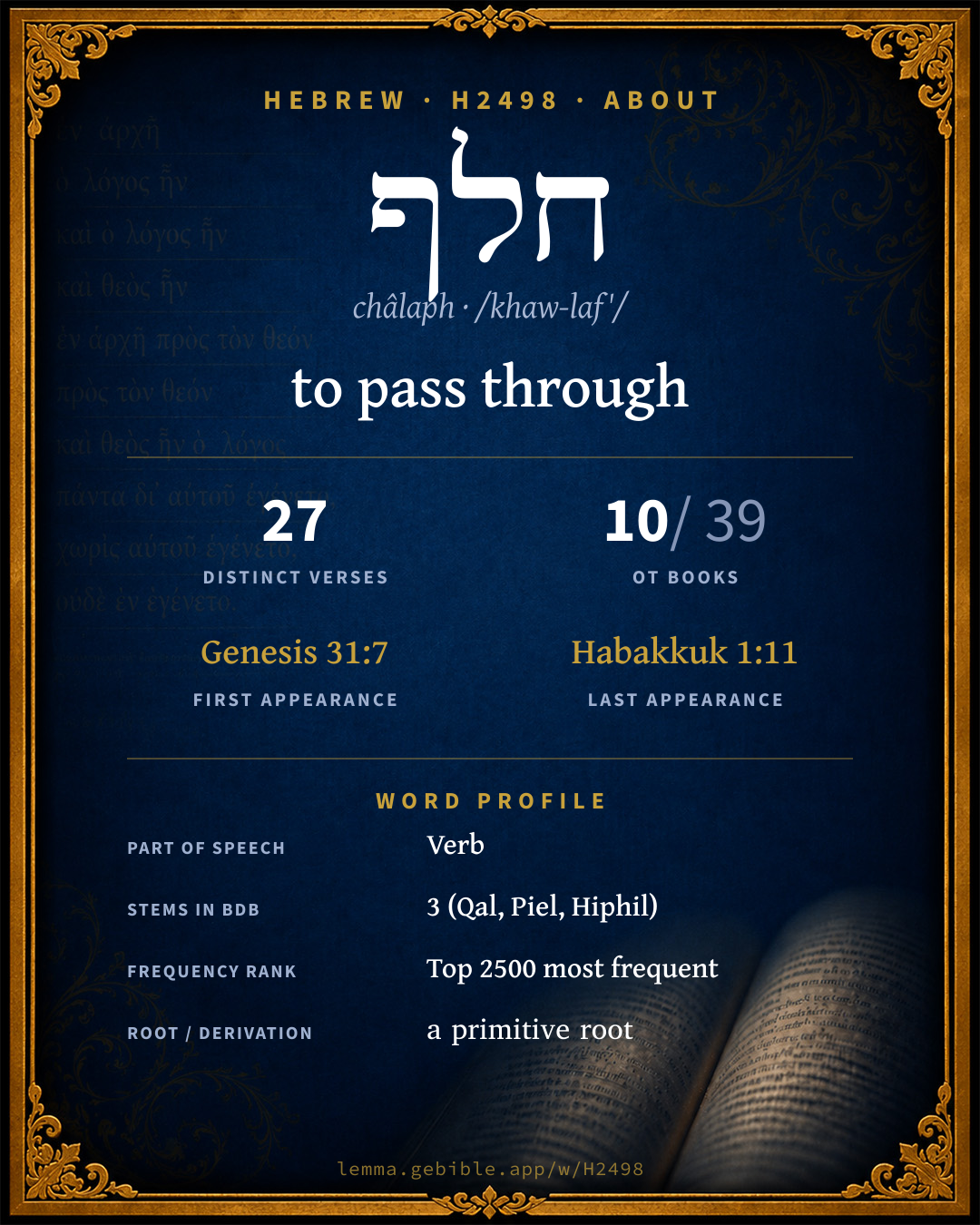
חָלַף
to pass through
‘to pass through’ is one of 2 main senses fuller range ↓
Full lexicon entry — Brown-Driver-Briggs (BDB)
From Brown-Driver-Briggs (BDB)
Where this word appears
See every Qal verb in the Hebrew Bible →
Grammar key — what these labels mean
Part of speech
- Verb
- An action or state-of-being word.
Stem
- Qal
- The basic, simple active stem — the plain form of the verb (“he wrote”). Here: ‘pass on quickly 1 Sa 10’
- Piel
- An intensive or resultative active stem.
- Hiphil
- The causative active stem (“he caused / brought about”). Here: ‘change’
Form
- Imperfect
- An incomplete, ongoing, or future action (“he will / would write”).
- Sequential Imperfect
- An imperfect with prefixed waw — the standard past-narrative form (waw-consecutive imperfect).
- Sequential Perfect
- A perfect with prefixed waw continuing a preceding imperfect or command (waw-consecutive perfect).
- Perfect
- A completed action or state — Hebrew marks aspect (completeness) more than strict tense (“he wrote”).
- Imperative
- A direct command (“write!”).
- Infinitive Construct
- A bound verbal noun, frequently with prepositions (“to write / in writing”).
Person
- 3rd Person
- The one spoken about (“he / she / it / they”).
- 2nd Person
- The one addressed (“you”).
- 1st Person
- The speaker (“I / we”).
Gender
- Masculine
- Grammatically masculine.
- Common
- Either gender — not distinguished for this form.
- Feminine
- Grammatically feminine.
Number
- Singular
- One.
- Plural
- More than one (in Hebrew, generally three or more).
Grammatical forms 18 distinct
- Verb, Qal, Imperfect, 3rd Person, Masculine, Singular 5 times (18%)
- Verb, Piel, Sequential Imperfect, 3rd Person, Masculine, Singular 2 times (7%)
- Verb, Qal, Sequential Perfect, 3rd Person, Masculine, Singular 2 times (7%)
- Verb, Hiphil, Imperfect, 3rd Person, Masculine, Plural 2 times (7%)
- Verb, Qal, Perfect, 3rd Person, Common, Plural 2 times (7%)
- Verb, Qal, Perfect, 3rd Person, Masculine, Singular 2 times (7%)
- Verb, Hiphil, Imperfect, 3rd Person, Masculine, Singular 2 times (7%)
- Verb, Hiphil, Perfect, 3rd Person, Masculine, Singular 1 time (4%)
+10 more forms (10 occurrences)
Parsed forms decoded from the imported morphology (morphhb / Westminster Leningrad Codex — WLC text public domain, morphhb tagging CC BY 4.0), counted across 28 parsed occurrences — not distinct verses.
Every verse where H2498 appears — 27 distinct verses across 10 books. Click any verse to open its interlinear word-by-word view. Verse text shown in the World English Bible for context — . Each verse’s Hebrew form is shown with its reference; the English is not keyword-highlighted, since the data carries no word-level English alignment. Use “Compare translations” on any verse to read it across multiple English versions. This concordance covers the Hebrew Bible; Septuagint (Greek Old Testament) occurrences are not indexed here.
Genesis 4 verses
- Genesis 31:7 וְ/הֶחֱלִ֥ף conj + Hiphil pf 3ms Your father has deceived me, and changed my wages ten times, but God didn't allow him to hurt me.
- Genesis 31:41 וַ/תַּחֲלֵ֥ף conj + Hiphil wimpf 2ms These twenty years have I been in your house. I served you fourteen years for your two daughters, and six years for your flock, and you have changed my wages ten times.
- Genesis 35:2 וְ/הַחֲלִ֖יפוּ conj + Hiphil impv 2mp Then Jacob said to his household, and to all who were with him, "Put away the foreign gods that are among you, purify yourselves, change your garments.
- Genesis 41:14 וַ/יְחַלֵּ֣ף conj + Piel wimpf 3ms Then Pharaoh sent and called Joseph, and they brought him hastily out of the dungeon. He shaved himself, changed his clothing, and came in to Pharaoh.
Leviticus 1 verse
Judges 1 verse
1 Samuel 1 verse
2 Samuel 1 verse
Job 7 verses
- Job 4:15 יַחֲלֹ֑ף Qal impf 3ms Then a spirit passed before my face; The hair of my flesh stood up.
- Job 9:11 וְ֝/יַחֲלֹ֗ף conj + Qal impf 3ms Behold, he goes by me, and I don't see him. He passes on also, but I don't perceive him.
- Job 9:26 חָ֭לְפוּ Qal pf 3cp They have passed away as the swift ships, As the eagle that swoops on the prey.
- Job 11:10 יַחֲלֹ֥ף Qal impf 3ms If he passes by, or confines, Or convenes a court, then who can oppose him?
- Job 14:7 יַחֲלִ֑יף Hiphil impf 3ms "For there is hope for a tree, If it is cut down, that it will sprout again, That the tender branch of it will not cease.
- Job 20:24 תַּ֝חְלְפֵ֗/הוּ Qal impf 3fs + sfx pers 3ms He shall flee from the iron weapon. The bronze arrow shall strike him through.
- Job 29:20 תַחֲלִֽיף Hiphil impf 3fs My glory is fresh in me, My bow is renewed in my hand.'
Psalms 3 verses
- Psalms 90:5 יַחֲלֹֽף Qal impf 3ms You sweep them away as they sleep. In the morning they sprout like new grass.
- Psalms 90:6 וְ/חָלָ֑ף conj + Qal wpf 3ms In the morning it sprouts and springs up. By evening, it is withered and dry.
- Psalms 102:26 תַּחֲלִיפֵ֣/ם וְֽ/יַחֲלֹֽפוּ Hiphil impf 2ms + sfx pers 3mp conj + Qal impf 3mp They will perish, but you will endure. Yes, all of them will wear out like a garment. You will change them like a cloak, and they will be changed.
Song of Solomon 1 verse
Isaiah 7 verses
- Isaiah 2:18 יַחֲלֹֽף Qal impf 3ms The idols shall utterly pass away.
- Isaiah 8:8 וְ/חָלַ֤ף conj + Qal wpf 3ms and it shall sweep onward into Judah; it shall overflow and pass through; it shall reach even to the neck; and the stretching out of its wings shall fill the breadth of your land, Immanuel.
- Isaiah 9:10 נַחֲלִֽיף Hiphil impf 1cp The bricks are fallen, but we will build with hewn stone; the sycamores are cut down, but we will put cedars in their place.
- Isaiah 21:1 לַֽ/חֲלֹ֔ף prep + Qal inf.cs The burden of the wilderness of the sea. As whirlwinds in the South sweep through, it comes from the wilderness, from an awesome land.
- Isaiah 24:5 חָ֣לְפוּ Qal pf 3cp The earth also is polluted under the inhabitants of it; because they have transgressed the laws, violated the statutes, broken the everlasting covenant.
- Isaiah 40:31 יַחֲלִ֣יפוּ Hiphil impf 3mp but those who wait for Yahweh shall renew their strength; they shall mount up with wings as eagles; they shall run, and not be weary; they shall walk, and not faint.
- Isaiah 41:1 יַחֲלִ֣יפוּ Hiphil impf 3mp Keep silence before me, islands; and let the peoples renew their strength: let them come near; then let them speak; let us come near together to judgment.
Habakkuk 1 verse
About this entry
At a glance — auto-summarized from this page’s data, not written by a person. Every figure links to its source below. This summary describes the numbers; it doesn’t interpret them.
At its core, חלף (châlaph) means “to pass through.” Scripture first uses it in Genesis 31:7. It appears 27 verses across 10 books of the Hebrew Bible, among its moderately common vocabulary. The word gravitates to Job (26%), then Isaiah and Genesis. Read the stem: it spans 3 stems, including Qal and Piel. Each statement above links to its evidence; the full detail follows below.
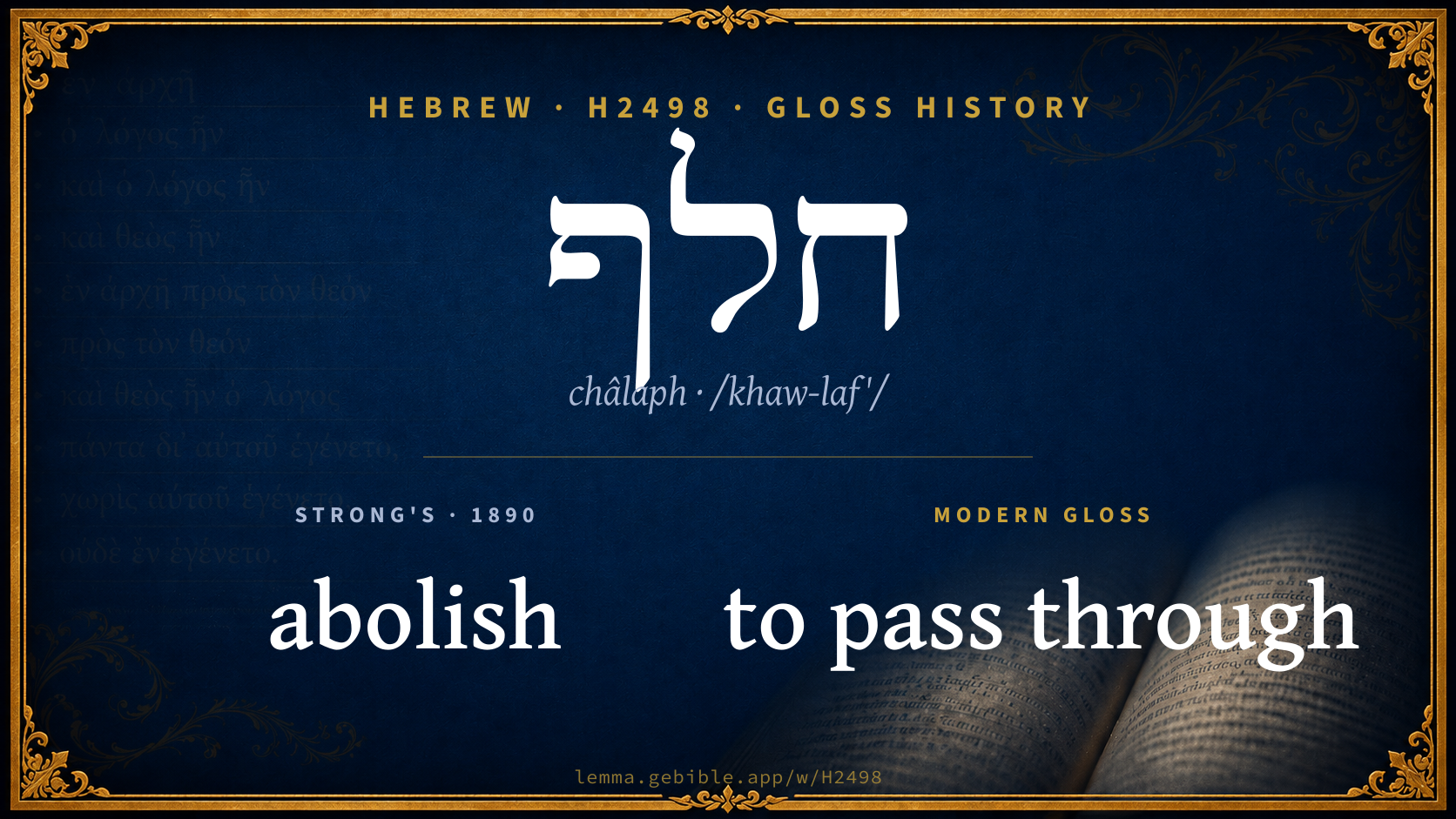
Gloss history
Strong's 1890 vs modern scholarship
About this word
Strong's H2498 catalogs a Hebrew word from the Hebrew Old Testament.
These counts are not copied from any lexicon or concordance. They are computed here, from the morphology-tagged Hebrew Old Testament. What Lemma adds →
- 27
- distinct verses
- The word appears in 27 distinct verses.
- 10 / 39
- OT books
- The word appears in 10 of 39 Old Testament books.
- #1,190
- by frequency
- Top 2500 most frequent Hebrew words (rank 1,190 of 8,640 Hebrew words by occurrence).
View all 27 occurrences in the concordance →
By section of the Old Testament
By traditional corpus
Conventional, traditional groupings — biblical authorship is debated, so this is a traditional corpus grouping, not an authorship claim. Each share is this word’s portion of its verses in that division of the Hebrew canon. Each figure is a share of the word’s 27 distinct verses.
- Prophets (Nevi'im) 11 verses · 41%
- Writings (Ketuvim) 11 verses · 41%
- Torah (Pentateuch) 5 verses · 19%
How translations render this word
Counts come from each version’s own published word-to-Strong’s tagging or interlinear alignment — an approximate guide to how each version renders this word, not a word-level alignment the data otherwise carries. Because each total is that version’s own tagged count, the per-version totals vary from one another and need not match the appearance or distinct-verse counts above. These counts may also differ from a printed concordance because Lemma counts each distinctly tagged rendering and does not collapse phrase taggings into a single head-word total. This is a fixed set of word-tagged versions (KJV, ASV, BSB, ULT) and does not change with the reading translation you choose elsewhere. Each version’s license is shown beside its name below (and on Sources).
- King James Version: Change 2×, Changed 2×, Groweth up 2×
- American Standard Version: Groweth up 2×, Himself 2×
- Berean Standard Bible: Changed 3×, They sweep by 2×
- unfoldingWord Literal Text: Changed 2×, Passes along 2×
King James Version Public Domain
Renders H2498 across 28 tagged occurrences — most commonly:
Plus 20 renderings that appear only once — usually multi-word phrases or single function words the recovered tagging swept in, not distinct renderings.
American Standard Version Public Domain
Renders H2498 across 28 tagged occurrences — most commonly:
Plus 24 renderings that appear only once — usually multi-word phrases or single function words the recovered tagging swept in, not distinct renderings.
Berean Standard Bible Public Domain
Renders H2498 across 27 tagged occurrences — most commonly:
Plus 22 renderings that appear only once — usually multi-word phrases or single function words the recovered tagging swept in, not distinct renderings. Not rendered by a distinct English word in 1 further occurrence.
unfoldingWord Literal Text CC BY-SA 4.0
Renders H2498 across 33 tagged occurrences — most commonly:
Plus 29 renderings that appear only once — usually multi-word phrases or single function words the recovered tagging swept in, not distinct renderings.
11 senses and sub-senses in the full BDB
Hebrew verbs can shift meaning by stem (binyan): Qal is the basic action, Niphal is often passive or reflexive, Piel often intensifies or makes it factitive, and Hiphil is typically causative. The senses below are grouped under the stem BDB assigns to each.
What do BDB’s symbols mean?
BDB uses these scholarly abbreviations:
| Symbol | Meaning |
|---|---|
| 𝔊 | the Septuagint (the ancient Greek translation, LXX) |
| 𝔙 | the Vulgate (the Latin translation) |
| 𝔖 | the Syriac version (the Peshitta) |
| 𝔗 | the Targum (the Aramaic translation) |
| ψ | the Psalms |
| √ | root (the underlying root or stem) |
| ‖ | parallel passage (a synonymous or contrasted parallel) |
| † | the dagger: every passage where the word occurs is cited |
The 11 senses and sub-senses the full Brown-Driver-Briggs lexicon distinguishes for this word, in lexicon order (not ranked by frequency), with BDB’s own verbatim wording and sub-sense lettering. Shown in Hebrew script with BDB’s own scholarly abbreviations. The condensed entry is in the Lexicon Entry tab. See also the Forms in the corpus table below.
Qal
- Pf. חָלַף Ct 2:11 Hb 1:11 etc.; Impf. יַחֲלֹף Jb 4:15 + 4 times; 3 fs. sf. תַּחְלְפֵ֫הוּ Jb 20:24; יַחֲלֹ֑פוּ ψ 102:27; Inf. cstr. לַחֲלוֹף Is 21:1;— e.g. Song of Solomon 2:11
- 1.
- a. pass on quickly 1 Sa 10:3; elsewhere only poet., move or sweep on, of a flood Is 8:8, or wind 21:1 Jb 4:15 Hb 1:11, of God Jb 9:11; 11:10. e.g. 1 Samuel 10:3
- b. pass away (vanish) Jb 9:26 (of days); Ct 2:11 (of rain ‖ עבר), of the heavens ψ 102:27, of idols Is 2:18, (but perhaps gloss JBL ix. 1890, 86). e.g. Job 9:26
- 2. of grass, come on anew, i.e. sprout again (cf. Hiph. 2) ψ 90:5, 6, so Thes AV De Hi Che Bae al.; less suitably in context 𝔊 𝔙 Ew pass away, supr. 1 b. e.g. Psalms 90:5
- 3. trans.
- a. pass through, i.e. pierce, sq. acc. Ju 5:26 Jb 20:24. e.g. Judges 5:26
- b. overstep, transgress Is 24:5 (‖ עבר), (cf. Arabic iv. to break a promise). e.g. Isaiah 24:5
Piel
- Impf. וַיְחַלֵּף (cause to pass) change, sq. acc. garment Gn 41:14 (E) 2 S 12:20. e.g. Genesis 41:14
Hiphil
- Pf. חֶחֱלִף Gn 31:7; Impf. יַחֲלִיף Jb 14:7; sf. יַחֲלִיפֶנּוּ Lv 27:10; 3 fs. תַּחֲלִיף Jb 29:20; 2 ms. וַתַּחֲלֵף Gn 31:41; sf. תַּחֲלִיפֵם; יַחֲלִ֫יפוּ Is 40:31; 41:1; נַחֲלִיף Is 9:9;— e.g. Genesis 31:7
- 1. change (trans.) garments Gn 35:2 (E) ψ 102:27, wages Gn 31:7, 41 (both E); no obj. expr. Lv 27:10 (P); substitute i.e. cause to succeed Is 9:9; change for better, renew, obj. כֹּחַ Is 40:31; 41:1. e.g. Genesis 35:2
- 2. shew newness, of tree, putting forth fresh shoots Jb 14:7, of bow 29:20. e.g. Job 14:7
Senses from the full Brown-Driver-Briggs lexicon (Brown, Driver, Briggs; Oxford 1906 — public domain), digitized via Sefaria, supplemented by the OpenScriptures HebrewLexicon (CC BY 4.0). Full attribution on Sources.
Word origin
vb. pass on or away, pass through (mostly poet.) (NH id., pass by or away, change; Ph. חלפת equivalent, ReinachRÉJ 188, 276; Hoffm G. G. Abh. xxxvi. 1890, 20; Aramaic חֲלַף pass away, change; ܚܠܰܦ change, substitute; Nab. חלף change (?) Eut p. 53; Arabic خَلَفَ come after, succeed, replace [cf. ‘Caliph’ i.e. successor (of Mohammed)] and many deriv. Lane792–799; so also ויחלפה MI 6 and his son succeeded him; Ethiopic ኀለፈ pass by, across, through)—
— Brown-Driver-Briggs (Oxford 1906, public domain), digitized via Sefaria, supplemented by the OpenScriptures HebrewLexicon (CC BY 4.0). See Sources.
Origin: a primitive root
Jastrow Dictionary
A second Hebrew/Aramaic lexicon for comparison, covering Aramaic and post-biblical (Talmudic, Targumic, Midrashic) usage that the biblical-Hebrew BDB does not. Matched by lemma rather than by Strong’s number, so a lemma may carry more than one Jastrow headword (shown separately below), and the entries cover usage well beyond the Bible.
חָלַף
- [to be smooth, glistening, sharp-edged,]
- 1. to cut. Denom. חַלִּיף, חֵילֶף.
- 2. (cmp גּוּז) to pass by, be gone. Num. R. s. 10 (ref. to חלוף, Prov. XXXI, 8) שח׳ והלך וכ׳ of him who passed away and went &c. e.g. Proverbs 31:8
- 3. to change, exchange. Y. Ber. II, 5ᶜ top נַחֲלוֹף את וכ׳ let us change our meeting-place. Dem. III, 5 חשודה לַחֲלוֹף (Y. ed. לחַלֵּף, Pi.) suspected of exchanging (the provision in her trust). Ib. 6 לח׳ את המתקלקל to replace what has been spoiled; a. fr.
- same. Yalk. Gen. 148 מי מְחַלְּפוֹ who will replace him? (v. חֲלִיפִין). Dem. III, 5, v. supra; a. e.
- 1. to exchange, barter. B. Mets. VIII, 4 המַחֲלִיף פרה ב־ if one exchanges a cow for an ass.—Dem. l. c. חשודה להַחֲלִיף, v. supra; Ḥull. 6ᵇ חשודה מַחֲלֶפֶת; a. fr.
- 2. to drive young shoots, to grow again. Erub. 100ᵇ; a. e., v. גֶּזַע. Pesik. R. s. 11 מַחֲלִיף וכ׳, v. גָּזַז.
- 3. to change; to reverse. Erub. 9ᵃ ובלבד שלא יַחֲלִיפוּ provided they do not change carriers. Sabb. 8ᵇ; a. fr.—Erub. 99ᵃ לעולם לא תַחֲלִיף it is not necessary to reverse (the authorities; Bets. 3ᵇ, a. e. תיפוך, v. אֲפַךְ).—Part. pass. מוּחֲלָף, f. מוּחֲלֶפֶת. Ib. מ׳ השיטה the statement must be reversed (the authorities for the two opinions must be exchanged); Bets. 3ᵃ
- 4. to be ambiguous, to equivocate. Snh. 92ᵃ; a. e. כל המחליף וכ׳ he who equivocates in his speech, is like an idolater.
- , Nithpa. נִתְחַלֵּף
- 1. to be exchanged, mixed up. Y. Pes. VI, 33ᶜ bot. דבר שאין דרכו (לֵחָלֵף) לִיתְחַלֵּף a thing which is not likely to be exchanged (by mistake); ib. להִתְחַלֵּיף; ib.ᵈ top. Ab. Zar. 17ᵇ מעות … נִתְחַלְּפוּ לי וכ׳ money set aside for Purim was mixed up with money &c. Nidd. 52ᵃ ונִתְחַלְּפָה לך וכ׳ and thou madest a mistake between Iyob and oyeb; B. Bath. 16ᵃ ונתחלף. Ib. לא נ׳ לי I make no mistake; a. e.
- 2. to change (in appearance). Pesik. R. s. 29 (—30—30) נִתְחַלַּפְתֶּם מן הרעב you have changed (beyond recognition) through starvation; יש לכם להִתְחַלֵּף וכ׳ you will change through plenty. Yalk. Gen. 133 מאיזה שם אני מִתְחַלֵּף (prob. לאיזה) what name I may be ordered to assume in turn.
- 3. to be succeeded, relieved, transferred. Lev. R. s. 23, end נתח׳ המלך the king has been succeeded (displaced; Num. R. s. 9, beg. מת וכ׳). Yalk. Deut. 813 כיון שנ׳ וכ׳ when the governor was recalled and another &c. Num. R. s. 5, beg. להִתְחַלֵּף מעבודה וכ׳ to be transferred from one service to another. Y. Taan. II, beg. 65ᵃ היו מִתְחַלְּפִין עליה took turns in guarding it.
חֲלַף I
- , to pass by, be gone. Targ. Cant. II, 11. Targ. Job IX, 11. Ib. 26; a. e.
- 1. to pass repeatedly, promenade. Kidd. 12ᵇ ח׳ אבבא וכ׳ went up and down in front of the house of his father-in-law (to attract the attention of his mother-in-law).
- 2. to exchange. Targ. O. Lev. XXVII, 10; a. e.—Ḥull. 6ᵇ חַלּוּפֵי מבעיא so much the more may she be suspected of exchanging (substituting something of her own). Meg. 7ᵇ מְחַלְּפֵי וכ׳ (v. Rabb. D. S. a. l. note 8; some ed. מִיחַ׳ Ithpa.) used to exchange their meals (on Purim).—Part. pass. f. מְחַלְּפָא. Y. Peah IV, 18ᵈ bot., a. e. מח׳ שיטתיה, v. preced. Hif.
- same. Targ. O. l. c.; a. e.
- to be exchanged; to change; to disappear. Targ. Ps. XC, 5; a. fr.—Gen. R. s. 78, beg. מִתְחַלְּפִין change their names. Ḥull. l. c. ולאִיחַלּוּפֵי לא וכ׳ Rashi (ed. לחַלּוּפֵי) and do we not apprehend an exchange?—Meg. l. c., v. supra.—B. Mets. 59ᵇ, v. חָסֵר II.
חִלֶף I
- (preced. wds.)
- 1. shoot.—Pl. חֲלָפִים, constr. הֶלְפֵי, חֶילְ׳. Bets. 3ᵇ; Yeb. 81ᵇ; Zeb. 72ᵇ ח׳ תרדין the young shoots of beet growing out of the root; Orl. III, 7 Ms. M. (ed. חוֹלְפוֹת; Y. ed. חִילְפּוֹת); Tosef. Ter. V, 10 חֲלִיפוֹת ed. Zuck. (Var. חילפות); Ukts. I, 4 חִלְפּוֹת. V. חֲלִיפִין, חֲלִיפָה.
- 2. rush, v. חֵילֶף.
חֵלֶף II
- (preced. wds.) reversion. Y. Sabb. VII, 9ᶜ או ח׳ is not perhaps the reverse the case?
חֶלֶף
- (b. h.) Ḥelef, a place in Naftali. Y. Meg. I, 70ᵃ bot. (ref. to Josh. XIX, 33) מחלף ח׳ me-Helef is (the present) Ḥ. Y. Erub. II, 20ᵃ top ר׳ … בהורי ח׳ וכ׳ R. Jerem. taught at Ḥ. &c. e.g. Joshua 19:33
חֲלַף II
- st. constr. (חלף) in place of, instead. Targ. Ex. XXI, 24; a. fr.—Sabb. 129ᵃ נפשא ח׳ נפשא life for life (meat is required after bloodletting), סומקא ח׳ סומקא red (wine) for red (blood).—Pl. חֲלָפֵי, with suffix חֲלָפוֹי in his place. Targ. Prov. XI, 8 Ms. (ed. תחותוהי, ed. Lag. both words).—חֲלַף סִדְרָא f. (an adaptation of κλεψύδρα) [change of order,] clepsydra, a water clock used in courts of justice for measuring the time given for argument. Gen. R. s. 49 (not סרדה); Yalk. ib. 83.
A Dictionary of the Targumim, the Talmud Babli and Yerushalmi, and the Midrashic Literature (Marcus Jastrow; London, Luzac, 1903) — Public Domain. Digitized via Sefaria. Digitized via Sefaria. Full attribution on Sources.
Forms in the corpus
The 26 distinct written forms H2498 takes in the Hebrew Bible, most frequent first — each parse links to that stem’s occurrences in the concordance. Hebrew forms include their vowel points and cantillation, so a single lemma takes many written forms.
Same root — word family
Other BDB entries built from the same root as H2498, grouped by Strong’s listed origin. These share a root / origin per the lexicon — not necessarily a shared meaning. Each links to that word’s own entry.
Derived from this word
- חלוף chălôwph H2475 destruction
- חליפה chălîyphâh H2487 change
- חלף chălaph H2499 to pass over
- חלף chêleph H2500 in exchange for
- מחלף machălâph H4252 knife
- מחלפה machlâphâh H4253 braid
Compare all same-root words → Showing 4 of 7 — not the complete family. They share a root, not necessarily a meaning.
Septuagint verse parallels
This word appears in 26 verses that also exist in the Greek Old Testament (Septuagint), out of the 27 Hebrew verses it occurs in. You can read those verses in Greek by switching the Old Testament edition to the Septuagint.
Read these verses in the Septuagint
- Genesis 31:7
- Leviticus 27:10
- Judges 5:26
- 1 Samuel 10:3
- 2 Samuel 12:20
- Job 4:15
- Psalms 90:5
- Song of Solomon 2:11
- Isaiah 2:18
- Habakkuk 1:11
This is a verse-level parallel only — the same verses exist in both the Hebrew and Greek Old Testaments. No word-level Hebrew↔Greek correspondence is claimed: the data carries no such alignment, so no Greek word is shown as this Hebrew word’s translation. Coverage is not total — the Septuagint omits the deuterocanon and renumbers the Psalms, so some Hebrew verses have no direct Greek parallel.