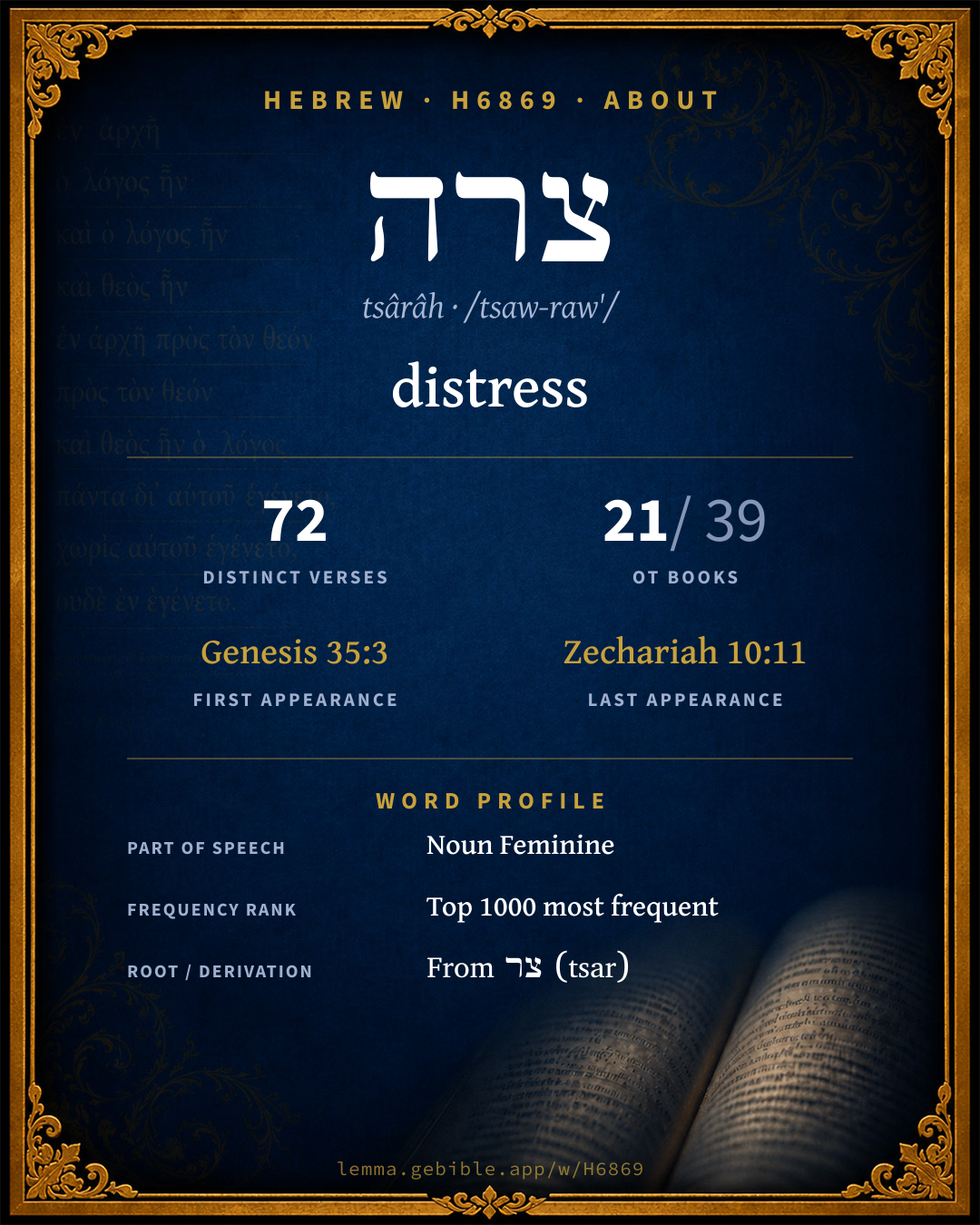
צָרָה
distress
also: straits, trouble fuller range ↓
Full lexicon entry — Brown-Driver-Briggs (BDB)
From Brown-Driver-Briggs (BDB)
Where this word appears
Grammar key — what these labels mean
Part of speech
- Noun
- A naming word — a person, place, thing, or idea.
Noun type
- Common
- A common noun — a general class of person, place, or thing (“king,” “city,” “water”), not a specific name.
State
- Absolute
- The independent form of a noun, not bound to a following word.
- Construct
- A noun bound to a following noun in a possessive / “of” relationship (the construct chain).
Gender
- Feminine
- Grammatically feminine.
Number
- Singular
- One.
- Plural
- More than one (in Hebrew, generally three or more).
Every verse where H6869 appears in the Book of Judges — 1 distinct verse. Click any verse to open its interlinear word-by-word view. Verse text shown in the World English Bible for context — . Each verse’s Hebrew form is shown with its reference; the English is not keyword-highlighted, since the data carries no word-level English alignment. Use “Compare translations” on any verse to read it across multiple English versions. This concordance covers the Hebrew Bible; Septuagint (Greek Old Testament) occurrences are not indexed here.
Judges
About this entry
At a glance — auto-summarized from this page’s data, not written by a person. Every figure links to its source below. This summary describes the numbers; it doesn’t interpret them.
“distress” is the headline sense of the Hebrew noun צרה (tsârâh). Its English rendering has broadened — “trouble” classically, “distress” (Berean Standard Bible) in modern versions; see the renderings breakdown. The Hebrew Bible uses it across 72 verses — moderately common. More than a third of its appearances fall in Psalms. Beyond “distress” it also covers “straits” and “trouble” — see its full sense range. The sections below give every sense, occurrence, and version rendering.
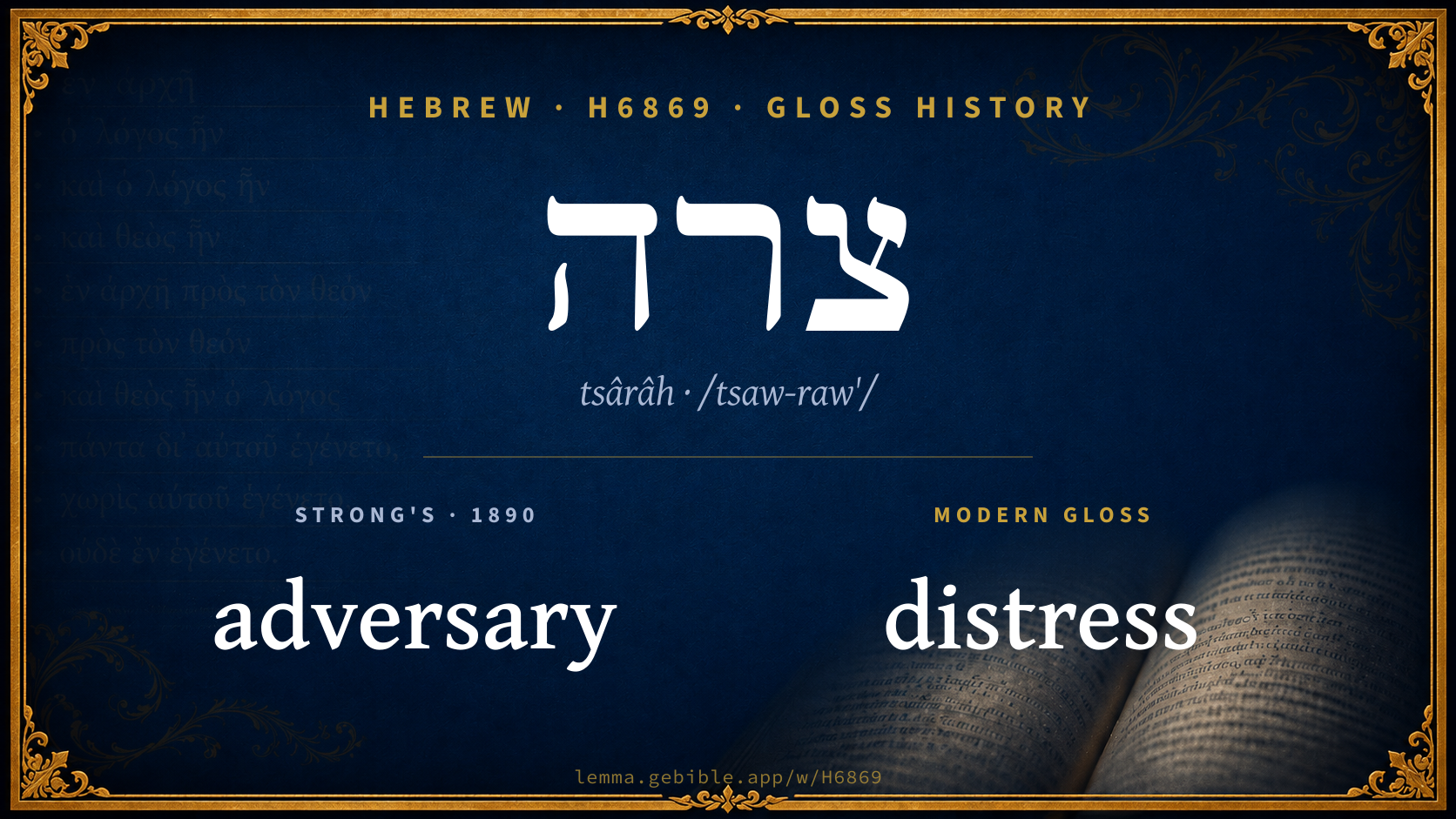
Gloss history
Strong's 1890 vs modern scholarship
About this word
Strong's H6869 catalogs a Hebrew word from the Hebrew Old Testament.
These counts are not copied from any lexicon or concordance. They are computed here, from the morphology-tagged Hebrew Old Testament. What Lemma adds →
- 72
- distinct verses
- The word appears in 72 distinct verses.
- 21 / 39
- OT books
- The word appears in 21 of 39 Old Testament books.
- #542
- by frequency
- Top 1000 most frequent Hebrew words (rank 542 of 8,640 Hebrew words by occurrence).
View all 72 occurrences in the concordance →
By section of the Old Testament
By traditional corpus
Conventional, traditional groupings — biblical authorship is debated, so this is a traditional corpus grouping, not an authorship claim. Each share is this word’s portion of its verses in that division of the Hebrew canon. Each figure is a share of the word’s 72 distinct verses.
- Writings (Ketuvim) 38 verses · 53%
- Prophets (Nevi'im) 30 verses · 42%
- Torah (Pentateuch) 4 verses · 6%
How translations render this word
Counts come from each version’s own published word-to-Strong’s tagging or interlinear alignment — an approximate guide to how each version renders this word, not a word-level alignment the data otherwise carries. Because each total is that version’s own tagged count, the per-version totals vary from one another and need not match the appearance or distinct-verse counts above. These counts may also differ from a printed concordance because Lemma counts each distinctly tagged rendering and does not collapse phrase taggings into a single head-word total. This is a fixed set of word-tagged versions (KJV, ASV, BSB, ULT) and does not change with the reading translation you choose elsewhere. Each version’s license is shown beside its name below (and on Sources).
BDB lists this Strong’s number as 7 distinct words (homographs). Each count above pools all of them and is not split by sense — see the Senses section below. A low-frequency rendering may belong to a different one of those words, not the primary meaning.
- King James Version†: Trouble 31×, Troubles 7×, Distress 6×
- American Standard Version†: Trouble 27×, Distress 8×, Troubles 7×
- Berean Standard Bible†: Distress 29×, Trouble 20×, Troubles 6×
- unfoldingWord Literal Text†: Distress 33×, Trouble 21×, Troubles 8×
King James Version Public Domain
Renders H6869 across 73† tagged occurrences — most commonly:
Plus 14 renderings that appear only once — usually multi-word phrases or single function words the recovered tagging swept in, not distinct renderings.
American Standard Version Public Domain
Renders H6869 across 73† tagged occurrences — most commonly:
Plus 19 renderings that appear only once — usually multi-word phrases or single function words the recovered tagging swept in, not distinct renderings.
Berean Standard Bible Public Domain
Renders H6869 across 73† tagged occurrences — most commonly:
Plus 8 renderings that appear only once — usually multi-word phrases or single function words the recovered tagging swept in, not distinct renderings.
unfoldingWord Literal Text CC BY-SA 4.0
Renders H6869 across 74† tagged occurrences — most commonly:
Plus 8 renderings that appear only once — usually multi-word phrases or single function words the recovered tagging swept in, not distinct renderings.
9 senses and sub-senses in the full BDB
Hebrew verbs can shift meaning by stem (binyan): Qal is the basic action, Niphal is often passive or reflexive, Piel often intensifies or makes it factitive, and Hiphil is typically causative. The senses below are grouped under the stem BDB assigns to each. This entry also uses Pual (the passive of Piel).
What do BDB’s symbols mean?
BDB uses these scholarly abbreviations:
| Symbol | Meaning |
|---|---|
| 𝔊 | the Septuagint (the ancient Greek translation, LXX) |
| 𝔙 | the Vulgate (the Latin translation) |
| 𝔖 | the Syriac version (the Peshitta) |
| 𝔗 | the Targum (the Aramaic translation) |
| ψ | the Psalms |
| √ | root (the underlying root or stem) |
| ‖ | parallel passage (a synonymous or contrasted parallel) |
| † | the dagger: every passage where the word occurs is cited |
The 9 senses and sub-senses the full Brown-Driver-Briggs lexicon distinguishes for this word, in lexicon order (not ranked by frequency), with BDB’s own verbatim wording and sub-sense lettering. Shown in Hebrew script with BDB’s own scholarly abbreviations. The condensed entry is in the Lexicon Entry tab. See also the Forms in the corpus table below.
צרה I bind, tie up, be restricted, narrow, scant, cramped (NH id.
- A. trans.:
Qal
- Pf. 3 ms. צָרַר Ho 4:19; Pr 30:4; Imv. צוֹר Is 8:16; Inf. cstr. צְרוֹר Pr 26:8 (?); Pt. act. צֹרֵר Jb 26:8; pass. צָרוּר Ho 13:12, f. צְרוּרָה 1 S 25:29; fpl. צְרֻרֹת Ex 12:34; 2 S 20:3;—bind or tie up, of kneading-troughs Ex 12:34 (E); fig. of a life preserved by י׳, נֶפֶשׁ צְרוּרָה בִּצְרוֹר הַחַיִּים 1 S 25:29; of preserving prophetic teaching Is 8:16; of retention of guilt Ho 13:12; of י׳’s binding waters in (a garment of) cloud Pr 30:4 Jb 26:8; = shut up 2 S 20:3;—צָרַר רוּחַ אֹתָהּ בִּכְנָפֶיהָ Ho 4:19 (si vera l.) pregn., the wind hath wrapped her up in its wings, to carry her off; כִּצְרוֹר אֶבֶן Pr 26:8 like the tying up of a stone, but unintellig. in context (v. Toy). e.g. Hosea 4:19
Pual
- Pt. pl. מְצֹרָרִים Jos 9:4 tied up (mended by tying), of old wine-skins. e.g. Joshua 9:4
- B. intrans.:
Qal
- Pf. 3 fs. צָ֫רָה Is 28:20; Impf. 3 ms. יֵצַר Pr 4:12, יֵ֫צֶר לוֹ Jb 20:22, וַיֵּ֫צֶר Gn 32:8 +, 2 fs. תֵּצְרִי Is 49:19;—be scant, cramped; of scanty bed-covering Is 28:20 (in fig.); of land too small for (מִן) its people Is 49:19 + Jos 19:47 (for וַיֵּצֵא) DrExpos. Jan. 1887, 59 Benn, cf. 𝔊; of steps = be cramped, or impeded, Pr 4:12; Jb 18:7 (both in fig.); especially impers. c. ל pers., וַיֵּצֶר לוֹ Gn 32:8 and it was narrow for him = he was in straits, distress, so Ju 2:15; 2 S 13:2; Jb 20:22, also 3 fs. וַתֵּ֫צֶר לְ Ju 10:9; 1 S 30:6 (v. Dr).* e.g. Isaiah 28:20
Hiphil
- Pf. 3 ms. וְהֵצַר Dt 28:52, 52 consec.; 1 s. וַהֲצֵרֹתִי Je 10:18; Zp 1:17; Impf. 3 ms. יָצַר־לוֹ 1 K 8:37 = 2 Ch 6:28, וַיָּ֫צַר 2 Ch 28:20; 3 mpl. וַיָּצֵרוּ Ne 9:27; Inf. cstr. הָצֵר 2 Ch 28:22; 33:12;—make narrow for, press hard upon, cause distress to, c. ל pers., Je 10:18 (subj. י׳), Zp 1:17 (subj. id.); Dt 28:52(×2); 1 K 8:37 = 2 Ch 6:28; Ne 9:27 (all subj. foe), 2 Ch 28:20 (subj. TP); Indef. subj. 2 Ch 28:22 (but read כִּי אִם לִצָרָה לוֹ, and join to v 21, opp. לְעֶזְרָה לוֹ, 𝔊 Kit BuhlLex), 33:12. e.g. Deuteronomy 28:52
צרה II denom.
Hiphil
- suffer distress (specif. of travail, cf. Je 4:31; 49:24);—Pt. לֵב אִשָּׁה מְצֵרָה (in sim.) Je 48:41; 49:22. e.g. Jeremiah 4:31
צרה III shew hostility toward, vex (NH צַר foe
Qal
- Pf. 3 pl. וְצָֽרֲרוּ Nu 33:55 consec., sf. צְרָרוּנִי ψ 129:1, 2; Impf. 3 ms. יָצֹר Is 11:13; Inf. abs. צָרוֹר Nu 25:17; Pt. act. צֹרֵר 10:9, pl. sf. צֹרֲרַי ψ 31:12 +, etc.;—shew hostility toward, treat with enmity, vex, harass, c. acc. pers. Is 11:13; Nu 10:9; 25:17; once c. ל pers. v 18; also pt. as subst. (cstr. or c. sf.) vexer, harasser, Am 5:12; Is 11:13; Ex 23:22 (E), ψ 6:8; 7:5, 7; 8:3; 10:5; 23:5; 31:12; 42:11; 69:20; 74:4, 23; 143:12; Est 3:10; 8:1; 9:10, 24.—Lv 18:18 v. [צָרַר] sub ii. צָרָה, infr. e.g. Numbers 33:55
צרה IV vexer, rival-wife (v. reff. sub √
צרה V denom. make a rival-wife
Qal
- Inf. cstr. לִצְרֹר Lv 18:18 to make [her] a rival-wife (LagGGN, 1882, 406 Dr-WhLv Baen Lv). e.g. Leviticus 18:18
Senses from the full Brown-Driver-Briggs lexicon (Brown, Driver, Briggs; Oxford 1906 — public domain), digitized via Sefaria, supplemented by the OpenScriptures HebrewLexicon (CC BY 4.0). Full attribution on Sources.
Word origin
I. vb. bind, tie up, be restricted, narrow, scant, cramped (NH id.; Arabic صَرَّ bind, tie up; so Aramaic צְרַר, ܨܰܪ );—
II. n.f. id.;—abs. צ׳ 1 S 26:24 +, צָרָ֫תָה ψ 120:1 (Ges§ 90 g); cstr. צָרַת Gn 42:21; sf. צָרָתִי 35:3 +, צָרַתְכֶם Ju 10:14, etc.; pl. צָרוֹת abs. Is 65:16 +; sf. צָרֹתֵיכֶם 1 S 10:19, etc.;—straits, distress, Gn 42:21 (E); 1 S 26:24; 2 S 4:9; 1 K 1:29; Is 8:22; Jb 5:19; 27:9; especially ψψ (24 times), e.g. 22:12; 25:17 (v. רחב), v 22 31:8; 34:17, 18; specif. of travail, צָרָה וַחֲבָלִים Je 49:24 (sim.), cf. 4:31 (Gie צְוָחָה, after 𝔊); צָרַת נַפְשׁוֹ Gn 42:21 (E); בְּיוֹם צָרָתִי 35:3 (E), ψ 77:3; 86:7, cf. 2 K 19:3 = Is 37:3, ψ 20:2; 50:15 Pr 24:10; 25:19; Je 16:19; Ob 12, 14; Na 1:7; Hb 3:16, יוֹם צ׳ וּמְצוּקָה Zp 1:15; בְּעֵת־צָרַתְכֶם Ju 10:14, cf. Ne 9:27 ψ 37:39 Is 33:2 Je 14:8; 15:11; 30:7; Dn 12:1; also בַּצָּרָה ψ 81:8, בְּצָרָה 91:15 Ne 9:37, בְּצָרוֹת ψ 46:2, etc.; רָעוֹת וְצָרוֹת Dt 31:17, 21 cf. 1 S 10:19 ψ 71:20, צָרָה וְצוּקָה Pr 1:27, אֶרֶץ צ׳ וְצ׳ Is 30:6; c. ל (poet.), בַּצָּרָ֫תָה לִי ψ 120:1 in my distress, מִצָּרָה לִי Jon 2:3.—צָרָה Zc 10:11, read מִצְרַיִם [or מָצוֹר] We Now GASm; צֹ֫רָה KloThLZ, 1879, 566 StaZAW i (1881), 22; ψ 9:10; 10:1 v. בַּצָּרָה.
III. vb. shew hostility toward, vex (NH צַר foe; Arabic ضَرَّ harm, damage, Sab. צֿר war, foe MordtmHim. Inschr. 60. 71 SabDenkm 24 CIS iv. 174, 1. 6 HomChrest. 125; Ethiopic ፀረረ be hostile, in der. spec. and deriv.; Assyrian ṣarâru, be hostile, ṣarru, foe; Arabic ضَرَّةٌ, Assyrian ṣirritu, Syriac ܥܰܪܬܳܐ, all = rival-wife, so (? Heb. infl.) 𝔗 צָרָא 1 S 1:6; v. especially Lag Deceased Wife’s Sister, GGN, 1882, No. 13; = Mi. 125 ff. Dr 1 S 1:6);—
III. n.f. vexer, rival-wife (v. reff. sub √; also Ecclus 37:11);—sf. צָרָתָהּ 1 S 1:6.
IV. vb. denom. make a rival-wife;—
— Brown-Driver-Briggs (Oxford 1906, public domain), digitized via Sefaria, supplemented by the OpenScriptures HebrewLexicon (CC BY 4.0). See Sources.
Derived from צר (tsar) (H6862) — distress.
Jastrow Dictionary
A second Hebrew/Aramaic lexicon for comparison, covering Aramaic and post-biblical (Talmudic, Targumic, Midrashic) usage that the biblical-Hebrew BDB does not. Matched by lemma rather than by Strong’s number, so a lemma may carry more than one Jastrow headword (shown separately below), and the entries cover usage well beyond the Bible.
צְרַהּ
- , v. צְרַח II
צָרָה I
- [nearest,] associate wife, rival (cmp. רֵעַ). Yeb. I, 2 כשם שבתו פטורה כך צָרָתָהּ פטורה as a man’s daughter (who was the wife of his brother that died without issue) is exempt from marrying the yabam (her father), so is her associate exempt. Ib. הלכה צָרַת בתו … כשם שצָרַת בתו פטורה כך צרת צרתה פטורה if this his daughter’s associate marries a second brother of his who has another wife besides her, and he dies (without issue): as his daughter’s former associate is exempt, so is the latter’s present associate exempt; a. v. fr.—Snh. 103ᵇ; Yoma 9ᵇ; Num. R. s. 7 מסכה צ׳, v. מַסֵּכָה I. Midr. Till. to Ps. CI ועבר בים צ׳ זה צלמו של מיכה ‘and a rival crossed the sea’ (Zech. X, 11), that means the image of Micah; Num. R. s. 16, end; Mekh. Bo, s. 14.—Yoma 19ᵇ, v. צְרֵדָה.—Pl. צָרוֹת. Yeb. I, 1 צרותיהן, חמש … פוטרות נָרוֹתֵיהֶן צ׳ fifteen women (married severally to the brother of a man with whom marriage is forbidden) cause the exemption from yibbum (יִבּוּם) of their associates and eventually the associates of their associates. Ib. 4 בית שמאי מתירין הצ׳ לאחים the school of Shammai allows the rivals of a woman forbidden on account of consanguinity to be married to one of the brothers of the deceased (without issue); a. fr. e.g. Zechariah 10:11
צָרָה II
- 1. fem. of צַר.
- 2. anguish, trouble, distress, persecution. Ber. 9ᵇ דיה לצ׳ בשעתה time enough for the trouble when it comes (‘sufficient unto the day is the evil thereof’). Ib. 63ᵃ (ref. to Prov. XXIV, 10) כל המרפה … ביום צ׳ he who neglects the words of the Law, has no strength on the day of trouble. Pes. 117ᵃ על כל צ׳ וצ׳ וכ׳ in every trouble that may not come (euphem. for: that comes) upon them. Yeb. 63ᵇ (from Ben Sira) אל תצר צָרת מחר וכ׳ worry not about to-morrow’s trouble, for thou knowest not what the day may beget. Sot. 12ᵃ (play on צֶרֶת, I Chr. IV, 7) שנעשית צ׳ וכ׳ because she was a trouble (an object of envy) to her companions. Snh. IV, 5 שמא תאמרו מה לנו ולצ׳ וכ׳ lest you say, why should we undergo this trouble (of giving testimony)? &c. Gen. R. s. 81 וכיון שראה שצָרָתוֹ צ׳ and when he saw that his trouble was a real trouble (when he felt greatly embarrassed). Ib. אל תזכירני צָרָתִיִ do not cause me to mention my trouble. Cant. R. to III, 4 (ref. to Is. XXI, 2) כבר נתעלה צָרָתָהּ של עילם … כבר נוצרה צרתה וכ׳ (not נתעלם) the anguish which Elam has to bring has already been brought up (prepared), … the anguish through Media has already been created; a. v. fr.—Pl. צָרוֹת. Ber. 13ᵃ צ׳ אחרונות וכ׳ the later troubles make us forget the earlier; Y. Sot. IX, 24ᵇ top. Y. Meg. I, 70ᵈ לא דיינו הצ׳ … צרתו של המן have we not enough with the persecutions that visit us (on account of which we hold fast-days), that you want to impose upon us (the fast in commemoration of) the persecution by Haman? Snh. 97ᵃ; a. v. fr. e.g. Proverbs 24:10
A Dictionary of the Targumim, the Talmud Babli and Yerushalmi, and the Midrashic Literature (Marcus Jastrow; London, Luzac, 1903) — Public Domain. Digitized via Sefaria. Digitized via Sefaria. Full attribution on Sources.
Forms in the corpus
The 48 distinct written forms H6869 takes in the Hebrew Bible, most frequent first — each parse links to that state’s occurrences in the concordance. Hebrew forms include their vowel points and cantillation, so a single lemma takes many written forms.
Septuagint verse parallels
This word appears in 62 verses that also exist in the Greek Old Testament (Septuagint), out of the 72 Hebrew verses it occurs in. You can read those verses in Greek by switching the Old Testament edition to the Septuagint.
Read these verses in the Septuagint
- Genesis 35:3
- Deuteronomy 31:17
- Judges 10:14
- 1 Samuel 1:6
- 2 Samuel 4:9
- 1 Kings 1:29
- 2 Kings 19:3
- 2 Chronicles 15:6
- Job 5:19
- Psalms 9:9
- Proverbs 1:27
- Isaiah 8:22
This is a verse-level parallel only — the same verses exist in both the Hebrew and Greek Old Testaments. No word-level Hebrew↔Greek correspondence is claimed: the data carries no such alignment, so no Greek word is shown as this Hebrew word’s translation. Coverage is not total — the Septuagint omits the deuterocanon and renumbers the Psalms, so some Hebrew verses have no direct Greek parallel.