
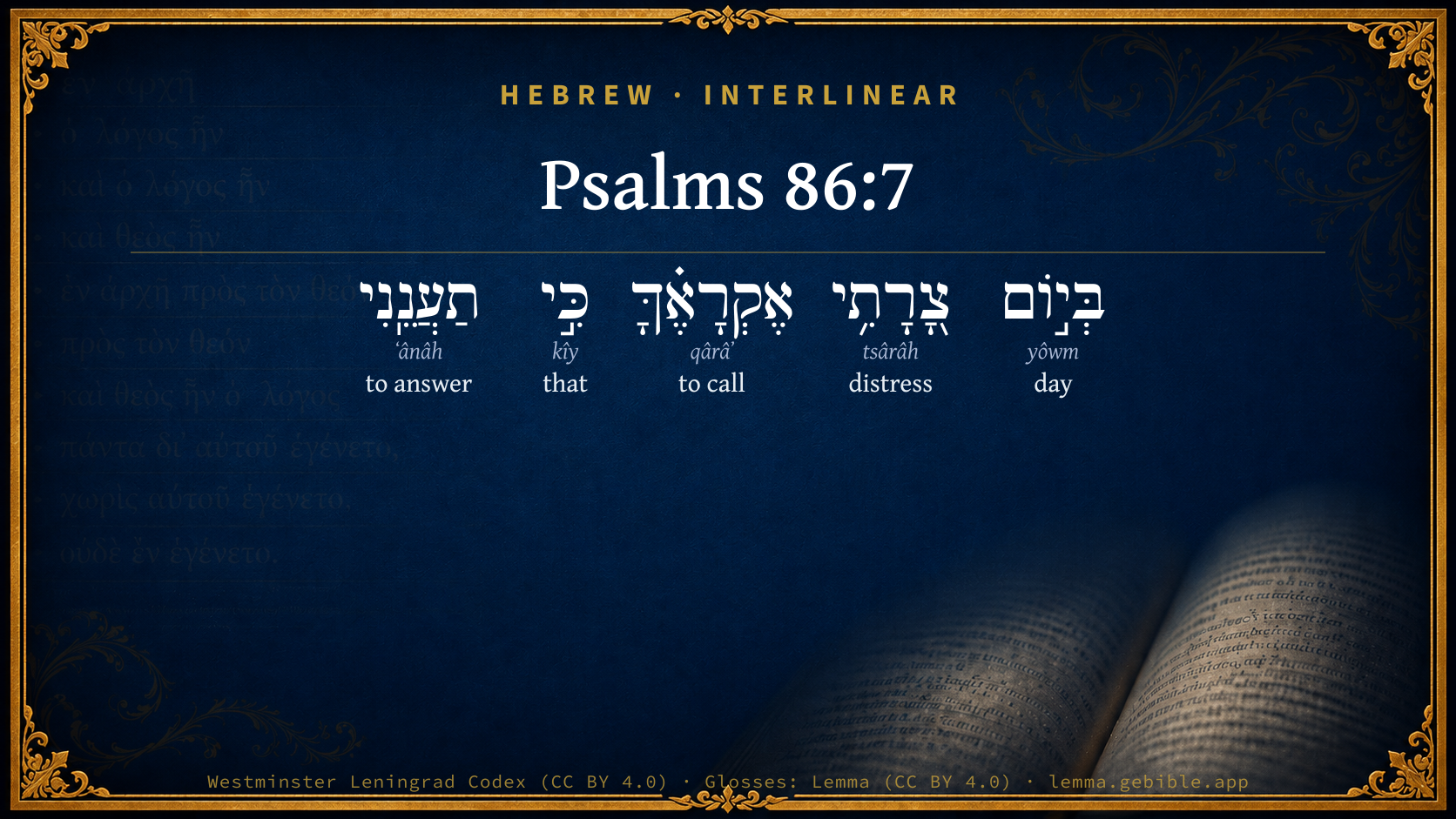
Psalms 86:7

Hebrew (Westminster Leningrad Codex) Psalms 86:7 appears in the Hebrew Old Testament. The text above is from the Westminster Leningrad Codex. Each word links to its Strong’s number, a concise gloss, and parsing drawn from the Open Scriptures Hebrew Bible morphology. Click any word for its full Brown-Driver-Briggs (BDB) entry.
Download image
Cite this verse

Psalms 86:7 (World English Bible). Public Domain. Lemma interlinear Bible study tool, https://lemma.gebible.app/v/psalms/86/7.

Show BibTeX & RIS
BibTeX
RIS
English Translation
In the day of my trouble I will call on you, For you will answer me.
World English Bible · Public Domain
Download a study sheet

One document with this verse’s original text, its word-by-word gloss line, the meaning frame, cross-references with their text, attributed commentary, and full source and license credits — printable, and it pastes into notes with its structure intact.

This verse Autodidact and up

Study sheet (.html) Plain text (.txt)

A passage Seminary Student

Up to 50 verses in one chapter. A passage sheet keeps up to 6 commentary sources and 12 cross-references per verse, in the order this page ranks them, and says so on the sheet whenever that leaves anything out. Ask for a single verse and you get the Autodidact verse sheet above.

Everything on this page stays free to read, with no account — the sheet is a download of what is already on screen, not access to it.

Want to remove ads? Support Godless Engineer
Compare translations 3

The same verse in 3 English versions, stacked beneath the original-language interlinear above. Click any original word for its lexicon entry.

Each is an independent rendering of the whole verse — the interlinear is not word-aligned to these translations.

Highlighted words mark where these versions differ — a whole-verse word diff, not a word-by-word alignment.

  • World English Bible Public Domain
    In the day of my trouble I will call on you, For you will answer me.
  • King James Version Public Domain
    In the day of my trouble I will call upon thee: for thou wilt answer me.
  • unfoldingWord Literal Text CC BY-SA 4.0
    In the day of my trouble I call on you, for you will answer me.

unfoldingWord Literal Text — © unfoldingWord, licensed CC BY-SA 4.0. Word-aligned USFM3 via Door43 (git.door43.org/unfoldingWord/en_ult).

Versions to compare (up to 4)

3 of 4 selected

Show all 18 translations

Every available English version of this verse, each an independent rendering of the whole verse.

  • World English Bible Public Domain
    In the day of my trouble I will call on you, For you will answer me.
  • Berean Standard Bible Public Domain
    In the day of my distress I call on You, because You answer me.
  • Majority Standard Bible Public Domain
    In the day of my distress I call on You, because You answer me.
  • King James Version Public Domain
    In the day of my trouble I will call upon thee: for thou wilt answer me.
  • American Standard Version (1901) Public Domain
    In the day of my trouble I will call upon thee; For thou wilt answer me.
  • Revised Version (1885) Public Domain
    In the day of my trouble I will call upon thee; for thou wilt answer me.
  • Geneva Bible (1599) Public Domain
    In the day of my trouble I will call vpon thee: for thou hearest me.
  • Douay-Rheims (1899) Public Domain
    I have called upon thee in the day of my trouble: because thou hast heard me.
  • Young's Literal Translation Public Domain
    In a day of my distress I call Thee, For Thou dost answer me.
  • Literal Standard Version CC BY-SA 4.0
    In a day of my distress I call You, || For You answer me.
  • Unlocked Literal Bible CC BY-SA 4.0
    In the day of my trouble I call on you, for you will answer me.
  • unfoldingWord Literal Text CC BY-SA 4.0
    In the day of my trouble I call on you, for you will answer me.
  • Darby Bible Public Domain
    In the day of my distress I will call upon thee, for thou wilt answer me.
  • World Messianic Bible Public Domain
    In the day of my trouble I will call on you, for you will answer me.
  • Webster's Bible Public Domain
    In the day of my trouble I will call upon thee: for thou wilt answer me.
  • Free Bible Version CC BY-SA 4.0
    When I'm in trouble I cry out to you because I know you will answer me.
  • Bible in Basic English Public Domain
    In the day of my trouble I send up my cry to you; for you will give me an answer.
  • JPS Tanakh (1917) Public Domain
    In the day of my trouble I call upon Thee; for Thou wilt answer me.

Literal Standard Version (2020), Covenant Press — licensed CC BY-SA 4.0. Text via the HelloAO Bible API (eBible.org). Unlocked Literal Bible (unfoldingWord) — licensed CC BY-SA 4.0. Text via the HelloAO Bible API (eBible.org). unfoldingWord Literal Text — © unfoldingWord, licensed CC BY-SA 4.0. Word-aligned USFM3 via Door43 (git.door43.org/unfoldingWord/en_ult). Free Bible Version, Dr. Jonathan Gallagher — licensed CC BY-SA 4.0. Text via the HelloAO Bible API (eBible.org).

Word by word

More ways to search: Search by grammar → Find every occurrence → Compare this word →

Practice this passage: Drill this verse → Learn its vocabulary →

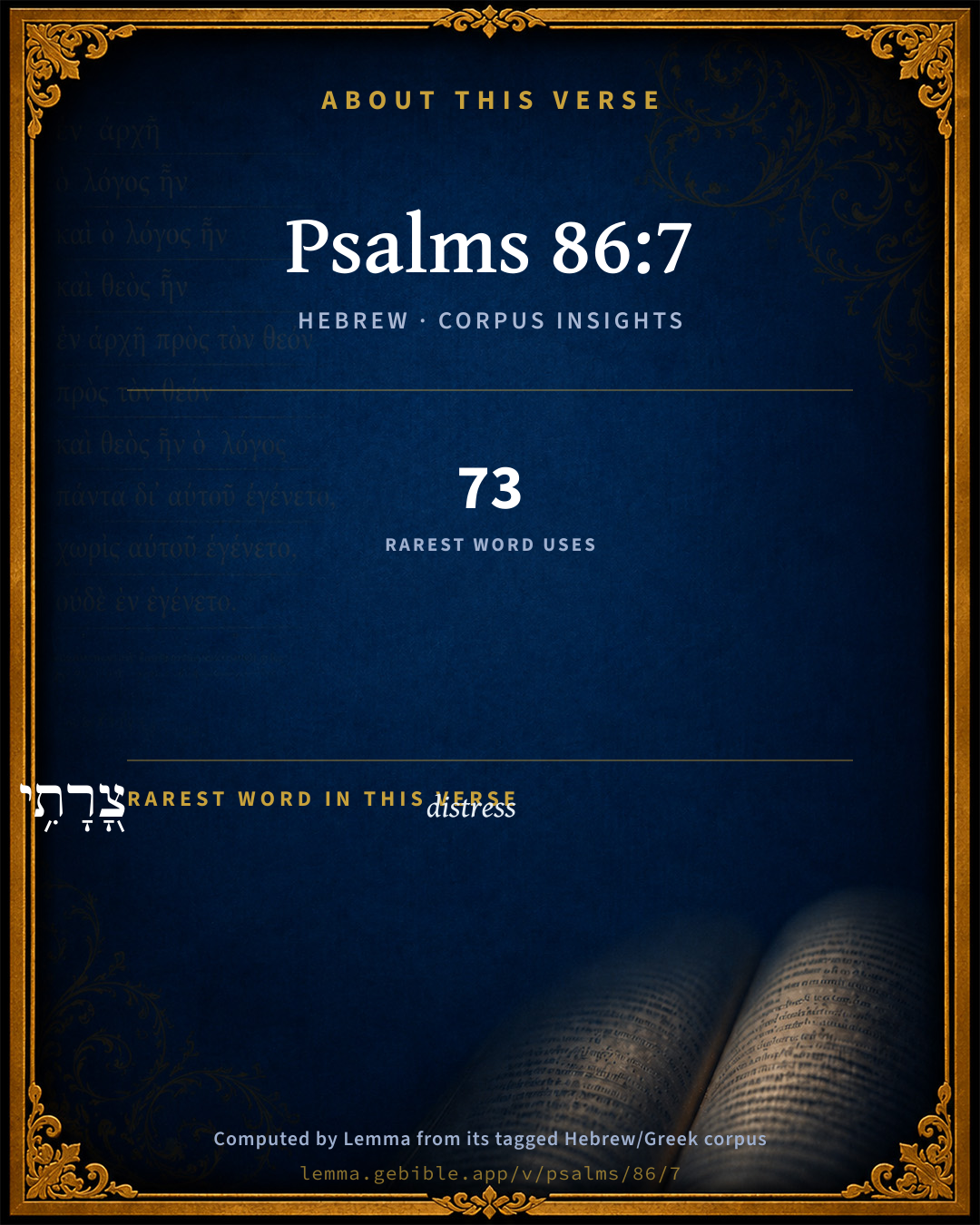
About this verse

These counts appear in no published source. They are computed here, from the morphology-tagged text and Lemma’s own curated glosses. What Lemma adds →

5
words
5
distinct lemmas
Wisdom
section

Grammatical profile

  • 2 verbs
  • 2 nouns
  • 1 conjunction

Verb forms

  • אֶקְרָאֶ֗ךָּ Qal · Imperfect
  • תַעֲנֵֽנִי Qal · Imperfect

Hebrew & Septuagint length

In English translation the verse runs 16 words from the Hebrew and 15 from the Septuagint (LXX English) — closely comparable.

A rough comparison of the two English renderings, which tokenize alike — not a word-level alignment.

Word counts can differ between the Hebrew and the Greek without any difference in meaning — e.g. the Hebrew direct-object marker אֵת has no separate Greek word, and Greek often adds the article ὁ.

Cross-references

14

Topical passages linked to Psalms 86:7 in the Treasury of Scripture Knowledge — connected by theme and wording, ordered by reader-vote popularity; previews shown in the World English Bible.

  • Jonah 2:2 He said, "I called because of my affliction to Yahweh. He answered me. Out of the belly of Sheol I cried. You heard my voice.
  • Psalms 34:4–6 I sought Yahweh, and he answered me, And delivered me from all my fears.
  • Psalms 17:6 I have called on you, for you will answer me, God: Turn your ear to me. Hear my speech.
  • Psalms 50:15 Call on me in the day of trouble. I will deliver you, and you will honor me."
  • Hebrews 5:7 He, in the days of his flesh, having offered up prayers and petitions with strong crying and tears to him who was able to save him from death, and having been heard for his godly fear,
  • Isaiah 26:16 Yahweh, in trouble have they visited you; they poured out a prayer [when] your chastening was on them.
  • Lamentations 3:55–57 I called on your name, Yahweh, out of the lowest dungeon.
  • Psalms 18:6 In my distress I called on Yahweh, And cried to my God. He heard my voice out of his temple, My cry before him came into his ears.
  • Psalms 142:1 I cry with my voice to Yahweh. With my voice, I ask Yahweh for mercy.
  • Psalms 91:15 He will call on me, and I will answer him. I will be with him in trouble. I will deliver him, and honor him.
  • Psalms 77:1–2 My cry goes to God! Indeed, I cry to God for help, And for him to listen to me.
  • Psalms 142:3 When my spirit was overwhelmed within me, You knew my path. In the way in which I walk, They have hidden a snare for me.
  • Psalms 55:16–18 As for me, I will call on God. Yahweh will save me.
  • Luke 22:44 Being in agony he prayed more earnestly. His sweat became like great drops of blood falling down on the ground.

Cross-references courtesy of OpenBible.info (CC BY 4.0).

Hebrew and Greek witnesses Masoretic Hebrew ↔ Greek Septuagint

The same verse in the two great witnesses to the Old Testament, shown verse-for-verse.

You’re reading Greek Psalm 85 (Hebrew Psalm 86). The Septuagint counts the superscription, so verse numbers can differ from the Hebrew — chapter-level alignment, not verse-by-verse. Numbering follows Rahlfs.

These are two independent witnesses, not word-aligned to each other, and the Septuagint is shown in lemma (dictionary) form.

Hebrew Psalms 86:7 Masoretic · Westminster Leningrad Codex

בְּי֣וֹם צָ֭רָתִ֥י אֶקְרָאֶ֗ךָּ כִּ֣י תַעֲנֵֽנִי

In the day of my trouble I will call on you, For you will answer me.

World English Bible · Public Domain

Greek LXX Greek Psalm 85:7 Septuagint · lemma form

ἐν ἡμέρα θλῖψις ἐγώ κράζω πρός σύ ὅτι εἰςἀκούω ἐγώ

In the day of my trouble I cried to you: for you did hear me.

LXX2012 (modern English Septuagint) · Public Domain

Hebrew: Westminster Leningrad Codex (CC BY 4.0). Greek: Septuagint (public domain); English from LXX2012 (modern English Septuagint) (Public Domain). How the Septuagint differs from the Hebrew →

Commentary

Notes on Psalms 86:7 from classic Christian and Jewish commentators (each source and its license shown beneath its notes). The classic Christian expositions comment on the surrounding passage and are grouped to its opening verse, so a note may address several verses; the Jewish commentaries on the Tanakh (Rashi and others) are per-verse, so they appear only where the commentator wrote on this verse.

Lemma curates 59 commentaries, every one of them public domain or Creative Commons licensed, each selected and text-cleaned for this edition rather than reprinted as found. About our sources →

Trapp's Complete Commentary

John Trapp

Psa 86:7 In the day of my trouble I will call upon thee: for thou wilt answer me.

Ver. 7. In the day of my trouble, &c.] God’s petitioners must pray and believe, and believe and pray, quasi in circulo. David had said, Psa 86:5, God is much in mercy to all that call upon him; here he assumeth and concludeth, but I in the day of my trouble will call upon him; therefore he will answer me.

John Trapp, A Commentary or Exposition upon All the Books of the Old and New Testament (1647–1656) — public domain. Text from a community e-Sword module.

The Biblical Illustrator

Joseph S. Exell

Psa_86:7

In the day of my trouble I will call upon Thee: for Thou wilt answer me.

The day of trouble

I. Here is a day that may be expected by us all, Though all men do not walk in the midst of trouble, all must meet with trouble sooner or later. There is no human experience that has not had, or will not have, such a day--personal and relative troubles, bodily and spiritual troubles.

II. Here is a determination that should be formed by us all. I will call upon Thee. This resolution--

1. Agrees with our instinct. In trouble, men involuntarily call on God. This resolution--

2. Agrees with our reason. Who else can really help us? Money profiteth nothing in the day of trouble; and the tenderest, truest friendships are helpless.

III. Here is a hope that may be entertained by us all. For Thou wilt answer me.

1. Thou hast answered others who called on Thee in trouble.

2. Thou hast promised to answer all who call on Thee in trouble. (Homilist.)

The Biblical Illustrator, edited by Joseph S. Exell (c. 1880s–1900s) — public domain. Text from a community e-Sword module.

J. A. Alexander on Psalms

Joseph Addison Alexander

7. (Psa 86:7) In the day of my distress I will invoke thee, for thou wilt answer me. The future includes the present, I do and will invoke thee, call thee to my aid, or call upon thee for assistance. The second clause assigns the reason, namely, his conviction that he shall not call in vain. The implied ground of this conviction is, that he never does and never did call, in the exercise of faith, without being favourably heard or answered.

Joseph Addison Alexander, The Psalms Translated and Explained (1850) — public domain. Text from a community e-Sword module.

Adam Clarke's Commentary

Verse 7. Thou wilt answer me.] Because thou art good, merciful, and ready to forgive; and I call upon thee fervently, and seek thee in thy own way.

Adam Clarke's Commentary on the Bible (1810–1826) — public domain. Text from a community e-Sword/MySword module.

The Cambridge Bible for Schools and Colleges

gen. ed. J. J. S. Perowne

7. From Psa_77:2; Psa_17:6.

The Cambridge Bible for Schools and Colleges (gen. ed. J. J. S. Perowne; Cambridge University Press, 1878–1918) — public domain. Text from a community e-Sword module.

John Gill's Exposition

In the day of my trouble I will call upon thee,.... David had his troubles, both inward and outward, before and after he came to the throne, in private and public life; and every good man has his troubles; and there are some particular times or days of trouble; which trouble arises from different causes; sometimes from themselves, their corruptions, the weakness of their grace, and the poor performance of their duties; sometimes from others; from the persecutions of the men of the world; from the wicked lives of profane sinners, and especially professors of religion, and from the spread of false doctrine; sometimes from Satan and his temptations; and sometimes from the more immediate hand of God in afflictions, and from the hidings of his face: these troubles do not last always; they are but for a day, for a particular time; and such a season is a fit one for prayer, and the Lord invites and encourages his people to call upon him in prayer when this is the case, Psa 50:15. Christ had his times of trouble, in which he called upon his divine Father, Joh 11:33.

for thou wilt answer me; which the idols of the Gentiles could not do; Baal could not answer his priests, Kg1 18:26, this the psalmist concluded, both from the promise of God, Psa 50:15, and from his frequent experience, Psa 138:3, a very encouraging reason or argument this to call on the Lord: Christ was always heard and answered, Joh 11:41.

John Gill's Exposition of the Whole Bible (1746–1763) — public domain (CC PDM 1.0). Text via the HelloAO Bible API.

Albert Barnes' Notes on the Bible

In the day of my trouble I will call upon thee - That is, I do it now; I have done it; I will do it. The language implies a habit, or a steady purpose of mind, that in all times of trouble he would make God his refuge. It was this fixed purpose - this regular habit - which was now the ground of his confidence. A man who always makes God his refuge, who has no other ground of reliance, may feel assured that God will interpose and save him.

For thou wilt answer me - This also implies a fixed and steady assurance of mind, applicable not only to this case, but to all similar cases. He had firm confidence in God at all times; an unwavering belief that God is a hearer of prayer. This is a just foundation of hope when we approach God. Compare Jam 1:6-7.

Albert Barnes' Notes on the Bible (1834–1885) — public domain. Text from a community e-Sword/MySword module.

Matthew Poole's English Annotations

Whereof I have assurance both from the benignity of thy nature, and from the truth and certainty of thy promises, and from my own and others’ experiences in former times.

Matthew Poole's English Annotations on the Holy Bible (1683–1685) — public domain. Text from a community e-Sword/MySword module.

The Treasury of David

Charles H. Spurgeon

Ver. 7. In the day of my trouble I will call upon thee: for thou wilt answer me. A pious resolve backed by a judicious reason. It is useless to cry to those who cannot or will not hear; once convince men that prayer has no effect upon God, and they will have no more of it. In these busy days and especially in troublous times, men cannot afford to waste time in entreaties which must be unavailing. Our experience confirms us in the belief that Jehovah the living God really does aid those who call upon him, and therefore we pray and mean to pray, not because we are so fascinated by prayer that for its own sake we would continue in it if it proved to be mere folly and superstition, as vain philosophers assert; but because we really, indeed, and of a truth, find it to be a practical and effectual means of obtaining help from God in the hour of need. There can be no reason for praying if there be no expectation of the Lord's answering. Who would make a conscience of pleading with the winds, or find a solace in supplicating the waves? The mercy seat is a mockery if there be no hearing nor answering. David, as the following verses show, believed the Lord to be a living and potent God, and indeed to be "God alone", and it was on that account that he resolved in every hour of trouble to call upon him.

Ver. 7.

1. Help needed.

2. Help sought.

3. Help found. G.R.

Ver. 7.

1. A time to be expected"day of my trouble".

2. A resolve to be practised"I will call upon thee."

3. A result to be experienced"thou wilt answer me".

Ver. 7. Prayer is the design of trouble, the evidence that it is sanctified, its solace, and the medium of deliverance from it. William Jay.

Psalms 86:8*

Charles H. Spurgeon's The Treasury of David (1869–1885) — public domain. Psalms only. Text from a community e-Sword/MySword module.

The Pulpit Commentary

In the day of my trouble I will call upon thee (comp. vers. 1 and 14). The nature of the trouble is not distinctly stated; but it appears to have been caused by domestic rather than foreign enemies. For thou wilt answer me (comp. ver. 5).

The Pulpit Commentary (1880–1919), ed. H.D.M. Spence-Jones & Joseph S. Exell — public domain. Text from a community e-Sword module.

Lesson kit

Teaching starters — assembled from the data on this page, not authored interpretation. Every prompt links to the verse data it draws on. Edit before teaching.

Psalms, in the Wisdom, opens this verse with 5 words (5 distinct Hebrew lemmas). Its most distinctive word is tsârâh (“distress”). A historical commentator’s framing appears above. Read the whole chapter for the surrounding context.

Discussion questions

  1. What does “distress” (tsârâh) contribute to the verse as a whole?
  2. How does Jonah 2:2, which shares this passage’s theme, read alongside this verse?
  3. These translations render this verse differently; the difference is in the English rendering, not the original. What questions does that raise?
  4. «אֶקְרָאֶ֗ךָּ» is a Qal Imperfect verb. How does that grammatical form shape the action described?
  5. Compare how Trapp's Complete Commentary and The Biblical Illustrator read this verse. Where do they agree or differ?

Things to notice

Reading settings

Reading text

Shown beneath each verse's original-language words.

Old Testament
Old Testament edition

Read the OT as the Masoretic Hebrew (MT) or the Greek Septuagint (LXX).

English shown for the Greek Septuagint (in the Hebrew ↔ Greek comparison).

Comparing translations? Open the Compare panel on any verse page to stack up to four side by side.