
Proverbs 25:19

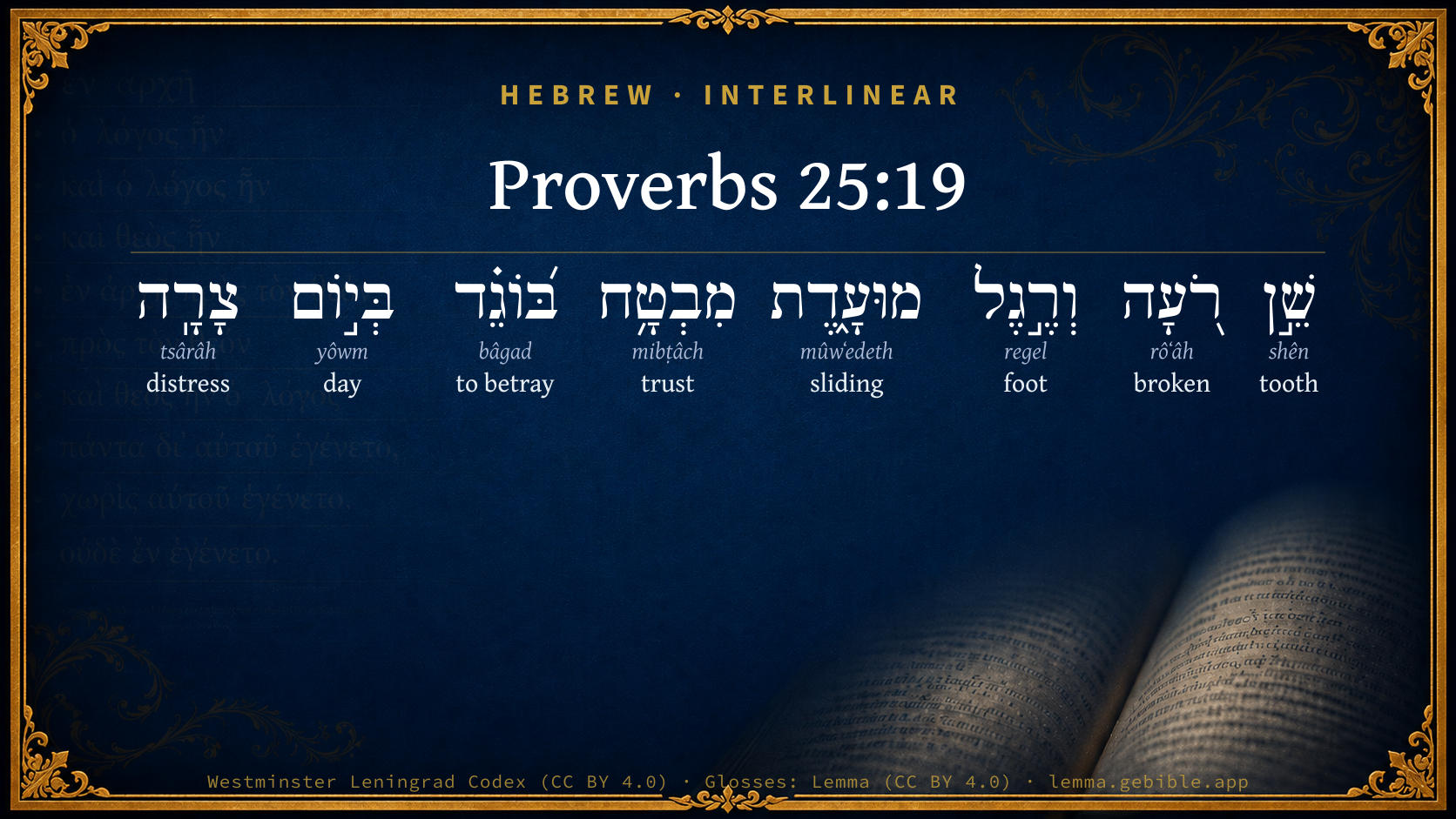
Hebrew (Westminster Leningrad Codex) Proverbs 25:19 appears in the Hebrew Old Testament. The text above is from the Westminster Leningrad Codex. Each word links to its Strong’s number, a concise gloss, and parsing drawn from the Open Scriptures Hebrew Bible morphology. Click any word for its full Brown-Driver-Briggs (BDB) entry.
Download image
Cite this verse

Proverbs 25:19 (World English Bible). Public Domain. Lemma interlinear Bible study tool, https://lemma.gebible.app/v/proverbs/25/19.

Show BibTeX & RIS
BibTeX
RIS
English Translation
Confidence in someone unfaithful in time of trouble Is like a bad tooth, or a lame foot.
World English Bible · Public Domain
Highlights
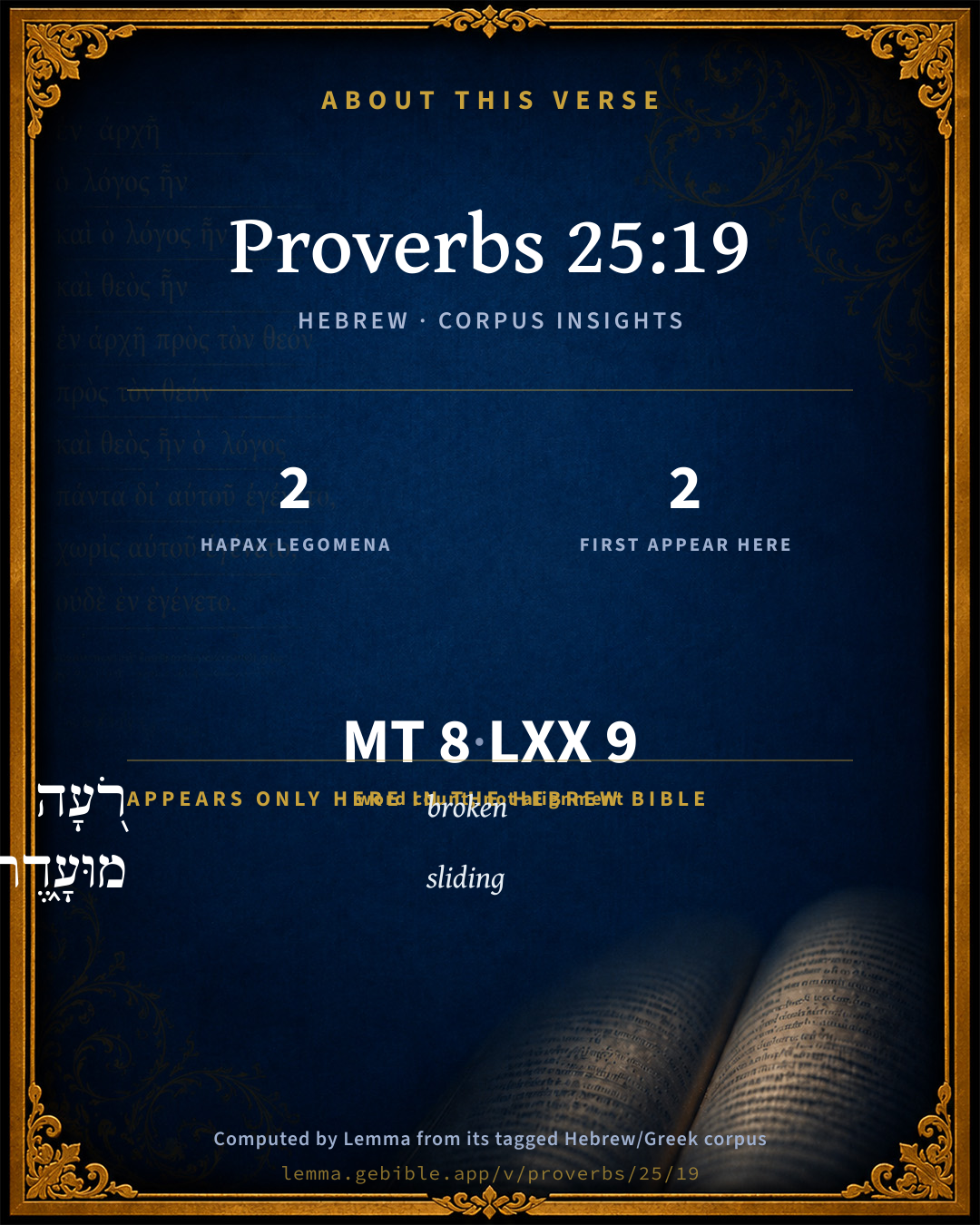
  • 2 hapax legomena — only here in the Hebrew Bible
  • 2 first appearances in the Hebrew Bible
Full analysis ↓
Download a study sheet

One document with this verse’s original text, its word-by-word gloss line, the meaning frame, cross-references with their text, attributed commentary, and full source and license credits — printable, and it pastes into notes with its structure intact.

This verse Autodidact and up

Study sheet (.html) Plain text (.txt)

A passage Seminary Student

Up to 50 verses in one chapter. A passage sheet keeps up to 6 commentary sources and 12 cross-references per verse, in the order this page ranks them, and says so on the sheet whenever that leaves anything out. Ask for a single verse and you get the Autodidact verse sheet above.

Everything on this page stays free to read, with no account — the sheet is a download of what is already on screen, not access to it.

Want to remove ads? Support Godless Engineer
Compare translations 3

The same verse in 3 English versions, stacked beneath the original-language interlinear above. Click any original word for its lexicon entry.

Each is an independent rendering of the whole verse — the interlinear is not word-aligned to these translations.

Highlighted words mark where these versions differ — a whole-verse word diff, not a word-by-word alignment.

  • World English Bible Public Domain
    Confidence in someone unfaithful in time of trouble Is like a bad tooth, or a lame foot.
  • King James Version Public Domain
    Confidence in an unfaithful man in time of trouble is like a broken tooth, and a foot out of joint.
  • unfoldingWord Literal Text CC BY-SA 4.0
    A broken tooth and a shaky foot confidence one who acts treacherously in the day of distress.

unfoldingWord Literal Text — © unfoldingWord, licensed CC BY-SA 4.0. Word-aligned USFM3 via Door43 (git.door43.org/unfoldingWord/en_ult).

Versions to compare (up to 4)

3 of 4 selected

Show all 18 translations

Every available English version of this verse, each an independent rendering of the whole verse.

  • World English Bible Public Domain
    Confidence in someone unfaithful in time of trouble Is like a bad tooth, or a lame foot.
  • Berean Standard Bible Public Domain
    Like a broken tooth or a foot out of joint is confidence in a faithless man in time of trouble.
  • Majority Standard Bible Public Domain
    Like a broken tooth or a foot out of joint is confidence in a faithless man in time of trouble.
  • King James Version Public Domain
    Confidence in an unfaithful man in time of trouble is like a broken tooth, and a foot out of joint.
  • American Standard Version (1901) Public Domain
    Confidence in an unfaithful man in time of trouble Is `like' a broken tooth, and a foot out of joint.
  • Revised Version (1885) Public Domain
    Confidence in an unfaithful man in time of trouble is like a broken tooth, and a foot out of joint.
  • Geneva Bible (1599) Public Domain
    Confidence in an vnfaythfull man in time of trouble, is like a broken tooth and a sliding foote.
  • Douay-Rheims (1899) Public Domain
    To trust to an unfaithful man in the time of trouble, is like a rotten tooth, and weary foot,
  • Young's Literal Translation Public Domain
    A bad tooth, and a tottering foot, `Is' the confidence of the treacherous in a day of adversity.
  • Literal Standard Version CC BY-SA 4.0
    A bad tooth, and a tottering foot, || [Is] the confidence of the treacherous in a day of adversity.
  • Unlocked Literal Bible CC BY-SA 4.0
    An unfaithful man in whom you trust in a time of trouble is like a bad tooth or a foot that slips.
  • unfoldingWord Literal Text CC BY-SA 4.0
    A broken tooth and a shaky foot confidence one who acts treacherously in the day of distress.
  • Darby Bible Public Domain
    A broken tooth, and a tottering foot, is confidence in an unfaithful [man] in the day of trouble.
  • World Messianic Bible Public Domain
    Confidence in someone unfaithful in time of trouble is like a bad tooth or a lame foot.
  • Webster's Bible Public Domain
    Confidence in an unfaithful man in time of trouble is like a broken tooth, and a foot out of joint.
  • Free Bible Version CC BY-SA 4.0
    Trusting in unreliable people in times of trouble is like eating with a broken tooth or walking on a bad foot.
  • Bible in Basic English Public Domain
    Putting one's faith in a false man in time of trouble is like a broken tooth and a shaking foot.
  • JPS Tanakh (1917) Public Domain
    Confidence in an unfaithful man in time of trouble is like a broken tooth, and a foot out of joint.

Literal Standard Version (2020), Covenant Press — licensed CC BY-SA 4.0. Text via the HelloAO Bible API (eBible.org). Unlocked Literal Bible (unfoldingWord) — licensed CC BY-SA 4.0. Text via the HelloAO Bible API (eBible.org). unfoldingWord Literal Text — © unfoldingWord, licensed CC BY-SA 4.0. Word-aligned USFM3 via Door43 (git.door43.org/unfoldingWord/en_ult). Free Bible Version, Dr. Jonathan Gallagher — licensed CC BY-SA 4.0. Text via the HelloAO Bible API (eBible.org).

Word by word

More ways to search: Search by grammar → Find every occurrence → Compare this word →

Practice this passage: Drill this verse → Learn its vocabulary →

About this verse

These counts appear in no published source. They are computed here, from the morphology-tagged text and Lemma’s own curated glosses. What Lemma adds →

8
words
8
distinct lemmas
Wisdom
section

Notable vocabulary

2 hapax legomena — words that appear only here in the entire Hebrew Bible:

  • רֹ֭עָה broken H7465
  • מוּעָ֑דֶת sliding H4154

First appearance in Scripture

These words make their first canonical appearance in the Hebrew Bible here:

  • רֹ֭עָה broken H7465
  • מוּעָ֑דֶת sliding H4154

Shared distinctive vocabulary

מִבְטָ֥ח trust H4009 occurs in 15 verses of the Hebrew Bible. Also found in:

Grammatical profile

  • 3 verbs
  • 5 nouns

Verb forms

  • רֹ֭עָה Qal · Participle Active
  • מוּעָ֑דֶת Qal Passive · Participle Passive
  • בּ֝וֹגֵ֗ד Qal · Participle Active

Hebrew & Septuagint length

In English translation the verse runs 17 words from the Hebrew and 17 from the Septuagint (LXX English) — the same length.

A rough comparison of the two English renderings, which tokenize alike — not a word-level alignment.

Word counts can differ between the Hebrew and the Greek without any difference in meaning — e.g. the Hebrew direct-object marker אֵת has no separate Greek word, and Greek often adds the article ὁ.

In the original languages it is 8 Hebrew tokens and 9 Greek tokens — but the two are counted differently (Hebrew bundles its prefixes and suffixes into one token; the Greek is in lemma form), so that isn’t a like-for-like length.

Cross-references

5

Topical passages linked to Proverbs 25:19 in the Treasury of Scripture Knowledge — connected by theme and wording, ordered by reader-vote popularity; previews shown in the World English Bible.

  • Isaiah 36:6 Behold, you trust on the staff of this bruised reed, even on Egypt, whereon if a man lean, it will go into his hand, and pierce it: so is Pharaoh king of Egypt to all who trust on him.
  • Ezekiel 29:6–7 All the inhabitants of Egypt shall know that I am Yahweh, because they have been a staff of reed to the house of Israel.
  • Job 6:14–20 "To him who is ready to faint, kindness should be shown from his friend; Even to him who forsakes the fear of the Almighty.
  • 2 Chronicles 28:20–21 Tilgath Pilneser king of Assyria came to him, and distressed him, but didn't strengthen him.
  • 2 Timothy 4:16 At my first defense, no one came to help me, but all left me. May it not be held against them.

Cross-references courtesy of OpenBible.info (CC BY 4.0).

Hebrew and Greek witnesses Masoretic Hebrew ↔ Greek Septuagint

The same verse in the two great witnesses to the Old Testament, shown verse-for-verse.

These are two independent witnesses, not word-aligned to each other, and the Septuagint is shown in lemma (dictionary) form.

Hebrew Proverbs 25:19 Masoretic · Westminster Leningrad Codex

שֵׁ֣ן רֹ֭עָה וְרֶ֣גֶל מוּעָ֑דֶת מִבְטָ֥ח בּ֝וֹגֵ֗ד בְּי֣וֹם צָרָֽה

Confidence in someone unfaithful in time of trouble Is like a bad tooth, or a lame foot.

World English Bible · Public Domain

Greek LXX Proverbs 25:19 Septuagint · lemma form

ὀδούς κακός καί πούς παράνομος ὄλλυμι ἐν ἡμέρα κακός

The way of the wicked and the foot of the transgressor shall perish in an evil day.

LXX2012 (modern English Septuagint) · Public Domain

On this verse, The Pulpit Commentary discusses the Septuagint’s reading. Read the note in Commentary ↓

Hebrew: Westminster Leningrad Codex (CC BY 4.0). Greek: Septuagint (public domain); English from LXX2012 (modern English Septuagint) (Public Domain). How the Septuagint differs from the Hebrew →

Commentary

Notes on Proverbs 25:19 from classic Christian and Jewish commentators (each source and its license shown beneath its notes). The classic Christian expositions comment on the surrounding passage and are grouped to its opening verse, so a note may address several verses; the Jewish commentaries on the Tanakh (Rashi and others) are per-verse, so they appear only where the commentator wrote on this verse.

Lemma curates 59 commentaries, every one of them public domain or Creative Commons licensed, each selected and text-cleaned for this edition rather than reprinted as found. About our sources →

Trapp's Complete Commentary

John Trapp

Pro 25:19 Confidence in an unfaithful man in time of trouble [is like] a broken tooth, and a foot out of joint.

Ver. 19. Confidence in an unfaithful man, &c.] In a prevaricator, a covenant breaker, a perfidious person, such as Ahithophel was to David; Job’s miserable comforters to him - he compares them to the brooks of Tema, Job 6:16-19, in a moisture they swelled, in a drought they failed; Egypt to Israel, "a staff or broken reed, whereon if a man lean, it will go into his hand and pierce it"; {Isa 36:6} the Roman senate to Julius Caesar, whom they killed in the council chamber with twenty-three wounds, and this was done a pluribus amicis quam inimicis quorum non expleverat spes inexplebiles saith Seneca, {a} by most of his pretended friends whose unreasonable hopes he had not satisfied. How good is it therefore to try before we trust: yea, to trust none that are not true to God! David dared not repose upon Saul’s fair promises, whom he knew to be moody and slippery. The French say in their proverb, When the Spaniard comes to parle of peace, then double bolt the door. The Hollanders make no conditions with the Spaniard, whom they know to hold that Machiavellian heresy - Fides tam diu servanda est quamdiu expediat - but such as are made at sea and sealed with great ordnance. Calvin and other Protestant divines were called to the Council of Trent, but dared not venture thither, quia me vestigia terrent, as the fox in the fable said: they had not forgot how John Huss, and Jerome of Prague sped at the Council of Constance, although they had the emperor’s safe conduct. They knew that Turks and Papists concur in this, as they do in many other tenets, That there is no faith to be kept with dogs - that is, with Christians, as Turks understand it, with heretics, as Papists.

{a} Seneca, De Ira, lib. iii.

John Trapp, A Commentary or Exposition upon All the Books of the Old and New Testament (1647–1656) — public domain. Text from a community e-Sword module.

The Biblical Illustrator

Joseph S. Exell

Pro_25:19

Confidence in an unfaithful man in time of trouble is like a broken tooth, and a foot out of joint.

Man trusting in man

This is sometimes a great evil. To trust in man and disregard God, or to repose in man the confidence that rightly belongs to God alone, is sinful and ruinous. But in some respects it is natural and right to trust our fellow-men. We are social beings. There can be no friendship without trust. It is right to trust our friends--

1. For sympathy in joy or sorrow.

2. For help in time of need.

3. For honourable fidelity in all confidences.

I. The test of man as an object of trust. The time of trouble tests the faithfulness of those in whom we confide. Prosperity brings friends; adversity tests them. Three kinds of trouble test man as an object of trust--

1. Trouble in our circumstances, or loss and poverty.

2. Trouble in our reputation, or misrepresentation and slander.

3. Trouble in our character, or sin. For a truly Christian man may fall into grievous sin.

II. The failure of man as an object of trust.

1. The unfaithful man in time of trial fails those who trust him.

2. The failure of the unfaithful man in time of trial is painful to those who trust him. The attempt to use the broken tooth or dislocated joint causes suffering. Some of the keenest anguish of human souls is caused by the failure of those in whom they trusted.

Learn--

(1) To be faithful to every trust reposed in us.

(2) To be careful in whom we repose confidence.

(3) To prize those whose trustworthiness we have proved.

(4) To place our supreme trust in God. (William Jones.)

The Biblical Illustrator, edited by Joseph S. Exell (c. 1880s–1900s) — public domain. Text from a community e-Sword module.

Joseph Benson's Commentary

Pro 25:19. Confidence in an unfaithful man, &c. — “As a broken tooth, or leg out of joint, not only fails a man when he comes to use them, but likewise puts him into pain; so doth a faithless person serve them that depend upon him, when they have the greatest need of his help; and such also is the confidence that a faithless person himself places in riches, or craft, or great friends, &c, which some time or other will disappoint him to his great grief, when he expects the most from them.” — Bishop Patrick.

Joseph Benson's Commentary on the Old and New Testaments (1811–1818) — public domain. Text from a community e-Sword module.

The Preacher's Complete Homiletical Commentary

Joseph S. Exell (gen. ed.)

CRITICAL NOTES.—

Pro_25:19. Foot out of joint. Rather “An unsteady foot.”

Pro_25:20. Nitre. “Not the substance we now understand by nitre—i.e., nitrate of potassa (saltpetre), but the natron or native carbonate of soda of modern chemistry.” (Smith’s Dictionary.) The combination of the acid and alkali would, of course, produce effervescence.

MAIN HOMILETICS OF Pro_25:19-20

MISPLACED CONFIDENCE AND UNSEASONABLE SONGS

The day of adversity is, as we saw on chap. Pro_24:10, a testing time for the man who is the subject of the calamity, and it is also a season in which he tests the worth of those who have called themselves his friends in the time of his prosperity. These verses deal with two varieties among many who intensify his affliction and deepen his grief, instead of bringing him help and comfort. There is—

I. The faithless friend. This phrase is a contradictory one, but it is used for want of a better. The word friend, in its highest and best sense, denotes one who is worthy of trust and who never fails in the hour of trial. But there are many who assume the name who are unworthy of it, and whose failure when they are most needed is one of the most bitter drops in the cup of calamity. If the cable breaks in a calm sea the vessel and the crew may escape serious injury; but if it gives way amid storm and tempest, the consequences are most disastrous. It is hard to find a professed friend failing us when we are sailing in calm waters, but it may then be borne without entirely crushing the spirit. But when such a discovery is first made in the day of trouble, it is enough to break the stoutest heart.

II. The undiscerning friend. There are many real friends who lack the ability to discern how best to help the sorrowful and heavy hearted. They sing a song with the intention of giving cheer when tears, or at least silence, would be far more acceptable to the wounded spirit. Songs of gladness, such as are doubtless here intended, fit the spirit when it is walking in the sunlight, but they aggravate the suffering of those who are in darkness of soul. He who aspires to the name of friend must learn to rejoice with those who rejoice and to weep with those that weep.

OUTLINES AND SUGGESTIVE COMMENTS

Pro_25:19. The greatest disaster, in proportion to the number of men engaged, that befel our arms in the Eastern insurrection, was the direct result of confidence in an unfaithful man. At Arrah-on-the-Ganges three or four hundred soldiers were sent to attack a body of the rebels, and relieve some British residents who were in danger there. A native was employed to ascertain the position of the enemy. In consequence of his report, the men left the river and made a night march into the interior. The messenger was false. The little army fell into an ambush prepared for them in the jungle. Two-thirds of their number were shot down in the dark by unseen foes. The remnant escaped to their ship when the day dawned. As they lay in that fatal valley getting their wounds in the dark, and helplessly wishing for the day, how exquisitely bitter must have been the reflection that a too ready trust in a faithless man had wrought them all this woe.—Arnot.

The God of nature hath placed the teeth in two jaws, that the one may be helpful to the other; and he hath supported man with two feet, that the one may be a succour to the other. From hence, to teach us the help and support which one man ought to yield to another. It is by means of this mutual support in the feet that we pass over the blocks that lie in our way; for while the one foot is lifted up to step over them, the other bears up the body. It is the mutual help of the jaws, and by their meeting together, that we break hard things and make them fit nourishment for us. In like manner, therefore, when a block lies in the way of anyone, another should be ready to support him until he get over it. When a hard distress lieth upon anyone, another should be ready to help him for the better breaking through it. But in this point too many are like a broken tooth, and he that looketh to meet with them for help in his distress, findeth them not to answer his expectation … and too many are like a foot out of joint, and he that thinketh to rest upon them in time of need, is sure to fall by them.—Jermin.

Pro_25:20. He that taketh away a garment from another may think to ease his burden, but it being done in cold weather, it addeth to his coldness; he that putteth vinegar upon nitre may think only to break the hardness of it, but he dissolveth it. In like manner he that singeth songs to a heavy heart may think to ease the burden of sorrow, may think to break the hardness of grief, but such is the force of the sad contraposition, such is the power of the contrariety between singing and sorrow of heart, that the ease of one’s heart being able to sing, increaseth the weight of the other’s trouble that he cannot do so.—Jermin.

The Preacher's Complete Homiletical Commentary (gen. ed. Joseph S. Exell; Funk & Wagnalls, c. 1892) — public domain (pre-1929). A full-Bible homiletical/sermon-outline anthology covering 65 of 66 books (2 John is absent from the source module). Text from a community e-Sword module.

Matthew Henry's Commentary

1. The confidence of an unfaithful man (so some read it) will be like a broken tooth; his policy, his power, his interest, all that which he trusted in to support him in his wickedness, will fail him in time of trouble, Psa 52:7. 2. Confidence in an unfaithful man (so we read it), in a man whom we thought trusty and therefore depended on, but who proves otherwise; it proves not only unserviceable, but painful and vexatious, like a broken tooth, or a foot out of joint, which, when we put any stress upon it, not only fails us, but makes us feel from it, especially in time of trouble, when we most expect help from it; it is like a broken reed, Isa 36:6. Confidence in a faithful God, in time of trouble, will not prove thus; on him we may rest and in him dwell at ease.

Matthew Henry's Commentary on the Whole Bible (1708–1710) — public domain (CC PDM 1.0). Text via the HelloAO Bible API.

Jamieson, Fausset & Brown

Robert Jamieson, A. R. Fausset & David Brown

Treachery annoys as well as deceives.

Jamieson, Fausset & Brown — Commentary Critical and Explanatory on the Whole Bible (1871) — public domain (CC PDM 1.0). Text via the HelloAO Bible API.

John Gill's Exposition

Confidence in an unfaithful man in time of trouble,.... It is not good to put confidence in any man, not in princes, nor in the best of men; much less in an unfaithful, prevaricating, and treacherous man; and especially in a time of distress and trouble, depending on his help and assistance, which is leaning on a broken reed, and trusting to a broken staff. Or, "the confidence of an unfaithful man in time of trouble" (o); that which he puts confidence in; who trusts in his riches, or in his righteousness, or in his own heart, all which are vain and deceitful:

is like a broken tooth, and a foot out of joint; which are so far from being of any use, the one in eating food, and the other in walking, that they are both an hindrance to those actions, and cause pain and uneasiness: or, "a bad tooth", so the Targum and Syriac version; a rotten one.

(o) "fiducia praevaricatoris", Pagninus, Montanus, Mercerus, Gejerus; "fiducia perfidi", Cocceius, Michaelis.

John Gill's Exposition of the Whole Bible (1746–1763) — public domain (CC PDM 1.0). Text via the HelloAO Bible API.

Albert Barnes' Notes on the Bible

Stress is to be laid on the uselessness of the “broken tooth” and the “foot out of joint,” or tottering, rather than on the pain connected with them. The King James Version loses the emphasis and point of the Hebrew by inverting the original order, which is “a broken ... joint is confidence” etc.

Albert Barnes' Notes on the Bible (1834–1885) — public domain. Text from a community e-Sword/MySword module.

Matthew Poole's English Annotations

It is not only deceitful, but hurtful, as a broken tooth though it make show of helping, yet is not only unhelpful to a man for chewing his meat, but also troublesome and painful; and as a foot out of joint doth not help, but hinder and pain, him that attempts to walk upon it.

Matthew Poole's English Annotations on the Holy Bible (1683–1685) — public domain. Text from a community e-Sword/MySword module.

Whedon's Commentary on the Bible

Daniel D. Whedon

19. An unfaithful man — A treacherous one. “A treacherous man will not only fail you in distress, but will annoy you like a broken tooth or a sprained foot.” — Stuart. “An unsteady foot.” — Conant. “Sliding fote,” (foot.) — Geneva Bible.

Daniel D. Whedon (gen. ed.), Commentary on the Old and New Testaments (1874–1909) — public domain. Text from a community e-Sword module.

The Pulpit Commentary

Hebrew (see on Ver. 11), A broken tooth, and a foot out of joint confidence in an unfaithful man in time of trouble. A faithless man is as little to be relied on in a time of need as a loose or broken tooth, and a foot unsteady or actually dislocated. You cannot bite on the one, you cannot walk on the other; so the perfidious man fails you when most wanted. Septuagint, "The way odov , Vatican, is probably a clerical error for odouv , al . of the wicked, and the foot of the transgressor, shall perish in an evil day." A Bengal maxim runs, "A loose tooth and a feeble friend are equally bad" (Lane).

The Pulpit Commentary (1880–1919), ed. H.D.M. Spence-Jones & Joseph S. Exell — public domain. Text from a community e-Sword module.

Bridges on Proverbs

Charles Bridges

The broken tooth and disjointed foot are not only useless for their respective offices, but a source of pain and uneasiness. So is an unfaithful man in time of trouble. "A friend loveth at all times, and a brother is born to adversity." (Pro 17:17 .) But many have the name only. Very friendly are they, when they are not needed; when we are dispensing, not receiving, our gifts; when there is no cost to pay. But in the time of trouble, "a faithful man who can find?" (Pro 20:6 .) Keenly did Job feel this to be a sinking confidence in his time of trouble. (Job 6:14-17 .) David was sorely tried by this affliction (Psa 55:12-14 ), even at the very last stage of life. (1Ki 1:19, 1Ki 1:25 .) The brethren came out to meet the Apostle at Appii Forum. Yet he records a time, when their support would have been specially cheering — "At my first answer no man stood by me, but all men forsook me."†1 Need we wonder at this appointed cross? His Master had endured it before him; and "it is enough for the servant, that he be as his lord."†2

The world abounds with instances of this disappointment. Micah’s Levite ungratefully repaid the trust reposed in him.†3 Mephibosheth’s trust in Ziba;†4 — and Israel’s dependence upon an arm of flesh; shewed the broken reed, not the staff of support.†5 Truly, when has the world ever answered its fair promises? When has it ever given a faithful confidence in time of trouble? When has it failed to make the soul "ashamed of its hope"? A merciful correction to the child of God, when he turns aside from his true confidence to vain dependences.

But whoever be unfaithful, God is true. Who ever trusted in him, and was confounded? Who has ever built upon his sure foundation, and not witnessed its unshaken security? (Isa 28:16 .) Though he has pledged himself never to forsake his servants (Heb 13:5 ), yet specially — "I will be with him in trouble — a very present help in time of trouble."†6

Footnotes:

†1 Act 28:15, with 2Ti 4:16 .

†2 Mat 26:56, with Mat 10:24-25 .

†3 Jdg 17:7-12; Jdg 18:20-24 .

†4 2Sa 16:1-4 ; 2Sa 19:24-28 .

†5 See also Assyria, 2Ch 28:20-21 . Hos 5:13 . Egypt, Isa 30:1-3 ; Isa 31:1-3 . Jer 36:5-7 . Eze 29:6-7 .

†6 Psa 91:15; Psa 46:1 . Jer 17:5-8 .

Charles Bridges, An Exposition of the Book of Proverbs (1846) — public domain. Text from a community e-Sword module.

Rashi

Rabbi Shlomo Yitzchaki (Rashi)

a broken tooth Heb. רעה, broken.

unsteady Heb. מועדת, as in (Ps. 18:37): “and my ankles have not slipped (מעדו).”

trust in a traitor He disappoints him on the day of his trouble like a broken tooth and an unsteady [foot].

Rashi on the Tanakh — English translations: “The Judaica Press complete Tanach with Rashi, translated by A. J. Rosenberg” (CC BY 4.0); “Pentateuch with Rashi's commentary by M. Rosenbaum and A.M. Silbermann, 1929-1934” (public domain); “The Metsudah Tanach series, Lakewood, N.J” (CC BY 4.0); and “The Book of Joshua, Metsudah Publications, 1997” (CC BY 4.0). Text via Sefaria.

Lesson kit

Teaching starters — assembled from the data on this page, not authored interpretation. Every prompt links to the verse data it draws on. Edit before teaching.

Proverbs, in the Wisdom, opens this verse with 8 words (8 distinct Hebrew lemmas). Its most distinctive word is rôʻâh (“broken”). A historical commentator’s framing appears above. Read the whole chapter for the surrounding context.

Discussion questions

  1. What does “broken” (rôʻâh) contribute to the verse as a whole?
  2. This verse holds 2 words here found nowhere else in the Hebrew Bible. What might the rare words draw attention to?
  3. 2 words here appear for the first time in Scripture. What is being introduced at this debut?
  4. Job 8:14 shares the word «trust» with this verse. How do the two illuminate each other?
  5. The translations on this page render this verse differently — a whole-verse word diff, not a word-by-word alignment. What might account for the different wordings?
  6. The verb «רֹ֭עָה» is Qal Participle Active. How does its form color the action?
  7. Reading how Trapp's Complete Commentary and The Biblical Illustrator read this verse, where do the two commentators agree and where do they part?

Things to notice

Reading settings

Reading text

Shown beneath each verse's original-language words.

Old Testament
Old Testament edition

Read the OT as the Masoretic Hebrew (MT) or the Greek Septuagint (LXX).

English shown for the Greek Septuagint (in the Hebrew ↔ Greek comparison).

Comparing translations? Open the Compare panel on any verse page to stack up to four side by side.