Proverbs 1:27

Hebrew (Westminster Leningrad Codex) Proverbs 1:27 appears in the Hebrew Old Testament. The text above is from the Westminster Leningrad Codex. Each word links to its Strong’s number, a concise gloss, and parsing drawn from the Open Scriptures Hebrew Bible morphology. Click any word for its full Brown-Driver-Briggs (BDB) entry.
Download image
Cite this verse

Proverbs 1:27 (World English Bible). Public Domain. Lemma interlinear Bible study tool, https://lemma.gebible.app/v/proverbs/1/27.

Show BibTeX & RIS
BibTeX
RIS
English Translation
When calamity overtakes you like a storm, When your disaster comes on like a whirlwind; When distress and anguish come on you.
World English Bible · Public Domain
Highlights Full analysis ↓
Download a study sheet

One document with this verse’s original text, its word-by-word gloss line, the meaning frame, cross-references with their text, attributed commentary, and full source and license credits — printable, and it pastes into notes with its structure intact.

This verse Autodidact and up

Study sheet (.html) Plain text (.txt)

A passage Seminary Student

Up to 50 verses in one chapter. A passage sheet keeps up to 6 commentary sources and 12 cross-references per verse, in the order this page ranks them, and says so on the sheet whenever that leaves anything out. Ask for a single verse and you get the Autodidact verse sheet above.

Everything on this page stays free to read, with no account — the sheet is a download of what is already on screen, not access to it.

Want to remove ads? Support Godless Engineer
Compare translations 3

The same verse in 3 English versions, stacked beneath the original-language interlinear above. Click any original word for its lexicon entry.

Each is an independent rendering of the whole verse — the interlinear is not word-aligned to these translations.

Highlighted words mark where these versions differ — a whole-verse word diff, not a word-by-word alignment.

  • World English Bible Public Domain
    When calamity overtakes you like a storm, When your disaster comes on like a whirlwind; When distress and anguish come on you.
  • King James Version Public Domain
    When your fear cometh as desolation, and your destruction cometh as a whirlwind; when distress and anguish cometh upon you.
  • unfoldingWord Literal Text CC BY-SA 4.0
    when your dread comes like a storm and your calamity happens like a whirlwind, when distress and anguish come upon you.

unfoldingWord Literal Text — © unfoldingWord, licensed CC BY-SA 4.0. Word-aligned USFM3 via Door43 (git.door43.org/unfoldingWord/en_ult).

Versions to compare (up to 4)

3 of 4 selected

Show all 18 translations

Every available English version of this verse, each an independent rendering of the whole verse.

  • World English Bible Public Domain
    When calamity overtakes you like a storm, When your disaster comes on like a whirlwind; When distress and anguish come on you.
  • Berean Standard Bible Public Domain
    when your dread comes like a storm, and your destruction like a whirlwind, when distress and anguish overwhelm you.
  • Majority Standard Bible Public Domain
    when your dread comes like a storm, and your destruction like a whirlwind, when distress and anguish overwhelm you.
  • King James Version Public Domain
    When your fear cometh as desolation, and your destruction cometh as a whirlwind; when distress and anguish cometh upon you.
  • American Standard Version (1901) Public Domain
    When your fear cometh as a storm, And your calamity cometh on as a whirlwind; When distress and anguish come upon you.
  • Revised Version (1885) Public Domain
    When your fear cometh as a storm, and your calamity cometh on as a whirlwind; when distress and anguish come upon you.
  • Geneva Bible (1599) Public Domain
    Whe your feare cometh like sudden desolation, and your destruction shall come like a whirle wind: whe affliction and anguish shall come vpon you,
  • Douay-Rheims (1899) Public Domain
    When sudden calamity shall fall on you, and destruction, as a tempest, shall be at hand: when tribulation and distress shall come upon you:
  • Young's Literal Translation Public Domain
    When your fear cometh as destruction, And your calamity as a hurricane doth come, When on you come adversity and distress.
  • Literal Standard Version CC BY-SA 4.0
    When your fear comes as destruction, || And your calamity comes as a windstorm, || When adversity and distress come on you.
  • Unlocked Literal Bible CC BY-SA 4.0
    when your fearful dread comes like a storm and disaster sweeps over you like a whirlwind, when distress and anguish come upon you.
  • unfoldingWord Literal Text CC BY-SA 4.0
    when your dread comes like a storm and your calamity happens like a whirlwind, when distress and anguish come upon you.
  • Darby Bible Public Domain
    when your fear cometh as sudden destruction, and your calamity cometh as a whirlwind; when distress and anguish come upon you:
  • World Messianic Bible Public Domain
    when calamity overtakes you like a storm, when your disaster comes on like a whirlwind, when distress and anguish come on you.
  • Webster's Bible Public Domain
    When your fear cometh as desolation, and your destruction cometh as a whirlwind; when distress and anguish cometh upon you.
  • Free Bible Version CC BY-SA 4.0
    When panic rains down on you like a storm, when trouble hits you like a whirlwind, when sorrow and pain come on you,
  • Bible in Basic English Public Domain
    When your fear comes on you like a storm, and your trouble like a rushing wind; when pain and sorrow come on you.
  • JPS Tanakh (1917) Public Domain
    When your dread cometh as a storm, and your calamity cometh on as a whirlwind; when trouble and distress come upon you.

Literal Standard Version (2020), Covenant Press — licensed CC BY-SA 4.0. Text via the HelloAO Bible API (eBible.org). Unlocked Literal Bible (unfoldingWord) — licensed CC BY-SA 4.0. Text via the HelloAO Bible API (eBible.org). unfoldingWord Literal Text — © unfoldingWord, licensed CC BY-SA 4.0. Word-aligned USFM3 via Door43 (git.door43.org/unfoldingWord/en_ult). Free Bible Version, Dr. Jonathan Gallagher — licensed CC BY-SA 4.0. Text via the HelloAO Bible API (eBible.org).

Word by word

More ways to search: Search by grammar → Find every occurrence → Compare this word →

Practice this passage: Drill this verse → Learn its vocabulary →

כשאוה
shaʼăvâh
H7584
“like/as · devastating storm”
Preposition + Noun, Common, Feminine, Singular, Absolute
Part of Speech
Preposition + Noun
Type
Common
Gender
Feminine
Number
Singular
State
Absolute
Full BDB Definition

Origin: from H7582

TWOT: 2301a

devastating storm
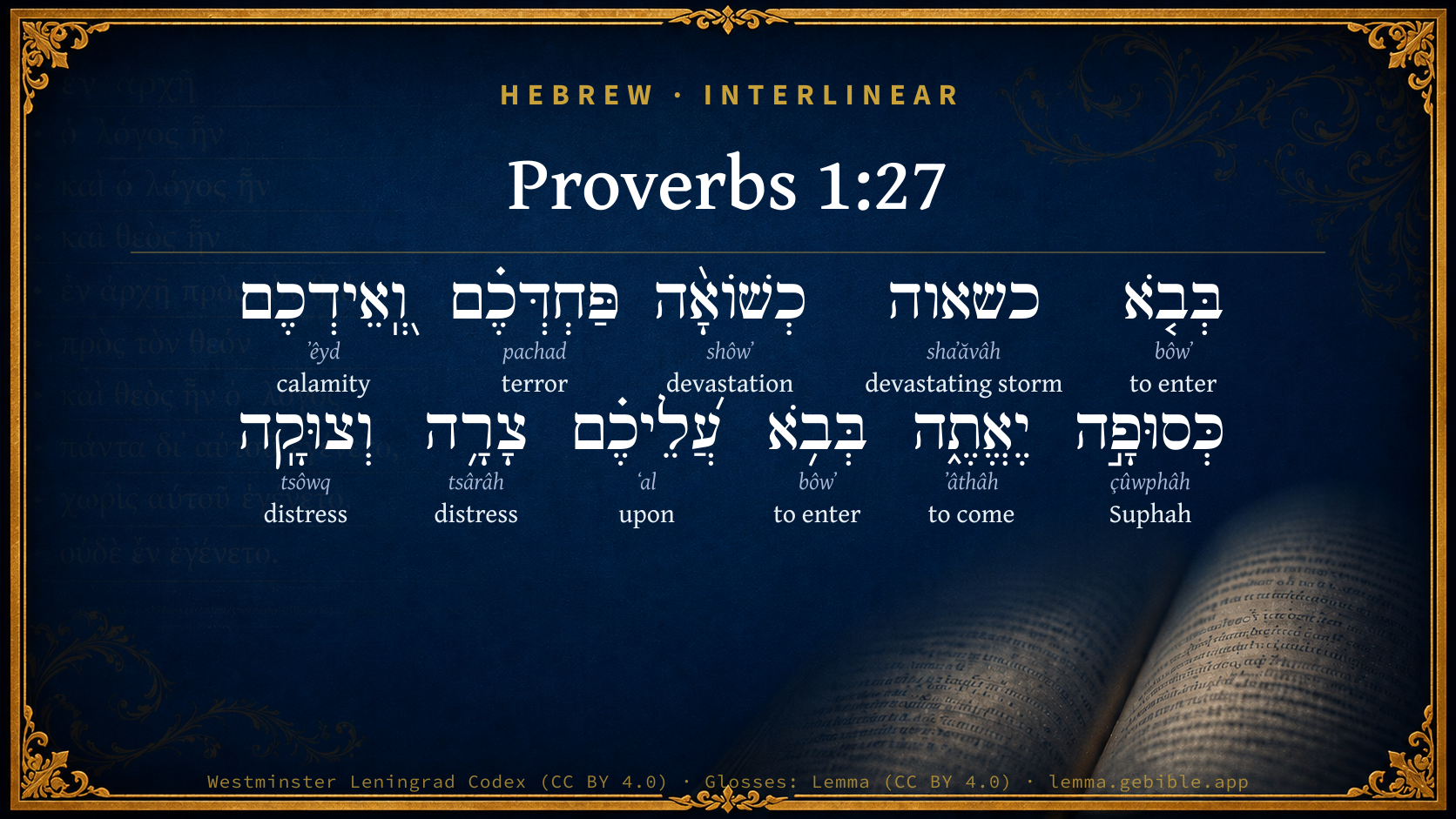
  1. בְּבֹ֤א bôwʼ H935 “in/at · to enter” Preposition + Verb, Qal, Infinitive Construct
  2. כְשׁוֹאָ֨ה shôwʼ H7722 “like/as · devastation” Preposition + Noun, Common, Feminine, Singular, Absolute
  3. פַּחְדְּכֶ֗ם pachad H6343 “terror · your” Noun, Common, Masculine, Singular, Construct + Suffix, Personal, 2nd Person, Masculine, Plural
  4. וְֽ֭אֵידְכֶם ʼêyd H343 “and · calamity · your” Conjunction + Noun, Common, Masculine, Singular, Construct + Suffix, Personal, 2nd Person, Masculine, Plural
  5. כְּסוּפָ֣ה çûwphâh H5492 “like/as · Suphah” Preposition + Noun, Common, Feminine, Singular, Absolute
  6. יֶאֱתֶ֑ה ʼâthâh H857 “to come” Verb, Qal, Imperfect, 3rd Person, Masculine, Singular
  7. בְּבֹ֥א bôwʼ H935 “in/at · to enter” Preposition + Verb, Qal, Infinitive Construct
  8. עֲ֝לֵיכֶ֗ם ʻal H5921 “upon · you” Preposition + Suffix, Personal, 2nd Person, Masculine, Plural
  9. צָרָ֥ה tsârâh H6869 “distress” Noun, Common, Feminine, Singular, Absolute
  10. וְצוּקָֽה tsôwq H6695 “and · distress” Conjunction + Noun, Common, Feminine, Singular, Absolute

About this verse

These counts appear in no published source. They are computed here, from the morphology-tagged text and Lemma’s own curated glosses. What Lemma adds →

11
words
10
distinct lemmas
Wisdom
section

Notable vocabulary

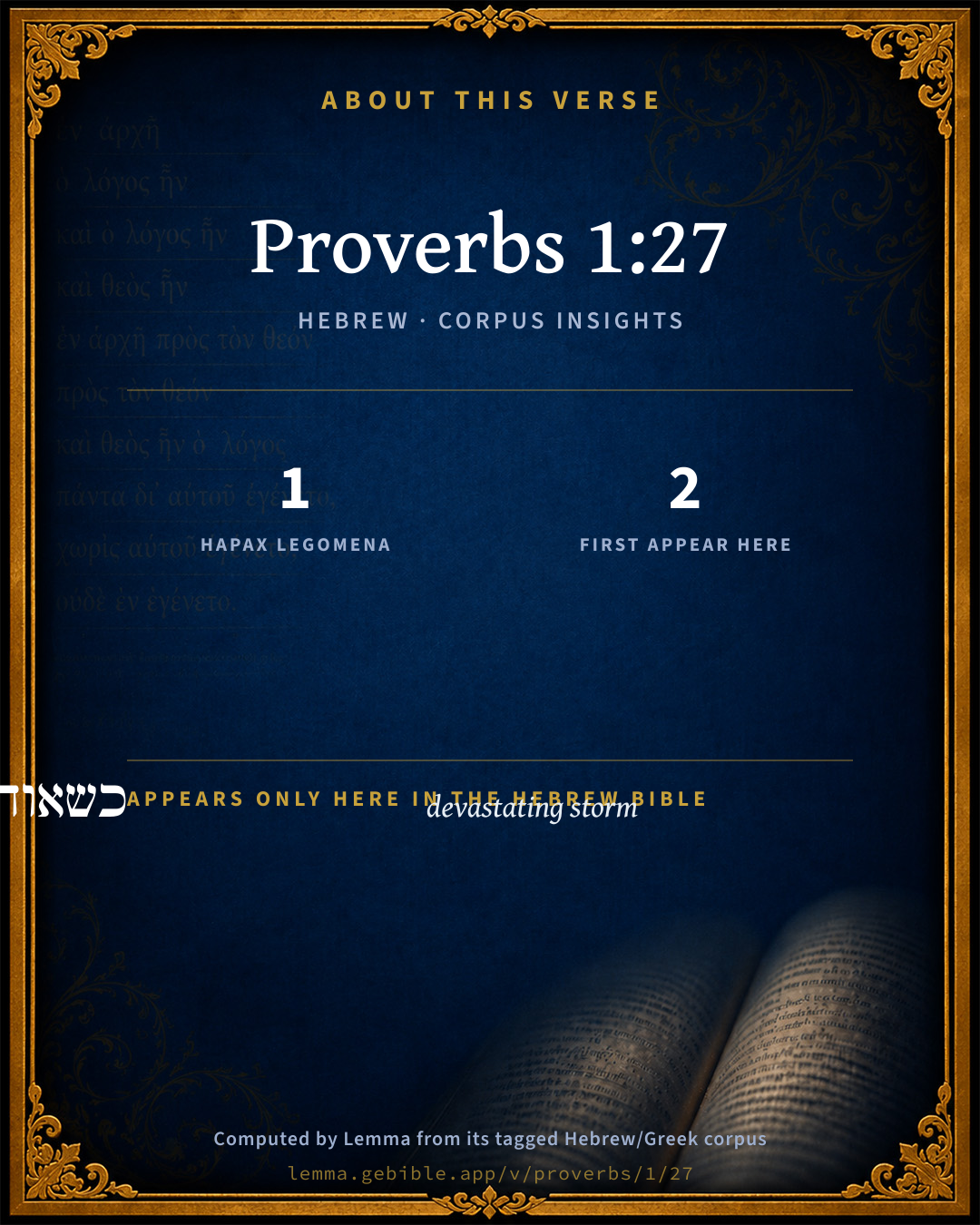
1 hapax legomenon — a word that appears only here in the entire Hebrew Bible:

  • כשאוה devastating storm H7584

First appearance in Scripture

These words make their first canonical appearance in the Hebrew Bible here:

  • כשאוה devastating storm H7584
  • וְצוּקָֽה distress H6695

Shared distinctive vocabulary

וְצוּקָֽה distress H6695 occurs in 4 verses of the Hebrew Bible. Also found in:

Grammatical profile

  • 3 verbs
  • 7 nouns
  • 1 preposition

Verb forms

  • בְּבֹ֤א Qal · Infinitive Construct
  • יֶאֱתֶ֑ה Qal · Imperfect
  • בְּבֹ֥א Qal · Infinitive Construct

Repetition

A word recurs within this verse — often emphatic in Hebrew:

  • בְּבֹ֤א to enter H935 ×2

Hebrew & Septuagint length

In English translation the verse runs 22 words from the Hebrew and 31 from the Septuagint (LXX English) — the Septuagint runs noticeably longer here. See the side-by-side →

A rough comparison of the two English renderings, which tokenize alike — not a word-level alignment.

Word counts can differ between the Hebrew and the Greek without any difference in meaning — e.g. the Hebrew direct-object marker אֵת has no separate Greek word, and Greek often adds the article ὁ.

Cross-references

11

Topical passages linked to Proverbs 1:27 in the Treasury of Scripture Knowledge — connected by theme and wording, ordered by reader-vote popularity; previews shown in the World English Bible.

  • Proverbs 3:25–26 Don't be afraid of sudden fear, Neither of the desolation of the wicked, when it comes:
  • Psalms 58:9 Before your pots can feel the heat of the thorns, He will sweep away the green and the burning alike.
  • Psalms 69:22–28 Let their table before them become a snare. May it become a retribution and a trap.
  • Proverbs 10:24–25 What the wicked fear, will overtake them, But the desire of the righteous will be granted.
  • Isaiah 17:13 The nations shall rush like the rushing of many waters: but he shall rebuke them, and they shall flee far off, and shall be chased as the chaff of the mountains before the wind, and like the whirling dust before the storm.
  • Nahum 1:3 Yahweh is slow to anger, and great in power, and will by no means leave the guilty unpunished. Yahweh has his way in the whirlwind and in the storm, and the clouds are the dust of his feet.
  • Luke 21:23–26 Woe to those who are pregnant and to those who nurse infants in those days! For there will be great distress in the land, and wrath to this people.
  • Luke 21:34–35 "So be careful, or your hearts will be loaded down with carousing, drunkenness, and cares of this life, and that day will come on you suddenly.
  • Romans 2:9 oppression and anguish, on every soul of man who works evil, on the Jew first, and also on the Greek.
  • 1 Thessalonians 5:3 For when they are saying, "Peace and safety," then sudden destruction will come on them, like birth pains on a pregnant woman; and they will in no way escape.
  • Revelation 6:15–17 The kings of the earth, the princes, the commanding officers, the rich, the strong, and every slave and free person, hid themselves in the caves and in the rocks of the mountains.

Cross-references courtesy of OpenBible.info (CC BY 4.0).

Hebrew and Greek witnesses Masoretic Hebrew ↔ Greek Septuagint

The same verse in the two great witnesses to the Old Testament, shown verse-for-verse.

Here the Septuagint runs noticeably longer than the Hebrew — LXX2012 (modern English Septuagint) 31 words vs World English Bible 22. A rough length comparison of the two English translations, not a word-level alignment — read both below.

These are two independent witnesses, not word-aligned to each other, and the Septuagint is shown in lemma (dictionary) form.

Hebrew Proverbs 1:27 Masoretic · Westminster Leningrad Codex

בְּבֹ֤א כשאוה כְשׁוֹאָ֨ה פַּחְדְּכֶ֗ם וְֽ֭אֵידְכֶם כְּסוּפָ֣ה יֶאֱתֶ֑ה בְּבֹ֥א עֲ֝לֵיכֶ֗ם צָרָ֥ה וְצוּקָֽה

When calamity overtakes you like a storm, When your disaster comes on like a whirlwind; When distress and anguish come on you.

World English Bible · Public Domain

Greek LXX Proverbs 1:27 Septuagint · lemma form

καί ὡς ἄν ἀποἱκνέομαι σύ ἄφνω θόρυβος ὁ δέ καταστροφή ὁμοίως καταιγίς παραεἰμί καί ὅταν ἔρχομαι σύ θλῖψις καί πολιορκία ἤ ὅταν ἔρχομαι σύ ὄλεθρος

yes when dismay suddenly comes upon you, and your overthrow shall arrive like a tempest; and when tribulation and distress shall come upon you, or when ruin shall come upon you.

LXX2012 (modern English Septuagint) · Public Domain

On this verse, The Cambridge Bible for Schools and Colleges discusses the Septuagint’s reading. Read the note in Commentary ↓

Hebrew: Westminster Leningrad Codex (CC BY 4.0). Greek: Septuagint (public domain); English from LXX2012 (modern English Septuagint) (Public Domain). How the Septuagint differs from the Hebrew →

Commentary

Notes on Proverbs 1:27 from classic Christian and Jewish commentators (each source and its license shown beneath its notes). The classic Christian expositions comment on the surrounding passage and are grouped to its opening verse, so a note may address several verses; the Jewish commentaries on the Tanakh (Rashi and others) are per-verse, so they appear only where the commentator wrote on this verse.

Lemma curates 59 commentaries, every one of them public domain or Creative Commons licensed, each selected and text-cleaned for this edition rather than reprinted as found. About our sources →

Trapp's Complete Commentary

John Trapp

Pro 1:27 When your fear cometh as desolation, and your destruction cometh as a whirlwind; when distress and anguish cometh upon you.

Ver. 27. When your fear cometh as desolation.] Scilicet, Of war, which lays heaps upon heaps, and leaves not a stone upon a stone. {Mat 24:2}

As a whirlwind.] Suddenly and irresistibly, and with a terrible noise and loud crash.

John Trapp, A Commentary or Exposition upon All the Books of the Old and New Testament (1647–1656) — public domain. Text from a community e-Sword module.

Geneva Bible (1599)

Geneva Bible translators

That is, your destruction, which thing you feared.

Geneva Bible (1599) marginal notes — public domain. Text via Bolls.life.

Jamieson, Fausset & Brown

Robert Jamieson, A. R. Fausset & David Brown

fear--the object of it.

desolation--literally, "a tumultuous noise," denoting their utter confusion.

destruction--or calamity (Pro 1:26) compared to a whirlwind, as to fatal rapidity.

distress-- (Psa 4:1; Psa 44:11).

anguish--a state of inextricable oppression, the deepest despair.

Jamieson, Fausset & Brown — Commentary Critical and Explanatory on the Whole Bible (1871) — public domain (CC PDM 1.0). Text via the HelloAO Bible API.

Adam Clarke's Commentary

Verse 27. Your destruction cometh as a whirlwind] כסופה kesuphah, as the all-prostrating blast. Sense and sound are here well expressed. Suphah here is the gust of wind.

Adam Clarke's Commentary on the Bible (1810–1826) — public domain. Text from a community e-Sword/MySword module.

The Cambridge Bible for Schools and Colleges

gen. ed. J. J. S. Perowne

27. desolation] So R.V. marg. Comp. Zep_1:15, where both in A.V. and R.V. this and a cognate Heb. word are rendered “wasteness and desolation.” The parallel, however, is better preserved if, with R.V. text we render storm, as in Eze_38:9, A.V. and R.V. LXX. has θόρυβος; Vulg. repentina calamitas.

The Cambridge Bible for Schools and Colleges (gen. ed. J. J. S. Perowne; Cambridge University Press, 1878–1918) — public domain. Text from a community e-Sword module.

John Gill's Exposition

When your fear cometh as desolation,.... When such will be the calamity that will occasion this fear, that it shall be like some desolating judgment, as famine, sword, and pestilence, which lays all waste: and such was the destruction of the Jews by the Romans; it not only laid Jerusalem and the temple waste, but the whole country of Judea. These are the "desolations" said to be "determined", or "the consummation and that determined", which should be "poured upon the desolate", Dan 9:26;

and your destruction cometh as a whirlwind; suddenly and unthought of, fierce, and boisterous, throwing down and carrying all before it: so the said destruction did; it threw down the walls and houses of the city of Jerusalem, and the temple, and its fine buildings, so that not one stone was left upon another not thrown down, Mat 24:2;

when distress and anguish cometh upon you; as they did at that time with a witness, when Jerusalem was besieged by the Romans: what with the sword of the enemy without, and the famine within; together with the vast number of cutthroats and seditious persons among themselves; it was such a time of distress and tribulation as never was from the beginning of the world, nor ever will be, Mat 24:22. Josephus's history of those times is a proper comment on these words.

John Gill's Exposition of the Whole Bible (1746–1763) — public domain (CC PDM 1.0). Text via the HelloAO Bible API.

Albert Barnes' Notes on the Bible

Desolation - Better, tempest. The rapid gathering of the clouds, the rushing of the mighty winds, are the fittest types of the suddenness with which in the end the judgment of God shall fall on those who look not for it. Compare Mat 24:29 etc.; Luk 17:24.

Albert Barnes' Notes on the Bible (1834–1885) — public domain. Text from a community e-Sword/MySword module.

Matthew Poole's English Annotations

As desolation; as some desolating sword or judgment, which quickly overruns a whole country.

As a whirlwind; which instantly spreadeth itself from place to place with great and irresistible violence, and doing much mischief.

Matthew Poole's English Annotations on the Holy Bible (1683–1685) — public domain. Text from a community e-Sword/MySword module.

Whedon's Commentary on the Bible

Daniel D. Whedon

27. When… fear cometh — Wisdom dwells upon this for the sake of impression, adding terrible qualifications.

Desolation — Or, a desolating tempest.

A whirlwind — A tornado, which rapidly whirls along with irresistible violence, spreading destruction in its path. Compare Job_1:16; Job_1:19; Zep_1:15. Tornadoes were very frequent in the East during the winter and cold seasons. They often proved fatal to travellers and others exposed to their fury. Morier, describing the whirlwinds of Persia, says they swept along in a manner truly terrific. They carried away in their vortex, sand, branches of trees, and the stubble of the fields, and usually appeared to make a communication between the earth and the clouds. Our own country occasionally furnishes examples of terrific tornadoes.

Daniel D. Whedon (gen. ed.), Commentary on the Old and New Testaments (1874–1909) — public domain. Text from a community e-Sword module.

The Pulpit Commentary

When your fear cometh as desolation. The imagery in this verse is borrowed from nature from the tempest and whirlwind, which, in their impetuous fury, involve all in irretrievable ruin. The two leading ideas here in the writer"s mind are calamity and fear. These their fear, that which causes their fear; and their destruction, i.e. calamity both representing Wisdom"s, and so God"s, judgment, will come on sinners as a wasting tempest and sweeping hurricane. The terror and devastation caused by these latter as they pass over the face of nature are employed to depict the alarm and ruin of sinners. Desolation; hwav (shaavah) is a wasting, crashing tempest, (cf. Pro_3:25 Zep_1:15) derived from hav (shaah). "to make a crash," as of a house falling. The Vulgate reads, repentura calamitas; the LXX, afnw yorubov ; both bringing out the idea of suddenness, and the latter that of the uproar of the tempest. The Khetib, or traditional text of the manuscripts (hwavk), is equivalent to the Keri, or emended reading (hawOvk), and both appear to have the same root meaning. Destruction (dyae, eyd); the same as "calamity" in the preceding verse. Whirlwind; hpWs (suphah), from the root pWs (suph), "to snatch, or carry away," means a whirlwind carrying everything before it the katagiv of the LXX, or hurricane, as in Arist., "Mund.," 4, 16. Distress and anguish (hqWxw hrx, tsarah v"tzukah). A corresponding alliteration occurs in Isa_30:6 and Zep_1:15. The root signification of the former is that of compression, reproduced in the LXX yliqiv , and the Vulgate tribulatio; that of the latter is narrowness. LXX, poliorkia , "a beleaguering;" VUlgate, angustga. The LXX adds, at the close of this verse, h otan erchtai umin oleyrov as explanatory.

The Pulpit Commentary (1880–1919), ed. H.D.M. Spence-Jones & Joseph S. Exell — public domain. Text from a community e-Sword module.

Rashi

Rabbi Shlomo Yitzchaki (Rashi)

when your fear comes like a storm Like a cloud that comes up suddenly.

like a whirlwind Tourbillon in Old French, in German wirbelwind (Cf. Rashi, Jer. 4:13, Ps. 83:16).

comes Heb. יאתה, it comes.

Rashi on the Tanakh — English translations: “The Judaica Press complete Tanach with Rashi, translated by A. J. Rosenberg” (CC BY 4.0); “Pentateuch with Rashi's commentary by M. Rosenbaum and A.M. Silbermann, 1929-1934” (public domain); “The Metsudah Tanach series, Lakewood, N.J” (CC BY 4.0); and “The Book of Joshua, Metsudah Publications, 1997” (CC BY 4.0). Text via Sefaria.

Lesson kit

Teaching starters — assembled from the data on this page, not authored interpretation. Every prompt links to the verse data it draws on. Edit before teaching.

Proverbs, in the Wisdom, opens this verse with 11 words (10 distinct Hebrew lemmas). Its most distinctive word is shaʼăvâh (“devastating storm”). The Greek Septuagint runs longer here. A historical commentator’s framing appears above. Read the whole chapter for the surrounding context.

Discussion questions

  1. The word shaʼăvâh carries the sense “devastating storm.” How does it shape the verse?
  2. 1 word here appears nowhere else in the Hebrew Bible. Why might the author reach for such rare wording?
  3. 2 words make their first appearance in Scripture here. What does this debut establish?
  4. How does Isaiah 8:22, which shares the word «distress», read alongside this verse?
  5. What does the repetition of “to enter” (2× in this one verse) do in this verse?
  6. The Septuagint runs longer here than the Hebrew. What might account for the difference?
  7. These translations render this verse differently. What is at stake in choosing one wording over another?
  8. «בְּבֹ֤א» is a Qal Infinitive Construct verb. How does that grammatical form shape the action described?

Things to notice

  • 1 word in this verse appears nowhere else in the Hebrew Bible.
  • 2 words make their first canonical appearance in Scripture here.
  • These translations choose different wording for 14 words in this verse.
  • “to enter” occurs 2× in this single verse.
  • 10 distinct Hebrew lemmas span 11 words in this verse.

Reading settings

Reading text

Shown beneath each verse's original-language words.

Old Testament
Old Testament edition

Read the OT as the Masoretic Hebrew (MT) or the Greek Septuagint (LXX).

English shown for the Greek Septuagint (in the Hebrew ↔ Greek comparison).

Comparing translations? Open the Compare panel on any verse page to stack up to four side by side.