
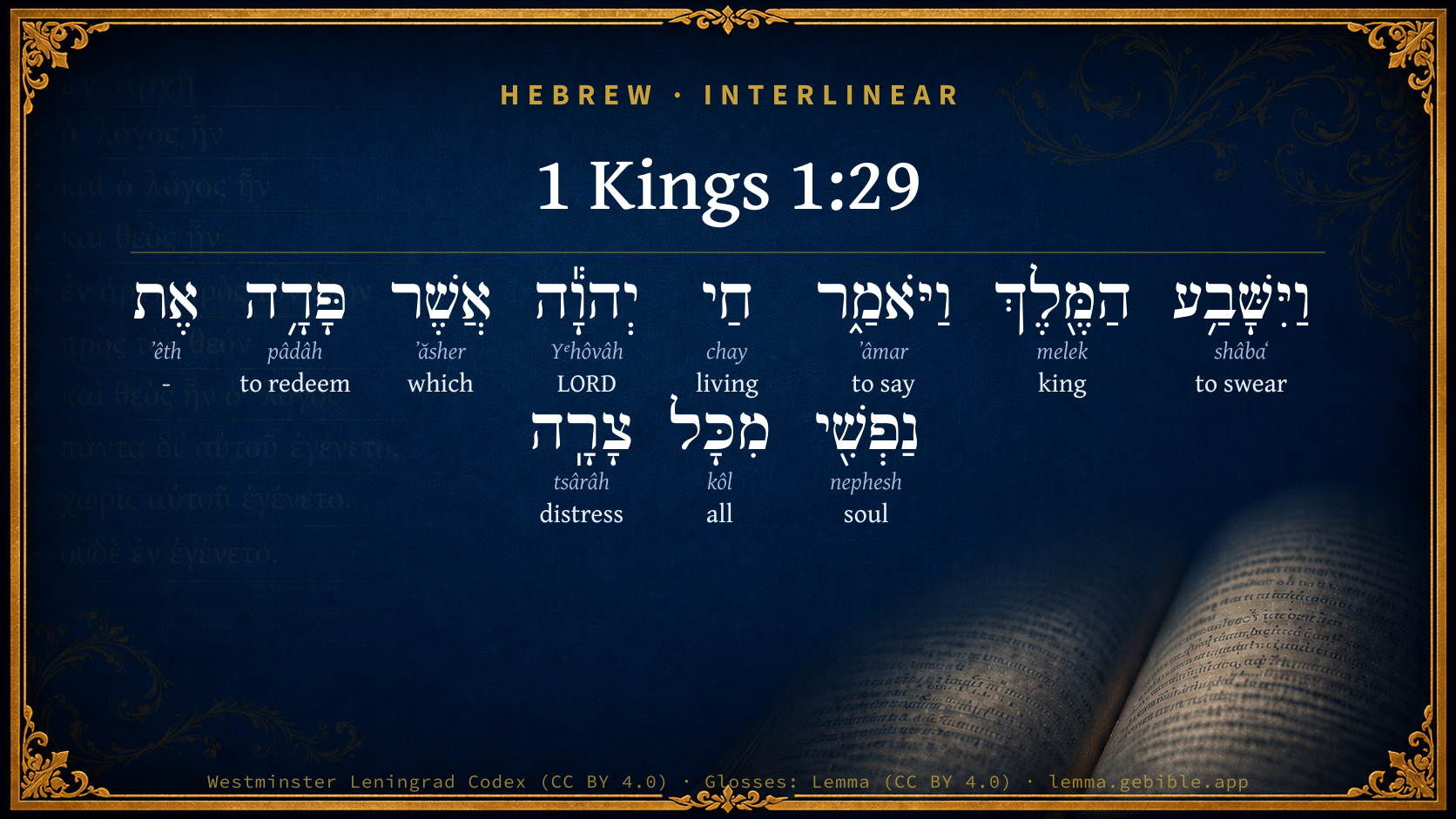
1 Kings 1:29

Hebrew (Westminster Leningrad Codex) 1 Kings 1:29 appears in the Hebrew Old Testament. The text above is from the Westminster Leningrad Codex. Each word links to its Strong’s number, a concise gloss, and parsing drawn from the Open Scriptures Hebrew Bible morphology. Click any word for its full Brown-Driver-Briggs (BDB) entry.
Download image
Cite this verse

1 Kings 1:29 (World English Bible). Public Domain. Lemma interlinear Bible study tool, https://lemma.gebible.app/v/1-kings/1/29.

Show BibTeX & RIS
BibTeX
RIS
English Translation
The king swore, and said, As Yahweh lives, who has redeemed my soul out of all adversity,
World English Bible · Public Domain
Download a study sheet

One document with this verse’s original text, its word-by-word gloss line, the meaning frame, cross-references with their text, attributed commentary, and full source and license credits — printable, and it pastes into notes with its structure intact.

This verse Autodidact and up

Study sheet (.html) Plain text (.txt)

A passage Seminary Student

Up to 50 verses in one chapter. A passage sheet keeps up to 6 commentary sources and 12 cross-references per verse, in the order this page ranks them, and says so on the sheet whenever that leaves anything out. Ask for a single verse and you get the Autodidact verse sheet above.

Everything on this page stays free to read, with no account — the sheet is a download of what is already on screen, not access to it.

Want to remove ads? Support Godless Engineer
Compare translations 3

The same verse in 3 English versions, stacked beneath the original-language interlinear above. Click any original word for its lexicon entry.

Each is an independent rendering of the whole verse — the interlinear is not word-aligned to these translations.

Highlighted words mark where these versions differ — a whole-verse word diff, not a word-by-word alignment.

  • World English Bible Public Domain
    The king swore, and said, As Yahweh lives, who has redeemed my soul out of all adversity,
  • King James Version Public Domain
    And the king sware, and said, As the LORD liveth, that hath redeemed my soul out of all distress,
  • unfoldingWord Literal Text CC BY-SA 4.0
    And the king swore and said, “The life of Yahweh, who has rescued my life from every distress,

unfoldingWord Literal Text — © unfoldingWord, licensed CC BY-SA 4.0. Word-aligned USFM3 via Door43 (git.door43.org/unfoldingWord/en_ult).

Versions to compare (up to 4)

3 of 4 selected

Show all 18 translations

Every available English version of this verse, each an independent rendering of the whole verse.

  • World English Bible Public Domain
    The king swore, and said, As Yahweh lives, who has redeemed my soul out of all adversity,
  • Berean Standard Bible Public Domain
    And the king swore an oath, saying, “As surely as the LORD lives, who has redeemed my life from all distress,
  • Majority Standard Bible Public Domain
    And the king swore an oath, saying, “As surely as the LORD lives, who has redeemed my life from all distress,
  • King James Version Public Domain
    And the king sware, and said, As the LORD liveth, that hath redeemed my soul out of all distress,
  • American Standard Version (1901) Public Domain
    And the king sware, and said, As Jehovah liveth, who hath redeemed my soul out of all adversity,
  • Revised Version (1885) Public Domain
    And the king sware, and said, As the LORD liveth, who hath redeemed my soul out of all adversity,
  • Geneva Bible (1599) Public Domain
    And the King sware, saying, As the Lord liueth, who hath redeemed my soule out of all aduersitie,
  • Douay-Rheims (1899) Public Domain
    The king swore and said: As the Lord liveth, who hath delivered my soul out of all distress,
  • Young's Literal Translation Public Domain
    And the king sweareth and saith, `Jehovah liveth, who hath redeemed my soul out of all adversity;
  • Literal Standard Version CC BY-SA 4.0
    And the king swears and says, “YHWH lives, who has redeemed my soul out of all adversity;
  • Unlocked Literal Bible CC BY-SA 4.0
    The king made an oath and said, “As Yahweh lives, who has redeemed me out of all trouble,
  • unfoldingWord Literal Text CC BY-SA 4.0
    And the king swore and said, “The life of Yahweh, who has rescued my life from every distress,
  • Darby Bible Public Domain
    And the king swore, and said, [As] Jehovah liveth, who has redeemed my soul out of all distress,
  • World Messianic Bible Public Domain
    The king vowed and said, “As the LORD lives, who has redeemed my soul out of all adversity,
  • Webster's Bible Public Domain
    And the king swore, and said, As the LORD liveth, that hath redeemed my soul out of all distress,
  • Free Bible Version CC BY-SA 4.0
    The king swore a vow, saying, “As the Lord lives, who has saved me from all kinds of trouble, just as I swore to you previously by the Lord the God of Israel,
  • Bible in Basic English Public Domain
    And the king took an oath, and said, By the living Lord, who has been my saviour from all my troubles,
  • JPS Tanakh (1917) Public Domain
    And the king swore and said: 'As the LORD liveth, who hath redeemed my soul out of all adversity,

Literal Standard Version (2020), Covenant Press — licensed CC BY-SA 4.0. Text via the HelloAO Bible API (eBible.org). Unlocked Literal Bible (unfoldingWord) — licensed CC BY-SA 4.0. Text via the HelloAO Bible API (eBible.org). unfoldingWord Literal Text — © unfoldingWord, licensed CC BY-SA 4.0. Word-aligned USFM3 via Door43 (git.door43.org/unfoldingWord/en_ult). Free Bible Version, Dr. Jonathan Gallagher — licensed CC BY-SA 4.0. Text via the HelloAO Bible API (eBible.org).

Word by word

More ways to search: Search by grammar → Find every occurrence → Compare this word →

Practice this passage: Drill this verse → Learn its vocabulary →

פָּדָ֥ה
pâdâh
H6299
“to redeem”
Verb, Qal, Perfect, 3rd Person, Masculine, Singular
Part of Speech
Verb
Stem
Qal
Form
Perfect
Person
3rd Person
Gender
Masculine
Number
Singular
Full BDB Definition

Origin: a primitive root

TWOT: 1734

to ransom, redeem, rescue, deliver - (Qal) to ransom - (Niphal) to be ransomed - (Hiphil) to allow one to be ransomed - (Hophal) redeemed
  1. וַיִּשָּׁבַ֥ע shâbaʻ H7650 “and · to swear” Conjunction + Verb, Niphal, Sequential Imperfect, 3rd Person, Masculine, Singular
  2. הַמֶּ֖לֶךְ melek H4428 “the · king” Particle, Definite Article + Noun, Common, Masculine, Singular, Absolute
  3. וַיֹּאמַ֑ר ʼâmar H559 “and · to say” Conjunction + Verb, Qal, Sequential Imperfect, 3rd Person, Masculine, Singular
  4. חַי chay H2416 “living” Adjective, Adjective, Masculine, Singular, Absolute
  5. יְהוָ֕ה Yᵉhôvâh H3068 “LORD” Noun, Proper
  6. אֲשֶׁר ʼăsher H834 “which” Particle, Relative
  7. אֶת ʼêth H853 “-” Particle, Direct Object
  8. נַפְשִׁ֖י nephesh H5315 “soul · my” Noun, Common, Both, Singular, Construct + Suffix, Personal, 1st Person, Common, Singular
  9. מִכָּל kôl H3605 “from · all of” Preposition + Noun, Common, Masculine, Singular, Construct
  10. צָרָֽה tsârâh H6869 “distress” Noun, Common, Feminine, Singular, Absolute

About this verse

These counts appear in no published source. They are computed here, from the morphology-tagged text and Lemma’s own curated glosses. What Lemma adds →

11
words
11
distinct lemmas
Historical
section

Shared distinctive vocabulary

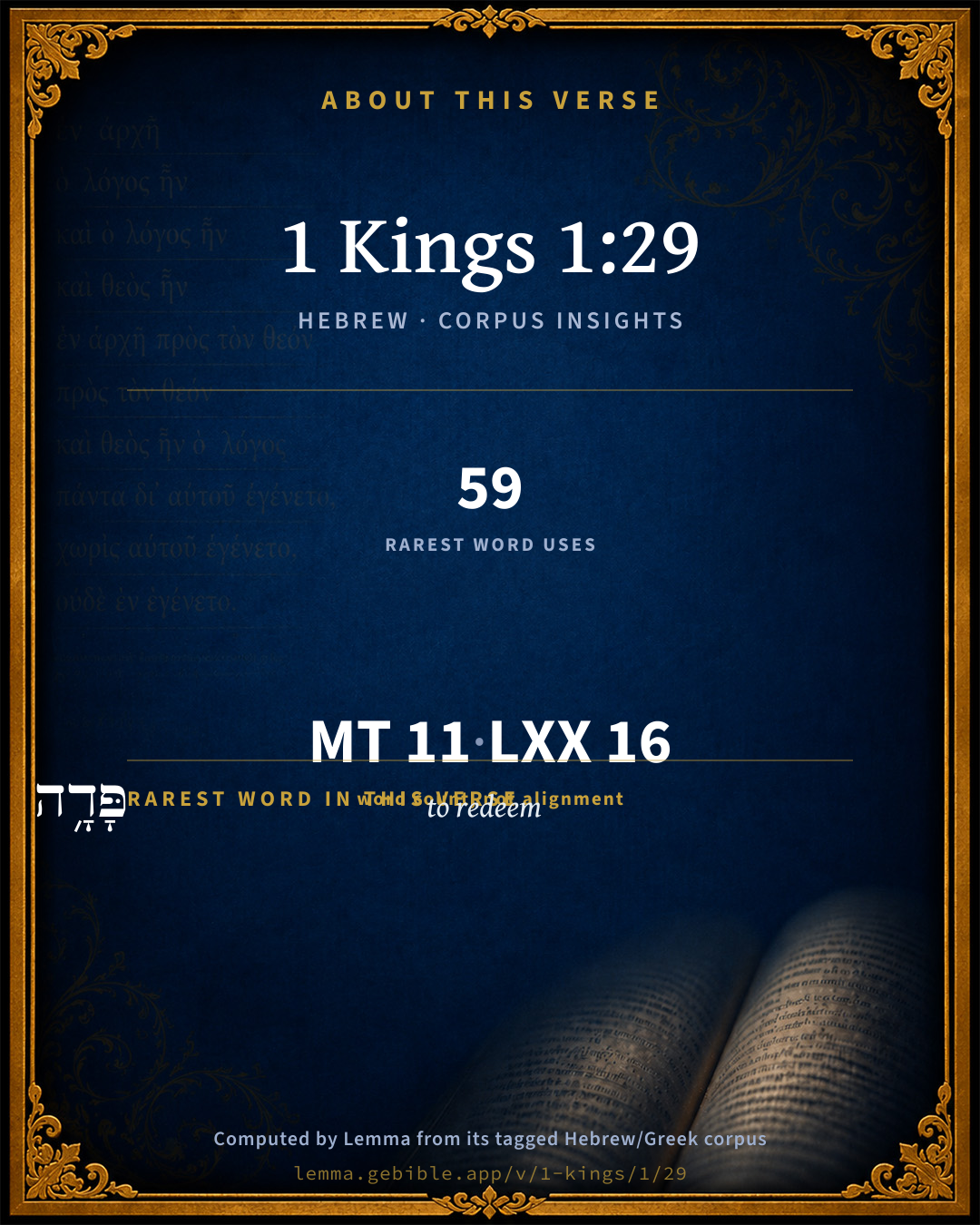
פָּדָ֥ה to redeem H6299 occurs in 48 verses of the Hebrew Bible. Also found in:

Grammatical profile

  • 3 verbs
  • 5 nouns
  • 1 adjective
  • 2 particles

Verb forms

  • וַיִּשָּׁבַ֥ע Niphal · Sequential Imperfect
  • וַיֹּאמַ֑ר Qal · Sequential Imperfect
  • פָּדָ֥ה Qal · Perfect

Hebrew & Septuagint length

In English translation the verse runs 17 words from the Hebrew and 18 from the Septuagint (LXX English) — closely comparable.

A rough comparison of the two English renderings, which tokenize alike — not a word-level alignment.

Word counts can differ between the Hebrew and the Greek without any difference in meaning — e.g. the Hebrew direct-object marker אֵת has no separate Greek word, and Greek often adds the article ὁ.

In the original languages it is 11 Hebrew tokens and 16 Greek tokens — but the two are counted differently (Hebrew bundles its prefixes and suffixes into one token; the Greek is in lemma form), so that isn’t a like-for-like length.

Cross-references

18

Topical passages linked to 1 Kings 1:29 in the Treasury of Scripture Knowledge — connected by theme and wording, ordered by reader-vote popularity; previews shown in the World English Bible.

  • 2 Samuel 4:9 David answered Rechab and Baanah his brother, the sons of Rimmon the Beerothite, and said to them, As Yahweh lives, who has redeemed my soul out of all adversity,
  • Psalms 136:24 And has delivered us from our adversaries; For his loving kindness endures forever:
  • Genesis 48:16 the angel who has redeemed me from all evil, bless the lads, and let my name be named on them, and the name of my fathers Abraham and Isaac. Let them grow into a multitude in the midst of the earth."
  • Judges 8:19 He said, They were my brothers, the sons of my mother: as Yahweh lives, if you had saved them alive, I would not kill you.
  • 1 Samuel 14:39 For, as Yahweh lives, who saves Israel, though it be in Jonathan my son, he shall surely die. But there was not a man among all the people who answered him.
  • 1 Samuel 14:45 The people said to Saul, Shall Jonathan die, who has worked this great salvation in Israel? Far from it: as Yahweh lives, there shall not one hair of his head fall to the ground; for he has worked with God this day. So the people rescued Jonathan, that he didn't die.
  • 1 Samuel 19:6 Saul listened to the voice of Jonathan: and Saul swore, As Yahweh lives, he shall not be put to death.
  • 1 Samuel 20:21 Behold, I will send the boy, [saying], Go, find the arrows. If I tell the boy, Behold, the arrows are on this side of you; take them, and come; for there is peace to you and no hurt, as Yahweh lives.
  • 2 Samuel 12:5 David's anger was greatly kindled against the man, and he said to Nathan, "As Yahweh lives, the man who has done this is worthy to die!
  • 1 Kings 2:24 Now therefore as Yahweh lives, who has established me, and set me on the throne of David my father, and who has made me a house, as he promised, surely Adonijah shall be put to death this day.
  • 1 Kings 17:1 Elijah the Tishbite, who was of the foreigners of Gilead, said to Ahab, As Yahweh, the God of Israel, lives, before whom I stand, there shall not be dew nor rain these years, but according to my word.
  • 1 Kings 18:10 As Yahweh your God lives, there is no nation or kingdom, where my lord has not sent to seek you: and when they said, He is not here, he took an oath of the kingdom and nation, that they didn't find you.
  • 2 Kings 4:30 The mother of the child said, As Yahweh lives, and as your soul lives, I will not leave you. He arose, and followed her.
  • 2 Kings 5:16 But he said, As Yahweh lives, before whom I stand, I will receive none. He urged him to take it; but he refused.
  • 2 Kings 5:20 But Gehazi the servant of Elisha the man of God, said, Behold, my master has spared this Naaman the Syrian, in not receiving at his hands that which he brought: as Yahweh lives, I will run after him, and take somewhat of him.
  • Psalms 34:19–22 Many are the afflictions of the righteous, But Yahweh delivers him out of them all.
  • Psalms 72:14 He will redeem their soul from oppression and violence. Their blood will be precious in his sight.
  • Psalms 138:7 Though I walk in the midst of trouble, you will revive me. You will stretch forth your hand against the wrath of my enemies. Your right hand will save me.

Cross-references courtesy of OpenBible.info (CC BY 4.0).

Hebrew and Greek witnesses Masoretic Hebrew ↔ Greek Septuagint

The same verse in the two great witnesses to the Old Testament, shown verse-for-verse.

These are two independent witnesses, not word-aligned to each other, and the Septuagint is shown in lemma (dictionary) form.

Hebrew 1 Kings 1:29 Masoretic · Westminster Leningrad Codex

וַיִּשָּׁבַ֥ע הַמֶּ֖לֶךְ וַיֹּאמַ֑ר חַי יְהוָ֕ה אֲשֶׁר פָּדָ֥ה אֶת נַפְשִׁ֖י מִכָּל צָרָֽה

The king swore, and said, As Yahweh lives, who has redeemed my soul out of all adversity,

World English Bible · Public Domain

Greek LXX 1 Kings 1:29 Septuagint · lemma form

καί ὄμνυμι ὁ βασιλεύς καί εἶπον ζάω κύριος ὅς λυτρόω ὁ ψυχή ἐγώ ἐκ πᾶς θλῖψις

And the king swore, and said, As the Lord lives who redeemed my soul out of all affliction,

LXX2012 (modern English Septuagint) · Public Domain

Hebrew: Westminster Leningrad Codex (CC BY 4.0). Greek: Septuagint (public domain); English from LXX2012 (modern English Septuagint) (Public Domain). How the Septuagint differs from the Hebrew →

Targum (Aramaic paraphrase)

1

The Targum is the ancient Jewish Aramaic paraphrase of the Hebrew Scriptures — an interpretive translation, not the Hebrew text itself. Onkelos (literal) and Pseudo-Jonathan (expansive) render the Torah, and Jonathan the Prophets. Coverage is partial: where no permissively-licensed English translation exists for a verse, only the Aramaic is shown. This is verse-level text, not a word-by-word alignment to the Hebrew.

  1. Targum Jonathan Prophets (Joshua–Malachi)
    וְקַיֵם מַלְכָּא וַאֲמַר קַיָם הוּא יְיָ דִפְּרַק יַת נַפְשִׁי מִכָּל עָקָא:

    (no public-domain English translation for this verse)

    Targum Jonathan — Aramaic: “Mikraot Gedolot” (public domain). English: “Sefaria Community Translation” (CC0 1.0 (public-domain dedication)); “London "Chaldee Paraphrase," 1871” (public domain). Text via Sefaria.

Commentary

Notes on 1 Kings 1:29 from classic Christian and Jewish commentators (each source and its license shown beneath its notes). The classic Christian expositions comment on the surrounding passage and are grouped to its opening verse, so a note may address several verses; the Jewish commentaries on the Tanakh (Rashi and others) are per-verse, so they appear only where the commentator wrote on this verse.

Lemma curates 59 commentaries, every one of them public domain or Creative Commons licensed, each selected and text-cleaned for this edition rather than reprinted as found. About our sources →

Trapp's Complete Commentary

John Trapp

1Ki 1:29 And the king sware, and said, [As] the LORD liveth, that hath redeemed my soul out of all distress,

Ver. 29. Who hath delivered my soul.] Deliverance commandeth obedience. {Ezr 9:13-14}

John Trapp, A Commentary or Exposition upon All the Books of the Old and New Testament (1647–1656) — public domain. Text from a community e-Sword module.

Ellicott's Commentary for English Readers

(29) As the Lord liveth, that hath redeemed my soul.—A characteristic adjuration of David, found also in 2Sa_4:9; but now peculiarly appropriate in the old man, who was so near the haven of rest, after all the storms of life. “O Lord, my strength and my Redeemer,” is the climax of his address to God, as the Creator of all things and the ruler of all men, in Psa_19:14.

A Bible Commentary for English Readers, edited by Charles John Ellicott (1878–1897) — public domain. Text from a community e-Sword module.

The Cambridge Bible for Schools and Colleges

gen. ed. J. J. S. Perowne

29. And the king sware] i.e. Solemnly renewed the oath which he had before (see 1Ki_1:13) made unto Bath-sheba.

As the Lord liveth] The expression is equivalent to ‘As surely as the Lord liveth,’ though in the Hebrew there is no word for as. God is frequently spoken of as ‘the living God’ and the idea in this form of asseveration seems to be this, ‘the Lord is living, of that there is no doubt, and as certainly shall that come to pass which is prefaced by this solemn assertion.’

that hath redeemed, &c.] David employs exactly the same words (in Hebrew) in 2Sa_4:6, previous to the punishment of Baanah and Rechab for the murder of Ishbosheth. And it is not without reason that he thinks of the termination of his distresses in connexion with Solomon, for the birth of that son marked the time when he became at peace not only with men but with God.

The Cambridge Bible for Schools and Colleges (gen. ed. J. J. S. Perowne; Cambridge University Press, 1878–1918) — public domain. Text from a community e-Sword module.

John Gill's Exposition

And the king sware,.... To his former oath, he added another for greater confirmation:

and said, as the Lord liveth; which was the proper form of an oath, which ought to be taken by the living God; and as what would lay him under the greater obligation to observe it, he adds,

that hath redeemed my soul out of all distress; saved his life when in the most imminent danger; delivered him out of the hand of Goliath, and from the Philistines and other enemies, in his wars with them; and from Saul and his persecuting rage and fury, and from the rebellion of his son Absalom, and the insurrection of Sheba.

John Gill's Exposition of the Whole Bible (1746–1763) — public domain (CC PDM 1.0). Text via the HelloAO Bible API.

Albert Barnes' Notes on the Bible

“As the Lord liveth” was the most common form of oath among the Israelites (e. g. Jdg 8:19; 1Sa 14:39; 1Sa 19:6). It was unique to David to attach a further clause to this oath - a clause of thankfulness for some special mercy 1Sa 25:34, or for God’s constant protection of him (here and in 2Sa 4:9).

Albert Barnes' Notes on the Bible (1834–1885) — public domain. Text from a community e-Sword/MySword module.

Whedon's Commentary on the Bible

Daniel D. Whedon

29. Hath redeemed my soul out of all distress — Many had been David’s deliverances from danger; but here, as he reaffirms this oath before that woman with whom, and for whose sake, he had perpetrated the darkest sins of his life, we should understand a special allusion to the bitter soul-agonies which resulted from those crimes: for it was at the time of his redemption and deliverance from those agonies that Jehovah had foretold to him the birth and destiny of Solomon. 2 Samuel 12.

Daniel D. Whedon (gen. ed.), Commentary on the Old and New Testaments (1874–1909) — public domain. Text from a community e-Sword module.

The Pulpit Commentary

And the king sware see on ver., 51 and said, As the Lord liveth or "by the life of Jehovah." Cf. "by the life of Pharaoh". (Gen_42:15) This was the common form of oath. See, e.g., Jud_1:8:19; Rth_3:13; 1Sa_14:39 1Sa_19:6 1Sa_20:24 1Sa_29:6; and especially Jer_4:2 Jer_5:2; Hos_4:15. It is characteristic of David to introduce into the formula some such clause as the following that hath redeemed my soul i.e., life out of all distress. Same expression as in 2Sa_4:9. Similar expressions are found in Psa_25:22, and 34:22. The repeated deliverance out of straits and danger of the hand of all his enemies, and out of the hand of Saul was one of the most remarkable features of David"s life, and it is nowonder that he repeatedly commemorates it, converting every adjuration into an act of thanksgiving. Similarly, Jacob (Gen_48:16)

The Pulpit Commentary (1880–1919), ed. H.D.M. Spence-Jones & Joseph S. Exell — public domain. Text from a community e-Sword module.

John Wesley's Explanatory Notes

Out of all distress - The words contain a grateful acknowledgement of the goodness of God to him, in bringing him safe through the many difficulties, which had lain in his way, and which he now mentions to the glory of God, (as Jacob when he lay a dying) thus setting to his seal, from his own experience that the Lord redeemeth the souls of his servants.

John Wesley, Explanatory Notes Upon the Whole Bible (1754–1765) — public domain. Text via the GEBible commentary corpus.

Scofield Reference Notes

C. I. Scofield

redeemed

Exo 14:30; Isa 59:20. (See Scofield "Exo 14:30"). See Scofield "Isa 59:20".

The Scofield Reference Bible (1917 edition), notes by C. I. Scofield — public domain. Text from a community e-Sword module.

Lesson kit

Teaching starters — assembled from the data on this page, not authored interpretation. Every prompt links to the verse data it draws on. Edit before teaching.

1 Kings, in the Historical, opens this verse with 11 words (11 distinct Hebrew lemmas). Its most distinctive word is pâdâh (“to redeem”). A historical commentator’s framing appears above. Read the whole chapter for the surrounding context.

Discussion questions

  1. How does “to redeem” (pâdâh) shape what this verse is saying?
  2. How does Exodus 13:13, which shares the word «to redeem», read alongside this verse?
  3. These translations render this verse differently; the difference is in the English rendering, not the original. What questions does that raise?
  4. «וַיִּשָּׁבַ֥ע» is a Niphal Sequential Imperfect verb. How does that grammatical form shape the action described?
  5. Compare how Trapp's Complete Commentary and Ellicott's Commentary for English Readers read this verse. Where do they agree or differ?

Things to notice

Reading settings

Reading text

Shown beneath each verse's original-language words.

Old Testament
Old Testament edition

Read the OT as the Masoretic Hebrew (MT) or the Greek Septuagint (LXX).

English shown for the Greek Septuagint (in the Hebrew ↔ Greek comparison).

Comparing translations? Open the Compare panel on any verse page to stack up to four side by side.