
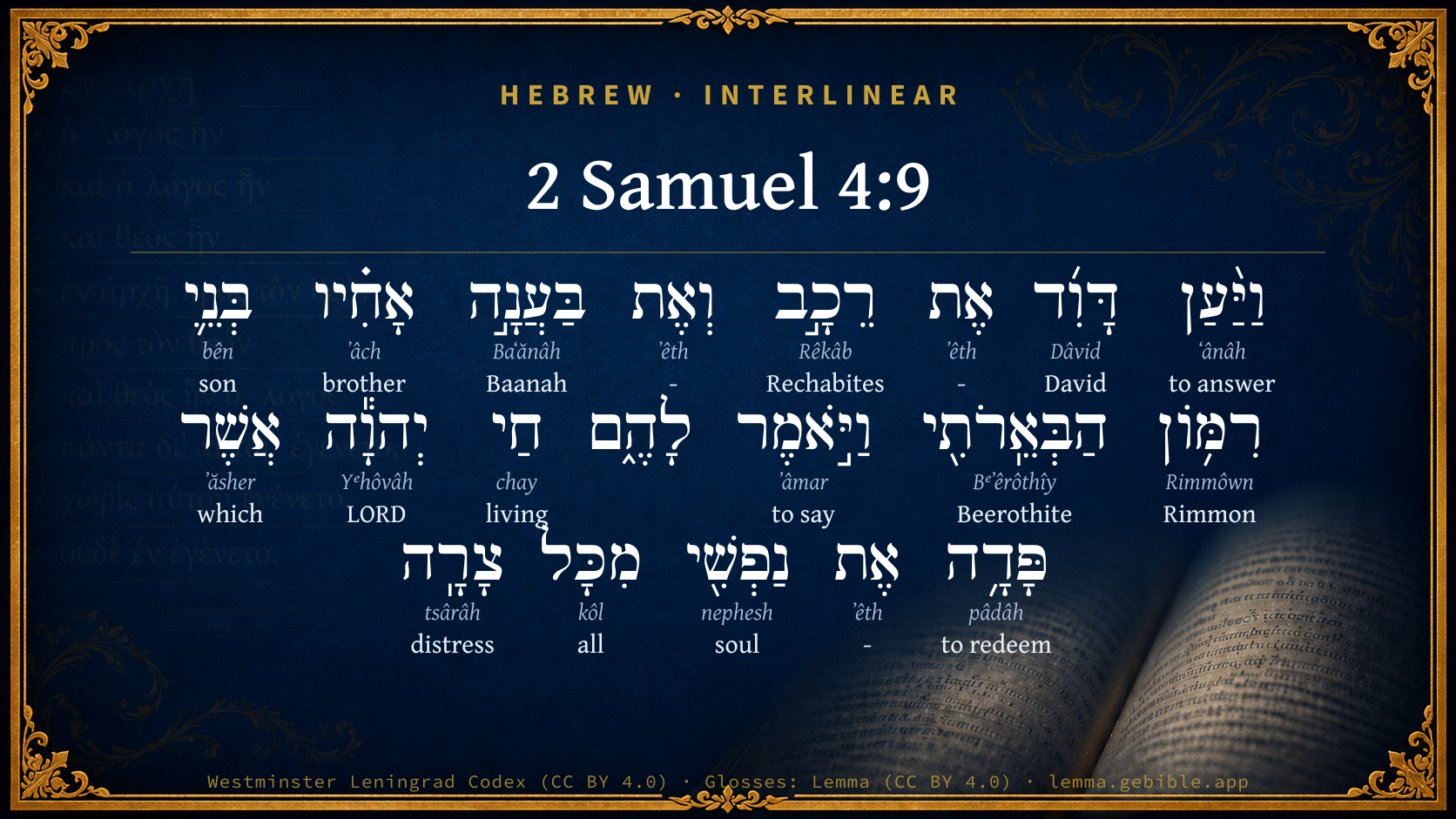
2 Samuel 4:9

Hebrew (Westminster Leningrad Codex) 2 Samuel 4:9 appears in the Hebrew Old Testament. The text above is from the Westminster Leningrad Codex. Each word links to its Strong’s number, a concise gloss, and parsing drawn from the Open Scriptures Hebrew Bible morphology. Click any word for its full Brown-Driver-Briggs (BDB) entry.
Download image
Cite this verse

2 Samuel 4:9 (World English Bible). Public Domain. Lemma interlinear Bible study tool, https://lemma.gebible.app/v/2-samuel/4/9.

Show BibTeX & RIS
BibTeX
RIS
English Translation
David answered Rechab and Baanah his brother, the sons of Rimmon the Beerothite, and said to them, As Yahweh lives, who has redeemed my soul out of all adversity,
World English Bible · Public Domain
Download a study sheet

One document with this verse’s original text, its word-by-word gloss line, the meaning frame, cross-references with their text, attributed commentary, and full source and license credits — printable, and it pastes into notes with its structure intact.

This verse Autodidact and up

Study sheet (.html) Plain text (.txt)

A passage Seminary Student

Up to 50 verses in one chapter. A passage sheet keeps up to 6 commentary sources and 12 cross-references per verse, in the order this page ranks them, and says so on the sheet whenever that leaves anything out. Ask for a single verse and you get the Autodidact verse sheet above.

Everything on this page stays free to read, with no account — the sheet is a download of what is already on screen, not access to it.

Want to remove ads? Support Godless Engineer
Compare translations 3

The same verse in 3 English versions, stacked beneath the original-language interlinear above. Click any original word for its lexicon entry.

Each is an independent rendering of the whole verse — the interlinear is not word-aligned to these translations.

Highlighted words mark where these versions differ — a whole-verse word diff, not a word-by-word alignment.

  • World English Bible Public Domain
    David answered Rechab and Baanah his brother, the sons of Rimmon the Beerothite, and said to them, As Yahweh lives, who has redeemed my soul out of all adversity,
  • King James Version Public Domain
    And David answered Rechab and Baanah his brother, the sons of Rimmon the Beerothite, and said unto them, As the LORD liveth, who hath redeemed my soul out of all adversity,
  • unfoldingWord Literal Text CC BY-SA 4.0
    But David answered Rechab and Baanah his brother, the sons of Rimmon the Beerothite, and he said to them, “The life of Yahweh, who rescued my life from every distress,

unfoldingWord Literal Text — © unfoldingWord, licensed CC BY-SA 4.0. Word-aligned USFM3 via Door43 (git.door43.org/unfoldingWord/en_ult).

Versions to compare (up to 4)

3 of 4 selected

Show all 18 translations

Every available English version of this verse, each an independent rendering of the whole verse.

  • World English Bible Public Domain
    David answered Rechab and Baanah his brother, the sons of Rimmon the Beerothite, and said to them, As Yahweh lives, who has redeemed my soul out of all adversity,
  • Berean Standard Bible Public Domain
    But David answered Rechab and his brother Baanah, the sons of Rimmon the Beerothite, “As surely as the LORD lives, who has redeemed my life from all distress,
  • Majority Standard Bible Public Domain
    But David answered Rechab and his brother Baanah, the sons of Rimmon the Beerothite, “As surely as the LORD lives, who has redeemed my life from all distress,
  • King James Version Public Domain
    And David answered Rechab and Baanah his brother, the sons of Rimmon the Beerothite, and said unto them, As the LORD liveth, who hath redeemed my soul out of all adversity,
  • American Standard Version (1901) Public Domain
    And David answered Rechab and Baanah his brother, the sons of Rimmon the Beerothite, and said unto them, As Jehovah liveth, who hath redeemed my soul out of all adversity,
  • Revised Version (1885) Public Domain
    And David answered Rechab and Baanah his brother, the sons of Rimmon the Beerothite, and said unto them, As the LORD liveth, who hath redeemed my soul out of all adversity,
  • Geneva Bible (1599) Public Domain
    Then Dauid answered Rechab and Baanah his brother, the sonnes of Rimmon the Beerothite, and saide vnto them, As the Lord liueth, who hath deliuered my soule out of al aduersity,
  • Douay-Rheims (1899) Public Domain
    But David answered Rechab, and Baana his brother, the sons of Remmon the Berothite, and said to them: As the Lord liveth, who hath delivered my soul out of all distress,
  • Young's Literal Translation Public Domain
    And David answereth Rechab and Baanah his brother, sons of Rimmon the Beerothite, and saith to them, `Jehovah liveth, who hath redeemed my soul out of all adversity,
  • Literal Standard Version CC BY-SA 4.0
    And David answers Rechab and his brother Baanah, sons of Rimmon the Beerothite, and says to them, “YHWH lives, who has redeemed my soul out of all adversity,
  • Unlocked Literal Bible CC BY-SA 4.0
    David answered Recab and Baanah his brother, the sons of Rimmon the Beerothite; he said to them, “As Yahweh lives, who delivered my life from every trouble,
  • unfoldingWord Literal Text CC BY-SA 4.0
    But David answered Rechab and Baanah his brother, the sons of Rimmon the Beerothite, and he said to them, “The life of Yahweh, who rescued my life from every distress,
  • Darby Bible Public Domain
    Then David answered Rechab and Baanah his brother, the sons of Rimmon the Beerothite, and said to them, [As] Jehovah liveth, who has redeemed my soul out of all distress,
  • World Messianic Bible Public Domain
    David answered Rechab and Baanah his brother, the sons of Rimmon the Beerothite, and said to them, “As the LORD lives, who has redeemed my soul out of all adversity,
  • Webster's Bible Public Domain
    And David answered Rechab and Baanah his brother, the sons of Rimmon the Beerothite, and said to them, As the LORD liveth, who hath redeemed my soul out of all adversity,
  • Free Bible Version CC BY-SA 4.0
    But David answered Rechab and his brother Baanah, sons of Rimmon from Beeroth, “As the Lord lives, who has saved me from all my troubles,
  • Bible in Basic English Public Domain
    And David made answer to Rechab and his brother Baanah, the sons of Rimmon the Beerothite, and said to them, By the living Lord, who has kept me safe from all my trouble,
  • JPS Tanakh (1917) Public Domain
    And David answered Rechab and Baanah his brother, the sons of Rimmon the Beerothite, and said unto them: 'As the LORD liveth, who hath redeemed my soul out of all adversity,

Literal Standard Version (2020), Covenant Press — licensed CC BY-SA 4.0. Text via the HelloAO Bible API (eBible.org). Unlocked Literal Bible (unfoldingWord) — licensed CC BY-SA 4.0. Text via the HelloAO Bible API (eBible.org). unfoldingWord Literal Text — © unfoldingWord, licensed CC BY-SA 4.0. Word-aligned USFM3 via Door43 (git.door43.org/unfoldingWord/en_ult). Free Bible Version, Dr. Jonathan Gallagher — licensed CC BY-SA 4.0. Text via the HelloAO Bible API (eBible.org).

Word by word

More ways to search: Search by grammar → Find every occurrence → Compare this word →

Practice this passage: Drill this verse → Learn its vocabulary →

הַבְּאֵֽרֹתִ֖י
Bᵉʼêrôthîy
H886
“the · Beerothite”
Particle, Definite Article + Noun, Gentilic, Masculine, Singular, Absolute
Part of Speech
Particle + Noun
Type
Gentilic
Gender
Masculine
Number
Singular
State
Absolute
Full BDB Definition

Origin: patrial from H881

TWOT: None

an inhabitant of Beeroth (in Benjamin)
  1. וַיַּ֨עַן ʻânâh H6030 “and · to answer” Conjunction + Verb, Qal, Sequential Imperfect, 3rd Person, Masculine, Singular
  2. דָּוִ֜ד Dâvid H1732 “David” Noun, Proper
  3. אֶת ʼêth H853 “-” Particle, Direct Object
  4. רֵכָ֣ב Rêkâb H7394 “Rechabites” Noun, Proper
  5. וְאֶת ʼêth H853 “and · -” Conjunction + Particle, Direct Object
  6. בַּעֲנָ֣ה Baʻănâh H1196 “Baanah” Noun, Proper
  7. אָחִ֗יו ʼâch H251 “brother · his” Noun, Common, Masculine, Singular, Construct + Suffix, Personal, 3rd Person, Masculine, Singular
  8. בְּנֵ֛י bên H1121 “sons of” Noun, Common, Masculine, Plural, Construct
  9. רִמּ֥וֹן Rimmôwn H7417 “Rimmon” Noun, Proper
  10. וַיֹּ֣אמֶר ʼâmar H559 “and · to say” Conjunction + Verb, Qal, Sequential Imperfect, 3rd Person, Masculine, Singular
  11. חַי chay H2416 “living” Adjective, Adjective, Masculine, Singular, Absolute
  12. יְהוָ֕ה Yᵉhôvâh H3068 “LORD” Noun, Proper
  13. אֲשֶׁר ʼăsher H834 “which” Particle, Relative
  14. פָּדָ֥ה pâdâh H6299 “to redeem” Verb, Qal, Perfect, 3rd Person, Masculine, Singular
  15. אֶת ʼêth H853 “-” Particle, Direct Object
  16. נַפְשִׁ֖י nephesh H5315 “soul · my” Noun, Common, Both, Singular, Construct + Suffix, Personal, 1st Person, Common, Singular
  17. מִכָּל kôl H3605 “from · all of” Preposition + Noun, Common, Masculine, Singular, Construct
  18. צָרָֽה tsârâh H6869 “distress” Noun, Common, Feminine, Singular, Absolute

About this verse

These counts appear in no published source. They are computed here, from the morphology-tagged text and Lemma’s own curated glosses. What Lemma adds →

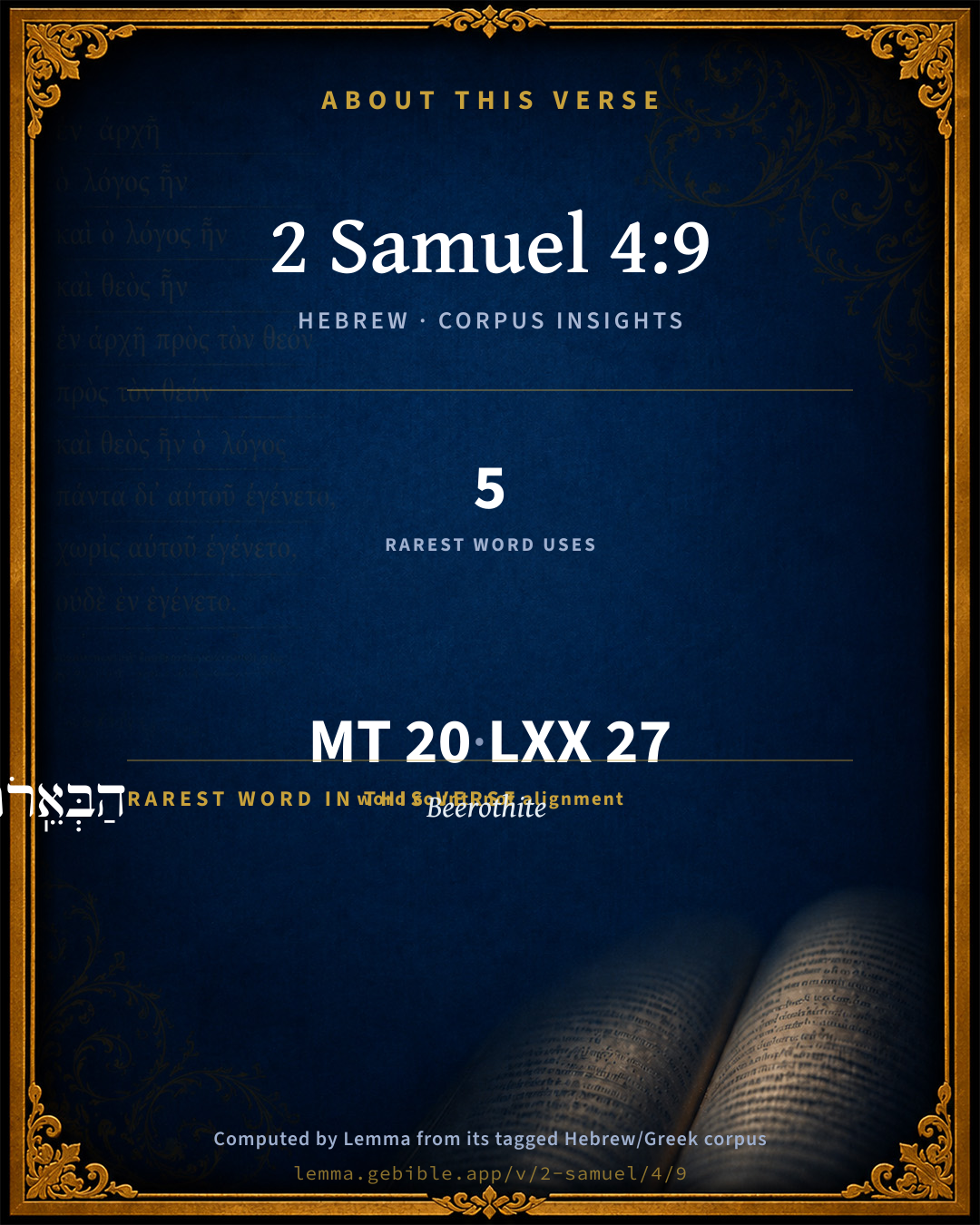
20
words
17
distinct lemmas
Historical
section

Notable vocabulary

The rarest word here is הַבְּאֵֽרֹתִ֖י Beerothite H886 — appearing just 5 times in the whole Hebrew Bible.

Shared distinctive vocabulary

הַבְּאֵֽרֹתִ֖י Beerothite H886 occurs in 5 verses of the Hebrew Bible. Also found in:

Grammatical profile

  • 3 verbs
  • 11 nouns
  • 1 adjective
  • 1 preposition
  • 4 particles

Verb forms

  • וַיַּ֨עַן Qal · Sequential Imperfect
  • וַיֹּ֣אמֶר Qal · Sequential Imperfect
  • פָּדָ֥ה Qal · Perfect

Hebrew & Septuagint length

In English translation the verse runs 29 words from the Hebrew and 32 from the Septuagint (LXX English) — closely comparable.

A rough comparison of the two English renderings, which tokenize alike — not a word-level alignment.

Word counts can differ between the Hebrew and the Greek without any difference in meaning — e.g. the Hebrew direct-object marker אֵת has no separate Greek word, and Greek often adds the article ὁ.

In the original languages it is 20 Hebrew tokens and 27 Greek tokens — but the two are counted differently (Hebrew bundles its prefixes and suffixes into one token; the Greek is in lemma form), so that isn’t a like-for-like length.

Cross-references

11

Topical passages linked to 2 Samuel 4:9 in the Treasury of Scripture Knowledge — connected by theme and wording, ordered by reader-vote popularity; previews shown in the World English Bible.

  • Genesis 48:16 the angel who has redeemed me from all evil, bless the lads, and let my name be named on them, and the name of my fathers Abraham and Isaac. Let them grow into a multitude in the midst of the earth."
  • 1 Kings 1:29 The king swore, and said, As Yahweh lives, who has redeemed my soul out of all adversity,
  • Psalms 34:6–7 This poor man cried, and Yahweh heard him, And saved him out of all his troubles.
  • Psalms 107:2 Let the redeemed by Yahweh say so, Whom he has redeemed from the hand of the adversary,
  • Psalms 34:17 The righteous cry, and Yahweh hears, And delivers them out of all their troubles.
  • Psalms 103:4 Who redeems your life from destruction; Who crowns you with loving kindness and tender mercies;
  • Psalms 31:5–7 Into your hand I commend my spirit. You redeem me, Yahweh, God of truth.
  • Psalms 34:22 Yahweh redeems the soul of his servants. None of those who take refuge in him shall be condemned.
  • Psalms 71:23 My lips shall shout for joy! My soul, which you have redeemed, sings praises to you!
  • Psalms 106:10 He saved them from the hand of him who hated them, And redeemed them from the hand of the enemy.
  • 2 Timothy 4:17–18 But the Lord stood by me, and strengthened me, that through me the message might be fully proclaimed, and that all the Gentiles might hear; and I was delivered out of the mouth of the lion.

Cross-references courtesy of OpenBible.info (CC BY 4.0).

Hebrew and Greek witnesses Masoretic Hebrew ↔ Greek Septuagint

The same verse in the two great witnesses to the Old Testament, shown verse-for-verse.

These are two independent witnesses, not word-aligned to each other, and the Septuagint is shown in lemma (dictionary) form.

Hebrew 2 Samuel 4:9 Masoretic · Westminster Leningrad Codex

וַיַּ֨עַן דָּוִ֜ד אֶת רֵכָ֣ב וְאֶת בַּעֲנָ֣ה אָחִ֗יו בְּנֵ֛י רִמּ֥וֹן הַבְּאֵֽרֹתִ֖י וַיֹּ֣אמֶר לָהֶ֑ם חַי יְהוָ֕ה אֲשֶׁר פָּדָ֥ה אֶת נַפְשִׁ֖י מִכָּל צָרָֽה

David answered Rechab and Baanah his brother, the sons of Rimmon the Beerothite, and said to them, As Yahweh lives, who has redeemed my soul out of all adversity,

World English Bible · Public Domain

Greek LXX 2 Samuel 4:9 Septuagint · lemma form

καί ἀποκρίνω δαυίδ ὁ ρεκχα καί ὁ βαανα ἀδελφός αὐτός υἱός ρεμμων ὁ βηρωθαίου καί εἶπον αὐτός ζάω κύριος ὅς λυτρόω ὁ ψυχή ἐγώ ἐκ πᾶς θλῖψις

And David answered and Rechab and Baana his brother, the sons of Remmon the Berothite, and said to them, As the Lord lives, who has redeemed my soul out of all affliction;

LXX2012 (modern English Septuagint) · Public Domain

Hebrew: Westminster Leningrad Codex (CC BY 4.0). Greek: Septuagint (public domain); English from LXX2012 (modern English Septuagint) (Public Domain). How the Septuagint differs from the Hebrew →

Targum (Aramaic paraphrase)

1

The Targum is the ancient Jewish Aramaic paraphrase of the Hebrew Scriptures — an interpretive translation, not the Hebrew text itself. Onkelos (literal) and Pseudo-Jonathan (expansive) render the Torah, and Jonathan the Prophets. Coverage is partial: where no permissively-licensed English translation exists for a verse, only the Aramaic is shown. This is verse-level text, not a word-by-word alignment to the Hebrew.

  1. Targum Jonathan Prophets (Joshua–Malachi)
    וַאֲתֵיב דָוִד יַת רֵכָב וְיַת בַּעֲנָה אֲחוּהִי בְּנֵי רִמוֹן דְמִבְּאֵרוֹת וַאֲמַר לְהוֹן קַיָם הוּא יְיָ דִי פְרַק יַת נַפְשִׁי מִכָּל עָקָא:

    (no public-domain English translation for this verse)

    Targum Jonathan — Aramaic: “Mikraot Gedolot” (public domain). English: “Sefaria Community Translation” (CC0 1.0 (public-domain dedication)); “London "Chaldee Paraphrase," 1871” (public domain). Text via Sefaria.

Commentary

Notes on 2 Samuel 4:9 from classic Christian and Jewish commentators (each source and its license shown beneath its notes). The classic Christian expositions comment on the surrounding passage and are grouped to its opening verse, so a note may address several verses; the Jewish commentaries on the Tanakh (Rashi and others) are per-verse, so they appear only where the commentator wrote on this verse.

Lemma curates 59 commentaries, every one of them public domain or Creative Commons licensed, each selected and text-cleaned for this edition rather than reprinted as found. About our sources →

Matthew Henry's Commentary

We have here justice done upon the murderers of Ish-bosheth.

I. Sentence passed upon them. There needed no evidence, their own tongues witnessed against them; they were so far from denying the fact that they gloried in it. David therefore shows them the heinousness of the crime, and that blood called for blood from his hand, who was now the chief magistrate, and was by office the avenger of blood. And, perhaps, he was the more vigorous in the prosecution because for reasons of state he had spared Joab: "Shall I not require the blood of the slain at the hand of the slayers, and, since they cannot make restitution, take theirs instead of it?" Observe, 1. How he aggravates the crime, Sa2 4:11. Ish-bosheth was a righteous person, he had done them no wrong, nor designed them any. As to himself, David was satisfied that what opposition he gave him was not from malice, but mistake, from an idea he had of his own title to the crown, and the influence of others upon him, who urged him to put in for it. Note, Charity teaches us to make the best, not only of our friends, but of our enemies, and to think those may be righteous persons who yet, in some instances, do us wrong. I must not presently judge a man a bad man because I think him so to me. David owns Ish-bosheth an honest man, though he had created him a great deal of trouble unjustly. The manner of it much aggravated the crime. To slay him in his own house, which should have been his castle, and upon his bed, when he was in no capacity of making any opposition, this is treacherous and barbarous, and all that is base, and that which the heart of every man who is not perfectly lost to all honour and humanity will rise with indignation at the thought of. Assassinating is confessedly the most odious and villainous way of murdering. Cursed is he that smiteth his neighbour secretly. 2. He quotes a precedent (Sa2 4:10): he had put him to death who had brought him the tidings of the death of Saul, because he thought it would be good tidings to David. Nothing is here said of that Amalekite's helping Saul to kill himself, only of his bringing the tidings of his death, by which it should seem that the story he told was upon enquiry found to be false, and that he lied against his own head. "Now" (says David) "did I treat him as a criminal, and not a favourite" (as he expected), "who brought me Saul's crown, and shall those be held guiltless that bring me Ish-bosheth's head?" 3. He ratifies the sentence with an oath (Sa2 4:9): As the Lord liveth, who hath redeemed my soul out of all adversity. He expresses himself thus resolutely, to prevent the making of any intercession for the criminals by those about him, and thus piously to intimate that his dependence was upon God for the putting of him in possession of the promised throne, and that he would not be beholden to any man to help him to it by any indirect or unlawful practices. God had redeemed him from all adversity hitherto, helped him over many a difficulty and through many a danger, and therefore he would depend upon him to crown and complete his own work. He speaks of his redemption from all adversity as a thing done, though he had many a storm yet before him, because he knew that he who had delivered would deliver. 4. Hereupon he signs a warrant for the execution of these men, Sa2 4:12. This may seem severe, when they intended him a kindness in what they did; but, (1.) He would thus show his detestation of the villany. When he heard that the Lord smote Nabal, he gave thanks (Sa1 25:38, Sa1 25:39), for he is the God to whom vengeance belongeth; but, if wicked men smite Ish-bosheth, they deserve to die for taking God's work out of his hand. (2.) He would thus show his resentment of the great affront they put upon him in expecting that he should patronize and reward it; they could scarcely have done him a greater injury than thus to think him altogether such a one as themselves, one that cared not what blood he waded through to the crown.

II. Execution done. The murderers were put to death according to law, and their hands and feet were hung up; not their whole bodies, the law forbade that; but only their hands and feet, in terrorem - to frighten others, to be monuments of David's justice, and to make that to be taken notice of which would recommend him to the esteem of the people, as a man fit to rule, and that aimed not at his own preferment, nor had any enmity to the house of Saul, but only and sincerely designed the public welfare. But what a confusion was this to the two murderers! What a horrid disappointment! And such those will meet with who think to serve the interests of the Son of David by any immoral practices, by war and persecution, fraud and rapine, who, under colour of religion, murder princes, break solemn contracts, lay countries waste, hate their brethren, and cast them out, and say, Let the Lord be glorified, kill them, and think they do God good service. However men may canonize such methods of serving the church and the catholic cause, Christ will let them know, another day, that Christianity was not intended to destroy humanity; and those who thus think to merit heaven shall not escape the damnation of hell.

Matthew Henry's Commentary on the Whole Bible (1708–1710) — public domain (CC PDM 1.0). Text via the HelloAO Bible API.

Trapp's Complete Commentary

John Trapp

2Sa 4:9 And David answered Rechab and Baanah his brother, the sons of Rimmon the Beerothite, and said unto them, [As] the LORD liveth, who hath redeemed my soul out of all adversity,

Ver. 9. As the Lord liveth.] Sunt verba iurantis, sed abrupta et praecisa: {a} Understand, I will surely punish you.

Who hath redeemed my soul.] And would have freed me from Ishbosheth also in his good time, without your treasonable practices against your lord and master.

{a} Piscat.

John Trapp, A Commentary or Exposition upon All the Books of the Old and New Testament (1647–1656) — public domain. Text from a community e-Sword module.

The Biblical Illustrator

Joseph S. Exell

2Sa_4:9-12

And David answered Rechab and Baanah his brother.

Nobleness and selfishness

We praise Caesar for slaying the man who brought intelligence of Pompeys death; let us have some reverent regard for this passion in the heart of David--this loyalty and all but adoration for the man who was king of Israel.

1. Those who did not understand David, or took narrow and partial views of his character, imagined that they could always please him by relating some misfortune that had befallen the house of Saul. King Saul had a son who was of weak mind and of weak body, inanimate, dependent largely upon others for all that he was and did, especially dependent upon his uncle Abner. This man was accustomed to take a mid-day sleep. He went up into his room one mid-day to slumber, and there went in upon him two young men, Baanah and Rechab by name, and they made as though they would have fetched wheat from the royal residence, and when they found Ishbosheth asleep they smote him under the fifth rib and beheaded him, and ran through the plain all night until they reached Hebron, and when they found David they said, The Lord hath avenged His servant; here is the head of the son of king Saul. David seems to have taken the large and true view of these men who brought him tidings which they thought would have pleased him. He said, They are essentially mean men; their meanness in this case counts for me, but I will none of them--hang them, drown them, burn them--they only want an opportunity to thrust the dagger under my fifth rib that they have drawn from the life of Ishbosheth. We would teach this lesson especially to the young, and make it very clear to them, and write it upon their hearts and upon their minds, that they who would do a mean trick for us would not hesitate to do a mean trick against us.

2. It is not enough to be clever in life--we must always be right. There is nothing more contemptible than cleverness when it is dissociated from integrity. Always endeavour to avoid a merely clever person. Cleverness is a two-edged instrument, cleverness is a word you may apply to a thimble-rigger. Keep the word cleverness for very small occasions and for very small persons. Associate it with moral sensibility, associate it with the moral virtues, and it becomes proportionately dignified. The first thing you have to make out in all life is, what is right. That ye may be sincere. What does that word sincere mean? It is two Latin words in one, and it means without wax, a term employed in describing the quality of honey, without wax. Or it is a Greek word, which refers to porcelain, and the meaning of it is that if the china be held up between the eye and the sun, it is sincere, without speck or flaw or breach. What should we look like if Christ were to take us up and look at us as we look critically at porcelain? That is the only true view to take of ourselves. Judging ourselves by ourselves we become fools; by social standards we are all respectable and good and fair and decent and honourable, but the grand test is the law of Divine rectitude, the standard and the balance of the sanctuary of heaven.

3. The real test of success is at the end. We never know what an action is, as to its real value, until we reach the end. Things may look tolerably well in the process--there is a way that seemeth right unto a man, but the end thereof is death. What talk Baanah and Rechab had that night as they hurried across the plain, what pictures they drew how David would receive them, how he would house them in the royal palace, how he would show them to the military and to the populace, and call for loud huzzas, how they would be the brothers whom the king would delight to honour, riding upon his noblest steeds, and for the time being sit at the front of his ranks and crowned with glory and honour. They went to Hebron, and never left it. The men were to be promoted--were promoted to the gallows. The clever men died as the fool dieth, and the earth was not allowed to have their bones. Let us be instructed by the narrative, for it may be even so with some of our own purposes and schemes. A thing is only everlasting, in its consolations and honours in proportion as it is genuinely right. Is our trade, is our purpose, is our programme, is our policy, is our set in life right. If so, we have succeeded even before we have begun.

4. Behold the contrast between nobleness and selfishness, as seen in David and in those who brought him tidings concerning the fate of Saul, and the ill-luck of his child. There are moments when a man is almost God; and it was so with David in this case. He had his moments of fretfulness about Saul, and his moments of supreme fear, but in his heart he loved the grand old king of Israel; and where there is a supreme love it rises above everything, and sacrifices everything that would oppose its sovereign sway. Have we any supreme love? Is our heart ever washed by a great tide of loving emotion about any man, woman, or little child? Then blessed are we; that river rises sometimes and submerges the whole life, and bears away all the ill-thinking and ill-behaviour of many days. Let us not allow our emotions to be talked down, nor allow the fountain of our tears to be sealed up so that it cannot be broken on any occasion. Sometimes it is good for the heart to sink under its own tears; it comes up out of that baptism sweeter and fresher than ever.

5. Beware of taking narrow views of life, then. The young Amalekite and Baanah and Rechab were men who saw only little points in a case. They were wanting in mental apprehensiveness and in moral expansion. There are many such Men in the world, keen as a hawk in seeing little points, blind as a mole in beholding the measure of a circumference. Let us pray for that enlargement of mind which sees every aspect of a question. (J. Parker, D. D.)

.

The Biblical Illustrator, edited by Joseph S. Exell (c. 1880s–1900s) — public domain. Text from a community e-Sword module.

Joseph Benson's Commentary

2Sa 4:9. David answered Rechab and Baanah, &c. — Together with this thankful acknowledgment of God’s care of him in all his straits and adversities, he suggests to them that he needed not the help of such men as they were, nor of the commission of wicked acts for his future preservation and advancement. “It was from God only that he sought for deliverance from his troubles and enemies; and he that doth so needeth not the aid of treachery. Even they that need it are often observed to punish it; they that need it not, always will. And surely vindictive justice is then seen in its greatest glory when it is exerted in the chastisement of guilt committed against an enemy; for then no mist either of partiality or prejudice can misguide or obscure it.” — Delaney.

Joseph Benson's Commentary on the Old and New Testaments (1811–1818) — public domain. Text from a community e-Sword module.

Tyndale Open Study Notes

Tyndale Open Resources

4:9-11 Someone once told me: Cp. 1:1-16.

Tyndale Open Study Notes — © Tyndale Open Resources, licensed CC BY-SA 4.0. Text via the HelloAO Bible API.

Adam Clarke's Commentary

Verse 9. Who hath redeemed my soul out of all adversity] This was, in David's case, a very proper view of the goodness and watchful providence of God towards him. His life was frequently in danger; murderers had often laid wait for it: but God, the living God, had always redeemed that life from all adversity; and called on him now to punish such evil-minded and blood-thirsty men.

Adam Clarke's Commentary on the Bible (1810–1826) — public domain. Text from a community e-Sword/MySword module.

Ellicott's Commentary for English Readers

(9) Who hath redeemed.—David’s answer shows that he could trust in God to avenge him, and did not encourage or need the crimes of men to help him.

A Bible Commentary for English Readers, edited by Charles John Ellicott (1878–1897) — public domain. Text from a community e-Sword module.

The Cambridge Bible for Schools and Colleges

gen. ed. J. J. S. Perowne

9. who hath redeemed, &c.] Compare the same oath in David’s mouth in 1Ki_1:29. In this connexion it implies that one who was under God’s protection had no need to commit crimes for his own defence.

The Cambridge Bible for Schools and Colleges (gen. ed. J. J. S. Perowne; Cambridge University Press, 1878–1918) — public domain. Text from a community e-Sword module.

John Gill's Exposition

When one told me, saying, behold, Saul is dead,.... No more is related, not that he killed him, or assisted in killing him, only that he was dead; by which it appears, as Abarbinel thinks, that the Amalekite did not slay Saul, and that David did not put him to death on that account, but for what follows:

thinking to have brought good tidings; which would have been very acceptable to David, that he would have rejoiced and exulted at it as he did; but he was mistaken; instead of that,

I took hold of him, and slew him at Ziklag; that is, ordered one of his young men to lay hold on him, and slay him, as he did, Sa2 1:15,

who thought that I would have given him a reward for his tidings; a handsome present, as the Targum here, a gift, or raised him to some post of honour and profit.

John Gill's Exposition of the Whole Bible (1746–1763) — public domain (CC PDM 1.0). Text via the HelloAO Bible API.

Matthew Poole's English Annotations

Who hath hitherto delivered and will deliver me from all mine enemies. So that I needed not your wicked help in this way.

Matthew Poole's English Annotations on the Holy Bible (1683–1685) — public domain. Text from a community e-Sword/MySword module.

The Pulpit Commentary

Vers. 9, 10. And David answered. David"s answer is worthy of him. His appeal to Jehovah, as One that had saved him in all time of adversity, was a declaration that he had no need of criminals. And throughout he had carefully abstained from taking any steps to bring about the accomplishment of God"s will, and had been upright and forbearing alike to Ishbosheth and Saul. How noble his conduct was we see by the contrast with Macbeth, whose better nature was poisoned and spoiled by the hope that he should be king hereafter. At the end of the verse the force is weakened in the Authorized Version by the insertion of irrelevant words. What David said is, "I slew him in Ziklag, and that was the reward I gave him for his tidings.

Vers. 9-11. (HEBRON.)

A good man"s motto.

Jehovah liveth, who hath redeemed my soul out of all adversity," etc.

1. An oath, such as David took, is properly an act of worship a directand solemn appeal to God as a witness, in confirmation of an assertion or of a promise or expressed obligation. There is implied an imprecation of Divine displeasure if the truth be not spoken or the engagement be not fulfilled. It was customary from ancient times; (Gen_14:22 Gen_21:23) often enjoined in the Law (Deu_6:13; Exo_22:10) and served important purposes. (Heb_6:16) Nor is it absolutely prohibited under the Christian dispensation (Mat_26:63; Rom_1:9; 2Co_1:23; Php_1:8) "The Saviour forbids absolutely such oaths only as are hostile to the reverence that is due to God" (Tholuck, "Serm. on the Mount;" Hodge, "Syst. Theology," 3:307; Paley; Dymond, "Essays").

2. Baanah and Rechab virtually claimed the Divine sanction to their deed, which, they said, was an act of judgment on David"s enemies, and a means of preserving his life. But David could not admit their claim, and would have no part in their crime, however it might seem to promote his.interest; and (lifting up his right hand toward heaven, (Deu_32:40) he appealed to the living God, on whom, and not on man, least of all on man"s wickedness, the preservation of his life depended, in confirmation of his purpose to inflict upon them the punishment of death, which was more richly deserved by them than by one on whom he formerly inflicted it when he confessed to a similar deed.

3. His appeal, considered with reference to the principles and feelings itinvolved, may be regarded as a statement of the motto of his life and expressive of

I BELIEF IN THE LIVING GOD. "Living (is) Jehovah," equivalent to "as surely as Jehovah liveth" (Jud_1:8:19; Rth_3:13; 1Sa_20:3 1Sa_25:34 1Sa_29:6; Jer_38:16, "who has made for us this soul "Along with the name of God, the person swearing would at the same time designate his other attributes, his power and greatness, or whatever else of the essence of this God appeared to him at the moment of swearing of special significance" (Ewald, "Antiquities"). "Jehovah liveth" (2 Samuel. (1Sa_17:26) A godly man believes in:

1. His actual existence and self-originated, personal, independent life. With him "is the fountain of life". (Psa_36:9) He "hath life in himself". (Joh_5:26) He "only hath immortality". (1Ti_6:16) The life of all creatures he gives, sustains, or takes away as it pleases him.

1. His immediate presence and accurate observation of everything as it really is, every thought, word, and action; and his approbation or disapprobation of it, according to its moral character. He is "a true and faithful Witness" (Jer_42:3; Isa_65:16)

2. His active intervention in human affairs, with wisdom and might, justice and mercy. "He is the living God, and an everlasting King" (Jer_10:10), and gives to every man his due reward. (Heb_11:6) Faith is not merely a general persuasion of these sublime truths, but also an intense realization of them, and a personal surrender to their influence. It is "an intelligent conviction of the truth, a hearty affection for the truth, and a practical submission to the truth.

II GRATITUDE FOR PAST DELIVERANCE. "Who hath redeemed my soul out of all adversity an expression often on the lips of David (1Ki_1:29; Psa_25:22 Psa_34:22 Psa_103:4 Psa_116:8) and never uttered without thankfulness to God.

1. The path of even a good man is beset by many dangers. What a scene of peril was David"s life from his youth upwards! (2Sa_19:7)

2. He traces his deliverance from them to the hand of God, and sees therein an evidence of his loving, constant, and distinguishing care for his "soul.

3. He is wont to cherish the recollection of such deliverance; and is incited thereby to "speak the praise of the Lord." Nothing is more becoming or beneficial than a thankful spirit; but it is by no means a common possession.

Some murmur when their sky is clear And wholly bright to view, If one small speck of dark appear In their great heaven of blue;

And some with thankful love are filled, If but one streak of light, One ray of God"s good mercy, gild The darkness of their night. (Trench.)

III CONSCIOUSNESS OF PRESENT RESPONSIBILITY. A good man feels that he is accountable to God; not impelled by forces over which he has no control, nor liberated from moral law; but, whilst free to act, bound by the highest motives to obey. His faith in the living God quickens his conscience, and shows him plainly the way of duty; his gratitude for past deliverance incites him to walk therein.

1. By abhorring that which is evil, and avoiding it.

2. By sincerity of heart, speaking the truth, and doing what is just andright.

3. By using the authority and power entrusted to him, not according to hisown will and for selfish ends, but according to the will of God, and for his honour and the welfare of men. His motto is Ich dien ("I serve"). He ever lives under a sense of obligation, and finds in faithful service his strength and joy. (Joh_4:34) "I must work". (Joh_9:4) "Remember now and always that life is no idle dream, but a solemn reality; based upon eternity, and encompassed by eternity. Find out your task: stand to it: the night cometh when no man can work" (Carlyle).

IV CONFIDENCE IN FUTURE PRESERVATION. The path of peril is not yet past. But a good man looks to God rather than to men to protect him against the wrath of men and deliver him from all evil. And his confidence is strong, because of:

1. His conviction of the Divine faithfulness. "Jehovah liveth," to fulfil bothhis promises and his threatenings.

2. His experience of the Divine favour. (see 1Sa_17:32-37)

3. His obedience to the Divine will, and express assurances of safety and ofa "crown of life" to every faithful servant. "The righteous hath hope in his death." "Into thine hand I commit my spirit: thou hast redeemed me, O Lord God of truth". (Psa_31:5) "The foundation of David"s character is a firm unshaken trust in Jehovah, a bright and most spiritual view of creation and the government of the world, a sensitive awe of the Holy One of Israel, a striving ever to be true to him, and a strong desire to return after errors and transgressions" (Ewald). D.

Redemption from all adversity.

the Lord liveth, who hath redeemed my soul out of all adversity." An expansion of the form of oath common with the Hebrews, "As the Lord liveth." By adding the words, "who hath redeemed," etc., David reminded himself of the goodness of God to him, and kept alive and expressed his gratitude. The same form of oath as used by him occurs in 1Ki_1:29. (where the words of the original are precisely the same) Occurring thus at the beginning and the end of his reign, we may reasonably conclude that it was employed in the intervening years, reminding him, in the height of his prosperity and power, of the days of adversity which had preceded them, and of him who had rescued and exalted him. This representation of God would probably be more helpful to the piety of David than grander but more general conceptions of him. So shall we find it well to include in our thought of God what he has been to us and done for us individually. (comp. Gen_48:15, Gen_48:16) As to the words: "redeemed" is not to be taken here in the signification suggested by its etymology, "bought back," "ransomed," but simply "delivered:" The use of the words, "my soul," must not lead us to suppose that David is thinking of the "redemption of the soul" in the spiritual sense. He refers to his deliverance from the perils, hardships, and anxieties of his previous life, through the enmity of Saul and his attempts to destroy him. The phrase is substantially equivalent to "me," though it may suggest that the seat of all the "distress" that attends adversity is the soul. The words are suitable to be used

I IN VIEW OF ACTUAL DELIVERANCE FROM VARIED OR PROLONGED TROUBLES. As David used them. They recognize and call to mind:

1. The extent of the deliverance. "From all adversity." The reference is to the past. David did not mean that he had done with adversity. Nor can we in this world use the words in that sense; but as from time to time troubles arise out of which we are delivered, be they adversities in the ordinary sense, or troubles of the soul strictly (temptations, conflicts, falls, pangs of remorse, fears, insensibility, gloom), let us mark and record our deliverance.

2. The Deliverer. "The Lord," Jehovah, the God who "liveth." Not self, not men, but God. David had employed his own great powers of thought and action, and had been well served by human helpers, but he does not ascribe his deliverance to the one or the other, but to God. He well knew that all power for self-help, and all human helpers, are the gift of God; that they are effectual through his working with them; and that apart from them God operates in ways transcendental and inexplicable. The greatness and variety of his troubles, the imminence of his perils, the wondrous special incidents which had contributed to his deliverance, all rendered conspicuous the hand of God. To him, therefore, he gave the glory. Most of our lives will, if carefully reviewed, furnish similar proofs of the operation of the living God, not merely of matter and dead laws, and of friends. And we should gratefully recognize and confess his goodness. Hence will spring humility, continuance and increase of thankfulness, and also confidence and hope in respect to future adversities (see 2Co_1:10; 2Ti_4:17, 2Ti_4:18)

II IN VIEW OF THE REDEMPTION FROM ALL EVIL EFFECTED FOR US BY OUR LORD JESUS CHRIST. The word "redeem" will in this case have the full signification of "ransom by payment of a price." We have "redemption through his blood, the forgiveness of sins." In redeeming us from our sins, he redeemed us from all kinds and degrees of evil. All who accept him as their Redeemer and Lord are thus assured of complete deliverance from all that now distresses them, and from all in the future world that would have distressed them but for his redeeming work; and, in the certainty that the purposes of his death will be accomplished, may speak of their deliverance as already effected. Nor can they fail to remember with unutterable thankfulness and perpetual thanksgiving the redemption thus wrought for them.

III BY THOSE WHO HAVE EXPERIENCED FINAL AND COMPLETE DELIVERANCE FROM ALL THE EVILS OF THIS PRESENT WORLD. What a blessed thing it will be to look back on all the evils of this present state, including death itself, as actually past! and to look forward to an eternity of complete freedom from evil, of full enjoyment of good! No sin, no want, no sickness, no pain, no sorrow, no peril; but perfect peace, perfect service of God, perfect communion with him, "fulness of joy" and "pleasures forevermore" (Psa_16:11; Rev_7:14-17 Rev_21:4) And evermore will the "redeemed from the earth" be mindful of their Deliverer, and unite in praise of God and the Lamb. In view of this glorious and complete redemption:

1. Let Christians be patient and thankful while enduring the adversitieswhich belong to their condition on earth.

2. Take heed lest, redemption being effected, you fail to attain to its actualexperience. To reject Christ is to reject deliverance from death and misery. G.W.

The Pulpit Commentary (1880–1919), ed. H.D.M. Spence-Jones & Joseph S. Exell — public domain. Text from a community e-Sword module.

Keil & Delitzsch

C. F. Keil & F. Delitzsch

But David rewarded them very differently from what they had expected. He replied, "As Jehovah liveth, who hath redeemed my soul out of all adversity, the man who told me, Behold, Saul is dead, and thought he was a messenger of good to me, I seized and slew at Ziklag (vid., Sa2 1:14-15), to give him a reward for his news: how much more when wicked men have murdered a righteous man in his house upon his bed, should I not require his blood at your hand, and destroy you from the earth?" The several parts of this reply are not closely linked together so as to form one period, but answer to the excited manner in which they were spoken. There is first of all the oath, "As truly as Jehovah liveth," and the clause appended, "who redeemed my soul," in which the thought is implied that David did not feel it necessary to get rid of his enemies by the commission of crimes. After this (Sa2 4:10) we have an allusion to his treatment of the messenger who announced Saul's death to him, and pretended to have slain him in order that he might obtain a good reward for his tidings. כּי, like ὅτι, simply introduces the address. בּעיניו ... המּגּיד is placed at the head absolutely, and made subordinate to the verb by בו after ואחזה. לתתּי־לו, "namely, to give him." עשׁר is employed to introduce the explanation, like our "namely" (vid., Ewald, 338, b.). בּשׂרה, good news, here "the reward of news." The main point follows in Sa2 4:11, beginning with כּי אף, "how much more" (vid., Ewald, 354, c.), and is introduced in the form of a climax. The words משׁכּבו ... אנשׁים are also written absolutely, and placed at the head: "men have slain," for "how much more in this instance, when wicked men have slain." "Righteous" (zaddik), i.e., not guilty of any wicked deed or crime. The assumption of the regal power, which Abner had forced upon Ishbosheth, was not a capital crime in the existing state of things, and after the death of Saul; and even if it had been, the sons of Rimmon had no right to assassinate him. David's sentence then follows: "And now that this is the fact, that ye have murdered a righteous man, should I not," etc. בּער, to destroy by capital punishment, as in Deu 13:6, etc. דּם בּקּשׁ (=דּם דּרשׁ, Gen 9:5), to require the blood of a person, i.e., to take blood-revenge.

Keil & Delitzsch — Biblical Commentary on the Old Testament (1861–1891) — public domain (CC PDM 1.0). Text via the HelloAO Bible API. (Old Testament only.)

Scofield Reference Notes

C. I. Scofield

redeemed

(See Scofield "Isa 59:20") See Scofield "Exo 14:30".

The Scofield Reference Bible (1917 edition), notes by C. I. Scofield — public domain. Text from a community e-Sword module.

Kretzmann's Popular Commentary

Paul E. Kretzmann

The Murder Avenged

v. 9. And David answered Rechab and Baanah, his brother, the sons of Rimmon, the Beerothite, and said unto them, As the Lord liveth, who hath redeemed my soul out of all adversity, from all the suffering with which he had been afflicted, thus putting him beyond the necessity of freeing himself from his enemies by crime,

v. 10. when one told me, saying, Behold, Saul is dead, namely, the Amalekite who came to Ziklag, 2Sa 1:2, thinking to have brought good tidings, literally, "and he was as a bringer of good tidings in his own eyes," I took hold of him and slew him in Ziklag, who thought that I would have given him a reward for his tidings, or, in order to give him the reward, to inflict on him the punishment which he deserved;

v. 11. how much more, when wicked men have slain a righteous person in his own house upon his bed? Ishbosheth, although connected with a wrong cause, was himself without falsehood and blameless; he was not out on a raiding expedition or engaged in anything wrong, but was at home, doing no one any harm. Shall I not, therefore, now require his blood of your hand, God Himself being the chief avenger of blood and the king His instrument in carrying out justice upon the murderers, and take you away from the earth?

v. 12. And David commanded his young men, and they slew them, and cut off their hands, which had committed the murder, and their feet, which had hurried after the reward, and hanged them up over the pool in Hebron, a public place visited by many people, as a testimony to David’s just severity against criminals of this kind. But they took the head of Ishbosheth, which the murderers had brought along as a trophy of their deed, and buried it in the sepulcher of Abner in Hebron. Note: As David finally subdued all his enemies who challenged his right to be king over Israel, so Christ, the Son of David, having conquered all enemies of mankind, will finally obtain the eternal victory.

Paul E. Kretzmann, Popular Commentary of the Bible (1921–1924) — public domain. Text from a community e-Sword module.

Lesson kit

Teaching starters — assembled from the data on this page, not authored interpretation. Every prompt links to the verse data it draws on. Edit before teaching.

2 Samuel, in the Historical, opens this verse with 20 words (17 distinct Hebrew lemmas). Its most distinctive word is Bᵉʼêrôthîy (“Beerothite”). A historical commentator’s framing appears above. Read the whole chapter for the surrounding context.

Discussion questions

  1. What does “Beerothite” (Bᵉʼêrôthîy) contribute to the verse as a whole?
  2. 2 Samuel 4:2 shares the word «Beerothite» with this verse. How do the two illuminate each other?
  3. These translations render this verse differently; the difference is in the English rendering, not the original. What questions does that raise?
  4. The verb «וַיַּ֨עַן» is Qal Sequential Imperfect. How does its form color the action?
  5. Reading how Matthew Henry's Commentary and Trapp's Complete Commentary read this verse, where do the two commentators agree and where do they part?

Things to notice

Reading settings

Reading text

Shown beneath each verse's original-language words.

Old Testament
Old Testament edition

Read the OT as the Masoretic Hebrew (MT) or the Greek Septuagint (LXX).

English shown for the Greek Septuagint (in the Hebrew ↔ Greek comparison).

Comparing translations? Open the Compare panel on any verse page to stack up to four side by side.