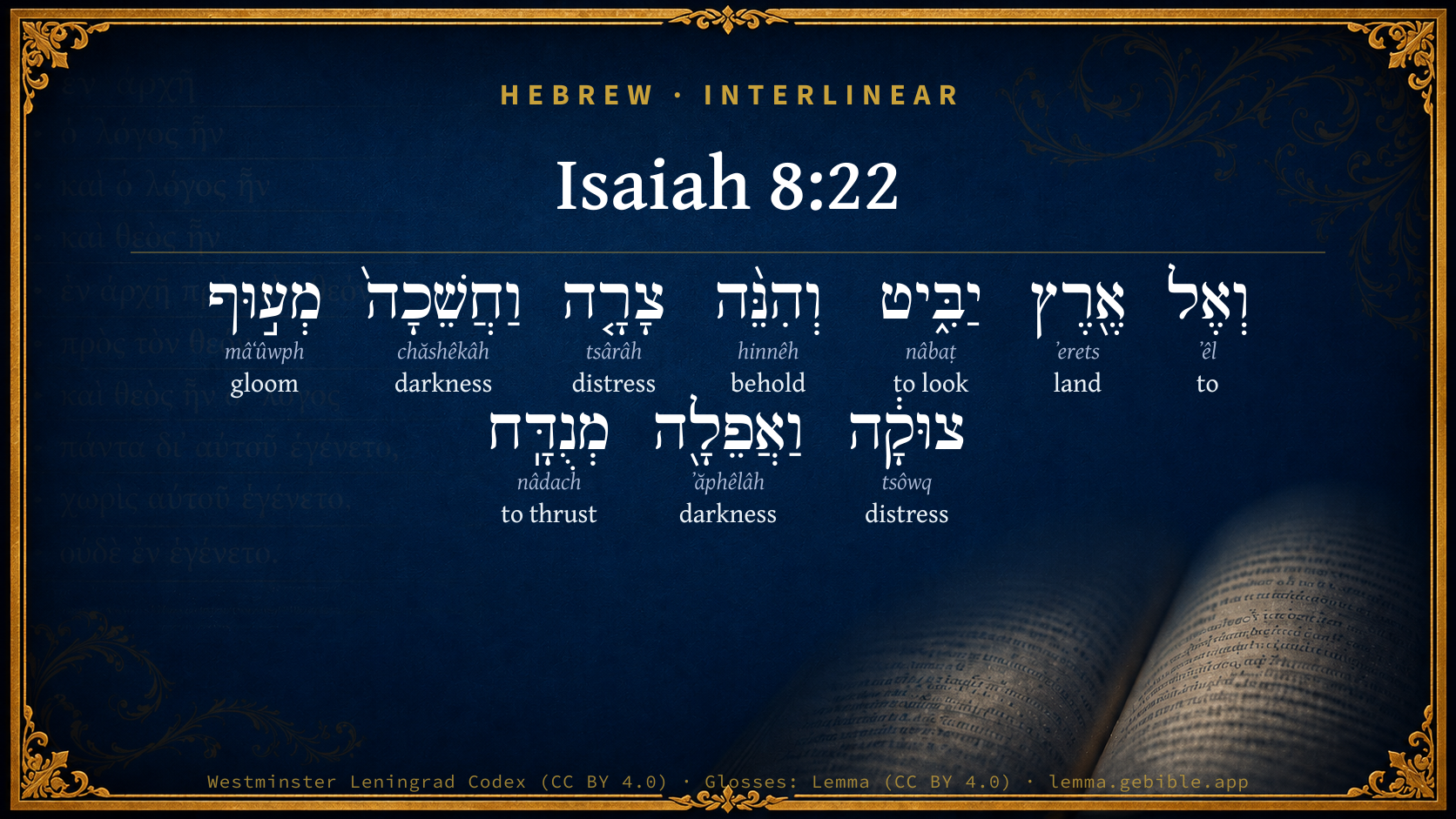
Isaiah 8:22

Hebrew (Westminster Leningrad Codex) Isaiah 8:22 appears in the Hebrew Old Testament. The text above is from the Westminster Leningrad Codex. Each word links to its Strong’s number, a concise gloss, and parsing drawn from the Open Scriptures Hebrew Bible morphology. Click any word for its full Brown-Driver-Briggs (BDB) entry.
Download image
Cite this verse

Isaiah 8:22 (World English Bible). Public Domain. Lemma interlinear Bible study tool, https://lemma.gebible.app/v/isaiah/8/22.

Show BibTeX & RIS
BibTeX
RIS
English Translation
and they shall look to the earth, and see, distress and darkness, the gloom of anguish; and into thick darkness [they shall be] driven away.
World English Bible · Public Domain
Highlights Full analysis ↓
Download a study sheet

One document with this verse’s original text, its word-by-word gloss line, the meaning frame, cross-references with their text, attributed commentary, and full source and license credits — printable, and it pastes into notes with its structure intact.

This verse Autodidact and up

Study sheet (.html) Plain text (.txt)

A passage Seminary Student

Up to 50 verses in one chapter. A passage sheet keeps up to 6 commentary sources and 12 cross-references per verse, in the order this page ranks them, and says so on the sheet whenever that leaves anything out. Ask for a single verse and you get the Autodidact verse sheet above.

Everything on this page stays free to read, with no account — the sheet is a download of what is already on screen, not access to it.

Want to remove ads? Support Godless Engineer
Compare translations 3

The same verse in 3 English versions, stacked beneath the original-language interlinear above. Click any original word for its lexicon entry.

Each is an independent rendering of the whole verse — the interlinear is not word-aligned to these translations.

Highlighted words mark where these versions differ — a whole-verse word diff, not a word-by-word alignment.

  • World English Bible Public Domain
    and they shall look to the earth, and see, distress and darkness, the gloom of anguish; and into thick darkness [they shall be] driven away.
  • King James Version Public Domain
    And they shall look unto the earth; and behold trouble and darkness, dimness of anguish; and they shall be driven to darkness.
  • unfoldingWord Literal Text CC BY-SA 4.0
    and he will look at the earth, and behold, trouble and darkness, gloom of anguish, and thick darkness he will be driven away.

unfoldingWord Literal Text — © unfoldingWord, licensed CC BY-SA 4.0. Word-aligned USFM3 via Door43 (git.door43.org/unfoldingWord/en_ult).

Versions to compare (up to 4)

3 of 4 selected

Show all 18 translations

Every available English version of this verse, each an independent rendering of the whole verse.

  • World English Bible Public Domain
    and they shall look to the earth, and see, distress and darkness, the gloom of anguish; and into thick darkness [they shall be] driven away.
  • Berean Standard Bible Public Domain
    Then they will look to the earth and see only distress and darkness and the gloom of anguish. And they will be driven into utter darkness.
  • Majority Standard Bible Public Domain
    Then they will look to the earth and see only distress and darkness and the gloom of anguish. And they will be driven into utter darkness.
  • King James Version Public Domain
    And they shall look unto the earth; and behold trouble and darkness, dimness of anguish; and they shall be driven to darkness.
  • American Standard Version (1901) Public Domain
    and they shall look unto the earth, and behold, distress and darkness, the gloom of anguish; and into thick darkness `they shall be' driven away.
  • Revised Version (1885) Public Domain
    and they shall look unto the earth, and behold, distress and darkness, the gloom of anguish; and into thick darkness they shall be driven away.
  • Geneva Bible (1599) Public Domain
    And when he shall looke to the earth, beholde trouble, and darkenes, vexation and anguish, and he is driuen to darkenes.
  • Douay-Rheims (1899) Public Domain
    And they shall look to the earth, and behold trouble and darkness, weakness and distress, and a mist following them, and they cannot fly away from their distress.
  • Young's Literal Translation Public Domain
    And unto the land it looketh attentively, And lo, adversity and darkness! -- Dimness, distress, and thick darkness is driven away, But not the dimness for which she is in distress!
  • Literal Standard Version CC BY-SA 4.0
    And it looks attentively to the land, || And behold, adversity and darkness! Dimness, distress, and thick darkness are driven away, || But not the dimness for which she is in distress!
  • Unlocked Literal Bible CC BY-SA 4.0
    They will look at the earth and see distress, darkness, and oppressive gloom. They will be driven into a land of darkness.
  • unfoldingWord Literal Text CC BY-SA 4.0
    and he will look at the earth, and behold, trouble and darkness, gloom of anguish, and thick darkness he will be driven away.
  • Darby Bible Public Domain
    and they will look to the earth; and behold, trouble and darkness, gloom of anguish; and they shall be driven into thick darkness.
  • World Messianic Bible Public Domain
    then look to the earth and see distress, darkness, and the gloom of anguish. They will be driven into thick darkness.
  • Webster's Bible Public Domain
    And they shall look to the earth; and behold trouble and darkness, dimness of anguish; and they shall be driven to darkness.
  • Free Bible Version CC BY-SA 4.0
    Then they will look towards the earth and see only misery and gloom and agonizing depression, and they will be thrown out into the darkness.
  • Bible in Basic English Public Domain
    And he will be looking down on the earth, and there will be trouble and dark clouds, black night where there is no seeing.
  • JPS Tanakh (1917) Public Domain
    or look unto the earth, behold distress and darkness, the gloom of anguish, and outspread thick darkness.

Literal Standard Version (2020), Covenant Press — licensed CC BY-SA 4.0. Text via the HelloAO Bible API (eBible.org). Unlocked Literal Bible (unfoldingWord) — licensed CC BY-SA 4.0. Text via the HelloAO Bible API (eBible.org). unfoldingWord Literal Text — © unfoldingWord, licensed CC BY-SA 4.0. Word-aligned USFM3 via Door43 (git.door43.org/unfoldingWord/en_ult). Free Bible Version, Dr. Jonathan Gallagher — licensed CC BY-SA 4.0. Text via the HelloAO Bible API (eBible.org).

Word by word

More ways to search: Search by grammar → Find every occurrence → Compare this word →

Practice this passage: Drill this verse → Learn its vocabulary →

About this verse

These counts appear in no published source. They are computed here, from the morphology-tagged text and Lemma’s own curated glosses. What Lemma adds →

10
words
10
distinct lemmas
Prophets
section

Notable vocabulary

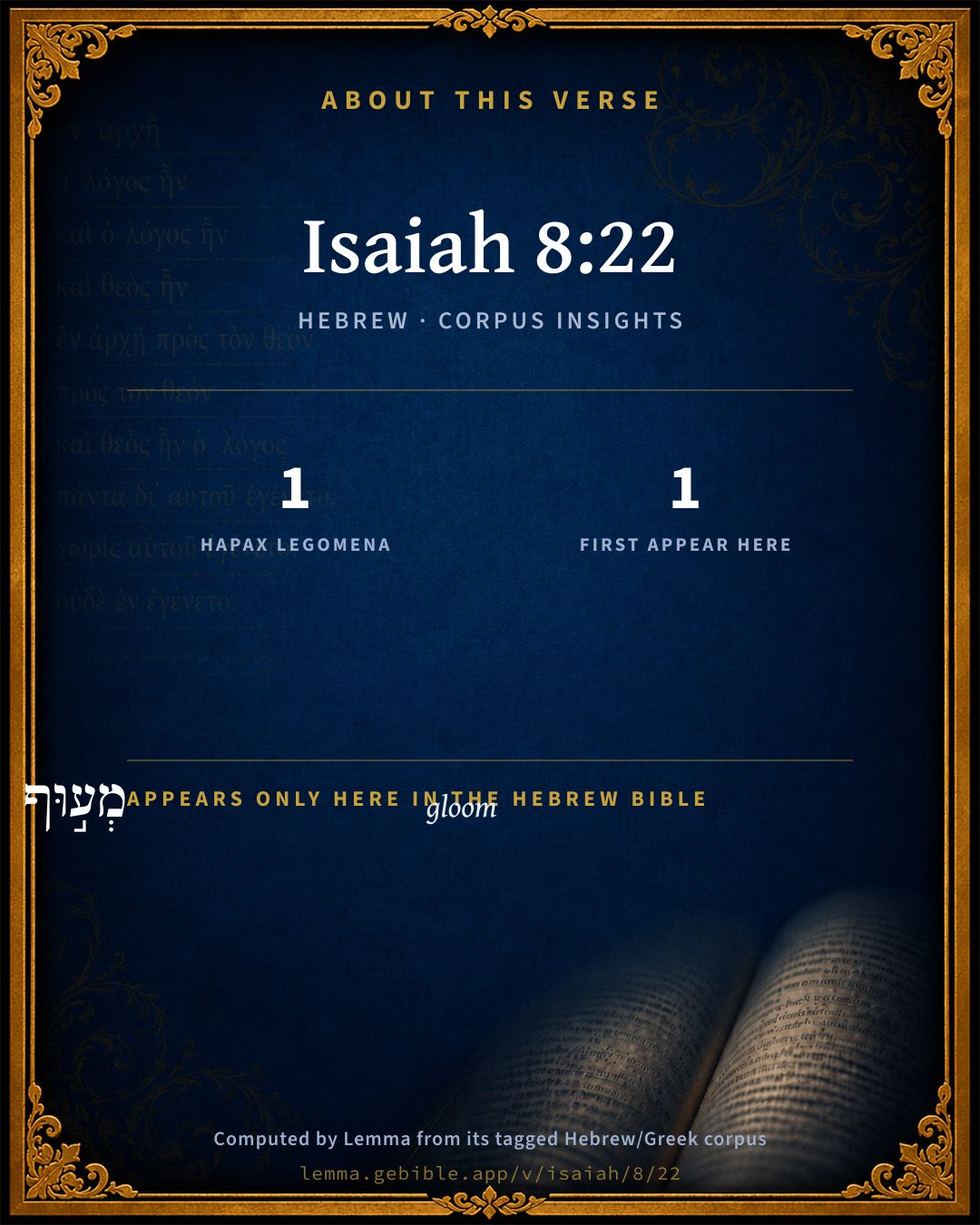
1 hapax legomenon — a word that appears only here in the entire Hebrew Bible:

  • מְע֣וּף gloom H4588

First appearance in Scripture

This word makes its first canonical appearance in the Hebrew Bible here:

  • מְע֣וּף gloom H4588

Shared distinctive vocabulary

צוּקָ֔ה distress H6695 occurs in 4 verses of the Hebrew Bible. Also found in:

Grammatical profile

  • 2 verbs
  • 6 nouns
  • 1 preposition
  • 1 particle

Verb forms

  • יַבִּ֑יט Hiphil · Imperfect
  • מְנֻדָּֽח Pual · Participle Passive

Hebrew & Septuagint length

In English translation the verse runs 25 words from the Hebrew and 38 from the Septuagint (LXX English) — the Septuagint runs noticeably longer here. See the side-by-side →

A rough comparison of the two English renderings, which tokenize alike — not a word-level alignment.

Word counts can differ between the Hebrew and the Greek without any difference in meaning — e.g. the Hebrew direct-object marker אֵת has no separate Greek word, and Greek often adds the article ὁ.

Cross-references

16

Topical passages linked to Isaiah 8:22 in the Treasury of Scripture Knowledge — connected by theme and wording, ordered by reader-vote popularity; previews shown in the World English Bible.

  • Isaiah 5:30 They will roar against them in that day like the roaring of the sea. If one looks to the land, behold, darkness and distress. The light is darkened in its clouds.
  • Jeremiah 13:16 Give glory to Yahweh your God, before he cause darkness, and before your feet stumble on the dark mountains, and, while you look for light, he turn it into the shadow of death, and make it gross darkness.
  • Matthew 8:12 but the children of the Kingdom will be thrown out into the outer darkness. There will be weeping and the gnashing of teeth."
  • Matthew 22:13 Then the king said to the servants, 'Bind him hand and foot, take him away, and throw him into the outer darkness; there is where the weeping and grinding of teeth will be.'
  • Job 18:18 He shall be driven from light into darkness, And chased out of the world.
  • Proverbs 14:32 The wicked is brought down in his calamity, But in death, the righteous has a refuge.
  • Jeremiah 30:6–7 Ask now, and see whether a man does travail with child: why do I see every man with his hands on his loins, as a woman in travail, and all faces are turned into paleness?
  • Zephaniah 1:14–15 The great day of Yahweh is near. It is near, and hurries greatly, the voice of the day of Yahweh. The mighty man cries there bitterly.
  • Jude 1:13 wild waves of the sea, foaming out their own shame; wandering stars, for whom the blackness of darkness has been reserved forever.
  • 2 Chronicles 15:5–6 In those times there was no peace to him who went out, nor to him who came in; but great vexations were on all the inhabitants of the lands.
  • Isaiah 8:20 To the law and to the testimony! if they don't speak according to this word, surely there is no morning for them.
  • Isaiah 9:1 But there shall be no gloom to her who was in anguish. In the former time he brought into contempt the land of Zebulun and the land of Naphtali; but in the latter time has he made it glorious, by the way of the sea, beyond the Jordan, Galilee of the nations.
  • Jeremiah 23:12 Therefore their way shall be to them as slippery places in the darkness: they shall be driven on, and fall therein; for I will bring evil on them, even the year of their visitation, says Yahweh.
  • Amos 5:18–20 "Woe to you who desire the day of Yahweh! Why do you long for the day of Yahweh? It is darkness, And not light.
  • Matthew 24:29 But immediately after the oppression of those days, the sun will be darkened, the moon will not give its light, the stars will fall from the sky, and the powers of the heavens will be shaken;
  • Luke 21:25–26 There will be signs in the sun, moon, and stars; and on the earth anxiety of nations, in perplexity for the roaring of the sea and the waves;

Cross-references courtesy of OpenBible.info (CC BY 4.0).

Hebrew and Greek witnesses Masoretic Hebrew ↔ Greek Septuagint

The same verse in the two great witnesses to the Old Testament, shown verse-for-verse.

Here the Septuagint runs noticeably longer than the Hebrew — LXX2012 (modern English Septuagint) 38 words vs World English Bible 25. A rough length comparison of the two English translations, not a word-level alignment — read both below.

These are two independent witnesses, not word-aligned to each other, and the Septuagint is shown in lemma (dictionary) form.

Hebrew Isaiah 8:22 Masoretic · Westminster Leningrad Codex

וְאֶל אֶ֖רֶץ יַבִּ֑יט וְהִנֵּ֨ה צָרָ֤ה וַחֲשֵׁכָה֙ מְע֣וּף צוּקָ֔ה וַאֲפֵלָ֖ה מְנֻדָּֽח

and they shall look to the earth, and see, distress and darkness, the gloom of anguish; and into thick darkness [they shall be] driven away.

World English Bible · Public Domain

Greek LXX Isaiah 8:22 Septuagint · lemma form

καί εἰς ὁ γῆ κάτω ἐνβλέπω καί ἰδού θλῖψις καί στενοχωρία καί σκότος ἀπορία στενός καί σκότος ὥστε μή βλέπω

and they shall look on the earth below, and behold severe distress, and darkness, affliction, and anguish, and darkness so that one can’t see; and he that is in anguish shall not be distressed only for a time.

LXX2012 (modern English Septuagint) · Public Domain

Hebrew: Westminster Leningrad Codex (CC BY 4.0). Greek: Septuagint (public domain); English from LXX2012 (modern English Septuagint) (Public Domain). How the Septuagint differs from the Hebrew →

Targum (Aramaic paraphrase)

1

The Targum is the ancient Jewish Aramaic paraphrase of the Hebrew Scriptures — an interpretive translation, not the Hebrew text itself. Onkelos (literal) and Pseudo-Jonathan (expansive) render the Torah, and Jonathan the Prophets. Coverage is partial: where no permissively-licensed English translation exists for a verse, only the Aramaic is shown. This is verse-level text, not a word-by-word alignment to the Hebrew.

  1. Targum Jonathan Prophets (Joshua–Malachi)
    וְסָעִיד מִיַתְבֵי אַרְעָא יִבְעֵי אֲרֵי יַיְתֵי עֲלוֹהִי עָקָא כְּפָן וְשַׁלְהֲבֵי עָקָא קְבֵל וּבַדוּר:

    And he shall seek help from the inhabitants of the earth, because there shall come upon him oppression, famine, weariness of oppression, darkness, and dispersion.

    Targum Jonathan — Aramaic: “Mikraot Gedolot” (public domain). English: “Sefaria Community Translation” (CC0 1.0 (public-domain dedication)); “London "Chaldee Paraphrase," 1871” (public domain). Text via Sefaria.

Commentary

Notes on Isaiah 8:22 from classic Christian and Jewish commentators (each source and its license shown beneath its notes). The classic Christian expositions comment on the surrounding passage and are grouped to its opening verse, so a note may address several verses; the Jewish commentaries on the Tanakh (Rashi and others) are per-verse, so they appear only where the commentator wrote on this verse.

Lemma curates 59 commentaries, every one of them public domain or Creative Commons licensed, each selected and text-cleaned for this edition rather than reprinted as found. About our sources →

Trapp's Complete Commentary

John Trapp

Isa 8:22 And they shall look unto the earth; and behold trouble and darkness, dimness of anguish; and [they shall be] driven to darkness.

Ver. 22. Trouble and darkness, &c.] A huge heap of words all to one sense; to set forth their deepest distress without all hope of help.

John Trapp, A Commentary or Exposition upon All the Books of the Old and New Testament (1647–1656) — public domain. Text from a community e-Sword module.

Geneva Bible (1599)

Geneva Bible translators

They shall think that heaven and earth and all creatures are bent against them to trouble them.

Geneva Bible (1599) marginal notes — public domain. Text via Bolls.life.

The Cambridge Bible for Schools and Colleges

gen. ed. J. J. S. Perowne

22. The last words of the previous verse should be taken along with this one: and he shall look upward and shall look to the earth: and behold, &c. Whether he look to heaven or earth, no ray of hope shall appear (cf. ch. Isa_5:30).

trouble and darkness …] Render with R.V. distress and darkness, the gloom of anguish. The word here translated “gloom” is slightly different in form from that in Isa_9:1, and does not occur again.

and they shall … darkness] Probably: and he shall be chased into thick darkness. A somewhat similar phrase in Jer_23:12. Others render: “and darkness shall be driven (upon him)”; others: “but (the) darkness shall be dispelled.”

The Cambridge Bible for Schools and Colleges (gen. ed. J. J. S. Perowne; Cambridge University Press, 1878–1918) — public domain. Text from a community e-Sword module.

John Gill's Exposition

And they shall look unto the earth,.... As persons in distress, upwards and downwards, backwards and forwards, on the right hand and on the left, particularly into the land of Judea; a land that used to flow with milk and honey, a land of light, plenty, and prosperity:

and behold trouble and darkness; adversity, and miseries of all kinds, expressed by a variety of words; and even words fail to express the tribulation of these times, which were such as were not from the beginning of the world, Mat 24:22,

dimness of anguish; or "fleeing from affliction" (e), multitudes everywhere fleeing from one place to another, to avoid the calamities coming upon them, Mat 24:16,

and they shall be driven to darkness; when they endeavour to escape one calamity, they shall be driven and fall into another; the whole land shall be full of nothing else.

(e) a "volare", Forerius.

Next: Isaiah Chapter 9

John Gill's Exposition of the Whole Bible (1746–1763) — public domain (CC PDM 1.0). Text via the HelloAO Bible API.

Albert Barnes' Notes on the Bible

And they shall look unto the earth - They would look upward and find no relief, and then in despair cast their eyes to the earth to obtain help there. Yet equally in vain. The whole image is one of intense anguish brought on the nation for leaving the counselor the true God.

And behold ... - see the note at Isa 5:30.

Trouble - Anguish, oppression, צרה tsârâh, from צור tsûr, to oppress, to straiten, to afflict. This is a remarkable instance of the prophet Isaiah’s manner - of a rapid, impetuous, and bold style of utterance. He accumulates images; piles words on each other; and deepens the anxiety by each additional word, until we almost feel that we are enveloped by the gloom, and see objects of terror and alarm on every side.

Dimness of anguish - These words should be kept separate in the translation - צוּקה מעוּף me‛ûp tsûqâh, “darkness, oppression” - accumulated epithets to heighten the gloom and terror of the scene.

And they shall be driven to darkness - Hebrew, מנדה ואפלה va'ăpēlâh menudāch a darkness that is driven, or that is urged upon itself; that becomes condensed, accumulated, until it becomes terrible and frightful. The idea is that of a driving tempest, or an involving obscurity (מנדה menudāch from נדה nâdâh, to push, thrust, impel, urge on, as a driving storm). The prophet has thus accumulated every possible idea of gloom and obscurity, and probably there is not anywhere a more graphic description of gathering darkness and trouble, and of the consternation of those involved in it, than this. So fearful and terrific are the judgments of God when he comes forth to punish people!

Albert Barnes' Notes on the Bible (1834–1885) — public domain. Text from a community e-Sword/MySword module.

Matthew Poole's English Annotations

They shall look unto the earth; finding no help from heaven, they turn their eyes downward, looking hither and thither for comfort.

Trouble and darkness. &c.; many words expressing the same thing are put together, to signify the variety, and extremity, and continuance of their miseries.

Matthew Poole's English Annotations on the Holy Bible (1683–1685) — public domain. Text from a community e-Sword/MySword module.

Whedon's Commentary on the Bible

Daniel D. Whedon

22. Then from looking upward they look to earth again; to enchantments and sorcery they look, only to feel woes more bitter, and to see forever no dawn, NO dawn.

Trouble… darkness… dimness… anguish — Accumulated images. Each one, as it rapidly flits before Isaiah, deepens the horror of gathering gloom and darkness. So fearful are God’s moral judgments on men when they to the last refuse to look to him for aid and guidance.

Daniel D. Whedon (gen. ed.), Commentary on the Old and New Testaments (1874–1909) — public domain. Text from a community e-Sword module.

The Pulpit Commentary

They shall look unto the earth. For necessary nutriment, or simply as the place to which downcast and despairing eyes are turned naturally. They shall be driven to darkness. So Kay, who thinks the Captivity is meant; but it seems better to render the whole passage, with Mr. Cheyne, "They shall look to earth, and behold, distress and darkness, gloom of affliction, and thick darkness driven (upon them)." The darkness is spoken of as if it were a thing palpable, like rain or snow. (comp. Exo_10:21)

The Pulpit Commentary (1880–1919), ed. H.D.M. Spence-Jones & Joseph S. Exell — public domain. Text from a community e-Sword module.

John Wesley's Explanatory Notes

Earth - Finding no help from heaven, they turn their eyes downward, looking hither and thither for comfort.

John Wesley, Explanatory Notes Upon the Whole Bible (1754–1765) — public domain. Text via the GEBible commentary corpus.

J. A. Alexander on Isaiah

Joseph Addison Alexander

“And to the earth he shall look, and behold distress and darkness, dimness of anguish, and into darkness (he shall be) driven” - or, ‘the dimness of anguish and of darkness is dispelled.’ Heaven and earth are here opposed to one another, as sea and land are in Isa 5:30. Distress and darkness are here identified, as distress and light are there contrasted. This darkness is to be dispelled; “for (there shall) not (be) darkness (forever) to her who is now distressed (literally, to whom there is distress)” (9.1).

Joseph Addison Alexander, The Prophecies of Isaiah (1846–1847; New York: Scribner, 1870–1878) — public domain. Text from a community e-Sword module.

Rashi

Rabbi Shlomo Yitzchaki (Rashi)

And he shall look to the land perhaps he will find aid. [This refers to the incident] that Hoshea son of Elah sent messengers to So the king of Egypt (II Kings 17:4).

and behold distress For they will not aid him, and also Shebna defected to Sennacherib, to his detriment.

weariness of oppression Heb. מְעוּף צוּקָה, weariness of oppression.

and to the darkness he is lost And through the darkness he is lost, for the expression of נִדּוּחַ [applies to darkness], as (Jer. 23:12): “Therefore, their way shall be to them like slippery land in the darkness; they shall be lost and fall upon it.” And to the darkness they shall be lost.

Rashi on the Tanakh — English translations: “The Judaica Press complete Tanach with Rashi, translated by A. J. Rosenberg” (CC BY 4.0); “Pentateuch with Rashi's commentary by M. Rosenbaum and A.M. Silbermann, 1929-1934” (public domain); “The Metsudah Tanach series, Lakewood, N.J” (CC BY 4.0); and “The Book of Joshua, Metsudah Publications, 1997” (CC BY 4.0). Text via Sefaria.

Ibn Ezra

Rabbi Abraham ibn Ezra

מעוף Dimness. Comp. עיפתה darkness (Job 10:22).

מנדח Scattered. Comp. והנדחים And they that are scattered (27:13); the construction of the sentence is perhaps אפלה מנדח ומעוף Dimness of darkness is scattered about; by this construction the masculine form of פנודח is explained.

Ibn Ezra on the Tanakh — English translations: “Sefaria Community Translation” (CC0 1.0 (public-domain dedication)); “Yalkut, Sifsei Chachomim Chumash, Metsudah Publications, 2009” (CC BY 4.0); and “Commentary of Ibn Ezra on Isaiah - trans. by M. Friedlander, 1873” (public domain). Text via Sefaria.

Lesson kit

Teaching starters — assembled from the data on this page, not authored interpretation. Every prompt links to the verse data it draws on. Edit before teaching.

Isaiah, in the Prophets, opens this verse with 10 words (10 distinct Hebrew lemmas). Its most distinctive word is mâʻûwph (“gloom”). The Greek Septuagint runs longer here. A historical commentator’s framing appears above. Read the whole chapter for the surrounding context.

Discussion questions

  1. The word mâʻûwph carries the sense “gloom.” How does it shape the verse?
  2. 1 word here appears nowhere else in the Hebrew Bible. Why might the author reach for such rare wording?
  3. This is the first place “gloom” appears in Scripture (first appears here). What does its debut here establish?
  4. How does Proverbs 1:27, which shares the word «distress», read alongside this verse?
  5. The Septuagint runs longer here than the Hebrew. What might account for the difference?
  6. These translations render this verse differently. What is at stake in choosing one wording over another?
  7. «יַבִּ֑יט» is a Hiphil Imperfect verb. How does that grammatical form shape the action described?
  8. Compare how Trapp's Complete Commentary and Geneva Bible (1599) read this verse. Where do they agree or differ?

Things to notice

  • 1 word in this verse appears nowhere else in the Hebrew Bible.
  • 1 word makes its first canonical appearance in Scripture here.
  • These translations choose different wording for 11 words in this verse.
  • 10 distinct Hebrew lemmas span 10 words in this verse.

Reading settings

Reading text

Shown beneath each verse's original-language words.

Old Testament
Old Testament edition

Read the OT as the Masoretic Hebrew (MT) or the Greek Septuagint (LXX).

English shown for the Greek Septuagint (in the Hebrew ↔ Greek comparison).

Comparing translations? Open the Compare panel on any verse page to stack up to four side by side.