

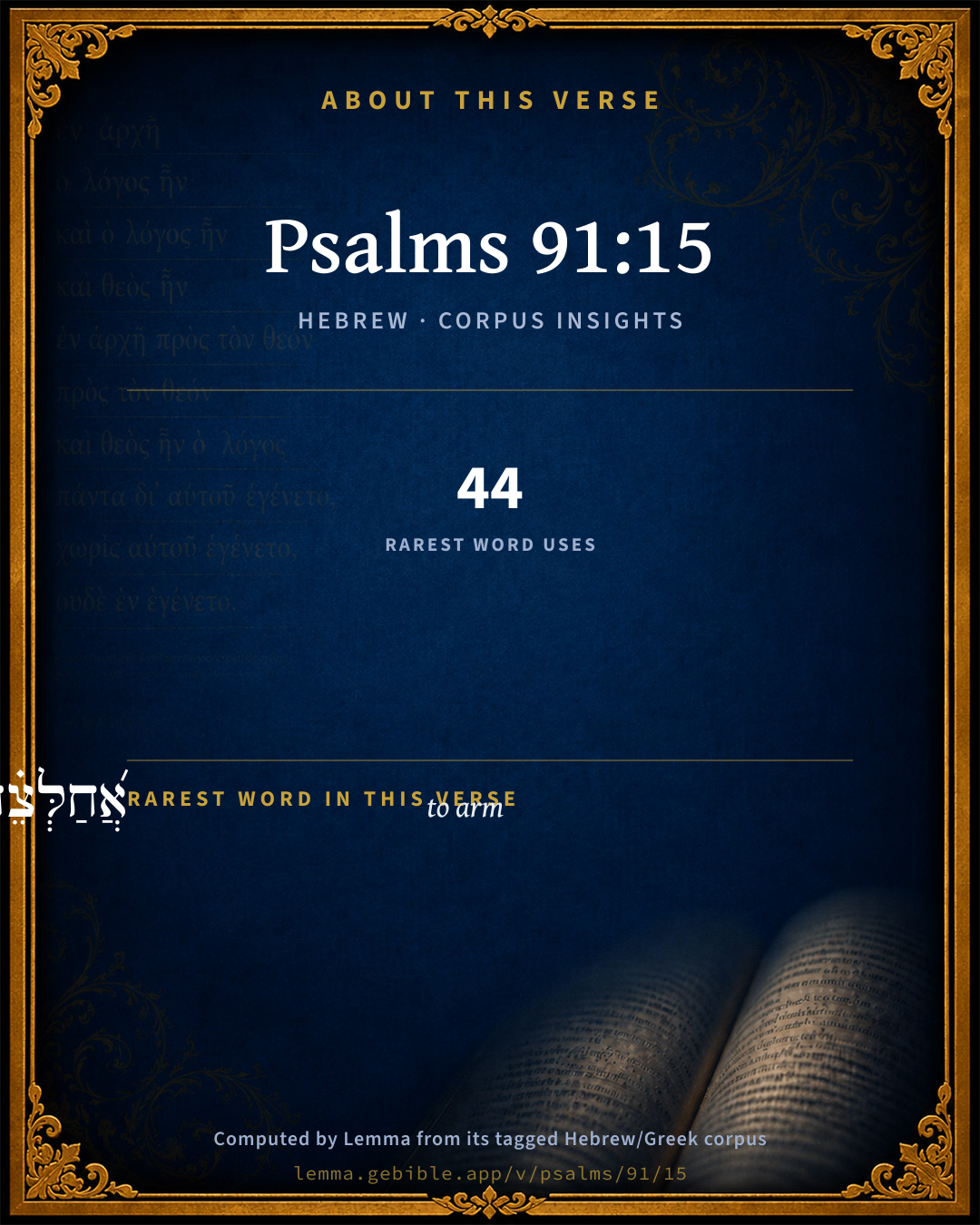
Psalms 91:15

Hebrew (Westminster Leningrad Codex) Psalms 91:15 appears in the Hebrew Old Testament. The text above is from the Westminster Leningrad Codex. Each word links to its Strong’s number, a concise gloss, and parsing drawn from the Open Scriptures Hebrew Bible morphology. Click any word for its full Brown-Driver-Briggs (BDB) entry.
Download image
Cite this verse

Psalms 91:15 (World English Bible). Public Domain. Lemma interlinear Bible study tool, https://lemma.gebible.app/v/psalms/91/15.

Show BibTeX & RIS
BibTeX
RIS
English Translation
He will call on me, and I will answer him. I will be with him in trouble. I will deliver him, and honor him.
World English Bible · Public Domain
Download a study sheet

One document with this verse’s original text, its word-by-word gloss line, the meaning frame, cross-references with their text, attributed commentary, and full source and license credits — printable, and it pastes into notes with its structure intact.

This verse Autodidact and up

Study sheet (.html) Plain text (.txt)

A passage Seminary Student

Up to 50 verses in one chapter. A passage sheet keeps up to 6 commentary sources and 12 cross-references per verse, in the order this page ranks them, and says so on the sheet whenever that leaves anything out. Ask for a single verse and you get the Autodidact verse sheet above.

Everything on this page stays free to read, with no account — the sheet is a download of what is already on screen, not access to it.

Want to remove ads? Support Godless Engineer
Compare translations 3

The same verse in 3 English versions, stacked beneath the original-language interlinear above. Click any original word for its lexicon entry.

Each is an independent rendering of the whole verse — the interlinear is not word-aligned to these translations.

Highlighted words mark where these versions differ — a whole-verse word diff, not a word-by-word alignment.

  • World English Bible Public Domain
    He will call on me, and I will answer him. I will be with him in trouble. I will deliver him, and honor him.
  • King James Version Public Domain
    He shall call upon me, and I will answer him: I will be with him in trouble; I will deliver him, and honour him.
  • unfoldingWord Literal Text CC BY-SA 4.0
    He will call me and I will answer him. I with him in trouble; I will rescue him and I will honor him.

unfoldingWord Literal Text — © unfoldingWord, licensed CC BY-SA 4.0. Word-aligned USFM3 via Door43 (git.door43.org/unfoldingWord/en_ult).

Versions to compare (up to 4)

3 of 4 selected

Show all 18 translations

Every available English version of this verse, each an independent rendering of the whole verse.

  • World English Bible Public Domain
    He will call on me, and I will answer him. I will be with him in trouble. I will deliver him, and honor him.
  • Berean Standard Bible Public Domain
    When he calls out to Me, I will answer him; I will be with him in trouble. I will deliver him and honor him.
  • Majority Standard Bible Public Domain
    When he calls out to Me, I will answer him; I will be with him in trouble. I will deliver him and honor him.
  • King James Version Public Domain
    He shall call upon me, and I will answer him: I will be with him in trouble; I will deliver him, and honour him.
  • American Standard Version (1901) Public Domain
    He shall call upon me, and I will answer him; I will be with him in trouble: I will deliver him, and honor him.
  • Revised Version (1885) Public Domain
    He shall call upon me, and I will answer him; I will be with him in trouble: I will deliver him, and honour him.
  • Geneva Bible (1599) Public Domain
    He shall call vpon me, and I wil heare him: I will be with him in trouble: I will deliuer him, and glorifie him.
  • Douay-Rheims (1899) Public Domain
    He shall cry to me, and I will hear him: I am with him in tribulation, I will deliver him, and I will glorify him.
  • Young's Literal Translation Public Domain
    He doth call Me, and I answer him, I `am' with him in distress, I deliver him, and honour him.
  • Literal Standard Version CC BY-SA 4.0
    He calls Me, and I answer him, || I [am] with him in distress, || I deliver him, and honor him.
  • Unlocked Literal Bible CC BY-SA 4.0
    When he calls to me, I will answer him. I will be with him in trouble; I will give him victory and will honor him.
  • unfoldingWord Literal Text CC BY-SA 4.0
    He will call me and I will answer him. I with him in trouble; I will rescue him and I will honor him.
  • Darby Bible Public Domain
    He shall call upon me, and I will answer him; I will be with him in trouble, I will deliver him and honour him.
  • World Messianic Bible Public Domain
    He will call on me, and I will answer him. I will be with him in trouble. I will deliver him, and honor him.
  • Webster's Bible Public Domain
    He shall call upon me, and I will answer him: I will be with him in trouble; I will deliver him, and honor him.
  • Free Bible Version CC BY-SA 4.0
    When they call out to me for help, I will answer; when they are in trouble, I will be with them. I will save and honor them.
  • Bible in Basic English Public Domain
    When his cry comes up to me, I will give him an answer: I will be with him in trouble; I will make him free from danger and give him honour.
  • JPS Tanakh (1917) Public Domain
    He shall call upon Me, and I will answer him; I will be with him in trouble; I will rescue him, and bring him to honour.

Literal Standard Version (2020), Covenant Press — licensed CC BY-SA 4.0. Text via the HelloAO Bible API (eBible.org). Unlocked Literal Bible (unfoldingWord) — licensed CC BY-SA 4.0. Text via the HelloAO Bible API (eBible.org). unfoldingWord Literal Text — © unfoldingWord, licensed CC BY-SA 4.0. Word-aligned USFM3 via Door43 (git.door43.org/unfoldingWord/en_ult). Free Bible Version, Dr. Jonathan Gallagher — licensed CC BY-SA 4.0. Text via the HelloAO Bible API (eBible.org).

Word by word

More ways to search: Search by grammar → Find every occurrence → Compare this word →

Practice this passage: Drill this verse → Learn its vocabulary →

אֲ֝חַלְּצֵ֗הוּ
châlats
H2502
“to arm · him”
Verb, Piel, Imperfect, 1st Person, Common, Singular + Suffix, Personal, 3rd Person, Masculine, Singular
Part of Speech
Verb
Stem
Piel
Form
Imperfect
Person
1st Person
Gender
Common
Number
Singular
Full BDB Definition

Origin: a primitive root

TWOT: 667 , 668

to remove, draw out, draw off, take off, withdraw, equip (for war), arm for war, rescue, be rescued - (Qal) equipped (participle) - (Niphal) - to be equipped - to go equipped - to be armed - (Hiphil) - to make strong, brace up - to invigorate - to draw off or out, withdraw - (Qal) - to draw, draw off - to withdraw - (Niphal) - to be delivered - to be saved - (Piel) - to pull out, tear out - to rescue, deliver, set free - to take away, plunder
  1. יִקְרָאֵ֨נִי qârâʼ H7121 “to call · me” Verb, Qal, Imperfect, 3rd Person, Masculine, Singular + Suffix, Personal, 1st Person, Common, Singular
  2. וְֽאֶעֱנֵ֗הוּ ʻânâh H6030 “and · to answer · him” Conjunction + Verb, Qal, Imperfect, 1st Person, Common, Singular + Suffix, Personal, 3rd Person, Masculine, Singular
  3. עִמּֽוֹ ʻim H5973 “with · him” Preposition + Suffix, Personal, 3rd Person, Masculine, Singular
  4. אָנֹכִ֥י ʼânôkîy H595 “I” Pronoun, Personal, 1st Person, Common, Singular
  5. בְצָרָ֑ה tsârâh H6869 “in/at · distress” Preposition + Noun, Common, Feminine, Singular, Absolute
  6. וַֽאֲכַבְּדֵֽהוּ kâbad H3513 “and · to be heavy · him” Conjunction + Verb, Piel, Imperfect, 1st Person, Common, Singular + Suffix, Personal, 3rd Person, Masculine, Singular

About this verse

These counts appear in no published source. They are computed here, from the morphology-tagged text and Lemma’s own curated glosses. What Lemma adds →

7
words
7
distinct lemmas
Wisdom
section

Shared distinctive vocabulary

אֲ֝חַלְּצֵ֗הוּ to arm H2502 occurs in 44 verses of the Hebrew Bible. Also found in:

Grammatical profile

  • 4 verbs
  • 1 noun
  • 1 pronoun
  • 1 preposition

Verb forms

  • יִקְרָאֵ֨נִי Qal · Imperfect
  • וְֽאֶעֱנֵ֗הוּ Qal · Imperfect
  • אֲ֝חַלְּצֵ֗הוּ Piel · Imperfect
  • וַֽאֲכַבְּדֵֽהוּ Piel · Imperfect

Hebrew & Septuagint length

In English translation the verse runs 24 words from the Hebrew and 25 from the Septuagint (LXX English) — closely comparable.

A rough comparison of the two English renderings, which tokenize alike — not a word-level alignment.

Word counts can differ between the Hebrew and the Greek without any difference in meaning — e.g. the Hebrew direct-object marker אֵת has no separate Greek word, and Greek often adds the article ὁ.

Cross-references

29

Topical passages linked to Psalms 91:15 in the Treasury of Scripture Knowledge — connected by theme and wording, ordered by reader-vote popularity; previews shown in the World English Bible.

  • Jeremiah 33:3 Call to me, and I will answer you, and will show you great things, and difficult, which you don't know.
  • Psalms 50:15 Call on me in the day of trouble. I will deliver you, and you will honor me."
  • Isaiah 65:24 It shall happen that, before they call, I will answer; and while they are yet speaking, I will hear.
  • Psalms 138:7 Though I walk in the midst of trouble, you will revive me. You will stretch forth your hand against the wrath of my enemies. Your right hand will save me.
  • John 12:26 If anyone serves me, let him follow me. Where I am, there will my servant also be. If anyone serves me, the Father will honor him.
  • 1 Samuel 2:30 Therefore Yahweh, the God of Israel, says, I said indeed that your house, and the house of your father, should walk before me forever: but now Yahweh says, Be it far from me; for those who honor me I will honor, and those who despise me shall be lightly esteemed.
  • Psalms 10:17 Yahweh, you have heard the desire of the humble. You will prepare their heart. You will cause your ear to hear,
  • Isaiah 41:10 Don't you be afraid, for I am with you; don't be dismayed, for I am your God; I will strengthen you; yes, I will help you; yes, I will uphold you with the right hand of my righteousness.
  • Acts 18:9–10 The Lord said to Paul in the night by a vision, "Don't be afraid, but speak and don't be silent;
  • 2 Corinthians 1:9–10 Yes, we ourselves have had the sentence of death within ourselves, that we should not trust in ourselves, but in God who raises the dead,
  • Psalms 18:3–4 I call on Yahweh, who is worthy to be praised; And I am saved from my enemies.
  • Psalms 23:4 Even though I walk through the valley of the shadow of death, I will fear no evil, for you are with me. Your rod and your staff, they comfort me.
  • Hebrews 5:7 He, in the days of his flesh, having offered up prayers and petitions with strong crying and tears to him who was able to save him from death, and having been heard for his godly fear,
  • Jeremiah 29:12–13 You shall call on me, and you shall go and pray to me, and I will listen to you.
  • 1 Peter 1:21 who through him are believers in God, who raised him from the dead, and gave him glory; so that your faith and hope might be in God.
  • Isaiah 43:1–2 But now thus says Yahweh who created you, Jacob, and he who formed you, Israel: Don't be afraid, for I have redeemed you; I have called you by your name, you are mine.
  • Matthew 28:20 teaching them to observe all things that I commanded you. Behold, I am with you always, even to the end of the age." Amen.
  • Romans 10:12–13 For there is no distinction between Jew and Greek; for the same Lord is Lord of all, and is rich to all who call on him.
  • Psalms 37:40 Yahweh helps them, and rescues them. He rescues them from the wicked, and saves them, Because they have taken refuge in him.
  • John 16:32 Behold, the time is coming, yes, and has now come, that you will be scattered, everyone to his own place, and you will leave me alone. Yet I am not alone, because the Father is with me.
  • 1 Peter 5:4 When the chief Shepherd is revealed, you will receive the crown of glory that doesn't fade away.
  • 2 Timothy 4:17 But the Lord stood by me, and strengthened me, that through me the message might be fully proclaimed, and that all the Gentiles might hear; and I was delivered out of the mouth of the lion.
  • 1 Peter 3:22 who is at the right hand of God, having gone into heaven, angels and authorities and powers being made subject to him.
  • Revelation 3:21 He who overcomes, I will give to him to sit down with me on my throne, as I also overcame, and sat down with my Father on his throne.
  • Job 12:4 I am like one who is a joke to his neighbor, I, who called on God, and he answered. The just, the blameless man is a joke.
  • Isaiah 58:9 Then shall you call, and Yahweh will answer; you shall cry, and he will say, Here I am. If you take away from the midst of you the yoke, the putting forth of the finger, and speaking wickedly;
  • John 5:44 How can you believe, who receive glory from one another, and you don't seek the glory that comes from the only God?
  • John 12:43 for they loved men's praise more than God's praise.
  • Psalms 18:15 Then the channels of waters appeared, The foundations of the world were laid bare at your rebuke, Yahweh, At the blast of the breath of your nostrils.

Cross-references courtesy of OpenBible.info (CC BY 4.0).

Hebrew and Greek witnesses Masoretic Hebrew ↔ Greek Septuagint

The same verse in the two great witnesses to the Old Testament, shown verse-for-verse.

You’re reading Greek Psalm 90 (Hebrew Psalm 91). The Septuagint counts the superscription, so verse numbers can differ from the Hebrew — chapter-level alignment, not verse-by-verse. Numbering follows Rahlfs.

These are two independent witnesses, not word-aligned to each other, and the Septuagint is shown in lemma (dictionary) form.

Hebrew Psalms 91:15 Masoretic · Westminster Leningrad Codex

יִקְרָאֵ֨נִי וְֽאֶעֱנֵ֗הוּ עִמּֽוֹ אָנֹכִ֥י בְצָרָ֑ה אֲ֝חַלְּצֵ֗הוּ וַֽאֲכַבְּדֵֽהוּ

He will call on me, and I will answer him. I will be with him in trouble. I will deliver him, and honor him.

World English Bible · Public Domain

Greek LXX Greek Psalm 90:15 Septuagint · lemma form

ἐπικαλέω ἐγώ καί εἰςἀκούω αὐτός μετά αὐτός εἰμί ἐν θλῖψις καί ἐκαἱρέω καί δοξάζω αὐτός

He shall call upon me, and I will listen to him: I am with him in affliction; and I will deliver him, and glorify him.

LXX2012 (modern English Septuagint) · Public Domain

Hebrew: Westminster Leningrad Codex (CC BY 4.0). Greek: Septuagint (public domain); English from LXX2012 (modern English Septuagint) (Public Domain). How the Septuagint differs from the Hebrew →

Commentary

Notes on Psalms 91:15 from classic Christian and Jewish commentators (each source and its license shown beneath its notes). The classic Christian expositions comment on the surrounding passage and are grouped to its opening verse, so a note may address several verses; the Jewish commentaries on the Tanakh (Rashi and others) are per-verse, so they appear only where the commentator wrote on this verse.

Lemma curates 59 commentaries, every one of them public domain or Creative Commons licensed, each selected and text-cleaned for this edition rather than reprinted as found. About our sources →

Trapp's Complete Commentary

John Trapp

Psa 91:15 He shall call upon me, and I will answer him: I [will be] with him in trouble; I will deliver him, and honour him.

Ver. 15. He shall call upon me] This is an indispensable duty, and will be cheerfully performed by those who know and love the Lord.

I will deliver him, &c.] As he did David, Joseph, Daniel, and others.

John Trapp, A Commentary or Exposition upon All the Books of the Old and New Testament (1647–1656) — public domain. Text from a community e-Sword module.

The Biblical Illustrator

Joseph S. Exell

Psa_91:15

He shall call upon Me, and I will answer him.

Four great promises

Peter speaks of exceeding great and precious promises (2Pe_1:4). The promises of the text are among this number.

I. He will answer their prayers. He answers--

1. Kindly.

2. Quickly.

3. Always.

4. More abundantly than we ask.

5. Wisely.

II. He will be with them is trouble. We cannot escape trouble in this world (Job_5:7). In trouble many persons are forsaken of their friends. But God is the companion and friend who is nearest to us when we need Him most. In poverty, persecution, sickness and death He will be with us.

III. He will deliver them.

1. Surely.

2. By unexpected means.

3. Completely.

4. Eternally.

IV. He will honour them. It is not wrong to seek honour, but we should seek the best (Rom_2:7; Joh_5:4; Joh_5:44). God honoured Moses, Joshua, David, Ruth. These promises belong only to the people of God. (Anon.)

Prayer and its answer

I. A declaration. God has said in positive terms, He shall call upon Me. It therefore does not rest with the creature, whether he will call upon Him or not; it is not a matter poised in the balances of the creature, whether he shall pray or not. God has not left it to man, whether he shall take up prayer or lay aside prayer, but He has made it a part of His own sovereign appointments, of His own eternal decrees, which can no more be frustrated than salvation itself. Therefore this soul, that dwells in the secret place of the Most High--he shall call upon God. He shall call upon Me. When shall he call? Why, when the Lord pours out the Spirit of grace and of supplications; when the Lord lays wants upon his heart; when the Lord brings conviction into his conscience; when the Lord brings trouble into his soul. Then to call upon the Lord is no point of duty, which is to be attended to as a duty; it is no point of legal constraint, which must be done because the Word of God speaks of it; but it is a feeling, an experience, an inward work, which springs from the Lords hand, and which flows in the Lords own Divine channel.

II. A promise. I will answer him. What will He answer? Why, He will answer those prayers, which He Himself has indited. He will answer those wants, which He Himself has created. He will answer those hungerings, which He Himself has produced. But the answer that God gives, He gives in His own time. And I believe many of the children of God have had to cry to Him for days and weeks and months and years. But sometimes the Lord is pleased to answer our prayers more immediately; He brings us into those straits and troubles from which we cannot extricate ourselves, and then will answer our prayers and fulfil the promise. But perhaps it is in such a way as we least expect; and yet in such a way as most glorifies Him. We say, Lord, make me rich. He says, I will; but thou must first be made poor. We say, Lord, let me have a precious view of Christ. I will; but you must first have a wretched view of self. Let me know the riches of Christs blood. I will; but you must first know the depth of your guilt. (J. C. Philpot.)

Prayer answered

You may not get what you fancy you need. You may not get this, that, or the other blessing which you ask, for perhaps they are not blessings. We are not always good at translating our needs into words, and it is a mercy that there is Some One who understands what we do want a great deal better than ourselves. But if below the special petition there lies the cry of a heart that calls for the living God, then, whether the specific petition be answered or dispersed into empty air will matter comparatively little. (A. Maclaren, D.D.)

The honour God puts on His faithful servants

The biographer of the Countess of Huntingdon tells how, One day at court the Prince of Wales inquired of Lady Charlotte Edwin where Lady Huntingdon was, that she so seldom visited the court. Lady Charlotte replied, with a sneer, I suppose praying with her beggars. The Prince shook his head, and, turning to Lady Charlotte, said, Lady Charlotte, when I am dying, I think I shall be happy to seize the skirt of Lady Huntingdons mantle to lift me with her up to heaven. (R. Pitman.)

The Biblical Illustrator, edited by Joseph S. Exell (c. 1880s–1900s) — public domain. Text from a community e-Sword module.

The Treasury of David

Charles H. Spurgeon

Ver. 15. He shall call upon me, and I will answer him. He will have need to pray, he will be led to pray aright and the answer shall surely come. Saints are first called of God and then they call upon God; such calls as theirs always obtain answers. Not without prayer will the blessing come to the most favoured, but by means of prayer they shall receive all good things.

I will be with him in trouble, or "I am with him in trouble." Heirs of heaven are conscious of a special divine presence in times of severe trial. God is always near in sympathy and in power to help his tried ones.

I will deliver him, and honour him. The man honours God, and God honours him. Believers are not delivered or preserved in a way which lowers them, and makes them feel themselves degraded; far from it, the Lord's salvation bestows honour upon those it delivers. God first gives us conquering grace, and then rewards us for it.

Ver. 15. I will answer him. I think we sometimes discourage ourselves by a misconception of the exact meaning of the expression, "answer, "taking it to mean only grant. Now, an answer is not necessarily an acquiescence. It may be a refusal, an explanation, a promise, a conditional grant. It is, in fact, simply attention to our request expressed. In this sense, before we call he will answer, and while we are get speaking he will hear, Isa 65:24. Mary B. M. Duncan.

Ver. 15. I will be with him in trouble. I will be with him in trouble, says God: and shall I seek meanwhile anything else than trouble? It is good for me to cleave unto God. Not only so, but also to put my hope in the Lord: because I will deliver him, he says, and honour him. I will be with him in trouble. My delights, he says, are with the sons of men. Emmanuel God with us. Hail, thou art highly favoured, says the Angel to Mary, the Lord is with thee. In the fulness of grace He is with us, in the plenitude of glory we shall be with Him. He descends in order to be near to those who are of a troubled heart, that He may be with us in our trouble... It is better for me, O Lord, to be troubled, whilst only Thou art with me, than to reign without Thee, to feast without Thee, to be honoured without Thee. It is good rather to be embraced by Thee in trouble, to have thee in this furnace with me, than to be without Thee even in heaven. For what have I in heaven, and without Thee what do I desire upon earth? The furnace tries the gold, and the temptation of trouble just men. Bernard.

Ver. 15. I will be with him trouble. God hath made promises of his special presence with his saints in suffering. If we have such a friend to visit us in prison, we shall do well enough; though we change our place, we shall not change our keeper. "I will be with him." God will hold our head and heart when we are fainting! What if we have more afflictions than others, if we have more of God's company? God's honour is dear to him; it would not be for his honour to bring his children into sufferings, and leave them there; he will be with them to animate and support them; yea, when new troubles arise. Job 5:19. "He shall deliver thee in six troubles." Thomas Watson.

Ver. 15. I will be with him in trouble. Again God speaks and acts like a tender hearted mother towards a sickly child. When the child is in perfect health she can leave it in the hands of the nurse; but when it is sick she will attend it herself; she will say to the nurse, "You may attend a while to some other business, I will watch over the child myself." She hears the slightest moan; she flies to the cradle; she takes it in her arms; she kisses its lips, and drops a tear upon its face, and asks, "What can I do for thee, my child? How can I relieve thy pain and soften thy sufferings? Do not weep and break my heart; it is thy mother's arms that are around thee; it is thy mother's lap on which thou art laid; it is thy mother's voice that speaks to thee; it is thy mother that is with thee; fear not." So the Lord speaks to his afflicted children. "I will be with him in trouble." No mother can equally sympathise with her suffering child; as the Lord does with his suffering people. No! could all the love that ever dwelt in all the mothers' hearts that ever existed, be united in one mother's heart, and fixed on her only child, it would no more bear a comparison with the love of God to his people than the summer midnight glow worm is to be compared to the summer midday sun.

Oh, that delightful sentence I will be with him in trouble. At other times God will leave them in the hands of angels: "I will give them charge over them, to keep them in all their ways; they bear them up lest at any time they dash their feet against a stone." But when they are in trouble, I will say to the angels, "Stand aside, I will take care of them myself." "I will be with them in trouble." So he speaks to his people: "When thou passest through the waters, I will be with thee and through the rivers, they shall not overflow thee: when thou walkest through the fire, thou shalt not be burned; neither shall the flame kindle upon thee. For I am the Lord thy God, the Holy One of Israel, thy Saviour." When languishing in sickness, He will make his bed, and his pillow; when travelling through the valley of the shadow of death, the Lord will be with him, and enable him to sing, "I will fear no evil: for thou art with me; thy rod and thy staff they comfort me." Thus he is with them as their physician and nurse, in pain and sickness; as their strength in weakness; as their guide in difficulty; their ease in pain; and as their life in death. "I will be with him in trouble." William Dawson.

Ver. 15-16. Observe,

1. The exceeding great and precious promises. (a) Answer to prayer: "he shall call, "etc. (b) Comfort in trouble: "I will be with him." (c) Deliverance from trouble: "I will deliver him." (d) Greater honour after trouble: deliver "and honour him." (e) Length of days; life long enough to satisfy him. (f) God's salvation; "show him my salvation; "far beyond what man could think or desire.

2. To whom these promises belong; who is the he and the him to whom these promises are made. He "calls upon God, "says Ps 91:15; he "hath known my name, "says Ps 91:14; he "hath set his love upon me, "says the former part of the same verse; he "has made the Lord his habitation, "says Ps 91:9; he "dwelleth in the secret place of the Most High, "says Ps 91:1. Hannah More says, "To preach privileges without specifying to whom they belong is like putting a letter in the post office without a direction." It may be very good and contain a valuable remittance, but no one can tell for whom it is intended. All the promises of Scripture are plainly directed to those to whom they belong. The direction put upon the promises of this Psalm is unmistakably clear and often repeated. G. R.

Psalms 91:16*

Charles H. Spurgeon's The Treasury of David (1869–1885) — public domain. Psalms only. Text from a community e-Sword/MySword module.

Whedon's Commentary on the Bible

Daniel D. Whedon

15. I will answer him—The response given to Psa_91:15-16 of the preceding psalm.

In trouble—Compare Gen_46:4; Isa_63:9.

Deliver… honour—Deliverance from trouble, even all the perils enumerated, which have been the world’s terror, is not the fulness of the salvation promised. The soul is advanced to “honour” also. God setteth him on high—to be understood of, and fully realized in, the spiritual life.

Daniel D. Whedon (gen. ed.), Commentary on the Old and New Testaments (1874–1909) — public domain. Text from a community e-Sword module.

J. A. Alexander on Psalms

Joseph Addison Alexander

12. (Psa 91:15) Upon (their) hands shall they bear thee, lest thou strike against the stone thy foot. The dual form, denoting both hands, might be regarded as emphatic and suggestive of peculiar care; but the Hebrew noun has no other plural form in common use. A smooth path and unimpeded walk is a common figure for prosperity and safety. Compare Pro 3:23.

15. (Psa 91:15) He shall call me and I will answer him. With him (am) I in trouble. I will deliver him and honour him. The meaning of the first clause is essentially the same as if he had said, when he calls I will answer, but with much more directness and force in the expression. Calls me to his aid, invokes me, prays to me. Answer him by granting his request, the idea commonlyconveyed by the Hebrew verb here used. See above, on Psa 3:4. The futures have their proper sense, as this is a direct and formal promise. I will be with him would have been expressed in the same manner; but I am with him is still stronger, for it describes God as already present for the protection and deliverance of his people. Deliver him, extricate him from his embarrassments and dangers; and lest the promise should be thought to ensure mere safety, it is added, I will honour him, procure for him the respect of others by shelving that I favour him myself.

Joseph Addison Alexander, The Psalms Translated and Explained (1850) — public domain. Text from a community e-Sword module.

MacLaren's Expositions of Holy Scripture

Alexander MacLaren

Psalms

WHAT GOD WILL DO FOR US

Psa 91:15 - Psa 91:16.

When considering the previous verses of this psalm, I pointed out that at its close we have God’s own voice coming in to confirm and expand the promises which, in the earlier portion of it, have been made in His name to the devout heart. The words which we have now to consider cover the whole range of human life and need, and may be regarded as being a picture of the sure and blessed consequences of keeping our hearts fixed upon our Father, God. He Himself speaks them, and His word is true.

The verses of the text fall into three portions. There are promises for the suppliant, promises for the troubled, promises for mortals. ‘He shall call upon Me and I will answer him’; that is for the suppliant. ‘I will be with him in trouble; I will deliver him and honour him’; that is for the distressed. ‘With long life will I satisfy him, and show him My salvation’; that is for the mortal. Now let us look at these three.

I. The promise to the suppliant.

‘He will call upon Me and I will answer.’ We may almost regard the first of these two clauses as part of the promise. It is not merely a Hebrew way of putting a supposition, ‘If he calls upon Me, then I will answer him,’ nor merely a virtual commandment, ‘Call, if you expect an answer,’ but itself is a part of the blessing and privilege of the devout and faithful heart. ‘He shall call upon Me’; the King opens the door of His chamber and beckons us within.

In these great words we may see set forth both the instinct, as I may call it, of prayer, and the privilege of access to God. If a man’s heart is set upon God, his very life-breath will be a cry to His Father. He will experience a need which is not degraded by being likened to an instinct, for it acts as certainly as do the instincts of the lower creatures, which guide them by the straightest possible road to the surest supply of their need. Any man who has learned in any measure to love God and trust Him will, in the measure in which he has so learned, live in the exercise and habit of prayer; and it will be as much his instinct to cry to God in all changing circumstances as it is for the swallows to seek the sunny south when the winter comes, or the cold north when the sunny south becomes torrid and barren. So, then, ‘He shall call upon Me’ is the characteristic of the truly God-knowing and God-loving heart, which was described in the previous verse. ‘Because he has clung to Me in love, therefore will I deliver him; because he has known My name, therefore will I set him on high,’ and because he has clung and known therefore it is certain that He will ‘call upon Me.’

My friend! do you know anything of that instinctive appeal to God? Does it come to your heart and to your lips without your setting yourself to pray, just as the thought of dear ones on earth comes stealing into our minds a hundred times a day, when we do not intend it nor know exactly how it has come? Does God suggest Himself to you in that fashion, and is the instinct of your hearts to call upon Him?

Again, we see here not only the unveiling of the very deepest and most characteristic attribute of the devout soul, but also the assurance of the privilege of access. God lets us speak to Him. And there is, further, a wonderful glimpse into the very essence of true prayer. ‘He shall call upon Me.’ What for? No particular object is specified as sought. It is God whom we want, and not merely any things that even He can give. If asking for these only or mainly is our conception of what prayer is, we know little about it. True prayer is the cry of the soul for the living God, in whom is all that it needs, and out of whom is nothing that will do it good. ‘He shall call upon Me,’ that is prayer.

‘I will answer him.’ Yes! Of course the instinct is not all on one side. If the devout heart yearns for God, God longs for the devout heart. If I might use such a metaphor, just as the ewe on one side of the hedge hears and answers the bleating of its lamb on the other, so, if my heart cries out for the living God, anything is more credible than that such a cry should not be answered. You may not get this, that, or the other blessing which you ask, for perhaps they are not blessings. You may not get what you fancy you need. We are not always good at translating our needs into words, and it is a mercy that there is Some One that understands what we do want a great deal better than we do ourselves. But if below the specific petition there lies the cry of a heart that calls for the living God, then whether the specific petition be answered or dispersed into empty air will matter comparatively little. ‘He shall call upon Me,’ and that part of his prayer ‘I will answer’ and come to him and be in him. Is that our experience of what it is to pray, and our notion of what it is to be answered?

II. Further, here we have a promise for suppliants.

I take the next three clauses of the text as being all closely connected. ‘I will be with him in trouble. I will deliver him and honour him’-in trouble, His presence; from trouble, His deliverance; after trouble, glorifying and refining. There are the whole theory and process of the discipline of the devout man’s life.

‘I will be with him in trouble.’ The promise is not only that, when trials of any kind, larger or smaller, more grave or more slight, fall upon us, we shall become more conscious, if we take them rightly, of God’s presence, but that all which is meant by God’s presence shall really be more fully ours, and that He is, if I may say so, actually nearer us. Though, of course, all words about being near or far have only a very imperfect application to our relation to Him, still the gifts that are meant by His presence-that is to say, His sympathy, His help, His love-are more fully given to a man who in the darkness is groping for his Father’s hand, and yet not so much groping for as grasping it. He is nearer us as well as felt to be nearer us, if we take our sorrows rightly. The effect of sorrow devoutly borne, in bringing God closer to us, belongs to it, whether it be great or small; whether it be, according to the metaphor of an earlier portion of this psalm, ‘a lion or an adder’; or whether it be a buzzing wasp or a mosquito. As long as anything troubles me, I may make it a means of bringing God closer to myself.

Therefore, there is no need for any sorrowful heart ever to say, ‘I am solitary as well as sad.’ He will always come and sit down by us, and if it be that, like poor Job upon his dunghill, we are not able to bear the word of consolation, yet He will wait there till we are ready to take it. He is there all the same, though silent, and will be near all of us, if only we do not drive Him away. ‘He will call upon Me and I will answer him’; and the beginning of the answer is the real presence of God with every troubled heart.

Then there follows the next stage, deliverance from trouble; ‘I will deliver him.’ That is not the same word as is employed in the previous verse, though it is translated in the same way in our Bibles. The word here means lifting up out of a pit, or dragging up out of the midst of anything that surrounds a man, and so setting him in some place of safety. Is this promise always true, about people who in sorrow of any kind cast themselves upon God? Do they always get deliverance from Him? There are some sorrows from the pressure of which we shall never escape. Some of us have to carry such. Has this promise no application to the people for whom outward life can never bring an end of the sorrows and burdens that they carry? Not so. He will deliver us not only by taking the burden off our backs, but by making us strong to carry it, and the sorrow, which has changed from wild and passionate weeping into calm submission, is sorrow from which we have been delivered. The serpent may still wound our heel, but if God be with us He will give us strength to press the wounded heel on the malignant head, and we can squeeze all the poison out of it. The bitterness remains; be it so, but let us be quite sure of this, that though sorrow be lifelong, that does not in the least contradict the great and faithful promise, ‘I will be with him in trouble and deliver him,’ for where He is there is deliverance.

Lastly, there is the third of these promises for the troubled. ‘I will honour him.’ The word translated ‘honour’ is more correctly rendered ‘glorify.’ Is not that the end of a trouble which has been borne in company with Him; and from which, because it has been so borne, a devout heart is delivered even whilst it lasts? Does not all such sorrow hallow, ennoble, refine, purify the sufferer, and make him liker his God? ‘He for our profit, that we should be partakers of His holiness.’ Is not that God’s way of glorifying us before heaven’s glory? When a blunt knife is ground upon a wheel, the sparks fly fast from the edge held down upon the swiftly-revolving emery disc, but that is the only way to sharpen the dull blade. Friction, often very severe friction, and heat are indispensable to polish the shaft and turn the steel into a mirror that will flash back the sunshine. So when God holds us to His grindstone, it is to get a polish on the surface. ‘I will deliver him and I will glorify him.’

III. Last of all, we have the promise for mortals.

‘With long life will I satisfy him, and show him My salvation.’ I do not know whether by that first clause the Psalmist meant, as people who sometimes like to make the Psalmist mean as little as possible tell us that he did mean, simply ‘length of days.’ For my own part I do not believe that he did. He meant that, no doubt, for longevity was part of the Old Testament promises for this life. But ‘length of days’ does not ‘satisfy’ all old people who attain to it, and that ‘satisfaction’ necessarily implies something more than the prolongation of the physical life to old age. The idea contained in this promise may be illustrated by the expression which is used in reference to a select few of the Old Testament saints, of whom it is recorded that they died ‘full of days.’ That does not merely mean that they had many days, but that, whatever the number, they had as many as they wished, and departed unreluctantly, having had enough of life. They looked back, and saw that all the past had been very good, and that goodness and mercy had determined and accompanied all their days, and so they did not wish to linger longer here, but closed their eyes in peace, with no hungry, vain cravings for prolonged life. They had got all out of the world which it could give, and were contented to have done with it all.

So this promise assures us that, if we are of those who, in the midst of fleeting days, lay hold on the ‘Ancient of Days’ and live by Him, we shall find a table spread in the wilderness, and like travellers in an inn, having eaten enough, shall willingly obey the call to leave the meal provided on the road, and pass into the Father’s house, and sit at the bountiful feast there.

The heart that lives near God, whether its years be few or many, will find in life all that life is capable of giving, and when the end comes will not be unwilling that it should come, nor hold on desperately to the last fag-end and fragment of life that it can keep within its clutches, but will be satisfied to have lived and be contented to die.

Nor is this all, for says the Psalmist, ‘I will show him My salvation.’ That sight comes after he is satisfied with length of days here. And so I think the fair interpretation of the words, in their place in this psalm, is, that however dimly, yet certainly, here the Psalmist saw something beyond. It was not a black curtain which dropped at death. He believed that, yonder, the man who here had been living near God, calling to Him, realising His presence, and satisfied with the fatness of His house upon earth, would see something that would satisfy him more. ‘I shall be satisfied when I awake in Thy likeness.’ That is satisfaction indeed, and the vision, which is possession, of that perfected salvation is the vision that makes the blessedness of heaven.

So, dear friends! we, if we will, may have access to God’s chamber at every moment, and may have His presence, which will make it impossible that we should ever be alone. We may have Him to deliver us from all the evil that is in evil, and to turn it into good. We may have Him to purge, and cleanse, and uplift, and change us into His likeness, even by the ministry of our trials. We may get out of life the last drop of the sweetness that He has put in it; and when it comes to a close, may say, ‘It is enough! Let Thy servant depart in peace; for mine eyes have seen Thy salvation,’ and then we may go to see it better in that world where we shall all, if we attain thither, be ‘satisfied’ when we ‘awake in His likeness.’

Alexander MacLaren, Expositions of Holy Scripture (1904–1910) — public domain. Text from a community e-Sword module.

Tyndale Open Study Notes

Tyndale Open Resources

91:15 The Lord promises to answer the prayers of his people. • The Psalter often speaks of people honoring the Lord (50:15); here, God promises to honor the godly who risk everything for his sake (62:7; 71:21; 84:11).

Tyndale Open Study Notes — © Tyndale Open Resources, licensed CC BY-SA 4.0. Text via the HelloAO Bible API.

Adam Clarke's Commentary

Verse 15. He shall call upon me] He must continue to pray; all his blessings must come in this way; when he calls, I will answer him - I will give him whatever is best for him.

I will be with him in trouble] Literally, I am with him. עמו אנכי immo anochi; as soon as the trouble comes, I are there.

I will deliver him] For his good I may permit him to be exercised for a time, but delivered he shall be.

And honour him] אכבדהו acabbedehu, "I will glorify him." I will load him with honour; that honour that comes from God. I will even show to men how highly I prize such.

Adam Clarke's Commentary on the Bible (1810–1826) — public domain. Text from a community e-Sword/MySword module.

John Calvin's Commentaries

15. He shall call upon me. He now shows more clearly what was meant by trusting in God, or placing our love and delight in him. For that affection and desire which is produced by faith, prompts us to call upon his name. This is another proof in support of the truth, which I had occasion to touch upon formerly, that prayer is properly grounded upon the word of God. We are not at liberty in this matter, to follow the suggestions of our own mind or will, but must seek God only in so far as he has in the first place invited us to approach him. The context, too, may teach us, that faith is not idle or inoperative, and that one test, by which we ought to try those who look for Divine deliverances, is, whether they have recourse to God in a right manner. We are taught the additional lesson, that believers will never be exempt from troubles and embarrassments. God does not promise them a life of ease and luxury, but deliverance from their tribulations. Mention is made of his glorifying them, intimating that the deliverance which God extends, and which has been spoken of in this psalm, is not of a mere temporary nature, but will issue at last in their being advanced to perfect happiness. He puts much honor upon them in the world, and glorifies himself in them conspicuously, but it is not till the completion of their course that he affords them ground for triumph. It may seem strange that length of days should be mentioned in the last verse as promised to them, since many of the Lord’s people are soon taken out of the world. But I may repeat an observation which has been elsewhere made, that those Divine blessings which are promised in relation to the present perishing world, are not to be considered as made good in a universal and absolute sense, or fulfilled in all according to one set and equal rule. Wealth and other worldly comforts must be looked upon as affording some experience of the Divine favor or goodness, but it does not follow that the poor are objects of the Divine displeasure; soundness of body and good health are blessings from God, but we must not conceive on this account that he regards with disapprobation the weak and the infirm. Long life is to be classed among benefits of this kind, and would be bestowed by God upon all his children, were it not for their advantage that they should be taken early out of the world. They are more satisfied with the short period during which they live than the wicked, though their life should be extended for thousands of years. The expression cannot apply to the wicked, that they are satisfied with length of days; for however long they live, the thirst of their desires continues to be unquenched. It is life, and nothing more, which they riot in with such eagerness; nor can they be said to have had one moment’s enjoyment of that Divine favor and goodness which alone can communicate true satisfaction. The Psalmist might therefore with propriety state it as a privilege peculiarly belonging to the Lord’s people, that they are satisfied with life. The brief appointed term is reckoned by them to be sufficient, abundantly sufficient. Besides, longevity is never to be compared with eternity. The salvation of God extends far beyond the narrow boundary of earthly existence; and it is to this, whether we live or come to die, that we should principally look. It is with such a view that the Psalmist, after stating all the other benefits which God bestows, adds this as a last clause, that when he has followed them with his fatherly goodness throughout their lives, he at last shows them his salvation.

John Calvin's Commentaries (1540-1563) — public domain. Text from the Calvin Translation Society English edition (1840s-50s) via the Christian Classics Ethereal Library (ccel.org). Calvin's coverage is partial (roughly two-thirds of the Bible); uncommented books and verses are honest gaps, never fabricated. The 19th-century editor's footnotes and remarks are omitted so the notes are faithfully Calvin's own voice.

The Cambridge Bible for Schools and Colleges

gen. ed. J. J. S. Perowne

15, 16. Cp. Psa_50:15; Psa_50:23.

honour him] Or, glorify him. Cp. Jer_30:19.

with long life] Lit., with length of days (Deu_30:20; Pro_3:2; Pro_3:16); in fulfilment of the ancient promises, Exo_20:12; Exo_23:26 (“the number of thy days I will fulfil”), and in contrast to the destruction of the wicked, Psa_91:7-8.

satisfy] Cp. Psa_90:14

my salvation] Visible manifestations of God’s Providence proving His care for His people, such as the author of Psalms 90 desired to see, and especially the deliverance from Babylon. Cp. Psa_98:2-3. Each such manifestation was a harbinger of the final Messianic glory which is the goal of O.T. hope. In the light of N.T. revelation the words of the verse gain a new and larger meaning (1Jn_5:11; 1Pe_1:5 ff.).

The Cambridge Bible for Schools and Colleges (gen. ed. J. J. S. Perowne; Cambridge University Press, 1878–1918) — public domain. Text from a community e-Sword module.

John Gill's Exposition

He shall call upon me, and I will answer him,.... God is to be invoked by prayer, and to be called upon in every time of trouble, in faith and with fervency, in truth and uprightness, and sincerity of soul; and he himself directs and encourages to it, and promises an answer, which he always sooner or later gives; for he is a God hearing and answering prayer; see Psa 50:15.

I will be with him in trouble; the Lord knows his people in adversity; he visits them in their affliction, grants his gracious presence with them, supports them under it, that they are not overwhelmed by it; he bears them up and through it, and makes all things work together for their good:

I will deliver him, and honour him: deliverance is again promised, to denote the certainty of it; and with this addition, that the Lord will honour such that know him, and love him: all his saints are honoured by him, by taking them into his family, and giving them a name better than that of sons and daughters of the greatest potentate; by clothing them with the righteousness of his Son; by adorning them with the graces of his Spirit; by granting them communion and fellowship with himself, and by bringing them to his kingdom and glory.

John Gill's Exposition of the Whole Bible (1746–1763) — public domain (CC PDM 1.0). Text via the HelloAO Bible API.

Albert Barnes' Notes on the Bible

He shall call upon me - He shall have the privilege of calling on me in prayer; and he will do it.

And I will answer him - I will regard his supplications, and will grant his requests. There could be no greater privilege - no more precious promise - than this.

I will be with him in trouble - I will stand by him; I will not forsake him.

I will deliver him, and honor him - I will not only rescue him from danger, but I will exalt him to honor. I will recognize him as my friend, and will regard and treat him as such. On earth he shall be treated as my friend; in another world he shall be exalted to honor among the redeemed, and become the associate of holy beings forever.

Albert Barnes' Notes on the Bible (1834–1885) — public domain. Text from a community e-Sword/MySword module.

Matthew Poole's English Annotations

He shall call upon me, to wit, in trouble, which is expressed in the following clause. As he knoweth and loveth me, so he will offer up sincere and fervent prayers to me upon all occasions.

I will be with him in trouble, to keep him from sinking under his burden.

Matthew Poole's English Annotations on the Holy Bible (1683–1685) — public domain. Text from a community e-Sword/MySword module.

The Pulpit Commentary

He shall call upon me, and I will answer him. This is equivalent to, "Whenever he calls upon me, I will answer him," or "I will grant all his prayers." I will be with him in trouble. (comp. Psa_46:1) I will deliver him (see above, ver. 14). And honour him; or, "bring him to honour" (compare "I will set him on high," in the preceding verse).

True prayer.

"He shall call," etc. This is the simplest view of prayer. And in our present weakness, sin, need, that which comes most home, suits us most. Prayer may extend far beyond the range of our own need, as in the first three petitions of the Lord"s Prayer. It may rise above petition into converse with God, adoration, thanksgiving, consecration. But this is the alphabet of those loftier lessons, "Ask and receive". (Luk_11:9, etc.; Psa_50:15)

I PRAYER IS A LAW OF GOD"S GOVERNMENT. He has ordained it among the conditions of the blessings he is ready to bestow, as surely as he has ordained sowing as the condition of reaping, or the dependence of the child on the parent. (Mat_7:11) We hear much in our day of laws; and no wonder, for the progress of science depends on the discovery of the laws which regulate nature. Rightly understood, they are the glorious witness of which Psa_19:1 speaks. The mischief and folly come in when men erect "laws" into an imaginary self-existence, and worship them as a sort of fetish, just as in old times people worshipped imaginary powers in nature. A strange idolatry! Laws can have no existence but in mind. In our minds they are truths which we discover as constant amid the infinite, ever-changing variety of nature. In the Divine mind they are the principles and rules according to which the Creator has made, upholds, and rules the universe. Now, if prayer be one of the great laws which God has ordained for human life, it must needs be in perfect harmony with all nature"s laws. God"s laws cannot contradict one another. The so called "scientific" objection against prayer (which has really nothing scientific in it) amounts to this that if God is influenced by prayer, so that he causes events which would not have happened had prayer not been offered, nature must be irregular, and God irresolute. The answer is It is God"s will that "men pray everywhere," as much as that the sun shall shine and rain fall. He has built this universe as a temple. All nature is so under his eye, hand, will, that it is no more deranged by his granting our petitions than by a parent granting a child"s request. (1Jn_5:14, 1Jn_5:15) Men can disobey, disbelieve, despise, this great law of prayer. The difference between natural laws and laws for intelligent beings is just thisthings cannot disobey God. Men can; but they must take the consequences.

II THAT GOD ANSWERS PRAYER IS A FACT OF EXPERIENCE. The truth of any law is verified by experience. So God says, "Prove me" The law of prayer is established by the teaching of the whole Bible, by abundant express promises, by our Saviour"s example as well as teaching. It has been tested constantly for thousands of years; is being tested hourly nay, every minute. And the immense witness of experience is, "This poor man cried, and the Lord heard him." If experience can establish any fact, it is this. But here is a difficulty. All prayers are not answered.

The response of God to his people.

I WHAT THIS RESPONSE IS.

1. That God will answer prayer. But on this, note:

(1) That it is not the prayer of every man, but only of those who have set their love upon God, and who dwell in the secret place of the Most High.

(2) That to them prayer is answered, but often in ways other than they have expected. God will always give to them what is best; but that may be far different from what they have thought.

2. He will be with them in trouble. God is always with us; but in our trouble he is more especially with us. This is shown sometimes by his providential help, or by his grace sustaining us.

3. He will deliver and honour. See this in such histories as that of Joseph.

II WHAT FOLLOWS FROM IT. That to the man of God the following things are impossible:

1. Disappointment; because God will answer.

2. Loneliness; for God is ever with him, and especially in trouble.

3. Disgrace; for how can that be to those whom he honours?

4. Defeat; for God will deliver. S.C.

Vers. 15, 16. God"s presence in time of trouble.

"I will be with him in trouble." Illustrate by presence of a friend in the time of sickness and distress. That friend may be unable to help, and yet the best of help comes from that friendly presence. If God is with us in trouble, we are sure he can help and deliver. If he does not, it can only be because he is doing kinder things for us, by letting the trouble stay. The strain of feeling alone in time of trouble may be illustrated by a lonely walk through a strange and dangerous country. "Have you ever walked on, mile after mile, until it grew very dark, and there were no stars overhead, and no friendly voice or guide anywhere; and, as you grew very tired and faint and footsore, did it not seem as if the way became more rough and stony at every step? You can remember each time you stumbled in the weary darkness against a stone, how the pain seemed to shoot hotly through every nerve; and the lack of light, and the uncertainty lest each step might bear you over the precipice, all this unnerved you. But how different if a loved friend had been with you! and especially if it so happened that he knew the road and the country well!" God"s presence is the summum bonum. All we can need is included and involved in it. He really need not tell us what he will do for us; it is enough if he will be there. And so the Lord Jesus wrapped up everything for his disciples in this one assurance, "Lo, I am with you all the days.

I GOD"S PRESENCE WITH US MEANS THE BEST POSSIBLE LIMITATION OF OUR TROUBLE.

II GOD"S PRESENCE WITH US MEANS ABUNDANT COMFORTING UNDER OUR TROUBLE.

III GOD"S PRESENCE WITH US MEANS THE FULFILMENT OF THE MISSION OF OUR TROUBLE.

IV GOD"S PRESENCE WITH US ASSURES OF A "HAPPY ISSUE OUT OF ALL OUR AFFLICTIONS.

God with us in trouble is the fact; but everything for us depends on our sensible realization of the fact. R.T.

The Pulpit Commentary (1880–1919), ed. H.D.M. Spence-Jones & Joseph S. Exell — public domain. Text from a community e-Sword module.

Lesson kit

Teaching starters — assembled from the data on this page, not authored interpretation. Every prompt links to the verse data it draws on. Edit before teaching.

Psalms, in the Wisdom, opens this verse with 7 words (7 distinct Hebrew lemmas). Its most distinctive word is châlats (“to arm”). A historical commentator’s framing appears above. Read the whole chapter for the surrounding context.

Discussion questions

  1. The word châlats carries the sense “to arm.” How does it shape the verse?
  2. Leviticus 14:40 shares the word «to arm» with this verse. How do the two illuminate each other?
  3. These translations render this verse differently. What is at stake in choosing one wording over another?
  4. The verb «יִקְרָאֵ֨נִי» is Qal Imperfect. How does its form color the action?
  5. Reading how Trapp's Complete Commentary and The Biblical Illustrator read this verse, where do the two commentators agree and where do they part?

Things to notice

Reading settings

Reading text

Shown beneath each verse's original-language words.

Old Testament
Old Testament edition

Read the OT as the Masoretic Hebrew (MT) or the Greek Septuagint (LXX).

English shown for the Greek Septuagint (in the Hebrew ↔ Greek comparison).

Comparing translations? Open the Compare panel on any verse page to stack up to four side by side.