
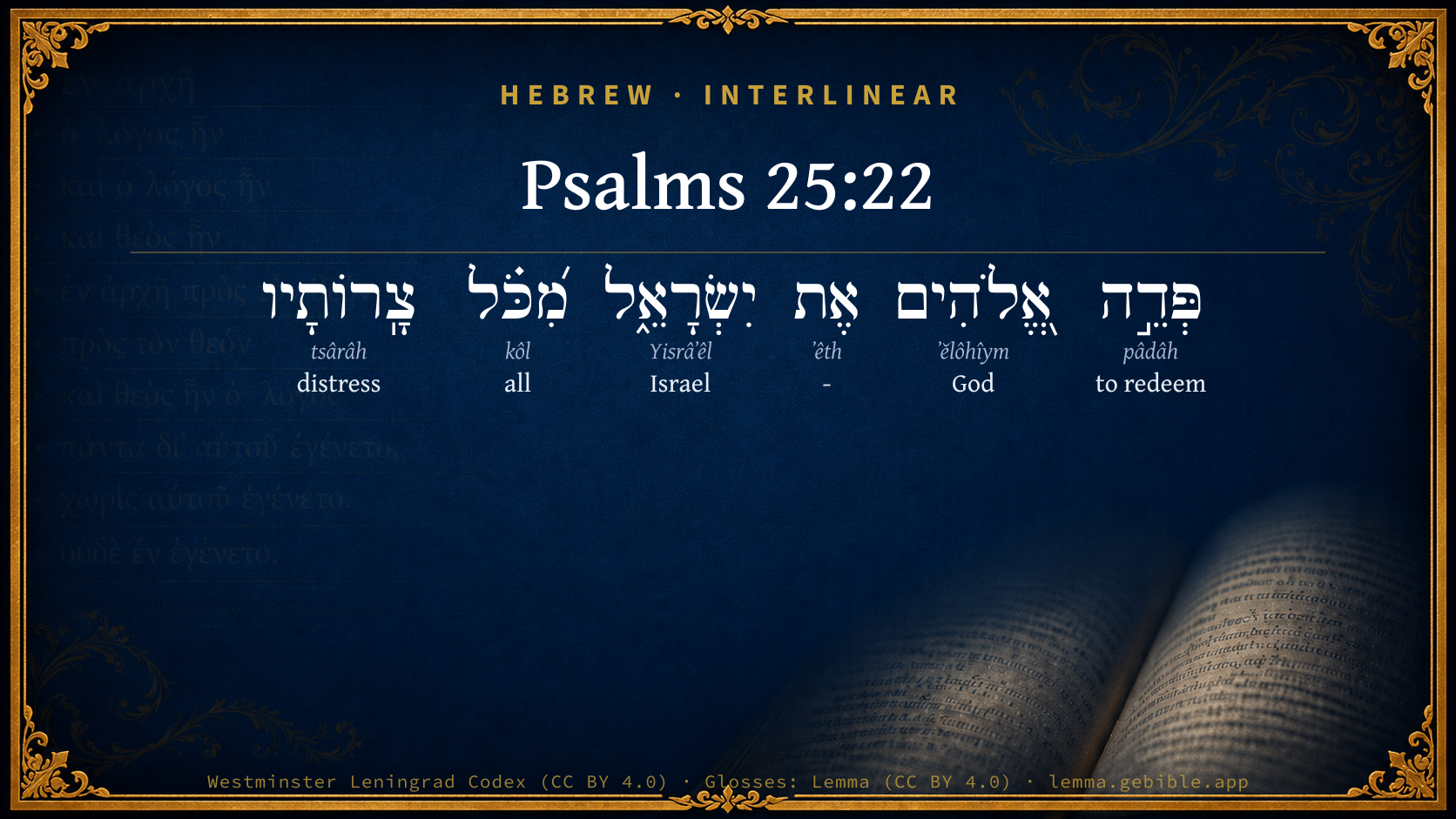
Psalms 25:22

Hebrew (Westminster Leningrad Codex) Psalms 25:22 appears in the Hebrew Old Testament. The text above is from the Westminster Leningrad Codex. Each word links to its Strong’s number, a concise gloss, and parsing drawn from the Open Scriptures Hebrew Bible morphology. Click any word for its full Brown-Driver-Briggs (BDB) entry.
Download image
Cite this verse

Psalms 25:22 (World English Bible). Public Domain. Lemma interlinear Bible study tool, https://lemma.gebible.app/v/psalms/25/22.

Show BibTeX & RIS
BibTeX
RIS
English Translation
Redeem Israel, God, Out all of his troubles.
World English Bible · Public Domain
Download a study sheet

One document with this verse’s original text, its word-by-word gloss line, the meaning frame, cross-references with their text, attributed commentary, and full source and license credits — printable, and it pastes into notes with its structure intact.

This verse Autodidact and up

Study sheet (.html) Plain text (.txt)

A passage Seminary Student

Up to 50 verses in one chapter. A passage sheet keeps up to 6 commentary sources and 12 cross-references per verse, in the order this page ranks them, and says so on the sheet whenever that leaves anything out. Ask for a single verse and you get the Autodidact verse sheet above.

Everything on this page stays free to read, with no account — the sheet is a download of what is already on screen, not access to it.

Want to remove ads? Support Godless Engineer
Compare translations 3

The same verse in 3 English versions, stacked beneath the original-language interlinear above. Click any original word for its lexicon entry.

Each is an independent rendering of the whole verse — the interlinear is not word-aligned to these translations.

Highlighted words mark where these versions differ — a whole-verse word diff, not a word-by-word alignment.

  • World English Bible Public Domain
    Redeem Israel, God, Out all of his troubles.
  • King James Version Public Domain
    Redeem Israel, O God, out of all his troubles.
  • unfoldingWord Literal Text CC BY-SA 4.0
    God, redeem Israel from all of his troubles!

unfoldingWord Literal Text — © unfoldingWord, licensed CC BY-SA 4.0. Word-aligned USFM3 via Door43 (git.door43.org/unfoldingWord/en_ult).

Versions to compare (up to 4)

3 of 4 selected

Show all 18 translations

Every available English version of this verse, each an independent rendering of the whole verse.

  • World English Bible Public Domain
    Redeem Israel, God, Out all of his troubles.
  • Berean Standard Bible Public Domain
    Redeem Israel, O God, from all its distress.
  • Majority Standard Bible Public Domain
    Redeem Israel, O God, from all its distress.
  • King James Version Public Domain
    Redeem Israel, O God, out of all his troubles.
  • American Standard Version (1901) Public Domain
    Redeem Israel, O God, Out all of his troubles. Psalm 26 `A Psalm' of David.
  • Revised Version (1885) Public Domain
    Redeem Israel, O God, out of all his troubles.
  • Geneva Bible (1599) Public Domain
    Deliuer Israel, O God, out of all his troubles.
  • Douay-Rheims (1899) Public Domain
    Deliver Israel, O God, from all his tribulations.
  • Young's Literal Translation Public Domain
    Redeem Israel, O God, from all his distresses!
  • Literal Standard Version CC BY-SA 4.0
    Redeem Israel, O God, from all his distresses!
  • Unlocked Literal Bible CC BY-SA 4.0
    Rescue Israel, God, from all of his troubles!
  • unfoldingWord Literal Text CC BY-SA 4.0
    God, redeem Israel from all of his troubles!
  • Darby Bible Public Domain
    Redeem Israel, O God, out of all his troubles.
  • World Messianic Bible Public Domain
    God, redeem Israel out of all his troubles.
  • Webster's Bible Public Domain
    Redeem Israel, O God, out of all his troubles.
  • Free Bible Version CC BY-SA 4.0
    God, please deliver the people of Israel from all their troubles!
  • Bible in Basic English Public Domain
    Give Israel salvation, O God, out of all his troubles.
  • JPS Tanakh (1917) Public Domain
    Redeem Israel, O God, out of all his troubles.

Literal Standard Version (2020), Covenant Press — licensed CC BY-SA 4.0. Text via the HelloAO Bible API (eBible.org). Unlocked Literal Bible (unfoldingWord) — licensed CC BY-SA 4.0. Text via the HelloAO Bible API (eBible.org). unfoldingWord Literal Text — © unfoldingWord, licensed CC BY-SA 4.0. Word-aligned USFM3 via Door43 (git.door43.org/unfoldingWord/en_ult). Free Bible Version, Dr. Jonathan Gallagher — licensed CC BY-SA 4.0. Text via the HelloAO Bible API (eBible.org).

Word by word

More ways to search: Search by grammar → Find every occurrence → Compare this word →

Practice this passage: Drill this verse → Learn its vocabulary →

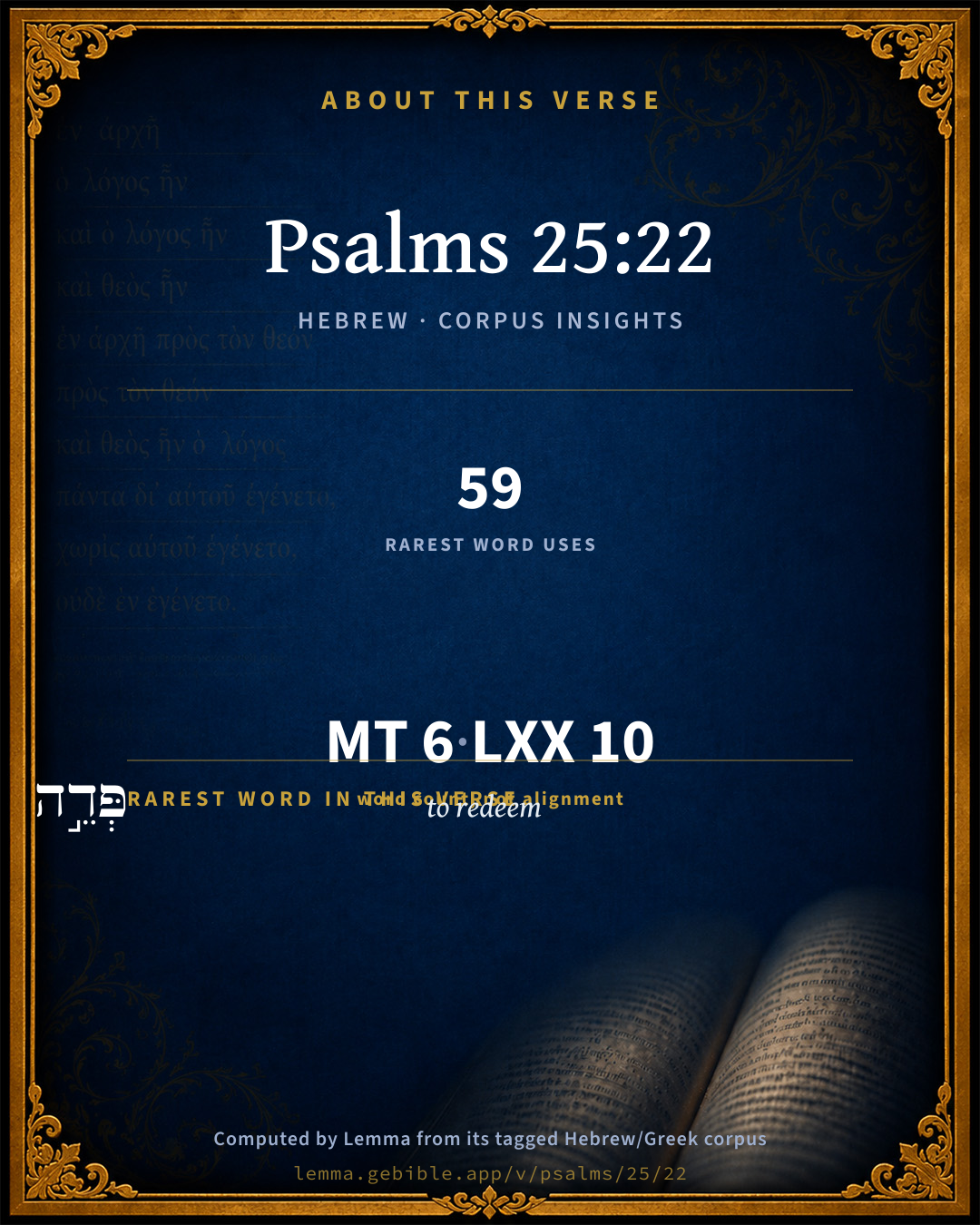
About this verse

These counts appear in no published source. They are computed here, from the morphology-tagged text and Lemma’s own curated glosses. What Lemma adds →

6
words
6
distinct lemmas
Wisdom
section

Shared distinctive vocabulary

פְּדֵ֣ה to redeem H6299 occurs in 48 verses of the Hebrew Bible. Also found in:

Grammatical profile

  • 1 verb
  • 4 nouns
  • 1 particle

Verb forms

  • פְּדֵ֣ה Qal · Imperative

Hebrew & Septuagint length

In English translation the verse runs 8 words from the Hebrew and 9 from the Septuagint (LXX English) — closely comparable.

A rough comparison of the two English renderings, which tokenize alike — not a word-level alignment.

Word counts can differ between the Hebrew and the Greek without any difference in meaning — e.g. the Hebrew direct-object marker אֵת has no separate Greek word, and Greek often adds the article ὁ.

In the original languages it is 6 Hebrew tokens and 10 Greek tokens — but the two are counted differently (Hebrew bundles its prefixes and suffixes into one token; the Greek is in lemma form), so that isn’t a like-for-like length.

Cross-references

4

Topical passages linked to Psalms 25:22 in the Treasury of Scripture Knowledge — connected by theme and wording, ordered by reader-vote popularity; previews shown in the World English Bible.

  • Psalms 130:8 He will redeem Israel from all their sins.
  • Psalms 14:7 Oh that the salvation of Israel would come out of Zion! When Yahweh restores the fortunes of his people, Then Jacob shall rejoice, and Israel shall be glad.
  • Psalms 51:18–19 Do well in your good pleasure to Zion. Build the walls of Jerusalem.
  • Psalms 122:6 Pray for the peace of Jerusalem. Those who love you will prosper.

Cross-references courtesy of OpenBible.info (CC BY 4.0).

Hebrew and Greek witnesses Masoretic Hebrew ↔ Greek Septuagint

The same verse in the two great witnesses to the Old Testament, shown verse-for-verse.

You’re reading Greek Psalm 24 (Hebrew Psalm 25). The Septuagint counts the superscription, so verse numbers can differ from the Hebrew — chapter-level alignment, not verse-by-verse. Numbering follows Rahlfs.

These are two independent witnesses, not word-aligned to each other, and the Septuagint is shown in lemma (dictionary) form.

Hebrew Psalms 25:22 Masoretic · Westminster Leningrad Codex

פְּדֵ֣ה אֱ֭לֹהִים אֶת יִשְׂרָאֵ֑ל מִ֝כֹּ֗ל צָֽרוֹתָיו

Redeem Israel, God, Out all of his troubles.

World English Bible · Public Domain

Greek LXX Greek Psalm 24:22 Septuagint · lemma form

λυτρόω ὁ θεός ὁ ἰσραήλ ἐκ πᾶς ὁ θλῖψις αὐτός

Deliver Israel, O God, out of all his afflictions.

LXX2012 (modern English Septuagint) · Public Domain

Hebrew: Westminster Leningrad Codex (CC BY 4.0). Greek: Septuagint (public domain); English from LXX2012 (modern English Septuagint) (Public Domain). How the Septuagint differs from the Hebrew →

Commentary

Notes on Psalms 25:22 from classic Christian and Jewish commentators (each source and its license shown beneath its notes). The classic Christian expositions comment on the surrounding passage and are grouped to its opening verse, so a note may address several verses; the Jewish commentaries on the Tanakh (Rashi and others) are per-verse, so they appear only where the commentator wrote on this verse.

Lemma curates 59 commentaries, every one of them public domain or Creative Commons licensed, each selected and text-cleaned for this edition rather than reprinted as found. About our sources →

Adam Clarke's Commentary

Verse 22. Redeems Israel, O God] The people are prayed for in the preceding verses as if one person; now he includes the whole, lest his own personal necessities should narrow his heart, and cause him to forget his fellow sufferers.

This verse stands out of the order of the Psalm; and does not appear to have formed a part of the alphabetical arrangement. It is a general prayer for the redemption of Israel from captivity; and may well be applied to those of the true Israel who are seeking for complete redemption from the power, the guilt, and the pollution of sin; and from all the troubles that spring from it. And let it be ever known, that God alone can redeem Israel.

ANALYSIS OF THE TWENTY-FIFTH PSALM

This Psalm is a continued earnest prayer of a man or a people pressed with danger and enemies, and sensible of God's heavy displeasure against sin. It consists of five petitions.

I. His first petition is, that his "enemies not triumph over him," Ps 25:2; Ps 25:3.

II. His second is for instruction, Ps 25:4; Ps 25:5, which he urges, Ps 25:8-10; Ps 25:12-14.

III. His third is for mercy and forgiveness, Ps 25:6; Ps 25:7; Ps 25:11.

IV. His fourth is a renewal of his first, Ps 25:15-17, c., with many arguments.

V. His fifth is for Israel in general, Ps 25:22.

I. He begins with the profession of his faith and confidence in God, without which there can be no prayer: " Unto thee, O Lord," c. he relies not on, nor seeks after, any human help. And upon this living hope, he prays -

1. For this life, that it shame him not, as it does where a man hopes, and is frustrated: "Let me not be ashamed." Make it appear that I hope not in thee in vain.

2. "Let not mine enemies triumph over me." Glorying that I am deserted. This petition he urges by this argument: The example may prove dangerous, if thou send me no help but it will be to thy glory, if I be relieved. If he were delivered, the faith and hope of others would be confirmed; if deserted, the good would faint and fail, the wicked triumph: therefore he prays, O, let none that wait on thee be ashamed; but let them be ashamed who transgress, that is, they that do me wrong maliciously, without my cause being given by myself.

II. He petitions for instruction, that he may be always guided and governed by the word of God, that he sink not under the cross, but rely on God's promises.

1. "Show me thy ways, and teach me thy paths." Show me that thou often dealest severely with thy best servants: bringest down, before thou exaltest; mortifiest, before thou quickenest; and settest the cross before the crown. Teach me - show me, that this is thy way.

2. "Lead me in thy truth, and teach me." Cause me to remember that thy promises are firm and true; yea and amen to those who trust in thee. This makes me hope still: "Thou art the God of my salvation."

III. His third petition is for mercy. He prays for mercy, and the removal of the sin that obstructs it.

1. "Remember, O Lord, thy tender mercies, c., which have been ever of old" i.e., deal mercifully with me as thou hast ever done with those who flee to thee in their extremity.

2. He prays for the remission of the sins of his youth: "Remember not the sins of my youth." This petition he repeats, Ps 25:11: "For thy name's sake pardon mine iniquity;" and upon this confession: "For it is great."

The psalmist here breaks off prayer; and, to confirm his confidence, speaks of the nature and person of God. It is necessary sometimes, even in the midst of our prayers, to call to mind the nature of God, and his ways with his people, lest, through a sense of our unworthiness or great unfaithfulness, we should be discouraged. And this course David takes; he says,

1. "Good and upright is the Lord." 1. Good, for he receives sinners gratis. 2. Upright - constant and true in his promises; therefore he will teach sinners in the way.

2. "The meek will he guide in judgment." He will not suffer them to be tempted above their strength; will teach them what to answer; and will not proceed with rigour, but will interpret all in the most favourable sense.

3. In a word, "All the ways of the Lord are mercy and truth." 1. Mercy, in that he freely offers the remission of sins, the graces of his Spirit, support in distresses, and at last eternal life, to those who by faith and a good conscience walk before him: "Keep his covenant and his testimonies;" for the words of the covenant are: "I will be thy God, and the God of thy seed;" upon which follows: "Walk before me, and be thou perfect."

4. Upon the confidence of which promises and covenant the psalmist repeats his prayer: "O Lord, pardon mine iniquity; for it is great," Ps 25:11.

The psalmist now admires the happiness of him who trusts in God: "What man is he that feareth the Lord!" This happiness he sets forth by the fruits that follow his piety: -

1. The first fruit he shall gather is instruction and direction in his vocation, and private life: "Him shall he teach in the way," c.

2. The second is, that his happiness shall not be momentary, but firm and lasting: "His soul shall dwell at ease."

3. The third is, that he shall be happy in his posterity: "His seed shall inherit the land."

4. The fourth is, that the redemption of mankind by Christ Jesus, with all the effects of it, pardon, holiness, c., which is a secret unknown to the world, shall be revealed and applied to him: "The secret of the Lord is with them that fear him and he will show them his covenant."

IV. Being confirmed by these promises, and cheered with these fruits, he,

1. Testifies his faith in God for deliverance: "My eyes are ever toward the Lord he will pluck my feet out of the net."

2. He then renews his former prayer, it being nearly the same as that with which he began. It is conceived in several clauses: 1. "Turn thee unto me." 2. "Have mercy upon me." 3. "O bring me out of my distresses." 4. "Look upon my affliction and trouble, and forgive me all my sins." 5. "Consider mine enemies." 6. "O keep my soul, and deliver me." 7. "Let me not be ashamed." 8. "Let integrity and uprightness preserve me."

Petitioners, and men in misery, think they can never say enough. This makes him often repeat the same thing. The sum is, that God would hear and grant him defence and deliverance in his dangers; remission of sins which caused them; and protect, direct, and govern him in his troubles.

3. That he might prevail in his suit, like an excellent orator, he uses many arguments to induce God to be propitious to him: -

1. His faith and trust in his promises: "Mine eyes are ever towards the Lord."

2. The danger he was now in: "His feet were in the net."

3. He was oppressed, alone, and had none to help him: "I am desolate and afflicted."

4. His inward afflictions and pain were grievous: "The troubles of my heart are enlarged."

5. His enemies were many, powerful, merciless, cruel: "Mine enemies are many - and hate me with cruel hatred."

6. And yet I am innocent, and desire to be so; and am thy servant: "Let integrity and uprightness preserve me; for I wait upon thee."

V. The psalmist having thus, through the Psalm, prayed for himself, at last offers up a short but earnest petition for the whole Church; which proceeds from that fellowship or communion which ought to be among all saints: "Redeem Israel, O God, out of all his troubles!" Turn our captivity, and forgive the sins which have occasioned it.

Adam Clarke's Commentary on the Bible (1810–1826) — public domain. Text from a community e-Sword/MySword module.

Trapp's Complete Commentary

John Trapp

Psa 25:22 Redeem Israel, O God, out of all his troubles.

Ver. 22. Redeem Israel, &c.] In vita vel post mortem meam, Either while I live, or after my death (R. David). This is every good man’s care and prayer. None is in case to pray for the Church, that hath not first made his own peace with God.

John Trapp, A Commentary or Exposition upon All the Books of the Old and New Testament (1647–1656) — public domain. Text from a community e-Sword module.

Joseph Benson's Commentary

Psa 25:22. Redeem Israel, O God, &c. — “Have mercy, not upon me only, but upon the whole nation, who are miserably distracted by their divisions, and restore them to peace and quietness.” — Bishop Patrick, who supposes that the Psalm was written during the troubles occasioned by Absalom. David was now in trouble himself, in great trouble, (Psa 25:17,) and very earnest he was in praying to God for deliverance; yet he forgets not the distresses of God’s church. Good men have little comfort in their own safety while the church is in distress and danger. This prayer is a three-fold prophecy; 1st, That God would at length give David rest, and therewith give Israel rest from all their enemies round about. 2d, That he would send the Messiah, in due time, to redeem Israel from all his iniquities, Psalms 130. ult., and so to redeem them from their troubles; and, 3d, Of the happiness of the future state. In heaven, and in heaven only, will God’s Israel be perfectly redeemed from all troubles.

Joseph Benson's Commentary on the Old and New Testaments (1811–1818) — public domain. Text from a community e-Sword module.

Keil & Delitzsch

C. F. Keil & F. Delitzsch

His experience is not singular, but the enmity of the world and sin bring all who belong to the people of God into straits just as they have him. And the need of the individual will not cease until the need of the whole undergoes a radical remedy. Hence the intercessory prayer of this meagre closing distich, whose connection with what precedes is not in this instance so close as in Ps 34:23. It looks as though it was only added when Ps 25 came to be used in public worship; and the change of the name of God favours this view. Both Psalms close with a פ in excess of the alphabet. Perhaps the first פ represents the π, and the second the φ; for Psa 25:16; Psa 34:17 follow words ending in a consonant, and Psa 25:22; 34:23, words ending in a vowel. Or is it a propensity for giving a special representation of the final letters, just as these are sometimes represented, though not always perfectly, at the close of the hymns of the synagogue (pijutim)?

Keil & Delitzsch — Biblical Commentary on the Old Testament (1861–1891) — public domain (CC PDM 1.0). Text via the HelloAO Bible API. (Old Testament only.)

Jamieson, Fausset & Brown

Robert Jamieson, A. R. Fausset & David Brown

Extend these blessings to all Thy people in all their distresses.

Next: Psalms Chapter 26

Jamieson, Fausset & Brown — Commentary Critical and Explanatory on the Whole Bible (1871) — public domain (CC PDM 1.0). Text via the HelloAO Bible API.

John Calvin's Commentaries

22. Do thou, O God! redeem Israel. By this conclusion David shows of what character the enemies were of whom he complained. From this it would appear that they were domestic enemies, who, like some disease raging within the bowels, were now the cause of trouble and vexation to the people of God. By the word redeem, which he here employs, we may infer that the Church was at that time oppressed with hard bondage; and, therefore, I have no doubt that in this psalm he alludes to Saul and others who reigned with him in a tyrannical manner. At the same time, he shows that he has respect not merely to his own benefit, but that he comprehends in his prayer the state of the whole realm, just as the mutual communion and connection which subsist among the saints require that every individual, deeply affected by a sense of the public calamities which befall the Church at large, should unite with all the others in lamentation before God. This contributed in no small degree to confirm the faith of David, when, regarding himself as in all things connected with the whole body of the faithful, he considered that all the afflictions and wrongs which he endured were common to himself with them. And we ought to regard it as of the greatest importance, that in accordance with this rule, every one of us, in bewailing his private miseries and trials, should extend his desires and prayers to the whole Church.

John Calvin's Commentaries (1540-1563) — public domain. Text from the Calvin Translation Society English edition (1840s-50s) via the Christian Classics Ethereal Library (ccel.org). Calvin's coverage is partial (roughly two-thirds of the Bible); uncommented books and verses are honest gaps, never fabricated. The 19th-century editor's footnotes and remarks are omitted so the notes are faithfully Calvin's own voice.

Ellicott's Commentary for English Readers

(22) This verse, beginning with Pe, was apparently a later addition. Not only is it an isolated line, interfering with the alphabetical arrangement, but it also differs from the rest of the psalm by employing Elohim in the place of Jehovah. (Comp. Psa_34:22.)

A Bible Commentary for English Readers, edited by Charles John Ellicott (1878–1897) — public domain. Text from a community e-Sword module.

The Cambridge Bible for Schools and Colleges

gen. ed. J. J. S. Perowne

22. A concluding prayer for the nation. The alphabet has been completed, and this is a supplementary distich beginning with Pç, which has already been represented in Psa_25:16. Psalms 34 has the same peculiarity. Lagarde has ingeniously conjectured that these verses contain a reference to the names of the authors, Pedael and Pedaiah. But this is very doubtful; and this verse at any rate is probably a liturgical addition to the original Psalm. The absolute use of God instead of Jehovah is contrary to the usage of the Psalm, and rare in the First Book of Psalms generally. See Introd. p. lv.

The Cambridge Bible for Schools and Colleges (gen. ed. J. J. S. Perowne; Cambridge University Press, 1878–1918) — public domain. Text from a community e-Sword module.

John Gill's Exposition

Redeem Israel, O God, out of all his troubles. David was not only concerned for himself, but for the whole nation of Israel, which was involved in trouble through this unnatural rebellion of his son, and many of his subjects; and no doubt he may have a further view to the redemption of the church of God, the spiritual Israel, by the Messiah; and his sense may be, that God would send the promised Redeemer and Saviour, to redeem his people from all their iniquities; from the law, its curses and condemnation; to ransom them out of the hands of Satan, that is stronger than they; and to deliver them from all their enemies, and from death itself, the last enemy, which will put an end to all their troubles, Isa 35:10.

Next: Psalms Chapter 26

John Gill's Exposition of the Whole Bible (1746–1763) — public domain (CC PDM 1.0). Text via the HelloAO Bible API.

Albert Barnes' Notes on the Bible

Redeem Israel - Redeem or save thy people - the word “Israel” here being used, as elsewhere, to denote the people of God.

Out of all his troubles - Save thy people from persecution, and from trial of all kinds. The prayer of the psalmist had, before this, related mainly to himself. He had made mention of his own troubles and sorrows, and had earnestly sought relief. The psalm, however, closes appropriately with a reference to others; to all the people of God who might be in similar circumstances. Religion is not selfish. The mind under the influence of true piety, however intensely it may feel its own trouble, and however earnestly it may pray for deliverance, is not forgetful of the troubles of others; and prayers for their comfort and deliverance are freely mingled with those which the afflicted children of God offer for themselves. This verse may be, therefore, taken as an illustration of the nature of true piety: piety that seeks the welfare of all; piety that does not terminate in itself alone; piety that desires the happiness of all people, especially the deliverance of the suffering and the sad. It should, however, be added that this verse is no part of the alphabetical series in the psalm - that having been ended, in Psa 25:21, with the last letter of the Hebrew alphabet. This verse commences with the Hebrew letter pe (p). Some have supposed that it was added to the psalm when it was prepared for public use, in order to make what was at first applicable to an individual appropriate as a part of public worship - or because the sentiments in the psalm, originally having reference to one individual, were as applicable to the people of God generally as to the author of the psalm. There is some plausibility in this conjecture.

Albert Barnes' Notes on the Bible (1834–1885) — public domain. Text from a community e-Sword/MySword module.

Matthew Poole's English Annotations

If thou wilt not pity and help me, yet spare thy people. who suffer for my sake, and in my sufferings.

Matthew Poole's English Annotations on the Holy Bible (1683–1685) — public domain. Text from a community e-Sword/MySword module.

The Treasury of David

Charles H. Spurgeon

Ver. 22. Redeem Israel, O God, out of all his troubles. This is a very comprehensive prayer, including all the faithful and all their trials. Sorrow had taught the psalmist sympathy, and given him communion with the tried people of God; he therefore remembers them in his prayers. Israel, the tried, the wrestling, the conquering hero, fit representative of all the saints. Israel in Egypt, in the wilderness, in wars with Canaanites, in captivity, fit type of the church militant on earth. Jesus is the Redeemer from trouble as well as sin, he is a complete Redeemer, and from every evil he will rescue every saint. Redemption by blood is finished: O God, send us redemption by power. Amen and Amen.

Ver. 22. Redeem Israel, O God, out of all his troubles. If thou wilt not pity and help me, yet spare thy people, who suffer for my sake, and in my sufferings. Matthew Poole.

Ver. 22. Redeem Israel, etc. In vita vel post mortem meam, (Rabbi David), either whiles I live, or after my death. This is every good man's care and prayer. None is in case to pray for the church, that hath not first made his own peace with God. John Trapp.

Ver. 22. This most beautiful of "Psalms and hymns and spiritual songs" closes with a sweet petitionsuch an one, as every one of the true Israel of God would wish to depart with on his lips. "Redeem Israel, O God, out of all his troubles." It breathes the same holy aspiration as the aged Simeon's "Lord! now lettest thy servant depart in peace, for mine eyes have seen thy salvation." Barton Bouchier.

Ver. 22. Jacob's life, as typical of ours, may illustrate this prayer.

Ver. 22. A prayer for the church militant.

Charles H. Spurgeon's The Treasury of David (1869–1885) — public domain. Psalms only. Text from a community e-Sword/MySword module.

The Pulpit Commentary

Redeem Israel, O God, out of all his troubles. It is supposed by some that this verse was added during the "trouble" of the Captivity; and certainly its stand-lug outside the alphabetical arrangement favours this view; but the similar irregularity at the close of Ps 34, rather makes against it. David evidently was not a slave to a mechanical arrangement; and any pious Israelite, at any age (therefore certainly David) might naturally append a prayer for his people to an outpouring of prayer for himself. Moreover, redemption is an idea familiar to David. (Psa_19:14 Psa_26:11 Psa_31:5 Psa_34:22)

The Pulpit Commentary (1880–1919), ed. H.D.M. Spence-Jones & Joseph S. Exell — public domain. Text from a community e-Sword module.

John Wesley's Explanatory Notes

Israel - If thou wilt not help me, yet spare thy people who suffer for my sake, and in my sufferings.

John Wesley, Explanatory Notes Upon the Whole Bible (1754–1765) — public domain. Text via the GEBible commentary corpus.

J. A. Alexander on Psalms

Joseph Addison Alexander

22. Redeem, O God, Israel out of all his troubles! As the psalm was designed, from the first, to be a vehicle of pious feeling and desire for the whole church, it is here wound up with a petition shewing this extent of purpose. The Psalmist prays no longer for himself, but for all Israel. The peculiar name, Jehovah, which had hitherto been used exclusively, is here exchanged for the generic name of God, perhaps in opposition to the human adversaries of the Psalmist, and his total destitution of all human help. This verse forms no part of the alphabetical series, but begins with the same letter as ver. 16. Like the first verse, it consists of a single clause, as if the two together were designed to constitute one sentence.

Joseph Addison Alexander, The Psalms Translated and Explained (1850) — public domain. Text from a community e-Sword module.

Scofield Reference Notes

C. I. Scofield

redeem

(See Scofield "Isa 59:20") See Scofield "Exo 14:30"

The Scofield Reference Bible (1917 edition), notes by C. I. Scofield — public domain. Text from a community e-Sword module.

unfoldingWord translationNotes

Door43 World Missions Community

Rescue Israel

"Save Israel" or "Redeem Israel"

Israel ... his troubles

Here "Israel" represents the people of Israel. AT: "the people of Israel ... our troubles" (See: Metonymy)

translationWords

Israel

trouble

unfoldingWord translationNotes — © Distant Shores Media and the Door43 World Missions Community, licensed CC BY-SA 4.0. Source: git.door43.org/Door43/en_tn.

Lesson kit

Teaching starters — assembled from the data on this page, not authored interpretation. Every prompt links to the verse data it draws on. Edit before teaching.

Psalms, in the Wisdom, opens this verse with 6 words (6 distinct Hebrew lemmas). Its most distinctive word is pâdâh (“to redeem”). A historical commentator’s framing appears above. Read the whole chapter for the surrounding context.

Discussion questions

  1. What does “to redeem” (pâdâh) contribute to the verse as a whole?
  2. How does Exodus 13:13, which shares the word «to redeem», read alongside this verse?
  3. The translations on this page render this verse differently — a whole-verse word diff, not a word-by-word alignment. What might account for the different wordings?
  4. «פְּדֵ֣ה» is a Qal Imperative verb. How does that grammatical form shape the action described?
  5. Compare how Adam Clarke's Commentary and Trapp's Complete Commentary read this verse. Where do they agree or differ?

Things to notice

Reading settings

Reading text

Shown beneath each verse's original-language words.

Old Testament
Old Testament edition

Read the OT as the Masoretic Hebrew (MT) or the Greek Septuagint (LXX).

English shown for the Greek Septuagint (in the Hebrew ↔ Greek comparison).

Comparing translations? Open the Compare panel on any verse page to stack up to four side by side.