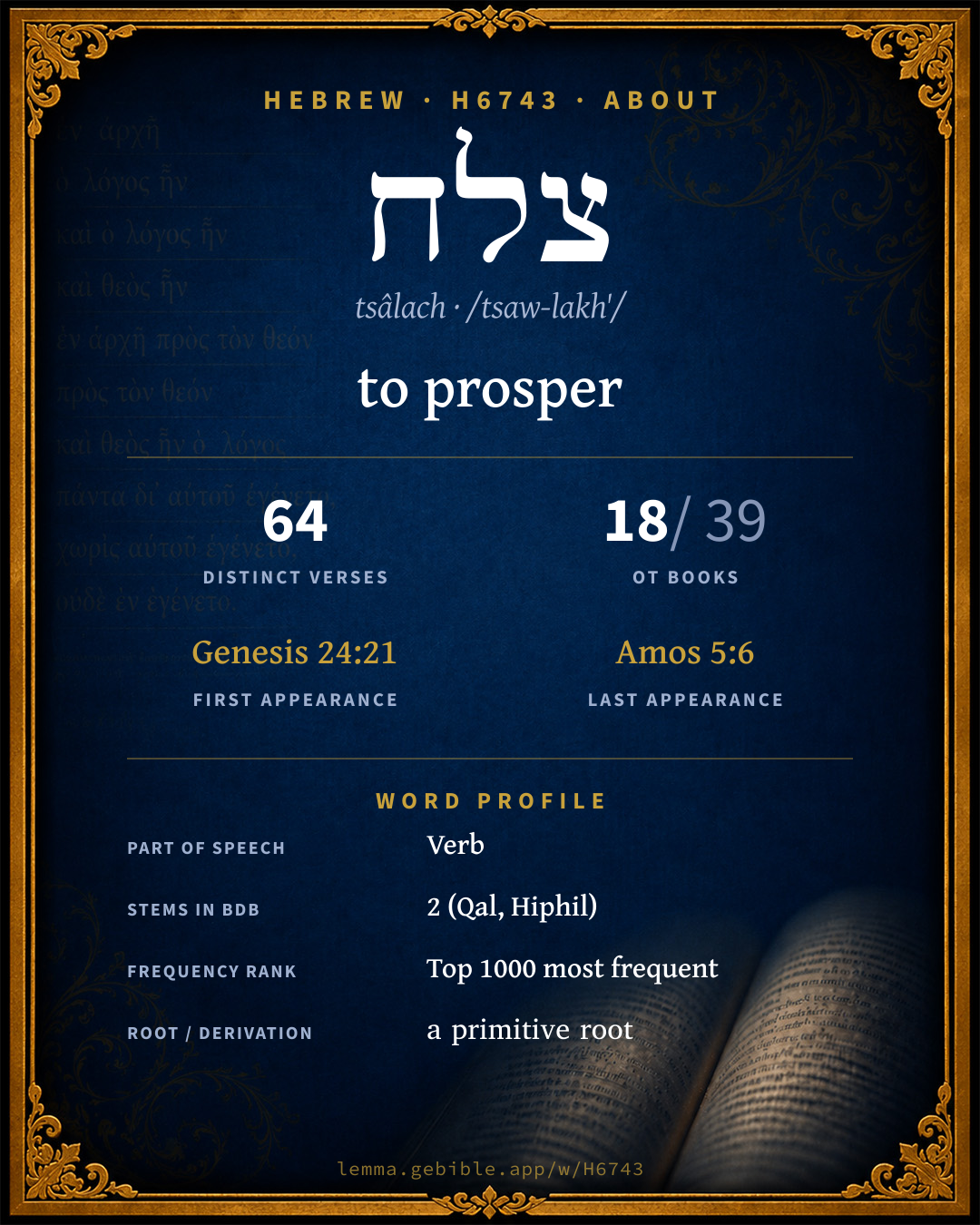
צלח
to prosper
‘to prosper’ is one of 2 main senses fuller range ↓
Full lexicon entry — Brown-Driver-Briggs (BDB)
From Brown-Driver-Briggs (BDB)
Where this word appears
See every Hiphil verb in the Hebrew Bible →
Grammar key — what these labels mean
Part of speech
- Verb
- An action or state-of-being word.
Stem
- Qal
- The basic, simple active stem — the plain form of the verb (“he wrote”).
- Hiphil
- The causative active stem (“he caused / brought about”). Here: ‘make prosperous’
Form
- Sequential Imperfect
- An imperfect with prefixed waw — the standard past-narrative form (waw-consecutive imperfect).
- Imperfect
- An incomplete, ongoing, or future action (“he will / would write”).
- Sequential Perfect
- A perfect with prefixed waw continuing a preceding imperfect or command (waw-consecutive perfect).
- Participle Active
- A verbal adjective expressing ongoing or characteristic action (“writing / one who writes”).
- Imperative
- A direct command (“write!”).
- Perfect
- A completed action or state — Hebrew marks aspect (completeness) more than strict tense (“he wrote”).
State
- Absolute
- The independent form of a noun, not bound to a following word.
- Construct
- A noun bound to a following noun in a possessive / “of” relationship (the construct chain).
Person
- 3rd Person
- The one spoken about (“he / she / it / they”).
- 2nd Person
- The one addressed (“you”).
Gender
- Feminine
- Grammatically feminine.
- Masculine
- Grammatically masculine.
- Common
- Either gender — not distinguished for this form.
Number
- Singular
- One.
- Plural
- More than one (in Hebrew, generally three or more).
Grammatical forms 24 distinct
- Verb, Qal, Imperfect, 3rd Person, Masculine, Singular 9 times (14%)
- Verb, Qal, Sequential Imperfect, 3rd Person, Feminine, Singular 7 times (11%)
- Verb, Hiphil, Perfect, 3rd Person, Masculine, Singular 6 times (9%)
- Verb, Hiphil, Sequential Perfect, 3rd Person, Masculine, Singular 5 times (8%)
- Verb, Hiphil, Imperative, 2nd Person, Masculine, Singular 5 times (8%)
- Verb, Hiphil, Participle Active, Masculine, Singular, Absolute 4 times (6%)
- Verb, Qal, Imperfect, 3rd Person, Feminine, Singular 4 times (6%)
- Verb, Hiphil, Imperfect, 2nd Person, Masculine, Plural 3 times (5%)
+16 more forms (22 occurrences)
Parsed forms decoded from the imported morphology (morphhb / Westminster Leningrad Codex — WLC text public domain, morphhb tagging CC BY 4.0), counted across 65 parsed occurrences — not distinct verses.
Every verse where H6743 appears — 64 distinct verses across 18 books. Click any verse to open its interlinear word-by-word view. Verse text shown in the World English Bible for context — . Each verse’s Hebrew form is shown with its reference; the English is not keyword-highlighted, since the data carries no word-level English alignment. Use “Compare translations” on any verse to read it across multiple English versions. This concordance covers the Hebrew Bible; Septuagint (Greek Old Testament) occurrences are not indexed here.
Genesis 7 verses
- Genesis 24:21 הַֽ/הִצְלִ֧יחַ ptcl inter + Hiphil pf 3ms The man looked steadfastly at her, holding his peace, to know whether Yahweh had made his journey prosperous or not.
- Genesis 24:40 וְ/הִצְלִ֣יחַ conj + Hiphil pf 3ms He said to me, 'Yahweh, before whom I walk, will send his angel with you, and prosper your way. You shall take a wife for my son of my relatives, and of my father's house.
- Genesis 24:42 מַצְלִ֣יחַ Hiphil ptcp.act ms I came this day to the spring, and said, 'Yahweh, the God of my master Abraham, if now you do prosper my way which I go.
- Genesis 24:56 הִצְלִ֣יחַ Hiphil pf 3ms He said to them, "Don't hinder me, seeing Yahweh has prospered my way. Send me away that I may go to my master."
- Genesis 39:2 מַצְלִ֑יחַ Hiphil ptcp.act ms Yahweh was with Joseph, and he was a prosperous man. He was in the house of his master the Egyptian.
- Genesis 39:3 מַצְלִ֥יחַ Hiphil ptcp.act ms His master saw that Yahweh was with him, and that Yahweh made all that he did prosper in his hand.
- Genesis 39:23 מַצְלִֽיחַ Hiphil ptcp.act ms The keeper of the prison didn't look after anything that was under his hand, because Yahweh was with him; and that which he did, Yahweh made it prosper.
Numbers 1 verse
Deuteronomy 1 verse
Joshua 1 verse
Judges 4 verses
- Judges 14:6 וַ/תִּצְלַ֨ח conj + Qal wimpf 3fs The Spirit of Yahweh came mightily on him, and he tore him as he would have torn a kid; and he had nothing in his hand: but he didn't tell his father or his mother what he had done.
- Judges 14:19 וַ/תִּצְלַ֨ח conj + Qal wimpf 3fs The Spirit of Yahweh came mightily on him, and he went down to Ashkelon, and struck thirty men of them, and took their spoil, and gave the changes [of clothing] to those who declared the riddle. His anger was kindled, and he went up to his father's house.
- Judges 15:14 וַ/תִּצְלַ֨ח conj + Qal wimpf 3fs When he came to Lehi, the Philistines shouted as they met him: and the Spirit of Yahweh came mightily on him, and the ropes that were on his arms became as flax that was burnt with fire, and his bands dropped from off his hands.
- Judges 18:5 הֲ/תַצְלִ֣יחַ ptcl inter + Hiphil impf 3fs They said to him, Ask counsel, we pray you, of God, that we may know whether our way which we go shall be prosperous.
1 Samuel 5 verses
- 1 Samuel 10:6 וְ/צָלְחָ֤ה conj + Qal wpf 3fs and the Spirit of Yahweh will come mightily on you, and you shall prophesy with them, and shall be turned into another man.
- 1 Samuel 10:10 וַ/תִּצְלַ֤ח conj + Qal wimpf 3fs When they came there to the hill, behold, a band of prophets met him; and the Spirit of God came mightily on him, and he prophesied among them.
- 1 Samuel 11:6 וַ/תִּצְלַ֤ח conj + Qal wimpf 3fs The Spirit of God came mightily on Saul when he heard those words, and his anger was kindled greatly.
- 1 Samuel 16:13 וַ/תִּצְלַ֤ח conj + Qal wimpf 3fs Then Samuel took the horn of oil, and anointed him in the midst of his brothers: and the Spirit of Yahweh came mightily on David from that day forward. So Samuel rose up, and went to Ramah.
- 1 Samuel 18:10 וַ/תִּצְלַ֣ח conj + Qal wimpf 3fs It happened on the next day, that an evil spirit from God came mightily on Saul, and he prophesied in the midst of the house: and David played with his hand, as he did day by day. Saul had his spear in his hand;
2 Samuel 1 verse
1 Kings 2 verses
- 1 Kings 22:12 וְ/הַצְלַ֔ח conj + Hiphil impv 2ms All the prophets prophesied so, saying, Go up to Ramoth-gilead, and prosper; for Yahweh will deliver it into the hand of the king.
- 1 Kings 22:15 וְ/הַצְלַ֔ח conj + Hiphil impv 2ms When he was come to the king, the king said to him, Micaiah, shall we go to Ramoth-gilead to battle, or shall we forbear? He answered him, Go up and prosper; and Yahweh will deliver it into the hand of the king.
1 Chronicles 3 verses
- 1 Chronicles 22:11 וְ/הִצְלַחְתָּ֗ conj + Hiphil wpf 2ms Now, my son, Yahweh be with you; and prosper you, and build the house of Yahweh your God, as he has spoken concerning you.
- 1 Chronicles 22:13 תַּצְלִ֔יחַ Hiphil impf 2ms Then shall you prosper, if you observe to do the statutes and the ordinances which Yahweh gave Moses concerning Israel. Be strong, and of good courage. Don't be afraid, neither be dismayed.
- 1 Chronicles 29:23 וַ/יַּצְלַ֑ח conj + Hiphil wimpf 3ms Then Solomon sat on the throne of Yahweh as king instead of David his father, and prospered; and all Israel obeyed him.
2 Chronicles 10 verses
- 2 Chronicles 7:11 הִצְלִֽיחַ Hiphil pf 3ms Thus Solomon finished the house of Yahweh, and the king's house: and all that came into Solomon's heart to make in the house of Yahweh, and in his own house, he prosperously effected.
- 2 Chronicles 13:12 תַצְלִֽיחוּ Hiphil impf 2mp Behold, God is with us at our head, and his priests with the trumpets of alarm to sound an alarm against you. Children of Israel, don't you fight against Yahweh, the God of your fathers; for you shall not prosper.
- 2 Chronicles 14:7 וַ/יַּצְלִֽיחוּ conj + Hiphil wimpf 3mp For he said to Judah, Let us build these cities, and make about them walls, and towers, gates, and bars; the land is yet before us, because we have sought Yahweh our God; we have sought him, and he has given us rest on every side. So they built and prospered.
- 2 Chronicles 18:11 וְ/הַצְלַ֔ח conj + Hiphil impv 2ms All the prophets prophesied so, saying, Go up to Ramoth-gilead, and prosper; for Yahweh will deliver it into the hand of the king.
- 2 Chronicles 18:14 וְ/הַצְלִ֔יחוּ conj + Hiphil impv 2mp When he was come to the king, the king said to him, Micaiah, shall we go to Ramoth-gilead to battle, or shall I forbear? He said, Go up, and prosper; and they shall be delivered into your hand.
- 2 Chronicles 20:20 וְ/הַצְלִֽיחוּ conj + Hiphil impv 2mp They rose early in the morning, and went forth into the wilderness of Tekoa: and as they went forth, Jehoshaphat stood and said, Hear me, Judah, and you inhabitants of Jerusalem: believe in Yahweh your God, so shall you be established; believe his prophets, so shall you prosper.
- 2 Chronicles 24:20 תַצְלִ֔יחוּ Hiphil impf 2mp The Spirit of God came on Zechariah the son of Jehoiada the priest; and he stood above the people, and said to them, Thus says God, Why disobey you the commandments of Yahweh, so that you can't prosper? because you have forsaken Yahweh, he has also forsaken you.
- 2 Chronicles 26:5 הִצְלִיח֖/וֹ Hiphil pf 3ms + sfx pers 3ms He set himself to seek God in the days of Zechariah, who had understanding in the vision of God: and as long as he sought Yahweh, God made him to prosper.
- 2 Chronicles 31:21 וְ/הִצְלִֽיחַ conj + Hiphil pf 3ms In every work that he began in the service of the house of God, and in the law, and in the commandments, to seek his God, he did it with all his heart, and prospered.
- 2 Chronicles 32:30 וַ/יַּצְלַ֥ח conj + Hiphil wimpf 3ms This same Hezekiah also stopped the upper spring of the waters of Gihon, and brought them straight down on the west side of the city of David. Hezekiah prospered in all his works.
Nehemiah 2 verses
- Nehemiah 1:11 וְ/הַצְלִֽיחָ/ה conj + Hiphil impv 2ms + sfx h Lord, I beg you, let now your ear be attentive to the prayer of your servant, and to the prayer of your servants, who delight to fear your name; and please prosper your servant this day, and grant him mercy in the sight of this man. Now I was cup bearer to the king.
- Nehemiah 2:20 יַצְלִ֣יחַֽ Hiphil impf 3ms Then answered I them, and said to them, The God of heaven, he will prosper us; therefore we his servants will arise and build: but you have no portion, nor right, nor memorial, in Jerusalem.
Psalms 4 verses
- Psalms 1:3 יַצְלִֽיחַ Hiphil impf 3ms He will be like a tree planted by the streams of water, That brings forth its fruit in its season, Whose leaf also does not wither. Whatever he does shall prosper.
- Psalms 37:7 בְּ/מַצְלִ֣יחַ prep + Hiphil ptcp.act ms cs Rest in Yahweh, and wait patiently for him. Don't fret because of him who prospers in his way, Because of the man who makes wicked plots happen.
- Psalms 45:4 צְלַ֬ח Qal impv 2ms In your majesty ride on victoriously on behalf of truth, humility, and righteousness. Let your right hand display awesome deeds.
- Psalms 118:25 הַצְלִ֘יחָ֥/ה Hiphil impv 2ms + sfx h Save us now, we beg you, Yahweh; Yahweh, we beg you, now send prosperity.
Proverbs 1 verse
Isaiah 4 verses
- Isaiah 48:15 וְ/הִצְלִ֥יחַ conj + Hiphil wpf 3ms I, even I, have spoken; yes, I have called him; I have brought him, and he shall make his way prosperous.
- Isaiah 53:10 יִצְלָֽח Qal impf 3ms Yet it pleased Yahweh to bruise him; he has put him to grief: when you shall make his soul an offering for sin, he shall see [his] seed, he shall prolong his days, and the pleasure of Yahweh shall prosper in his hand.
- Isaiah 54:17 יִצְלָ֔ח Qal impf 3ms No weapon that is formed against you shall prosper; and every tongue that shall rise against you in judgment you shall condemn. This is the heritage of the servants of Yahweh, and their righteousness which is of me, says Yahweh.
- Isaiah 55:11 וְ/הִצְלִ֖יחַ conj + Hiphil wpf 3ms so shall my word be that goes forth out of my mouth: it shall not return to me void, but it shall accomplish that which I please, and it shall prosper in the thing whereto I sent it.
Jeremiah 7 verses
- Jeremiah 2:37 תַצְלִ֖יחִי Hiphil impf 2fs From there also shall you go forth, with your hands on your head: for Yahweh has rejected those in whom you trust, and you shall not prosper with them.
- Jeremiah 5:28 וְ/יַצְלִ֑יחוּ conj + Qal wimpf 3mp They are grew fat, they shine: yes, they overpass in deeds of wickedness; they don't plead the cause, the cause of the fatherless, that they may prosper; and the right of the needy they don't judge.
- Jeremiah 12:1 צָלֵ֔חָה Qal pf 3fs Righteous are you, Yahweh, when I contend with you; yet would I reason the cause with you: why does the way of the wicked prosper? why are all they at ease who deal very treacherously?
- Jeremiah 13:7 יִצְלַ֖ח Qal impf 3ms Then I went to the Euphrates, and dug, and took the belt from the place where I had hid it; and, behold, the belt was marred, it was profitable for nothing.
- Jeremiah 13:10 יִצְלַ֖ח Qal impf 3ms This evil people, who refuse to hear my words, who walk in the stubbornness of their heart, and are gone after other gods to serve them, and to worship them, shall even be as this belt, which is profitable for nothing.
- Jeremiah 22:30 יִצְלַ֣ח יִצְלַ֜ח Qal impf 3ms Qal impf 3ms Thus says Yahweh, Write you this man childless, a man who shall not prosper in his days; for no more shall a man of his seed prosper, sitting on the throne of David, and ruling in Judah.
- Jeremiah 32:5 תַצְלִֽיחוּ Hiphil impf 2mp and he shall bring Zedekiah to Babylon, and there shall he be until I visit him, says Yahweh: though you fight with the Chaldeans, you shall not prosper?
Ezekiel 5 verses
- Ezekiel 15:4 הֲ/יִצְלַ֖ח ptcl inter + Qal impf 3ms Behold, it is cast into the fire for fuel; the fire has devoured both the ends of it, and the midst of it is burned: is it profitable for any work?
- Ezekiel 16:13 וַֽ/תִּצְלְחִ֖י conj + Qal wimpf 2fs Thus was you decked with gold and silver; and your clothing was of fine linen, and silk, and embroidered work; you ate fine flour, and honey, and oil; and you were exceeding beautiful, and you did prosper to royal estate.
- Ezekiel 17:9 תִּצְלָ֑ח Qal impf 3fs Say you, Thus says the Lord Yahweh: Shall it prosper? shall he not pull up the roots of it, and cut off the fruit of it, that it may wither; that all its fresh springing leaves may wither? and not by a strong arm or much people can it be raised from the roots of it.
- Ezekiel 17:10 הֲ/תִצְלָ֑ח ptcl inter + Qal impf 3fs Yes, behold, being planted, shall it prosper? shall it not utterly wither, when the east wind touches it? it shall wither in the beds where it grew.
- Ezekiel 17:15 הֲ/יִצְלָ֤ח ptcl inter + Qal impf 3ms But he rebelled against him in sending his ambassadors into Egypt, that they might give him horses and much people. Shall he prosper? shall he escape who does such things? shall he break the covenant, and yet escape?
Daniel 5 verses
- Daniel 8:12 וְ/הִצְלִֽיחָה conj + Hiphil wpf 3fs The host was given over [to it] together with the continual [burnt offering] through disobedience; and it cast down truth to the ground, and it did [its pleasure] and prospered.
- Daniel 8:24 וְ/הִצְלִ֣יחַ conj + Hiphil wpf 3ms His power shall be mighty, but not by his own power; and he shall destroy wonderfully, and shall prosper and do [his pleasure]; and he shall destroy the mighty ones and the holy people.
- Daniel 8:25 וְ/הִצְלִ֤יחַ conj + Hiphil wpf 3ms Through his policy he shall cause craft to prosper in his hand; and he shall magnify himself in his heart, and in [their] security shall he destroy many: he shall also stand up against the prince of princes; but he shall be broken without hand.
- Daniel 11:27 תִצְלָ֔ח Qal impf 3fs As for both these kings, their hearts shall be to do mischief, and they shall speak lies at one table: but it shall not prosper; for yet the end shall be at the time appointed.
- Daniel 11:36 וְ/הִצְלִ֨יחַ֙ conj + Hiphil wpf 3ms The king shall do according to his will; and he shall exalt himself, and magnify himself above every god, and shall speak marvelous things against the God of gods; and he shall prosper until the indignation be accomplished; for that which is determined shall be done.
Amos 1 verse
About this entry
At a glance — auto-summarized from this page’s data, not written by a person. Every figure links to its source below. This summary describes the numbers; it doesn’t interpret them.
צלח — transliterated tsâlach — is a Hebrew verb carrying the sense “to prosper.” Where the King James Version says “prosper,” newer translations reach for “succeed” (unfoldingWord Literal Text); the renderings breakdown has the detail. It appears 64 verses across 18 books of the Hebrew Bible, among its moderately common vocabulary. Debuting at Genesis 24:21, it then recurs through the corpus. Different stems carry different senses — BDB groups them under 2 stems, among them Qal and Hiphil. Each statement above links to its evidence; the full detail follows below.
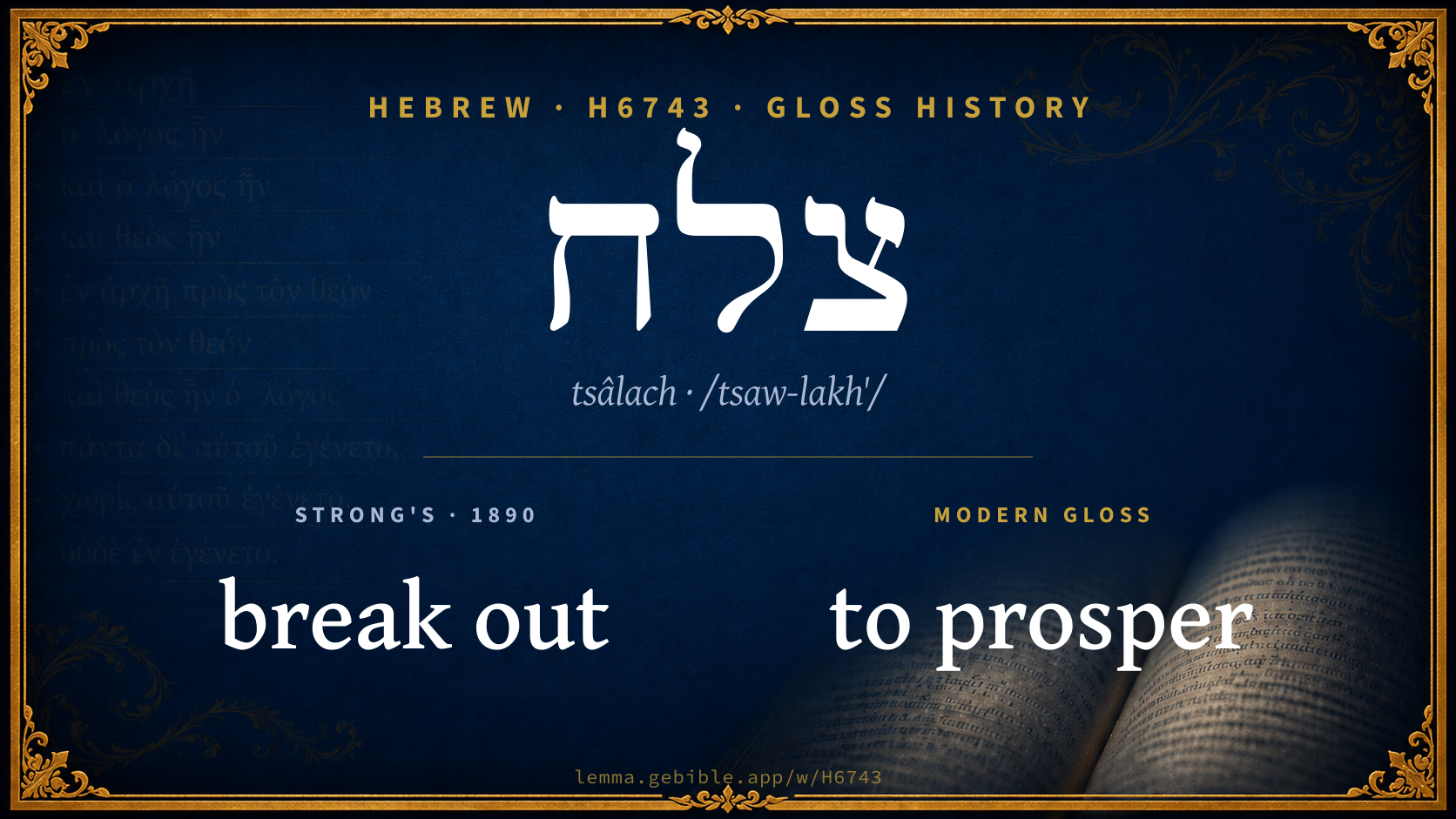
Gloss history
Strong's 1890 vs modern scholarship
About this word
Strong's H6743 catalogs a Hebrew word from the Hebrew Old Testament.
These counts are not copied from any lexicon or concordance. They are computed here, from the morphology-tagged Hebrew Old Testament. What Lemma adds →
- 64
- distinct verses
- The word appears in 64 distinct verses.
- 18 / 39
- OT books
- The word appears in 18 of 39 Old Testament books.
- #597
- by frequency
- Top 1000 most frequent Hebrew words (rank 597 of 8,640 Hebrew words by occurrence).
View all 64 occurrences in the concordance →
Most concentrated in
- 2 Chronicles 10 verses 16%
- Genesis 7 verses 11%
- Jeremiah 7 verses 11%
By section of the Old Testament
By traditional corpus
Conventional, traditional groupings — biblical authorship is debated, so this is a traditional corpus grouping, not an authorship claim. Each share is this word’s portion of its verses in that division of the Hebrew canon. Each figure is a share of the word’s 64 distinct verses.
- Prophets (Nevi'im) 30 verses · 47%
- Writings (Ketuvim) 25 verses · 39%
- Torah (Pentateuch) 9 verses · 14%
How translations render this word
Counts come from each version’s own published word-to-Strong’s tagging or interlinear alignment — an approximate guide to how each version renders this word, not a word-level alignment the data otherwise carries. Because each total is that version’s own tagged count, the per-version totals vary from one another and need not match the appearance or distinct-verse counts above. These counts may also differ from a printed concordance because Lemma counts each distinctly tagged rendering and does not collapse phrase taggings into a single head-word total. This is a fixed set of word-tagged versions (KJV, ASV, BSB, ULT) and does not change with the reading translation you choose elsewhere. Each version’s license is shown beside its name below (and on Sources).
BDB lists this Strong’s number as 2 distinct words (homographs). Each count above pools all of them and is not split by sense — see the Senses section below. A low-frequency rendering may belong to a different one of those words, not the primary meaning.
- King James Version†: Prosper 9×, Shall prosper 6×, Came 5×
- American Standard Version†: Prosper 9×, Came 5×, Prospered 5×
- Berean Standard Bible†: Prosper 7×, Success 5×, Succeed 4×
- unfoldingWord Literal Text†: Succeed 13×, Prosper 12×, And 7×
King James Version Public Domain
Renders H6743 across 67† tagged occurrences — most commonly:
Plus 27 renderings that appear only once — usually multi-word phrases or single function words the recovered tagging swept in, not distinct renderings.
American Standard Version Public Domain
Renders H6743 across 67† tagged occurrences — most commonly:
Plus 33 renderings that appear only once — usually multi-word phrases or single function words the recovered tagging swept in, not distinct renderings.
Berean Standard Bible Public Domain
Renders H6743 across 65† tagged occurrences — most commonly:
Plus other, less common renderings. Plus 24 renderings that appear only once — usually multi-word phrases or single function words the recovered tagging swept in, not distinct renderings.
unfoldingWord Literal Text CC BY-SA 4.0
Renders H6743 across 99† tagged occurrences — most commonly:
Plus other, less common renderings. Plus 37 renderings that appear only once — usually multi-word phrases or single function words the recovered tagging swept in, not distinct renderings.
Senses in the full BDB
Hebrew verbs can shift meaning by stem (binyan): Qal is the basic action, Niphal is often passive or reflexive, Piel often intensifies or makes it factitive, and Hiphil is typically causative. The senses below are grouped under the stem BDB assigns to each.
What do BDB’s symbols mean?
BDB uses these scholarly abbreviations:
| Symbol | Meaning |
|---|---|
| 𝔊 | the Septuagint (the ancient Greek translation, LXX) |
| 𝔙 | the Vulgate (the Latin translation) |
| 𝔖 | the Syriac version (the Peshitta) |
| 𝔗 | the Targum (the Aramaic translation) |
| ψ | the Psalms |
| √ | root (the underlying root or stem) |
| ‖ | parallel passage (a synonymous or contrasted parallel) |
| † | the dagger: every passage where the word occurs is cited |
The 5 senses and sub-senses the full Brown-Driver-Briggs lexicon distinguishes for this word, in lexicon order (not ranked by frequency), with BDB’s own verbatim wording and sub-sense lettering. Shown in Hebrew script with BDB’s own scholarly abbreviations. The condensed entry is in the Lexicon Entry tab. See also the Forms in the corpus table below.
צלח I rush
Qal
- Pf. 3 fs. וְצָֽלְחָה consec. 1 S 10:6; 3 pl. וְצָֽלְחוּ 2 S 19:18; Impf. 3 ms. יִצְלַח Am 5:6 (v. infr.), 3 fs. וַתִּצְלַח Ju 14:6 +;—rush, וְצ׳ הַיַּרְדֵּן 2 S 19:18 they rushed into the Jordan (dub., v. Dr HPS), יִצ׳ כָּאֵשׁ בֵּית יוֹסֵף Am 5:6 lest he rush like fire upon the house of Joseph (or O house, etc. GASm; Now conj. יַצִּית בָּאֵשׁ); especially of sudden possession by (אֱלֹהִים) רוּחַ י׳, c. עַל pers. Ju 14:6 the Spirit … rushed upon him, so v 19; 15:14 1 S 10:6, 10; 11:6; c. אֶל pers. 16:13 and (of רוּחַ א׳ רָעָה) 18:10. e.g. 1 Samuel 10:6
צלח II ance, prosper (NH id.
Qal
- Pf. 3 fs. צָלֵ֑חָה Je 12:1; Impf. 3 ms. יִצְלַח Je 13:7 +, etc.; Imv. ms. צְלַח ψ 45:5; prosper, of way of wicked Je 12:1, cf. Nu 14:41; Is 53:10; 54:17; Ez 17:9, 10; Dn 11:27; c. ל rei, = be good for anything Je 13:7, 10 Ez 15:4; subj. pers., abs., Je 22:30(×2) Ez 17:15, ψ 45:5 be successful! וַתִּצְלְחִי לִמְלוּכָה Ez 16:13 and thou didst prosper to royalty (dub.; del. 𝔊 Co Toy; > StaZAW vi (1886), 337 f. Krae לִמְלָאכָה i.e. harlotry). e.g. Jeremiah 12:1
Hiphil
- Pf. 3 ms. הִצְלִיחַ Gn 24:21, 2 ms. וְהִצְלַחְתָּ֫ 1 Ch 22:11, etc.; Impf. 3 ms. יַצְלִיחַ Ne 2:20 +, וַיַּצְלַח 1 Ch 29:23; 2 Ch 32:30, etc.; Imv. ms. הַצְלַח 1 K 22:12 +, הַצְלִ֫יחָה Ne 1:11, יחָ֫ה—ִ ψ 118:25, etc.; Pt. מַזְלִיחַ Gn 24:42 +;— e.g. Genesis 24:21
- 1. make prosperous, bring to successful issue, of י׳, c. acc. of man’s way (דֶּרֶךְ), Gn 24:21, 40, 42, 56 (J), c. acc. rei Gn 39:3, 23 (J), c. acc. pers. 2 Ch 26:5, c. ל pers. Ne 1:11; 2:20; abs. send success ψ 118:25; human subj. c. acc. דֶּרֶךְ Dt 28:29; Jos 1:8 (D), Is 48:15 ψ 37:7, so prob. 1:3 (al. sub 2), 2 Ch 7:11; c. acc. מִרְמָה Dn 8:25. e.g. Genesis 24:21
- 2. shew, experience, prosperity, of men 1 K 22:12, 15 = 2 Ch 18:11, 14; Je 2:37 (+ ל pers. in ref. to whom) 5:28; 32:5; 1 Ch 22:11, 13; 29:23; 2 Ch 13:12; 14:6; 20:20; 24:20; 31:21; 32:30 (בְּכָל־מַעֲשֵׂהוּ), Pr 28:13; Dn 8:12 (of horn), v 24; 11:36; אִישׁ מַצְלִיחַ Gn 39:2 (J) a prosperous man; subj. דֶּרֶךְ Ju 18:5 (cf. ψ 1:3 supr.), י׳’s word Is 55:11. e.g. 1 Kings 22:12
Senses from the full Brown-Driver-Briggs lexicon (Brown, Driver, Briggs; Oxford 1906 — public domain), digitized via Sefaria, supplemented by the OpenScriptures HebrewLexicon (CC BY 4.0). Full attribution on Sources.
Word origin
I. vb. rush;—(Thes al. cp. 𝔗 צְלַח, Syriac ܨܠܰܚ, cleave, penetrate, then advance, v. foll.);—
I. vb. advance, prosper (NH id.; Ph. Pi. causat. in n.pr.; Arabic صَلَحَ be in good condition, cf. Sab. הצלח Sab Denkm 93; Aramaic צְלַח, ܨܠܰܚ prosper);—
— Brown-Driver-Briggs (Oxford 1906, public domain), digitized via Sefaria, supplemented by the OpenScriptures HebrewLexicon (CC BY 4.0). See Sources.
Origin: a primitive root
Jastrow Dictionary
A second Hebrew/Aramaic lexicon for comparison, covering Aramaic and post-biblical (Talmudic, Targumic, Midrashic) usage that the biblical-Hebrew BDB does not. Matched by lemma rather than by Strong’s number, so a lemma may carry more than one Jastrow headword (shown separately below), and the entries cover usage well beyond the Bible.
צָלַח
- (b. h.) [to split, pass through,] to succeed, prosper. Ber. 46ᵃ ויִצְלַח מאוד וכ׳, v. נְכָסִים; a. e.
- 1. same. Ib. 64ᵃ עלה וה׳ he went and succeeded; M. Kat. 29ᵃ. Ab. Zar. 19ᵇ נכסיו מַצְלִיחִין לו his business enterprises will prosper. Y. R. Hash. III, end, 59ᵃ (ref. to Dan. VIII, 12) whenever Israel casts truth to the ground, המלכות … גוזרת ומַצְלַחַת that wicked (Roman) government decrees (persecution) and succeeds; Lam. R. introd. (R. Abba. Midr. Till. to Ps. I, 3 ומַצְלִיחוֹת, v. עֵצָה II; a. fr.—2) to cause to prosper. Sabb. 63ᵃ הקב"ה מַצְלִיחַ להם the Lord helps them to success.—Part. pass. מוּצְלָח; pl. מוּצְלָחִין. Ber. 46ᵃ ויהיו … מוצ׳ (Ms. M. נכסיו מצליחין), v. נְכָסִים; a. e. e.g. Daniel 8:12
צְלַח
- 1. to split, pass through. Targ. I Chr. II, 54. Ib. XI, 18 צ׳ ארחא (h. text ויבקעו).
- 2. to be successful, prosper; to become fit. Targ. Jer. XX, 11. Targ. Prov. XXVIII, 13; a. fr.
- to split. Targ. O. Gen. XXII, 3. Targ. I Chr. XXI, 23.—B. Mets. 79ᵃ נְצַלְּחֵיה לציבי וכ׳ let him chop it into chips and use it. B. Kam. 113ᵇ זבין … לצַלָּחָא bought a palm, in partnership with a gentile, to chop it up (and divide it). Sabb. 119ᵃ רבה … מְצַלְּחֵי וכ׳ Rabbah and R. J. used to chop wood themselves (in preparation for the Sabbath). Ib. 129ᵃ; a. e.
- 1. to pass through; to do a thing successfully; to prosper. Targ. O. Deut. XXVIII, 29. Targ. ib. XXIX, 8 (O. ed. Vien. Pe.). Targ. O. a. Y. I ib. XXXII, 15 אצ׳ תקוף succeeded in gaining strength. Targ. I Kings I, 34 (h. text יחי); a. fr.—Men. 43ᵃ וא׳ עיסקייהו and their business prospered. Erub. 45ᵃ אי מַצְלַח וכ׳ whether or not he shall succeed. Y. Snh. VI, 23ᶜ bot. ולא מַצְלְחָא מה דו עבדא (not מצלח) and she will not succeed in what she wants to do. B. Bath. 3ᵇ כל עבדא … מצלח any slave that will now rebel, shall succeed; Yalk. Deut. 913. R. Hash. 16ᵃ דמצלח זרעא וכ׳ that the winter seed thrives; a. fr.
- 2. to cause to succeed, prosper. Targ. Gen. XXIV, 21. Targ. Jer. III, 19 (h. text אשיתך); a. fr.—Gen. R. s. 13 תַצְלִיחַ, v. עֲבַד I.
A Dictionary of the Targumim, the Talmud Babli and Yerushalmi, and the Midrashic Literature (Marcus Jastrow; London, Luzac, 1903) — Public Domain. Digitized via Sefaria. Digitized via Sefaria. Full attribution on Sources.
Forms in the corpus
The 56 distinct written forms H6743 takes in the Hebrew Bible, most frequent first — each parse links to that stem’s occurrences in the concordance. Hebrew forms include their vowel points and cantillation, so a single lemma takes many written forms.
Same root — word family
Other BDB entries built from the same root as H6743, grouped by Strong’s listed origin. These share a root / origin per the lexicon — not necessarily a shared meaning. Each links to that word’s own entry.
Derived from this word
- צלח tsᵉlach H6744 to prosper
- צלחה tsêlâchâh H6745 pot
- צלחית tsᵉlôchîyth H6746 bowl
- צלחת tsallachath H6747 dish
Compare all same-root words → Showing 4 of 5 — not the complete family. They share a root, not necessarily a meaning.
Septuagint verse parallels
This word appears in 62 verses that also exist in the Greek Old Testament (Septuagint), out of the 64 Hebrew verses it occurs in. You can read those verses in Greek by switching the Old Testament edition to the Septuagint.
Read these verses in the Septuagint
- Genesis 24:21
- Numbers 14:41
- Deuteronomy 28:29
- Joshua 1:8
- Judges 14:6
- 1 Samuel 10:6
- 2 Samuel 19:17
- 1 Kings 22:12
- 1 Chronicles 22:11
- 2 Chronicles 7:11
- Psalms 1:3
- Proverbs 28:13
This is a verse-level parallel only — the same verses exist in both the Hebrew and Greek Old Testaments. No word-level Hebrew↔Greek correspondence is claimed: the data carries no such alignment, so no Greek word is shown as this Hebrew word’s translation. Coverage is not total — the Septuagint omits the deuterocanon and renumbers the Psalms, so some Hebrew verses have no direct Greek parallel.