
2 Chronicles 18:14

Hebrew (Westminster Leningrad Codex) 2 Chronicles 18:14 appears in the Hebrew Old Testament. The text above is from the Westminster Leningrad Codex. Each word links to its Strong’s number, a concise gloss, and parsing drawn from the Open Scriptures Hebrew Bible morphology. Click any word for its full Brown-Driver-Briggs (BDB) entry.
Download image
Cite this verse

2 Chronicles 18:14 (World English Bible). Public Domain. Lemma interlinear Bible study tool, https://lemma.gebible.app/v/2-chronicles/18/14.

Show BibTeX & RIS
BibTeX
RIS
English Translation
When he was come to the king, the king said to him, Micaiah, shall we go to Ramoth-gilead to battle, or shall I forbear? He said, Go up, and prosper; and they shall be delivered into your hand.
World English Bible · Public Domain
Download a study sheet

One document with this verse’s original text, its word-by-word gloss line, the meaning frame, cross-references with their text, attributed commentary, and full source and license credits — printable, and it pastes into notes with its structure intact.

This verse Autodidact and up

Study sheet (.html) Plain text (.txt)

A passage Seminary Student

Up to 50 verses in one chapter. A passage sheet keeps up to 6 commentary sources and 12 cross-references per verse, in the order this page ranks them, and says so on the sheet whenever that leaves anything out. Ask for a single verse and you get the Autodidact verse sheet above.

Everything on this page stays free to read, with no account — the sheet is a download of what is already on screen, not access to it.

Want to remove ads? Support Godless Engineer
Compare translations 3

The same verse in 3 English versions, stacked beneath the original-language interlinear above. Click any original word for its lexicon entry.

Each is an independent rendering of the whole verse — the interlinear is not word-aligned to these translations.

Highlighted words mark where these versions differ — a whole-verse word diff, not a word-by-word alignment.

  • World English Bible Public Domain
    When he was come to the king, the king said to him, Micaiah, shall we go to Ramoth-gilead to battle, or shall I forbear? He said, Go up, and prosper; and they shall be delivered into your hand.
  • King James Version Public Domain
    And when he was come to the king, the king said unto him, Micaiah, shall we go to Ramothgilead to battle, or shall I forbear? And he said, Go ye up, and prosper, and they shall be delivered into your hand.
  • unfoldingWord Literal Text CC BY-SA 4.0
    And he came to the king, and the king said to him, “Micaiah, should we go against Ramoth Gilead for battle, or should I refrain?” And he said, “Go up and succeed. And they will be given into your hand.”

unfoldingWord Literal Text — © unfoldingWord, licensed CC BY-SA 4.0. Word-aligned USFM3 via Door43 (git.door43.org/unfoldingWord/en_ult).

Versions to compare (up to 4)

3 of 4 selected

Show all 18 translations

Every available English version of this verse, each an independent rendering of the whole verse.

  • World English Bible Public Domain
    When he was come to the king, the king said to him, Micaiah, shall we go to Ramoth-gilead to battle, or shall I forbear? He said, Go up, and prosper; and they shall be delivered into your hand.
  • Berean Standard Bible Public Domain
    When Micaiah arrived, the king asked him, “Micaiah, should we go to war against Ramoth-gilead, or should we refrain?” “Go up and triumph,” Micaiah replied, “for they will be given into your hand.”
  • Majority Standard Bible Public Domain
    When Micaiah arrived, the king asked him, “Micaiah, should we go to war against Ramoth-gilead, or should we refrain?” “Go up and triumph,” Micaiah replied, “for they will be delivered into your hand.”
  • King James Version Public Domain
    And when he was come to the king, the king said unto him, Micaiah, shall we go to Ramothgilead to battle, or shall I forbear? And he said, Go ye up, and prosper, and they shall be delivered into your hand.
  • American Standard Version (1901) Public Domain
    And when he was come to the king, the king said unto him, Micaiah, shall we go to Ramoth-gilead to battle, or shall I forbear? And he said, Go ye up, and prosper; and they shall be delivered into your hand.
  • Revised Version (1885) Public Domain
    And when he was come to the king, the king said unto him, Micaiah, shall we go to Ramoth-gilead to battle, or shall I forbear? And he said, Go ye up, and prosper; and they shall be delivered into your hand.
  • Geneva Bible (1599) Public Domain
    So he came to the King, and the King said vnto him, Michaiah, shall we go to Ramoth Gilead to battel, or shall I leaue off? And he said, Goe yee vp, and prosper, and they shalbe deliuered into your hand.
  • Douay-Rheims (1899) Public Domain
    So he came to the king: and the king said to him: Micheas, shall we go to Ramoth Galaad to fight, or forbear? And he answered him: Go up, for all shall succeed prosperously, and the enemies shall be delivered into your hands.
  • Young's Literal Translation Public Domain
    And he cometh in unto the king, and the king saith unto him, `Micaiah, do we go unto Ramoth-Gilead to battle, or do I forbear?' And he saith, `Go ye up, and prosper, and they are given into your hand.'
  • Literal Standard Version CC BY-SA 4.0
    And he comes to the king, and the king says to him, “Micaiah, do we go to Ramoth-Gilead to battle, or do I refrain?” And he says, “Go up, and prosper, and they are given into your hand.”
  • Unlocked Literal Bible CC BY-SA 4.0
    When he came to the king, the king said to him, “Micaiah, should we go to Ramoth Gilead for battle, or not?” Micaiah answered him, “Attack and be victorious! For it will be a great victory.”
  • unfoldingWord Literal Text CC BY-SA 4.0
    And he came to the king, and the king said to him, “Micaiah, should we go against Ramoth Gilead for battle, or should I refrain?” And he said, “Go up and succeed. And they will be given into your hand.”
  • Darby Bible Public Domain
    And he came to the king. And the king said to him, Micah, shall we go against Ramoth-Gilead to battle, or shall I forbear? And he said, Go ye up, and prosper; and they will be given into your hands.
  • World Messianic Bible Public Domain
    When he had come to the king, the king said to him, “Micaiah, shall we go to Ramoth Gilead to battle, or shall I forbear?” He said, “Go up, and prosper. They shall be delivered into your hand.”
  • Webster's Bible Public Domain
    And when he had come to the king, the king said to him, Micaiah, shall we go to Ramoth-gilead to battle, or shall I forbear? And he said, Go ye up, and prosper, and they shall be delivered into your hand.
  • Free Bible Version CC BY-SA 4.0
    When he came before the king, the king asked him, “Should we go up and attack Ramoth-gilead, or should I not?” “Yes, go ahead and be victorious,” Micaiah replied, “for they will be handed over to the king.”
  • Bible in Basic English Public Domain
    When he came to the king, the king said to him, Micaiah, are we to go to Ramoth-gilead to make war or not? And he said, Go up, and it will go well for you; and they will be given up into your hands.
  • JPS Tanakh (1917) Public Domain
    And when he was come to the king, the king said unto him: 'Micaiah, shall we go to Ramoth-gilead to battle, or shall I forbear?' And he said: 'Go ye up, and prosper; and they shall be delivered into your hand.'

Literal Standard Version (2020), Covenant Press — licensed CC BY-SA 4.0. Text via the HelloAO Bible API (eBible.org). Unlocked Literal Bible (unfoldingWord) — licensed CC BY-SA 4.0. Text via the HelloAO Bible API (eBible.org). unfoldingWord Literal Text — © unfoldingWord, licensed CC BY-SA 4.0. Word-aligned USFM3 via Door43 (git.door43.org/unfoldingWord/en_ult). Free Bible Version, Dr. Jonathan Gallagher — licensed CC BY-SA 4.0. Text via the HelloAO Bible API (eBible.org).

Word by word

More ways to search: Search by grammar → Find every occurrence → Compare this word →

Practice this passage: Drill this verse → Learn its vocabulary →

רָמֹ֥ת
Râmôth Gilʻâd
H7433
“Ramoth”
Noun, Proper
Part of Speech
Noun
Type
Proper
Full BDB Definition

Origin: from the pl. of H7413 and H1568

TWOT: None

Ramoth = "heights" - an Israelite who had a foreign wife in the time of Ezra (noun proper masculine) - Ramoth-gilead - a place in Gilead (noun proper locative) - site dubious
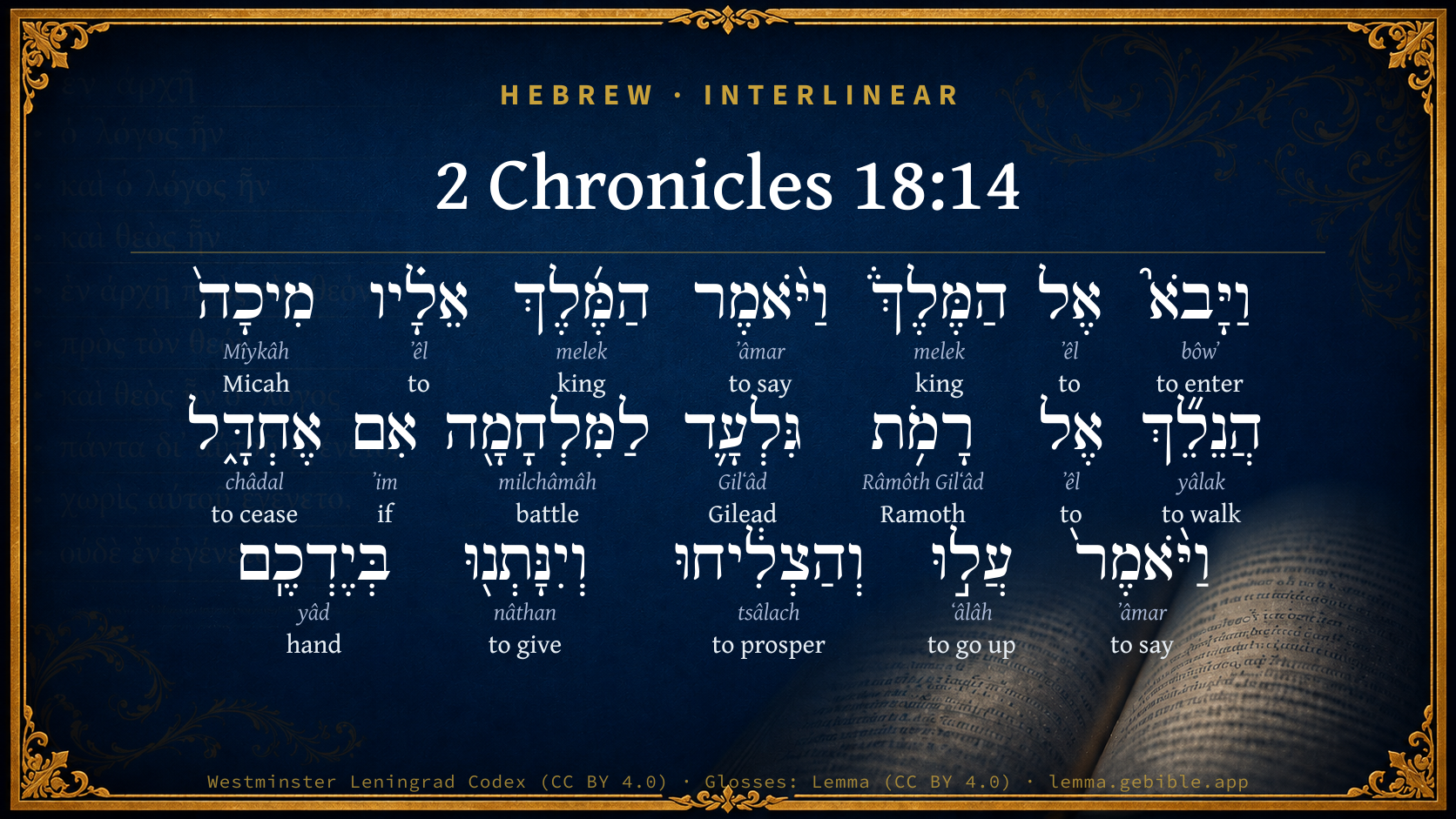
  1. וַיָּבֹא֮ bôwʼ H935 “and · to enter” Conjunction + Verb, Qal, Sequential Imperfect, 3rd Person, Masculine, Singular
  2. אֶל ʼêl H413 “to” Preposition
  3. הַמֶּלֶךְ֒ melek H4428 “the · king” Particle, Definite Article + Noun, Common, Masculine, Singular, Absolute
  4. וַיֹּ֨אמֶר ʼâmar H559 “and · to say” Conjunction + Verb, Qal, Sequential Imperfect, 3rd Person, Masculine, Singular
  5. הַמֶּ֜לֶךְ melek H4428 “the · king” Particle, Definite Article + Noun, Common, Masculine, Singular, Absolute
  6. אֵלָ֗יו ʼêl H413 “to · him” Preposition + Suffix, Personal, 3rd Person, Masculine, Singular
  7. מִיכָה֙ Mîykâh H4318 “Micah” Noun, Proper
  8. הֲנֵלֵ֞ךְ yâlak H3212 “to walk” Particle, Interrogative + Verb, Qal, Imperfect, 1st Person, Common, Plural
  9. אֶל ʼêl H413 “to” Preposition
  10. גִּלְעָ֛ד Gilʻâd H1568 “Gilead” Noun, Proper
  11. לַמִּלְחָמָ֖ה milchâmâh H4421 “to/for the · battle” Preposition, Determined + Noun, Common, Feminine, Singular, Absolute
  12. אִם ʼim H518 “if” Conjunction
  13. אֶחְדָּ֑ל châdal H2308 “to cease” Verb, Qal, Imperfect, 1st Person, Common, Singular
  14. וַיֹּ֨אמֶר֙ ʼâmar H559 “and · to say” Conjunction + Verb, Qal, Sequential Imperfect, 3rd Person, Masculine, Singular
  15. עֲל֣וּ ʻâlâh H5927 “go up” Verb, Qal, Imperative, 2nd Person, Masculine, Plural
  16. וְהַצְלִ֔יחוּ tsâlach H6743 “and · prosper” Conjunction + Verb, Hiphil, Imperative, 2nd Person, Masculine, Plural
  17. וְיִנָּתְנ֖וּ nâthan H5414 “and · to give” Conjunction + Verb, Niphal, Imperfect, 3rd Person, Masculine, Plural
  18. בְּיֶדְכֶֽם yâd H3027 “in/at · hand · your” Preposition + Noun, Common, Both, Singular, Construct + Suffix, Personal, 2nd Person, Masculine, Plural

About this verse

These counts appear in no published source. They are computed here, from the morphology-tagged text and Lemma’s own curated glosses. What Lemma adds →

19
words
15
distinct lemmas
Historical
section

Notable vocabulary

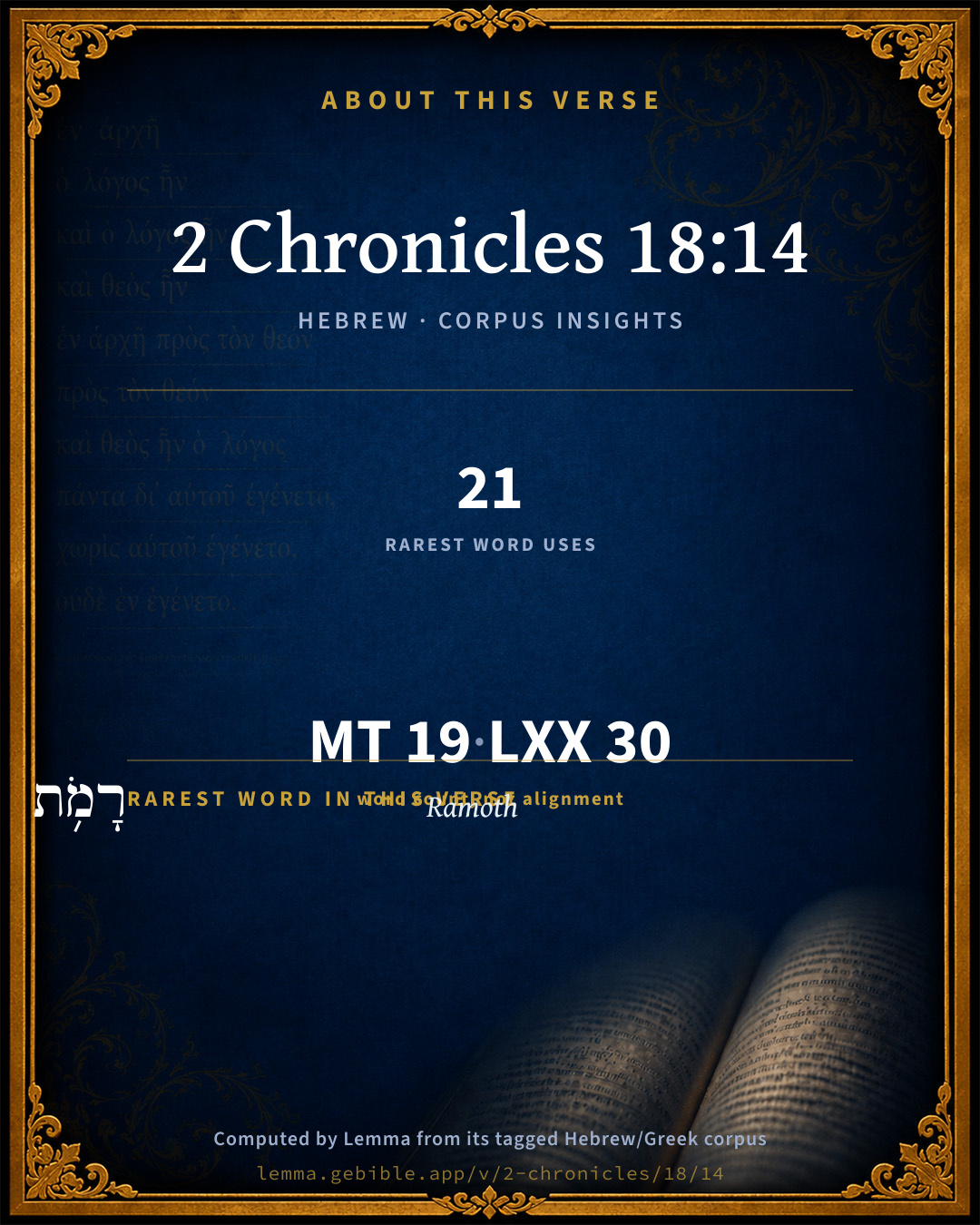
The rarest word here is רָמֹ֥ת Ramoth H7433 — appearing just 21 times in the whole Hebrew Bible.

Shared distinctive vocabulary

רָמֹ֥ת Ramoth H7433 occurs in 21 verses of the Hebrew Bible. Also found in:

Grammatical profile

  • 8 verbs
  • 7 nouns
  • 3 prepositions
  • 1 conjunction

Verb forms

  • וַיָּבֹא֮ Qal · Sequential Imperfect
  • וַיֹּ֨אמֶר Qal · Sequential Imperfect
  • הֲנֵלֵ֞ךְ Qal · Imperfect
  • אֶחְדָּ֑ל Qal · Imperfect
  • וַיֹּ֨אמֶר֙ Qal · Sequential Imperfect
  • עֲל֣וּ Qal · Imperative
  • וְהַצְלִ֔יחוּ Hiphil · Imperative
  • וְיִנָּתְנ֖וּ Niphal · Imperfect

Repetition

Words recur within this verse — often emphatic in Hebrew:

  • הַמֶּלֶךְ֒ king H4428 ×2
  • וַיֹּ֨אמֶר to say H559 ×2
  • אֶל to H413 ×3

Hebrew & Septuagint length

In English translation the verse runs 38 words from the Hebrew and 43 from the Septuagint (LXX English) — closely comparable.

A rough comparison of the two English renderings, which tokenize alike — not a word-level alignment.

Word counts can differ between the Hebrew and the Greek without any difference in meaning — e.g. the Hebrew direct-object marker אֵת has no separate Greek word, and Greek often adds the article ὁ.

In the original languages it is 19 Hebrew tokens and 30 Greek tokens — but the two are counted differently (Hebrew bundles its prefixes and suffixes into one token; the Greek is in lemma form), so that isn’t a like-for-like length.

Cross-references

6

Topical passages linked to 2 Chronicles 18:14 in the Treasury of Scripture Knowledge — connected by theme and wording, ordered by reader-vote popularity; previews shown in the World English Bible.

  • 1 Kings 18:27 It happened at noon, that Elijah mocked them, and said, Cry aloud; for he is a god: either he is musing, or he is gone aside, or he is on a journey, or peradventure he sleeps and must be awakened.
  • 1 Kings 22:15 When he was come to the king, the king said to him, Micaiah, shall we go to Ramoth-gilead to battle, or shall we forbear? He answered him, Go up and prosper; and Yahweh will deliver it into the hand of the king.
  • Ecclesiastes 11:1 Cast your bread on the waters; For you shall find it after many days.
  • Lamentations 4:21 Rejoice and be glad, daughter of Edom, that dwell in the land of Uz: The cup shall pass through to you also; you shall be drunken, and shall make yourself naked.
  • Amos 4:4–5 "Go to Bethel, and sin; To Gilgal, and sin more. Bring your sacrifices every morning, Your tithes every three days,
  • Matthew 26:45 Then he came to his disciples, and said to them, "Sleep on now, and take your rest. Behold, the hour is at hand, and the Son of Man is betrayed into the hands of sinners.

Cross-references courtesy of OpenBible.info (CC BY 4.0).

Hebrew and Greek witnesses Masoretic Hebrew ↔ Greek Septuagint

The same verse in the two great witnesses to the Old Testament, shown verse-for-verse.

These are two independent witnesses, not word-aligned to each other, and the Septuagint is shown in lemma (dictionary) form.

Hebrew 2 Chronicles 18:14 Masoretic · Westminster Leningrad Codex

וַיָּבֹא֮ אֶל הַמֶּלֶךְ֒ וַיֹּ֨אמֶר הַמֶּ֜לֶךְ אֵלָ֗יו מִיכָה֙ הֲנֵלֵ֞ךְ אֶל רָמֹ֥ת גִּלְעָ֛ד לַמִּלְחָמָ֖ה אִם אֶחְדָּ֑ל וַיֹּ֨אמֶר֙ עֲל֣וּ וְהַצְלִ֔יחוּ וְיִנָּתְנ֖וּ בְּיֶדְכֶֽם

When he was come to the king, the king said to him, Micaiah, shall we go to Ramoth-gilead to battle, or shall I forbear? He said, Go up, and prosper; and they shall be delivered into your hand.

World English Bible · Public Domain

Greek LXX 2 Chronicles 18:14 Septuagint · lemma form

καί ἔρχομαι πρός ὁ βασιλεύς καί εἶπον αὐτός ὁ βασιλεύς μιχαια εἰ πορεύομαι εἰς ραμωθ γαλαάδ εἰς πόλεμος ἤ ἐπιἔχω καί εἶπον ἀναβαίνω καί εὐοδόω καί δίδωμι εἰς χείρ σύ

And he came to the king, and the king said to him, Michaias, shall I go up to Ramoth Galaad to battle, or shall I forbear? And he said, Go up, and you shall prosper, and they shall be given into your hands.

LXX2012 (modern English Septuagint) · Public Domain

Hebrew: Westminster Leningrad Codex (CC BY 4.0). Greek: Septuagint (public domain); English from LXX2012 (modern English Septuagint) (Public Domain). How the Septuagint differs from the Hebrew →

Commentary

Notes on 2 Chronicles 18:14 from classic Christian and Jewish commentators (each source and its license shown beneath its notes). The classic Christian expositions comment on the surrounding passage and are grouped to its opening verse, so a note may address several verses; the Jewish commentaries on the Tanakh (Rashi and others) are per-verse, so they appear only where the commentator wrote on this verse.

Lemma curates 59 commentaries, every one of them public domain or Creative Commons licensed, each selected and text-cleaned for this edition rather than reprinted as found. About our sources →

Geneva Bible (1599)

Geneva Bible translators

He spake this by derision of the false prophets, as the King well perceived.

Geneva Bible (1599) marginal notes — public domain. Text via Bolls.life.

Ellicott's Commentary for English Readers

(14) Shall I forbear.—Kings, shall we forbear. (See Note on 2Ch_18:5.)

And he said, Go ye up . . . and they shall be delivered.—Kings repeats the words of 2Ch_18:11, “Go thou up, and prosper thou, and the Lord,” &c. The chronicler has substituted a reply, which states quite definitely that they (i.e., the Syrians) shall be delivered into the hands of the allied sovereigns. In 2Ch_18:11 the object of the verb “deliver” was not expressed. This rather reminds us of the Delphic oracle: “If Crœsus pass the Halys, a mighty empire will be overthrown,” though the words of Zedekiah in the preceding verse are plain enough.

A Bible Commentary for English Readers, edited by Charles John Ellicott (1878–1897) — public domain. Text from a community e-Sword module.

The Cambridge Bible for Schools and Colleges

gen. ed. J. J. S. Perowne

14. Go ye up … into your hand] Micaiah addresses both kings. In 1 Kin. Ahab only is addressed, Go and prosper, for the Lord shall deliver it into the hand of the king. Micaiah repeats in mocking tones the utterance of the other prophets.

The Cambridge Bible for Schools and Colleges (gen. ed. J. J. S. Perowne; Cambridge University Press, 1878–1918) — public domain. Text from a community e-Sword module.

Haydock's Catholic Bible Commentary

Hands. He ironically (C.) alludes to the declarations of the false prophets. H.

George Leo Haydock (1774–1849), Haydock's Catholic Family Bible and Commentary, 1859 edition — public domain. Excludes Psalms (Douay-Rheims chapter numbering differs from Protestant) and Deuterocanonical books (Catholic canon only).

The Pulpit Commentary

This first reply of Micaiah, given in the latter haft of the verse, does not stand for untruth or deceit, but for very thinly veiled, very thinly disguised, very keen taunt and reproof. It has been well described as the ironical echo of the language of the unreal prophets. Micaiah begins by answering a fool according to his folly, i.e. according to his own heart"s desire. He had just come from some place of imprisonment or punishment (ver. 25). And he so spoke or so looked that the king should know he had not spoken his last word in answer to the inquiry addressed to him.

The Pulpit Commentary (1880–1919), ed. H.D.M. Spence-Jones & Joseph S. Exell — public domain. Text from a community e-Sword module.

Rashi

Rabbi Shlomo Yitzchaki (Rashi)

Go up and triumph, and may they be delivered into your hand i.e., May you only prosper, and may they be delivered into your hands.

Rashi on the Tanakh — English translations: “The Judaica Press complete Tanach with Rashi, translated by A. J. Rosenberg” (CC BY 4.0); “Pentateuch with Rashi's commentary by M. Rosenbaum and A.M. Silbermann, 1929-1934” (public domain); “The Metsudah Tanach series, Lakewood, N.J” (CC BY 4.0); and “The Book of Joshua, Metsudah Publications, 1997” (CC BY 4.0). Text via Sefaria.

Lesson kit

Teaching starters — assembled from the data on this page, not authored interpretation. Every prompt links to the verse data it draws on. Edit before teaching.

2 Chronicles, in the Historical, opens this verse with 19 words (15 distinct Hebrew lemmas). Its most distinctive word is Râmôth Gilʻâd (“Ramoth”). A historical commentator’s framing appears above. Read the whole chapter for the surrounding context.

Discussion questions

  1. The word Râmôth Gilʻâd carries the sense “Ramoth.” How does it shape the verse?
  2. Joshua 21:38 shares the word «Ramoth» with this verse. How do the two illuminate each other?
  3. “king” occurs 2× in this one verse. What is the effect of the repetition?
  4. The translations on this page render this verse differently — a whole-verse word diff, not a word-by-word alignment. What might account for the different wordings?
  5. The verb «וַיָּבֹא֮» is Qal Sequential Imperfect. How does its form color the action?
  6. Reading how Geneva Bible (1599) and Ellicott's Commentary for English Readers read this verse, where do the two commentators agree and where do they part?

Things to notice

Reading settings

Reading text

Shown beneath each verse's original-language words.

Old Testament
Old Testament edition

Read the OT as the Masoretic Hebrew (MT) or the Greek Septuagint (LXX).

English shown for the Greek Septuagint (in the Hebrew ↔ Greek comparison).

Comparing translations? Open the Compare panel on any verse page to stack up to four side by side.